
| Key Takeaways |
| All ten stories below come from the Quran or authentic Sunnah, with the exact Surah or hadith reference listed so parents can verify every detail. |
| Children between 3 and 6 absorb short prophet stories best, while ages 10 to 12 are ready for longer stories built around moral choices. |
| A five to ten minute story followed by two or three simple questions builds stronger lesson retention than a long story with no discussion. |
| Linking each story to one daily habit, such as saying Alhamdulillah or sharing food, turns a bedtime tale into lasting Islamic character. |
Islamic stories for kids give parents one of the best ways to plant faith in a young heart. A child who cannot follow a lecture on Tawheed, the oneness of Allah, will still remember a fire that turned cool for Prophet Ibrahim.
Allah Himself teaches through stories. The Quran narrates the lives of prophets, kings, and ordinary people, so believers of every age can see faith, patience, and gratitude in action instead of meeting them as abstract rules.
Each story here includes a kid-friendly retelling, clear lessons, discussion questions, and its original source. You will also find an age guide and practical bedtime tips. Here are the ten stories, starting with the father of the prophets.
1. Prophet Ibrahim and the Idols Teach Kids Pure Tawheed
Prophet Ibrahim (peace be upon him) grew up among people who carved statues from stone and wood, then bowed to them. He asked a simple question: how can something you made with your own hands create or help you?
When the people left town for a festival, Ibrahim broke the idols with an axe and left only the biggest one standing. He hung the axe on its neck, so the scene would tell its own story.
Angry crowds rushed back and asked who had done this. Ibrahim told them to ask the biggest idol, if it could speak. Their silence proved they knew the statues were powerless, yet they still chose to punish him.
They built an enormous fire and threw Ibrahim into it. Allah gave the fire a direct command, and Ibrahim walked out completely unharmed, as the Quran describes:
قُلْنَا يَـٰنَارُ كُونِى بَرْدًۭا وَسَلَـٰمًا عَلَىٰٓ إِبْرَٰهِيمَ
(Qulna ya naru kooni bardan wa salaman ‘ala Ibraheem)
(“We ordered, ‘O fire! Be cool and safe for Abraham!'”)
Lessons for Your Child:
- Allah alone creates, sees, and helps us, so we worship only Him.
- Asking thoughtful questions leads us to the truth.
- Allah protects those who stand firm on His path.
Questions to Ask After the Story:
- Why could the idols not protect themselves?
- What did Ibrahim do when he felt alone against everyone?
- What can we ask Allah for when we feel scared?
Source: Surah Maryam 19:41-50 and Surah Al-Anbiya 21:51-70.
2. Prophet Sulayman and the Ant Teach Mercy to Creatures
Prophet Sulayman (peace be upon him) was a king whom Allah gifted with understanding the speech of birds and animals. His army of people, jinn, and birds marched in perfect order wherever he traveled.
One day the army reached a valley full of ants. A small ant saw the soldiers approaching and called out a warning to her whole colony, as the Quran records:
حَتَّىٰٓ إِذَآ أَتَوْا۟ عَلَىٰ وَادِ ٱلنَّمْلِ قَالَتْ نَمْلَةٌ يَـٰٓأَيُّهَا ٱلنَّمْلُ ٱدْخُلُوا۟ مَسَـٰكِنَكُمْ لَا يَحْطِمَنَّكُمْ سُلَيْمَـٰنُ وَجُنُودُهُۥ وَهُمْ لَا يَشْعُرُونَ
(Hatta idha ataw ‘ala wadin-naml, qalat namlatun ya ayyuhan-namlu-dkhulu masakinakum la yahtimannakum Sulaymanu wa junuduhu wa hum la yash’urun)
(“And when they came across a valley of ants, an ant warned, ‘O ants! Go quickly into your homes so Solomon and his armies do not crush you, unknowingly.'”)
Sulayman heard her words and smiled. Instead of feeling proud, he thanked Allah for His blessings and guided his army so that not a single ant in that valley was harmed.
Notice how fair the little ant was. She warned her colony without accusing Sulayman of cruelty, saying his army would only harm them unknowingly. Even her short warning teaches children to speak about others with justice.
Lessons for Your Child:
- Every creature, even the tiniest ant, matters to Allah.
- Strong people use their power gently and fairly.
- A grateful heart remembers Allah after every blessing.
Questions to Ask After the Story:
- What did the little ant do to protect her friends?
- Why did Sulayman smile instead of getting angry?
- How can we be kind to animals and insects at home?
Source: Surah An-Naml 27:15-19.
Children who love this story often ask what the rest of Surah An-Naml teaches. Quran House offers Quran Tafseer lessons for kids that explain each verse in simple language through live one-on-one sessions.

Book a Free Kids Tafseer Lesson
3. Young Believer and the Tyrant King Teach Brave Faith
Long ago, a cruel king relied on an old magician to frighten his people. When the magician grew weak, he asked for a clever boy who could learn his tricks and replace him at the palace.
On the way to his lessons, the boy met a righteous monk who taught him about Allah. Slowly he realized that the monk spoke the truth, while the magician only served a cruel king.
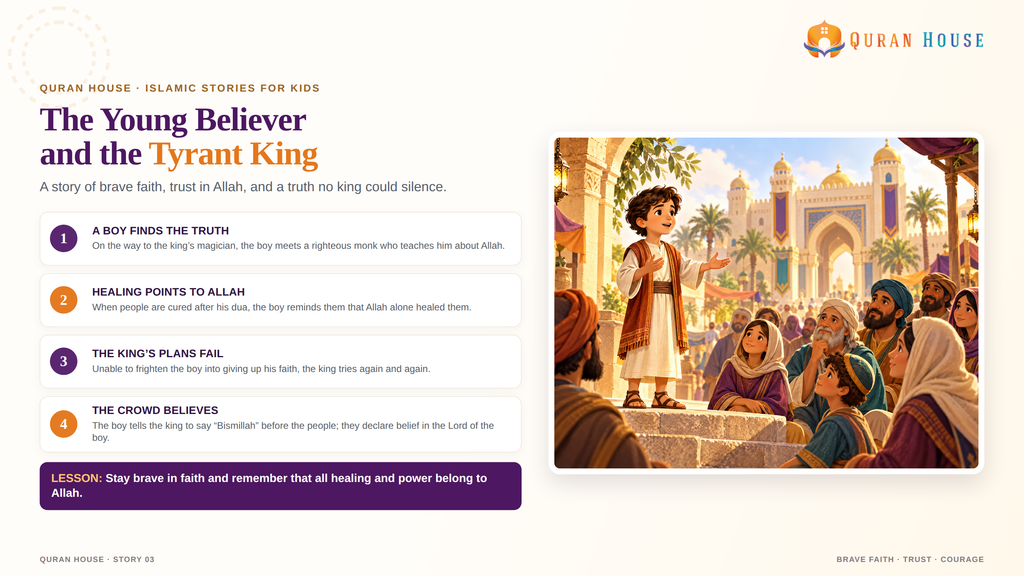
Allah blessed the boy so that when he made dua, blind and sick people were cured. Each time, he told them clearly that Allah alone had healed them, and many of them believed.
Furious, the king tried again and again to harm the boy, but every plan failed. Finally the boy told the king he could only succeed by gathering the people and saying Bismillah first.
When the crowd heard the name of Allah and saw what happened, they all declared their belief in the Lord of the boy. The king’s plan to frighten them away from faith collapsed completely.
Lessons for Your Child:
- Once we know the truth, we follow it even when it is hard.
- Giving credit to Allah for every good thing keeps the heart humble.
- Courage comes from trusting Allah more than fearing people.
Questions to Ask After the Story:
- Who taught the boy about Allah?
- Why did the boy always say that Allah healed the sick?
- When is it hard for you to tell the truth?
Source: Riyad as-Salihin 30, narrated in Sahih Muslim.
Parent tip: For children under seven, end the story at the moment the people believe. Keep the focus on the boy’s honesty about Allah’s healing rather than on the king’s cruelty.
4. Owners of the Garden Learn the Cost of Greed
Surah Al-Qalam tells of brothers who owned a beautiful garden full of fruit. Their father used to share part of every harvest with the poor, but the sons made a selfish plan together.
They agreed to pick all the fruit early in the morning, before any poor person could arrive. They did not even say In sha Allah, as if the harvest depended only on their own power.
While they slept, a punishment from Allah swept over the garden. At dawn they found black, burned land and first thought they had lost their way, until they realized it was their own garden.
Then the wisest brother reminded the others of their mistake. They admitted their greed, turned to Allah in repentance, and hoped He would replace their loss with something better.
Lessons for Your Child:
- Sharing with the poor brings barakah, or blessing, into what we own.
- Saying In sha Allah reminds us that every plan depends on Allah.
- Admitting a mistake and saying sorry to Allah is always the right next step.
Questions to Ask After the Story:
- What did the father do with the fruit of his garden?
- What went wrong with the brothers’ plan?
- What can you share with someone this week?
Source: Surah Al-Qalam 68:17-33.
Learning Through Play: A Live Kids Class
Young learners stay focused when lessons feel like a game. Watch a real Quran House class where interactive activities and a patient tutor keep a child engaged, reciting, and smiling from start to finish.
Start Your Quran Journey With Quran House
Learn live and one-on-one with Al-Azhar-trained tutors, male and female, for children and adults, at a time that fits your timezone.
Try a Free Session5. Three Men in the Cave Show the Power of Sincere Deeds
Three travelers once took shelter in a mountain cave for the night. Suddenly a huge rock rolled down and sealed the entrance, and no amount of pushing could move it.
They agreed that only one thing could save them: calling on Allah by the good deeds they had done purely for His sake. Each man raised his hands and remembered his most sincere action:
- The first man always gave milk to his elderly parents before anyone else. One night they fell asleep, so he stood holding the bowl until dawn rather than wake them or feed his children first.
- The second man was about to commit a serious sin, then stopped out of fear of Allah. He walked away and left behind the money he had given, choosing Allah’s pleasure over his own desire.
- The third man kept a worker’s forgotten wages and invested them for years. When the worker returned, he handed over the whole herd of camels, cows, and sheep that had grown from that small amount.
After each dua, the rock moved a little. After the third, it rolled away completely, and the three men walked out into the open air, safe and full of gratitude.
Lessons for Your Child:
- Good deeds done only for Allah are never wasted.
- Kindness to parents is among the most beloved deeds.
- Honesty with other people’s rights brings Allah’s help in hard times.
Questions to Ask After the Story:
- What good deed did the first man remember?
- Why did the rock move a little after each dua?
- Which secret good deed could you do for Allah today?
Source: Riyad as-Salihin 12, narrated in Sahih al-Bukhari and Sahih Muslim.
Parent tip: For younger children, describe the second man simply as someone who stopped himself from doing something wrong because he feared Allah, even though no one else was watching.
Stories from the Sunnah feel even closer when a child understands the Arabic words behind them. Quran House runs Quran and Arabic classes for kids that pair recitation with simple vocabulary drawn from authentic texts.
Start Your Child’s Free Quran and Arabic Trial
6. Owner of the Two Gardens Learns Humility Before Allah
Surah Al-Kahf describes a man blessed with two gardens of grapevines and date palms, with a river flowing between them. Every season they gave a full harvest, and he grew proud of his wealth.
Walking through his gardens with a poorer friend, he boasted that he had more money and more people behind him. He even claimed that his gardens would never perish and doubted that the Hour would ever come.
His believing friend answered calmly. He reminded him that Allah created him from dust, and advised him to say Ma sha Allah, meaning “what Allah wills,” whenever he looked at his blessings.
The proud man ignored the advice. Soon his fruits were destroyed and his gardens collapsed. Wringing his hands over everything he had spent, he wished he had never associated anyone with his Lord.
Lessons for Your Child:
- Everything we own is a gift from Allah, not a result of our power alone.
- Saying Ma sha Allah protects our hearts from showing off.
- A good friend gives honest advice, even when it is difficult to hear.
Questions to Ask After the Story:
- What should the man have said when he looked at his gardens?
- How did his friend try to help him?
- What blessing can you say Ma sha Allah about today?
Source: Surah Al-Kahf 18:32-44.
7. Year of the Elephant Shows How Allah Protects the Kaaba
This story took place in Makkah in the same year Prophet Muhammad ﷺ was born. Abraha, a ruler of Yemen, built a grand church and wanted the Arabs to visit it instead of the Kaaba.
When the Arabs refused, Abraha marched toward Makkah with a huge army and a giant elephant. He seized the camels of Abdul Muttalib, the Prophet’s grandfather, and the leader of Makkah went to meet him.
Abdul Muttalib asked only for his camels back. When Abraha asked about the Kaaba, he answered that he was the owner of the camels, and the House had a Lord who would protect it.
As the army pointed the elephant toward the Kaaba, it knelt and refused to move. Allah then sent flocks of birds carrying small stones of baked clay that struck the army until it was defeated.
Allah preserved this event in Surah Al-Fil, one of the shortest Surahs children memorize. Telling the story before teaching the Surah helps a child picture every verse while reciting it.
Lessons for Your Child:
- Allah protects His House and the things He loves.
- No army or power can stand against the will of Allah.
- We rely on Allah first when we feel danger.
Questions to Ask After the Story:
- Why did the elephant refuse to walk toward the Kaaba?
- What did Abdul Muttalib say about the Kaaba?
- Which short Surah tells this story?
Source: Surah Al-Fil 105:1-5 and the classical books of Seerah.
Families who want a wider plan for nurturing faith beyond bedtime stories can read our parent guide on how to teach Islam to kids through daily routines, prayer, and age-appropriate lessons.
8. Qarun’s Treasure Warns Children Against Arrogance
Qarun lived among the people of Prophet Musa (peace be upon him). Allah gave him so much treasure that the keys alone were a heavy load for a group of strong men.
Wise people from his own community advised him not to be arrogant and to use his wealth for the Hereafter. Qarun refused, claiming he had earned everything through his own knowledge.
One day he paraded through town in his finest clothes. Some people wished they had his riches, while those with real knowledge said the reward of Allah is far better for believers who do good.
Then Allah caused the earth to swallow Qarun and his palace. The same people who envied him the day before thanked Allah that they had not been in his place.
Lessons for Your Child:
- Money is a test from Allah, not a sign that someone is better.
- Wealth should be used to help others and please Allah.
- We should never envy someone who forgets Allah.
Questions to Ask After the Story:
- What did Qarun say about where his treasure came from?
- How did people feel before and after the earth swallowed him?
- How can we use our pocket money in a way that pleases Allah?
Source: Surah Al-Qasas 28:76-83.
Reading Surah Al-Qasas independently gives children a deeper connection to Qarun’s story. Quran House offers Quran reading classes for kids where certified tutors move each child from Arabic letters to fluent recitation step by step.

Book Your Child’s Free Reading Session
9. Prophet Yusuf Forgives His Brothers With a Kind Heart
Allah introduces the story of Prophet Yusuf (peace be upon him), and the stories of the Quran in general, as the best of all stories:
نَحْنُ نَقُصُّ عَلَيْكَ أَحْسَنَ ٱلْقَصَصِ بِمَآ أَوْحَيْنَآ إِلَيْكَ هَـٰذَا ٱلْقُرْءَانَ وَإِن كُنتَ مِن قَبْلِهِۦ لَمِنَ ٱلْغَـٰفِلِينَ
(Nahnu naqussu ‘alayka ahsanal-qasasi bima awhayna ilayka hadhal-Qur’ana wa in kunta min qablihi laminal-ghafilin)
(“We relate to you ˹O Prophet˺ the best of stories through Our revelation of this Quran, though before this you were totally unaware ˹of them˺.”)
As a boy, Yusuf saw a dream of eleven stars, the sun, and the moon bowing to him. His jealous brothers threw him into a well, then told their father, Prophet Yaqub, that a wolf had eaten him.
Travelers rescued Yusuf and sold him in Egypt. He faced false accusations and years in prison, yet he stayed honest, patient, and kind, and even taught his fellow prisoners about Allah.
Allah later raised Yusuf to a high position in Egypt. When famine struck, his brothers came begging for food without recognizing him. Instead of punishing them, Yusuf forgave them and asked Allah to forgive them too.
Lessons for Your Child:
- Patience during hard times always leads to Allah’s help.
- Jealousy can push people to do terrible things, so we guard our hearts.
- Forgiving those who hurt us is a sign of a strong believer.
Questions to Ask After the Story:
- Why were Yusuf’s brothers jealous of him?
- How did Yusuf behave while he was in prison?
- Is there someone you need to forgive today?
Source: Surah Yusuf, Chapter 12.
10. Prophet Ibrahim Answers King Namrud With Clear Proof
Prophet Ibrahim (peace be upon him) once faced Namrud, a king who claimed to be a god. Ibrahim told him that his Lord is the One who gives life and causes death.
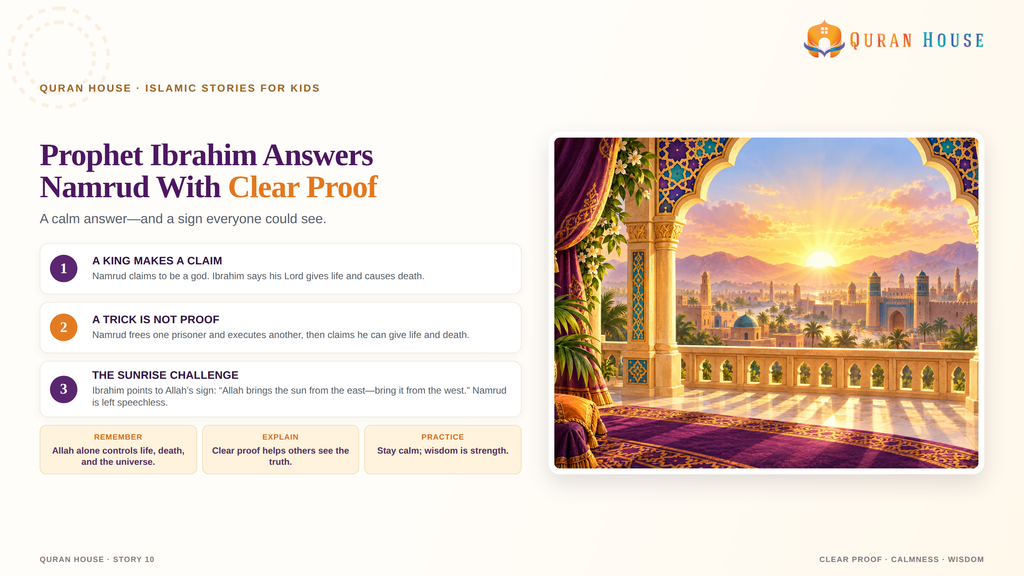
Namrud called for two prisoners. He freed one and executed the other, then claimed that he too could give life and cause death. Ibrahim saw that this argument was only a trick.
So Ibrahim offered a proof the king could not twist. Allah brings the sun up from the east, he said, so bring it from the west. Namrud was left speechless, unable to reply.
Ibrahim did not shout, insult, or waste time on the king’s trick. He calmly moved to a sign everyone could see each morning, teaching children that the strongest answer is often the clearest one.
Lessons for Your Child:
- Allah is the only Creator who controls life, death, and the whole universe.
- Choosing clear, simple proof helps others see the truth.
- Staying calm during an argument shows strength and wisdom.
Questions to Ask After the Story:
- What false claim did Namrud make?
- Why could Namrud not answer the question about the sun?
- What signs of Allah do you see in the sky every day?
Source: Surah Al-Baqarah 2:258.
Which Islamic Stories Suit Each Age Group?
Each child is different, yet age shapes how much detail a story can carry. The table below matches all ten stories to a starting age, so you can choose the right one tonight.
| Story | Best Starting Age | Core Lesson |
| Prophet Sulayman and the Ant | 3+ | Mercy to all creatures |
| Year of the Elephant | 3+ | Allah protects the Kaaba |
| Prophet Ibrahim and the Idols | 4+ | Worship Allah alone |
| Owners of the Garden | 5+ | Sharing and saying In sha Allah |
| Owner of the Two Gardens | 6+ | Humility and gratitude |
| Prophet Yusuf and His Brothers | 6+ | Patience and forgiveness |
| Three Men in the Cave | 7+ | Sincere deeds and honesty |
| Qarun’s Treasure | 8+ | Wealth as a test |
| Prophet Ibrahim and King Namrud | 9+ | Clear reasoning about Allah |
| Young Believer and the Tyrant King | 10+ | Courage and conviction |
Ages 3 to 6 Start With Animals, Miracles, and Simple Morals
Young children connect with talking ants, giant elephants, and fires that turn cool. Keep each retelling under five minutes, use one sound effect or gesture, and repeat a single lesson sentence at the end.
Quick activity: After the Sulayman story, go outside and watch ants for two minutes together. Ask your child to whisper “Subhan Allah” each time they spot one carrying food home.
Ages 7 to 9 Explore Choices, Honesty, and Consequences
At this stage, children begin judging right and wrong for themselves. Matching the right Islamic stories for kids to this age means choosing tales where a character makes a choice and faces the outcome.
Ask your child to predict what happens next before you reveal the ending. Prediction builds attention, and comparing the guess with the real story makes the lesson memorable.
Children in this range also enjoy simple background knowledge about their faith. Reading a short guide of facts about Islam together answers many of the questions these stories naturally raise.
Ages 10 to 12 Discuss Courage, Faith, and Deeper Questions
Older children can handle stories with tension, sacrifice, and debate. Invite them to retell a story in their own words, then ask which character they admire most and why.
Quick activity: Ask your child to write three lines of dua that Prophet Yusuf might have made in prison. This exercise links the story to their own relationship with Allah.
Older children who connect deeply with these stories are often ready to memorize the Surahs they come from. Quran House offers a Hifz program for kids with daily revision plans and one-on-one memorization sessions.

Book a Free Kids Hifz Assessment
How to Tell Islamic Stories for Kids So Lessons Stick
Telling a story well matters as much as choosing the right one. Our tutors at Quran House have seen that children remember lessons best when storytelling follows a short, repeated routine.
Follow these steps to turn any of the ten stories into a lesson your child keeps:
- Read the original Surah or hadith yourself first, so every detail you share is accurate.
- Choose one lesson per night instead of listing every moral at once.
- Use a calm voice, short pauses, and simple gestures to bring each scene to life.
- Stop at a key moment and ask, “What would you do here?”
- End with two questions from the story and one small action for the next day.
- Repeat favorite stories every week, since repetition builds deep familiarity.
- Close with a short dua, such as asking Allah to make your child patient like Yusuf.
Consistency matters more than length. Ten focused minutes of Islamic stories for kids every night build more character than a single long session once a month, because the routine itself becomes something children look forward to.
Avoid adding details that are not found in the Quran or authentic Sunnah. When a child asks something the sources do not answer, it is perfectly fine to say, “Allah knows best, and we can learn more together.”
A Real Surah Lesson: Surah Ash-Shams
Watch a student work through Surah Ash-Shams step by step with their tutor, practicing each ayah until the recitation flows clearly and correctly.
Start Your Quran Journey With Quran House
Learn live and one-on-one with Al-Azhar-trained tutors, male and female, for children and adults, at a time that fits your timezone.
Try a Free SessionHelp Your Child Love Quran Stories With Quran House Tutors
Stories open the door, and the Quran keeps it open. Quran House connects your child with Al-Azhar-trained tutors who have taught recitation, meaning, and Islamic character through live one-on-one classes since 2018.
What sets Quran House apart:
- Every lesson is live and one-on-one, so your child receives full attention and real-time correction.
- Sisters and daughters can choose a female tutor for a comfortable learning space.
- Flexible scheduling fits school routines across different time zones.
Book Your Child’s FREE Trial Lesson

Our Kids Quran Courses:
- Quran Tafseer for Kids.
- Quran Reading for Kids.
- Quran and Arabic Classes for Kids.
- Hifz School for Kids.
- Juz Amma Memorization Course.
- Noorani Qaida for Beginners.
Conclusion
Prophets, kings, travelers, and even a tiny ant carry lessons that shape a child’s heart for life. Each story in this collection comes from the Quran or authentic Sunnah, so parents can share them with full confidence.
The most effective Islamic stories for kids are those told with care, discussed with simple questions, and linked to one daily action. Start with the age guide, pick one story tonight, and let the routine grow naturally.
Over time, your child will see Tawheed in Ibrahim’s courage, mercy in Sulayman’s smile, and forgiveness in Yusuf’s kindness. These moments become the foundation of a lifelong relationship with Allah and His Book.
FAQs
Parents often ask these questions before building a family storytelling routine.
Which Islamic Story Should a Young Child Hear First?
The story of Prophet Sulayman and the ant works well as a first story for children aged three and above. It is short, features a lovable animal, and teaches mercy and gratitude without frightening details.
At What Age Can Children Start Hearing Prophet Stories?
Children can start hearing simple prophet stories from around age three. Keep early versions under five minutes, focus on one lesson, and add more detail and discussion as your child grows older and asks deeper questions.
Are Stories From the Quran True Events?
Yes, Muslims believe every story in the Quran is a true account revealed by Allah. They are not fables or myths, which is why parents should share them accurately without adding invented details or imaginary dialogue.
How Long Should an Islamic Bedtime Story Be?
An Islamic bedtime story should last about five to ten minutes for most children. That length holds attention, leaves time for two or three questions, and helps the lesson settle before sleep.
Can Islamic Stories Help Children Learn the Quran?
Yes, stories give children a personal connection to the Surahs they later read and memorize. A child who knows the story of the elephant often recites Surah Al-Fil with more interest, focus, and understanding.