

A Quran with Tajweed Course is one of the most effective ways to learn how to recite the Quran accurately while preserving the beauty and meaning of every verse. Many Muslims can read the Quran, but they are often unsure whether they are pronouncing every letter correctly or applying the rules of Tajweed as they should. A structured learning program provides expert guidance, regular practice, and immediate correction, helping students build confidence and improve their recitation step by step.
At Quran House Academy, students receive personalised online lessons from qualified Quran teachers who adapt every class to the learner’s level and goals. Whether you are a complete beginner, an adult returning to Quran study, or someone seeking to refine your recitation, a Quran with Tajweed Course offers a clear learning path supported by live instruction, practical exercises, and continuous feedback. For learners who want to go further, take a look at our reward of learning tajweed. For learners who want to go further, take a look at our memorizing quran word for word. For learners who want to go further, take a look at our islam step step. For learners who want to go further, take a look at our izhar halqi.
What to Expect in Your First Quran with Tajweed Course Lesson?
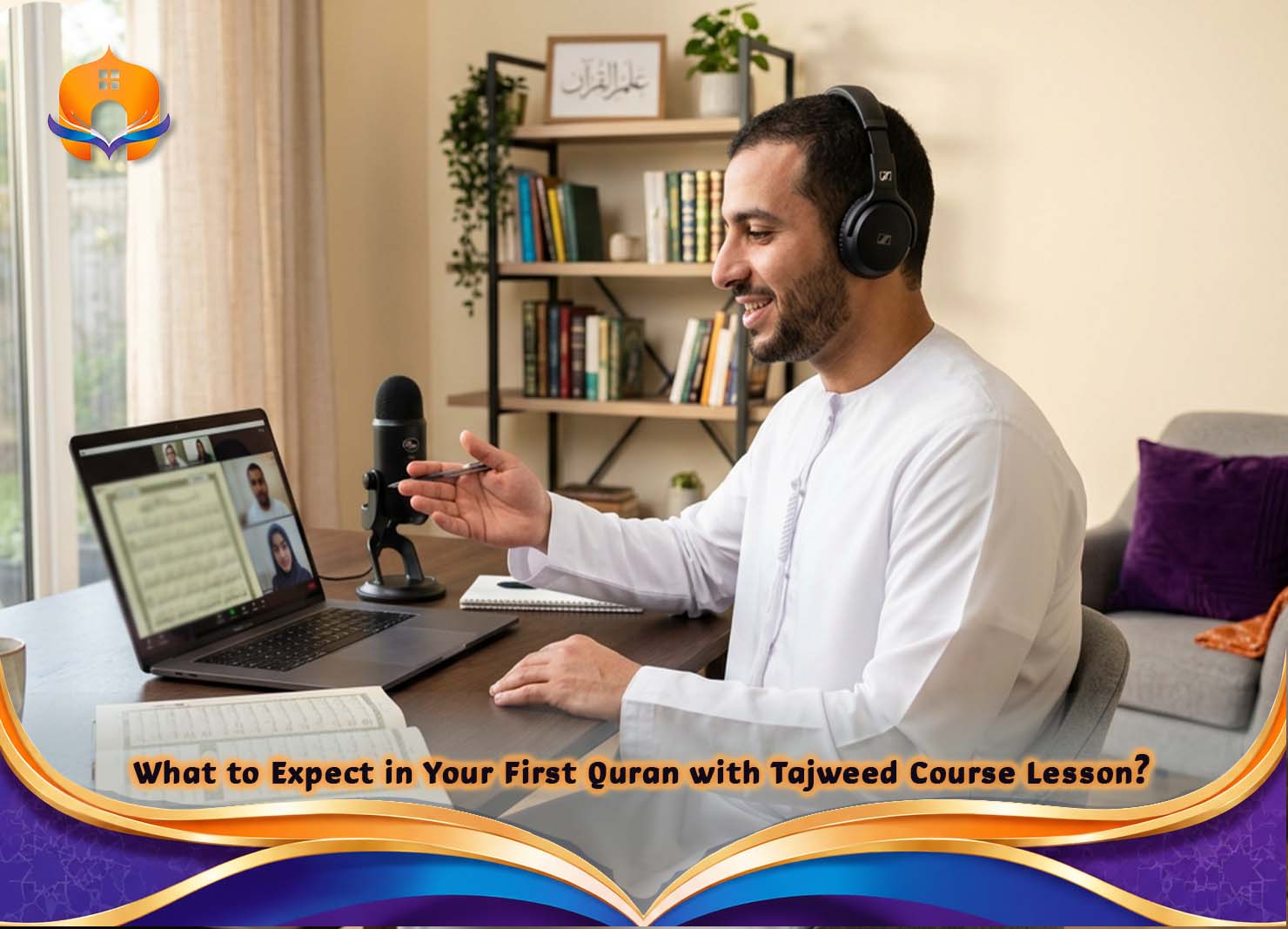
Starting a Quran with Tajweed Course can feel exciting, especially for beginners who are unsure of what the first lesson will include. Most qualified Quran teachers begin by assessing the student’s current reading ability rather than immediately introducing advanced Tajweed rules. This initial evaluation helps identify pronunciation strengths, common mistakes, familiarity with Arabic letters, and the learner’s long-term goals. If this is an area you’d like to explore in more depth, check out our online tajweed course duration. If this is an area you’d like to explore in more depth, check out our understanding the message of the quran. If this is an area you’d like to explore in more depth, check out our surahs about the 99 names of allah. If this is an area you’d like to explore in more depth, check out our izhar mutlaq.
After the assessment, the teacher explains the learning plan and introduces practical exercises that match the student’s level. Beginners may review the Arabic alphabet, Noorani Qaida, or basic Makharij, while more experienced students often begin correcting Tajweed mistakes directly from Quranic verses. Throughout the lesson, students receive live feedback, clear explanations, and opportunities to repeat difficult words until they are pronounced correctly. Many students pair this with our learning tajweed online to round out their learning. Many students pair this with our completing vs understanding the quran to round out their learning. Many students pair this with our the beauty and heart of the quran to round out their learning.
The first lesson also helps establish a comfortable learning routine. Students learn how homework will be assigned, how progress will be monitored, and what daily practice is recommended between classes. By the end of the session, most learners have a clear understanding of their current level and the specific steps they will follow to improve their Quran recitation through a structured Quran with Tajweed Course. Our self studying tajweed can be a good complement for anyone following this path. Our not reading quran in your life can be a good complement for anyone following this path. Our ayatul kursi can be a good complement for anyone following this path.
Start Your Quran Learning Journey Today
Begin your Quran learning journey with confidence through well-organised and structured lessons designed specifically for beginners and gradual learners. Whether your goal is to improve pronunciation, master Tajweed rules, or learn to read the Quran step by step, Quran House Academy provides clear and easy guidance within a supportive and flexible learning environment. Those who found this helpful often continue with our reading quran like a pure arab. Those who found this helpful often continue with our dua for memorizing quran. Those who found this helpful often continue with our surah taghabun.
With experienced and qualified teachers, personalised one-on-one sessions, and a calm teaching approach, students of all ages can develop strong Quran reading skills from the comfort of their homes. Start today and move forward steadily toward accurate and fluent recitation through a structured system focused on consistency, improvement, confidence, and long-term success. This connects closely with our obligation of reading with tajweed, which many find useful. This connects closely with our quran to read when someone dies, which many find useful. This connects closely with our surah kafirun, which many find useful.

The Student Journey from the First Lesson to Confident Recitation
Progress becomes easier to understand when the course follows a clear sequence.
| Learning Stage | Main Focus | Expected Development |
|---|---|---|
| Stage 1 | Level assessment | The teacher identifies strengths, weaknesses, and learning goals |
| Stage 2 | Letters and Noorani Qaida | The student recognises letters and reads basic Arabic combinations |
| Stage 3 | Makharij and Sifaat | The student improves the pronunciation of individual sounds |
| Stage 4 | Quran reading fluency | The student reads words and verses with fewer pauses |
| Stage 5 | Core Tajweed rules | The student applies Madd, Ghunnah, Qalqalah, Noon, and Meem rules |
| Stage 6 | Corrected recitation | The student reads directly from the Mushaf with live feedback |
| Stage 7 | Tarteel and consistency | The student maintains accuracy across longer passages |
| Stage 8 | Advanced study | The student may continue toward memorisation or Ijazah preparation |
Students do not always move through these stages at the same speed. A child learning Arabic letters may need additional repetition, while an adult who already reads fluently may progress quickly to practical Tajweed correction. The purpose of the stages is to provide direction rather than pressure.
Self-Learning Compared with a Guided Tajweed Course
Books, recordings, videos, and mobile applications can support learning, but they cannot listen to the student or identify the exact cause of a pronunciation error.
| Self-Learning | Quran with Tajweed Course |
|---|---|
| No direct pronunciation correction | Live feedback from a Quran tutor |
| Mistakes may go unnoticed | Errors are identified during recitation |
| Lessons may lack order | Skills follow a structured curriculum |
| Progress depends entirely on self-discipline | Classes create consistency and accountability |
| Rules may remain theoretical | Rules are applied to Quranic verses |
| The learner may guess difficult sounds | The teacher demonstrates the correct Makharij |
| Limited progress assessment | Regular reviews show improvement |
| Questions may remain unanswered | Students can ask questions immediately |
Self-study remains useful between lessons; students can listen to skilled reciters, review rules, repeat difficult verses, and record their voices. The strongest approach often combines independent practice with live Tajweed lessons online.
Mistakes Students Commonly Make When Learning Tajweed
Even with a well-structured Quran with Tajweed Course, students may develop habits that slow their progress if they are not corrected early. Recognising these common mistakes helps learners improve their recitation more efficiently and build a stronger foundation. It’s worth pairing this with our makki madani surahs for a fuller picture.
Memorising Rules Without Practice
Some students learn Tajweed terms such as Idgham, Ikhfa, and Madd but struggle to apply them while reciting the Quran. A Quran with Tajweed Course should combine theoretical explanations with continuous practical recitation so that every rule becomes a natural part of reading. For a deeper dive, take a look at our hamzatul wasl hamzatul qat.
Depending Only on Videos
Recorded lessons are useful for revision, but they cannot identify personal pronunciation errors. During a Quran with Tajweed Course, live teacher feedback helps students correct Makharij and other mistakes before they become permanent habits. For learners who want to go further, take a look at our online quran classes for adults.
Ignoring Makharij and Reading Too Quickly
Many learners focus on advanced rules before mastering the correct pronunciation of Arabic letters. Others read too quickly, leading to incorrect Madd, missed Ghunnah, and poor stopping points. Qualified teachers in a Quran with Tajweed Course encourage students to read slowly and accurately before increasing their fluency. If this is an area you’d like to explore in more depth, check out our eating while reading quran.
Practicing Inconsistently
Reviewing only before class rarely leads to lasting improvement. Short daily practice sessions are far more effective because they strengthen memory and reinforce correct pronunciation between lessons. Keeping notes of recurring mistakes also helps students focus on areas that need additional attention.
To build this skill properly from the start, our Quran classes with tajweed pair every student with a certified tajweed instructor.
Comparing Yourself with Other Students
Every learner progresses at a different pace depending on age, language background, and previous Quran experience. Instead of comparing results with others, students should measure improvement by comparing their current recitation with their earlier performance. A personalised Quran with Tajweed Course supports this approach by providing individual feedback and goals that match each learner’s level.
How Do Teachers Assess Your Progress?
Assessment should continue after the first lesson. A teacher may review the same Surah or passage after several weeks to determine whether earlier pronunciation problems have improved. Progress can be evaluated through
- Fewer repeated mistakes
- Better articulation of difficult letters
- More accurate vowel length
- Improved control of Ghunnah and Qalqalah
- Correct application of rules without reminders
- More suitable stopping and starting
- Smoother reading with fewer hesitations
- Greater confidence while reciting aloud
- Ability to explain and apply learned rules
Some instructors keep lesson notes that identify the rules studied, verses practised, recurring errors, and homework assigned. Regular assessments allow the learning plan to change as the student develops. When a weakness improves, the teacher can introduce a new skill; when an error continues, the student receives additional exercises instead of being pushed forward too quickly.
A Practical Weekly Tajweed Study Plan

Students do not need several hours every day to make progress.A realistic plan built around short, focused practice can produce better results than irregular study sessions.
| Day | Suggested Activity | Approximate Focus |
|---|---|---|
| Day 1 | Live lesson with the teacher | New rule and corrected recitation |
| Day 2 | Review lesson notes | Repeat corrected words and verses |
| Day 3 | Listening practice | Follow a skilled reciter while reading the Mushaf |
| Day 4 | Makharij exercises | Practice difficult letters and sound contrasts |
| Day 5 | Second live lesson or revision | Apply the rule to a new passage |
| Day 6 | Record your recitation | Listen for pauses, Madd, and repeated mistakes |
| Day 7 | Light review | Recite familiar Surahs with confidence |
The schedule can be adjusted according to work, school, family responsibilities, and the number of weekly classes. The most important factor is consistency. Fifteen focused minutes every day may be more valuable than one long session followed by several days without practice.
How to Practice Between Tajweed Lessons?
A student’s improvement depends partly on what happens during class and partly on how the lesson is reinforced afterwards. Begin by reviewing the exact verses corrected by the teacher rather than immediately reading a new page.
Repeat difficult words slowly, isolate the letter or rule causing the problem, then return to the complete verse. Listening to a reliable reciter while following the Mushaf can strengthen sound recognition; students should listen to a short passage several times instead of playing long recitations without focused attention.
Recording your voice can also reveal hesitation, unclear letters, uneven Madd, or rushed stopping points. Students should avoid changing reciters constantly during early learning; following one clear recitation style can make imitation and comparison easier.
A productive practice session may include five minutes of Makharij exercises, five minutes reviewing the current Tajweed rule, and ten minutes reciting the assigned verses.
Signs Your Tajweed Is Improving
Progress is not measured only by completing pages or learning new terminology. Students may notice improvement when:
- Difficult Arabic letters require less effort
- They recognise mistakes before the teacher corrects them
- Previously learned rules appear naturally during recitation
- Their reading becomes smoother without becoming rushed
- They can maintain Madd length more consistently
- They stop at more suitable places
- They feel less anxious when reading aloud
- Their teacher repeats fewer corrections
- They can read unfamiliar verses with better control
- They enjoy recitation more because it feels clearer and more confident
- Improvement is often gradual.
A learner may not notice daily changes, but comparing a current recording with one made several months earlier can reveal meaningful progress.
How Parents Can Support Children Learning Tajweed?
Parents play an important role in helping children remain consistent without making Quran study feel stressful. A child benefits from a quiet learning area, a regular class schedule, and a short daily review routine.
Parents do not need to teach Tajweed rules themselves; they can support the learning process by ensuring the child attends lessons on time, completes assigned practice, and reviews the verses corrected by the teacher.
Positive encouragement is more effective than constant criticism. Parents can praise effort, careful pronunciation, and consistency rather than focusing only on how many pages the child completes.
Communication with the teacher is also valuable. Parents can ask about repeated mistakes, lesson participation, homework, and whether the child is ready to progress from Noorani Qaida to a Quran Reading Course or from reading to a Quran Memorisation Course.
How do Children and Adults Learn Tajweed Differently?
Children and adults may study the same Quranic rules, but they usually respond to different teaching approaches. Children often benefit from short lessons, repetition, visual material, sound games, rewards, and frequent encouragement.
Their teachers may divide one rule into several small exercises to maintain attention. Adults often prefer understanding why a rule is applied; they may ask detailed questions and want to connect the explanation directly with verses they read in prayer or daily recitation.
Adult learners may also need support in correcting habits they have repeated for many years. A flexible quran with Tajweed course should adapt the pace, language, examples, and homework according to the learner’s age and experience.
Related Courses That Can Support Your Quran Journey
Tajweed study often connects naturally with other Quran and Arabic programs.Students should select the course that matches their current level rather than enrolling in the most advanced option immediately.
Noorani Qaida Course
A Noorani Qaida Course is suitable for beginners who need to recognize Arabic letters, vowels, connected forms, Sukoon, Shaddah, Tanween, and basic reading patterns. It creates the foundation needed before applying detailed Tajweed rules to complete Quranic verses.
Quran Reading Course
A Quran Reading Course focuses on helping students read words and verses more fluently. It may be the right next step for learners who understand Arabic letters but still pause frequently or struggle to connect words.
Quran Memorisation Course
A Quran Memorisation Course helps students memorise Surahs through repetition, revision, and teacher supervision. Studying Tajweed alongside memorisation can prevent the learner from memorising verses with incorrect pronunciation.
Arabic Course
An Arabic Course can help students understand vocabulary, sentence structure, and the meanings of frequently used Quranic words.
Knowing Arabic is not required to begin Tajweed, but language study can deepen understanding and strengthen the learner’s connection with the Quran.
Ijazah Course
An Ijazah Course is generally intended for advanced students who already recite accurately and want to read the complete Quran under qualified supervision.
The requirements are more detailed than those of a standard Tajweed course and may involve precise application of a recognised Qira’ah or narration such as Hafs ‘an Asim.
How to Choose the Right Online Tajweed Classes?

Not every program offers the same teaching quality or level of personal support. Before enrolling, students should consider how lessons are delivered, how progress is assessed, and whether the teacher can adapt to their needs. Look for a program that provides:
- Qualified and experienced Quran teachers
- Live one-to-one or small-group instruction
- Direct pronunciation correction
- A structured curriculum
- Level assessment before advanced study
- Regular progress reviews
- Practical recitation in every lesson
- Flexible scheduling
- Support for children and adults
- Teachers who can communicate clearly with non-Arabic speakers
- Homework based on the student’s actual mistakes
- Clear options for continuing into reading, memorisation, Arabic, or Ijazah study
Students may also ask about the teacher’s training, experience, Ijazah, or studies with recognised scholars and institutions such as Al-Azhar.
A title or certificate alone is not enough; the teacher should also be patient, attentive, and capable of explaining difficult sounds in a way the student understands.
Why do personalised Tajweed Lessons Produce Better Results?
Every student begins with a different combination of strengths and weaknesses. One learner may understand Tajweed terminology but struggle with Makharij; another may pronounce letters correctly but read too quickly, while a third may need to improve fluency before studying advanced rules.
Personalised lessons allow the teacher to focus on the problem that most affects the student’s recitation. Instead of giving every learner identical homework, the teacher can select specific words, verses, or exercises.
A student confusing ق and ك may receive focused tongue-position practice, while another struggling with Madd may work on timing and repetition. This makes each lesson more practical and helps the student understand exactly what to improve before the next class.
Why Choose Quran House Academy?
The learning environment can influence whether students remain motivated and consistent. Quran House Academy offers structured online learning for students of different ages, backgrounds, and levels of Quran experience.
Lessons focus on practical recitation, teacher correction, and gradual skill development. Students receive guidance based on their current ability rather than being expected to follow a fixed pace designed for everyone. The learning experience may include:
- Structured progression from beginner to advanced levels
- Live online instruction
- Flexible lesson scheduling
- Personalised recitation feedback
- Practical application through Quranic verses
- Support for children, adults, reverts, and non-Arabic speakers
- Regular review of previously learned skills
- Opportunities to continue into related Quran courses
The aim is not to rush students through a list of rules.
The aim is to help them understand each skill, apply it during recitation, and continue improving through consistent practice and qualified guidance.
How does a Quran with a Tajweed Course improve daily salah?
One of the greatest benefits of joining a Quran with Tajweed Course is the positive impact it has on daily prayer. Every Muslim recites portions of the Quran during Salah, and learning the correct pronunciation through a Quran with Tajweed Course helps ensure that these verses are recited with greater accuracy and confidence. As students improve their Makharij and apply Tajweed rules consistently, they often feel more focused during prayer because they no longer worry about repeating common pronunciation mistakes.
Regular practice also helps learners recite familiar Surahs more naturally. Over time, proper recitation becomes a habit that extends beyond lessons into everyday worship, making each prayer a meaningful opportunity to apply what has been learned in a Quran with Tajweed Course. Many international students also choose an Online Quran academy in the UK because it combines qualified teachers with convenient scheduling and live one-to-one instruction.
Why Consistency Matters More Than Long Study Sessions?
Many students believe they need several hours every day to improve their recitation. In reality, a Quran with Tajweed Course is most effective when students practice consistently, even if each session is relatively short.
Daily revision reinforces correct pronunciation, strengthens memory, and prevents previously corrected mistakes from returning. Students who practice for fifteen to twenty minutes every day often make steadier progress than those who study for several hours only once a week while following a Quran with Tajweed Course.
Consistency allows every lesson to build naturally on the previous one while helping students develop confidence through continuous improvement. Many learners achieve this more easily by enrolling in an Online Quran Academy Flexible Time program that fits around work, school, and family commitments.
Essential Tajweed Rules Every Beginner Should Master
Although Tajweed includes many detailed principles, beginners usually start with a small group of essential rules that appear frequently throughout the Quran before progressing in a Quran with Tajweed Course. These include:
- Correct Makharij for every Arabic letter.
- Rules of Noon Sakinah and Tanween.
- Rules of Meem Sakinah.
- Different types of Madd.
- Ghunnah during specific letters.
- Qalqalah pronunciation.
- Proper stopping and starting (Waqf and Ibtida).
A structured Quran with Tajweed Course introduces these rules gradually through practical recitation instead of expecting students to memorise complex terminology from the beginning.
The Role of Listening in Learning Tajweed
Listening is an important part of Tajweed development. Students improve not only by reading but also by carefully listening to qualified Quran reciters while studying in a Quran with Tajweed Course.
During a Quran with Tajweed Course, teachers often recommend listening to short passages repeatedly while following the Mushaf. This approach helps learners recognise correct pronunciation, vowel length, rhythm, and stopping points before attempting to recite independently.
Listening should complement active practice rather than replace it. The greatest improvement occurs when students hear the correct recitation, imitate it, and receive direct feedback from their teacher throughout the Quran with the Tajweed Course.
Benefits of Learning with Native Arabic Quran Teachers

Many students prefer learning from native Arabic Quran teachers because they naturally pronounce Arabic sounds as they have been transmitted through generations.
In a Quran with Tajweed Course, experienced native teachers can demonstrate subtle pronunciation differences that may be difficult for non-Arabic speakers to recognise through books or recorded lessons alone.
Their guidance becomes especially valuable when correcting letters with similar sounds, refining Makharij, and helping students develop confidence while reciting complete Quranic verses. This personalised support makes every Quran with Tajweed Course more effective for long-term improvement. Families seeking female instructors often benefit from an Online Quran academy for sisters, where women and girls can learn in a supportive educational environment.
Setting Realistic Goals for Tajweed Learning
Every learner begins from a different starting point, so setting realistic goals is an important part of long-term success.
Rather than trying to master every Tajweed rule immediately, students can focus on smaller milestones such as improving one group of letters, reading one Surah fluently, or reducing repeated pronunciation mistakes.
A Quran with Tajweed Course allows teachers to divide larger objectives into manageable steps, making progress easier to measure and helping students stay motivated throughout their learning journey. Following a structured Quran with Tajweed Course also helps learners remain consistent without feeling overwhelmed.
Building Confidence Through Regular Teacher Feedback
Confidence develops gradually as students receive clear and consistent correction. During a Quran with Tajweed Course, teachers identify recurring mistakes, explain the reason behind each correction, and provide exercises that target specific areas of weakness. This process helps learners understand exactly what needs improvement instead of guessing whether their recitation is correct.
Over time, students begin recognising their own mistakes before the teacher points them out, demonstrating real progress in both accuracy and self-awareness. Continuous assessment is one of the greatest strengths of a Quran with Tajweed Course. Students looking for quality education without high tuition fees often begin with an Affordable online Quran academy that offers experienced teachers and personalised learning plans.
How Does Online Tajweed Learning Fit Busy Schedules?
Modern online learning allows students to continue Quran study without disrupting work, school, or family responsibilities.
A flexible Quran with Tajweed Course enables learners to schedule lessons at convenient times while continuing regular revision between classes. This flexibility makes it easier to remain consistent throughout the year, even for students with demanding daily routines.
Because lessons take place online, learners can study from home while receiving the same personalised guidance and live correction that are essential for accurate Quran recitation. For many families, choosing a Quran with Tajweed Course online makes learning more accessible while maintaining high educational standards. Parents can also complement Tajweed instruction with an Islamic studies course for kids, helping children strengthen their understanding of Islamic beliefs, manners, and daily worship alongside Quran recitation.
How to Measure Success in a Quran with Tajweed Course?
Success in a Quran with Tajweed Course should not be measured only by the number of Surahs completed or the amount of Tajweed terminology memorised. Real progress is reflected in the quality and consistency of recitation.
As students advance, they begin pronouncing Arabic letters from their correct Makharij, applying Tajweed rules naturally without constant reminders, and reciting verses with greater fluency while maintaining proper rhythm and stopping points. They also become more confident when reading unfamiliar passages because they understand how to apply the rules rather than simply memorising them.
Qualified teachers monitor these improvements through regular assessments, recorded recitations, and personalised feedback, ensuring that each learner masters one skill before progressing to the next. This gradual approach creates a strong foundation for lifelong Quran recitation and prepares students for future goals such as Quran memorisation, advanced Tajweed study, or even earning an Ijazah.
Frequently Asked Questions
We’ve answered the most common questions to provide quick and helpful information.
Can I learn Tajweed without knowing Arabic?
Yes, students can learn Tajweed without understanding conversational or grammatical Arabic; beginners can start with Arabic letters, Noorani Qaida, and pronunciation before progressing to complete Quranic verses.
Is Tajweed difficult for adults?
Tajweed is manageable for adults when lessons are introduced gradually. Adults may need extra practice to correct old habits, but regular feedback and short daily exercises can produce steady improvement.
How long should I practice Tajweed each day?
Fifteen to twenty minutes of focused daily practice is suitable for many learners; consistency is generally more beneficial than studying for several hours only once a week.
Can children and adults study Tajweed together?
They can study the same rules, but separate lessons are often more effective because children and adults usually need different teaching speeds, explanations, activities, and lesson lengths.
How long does it take to learn Quran with Tajweed?
The timeframe depends on the student’s starting level, lesson frequency, practice routine, age, and familiarity with Arabic sounds; many learners notice improvements within a few months, while advanced fluency requires continued study and correction.
Can I learn Tajweed through videos only?
Videos are useful for introductions and revision, but they cannot identify personal pronunciation errors; live feedback from a Quran tutor is important for correcting Makharij, Madd, Ghunnah, Qalqalah, and stopping mistakes.
Should I learn Noorani Qaida before Tajweed?
Students who cannot read Arabic words confidently usually benefit from studying Noorani Qaida first, learners who already read the Quran may begin with a level assessment and move directly into Tajweed correction.
How many online Tajweed classes should I take each week?
Many students progress well with two or three live classes each week combined with short daily practice; the ideal schedule depends on the learner’s goals and available time.
In conclusion, choosing the right quran with Tajweed course is an investment in a skill that can support your Quran recitation throughout life.
Through structured lessons, qualified guidance, practical exercises, and consistent feedback, students can improve Makharij, understand Tajweed rules, strengthen fluency, and read from the Mushaf with greater confidence.
The journey does not depend on learning every rule immediately or reading at the fastest speed.
Meaningful progress comes from careful practice, direct correction, regular review, and a willingness to improve one sound and one verse at a time.
Whether you are a complete beginner, an adult correcting long-standing mistakes, a parent searching for live Quran classes for your child, or an advanced reader preparing for Ijazah study, Quran House Academy provides a supportive path for learning Quran reading with Tajweed clearly and consistently.