| Key Takeaways |
| The Friday reading window runs from sunset on Thursday to sunset on Friday, and a hadith in Mishkat al-Masabih 2175 promises light between two Fridays. |
| Sahih Muslim 809a promises protection from the Dajjal for whoever memorizes the first ten verses, so even a short memorization goal brings real reward. |
| The four stories teach four trials, faith, wealth, knowledge, and power, and each story gives one clear lesson to apply during the week. |
| Listening with reflection is still beneficial, but the narrations speak of reading, so reciting aloud with correct Tajweed remains the best practice. |
Surah Kahf benefits reach the heart, the home, and the week ahead, which is why Muslims recite this chapter from Thursday sunset to Friday sunset. It is the 18th surah of the Quran and contains 110 verses.
Reciting it on Friday is a practice rooted in the Sunnah, yet the surah offers far more than a weekly routine. Four stories teach believers how to handle trials of faith, wealth, knowledge, and power with trust in Allah.
Each benefit below has its own section, with the Quranic verse or hadith behind it. After the benefits come the story context, the Friday timing, and practical steps for families and students. The benefits are as follows.
1. Receive Light From One Friday to the Next
Light is the best known reward attached to this surah, and the Prophet ﷺ tied it directly to Friday. Two points explain how this benefit works.
Mishkat al-Masabih 2175 on Light Between Two Fridays
Abu Sa’id al-Khudri reported the reward of Friday recitation from the Prophet ﷺ. Al-Bayhaqi recorded it in al-Da’awat al-Kabir, and Sheikh al-Albani graded it hasan.
من قَرَأَ سُورَة الْكَهْف فِي يَوْم الْجُمُعَة أَضَاء لَهُ النُّور مَا بَيْنَ الْجُمْعَتَيْنِ
(Man qara’a soorat al-Kahf fee yawm al-jumu’ah ada’a lahu an-noor ma bayna al-jumu’atayn)
(“If anyone recites sūra al-Kahf (Qur’ān, 18) on Friday, light will shine brightly for him till the next Friday.”)
Scholars explain this light in two ways. Some see it as guidance that keeps the reciter away from sin, while others also expect a literal light on the Day of Resurrection.
What the Light Means in Daily Life
Light in the Quran is closely tied to guidance, so the practical reading of this hadith is steadier judgment through the week. A believer who revisits the four stories each Friday carries their lessons into work, study, and family decisions.
Consistency also decides this benefit. One hurried reading rarely changes a routine, while a calm weekly reading builds a habit that each new Friday renews.
2. Gain Protection From the Trial of the Dajjal
The Dajjal is the false messiah who will appear near the end of time. Protection from his trial is linked to the opening verses of this surah.
Sahih Muslim 809a on Memorizing the First Ten Verses
Abu al-Darda’ reported a clear promise from the Prophet ﷺ. Imam Muslim recorded it in the chapter on the virtue of Surat al-Kahf and Ayat al-Kursi.
مَنْ حَفِظَ عَشْرَ آيَاتٍ مِنْ أَوَّلِ سُورَةِ الْكَهْفِ عُصِمَ مِنَ الدَّجَّالِ
(Man hafiza ‘ashra aayaatin min awwali soorati al-Kahfi ‘usima min ad-Dajjaal)
(“If anyone learns by heart the first ten verses of the Surah al-Kahf, he will be protected from the Dajjal.”)
The verses involved are 18:1 to 18:10, so the reward is within reach of beginners. Verse 1 praises Allah for sending the Book without any crookedness.
ٱلْحَمْدُ لِلَّهِ ٱلَّذِىٓ أَنزَلَ عَلَىٰ عَبْدِهِ ٱلْكِتَٰبَ وَلَمْ يَجْعَل لَّهُۥ عِوَجَا
(Al-hamdu lillahi alladhi anzala ‘ala ‘abdihi al-Kitaba wa lam yaj’al lahu ‘iwaja)
(“All praise is due to Allah, who has sent down upon His Servant the Book and has not made therein any deviance.”)
Why the First Ten Verses Matter Most
Another wording mentions the last ten verses, yet scholars such as Ibn al-Qayyim and al-Albani judged that wording not established.
The opening verses are also the ones the Prophet ﷺ told believers to recite against the Dajjal. That makes the first ten verses the safest choice.
Memorizing ten verses is a realistic goal at any age. A tutor who corrects pronunciation and schedules daily review makes the difference between memorizing once and retaining for years.
Quran House offers Quran Memorization for Adults, a one-on-one program where a tutor builds a review plan around short portions such as the opening of Surah Al-Kahf.

Start Your Free Memorization Trial
3. Experience Tranquility Through Recitation
Sakinah is the calm and reassurance that Allah sends down when the Quran is recited. A companion reciting Surah Al-Kahf experienced it directly, and the Prophet ﷺ explained what had happened.
Al-Bara’ ibn Azib narrated the incident, and Imam al-Bukhari recorded it in the chapter on the superiority of Surat Al-Kahf.
كَانَ رَجُلٌ يَقْرَأُ سُورَةَ الْكَهْفِ وَإِلَى جَانِبِهِ حِصَانٌ مَرْبُوطٌ بِشَطَنَيْنِ فَتَغَشَّتْهُ سَحَابَةٌ فَجَعَلَتْ تَدْنُو وَتَدْنُو وَجَعَلَ فَرَسُهُ يَنْفِرُ فَلَمَّا أَصْبَحَ أَتَى النَّبِيَّ صلى الله عليه وسلم فَذَكَرَ ذَلِكَ لَهُ فَقَالَ تِلْكَ السَّكِينَةُ تَنَزَّلَتْ بِالْقُرْآنِ
(Kana rajulun yaqra’u soorata al-Kahfi wa ila janibihi hisanun marbootun bishatanayn, fataghashshathu sahabatun, faja’alat tadnoo wa tadnoo, wa ja’ala farasuhu yanfiru, falamma asbaha ata an-Nabiyya sallallahu ‘alayhi wa sallam, fadhakara dhalika lahu, faqala: tilka as-sakeenatu tanazzalat bil-Qur’an)
(“A man was reciting Surat Al-Kahf and his horse was tied with two ropes beside him. A cloud came down and spread over that man, and it kept on coming closer and closer to him till his horse started jumping (as if afraid of something). When it was morning, the man came to the Prophet, and told him of that experience. The Prophet (ﷺ) said, ‘That was As-Sakina (tranquility) which descended because of (the recitation of) the Qur’an.'”)
Another narration in al-Bukhari names the companion as Usayd ibn Hudayr. The Prophet ﷺ did not treat the event as a fright to avoid but as a blessing to welcome.
The practical lesson is to recite slowly and attentively, giving every verse its full attention. Calm follows presence of heart, and a rushed reading rarely brings it.
4. Stay Steadfast in Faith Like the People of the Cave
This benefit is faith under pressure. The youths of the cave show what steadfastness looks like when the surrounding society pulls the other way.
Who Are the People of the Cave?
The People of the Cave were young believers who fled the persecution of their people to protect their faith. They took shelter in a cave, and Allah caused them to sleep for years.
According to the Quran, they stayed there 309 years, and people differ about their number. Christian tradition preserves a comparable account known as the Seven Sleepers of Ephesus.
When they woke, their world had changed. Their story became a sign of Allah’s power to protect His servants and to raise the dead.
Surah Al-Kahf 18:10 on Seeking Mercy in Hardship
Their first act in the cave was a prayer, and the Quran preserves the exact words for believers to repeat.
إِذْ أَوَى ٱلْفِتْيَةُ إِلَى ٱلْكَهْفِ فَقَالُوا۟ رَبَّنَآ ءَاتِنَا مِن لَّدُنكَ رَحْمَةًۭ وَهَيِّئْ لَنَا مِنْ أَمْرِنَا رَشَدًۭا
(Idh awa al-fityatu ila al-kahfi faqaloo Rabbana atina min ladunka rahmatan wa hayyi’ lana min amrina rashada)
(“[Mention] when the youths retreated to the cave and said, ‘Our Lord, grant us from Yourself mercy and prepare for us from our affair right guidance.'”)
This dua asks for two things: mercy and right guidance. A believer facing pressure at work, school, or home can use the same words to ask for the same two gifts.
5. Learn Humility and Gratitude From the Two Gardens
The story of the two gardens contrasts a wealthy man who trusted his orchard with a poor believer who trusted Allah. Boasting about his orchard, the rich man claimed it would never perish and doubted the Day of Resurrection.
His believing companion answered him directly, and the Quran records the reply word for word so that believers can reflect on it.
قَالَ لَهُۥ صَاحِبُهُۥ وَهُوَ يُحَاوِرُهُۥٓ أَكَفَرْتَ بِٱلَّذِى خَلَقَكَ مِن تُرَابٍۢ ثُمَّ مِن نُّطْفَةٍۢ ثُمَّ سَوَّىٰكَ رَجُلًۭا
(Qala lahu sahibuhu wa huwa yuhawiruhu akafarta bil-ladhi khalaqaka min turabin thumma min nutfatin thumma sawwaka rajula)
(“His companion said to him while he was conversing with him, ‘Have you disbelieved in He who created you from dust and then from a sperm-drop and then proportioned you [as] a man?'”)
The garden was later destroyed, and the owner regretted trusting it. Wealth was never the problem; forgetting the One who gave it was. The surah then states the lesson in a single verse.
ٱلْمَالُ وَٱلْبَنُونَ زِينَةُ ٱلْحَيَوٰةِ ٱلدُّنْيَا وَٱلْبَٰقِيَٰتُ ٱلصَّٰلِحَٰتُ خَيْرٌ عِندَ رَبِّكَ ثَوَابًۭا وَخَيْرٌ أَمَلًۭا
(Al-malu wal-banoona zeenatu al-hayati ad-dunya, wal-baqiyatu as-salihatu khayrun ‘inda Rabbika thawaban wa khayrun amala)
(“Wealth and children are [but] adornment of the worldly life. But the enduring good deeds are better to your Lord for reward and better for [one’s] hope.”)
Gratitude then becomes a weekly check. Is wealth serving the Hereafter or replacing it? Many readers use Friday to review spending, time, and priorities.
Inside an Interactive One-on-One Session
Every class is live and personal. See how our tutor uses on-screen tools, quick reviews, and gentle correction to help a student build confidence with every new word.
Start Your Quran Journey With Quran House
Learn live and one-on-one with Al-Azhar-trained tutors, male and female, for children and adults, at a time that fits your timezone.
Try a Free Session6. Lessons on Patience From Musa and Al-Khidr
Musa asked a wise servant of Allah, Al-Khidr, to teach him knowledge he had not been given. The request itself shows humility, because a prophet asked to learn.
قَالَ لَهُۥ مُوسَىٰ هَلْ أَتَّبِعُكَ عَلَىٰٓ أَن تُعَلِّمَنِ مِمَّا عُلِّمْتَ رُشْدًۭا
(Qala lahu Moosa hal attabi’uka ‘ala an tu’allimani mimma ‘ullimta rushda)
(“Moses said to him, ‘May I follow you on [the condition] that you teach me from what you have been taught of sound judgment?'”)
Al-Khidr replied that Musa would not be able to bear patiently what he did not fully understand. A damaged boat, a slain youth, and a repaired wall then tested that patience.
Each act looked wrong on the surface and carried a hidden mercy, which Al-Khidr explained at the end. Human sight is limited, and trust in Allah’s wisdom is the cure for impatience.
A believer facing a delay or a loss can apply this lesson weekly: pause before judging, because the full picture is not yet visible.
Understanding why each event unfolded takes careful tafseer, the scholarly explanation of Quranic verses. Quran House offers a Quran Tafseer Course for All Levels that walks students through stories like this one with qualified tutors.

Join a Free Tafseer Trial Session
7. Learn Justice and Restraint From Dhul-Qarnayn
Dhul-Qarnayn was a just ruler who traveled to the far ends of the earth and used his power to help people in distress. His name means the one with two horns.
A community suffering from the raids of Gog and Magog asked him for protection, and the Quran records their request.
قَالُوا۟ يَٰذَا ٱلْقَرْنَيْنِ إِنَّ يَأْجُوجَ وَمَأْجُوجَ مُفْسِدُونَ فِى ٱلْأَرْضِ فَهَلْ نَجْعَلُ لَكَ خَرْجًا عَلَىٰٓ أَن تَجْعَلَ بَيْنَنَا وَبَيْنَهُمْ سَدًّۭا
(Qaloo ya Dha al-Qarnayni inna Ya’jooja wa Ma’jooja mufsidoona fi al-ardi fahal naj’alu laka kharjan ‘ala an taj’ala baynana wa baynahum sadda)
(“They said, ‘O Dhul-Qarnayn, indeed Gog and Magog are [great] corrupters in the land. So may we assign for you an expenditure that you might make between us and them a barrier?'”)
He declined payment and built the barrier with their labor, saying that what his Lord had given him was better than tribute. Power, in this account, is a trust to protect others.
Some popular sources claim that reciting the surah holds Gog and Magog behind the wall. No authentic text confirms that claim, so the benefit here is the lesson itself: strength is for justice and service.
8. Build Self-Reflection and a Weekly Return to Allah
The surah closes with a reminder that every story leads to one decision: how to meet Allah. The final verse sets the standard in two parts, righteous deeds and pure worship.
قُلْ إِنَّمَآ أَنَا۠ بَشَرٌۭ مِّثْلُكُمْ يُوحَىٰٓ إِلَىَّ أَنَّمَآ إِلَٰهُكُمْ إِلَٰهٌۭ وَٰحِدٌۭ فَمَن كَانَ يَرْجُوا۟ لِقَآءَ رَبِّهِۦ فَلْيَعْمَلْ عَمَلًۭا صَٰلِحًۭا وَلَا يُشْرِكْ بِعِبَادَةِ رَبِّهِۦٓ أَحَدًۢا
(Qul innama ana basharun mithlukum yooha ila yya annama ilahukum ilahun wahid, faman kana yarjoo liqa’a Rabbihi falya’mal ‘amalan salihan wa la yushrik bi’ibadati Rabbihi ahada)
(“Say, [O Muhammad], ‘I am only a man like you, to whom has been revealed that your god is but one God. So whoever would hope for the meeting with his Lord, let him do righteous work and not associate in the worship of his Lord anyone.'”)
Reading the surah every Friday creates a rhythm of self-review. Each story asks a different question: is my faith firm, is my wealth in perspective, is my knowledge humble, is my power just?
Students who want to turn that rhythm into lasting memorization will find practical guidance in our explanation of why Muslims memorize the Quran.
Why Was Surah Al Kahf Revealed?
Surah Al Kahf was revealed in Makkah after the Quraysh, the leading tribe of the city, tested the Prophet ﷺ with three questions suggested by the Jewish scholars of Madinah.
Those questions concerned some youths of ancient times, a traveler who reached the east and the west, and the soul. The surah answers the first two directly, while Surah Al-Isra 17:85 addresses the soul.
Some Seerah narrations add that revelation paused for about fifteen days after the Prophet ﷺ promised answers without saying “if Allah wills.” Verses 18:23 and 18:24 then taught believers to attach every plan to Allah’s will.
These origins explain the surah’s themes: proof of prophethood, the Day of Resurrection (Al-Qiyamah), and the limits of human knowledge. Each story quietly points back to the same accountability before Allah.
Surah Kahf Benefits and the Theme Linking Four Stories
Scholars often read the four stories as answers to four trials, which gives the surah a clear structure. The table below shows how each trial maps to a lesson.
| Story | Trial | Core Lesson | Verses |
| People of the Cave | Faith | Stay firm and ask Allah for mercy | 18:9-26 |
| Owner of the Two Gardens | Wealth | Choose gratitude over pride | 18:32-44 |
| Musa and Al-Khidr | Knowledge | Practice patience and humility | 18:60-82 |
| Dhul-Qarnayn | Power | Use strength for justice | 18:83-98 |
Reading the stories as a set matters. Without the structure, the surah looks like four unrelated tales; with it, each Friday becomes a self-review across all four trials.
This structure is one of the Surah Kahf benefits that readers often overlook. Choose the trial that matches your current season, then reread that story slowly after the full recitation.
Benefits of Reciting Surah Kahf on Friday
Friday recitation has a clear window. The recommended time runs from sunset on Thursday to sunset on Friday, because Jumu’ah is counted from Maghrib.
Scholars such as al-Shafi’i held that both the night and the day of Friday count. Either part of the window therefore fulfills the Sunnah.
Reading aloud from the Mushaf or from memory fits the hadith wording, which speaks of whoever reads the surah. Listening with reflection is still valuable, especially for those who cannot yet read Arabic.
A full recitation takes about half an hour at a calm pace, so many families divide it into sections. However it is divided, the Surah Kahf benefits described above attach to the surah as a whole, so finishing it matters more than speed.
Reading with Tajweed, the rules that give every letter its correct sound, protects the words of Allah from error and slows the reader to a reflective pace.
Quran House offers Learn Quran Reading with Tajweed for Beginners, a step-by-step course in which a tutor corrects articulation in real time.
Book a Free Tajweed Trial Class
Common Mistakes When Reading Surah Al Kahf on Friday
Four habits reduce the value of Friday recitation, and each has a simple fix:
- Reading in a rush to finish, which removes reflection and the calm described in Bukhari 5011.
- Attaching promises that no authentic text states, such as guaranteed wishes or fixed rewards beyond the narrations above.
- Reciting only the last ten verses for Dajjal protection, when the established wording names the opening verses.
- Skipping the meaning, so the four stories pass as sounds instead of lessons.
Families who want another surah for the same weekly routine can explore the lessons of Surah Al-Waqiah in a separate guide.
Practical Ways to Apply Surah Al Kahf’s Lessons in Daily Life
Knowledge becomes a benefit only when it changes behavior. The steps below keep the surah active between one Friday and the next:
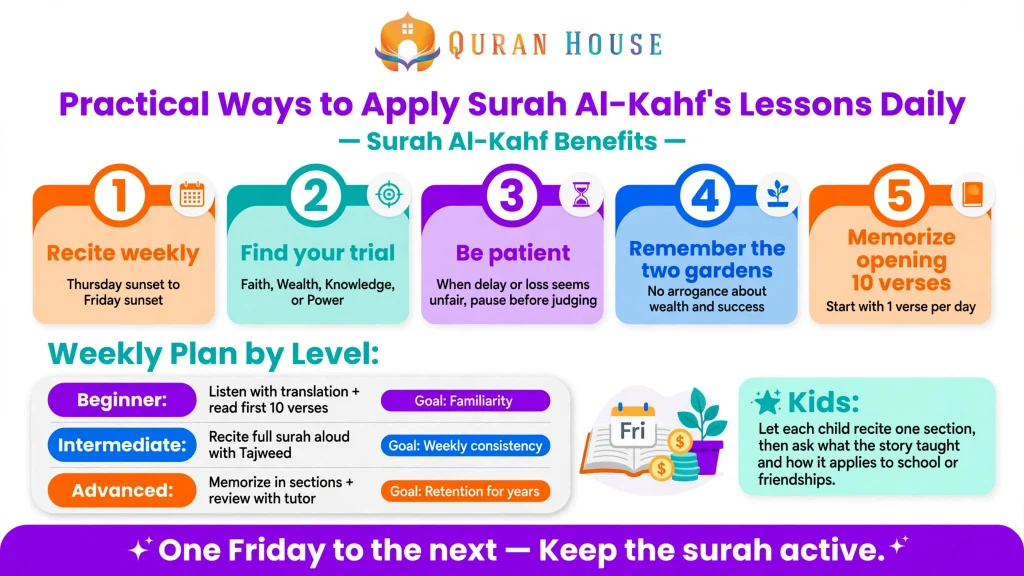
- Recite the surah weekly between Thursday sunset and Friday sunset as a steady source of guidance.
- Identify which of the four trials, faith, wealth, knowledge, or power, feels most relevant to your current season.
- Apply the patience of Musa when a delay or loss seems unfair, and pause before judging.
- Reflect on the two gardens as a reminder against arrogance about wealth and success.
- Memorize the opening ten verses, starting with one verse per day.
The plan below scales with your level, so a beginner and an advanced student can follow the same Friday rhythm:
| Level | Weekly Plan | Goal |
| Beginner | Listen with translation, then read the first ten verses | Familiarity with the opening |
| Intermediate | Recite the full surah aloud with Tajweed | Weekly consistency |
| Advanced | Memorize the surah in sections and review with a tutor | Retention for years |
Children learn faster when the surah is shared. Let each child recite one section, then ask what the story taught and how it applies to school or friendships.
Quran House offers Quran Reading for Kids, where young students recite with patient tutors in live one-on-one sessions.

Small steps repeated every week outperform large plans abandoned by Sunday. Start with one story, one verse, or one Friday, and let the habit grow from there.
It’s Never Too Late to Learn
Adults learn with us too. Watch a real session with one of our adult learners and see how calm, one-on-one guidance makes Quran recitation feel achievable at any age.
Start Your Quran Journey With Quran House
Learn live and one-on-one with Al-Azhar-trained tutors, male and female, for children and adults, at a time that fits your timezone.
Try a Free SessionStart Reciting Surah Al Kahf With Quran House Instructors
Quran House pairs every student with a live tutor, so correction happens during the lesson instead of weeks later. Sessions run one on one at flexible times for students in any time zone.
What Sets Quran House Apart:
- Al-Azhar-trained tutors who correct recitation in real time.
- Live one-on-one sessions for kids, adults, and sisters.
- Two free trial sessions before any commitment.
Our Quran Courses
- Learn Quran Reading with Tajweed for Beginners.
- Quran Memorization for Adults.
- Quran Tafseer Course for All Levels.
- Quran Reading for Kids.
- Part-Time and Weekend Hifz Program.
- Understand the Quran Course.
Conclusion
Surah Kahf benefits combine reward and reform: light between two Fridays, protection linked to the opening verses, and tranquility for the reciter. Each benefit rests on an authentic text, which is why the practice has lasted across generations.
The four stories add daily wisdom. Faith stays firm like the youths of the cave, wealth stays in perspective like the two gardens, knowledge stays humble like Musa’s, and power stays just like Dhul-Qarnayn’s.
Start this Thursday evening with the first ten verses, then build toward the full surah and its meanings. With steady practice and a qualified tutor, the Friday habit becomes a lifelong source of guidance.
FAQs
When Should Surah Al Kahf Be Read on Friday?
Read it any time from sunset on Thursday until sunset on Friday. Scholars count Jumu’ah from Maghrib, and the narrations mention both the night and the day, so either part of the window is valid.
Is It Necessary to Read the Whole Surah?
Reading the full surah matches the wording of the hadith. If time is short, reciting part of it with sincerity is better than leaving it, and memorizing the first ten verses has its own reward in Sahih Muslim 809a.
Can I Listen Instead of Reading?
Listening with attention is beneficial and helps those who cannot yet read Arabic. The narrations, however, speak of reading the surah, so reciting aloud remains the best practice whenever you are able.
Does Surah Al Kahf Protect From the Dajjal?
Yes, Sahih Muslim 809a promises protection to whoever memorizes the first ten verses. The established wording names the opening verses, and the Prophet ﷺ also told believers to recite them against the Dajjal.
Can Children Read Surah Al Kahf on Friday?
Children can recite or listen with the family one section at a time. Short sessions with a patient tutor build confidence, and a shared family routine keeps the habit alive.