| Key Takeaways |
| Surah Qaf is a Makki chapter of 45 verses in Juz 26 that builds certainty in resurrection through nature, history, and personal accountability. |
| Authentic reports confirm the Prophet ﷺ recited Surah Qaf in Friday sermons, Fajr prayer, and both Eid prayers (Sahih Muslim 873, 458, 891). |
| Claims that Surah Qaf cures epilepsy, eases death, or repairs eyesight do not appear in the authentic hadith collections and should not be practiced as Sunnah. |
| Memorizing the surah in five blocks of nine verses, with two review days each week, gives steady progress without overload. |
The benefits of Surah Qaf reach far beyond a single recitation. This short Makki chapter reshapes how a believer thinks about death, speech, and accountability, using vivid scenes that the Prophet ﷺ chose to repeat before large gatherings.
Many pages list Surah Qaf benefits without checking the sources behind them. This guide separates what the Quran and authentic hadith confirm from claims that lack reliable evidence, so every lesson here rests on a verifiable reference.
Each of the eight benefits below connects to a specific verse or hadith. Practical sections on memorization, recitation times, and daily application follow them. The benefits are as follows.
1. Strengthen Certainty in the Resurrection Through Nature
Surah Qaf builds certainty in the resurrection by pointing to rain reviving dead land, a scene every reader has witnessed. A dry field turning green becomes a daily proof of the Hereafter, which Allah states in these words:
رِّزْقًۭا لِّلْعِبَادِ ۖ وَأَحْيَيْنَا بِهِۦ بَلْدَةًۭ مَّيْتًۭا ۚ كَذَٰلِكَ ٱلْخُرُوجُ
(Rizqan lil-‘ibaad, wa ahyaynaa bihi baldatan maytaa, kadhaalikal-khurooj)
(“As provision for the servants. And We have brought to life thereby a dead land. Thus is the emergence [from the graves].”)
The word thus acts as the logical bridge of the verse. If lifeless land returns to life each season, resurrection is no stranger than the rain itself. Believers who pause at every shower recall this verse and renew their conviction.
2. Feel Allah’s Nearness Closer Than the Jugular Vein
Surah Qaf gives the believer a rare sense of nearness to Allah by describing His knowledge as closer than the jugular vein. This single verse removes the feeling of distance and replaces it with calm awareness:
وَلَقَدْ خَلَقْنَا ٱلْإِنسَـٰنَ وَنَعْلَمُ مَا تُوَسْوِسُ بِهِۦ نَفْسُهُۥ ۖ وَنَحْنُ أَقْرَبُ إِلَيْهِ مِنْ حَبْلِ ٱلْوَرِيدِ
(Wa laqad khalaqnal-insaana wa na’lamu maa tuwaswisu bihi nafsuh, wa nahnu aqrabu ilayhi min hablil-wareed)
(“And We have already created man and know what his soul whispers to him, and We are closer to him than [his] jugular vein.”)
The jugular vein is a vital vessel in the neck, so it stands for life itself. Allah knows even the whispers of the soul, which brings humility and comfort to anyone who prays in private or struggles alone.
3. Guard Your Speech Because Angels Record Every Word
Surah Qaf trains speech by reminding readers that two angels record every utterance, whether it is kind advice or careless gossip. The verse makes accountability concrete and immediate:
مَّا يَلْفِظُ مِن قَوْلٍ إِلَّا لَدَيْهِ رَقِيبٌ عَتِيدٌۭ
(Maa yalfizu min qawlin illaa ladayhi raqeebun ‘ateed)
(“Man does not utter any word except that with him is an observer prepared [to record].”)
A believer who recalls this verse pauses before sarcasm, backbiting, and idle jokes. Over time the habit becomes a quiet filter, and it applies equally to group chats and online comments, where words travel farther than intended.
Quran House offers the Understand the Quran Course that helps students read verses like these in context, so lessons about speech and accountability stay clear and practical.

4. Prepare Your Heart for the Moment of Death
Surah Qaf prepares the heart for death by describing its throes as a certain truth that no one escapes. Instead of producing fear alone, the verse motivates action while time remains:
وَجَآءَتْ سَكْرَةُ ٱلْمَوْتِ بِٱلْحَقِّ ۖ ذَٰلِكَ مَا كُنتَ مِنْهُ تَحِيدُ
(Wa jaa’at sakratul-mawti bil-haqq, dhaalika maa kunta minhu taheed)
(“And the intoxication of death will bring the truth; that is what you were trying to avoid.”)
Reflection on this verse encourages timely repentance, repaired relationships, and sincere prayer. The surah treats death as the doorway to accountability, so preparation becomes a daily practice rather than a late regret.
5. Learn From Nations That Rejected Guidance
Surah Qaf teaches through history by naming the peoples of Noah, Thamud, ‘Ad, Pharaoh, and Lot, who denied their messengers and met the warning they ignored. Their stories work as mirrors for every generation, as this verse explains:
إِنَّ فِى ذَٰلِكَ لَذِكْرَىٰ لِمَن كَانَ لَهُۥ قَلْبٌ أَوْ أَلْقَى ٱلسَّمْعَ وَهُوَ شَهِيدٌۭ
(Inna fee dhaalika ladhikraa liman kaana lahu qalbun aw alqas-sam’a wa huwa shaheed)
(“Indeed in that is a reminder for whoever has a heart or who listens while he is present [in mind].”)
The verse names two ways to benefit: a heart that reflects and an ear that listens attentively. Readers who study these accounts sincerely learn humility, because earlier generations were mightier than their audience and still found no escape.
6. Find Hope in the Promise of Paradise
Surah Qaf balances warning with hope by describing Paradise as brought near to the righteous, not far away. After the scenes of judgment, the believer meets a promise that feels close and real:
وَأُزْلِفَتِ ٱلْجَنَّةُ لِلْمُتَّقِينَ غَيْرَ بَعِيدٍ
(Wa uzlifatil-jannatu lil-muttaqeena ghayra ba’eed)
(“And Paradise will be brought near to the righteous, not far.”)
The following verses describe those who constantly turn to Allah and keep His commandments. They add that such people will have whatever they wish, with more from Him. This hope sustains steady worship during hard seasons.
7. Build Patience Through Daily Glorification
Surah Qaf ends its practical guidance with patience and tasbih, giving the believer a simple routine for difficult days. Allah instructs the Prophet ﷺ to endure what people say and to glorify Him at fixed times:
فَٱصْبِرْ عَلَىٰ مَا يَقُولُونَ وَسَبِّحْ بِحَمْدِ رَبِّكَ قَبْلَ طُلُوعِ ٱلشَّمْسِ وَقَبْلَ ٱلْغُرُوبِ
(Fasbir ‘alaa maa yaqooloona wa sabbih bihamdi rabbika qabla tuloo’ish-shamsi wa qablal-ghuroob)
(“So be patient over what they say and exalt [Allah] with praise of your Lord before the rising of the sun and before its setting.”)
The next verse adds glorification during part of the night and after the prayers. Even five quiet minutes of tasbih after Fajr turns this lesson into a habit that steadies the heart against criticism and fatigue.
A Real Surah Lesson: Surah Ash-Shams
Watch a student work through Surah Ash-Shams step by step with their tutor, practicing each ayah until the recitation flows clearly and correctly.
Start Your Quran Journey With Quran House
Learn live and one-on-one with Al-Azhar-trained tutors, male and female, for children and adults, at a time that fits your timezone.
Try a Free Session8. Revive the Prophet’s Friday Habit of Reciting Qaf
Surah Qaf holds a special place in the Sunnah because the Prophet ﷺ recited it from the minbar during Friday sermons. A companion even learned the surah simply by listening to him each week, as Umm Hisham bint Harithah reported:
لَقَدْ كَانَ تَنُّورُنَا وَتَنُّورُ رَسُولِ اللَّهِ صلى الله عليه وسلم وَاحِدًا سَنَتَيْنِ أَوْ سَنَةً وَبَعْضَ سَنَةٍ وَمَا أَخَذْتُ ق وَالْقُرْآنِ الْمَجِيدِ إِلاَّ عَنْ لِسَانِ رَسُولِ اللَّهِ صلى الله عليه وسلم يَقْرَؤُهَا كُلَّ يَوْمِ جُمُعَةٍ عَلَى الْمِنْبَرِ إِذَا خَطَبَ النَّاسَ
(Laqad kaana tannuuruna wa tannuuru Rasoolillaahi ﷺ waahidan sanatayni aw sanatan wa ba’da sanatin, wa maa akhadhtu Qaaf wal-Qur’aanil-Majeed illaa ‘an lisaani Rasoolillaahi ﷺ yaqra’uhaa kulla yawmi jumu’atin ‘alal-minbari idhaa khatabannaas)
(“Our oven and the oven of the Messenger of Allah ﷺ were the same for two years, or for one year and part of a year. And I only learned ‘Qaf. By the Glorious Quran’ from the tongue of the Messenger of Allah ﷺ, who used to recite it every Friday from the minbar when he addressed the people.”)
This report shows why scholars such as Imam an-Nawawi regarded reciting Qaf, or part of it, in the Friday sermon as recommended. It also reminds listeners that weekly reflection on resurrection keeps the heart alert.
Meaning and Name of Surah Qaf
Surah Qaf takes its name from the single Arabic letter that opens it, which is Qaf. The surah is the 50th chapter of the Quran, and it begins with this letter followed by an oath by the glorious Quran:
قٓ ۚ وَٱلْقُرْءَانِ ٱلْمَجِيدِ
(Qaaf. Wal-Qur’aanil-Majeed)
(“Qaf. By the glorious Quran.”)
Two common questions follow naturally: why the surah opens with one letter, and how that letter should sound in recitation.
Why Does Surah Qaf Begin With a Single Letter?
Qaf is one of the disconnected letters that open 29 surahs, and scholars have not fixed one explanation for them. Some commentators note that the Quran is mentioned right after such letters, as the oath by the glorious Quran follows here.
Many scholars simply say Allah knows their meaning best. The surah remains fully clear without a fixed interpretation, and its message does not depend on solving the mystery.
How to Pronounce the Letter Qaf Correctly
Qaf is produced from the deepest part of the tongue against the soft palate, which makes it heavy and full. Kaf comes slightly forward, so mixing the two changes the sound and weakens recitation accuracy.
Because Qaf is also a Qalqalah letter, a sukoon on it produces a slight echo. A teacher can correct both the depth of the letter and the control of that echo in real time.
Quran House offers Learn Quran Reading with Tajweed for Beginners, a course that trains students to pronounce heavy letters like Qaf accurately through live correction.

Book a Free Tajweed Trial Class
Revelation and Main Themes of Surah Qaf
Surah Qaf is a Makki chapter with 45 verses, placed in Juz 26 and following Surah Al-Hujurat in the order of the Quran. No authentic report fixes the exact year of its revelation, so claims about a specific year deserve caution.
Its message moves in a clear sequence, from the denial of resurrection to proofs in nature, then death, judgment, and a closing call to patience. The table below maps each block of verses to its theme.
| Verses | Main Theme |
| 1 to 5 | An oath by the Quran and the astonishment of the deniers at resurrection |
| 6 to 11 | Signs in the sky, the earth, the rain, and the revived land |
| 12 to 15 | Earlier nations that denied their messengers |
| 16 to 18 | Allah’s nearness and the two recording angels |
| 19 to 29 | Death, the trumpet, and the scene of judgment |
| 30 to 35 | Hell’s reply and Paradise brought near |
| 36 to 38 | Lessons from destroyed generations and creation in six days |
| 39 to 45 | Patience, glorification, and the final reminder |
When Is the Best Time to Recite Surah Qaf?
The best documented times to recite Surah Qaf are the Friday sermon, the Fajr prayer, and the two Eid prayers, because authentic reports connect the Prophet ﷺ to each occasion. Abu Waqid al-Laythi described the Eid recitation when Umar asked him:
أَنَّ عُمَرَ بْنَ الْخَطَّابِ، سَأَلَ أَبَا وَاقِدٍ اللَّيْثِيَّ مَا كَانَ يَقْرَأُ بِهِ رَسُولُ اللَّهِ صلى الله عليه وسلم فِي الأَضْحَى وَالْفِطْرِ فَقَالَ كَانَ يَقْرَأُ فِيهِمَا بِـ ق وَالْقُرْآنِ الْمَجِيدِ وَ اقْتَرَبَتِ السَّاعَةُ وَانْشَقَّ الْقَمَرُ
(Anna ‘Umara ibnal-Khattaabi sa’ala Abaa Waaqidinil-Laythiyya maa kaana yaqra’u bihi Rasoolullaahi ﷺ fil-adhaa wal-fitri, faqaala kaana yaqra’u feehimaa bi Qaaf wal-Qur’aanil-Majeed wa iqtarabatis-saa’atu wanshaqqal-qamar)
(“Umar ibn al-Khattab asked Abu Waqid al-Laythi what the Messenger of Allah ﷺ used to recite on Eid al-Adha and Eid al-Fitr. He said: He used to recite in them ‘Qaf. By the Glorious Quran’ and ‘The Hour drew near, and the moon was rent asunder.’”)
Fajr is the second documented occasion for this recitation, and it shows the surah was not limited to sermons. Jabir ibn Samurah described the Prophet’s ﷺ morning prayer in these words:
إِنَّ النَّبِيَّ صلى الله عليه وسلم كَانَ يَقْرَأُ فِي الْفَجْرِ بِـ ق وَالْقُرْآنِ الْمَجِيدِ وَكَانَ صَلاَتُهُ بَعْدُ تَخْفِيفًا
(Inna n-Nabiyya ﷺ kaana yaqra’u fil-fajri bi Qaaf wal-Qur’aanil-Majeed, wa kaana salaatuhu ba’du takhfeefaa)
(“The Prophet ﷺ used to recite ‘Qaf. By the Glorious Quran’ in the Fajr prayer, and his prayer afterward was shortened.”)
Anyone still learning the prayer steps can review our guide on how to pray Salah step by step before adding longer surahs to Fajr. Start with short recitations, then increase gradually as fluency grows.
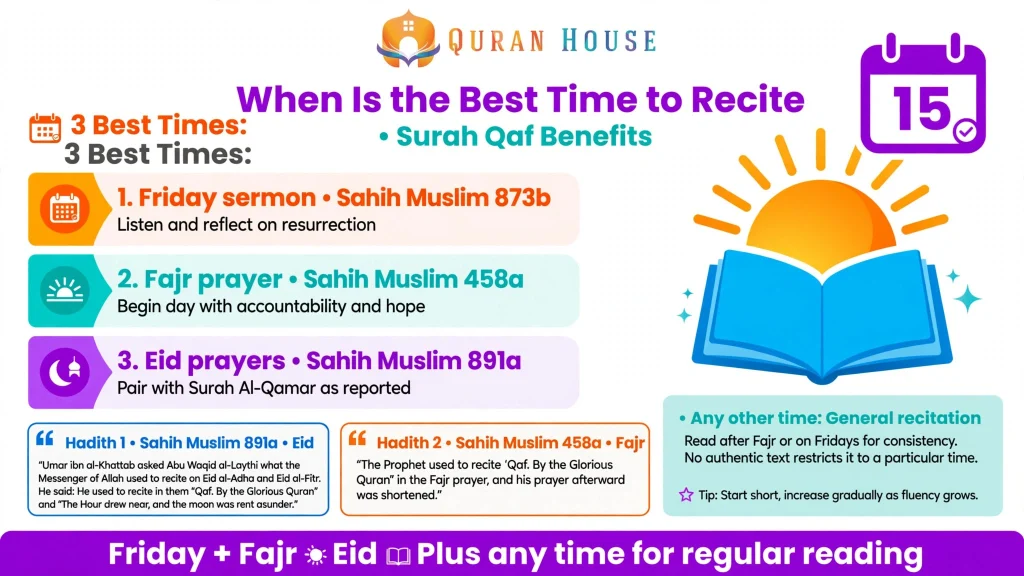
To gain the benefits of Surah Qaf outside these occasions, treat it as a regular reading portion, since no authentic text restricts it to a particular time. The table summarizes each occasion.
| Occasion | Evidence | Practical Note |
| Friday sermon | Sahih Muslim 873b | Listen attentively and reflect on resurrection |
| Fajr prayer | Sahih Muslim 458a | Begin the day with accountability and hope |
| Eid prayers | Sahih Muslim 891a | Pair it with Surah Al-Qamar as reported |
| Any other time | General Quran recitation | Read it after Fajr or on Fridays for consistency |
Weak Claims About Surah Qaf Benefits to Avoid
Some websites attribute healing, an easier death, and extra wealth to Surah Qaf, but those claims are not found in the authentic hadith collections. Clear sourcing protects readers from practices that Islam never taught.
The two sections below separate what is established from what lacks reliable support.
What the Authentic Sources Confirm
Authentic sources confirm the Prophet’s ﷺ recitation of Qaf in Friday sermons, Fajr, and Eid prayers. They also confirm the surah’s own teachings, such as resurrection, accountability, and patience, which come directly from its verses.
What Lacks Reliable Evidence
Rituals attached to Surah Qaf appear in later compilations and folk practice, not in the authentic hadith collections, so they should not be treated as Sunnah. Common examples include the following:
- Writing the surah with saffron and drinking it as a cure.
- Reciting one verse a fixed number of times for eyesight or wishes.
- Hanging the surah on the neck or keeping it in a pocket for protection.
- Promises of an easier death or guaranteed wealth for those who recite it.
The safer path is to recite Surah Qaf for reflection and worship, and to seek medical treatment and lawful means for health and income. Ruqyah from the Quran and Sunnah remains valid, but fixed numbers and rituals need authentic proof.
Quran House offers the Quran Tafseer Course for All Levels so students can separate authentic explanation from weak claims with guidance from qualified tutors.

Start With a Free Tafseer Lesson
How Surah Qaf Compares With Other Resurrection Surahs
Surah Qaf stands out among resurrection surahs by combining rain, recording angels, and the dialogue with Hell in one short chapter. Comparing it with other surahs shows what each one emphasizes:
| Surah | Main Emphasis | Distinctive Image |
| Qaf (50) | Resurrection proved through nature and accountability | Two recording angels and Hell’s reply |
| Al-Waqi’ah (56) | Three groups of people on that Day | The companions of the right, the left, and the foremost |
| Al-Qiyamah (75) | The Day of Resurrection and the self-reproaching soul | Fingertips reassembled by Allah |
| Al-Qari’ah (101) | The striking Hour and the weighing of deeds | People like scattered moths |
Our overview of Surah Al-Qariah and its Day of Judgment imagery explores the weighing of deeds in more detail, which complements the accountability focus of Surah Qaf.
Reading these surahs together gives a fuller picture. Qaf argues from nature, Al-Qiyamah from the human body, Al-Qari’ah from cosmic upheaval, and Al-Waqi’ah from the final grouping of people.
How to Memorize Surah Qaf Step by Step
Memorizing Surah Qaf is manageable because its 45 verses divide into five blocks of nine. A memorized surah also lets a believer enjoy the benefits of Surah Qaf in Fajr without depending on a mushaf.
The plan and revision habits below keep the verses accurate from the first day.
A Five Block Plan for 45 Verses
Assign one block of nine verses to each of five days, then reserve two days for review. Listen to the block three times, recite it with the text, and repeat it from memory until it flows.
| Day | Verses | Task |
| Day 1 | 1 to 9 | Listen, read, and memorize |
| Day 2 | 10 to 18 | Memorize and connect to Day 1 |
| Day 3 | 19 to 27 | Memorize and connect to Day 2 |
| Day 4 | 28 to 36 | Memorize and connect to Day 3 |
| Day 5 | 37 to 45 | Memorize and connect to Day 4 |
| Days 6 and 7 | 1 to 45 | Full review with a teacher |
Revision Habits That Keep Verses Strong
Recite the previous block before starting a new one, and record yourself once a week. Listening back exposes slips in Qaf, Qalqalah, and elongation that are hard to notice while reciting.
Pairing memorization with meaning also helps. Knowing that verse 16 speaks about nearness and verse 18 about recording angels anchors the sequence and makes recall faster.
Quran House offers Quran Memorization for Adults, a program that guides learners through surahs like Qaf with structured review and live tutor correction.

Book Your Free Hifz Trial Lesson
Practical Ways to Apply the Benefits of Surah Qaf
Applying Surah Qaf means turning its verses into small daily habits that fit ordinary schedules. The following practices come directly from the surah’s own teachings:
- Read or listen to Surah Qaf every Friday and reflect on one verse after Jumu’ah.
- Pause before speaking and recall the two angels recording every word.
- Notice rain or green growth and silently remember the revival of dead land.
- Glorify Allah after Fajr and before sunset, following the pattern in verses 39 and 40.
- Keep a short repentance habit each night, remembering that death is certain.
- Study one block of verses weekly with a teacher to learn vocabulary and context.
A simple weekly rhythm helps these habits last: Friday for reflection, Fajr for glorification, and evenings for repentance. Small actions repeated consistently build the awareness that the surah aims to create.
Memorizing Surah Ad-Duha in Class
Memorization is easier with structure. See how a student reviews and recites Surah Ad-Duha in a live lesson, guided by a tutor who follows every step of their progress.
Start Your Quran Journey With Quran House
Learn live and one-on-one with Al-Azhar-trained tutors, male and female, for children and adults, at a time that fits your timezone.
Try a Free SessionLearn Surah Qaf With Quran House Expert Tutors
Quran House has taught Quran, Tajweed, and Arabic online since 2018 to kids and adults through Al-Azhar-trained tutors. Each live lesson focuses on accurate recitation, steady memorization, and clear meaning for surahs like Qaf.
What sets Quran House apart:
- Al-Azhar-trained tutors who correct recitation in real time.
- Live one-on-one sessions for kids, adults, and sisters, with female tutors available for sisters.
- Two free sessions to experience the classroom before committing.
Our Quran Courses
- Quran Tafseer Course for All Levels
- Understand the Quran Course
- Quran Memorization for Adults
- Learn Quran Reading with Tajweed for Beginners
- Quran Reading Fluency Course
- Online Quran Classes for Sisters and Women
Conclusion
Surah Qaf offers a rare mix of proof, warning, and comfort within only 45 verses. Its rain, recording angels, and scenes of judgment give believers practical tools for faith, speech, and preparation for the Hereafter.
The benefits of Surah Qaf become real when verses turn into habits: Friday reflection, Fajr glorification, careful speech, and regular study. Authentic reports show that the Prophet ﷺ placed these practices at the center of public worship.
Reliable Surah Qaf benefits rest on the Quran and the authentic Sunnah, so avoid unverified promises. Seek qualified teachers when learning to recite or memorize, and the surah’s message will stay accurate and its impact lasting.
FAQs
What Is Surah Qaf Mainly About?
The main theme of Surah Qaf is resurrection and accountability. It argues for the Hereafter through rain and creation, warns about earlier nations that denied their messengers, describes recording angels and judgment, and ends with patience and glorification of Allah.
Is Surah Qaf Makki or Madani?
Surah Qaf is Makki, meaning it was revealed before the Prophet’s ﷺ migration to Madinah. It has 45 verses and sits in Juz 26, though no authentic report fixes its exact year of revelation.
Did the Prophet Recite Surah Qaf in Prayer and Sermons?
Yes, authentic reports mention Qaf in the Fajr prayer, in both Eid prayers, and in Friday sermons from the minbar. These reports appear in Sahih Muslim, numbers 458, 891, and 873.
Is It Authentic That Surah Qaf Cures Illness?
No authentic hadith establishes that reciting Surah Qaf cures epilepsy or eye problems. Reliable Surah Qaf benefits are spiritual and educational: certainty in resurrection, mindful speech, patience, and following the Prophet’s ﷺ practice.
How Long Does It Take to Memorize Surah Qaf?
A focused learner can memorize Surah Qaf in about one week using five blocks of nine verses, followed by two review days. Pace varies, so slow down whenever accuracy begins to suffer.