| Key Takeaways |
| Surah Al-Waqiah is the 56th chapter of the Quran, contains 96 verses, and divides humanity into three groups on the Day of Judgment. |
| The narration promising freedom from poverty for nightly recitation is graded weak by many hadith scholars, so the surah’s own verses on provision remain the strongest evidence. |
| Verses 63 to 72 ask believers to consider the seed, the water, and the fire, which builds gratitude and trust in Allah’s provision. |
| Reciting slowly with Tajweed for a few minutes each night matters more than reciting quickly and rarely. |
Surah Al Waqiah lessons and benefit reach far beyond the well-known promise of protection from poverty. This chapter shapes belief in the Day of Judgment, builds trust in Allah’s provision, and gives believers a clear picture of what awaits every soul.
Surah Al-Waqiah is the 56th chapter of the Quran, found in Juz 27, with 96 verses revealed in Makkah. Its name means the Inevitable Event, a title for the Day of Judgment.
This guide to surah waqiah benefits draws on Quranic verses, a verified hadith, and careful scholarly context. The lessons follow one by one, each with its evidence.
1. Build Firm Belief in the Day of Judgment
Surah Al-Waqiah opens with the certainty of the Day of Judgment, and it leaves no room for doubt about what is coming. Allah describes the event as undeniable once it arrives.
The first two verses set the tone for the whole chapter, naming the Hour as an event that no one will be able to deny when it comes.
إِذَا وَقَعَتِ الْوَاقِعَةُ • لَيْسَ لِوَقْعَتِهَا كَاذِبَةٌ
(Idha waqa’at il-waqi’ah. Laysa liwaq’atiha kadhibah)
(“When the Inevitable Event takes place, then no one can deny it has come.”)
Belief in the Hereafter is one of the six pillars of faith, and this surah renews it with unusual force. Regular reading keeps the believer aware that every deed will meet a day of reckoning.
The surah then paints the moment itself, describing a shaking of the earth that no mountain can resist.
إِذَا رُجَّتِ الْأَرْضُ رَجًّا • وَبُسَّتِ الْجِبَالُ بَسًّا • فَكَانَتْ هَبَاءً مُّنبَثًّا
(Idha rujjatil-ardu rajja. Wa bussatil-jibalu bassa. Fakanat haba’an munbatta)
(“When the earth will be violently shaken, and the mountains will be crushed to pieces, becoming scattered particles of dust.”)
Such imagery makes the abstract idea of resurrection concrete. A believer who recites these verses at night goes to sleep remembering that this world is temporary and that preparation matters.
Reading the translation alongside the Arabic helps the imagery land. Learners who cannot yet read Arabic fluently can follow the meaning first, then build recitation skill step by step.
2. Learn Allah’s Justice Through Three Groups of People
Surah Al-Waqiah teaches divine justice by dividing every person into one of three groups on the Day of Judgment. Nobody is judged by wealth, lineage, or status, only by faith and deeds.
Allah announces the division in a short, rhythmic passage that is easy to memorize and worth reflecting on slowly during nightly recitation, verse by verse.
وَكُنتُمْ أَزْوَاجًا ثَلَاثَةً • فَأَصْحَابُ الْمَيْمَنَةِ مَا أَصْحَابُ الْمَيْمَنَةِ • وَأَصْحَابُ الْمَشْأَمَةِ مَا أَصْحَابُ الْمَشْأَمَةِ • وَالسَّابِقُونَ السَّابِقُونَ
(Wa kuntum azwajan thalathah. Fa-ashabul-maymanati ma ashabul-maymanah. Wa-ashabul-mash’amati ma ashabul-mash’amah. Was-sabiqunas-sabiqun)
(“You will all be divided into three groups: the people of the right, how blessed will they be; the people of the left, how miserable will they be; and the foremost in faith will be the foremost in Paradise.”)
The table below summarizes the three groups, their Arabic names, and the verses where the surah describes the reward or punishment of each one.
| Group | Arabic Name | Description | Verses |
| The foremost | As-Sabiqoon | Believers who raced toward good deeds and are nearest to Allah. | 56:10-26 |
| People of the right | Ashab al-Yameen | Righteous believers honored with gardens, shade, and flowing water. | 56:27-40 |
| People of the left | Ashab al-Shimal | Those who rejected the truth and persisted in sin, facing scorching wind and boiling water. | 56:41-56 |
This classification mirrors a lesson found across the Quran: faith and action together decide a person’s destiny. Understanding these categories is easier with structured explanation, especially for students who read translations alone.
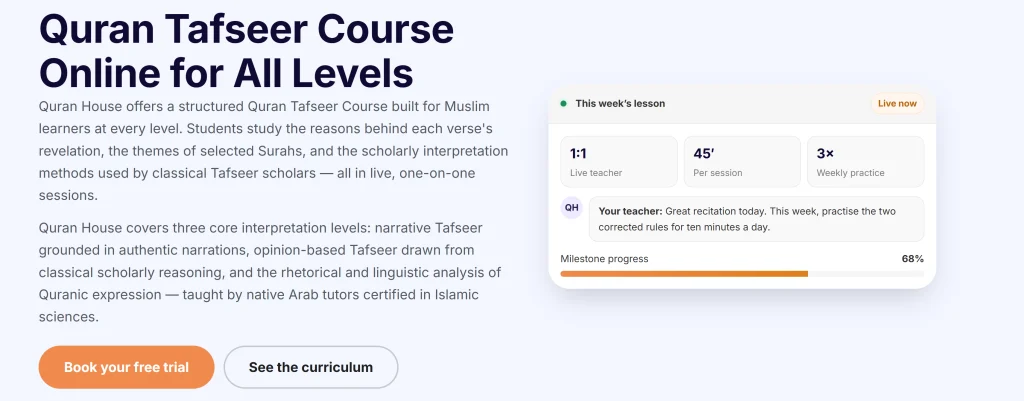
Quran House offers a Quran Tafseer Course for All Levels that explains verses like these step by step with Al-Azhar-trained tutors in live one-on-one sessions.
Book Your Free Trial Tafseer Lesson
3. Surah Waqiah Benefits for Daily Provision
Trust in Allah’s provision is the most practical of the surah’s lessons, and it comes from the chapter’s own words rather than from any single narration. Verses 63 to 74 ask direct questions about daily sustenance.
The first question concerns the crops that feed every household, a reminder that growth belongs to Allah even though planting is human work and worth doing carefully.
أَفَرَأَيْتُم مَّا تَحْرُثُونَ • أَأَنتُمْ تَزْرَعُونَهُ أَمْ نَحْنُ الزَّارِعُونَ
(Afara’aytum ma tahruthun. A-antum tazra’unahu am nahnuz-zari’un)
(“Have you considered the seeds you sow? Is it you who make them grow, or are We the Grower?”)
Seeds, rain, and fire in the surah stand for food, water, and warmth, the basics of survival. By asking who truly produces them, Allah shifts attention from human effort alone to divine gift.
Islam still values effort and planning. The point is that anxiety about provision eases when a person recognizes that results come from Allah while diligence remains a duty.
This focus on reliance is the part of the surah most useful to believers under financial pressure, because nightly recitation pairs honest work with trust in Allah. Many readers find the pairing reduces worry without reducing responsibility.
4. Seek Protection from Poverty Through Nightly Recitation
A well-known narration promises that whoever recites Surah Al-Waqiah every night will not be afflicted by poverty, but many hadith scholars grade it weak.
It is attributed to Abdullah ibn Mas’ud (may Allah be pleased with him) and appears in al-Bayhaqi’s Shu’ab al-Iman and in Ibn Asakir’s work. Its chain is disputed, so no hadith text is quoted here.
A report also says Ibn Mas’ud told his daughters to recite the surah every night, which some scholars cite as supporting evidence for the practice.
Many scholars allow acting on weak narrations about virtuous deeds when the deed itself is already established, as reciting Quran at night certainly is. Others prefer to rely only on authentic reports, and both views deserve respect.
The safest approach is to recite for the sake of Allah and for the meaning, not as a guaranteed financial formula. Seeking halal work, giving charity, and making dua remain essential companions to recitation.
5. Strengthen Closeness to Allah Among the Foremost
The foremost in faith, called As-Sabiqoon, are the nearest to Allah, and the surah presents their rank as the highest goal a believer can aim for.
Allah describes their position right after announcing the three groups, and the wording is brief yet powerful for any believer who hopes to draw near.
وَالسَّابِقُونَ السَّابِقُونَ • أُولَٰئِكَ الْمُقَرَّبُونَ • فِي جَنَّاتِ النَّعِيمِ
(Was-sabiqunas-sabiqun. Ula’ikal-muqarrabun. Fi jannatin-na’im)
(“And the foremost in faith will be the foremost in Paradise. They are the ones nearest to Allah, in the Gardens of Bliss.”)
Being among the foremost is not reserved for scholars or the wealthy. It is earned by racing toward good deeds, praying on time, and keeping a daily connection with the Quran.
Among all surah al waqiah lessons and benefits, this aspiration may be the most motivating, because it turns recitation from routine into a daily step toward Allah.
Memorizing and reviewing the Quran is one of the clearest ways to build that closeness. Students who commit a few verses each week develop a relationship with the text that casual reading rarely creates.
Quran House offers a Quran Memorization for Adults program that gives adult learners a patient, structured path to memorize and review verses with live guidance.

Start Your Free Hifz Trial Lesson
6. Reflect on Paradise to Renew Spiritual Motivation
The surah’s detailed descriptions of Paradise renew motivation by turning an abstract reward into a vivid, concrete picture. This is a central part of the surah waqiah benefits for learners.
Fruit, shade, and flowing water appear throughout the description of the people of the right, and two short verses capture the sense of abundance and freedom.
وَفَاكِهَةٍ كَثِيرَةٍ • لَّا مَقْطُوعَةٍ وَلَا مَمْنُوعَةٍ
(Wa fakihatin kathirah. La maqtu’atin wa la mamnu’ah)
(“Abundant fruit, never out of season nor forbidden.”)
Beyond physical comfort, Paradise is described as a place of peace, where harmful speech is absent and only greetings of peace are heard by those who enter.
لَا يَسْمَعُونَ فِيهَا لَغْوًا وَلَا تَأْثِيمًا • إِلَّا قِيلًا سَلَامًا سَلَامًا
(La yasma’una fiha laghwan wa la ta’thima. Illa qilan salaman salama)
(“There they will never hear any idle or sinful talk, only good and virtuous speech.”)
Reflecting on such scenes helps during weeks when worship feels heavy. A short recitation with a focused mind often restores the sense that the effort is worth it.
See Us in Action!
Curious about what our online classrooms look like? Watch the short clips below to see how our interactive, one-on-one sessions bring learning to life with real-time feedback and engaging teaching methods.
A Real Surah Lesson: Surah Ash-Shams
Watch a student work through Surah Ash-Shams step by step with their tutor, practicing each ayah until the recitation flows clearly and correctly.
Start Your Quran Journey With Quran House
Learn live and one-on-one with Al-Azhar-trained tutors, male and female, for children and adults, at a time that fits your timezone.
Try a Free Session7. Take Heed from the Fate of the People of the Left
The surah balances hope with warning by describing the fate of those who rejected the truth, showing scorching wind, boiling water, and black smoke.
The warning is delivered in plain language, right after the description of Paradise, so readers feel the weight of both outcomes in a single sitting.
فِي سَمُومٍ وَحَمِيمٍ • وَظِلٍّ مِّن يَحْمُومٍ • لَّا بَارِدٍ وَلَا كَرِيمٍ
(Fi samumin wa hamim. Wa zillin min yahmum. La baridin wa la karim)
(“In scorching heat and boiling water, in the shade of black smoke, neither cool nor refreshing.”)
The next verses explain the cause, describing a life of heedless luxury and persistence in major sin. The warning is aimed at attitudes, not at ordinary human weakness.
Healthy fear of Allah’s reckoning is meant to push a believer toward repentance, not despair. The door of tawbah remains open for every sincere person during this life.
For a verse-by-verse explanation of these passages, read our tafseer of Surah Al-Waqiah, which covers the vocabulary and context in more detail.
8. Rise in Rank Through Recitation with Tartil
Reciting with tartil, meaning slow and measured recitation with correct pronunciation, raises a reader’s rank in the Hereafter according to an authentic hadith recorded by Abu Dawud.
The Prophet (ﷺ) described the reward of a devoted reciter in these words, which apply to every chapter of the Quran, including Surah Al-Waqiah and its long, flowing verses.
يُقَالُ لِصَاحِبِ الْقُرْآنِ اقْرَأْ وَارْتَقِ وَرَتِّلْ كَمَا كُنْتَ تُرَتِّلُ فِي الدُّنْيَا فَإِنَّ مَنْزِلَكَ عِنْدَ آخِرِ آيَةٍ تَقْرَؤُهَا
(Yuqalu li-sahibil-Qur’ani: iqra’ wartaqi wa rattil kama kunta turattilu fid-dunya, fa-inna manzilaka ‘inda akhiri ayatin taqra’uha)
(“One who was devoted to the Qur’an will be told to recite, ascend and recite carefully as he recited carefully when he was in the world, for he will reach his abode when he comes to the last verse he recites.”)
Al-Albani graded this hadith hasan sahih. Its message is clear: the pace, care, and sincerity of recitation in this world shape a believer’s standing in the next.
Surah Al-Waqiah is an ideal chapter for practicing tartil, since its long, rhythmic verses reward a calm pace. Tajweed rules such as Madd and Ghunnah appear often and can be refined with a teacher.
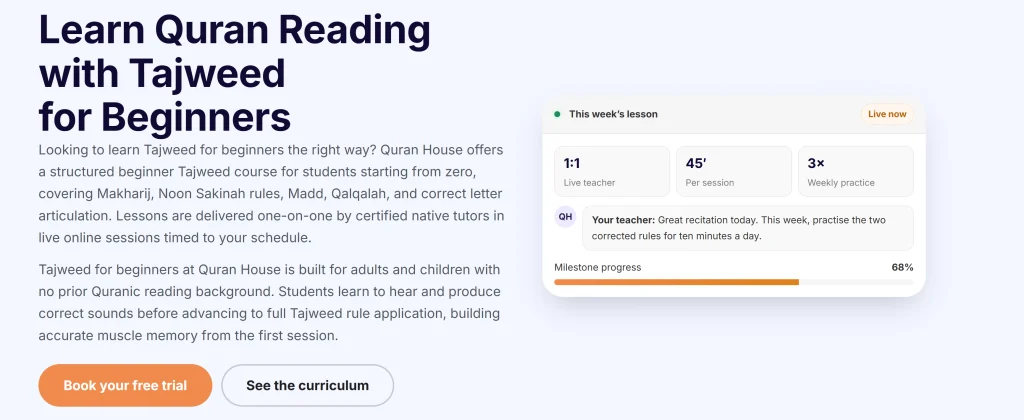
Quran House offers Learn Quran Reading with Tajweed for Beginners, a course where tutors correct pronunciation in real time as students build toward long chapters.
Book a Free Tajweed Trial Lesson
9. Cultivate Gratitude for Everyday Blessings
The surah cultivates gratitude by asking believers to look closely at water, a blessing used every day and rarely noticed until it becomes scarce.
Allah reminds readers that the rain falling from the clouds is entirely His gift and that He could have made it undrinkable, then asks why gratitude is so rare.
أَفَرَأَيْتُمُ الْمَاءَ الَّذِي تَشْرَبُونَ • أَأَنتُمْ أَنزَلْتُمُوهُ مِنَ الْمُزْنِ أَمْ نَحْنُ الْمُنزِلُونَ • لَوْ نَشَاءُ جَعَلْنَاهُ أُجَاجًا فَلَوْلَا تَشْكُرُونَ
(Afara’aytumul-ma’al-ladhi tashrabun. A-antum anzaltumuhu minal-muzni am nahnul-munzilun. Law nasha’u ja’alnahu ujajan falawla tashkurun)
(“Have you considered the water you drink? Is it you who send it down from the clouds, or are We the Sender? If We willed, We could make it salty. Why then are you not grateful?”)
A grateful heart notices small provisions, such as a meal, a safe home, and the ability to recite. Reciting these verses at night is a gentle prompt to thank Allah before sleeping.
Of all the surah al waqiah lessons and benefits, gratitude is among the easiest to feel, since it needs no special ritual beyond reflection and a sincere thanks to Allah.
Parents can use the verses to teach children that water, food, and shelter are gifts, not entitlements. A simple dua of thanks after meals builds the same lesson into family life.
10. Hold the Quran with Reverence and Care
Surah Al-Waqiah describes the Quran as a noble book that only the purified may touch, and scholars have drawn lessons about reverence from that statement.
The passage appears near the end of the surah and affirms the Quran’s honor and protection, inviting readers to approach recitation with humility.
إِنَّهُ لَقُرْآنٌ كَرِيمٌ • فِي كِتَابٍ مَّكْنُونٍ • لَّا يَمَسُّهُ إِلَّا الْمُطَهَّرُونَ
(Innahu laqur’anun karim. Fi kitabin maknun. La yamassuhu illal-mutahharun)
(“This is truly a noble Quran, in a Book well-guarded, which none can touch except the purified.”)
Scholars differ on the exact meaning of the purified. Some understand it as the angels who carry the preserved book, while others also derive etiquette for people handling a physical copy.
Many jurists therefore require wudu before touching a printed mushaf, while reciting from memory does not require it. Opinions on touching a phone screen vary, so students should ask a trusted scholar.
Beyond rulings, the verse builds an attitude: treat the Quran as the most honored text in the home, keep it in a clean place, and approach recitation with attention rather than haste.
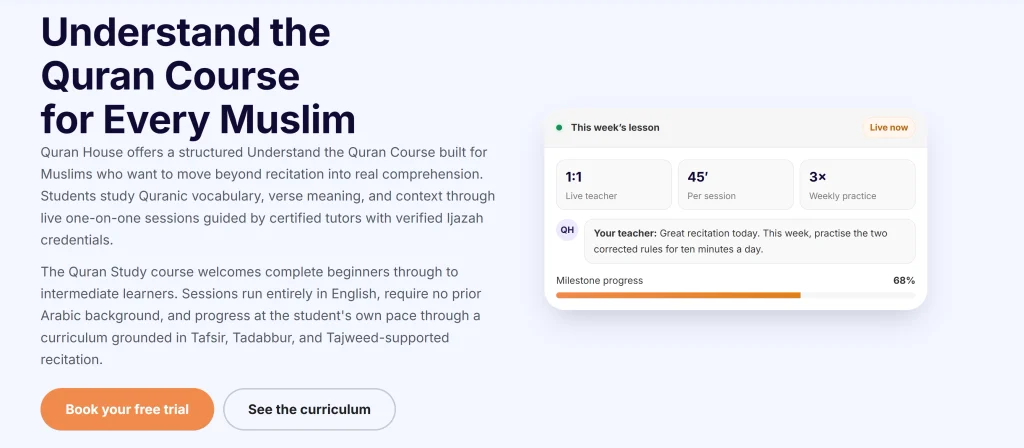
Quran House offers an Understand the Quran Course that helps students move from reciting words to grasping their meaning with a live tutor.
Start Your Free Quran Meaning Lesson
11. End Every Recitation with Glorification of Allah
The final verse of Surah Al-Waqiah commands glorification, so each full recitation closes with an act of tasbih directed at Allah, which gives the reading a clear and humble ending.
فَسَبِّحْ بِاسْمِ رَبِّكَ الْعَظِيمِ
(Fasabbih bismi rabbikal-‘azim)
(“So glorify the name of your Lord, the Greatest.”)
Saying Subhana Rabbiyal Azeem repeats the same theme in the posture of ruku, so the closing verse connects easily to daily prayer and builds familiarity with the phrase.
Readers who want to continue their study can also explore our guide to the benefits of Ayatul Kursi, another powerful passage for evening and nightly routines.
Ending with tasbih also gives the surah a personal lesson. Everything described before it, from resurrection to provision, points back to Allah’s greatness, and the believer responds with praise.
How to Build a Nightly Surah Waqiah Habit
A nightly habit takes only a few minutes for most readers, and the practice stays sustainable when it is simple and sincere. These six steps work for beginners and experienced readers alike.
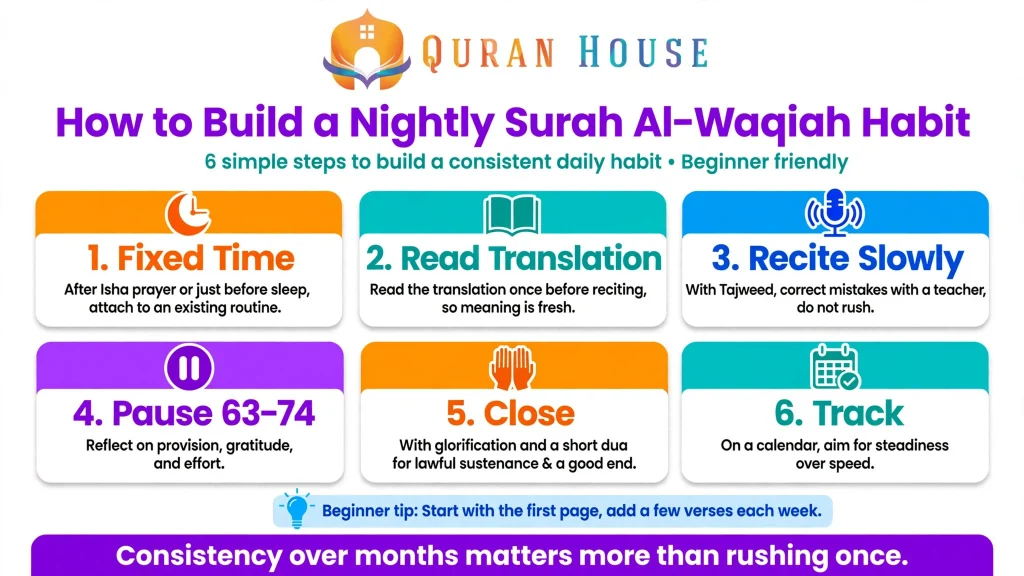
- Choose a fixed time, such as after Isha prayer or just before sleep, so the habit attaches to an existing routine.
- Read the translation once before reciting, so the meaning is fresh in the mind.
- Recite slowly with Tajweed, correcting mistakes with a teacher rather than rushing to finish.
- Pause on verses 63 to 74 and reflect on provision, gratitude, and effort.
- Close with glorification and a short dua for lawful sustenance and a good end.
- Track the habit on a calendar, aiming for steadiness over speed.
For learners still building fluency, begin with the first page and add a few verses each week. Consistency over months matters far more than reciting the whole surah once in a rush.
Inside Our Virtual Classrooms
We believe in full transparency and proven quality. Take a look at these actual snippets from our live classes to experience our modern learning platform, patient instructors, and interactive student participation.
Memorizing Surah Ad-Duha in Class
Memorization is easier with structure. See how a student reviews and recites Surah Ad-Duha in a live lesson, guided by a tutor who follows every step of their progress.
Start Your Quran Journey With Quran House
Learn live and one-on-one with Al-Azhar-trained tutors, male and female, for children and adults, at a time that fits your timezone.
Try a Free SessionStart Learning Surah Waqiah with Quran House Instructors
Quran House has taught online Quran, Tajweed, and Arabic classes for kids and adults since 2018, with Al-Azhar-trained tutors who correct recitation live. Sessions are one-on-one, so every learner moves at a comfortable pace.
What sets Quran House apart:
- Live one-on-one sessions with real-time correction.
- Al-Azhar-trained tutors for kids, adults, and sisters.
- Female tutors available for sisters who prefer a private learning space.
- Courses covering reading, Tajweed, Hifz, Arabic, and Tafseer.
Our Quran Courses
- Learn Quran Reading with Tajweed for Beginners.
- Quran Memorization for Adults.
- Quran Tafseer Course for All Levels.
- Understand the Quran Course.
- Quran Reading Fluency Course.
- Quran Reading for Adults.
Conclusion
Surah Al Waqiah lessons and benefits are spiritual first and practical second. The chapter strengthens belief in the Day of Judgment, teaches divine justice, and invites believers to trust Allah for provision while continuing to work honestly.
The surah waqiah benefits covered here also include gratitude, reverence for the Quran, and glorification of Allah. The narration about poverty is disputed, so the surah’s verses remain the surest source of guidance.
Choose a calm time tonight, read the translation, and recite with care. Small, steady practice with understanding will teach more than any shortcut, and a qualified tutor can help refine every verse.
FAQs
These answers cover the questions readers ask most often about this chapter.
Is the Hadith About Surah Waqiah and Poverty Authentic?
Many hadith scholars grade the narration weak, though some scholars permit acting on weak reports about virtuous deeds. Recite the surah for its meaning, and treat any financial benefit as a hope placed in Allah, not a guarantee.
What Are the Main Lessons of Surah Al-Waqiah?
The main lessons are certainty about the Day of Judgment, divine justice among three groups, trust in Allah’s provision, gratitude for daily blessings, and reverence for the Quran. Each lesson is drawn directly from the verses.
How Many Verses Does Surah Waqiah Have?
Surah Al-Waqiah has 96 verses. It is the 56th chapter of the Quran, located in Juz 27, and it was revealed in Makkah. Its Arabic name means the Inevitable Event.
When Is the Best Time to Recite Surah Waqiah?
Many Muslims recite it at night, after Isha prayer or before sleep, because the well-known narration mentions nightly recitation. No fixed time is obligatory, so choose a calm moment you can keep every day.
Can I Read Surah Waqiah on My Phone Without Wudu?
Many scholars permit reading from a phone screen in a state of minor impurity, since a device is not a printed mushaf. Views differ, so confirm your school’s position with a trusted scholar.