
| Key Takeaways |
| Surah Abasa is the 80th chapter of the Quran, a Meccan surah of 42 verses that teaches equal respect for every sincere seeker of guidance. |
| Its opening verses gently correct the Prophet ﷺ over a blind companion, showing that sincerity outweighs wealth, rank, and influence. |
| The surah links humility to human origins, Allah’s provision of food, and the Day when every person will be concerned only with himself. |
| The authentic virtue is clear: the Prophet ﷺ recited it in prayer, while claims about wealth, travel protection, or amulets lack reliable support. |
The benefits of Surah Abasa reach far beyond a single story. This short Meccan chapter shapes how a believer treats people, receives correction, and prepares for the Day of Judgment, which is why it deserves careful study.
Many readers search for Surah Abasa benefits hoping for quick spiritual rewards. The sound benefits are moral and spiritual lessons drawn from the Quran itself, from the reason the surah was revealed, and from authentic teachings of the Prophet ﷺ.
Each lesson comes with the relevant verses, historical context, and practical steps you can apply in daily life, whether at home, at work, or in the mosque. The eight benefits are as follows.
1. Learn to Honor Every Sincere Seeker of Guidance
Surah Abasa teaches believers to honor every person who comes sincerely seeking guidance, whatever their appearance or status. The surah opens with a gentle correction of the Prophet ﷺ when a blind companion, Abdullah ibn Umm Maktum, approached him during a meeting.
Rather than naming the companion or blaming the Prophet ﷺ directly, Allah describes the event in the third person. This protects dignity on every side, as the opening verses show.
عَبَسَ وَتَوَلَّىٰٓ • أَن جَآءَهُ ٱلْأَعْمَىٰ
(‘Abasa wa tawalla. An ja’ahul-a’ma)
(“He frowned and turned away because there came to him the blind man.”)
Scholars mention that the Prophet ﷺ honored Ibn Umm Maktum whenever he saw him afterward. In daily life, this lesson means giving full attention to the student, the newcomer, or the elderly relative who asks a sincere question.
2. Value Sincerity Above Social Status and Wealth
Surah Abasa places sincerity above rank and wealth, and the next verses give the reason. Allah reminds the Prophet ﷺ that the blind man may have been seeking purification, something no outward status can measure.
Only Allah knows who is closest to Him, so human judgment based on rank or appearance is unreliable. The following verses state this principle directly.
وَمَا يُدْرِيكَ لَعَلَّهُۥ يَزَّكَّىٰٓ • أَوْ يَذَّكَّرُ فَتَنفَعَهُ ٱلذِّكْرَىٰٓ
(Wa ma yudrika la’allahu yazzakka. Aw yadhdhakkaru fatanfa’ahudh-dhikra)
(“But what would make you perceive that perhaps he might be purified, or be reminded and the remembrance would benefit him?”)
This is one of the clearest Surah Abasa benefits for daily life. A believer learns to assume that every sincere questioner may be closer to Allah than a confident, well-dressed critic, and to give time accordingly.
Teachers, parents, and community leaders can apply this immediately by answering a genuine question patiently before returning to conversations that seem more prestigious or urgent.
Quran House offers a Quran Tafseer Course for All Levels that helps students study the reasons behind revelation and the moral lessons of surahs like this one.
3. Guard Your Heart Against Arrogance and Pride
Surah Abasa warns against arrogance, the feeling of needing no guidance from anyone, including Allah. The verses contrast a humble seeker with a person who considers himself self-sufficient and therefore ignores the message.
The Prophet ﷺ was not blamed for the refusal of such a person, since his duty was only to convey. This teaches balance: invite everyone, but never chase approval from those who dismiss the truth. Allah states the contrast plainly.
أَمَّا مَنِ ٱسْتَغْنَىٰ • فَأَنتَ لَهُۥ تَصَدَّىٰ • وَمَا عَلَيْكَ أَلَّا يَزَّكَّىٰ
(Amma manis-taghna. Fa-anta lahu tasadda. Wa ma ‘alayka alla yazzakka)
(“As for he who thinks himself self-sufficient, to him you give attention. And not upon you is any blame if he will not be purified.”)
Pride rarely announces itself. It appears as impatience with beginners, contempt for simple questions, or reluctance to admit a mistake. Reflecting on these verses regularly serves as a personal check against all three habits.
The surah then describes the Quran itself as a reminder open to anyone who wishes to benefit.
كَلَّآ إِنَّهَا تَذْكِرَةٌ • فَمَن شَآءَ ذَكَرَهُۥ
(Kalla innaha tadhkirah. Faman sha’a dhakarah)
(“No! Indeed, it is a reminder. So whoever wills may remember it.”)
Guidance is offered openly, and each person remains responsible for accepting or refusing it. That fact keeps teachers patient and students accountable.
4. Accept Correction With Humility and Grow Through It
Accepting correction with humility is one of the surah’s most practical lessons. The Prophet ﷺ, the best of creation, received a divine reminder here, and reports say he honored Ibn Umm Maktum warmly afterward.
No ordinary leader records criticism of himself in his own message. Many scholars see the opening verses as a sign that the Quran is revelation and not the Prophet’s own composition, since it exposes even his momentary choice.
For believers, this changes how feedback is received. A sincere correction from a teacher, parent, or colleague is a chance to improve, not an attack on one’s worth. Growth begins when pride steps aside.
A simple habit helps: when someone corrects your recitation or behavior, thank them first, then review what they said later in private. Over time, this response turns correction into character.
See Us in Action!
Curious about what our online classrooms look like? Watch this short clip below to see how our interactive, one-on-one sessions bring learning to life with real-time feedback and engaging teaching methods.
Start Your Quran Journey With Quran House
Learn live and one-on-one with Al-Azhar-trained tutors, male and female, for children and adults, at a time that fits your timezone.
Try a Free Session5. Reflect on Human Origins to Build Humility
Surah Abasa asks every person to remember where he came from, because reflecting on origins builds humility. The surah questions human pride by pointing to a humble beginning that Allah shaped with care and purpose.
The question is short, and the answer is humbling. A person who remembers he began as a drop, and was measured and shaped by Allah, finds little room for boasting.
مِنْ أَىِّ شَىْءٍ خَلَقَهُۥ • مِن نُّطْفَةٍ خَلَقَهُۥ فَقَدَّرَهُۥ
(Min ayyi shay’in khalaqah. Min nutfatin khalaqahu faqaddarah)
(“From what thing did He create him? From a sperm-drop He created him and destined for him.”)
Every stage of life follows a measure set by Allah, and the surah says so with the word qaddarahu, meaning He determined it. This removes the illusion of self-made greatness.
Regular reading turns this reflection into habit. Our guide to the benefits of reading the Quran explains how consistent recitation shapes the heart, and it pairs naturally with the lesson of this surah.
6. Notice Allah’s Blessings in Daily Food and Provision
Surah Abasa directs attention to ordinary food as proof of Allah’s care and as a reason for gratitude. The verses trace a meal back to rain, soil, and growth, none of which humans control.
This passage turns a daily routine into an act of reflection. Looking at bread, fruit, or vegetables with this awareness replaces entitlement with thankfulness. Allah invites the reader to look at his own food.
فَلْيَنظُرِ ٱلْإِنسَـٰنُ إِلَىٰ طَعَامِهِۦٓ • أَنَّا صَبَبْنَا ٱلْمَآءَ صَبًّا • ثُمَّ شَقَقْنَا ٱلْأَرْضَ شَقًّا • فَأَنۢبَتْنَا فِيهَا حَبًّا
(Falyanzuril-insanu ila ta’amih. Anna sababnal-ma’a sabba. Thumma shaqaqnal-arda shaqqa. Fa-anbatna fiha habba)
(“Then let mankind look at his food: how We poured down water in torrents, then We broke open the earth, splitting it, and caused to grow within it grain.”)
The sequence is precise: water descends, the earth splits open, and grain emerges. Farmers, cooks, and consumers all depend on steps that begin long before the meal reaches the table.
Practical gratitude follows naturally. Say bismillah before eating, avoid wasting food, and share a portion with someone in need. These small acts express the lesson the verses teach.
Quran House offers an Understand the Quran Course that connects verses like these to their meaning, so students recite with awareness instead of repeating words they cannot follow.
7. Take Personal Responsibility for the Day of Judgment
Surah Abasa teaches personal responsibility by describing a Day when every person is concerned only with himself. The verses name the closest bonds, brother, parents, spouse, and children, and show even those bonds giving way to individual accountability.
The scene is not meant to frighten without purpose. It corrects the habit of relying on family reputation, social connections, or the good deeds of others as a substitute for one’s own preparation. The surah paints it directly.
يَوْمَ يَفِرُّ ٱلْمَرْءُ مِنْ أَخِيهِ • وَأُمِّهِۦ وَأَبِيهِ • وَصَـٰحِبَتِهِۦ وَبَنِيهِ • لِكُلِّ ٱمْرِئٍۢ مِّنْهُمْ يَوْمَئِذٍۢ شَأْنٌۭ يُغْنِيهِ
(Yawma yafirrul-mar’u min akhih. Wa ummihi wa abih. Wa sahibatihi wa banih. Likullim-ri’im minhum yawma’idhin sha’nun yughnih)
(“On the Day a man will flee from his brother, and his mother and his father, and his wife and his children. For every person that Day will be a matter adequate for him.”)
Remembering this Day reshapes priorities now. Prayer, honesty, and kindness are personal deposits that no one else can make on your behalf, which is why small daily deeds matter.
A simple habit helps: end each day by asking which good action was completed and which mistake needs repair. This brief review keeps accountability present without anxiety.
8. Strive for a Bright Face on the Day of Judgment
Surah Abasa ends by describing two groups of faces, and this ending motivates believers to live so that their final scene is bright. Some faces will be radiant and joyful, while others will be covered with dust and darkness.
The closing image is both a warning and a promise. It tells the reader that choices made now decide which group they join, and that sincere effort is never wasted. Allah describes the two outcomes briefly.
وُجُوهٌۭ يَوْمَئِذٍۢ مُّسْفِرَةٌۭ • ضَاحِكَةٌۭ مُّسْتَبْشِرَةٌۭ • وَوُجُوهٌۭ يَوْمَئِذٍ عَلَيْهَا غَبَرَةٌۭ • تَرْهَقُهَا قَتَرَةٌ
(Wujuhun yawma’idhin musfirah. Dahikatun mustabshirah. Wa wujuhun yawma’idhin ‘alayha ghabarah. Tarhaquha qatarah)
(“Some faces, that Day, will be bright, laughing, rejoicing. And other faces, that Day, will have dust upon them. Darkness will cover them.”)
Hope and fear work together here. Fear keeps a believer from neglect, while hope keeps him consistent in prayer, charity, and recitation. Scholars often describe this balance as the ideal posture of faith.
Reciting these final verses slowly, with attention to their meaning, is a practical way to renew your intention before prayer and to remember why daily effort matters.
How Surah Abasa Benefits Apply Today
Surah Abasa applies wherever people are judged by status instead of sincerity, including schools, workplaces, mosques, and family gatherings. Its lessons translate into five practical habits for everyday life.
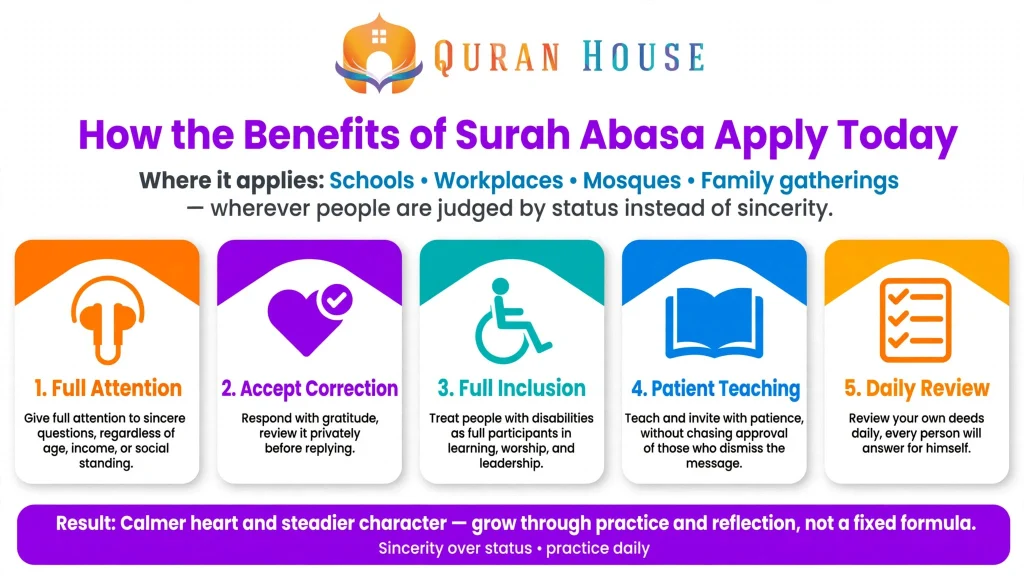
- Give full attention to sincere questions, regardless of the asker’s age, income, or social standing.
- Respond to correction with gratitude and review it privately before replying.
- Treat people with disabilities as full participants in learning, worship, and leadership.
- Teach and invite with patience, without chasing the approval of those who dismiss the message.
- Review your own deeds daily, remembering that every person will answer for himself.
Many Surah Abasa benefits that readers describe, such as a calmer heart and steadier character, follow naturally from these habits. They grow through practice and reflection, not through a fixed formula.
Surah Abasa Story and Reason for Revelation
Surah Abasa is chapter 80 of the Quran, a Meccan surah of 42 verses named after its opening word, which means He frowned. Its reason for revelation, reported by Aishah in Jami at-Tirmidhi 3331, centers on a blind companion.
The account has two parts, the incident itself and the divine response that followed, and each part carries its own lesson for readers and teachers.
The Incident of the Blind Companion
Abdullah ibn Umm Maktum, a blind man, came to the Prophet ﷺ asking for guidance while the Prophet was speaking with prominent leaders of Quraysh. According to Aishah, he asked to be guided, and the Prophet turned toward the others.
The Prophet’s aim was to reach influential people whose acceptance might have helped the early Muslims. The surah corrects the method, not the sincerity, by reminding him that the seeker in front of him deserved priority.
Divine Response and Lasting Lesson
Allah revealed the opening verses as a gentle correction. The Prophet ﷺ then honored Ibn Umm Maktum, and well-known reports mention that he later served as a caller to prayer in Madinah alongside Bilal.
Many scholars note that the surah does not name the blind man, which keeps the focus on the principle of equal respect rather than on blame.
Authentic Virtues of Surah Abasa and Weak Claims
The authentic virtues of Surah Abasa are limited but clear, and honest study separates them from popular claims that lack reliable support.
It belongs to the Mufassal group of surahs, and the Prophet ﷺ recited it in prayer. Ibn Mas’ud reported that the Prophet ﷺ paired Abasa with Al-Mutaffifin in a single rak’ah, recorded in Sahih Muslim 822 and Sunan Abu Dawud 1396.
Another authentic principle applies to every reciter. The Prophet ﷺ said that the skilled reciter will be with the noble and obedient angels, and that the one who struggles to recite earns a double reward, as recorded in Sahih Bukhari 4937 and Sahih Muslim 798. The surah itself describes these angels.
بِأَيْدِى سَفَرَةٍۢ • كِرَامٍۭ بَرَرَةٍۢ
(Bi-aydi safarah. Kiramin bararah)
(“By the hands of messengers, noble and dutiful.”)
Popular claims that Surah Abasa increases wealth, protects travelers, or works as a written amulet rely on narrations whose authenticity cannot be confirmed. Muslims should not attribute such promises to the Prophet ﷺ without a sound chain.
The reliable benefits of Surah Abasa are therefore moral and spiritual: humility, sincerity, accountability, and gratitude, all drawn directly from its verses.
Quran House offers a Practical (Amali) Tajweed Course where students apply Tajweed rules while reciting surahs such as Abasa and receive correction from a live tutor.
How to Memorize Surah Abasa Step by Step
Because the benefits of Surah Abasa depend on understanding, memorize it together with its meaning. Memorization also fits the wider reasons explained in our article on why memorize the Quran.
Surah Abasa has 42 verses, so most students can learn it within a few weeks by memorizing a small portion each day and revising consistently.
- Read the translation and a short tafseer first, so every verse has meaning attached.
- Divide the surah into three sections: verses 1 to 16, verses 17 to 32, and verses 33 to 42.
- Listen to a skilled reciter several times, then recite along with the text.
- Memorize two to four verses per day and repeat them aloud at least ten times.
- Revise the previous day’s portion before adding new verses.
- Recite to a qualified teacher who can correct Tajweed and pronunciation.
Surah Abasa sits in Juz Amma, the thirtieth part of the Quran, so it fits naturally into a structured memorization plan.
Quran House offers a Juz Amma Memorization Course that guides students through short surahs with daily revision and live correction.
Main Themes of Surah Abasa Verse by Verse
The surah moves in clear stages, from a correction, to the Quran as a reminder, to signs in creation, and finally to the Day of Judgment. The table below organizes them by verse range.
| Verses | Main Theme | Practical Lesson |
| 1 to 10 | Correction concerning the blind seeker and the proud listener | Give priority to sincerity over status |
| 11 to 16 | The Quran as an honored reminder | Approach the Quran with respect and reflection |
| 17 to 23 | Human origin and ingratitude | Replace pride with humility |
| 24 to 32 | Allah’s provision of food | Express gratitude through action |
| 33 to 42 | The Day of Judgment and two outcomes | Prepare personally for accountability |
These themes show why the surah rewards slow reading. Each stage builds on the last, moving from outward behavior to inner humility and finally to accountability before Allah.
Inside Our Virtual Classrooms
We believe in full transparency and proven quality. Take a look at this actual snippet from our live classes to experience our modern learning platform, patient instructors, and interactive student participation.
Start Your Quran Journey With Quran House
Learn live and one-on-one with Al-Azhar-trained tutors, male and female, for children and adults, at a time that fits your timezone.
Try a Free SessionLearn Surah Abasa With Quran House Certified Instructors
Quran House offers live, one-on-one Quran, Tajweed, and Arabic classes for kids and adults with Al-Azhar-trained tutors, serving students since 2018. Sisters can choose a female tutor, and every learner receives real-time correction instead of guessing alone.
Our Quran Courses
- Quran Tafseer Course for All Levels
- Understand the Quran Course
- Practical (Amali) Tajweed Course
- Juz Amma Memorization Course
- Quran Reading Course Online for Kids and Adults
- Online Quran Classes for Sisters and Women
Conclusion
The benefits of Surah Abasa begin with a single moment, a blind companion approaching the Prophet ﷺ, and extend into lessons for every believer. Equal respect, sincerity, humility, and accountability run through its forty-two verses.
Surah Abasa benefits are strongest when reflection becomes action. Giving attention to sincere seekers, accepting correction, noticing Allah’s provision, and preparing for the Day of Judgment turn recitation into character.
Learning this surah with its meaning, under a qualified teacher, makes these lessons easier to retain and apply. May Allah make us among those who listen, remember, and act on His reminder.
FAQs
What Lessons Does Surah Abasa Teach Believers?
Surah Abasa teaches equal respect for every sincere seeker, humility before Allah, gratitude for His provision, and personal accountability on the Day of Judgment. Its opening verses show that sincerity matters more than rank or wealth.
Who Was the Blind Man in Surah Abasa?
He was Abdullah ibn Umm Maktum, a sincere companion who approached the Prophet ﷺ seeking guidance. According to Aishah, as recorded in Jami at-Tirmidhi 3331, the opening verses were revealed concerning him.
Is There an Authentic Hadith About Reciting Surah Abasa?
Yes, Sahih Muslim 822 and Sunan Abu Dawud 1396 report that the Prophet ﷺ paired it with Al-Mutaffifin in one rak’ah, as Ibn Mas’ud described. No sound text promises wealth or amulet protection.
Does Surah Abasa Criticize the Prophet?
No, it offers a gentle correction of a single decision, not of his character. Scholars note that this candor supports the Quran’s divine origin, since the Prophet ﷺ conveyed a verse that corrected him.
How Many Verses Does Surah Abasa Have?
Surah Abasa has 42 verses and is chapter 80 of the Quran. It is usually memorized as part of Juz Amma, so students can learn it within a short, structured plan.