Surah Lahab, also known as Surah Al-Masad, is the 111th chapter of the Quran and one of its shortest, with only five verses. Yet it holds a unique place: it is the only surah that condemns, by name, a living enemy of the Prophet ﷺ, and that enemy was his own uncle, Abu Lahab. The surah announced his fate years before his death, and every word of it came true.
Because the surah is so short and so often recited, many people search for its benefits. Unfortunately, much of what is shared online mixes authentic knowledge with claims that have no basis in the Quran or the Sunnah, such as reciting it a set number of times for love, health, or work.
In this guide, we go straight to the 7 authentic benefits of Surah Lahab, each supported by its verse or by an authentic hadith with its source. After that, you will find the full text of the surah with the meaning of every verse, and an honest look at the popular claims about it, with the authentic Sunnah for each need.
1. It Proves the Quran Is From Allah Through a Fulfilled Prophecy
Surah Lahab declared that Abu Lahab would enter the Fire, which means he would die without faith. It was revealed in Makkah, years before his death, and he heard it recited. All he had to do to challenge the Quran was to say he believed, even falsely, yet he never did.
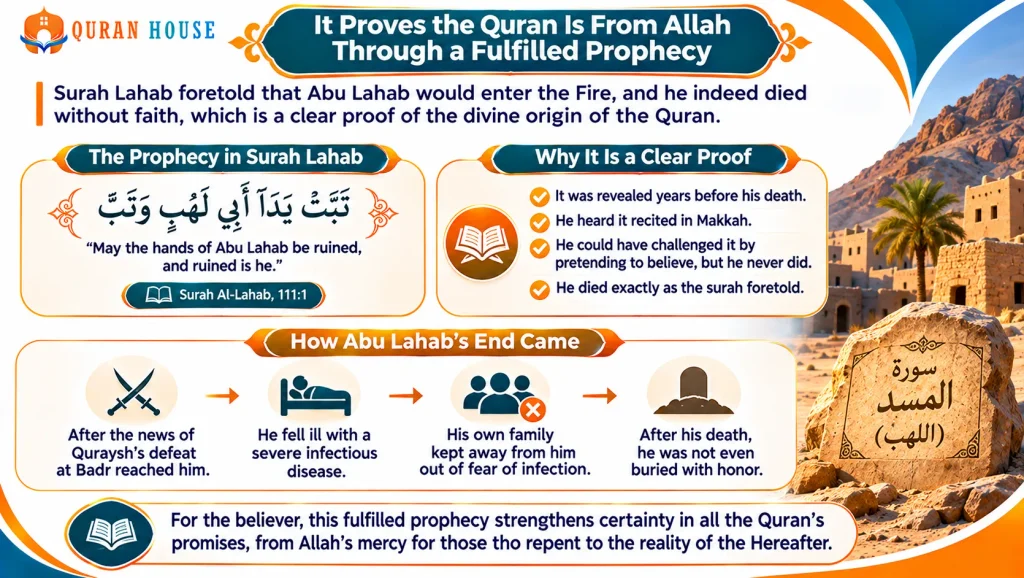
Abu Lahab died shortly after the Battle of Badr, still an enemy of Islam, exactly as the surah had foretold. For this reason, scholars count Surah Lahab among the clear proofs that the Quran is from Allah: no human author would stake the truth of his message on the future choice of a living opponent.
The books of seerah describe how his end came: within days of hearing the news of Quraysh’s defeat at Badr, he fell ill with a severe infectious disease, his own family kept away from him out of fear of infection, and after his death he was not even buried with honor. For the believer, this fulfilled prophecy is more than a historical fact.
It strengthens certainty in everything else the Quran promises, from Allah’s mercy for those who repent to the reality of the Hereafter, because the same Book that foretold Abu Lahab’s fate so precisely also tells us about our own.
2. It Shows That Allah Defends His Messenger ﷺ
The surah was revealed in direct response to an insult against the Prophet ﷺ. When Allah commanded him to warn his closest relatives, he climbed the hill of As-Safa and called the clans of Quraysh. When they gathered, he told them he was a warner before a severe punishment, and Abu Lahab replied:
«فَقَالَ أَبُو لَهَبٍ: أَلِهَذَا جَمَعْتَنَا؟ تَبًّا لَكَ. فَأَنْزَلَ اللَّهُ عَزَّ وَجَلَّ: ﴿تَبَّتْ يَدَا أَبِي لَهَبٍ﴾ إِلَى آخِرِهَا»
“Abu Lahab said: Is this why you gathered us? May you perish! So Allah, the Mighty and Majestic, revealed: May the hands of Abu Lahab perish, to the end of the surah.”
The very words Abu Lahab used against the Prophet ﷺ were turned back on him by Allah. This teaches the believer that Allah defends His Messenger and those who follow him, and that patience in the face of insults is never wasted.
3. It Teaches That Wealth and Children Cannot Save You Without Faith
Abu Lahab was rich and proud of his position, and he once claimed he could ransom himself from punishment with his wealth and his children. The surah answers him directly:
﴿مَا أَغْنَىٰ عَنْهُ مَالُهُ وَمَا كَسَبَ﴾
“His wealth did not benefit him, nor what he earned.”
Ibn ’Abbas and other early scholars explained “what he earned” as his children. The lesson is timeless: money, influence, and family are blessings, but they cannot replace faith and good deeds on the Day of Judgment. The surah serves as a stark reminder of the passing nature of worldly pleasures and of the danger of being deceived by them.
Discover the deeper meanings of every verse with our online Quran Tafseer course, where Al-Azhar-trained instructors guide you through the interpretation of the Quran step by step.
4. It Teaches That Family Ties Alone Cannot Save Anyone
Abu Lahab was not a distant enemy; he was the Prophet’s ﷺ paternal uncle and his next-door neighbor. In Arab society, an uncle was like a father, especially to an orphan. Yet this close blood relation did not benefit him at all, because he chose to reject the truth and fight it.
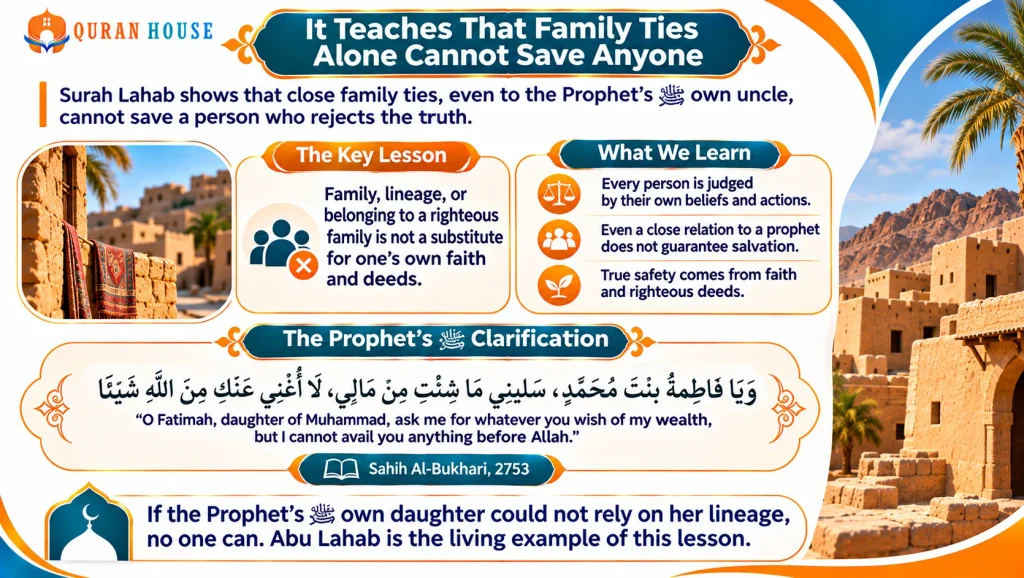
This is one of the strongest lessons of the surah: being related to a righteous person, or coming from a religious family, is not a substitute for one’s own faith and deeds. Every person stands before Allah with what they have done.
The Prophet ﷺ himself made this clear on the same occasion that led to the revelation of Surah Lahab, when he was commanded to warn his closest relatives. He called his clan, his uncle, his aunt, and even his beloved daughter, and said to her:
«وَيَا فَاطِمَةُ بِنْتَ مُحَمَّدٍ، سَلِينِي مَا شِئْتِ مِنْ مَالِي، لَا أُغْنِي عَنْكِ مِنَ اللَّهِ شَيْئًا»
“O Fatimah, daughter of Muhammad, ask me for whatever you wish of my wealth, but I cannot avail you anything before Allah.”
If the Prophet’s ﷺ own daughter could not rely on her lineage, no one can. Abu Lahab is the living example of this hadith: the closest relative of the Messenger ﷺ, yet his kinship did not save him because he refused to believe.
5. It Warns Against Spreading Harm and Slander
The surah describes Abu Lahab’s wife, Umm Jamil, as the carrier of firewood:
﴿وَامْرَأَتُهُ حَمَّالَةَ الْحَطَبِ فِي جِيدِهَا حَبْلٌ مِّن مَّسَدٍ﴾
“And his wife, the carrier of firewood. Around her neck is a rope of palm fiber.”
Scholars of tafsir mention two explanations. Ibn ’Abbas and others reported that she used to place thorns in the path of the Prophet ﷺ. Other scholars explained “carrying firewood” as spreading gossip and slander, because the one who carries tales between people feeds the fire of hatred just as firewood feeds a flame.
Both meanings carry a clear lesson: actively spreading harm, whether physical or through words, is a serious sin with fitting consequences. The believer should be the one who puts out fires between people, not the one who carries wood to them.
6. It Shows How Allah Protected His Prophet ﷺ From His Enemies
When Umm Jamil heard that a surah had been revealed about her, she came looking for the Prophet ﷺ with a stone in her hand while he was sitting near the Ka’bah with Abu Bakr. Ibn Kathir reports from Asma’ bint Abi Bakr that she stood right in front of them, yet Allah prevented her from seeing the Prophet ﷺ, and she spoke only to Abu Bakr before leaving (Tafsir Ibn Kathir on Surah Al-Masad).
This story shows that the one Allah protects cannot be harmed, however strong his enemies seem. It gives the believer confidence to stand for the truth and rely on Allah.
In the same narration, Umm Jamil told Abu Bakr she had heard that his companion was mocking her in poetry, and Abu Bakr answered that, by the Lord of the Ka’bah, he was not; the words were revelation, not poetry. Her failure to see the Prophet ﷺ while he sat right before her was a living example of a promise Allah made to His Messenger:
﴿إِنَّا كَفَيْنَاكَ الْمُسْتَهْزِئِينَ﴾
“Indeed, We are sufficient for you against the mockers.”
The mockers of Makkah had wealth, power, and numbers, yet none of them could harm the Prophet ﷺ beyond what Allah allowed. This gives every believer facing ridicule for their faith a source of calm: Allah is enough for those who rely on Him.
A Real Surah Lesson: Surah Ash-Shams
Watch a student work through Surah Ash-Shams step by step with their tutor, practicing each ayah until the recitation flows clearly and correctly.
Start Your Quran Journey With Quran House
Learn live and one-on-one with Al-Azhar-trained tutors, male and female, for children and adults, at a time that fits your timezone.
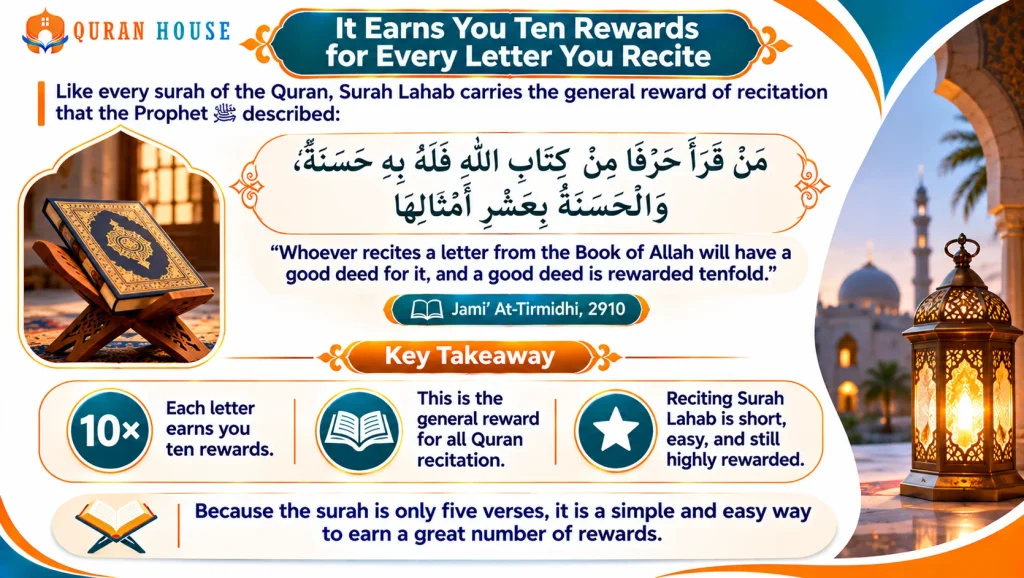
Try a Free Session7. It Earns You Ten Rewards for Every Letter You Recite
Like every surah of the Quran, Surah Lahab carries the general reward of recitation that the Prophet ﷺ described:
«مَنْ قَرَأَ حَرْفًا مِنْ كِتَابِ اللَّهِ فَلَهُ بِهِ حَسَنَةٌ، وَالْحَسَنَةُ بِعَشْرِ أَمْثَالِهَا»
“Whoever recites a letter from the Book of Allah will have a good deed for it, and a good deed is rewarded tenfold.”
This is the authentic reward of reciting Surah Lahab, and it is a great one. Because the surah is only five verses, it is also one of the first surahs children memorize, and it is often recited in prayer.
To earn this reward fully, recite it with correct pronunciation; if you are new to the rules of recitation, start with this guide on what Tajweed is and why it matters. Reciting it with understanding adds a reminder of accountability every time you read it.
Surah Lahab Full Text With the Meaning of Each Verse
The whole surah is only five verses, short enough to read and understand in a few minutes. Below is each verse in Arabic, followed by its translation and a brief explanation. To recite these verses correctly, you can review the basics in our guide on what Tajweed is.
Verse 1: The Ruin of Abu Lahab and His Deeds
The surah opens with a decisive verdict on Abu Lahab, using the very word he had thrown at the Prophet ﷺ. In just a few words, it announces the failure of everything he worked for against Islam.
﴿تَبَّتْ يَدَا أَبِي لَهَبٍ وَتَبَّ﴾
“May the hands of Abu Lahab perish, and he has perished.”
The first part is a supplication against him, answering his own words to the Prophet ﷺ, and the second part states that his ruin has already been decreed. The hands are mentioned because they stand for a person’s deeds and efforts, all of which came to nothing.
Verse 2: His Wealth and Children Did Not Save Him
After announcing his ruin, the surah answers the question of what could have saved him. It names the two things he relied on most, his money and his sons, and declares them useless.
﴿مَا أَغْنَىٰ عَنْهُ مَالُهُ وَمَا كَسَبَ﴾
“His wealth did not benefit him, nor what he earned.”
Ibn ’Abbas explained “what he earned” as his children. Abu Lahab was proud of his wealth and sons, yet neither could protect him from Allah’s decree.
Verse 3: The Fire of Blazing Flames That Awaits Him
The third verse moves from this world to the Hereafter and describes Abu Lahab’s final destination. It is also the verse that made the surah a prophecy, because it was revealed while he was still alive.
﴿سَيَصْلَىٰ نَارًا ذَاتَ لَهَبٍ﴾
“He will burn in a Fire of blazing flames.”
The word lahab (flame) echoes his own nickname, Abu Lahab. The verse is also the prophecy at the heart of the surah: it states, while he was still alive, that he would die without faith.
Verse 4: His Wife, the Carrier of Firewood
The surah then turns to Abu Lahab’s partner in hostility, his wife. She is described not by her name but by her deeds, which became her lasting title.
﴿وَامْرَأَتُهُ حَمَّالَةَ الْحَطَبِ﴾
“And his wife, the carrier of firewood.”
This refers to Umm Jamil, who placed thorns in the Prophet’s ﷺ path and spread harm and slander against him. She shares her husband’s fate because she shared his hostility.
Verse 5: The Rope of Palm Fiber Around Her Neck
The surah closes with one more image of Umm Jamil’s punishment. It contrasts the precious jewelry she wore in this life with what will surround her neck in the next.
﴿فِي جِيدِهَا حَبْلٌ مِّن مَّسَدٍ﴾
“Around her neck is a rope of palm fiber.”
A humiliating image for a woman of high status in Quraysh who used her wealth and position against the truth. The word masad (palm fiber) gives the surah its second name, Surah Al-Masad.
Popular Surah Lahab Benefits That Have No Authentic Evidence
Many websites list benefits of Surah Lahab that include reciting it a set number of times for love, health, or work. We have looked at the sources of these claims, and none of them is supported by an authentic hadith; some come from late books without chains of narration, and others have no source at all.
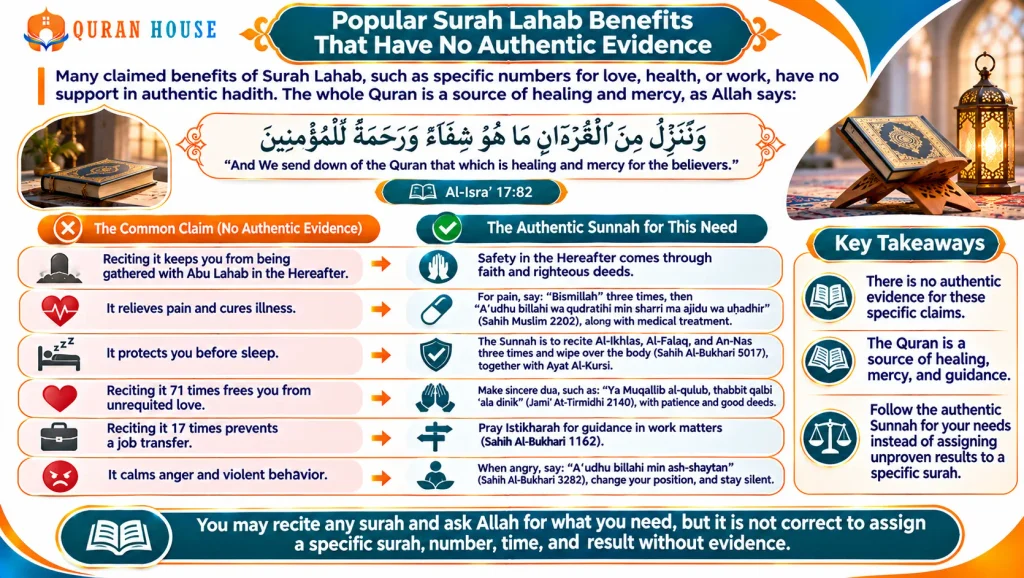
This does not mean that reciting Surah Lahab is without benefit. The whole Quran is a source of healing and mercy, as Allah says:
﴿وَنُنَزِّلُ مِنَ الْقُرْآنِ مَا هُوَ شِفَاءٌ وَرَحْمَةٌ لِّلْمُؤْمِنِينَ﴾
“And We send down of the Quran that which is healing and mercy for the believers.”
You may recite any surah and then ask Allah for what you need. What scholars warn against is assigning a specific surah, number, time, and result to an act of worship without evidence, because that is adding to the religion. Below are the most common claims, with the authentic Sunnah for each need.
The Claim of Safety From Abu Lahab’s Fate in the Hereafter
The claim that the Prophet ﷺ promised that whoever recites Surah Lahab will not be gathered with Abu Lahab in the Hereafter has no reliable chain of narration in the books of hadith, and hadith scholars have not authenticated it, so it cannot be attributed to the Prophet ﷺ.
The authentic reward is the one we explained above: ten good deeds for every letter you recite. Safety in the Hereafter comes through faith and righteous deeds, which is exactly the lesson the surah teaches.
The Claim That Surah Lahab Relieves Pain and Illness
There is no authentic narration that Surah Lahab in particular relieves pain or cures illness; the claim is cited from a late book of tafsir without a reliable chain. The Prophet ﷺ taught a specific practice for physical pain:
«ضَعْ يَدَكَ عَلَى الَّذِي تَأَلَّمَ مِنْ جَسَدِكَ، وَقُلْ: بِاسْمِ اللَّهِ ثَلَاثًا، وَقُلْ سَبْعَ مَرَّاتٍ: أَعُوذُ بِاللَّهِ وَقُدْرَتِهِ مِنْ شَرِّ مَا أَجِدُ وَأُحَاذِرُ»
“Place your hand on the part of your body that hurts and say: In the name of Allah three times, then say seven times: I seek refuge in Allah and His power from the evil of what I feel and what I fear.”
This is an authentic ruqyah for pain, and it is used alongside medical treatment, not instead of it.
The Claim That Surah Lahab Protects You Before Sleep
The Sunnah for protection before sleep is not Surah Lahab, but the three surahs that come right after it. Aisha, may Allah be pleased with her, described the Prophet’s ﷺ nightly practice:
«كَانَ إِذَا أَوَى إِلَى فِرَاشِهِ كُلَّ لَيْلَةٍ جَمَعَ كَفَّيْهِ، ثُمَّ نَفَثَ فِيهِمَا فَقَرَأَ فِيهِمَا: ﴿قُلْ هُوَ اللَّهُ أَحَدٌ﴾ وَ﴿قُلْ أَعُوذُ بِرَبِّ الْفَلَقِ﴾ وَ﴿قُلْ أَعُوذُ بِرَبِّ النَّاسِ﴾، ثُمَّ يَمْسَحُ بِهِمَا مَا اسْتَطَاعَ مِنْ جَسَدِهِ»
“Every night when he went to bed, he would cup his hands, blow into them, and recite Al-Ikhlas, Al-Falaq, and An-Nas, then wipe over as much of his body as he could.”
The hadith adds that he did this three times, starting with his head and face. This is the established bedtime protection, together with Ayat Al-Kursi.
The Claim of Reciting Surah Lahab 71 Times for Unrequited Love
The claim of reciting Surah Lahab 71 times between Maghrib and Isha to be freed from unrequited love has no source in the Quran or the Sunnah. A heart troubled by attachment is best treated with sincere dua and turning to Allah. One of the Prophet’s ﷺ most frequent supplications was:
«يَا مُقَلِّبَ الْقُلُوبِ ثَبِّتْ قَلْبِي عَلَى دِينِكَ»
“O Turner of hearts, keep my heart firm upon Your religion.”
Asking the One who controls hearts to guide yours, along with patience and keeping busy with beneficial things, is the path the Sunnah teaches for these struggles.
The Claim of Reciting Surah Lahab 17 Times to Prevent a Job Transfer
Reciting Surah Lahab 17 times after Maghrib to prevent a job transfer also has no evidence. For decisions and worries about work, the Prophet ﷺ taught the prayer of Istikharah:
«إِذَا هَمَّ أَحَدُكُمْ بِالْأَمْرِ فَلْيَرْكَعْ رَكْعَتَيْنِ مِنْ غَيْرِ الْفَرِيضَةِ، ثُمَّ لِيَقُلْ: اللَّهُمَّ إِنِّي أَسْتَخِيرُكَ بِعِلْمِكَ…»
“If any of you is concerned about a matter, let him pray two units of voluntary prayer, then say: O Allah, I seek Your guidance through Your knowledge…”
Istikharah asks Allah to choose what is best for you, which is wiser than asking for a specific outcome you may later regret.
The Claim That Surah Lahab Calms Anger and Violent Behavior
There is no narration linking Surah Lahab to calming anger. The Prophet ﷺ gave a clear remedy when he saw a man whose face had turned red with rage:
«إِنِّي لَأَعْلَمُ كَلِمَةً لَوْ قَالَهَا ذَهَبَ عَنْهُ مَا يَجِدُ، لَوْ قَالَ: أَعُوذُ بِاللَّهِ مِنَ الشَّيْطَانِ، ذَهَبَ عَنْهُ مَا يَجِدُ»
“I know a word that, if he said it, what he feels would leave him. If he said: I seek refuge in Allah from Satan, what he feels would leave him.”
Seeking refuge in Allah, changing your position, and staying silent are the authentic steps for controlling anger.
The Main Messages of Surah Lahab
The surah explicitly condemns Abu Lahab, an ardent opponent of Islam and of the Prophet ﷺ. His real name was ’Abd Al-’Uzza, and Ibn Kathir notes that he was called Abu Lahab (father of flame) because of the brightness of his face. The surah announces his downfall and punishment, as a warning to everyone who fights Allah’s message.
It also condemns his wife, Umm Jamil, for her active part in opposing the Prophet ﷺ and supporting her husband. Together, their fate shows the ultimate loss awaiting those who choose to reject faith and act with hostility toward the believers.
Beyond its historical setting, the surah invites believers to reflect on their own behavior. It warns against arrogance, pride, and hatred, and calls instead for humility, faith, and compassion.
The Punishment of Abu Lahab and His Wife in Surah Lahab
Abu Lahab will burn in a Fire of blazing flames, and his wife will carry firewood with a rope of palm fiber around her neck. The surah opens with “May the hands of Abu Lahab perish, and he has perished,” announcing his total loss in this life and the next. The Fire is described as dhat lahab, full of flames, an echo of his own nickname: the man known as the father of flame meets a fire of flames.
His wife, Umm Jamil, is described as the carrier of firewood. Some scholars explained this as the firewood she will carry to feed the Fire in which she is punished, while others linked it to the thorns she placed in the Prophet’s ﷺ path and the slander she spread, as we explained in benefit 5. The rope of palm fiber around her neck is a fitting humiliation: some commentators mention that she swore to spend her precious necklace in enmity against the Prophet ﷺ, and in its place she is given a rough rope of fiber.
This vivid imagery reinforces the surah’s broader theme: active participation in spreading harm and hostility carries serious and fitting consequences.
Why Surah Lahab Was Revealed?
Surah Lahab was revealed in Makkah after the Prophet ﷺ began openly calling his relatives to Islam, when Abu Lahab cursed him in front of the gathered clans, as narrated in Sahih Al-Bukhari 4971. Abu Lahab did not stop there: he followed the Prophet ﷺ to markets and gatherings to call him a liar, and his wife placed thorns at his door.
The event that triggered the surah began with a command from Allah to the Prophet ﷺ, marking the start of his open call to his own family:
﴿وَأَنذِرْ عَشِيرَتَكَ الْأَقْرَبِينَ﴾
“And warn your closest relatives.”
Ibn ’Abbas reported that it was right after this verse was revealed that the Prophet ﷺ climbed As-Safa and called the clans of Quraysh. This places Surah Lahab among the early Makkan revelations, and it shows that Abu Lahab was among the first to oppose the message openly, from the very first public invitation.
Understanding this context shows that the surah was a direct rebuke of a specific, persistent, and public hostility, and at the same time a general lesson about the consequences of rejecting clear guidance.
Why the Quran Names Abu Lahab Directly?
Surah Lahab stands out for naming one of the Prophet’s ﷺ contemporaries directly, instead of addressing wrongdoing in general terms as the Quran usually does. In fact, only two people from the Prophet’s ﷺ own time are named in the Quran: Abu Lahab here, and Zayd ibn Harithah, may Allah be pleased with him, in Surah Al-Ahzab:
﴿فَلَمَّا قَضَىٰ زَيْدٌ مِّنْهَا وَطَرًا زَوَّجْنَاكَهَا﴾
“So when Zayd had ended his marriage to her, We married her to you.”
The contrast is striking: one is named for honor, a man who loved the Prophet ﷺ like a son, and the other is named for condemnation, though he was the Prophet’s ﷺ blood uncle. This exceptional naming underscores how severe Abu Lahab’s deliberate public hostility was, and it reminds us that closeness to the Prophet ﷺ is measured by faith, not by lineage.
Understand the core beliefs of Islam, including how to tell authentic sources from weak ones, with the Islamic Aqeedah Course Online.
How to Apply the Lessons of Surah Lahab in Daily Life?
When you feel secure because of your income, position, or family name, remember verse 2: none of these benefited Abu Lahab. Let it push you to invest in faith and good deeds that will benefit you on the Day of Judgment.
Before passing on a story or a rumor about someone, think of the carrier of firewood. Ask yourself whether your words will calm a conflict or feed it.
Recite this short surah in your prayers with understanding, and teach it to your children with its story. It is an easy way to plant in them, from an early age, the lesson that every person is accountable for their own choices.
Inside an Interactive One-on-One Session
Every class is live and personal. See how our tutor uses on-screen tools, quick reviews, and gentle correction to help a student build confidence with every new word.
Start Your Quran Journey With Quran House
Learn live and one-on-one with Al-Azhar-trained tutors, male and female, for children and adults, at a time that fits your timezone.
Try a Free SessionLearn Surah Lahab and Its Meanings With a Qualified Tutor
Short surahs like Surah Lahab are among the first we memorize, yet many of us recite them for years without knowing their story or their lessons. And when we search for their benefits online, we often find claims with no evidence mixed with authentic knowledge.
At Quran House, our Al-Azhar-trained tutors teach you the surahs of Juz ’Amma with correct Tajweed, their meanings, and the stories behind them, relying only on authentic sources. In live one-to-one sessions, they correct your recitation and build a plan around your level and schedule. We teach adults and kids, and sisters who prefer a female tutor can learn with a female Quran, Tajweed, and Arabic teacher.
Whether you want to memorize Juz ’Amma, understand what you recite in prayer, or teach your children the Quran the right way, you will have a trusted teacher by your side at every step.
Explore Our Quran Courses:
- Quran Reading Course Online for Kids and Adults
- Learn to Read Quran in Arabic
- Noorani Qaida for Adults
- Noor Al-Bayan Course
- Quran Reading Fluency Course
- Word-by-Word Quran Reading Course
- Complete Quran Reading (Khatma) Program
- Intensive Quran Course
- Online Quran Classes for Sisters and Women
- Online Quran Classes for Men and Brothers

Final Thoughts
The benefits of Surah Lahab lie in its message, not in secret formulas. We saw how it was revealed in defense of the Prophet ﷺ, how its prophecy about Abu Lahab came true years later, and how it teaches that wealth, children, and even the closest family ties cannot save a person who rejects the truth. Through Umm Jamil, it also warns against spreading harm and slander.
We also separated the authentic from the unfounded: the claims about reciting the surah a set number of times for love, health, or work have no evidence, while the Sunnah gives us clear, authentic practices for each of these needs. Recite this short surah with understanding, teach it to your children with its story, and use a trusted source such as Quran.com to follow its text and meaning.
In the end, Surah Lahab is a short surah with a long reach. Abu Lahab had everything people usually rely on: wealth, sons, status, and the closest possible kinship to the Prophet ﷺ, yet he lost all of it because he turned away from the truth. Every time you recite these five verses, let them remind you to measure your life by your faith and your deeds, and to ask Allah, as the Prophet ﷺ used to, to keep your heart firm upon His religion until you meet Him.
Frequently Asked Questions About Surah Lahab
Is there an authentic hadith about the virtues of Surah Lahab?
No, there is no authentic hadith about a specific reward for Surah Lahab. The narration about not being gathered with Abu Lahab has no reliable chain of narration. Its authentic reward is the general reward of reciting the Quran, ten good deeds for every letter.
Can I recite Surah Lahab for love, health, or a job?
You can recite any surah and ask Allah for what you need, but there is no evidence for reciting Surah Lahab a set number of times for these purposes. The Sunnah offers specific practices instead: the ruqyah for pain, Istikharah for decisions, and dua for the heart.
Why does the Quran specifically name Abu Lahab?
Because his hostility was exceptionally severe and public. He was the Prophet’s ﷺ own uncle, yet he cursed him in front of his people and followed him to call him a liar, so the Quran answered him by name.
Who was Abu Lahab’s wife?
Her name was Arwa bint Harb, known as Umm Jamil, and she was the sister of Abu Sufyan. She shared her husband’s hostility, placed thorns in the Prophet’s ﷺ path, and is described in the surah as the carrier of firewood.
What is the significance of the firewood mentioned in relation to his wife?
It refers either to the firewood she will carry in Hell, or to the harm and slander she spread. In both meanings, it shows that spreading harm brings a fitting punishment.
What is the surah’s main lesson beyond its historical context?
Wealth, status, and family ties offer no protection without faith. Every person is accountable for their own choices before Allah.