| Key Takeaways |
| Surah At-Taghabun is the 64th chapter of the Quran, has 18 verses, and takes its name from the Day of mutual loss and gain. |
| The Prophet ﷺ recited the Musabbihat before sleep, a report that scholars grade differently, so it is best treated as a recommended habit. |
| Claims about wealth, debt relief, or protection from rulers have no authentic proof, so every benefit below rests on the verses themselves. |
| Verses 11 to 17 teach trust in Allah’s decree, balance with family and wealth, charity, and obedience, all of which can be practiced daily. |
| Memorizing the surah in three sessions of six verses, with tajweed review, makes the 18 verses manageable for adults and teens. |
Surah Taghabun benefits are most meaningful when they rest on what Allah actually revealed in this chapter. Surah At-Taghabun is the 64th chapter of the Quran, and its 18 verses speak to faith, family, wealth, and accountability.
The name Taghabun means mutual loss and gain. It points to the Day when every person sees what they truly gained or lost, and it gives the chapter a serious, reflective tone that rewards slow reading.
Many pages online attach unverified promises to this chapter, so we separate evidence from assumption here. The benefits below are drawn from the verses and from authentic guidance, and each can be applied today. Here are the benefits in order.
1. Strengthen Trust in Allah’s Decree Through Surah Taghabun
Surah At-Taghabun teaches that nothing happens outside Allah’s knowledge and permission. This is the foundation of trust, and the surah states it plainly in a single verse that believers can carry through any difficulty.
Allah says in verse 11:
مَآ أَصَابَ مِن مُّصِيبَةٍ إِلَّا بِإِذۡنِ ٱللَّهِۗ وَمَن يُؤۡمِنۢ بِٱللَّهِ يَهۡدِ قَلۡبَهُۥۚ وَٱللَّهُ بِكُلِّ شَيۡءٍ عَلِيمٞ
(Ma asaba min musibatin illa bi-idhnillah. Wa man yu’min billahi yahdi qalbah. Wallahu bi-kulli shay’in ‘aleem)
(“No calamity strikes except by Allah’s permission. Whoever believes in Allah, He guides their heart. And Allah has full knowledge of all things.”)
A believer who absorbs this verse stops treating hardship as random. The verse links belief with guidance of the heart, so trust grows as faith grows, and anxiety about outcomes begins to loosen.
In practice, this means pausing after bad news and remembering that Allah knows what remains hidden from you. That pause protects the heart from panic and keeps decisions calm and fair.
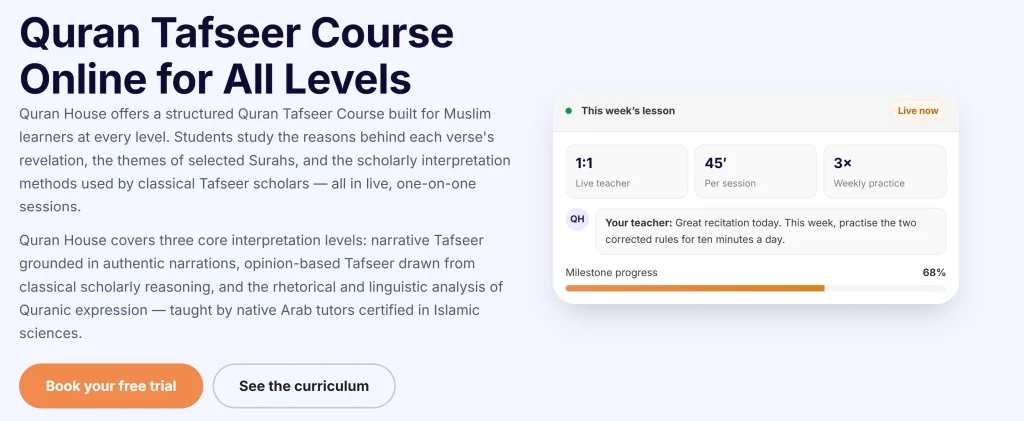
Quran House offers the Quran Tafseer Course for All Levels for students who want to study verses like this phrase by phrase with a live teacher.
2. Build Patience When Trials Arrive in Life
Patience grows when a believer sees every trial as measured and meaningful. Surah At-Taghabun places loss, illness, and family strain inside Allah’s wider wisdom, which makes endurance easier to practice.
The same verse that teaches trust also promises guidance for the heart. Guidance here means steadiness, so a person facing a hard season keeps praying, keeps working, and keeps speaking well of Allah.
Try a simple habit during difficulty. Recite verse 11 slowly, reflect on one meaning, and make dua for steadfastness. Over weeks, that routine turns patience from a hope into a skill.
3. Remember the Day of Mutual Loss and Gain
The surah names its central theme in verse 9, where Allah describes the Day of Gathering and the result for believers.
يَوۡمَ يَجۡمَعُكُمۡ لِيَوۡمِ ٱلۡجَمۡعِۖ ذَٰلِكَ يَوۡمُ ٱلتَّغَابُنِۗ وَمَن يُؤۡمِنۢ بِٱللَّهِ وَيَعۡمَلۡ صَٰلِحٗا يُكَفِّرۡ عَنۡهُ سَيِّـَٔاتِهِۦ وَيُدۡخِلۡهُ جَنَّٰتٖ تَجۡرِي مِن تَحۡتِهَا ٱلۡأَنۡهَٰرُ خَٰلِدِينَ فِيهَآ أَبَدٗاۚ ذَٰلِكَ ٱلۡفَوۡزُ ٱلۡعَظِيمُ
(Yawma yajma’ukum li-yawmil-jam’i dhalika yawmut-taghabun. Wa man yu’min billahi wa ya’mal salihan yukaffir ‘anhu sayyi’atihi wa yudkhilhu jannatin tajri min tahtihal-anharu khalidina feeha abada. Dhalikal-fawzul-‘azeem)
(“On the Day He gathers you for the Day of Gathering, that is the Day of mutual loss and gain. Whoever believes in Allah and does good, He will erase their sins and admit them into Gardens beneath which rivers flow, to remain there forever. That is the great triumph.”)
Taghabun carries the idea of mutual loss and gain. People who chased only the world discover what they missed, while believers who invested in good deeds discover how much they secured.
Remembering this Day daily reorders priorities. Prayer, honesty, and kindness stop feeling like optional extras and begin to feel like the real work of a lifetime.
A short evening review helps. Ask which actions today would weigh well and which would not, then correct one small thing tomorrow. This five-minute habit turns reflection into steady improvement.
4. Balance Family Love With Obedience to Allah
Family is one of the surah’s most practical themes. Verse 14 speaks directly to believers about spouses and children, and it offers a warning together with a remedy.
يَٰٓأَيُّهَا ٱلَّذِينَ ءَامَنُوٓاْ إِنَّ مِنۡ أَزۡوَٰجِكُمۡ وَأَوۡلَٰدِكُمۡ عَدُوّٗا لَّكُمۡ فَٱحۡذَرُوهُمۡۚ وَإِن تَعۡفُواْ وَتَصۡفَحُواْ وَتَغۡفِرُواْ فَإِنَّ ٱللَّهَ غَفُورٞ رَّحِيمٌ
(Ya ayyuhal-ladhina amanu inna min azwajikum wa awladikum ‘aduwwan lakum fahdharuhum. Wa in ta’fu wa tasfahu wa taghfiru fa-innallaha ghafurun raheem)
(“O believers, among your spouses and children are enemies to you, so beware of them. But if you pardon, overlook, and forgive, then Allah is Forgiving and Merciful.”)
Many commentators explain that the word enemies here describes distraction, not hatred. Al-Qurtubi relates from Ibn Abbas that Awf ibn Malik al-Ashja’i complained to the Prophet ﷺ about his family’s harshness, and this verse was revealed.
Verse 15 then gives the reason behind the warning.
إِنَّمَآ أَمۡوَٰلُكُمۡ وَأَوۡلَٰدُكُمۡ فِتۡنَةٞۚ وَٱللَّهُ عِندَهُۥٓ أَجۡرٌ عَظِيمٞ
(Innama amwalukum wa awladukum fitnah. Wallahu ‘indahu ajrun ‘azeem)
(“Your wealth and your children are only a trial, and with Allah is a great reward.”)
Family is a blessing, and the surah never asks believers to love less. It asks them to keep love in its proper place, below obedience to Allah, and to answer mistakes with pardon and forgiveness.
In daily life, that means keeping prayer on time despite family schedules and forgiving small offenses quickly. It also means refusing to let provision for children justify unlawful earnings.
Quran House offers the Understand the Quran Course for families who want to learn the meanings of the Quran together, one lesson at a time.
5. Purify Wealth Through Charity and Generous Giving
Verses 16 and 17 turn belief into action through spending. Wealth is described as a trial, and charity is presented as the way to pass that trial with success.
Allah says in verse 16:
فَٱتَّقُواْ ٱللَّهَ مَا ٱسۡتَطَعۡتُمۡ وَٱسۡمَعُواْ وَأَطِيعُواْ وَأَنفِقُواْ خَيۡرٗا لِّأَنفُسِكُمۡۗ وَمَن يُوقَ شُحَّ نَفۡسِهِۦ فَأُوْلَٰٓئِكَ هُمُ ٱلۡمُفۡلِحُونَ
(Fattaqullaha mastata’tum wasma’u wa ati’u wa anfiqu khayran li-anfusikum. Wa man yuqa shuhha nafsihi fa-ulaika humul-muflihun)
(“So fear Allah as much as you can, listen, obey, and spend for the good of your own souls. And whoever is protected from the greed of their own souls, it is they who will succeed.”)
Then verse 17 describes charity as a loan to Allah:
إِن تُقۡرِضُواْ ٱللَّهَ قَرۡضًا حَسَنٗا يُضَٰعِفۡهُ لَكُمۡ وَيَغۡفِرۡ لَكُمۡۚ وَٱللَّهُ شَكُورٌ حَلِيمٌ
(In tuqridullaha qardan hasanan yudo’ifhu lakum wa yaghfir lakum. Wallahu shakurun haleem)
(“If you lend Allah a good loan, He will multiply it for you and forgive you. And Allah is Most Appreciative and Forbearing.”)
The phrase good loan reframes giving. Charity is not a loss, because Allah promises to multiply it and forgive the giver, and He is described as Shakur, Most Appreciative of even small acts.
Verse 16 adds that whoever is protected from the stinginess of the soul will succeed. Generosity therefore protects the heart first and the wallet second.
Start with a fixed small amount each week. Consistency matters more than size, and giving quietly for Allah’s sake keeps the intention clean. A weekly habit also stops you from postponing charity until it feels convenient.
6. Follow Allah and the Messenger With Sincere Trust
Verses 12 and 13 summarize the practical creed of the surah. They join obedience and reliance in two short verses.
وَأَطِيعُواْ ٱللَّهَ وَأَطِيعُواْ ٱلرَّسُولَۚ فَإِن تَوَلَّيۡتُمۡ فَإِنَّمَا عَلَىٰ رَسُولِنَا ٱلۡبَلَٰغُ ٱلۡمُبِينُ
(Wa ati’ullaha wa ati’ur-rasul, fa-in tawallaytum fa-innama ‘ala rasulinal-balaghul-mubeen)
(“Obey Allah and obey the Messenger. But if you turn away, then Our Messenger’s duty is only to deliver the clear message.”)
Verse 13 follows with the declaration of Tawheed and the call to rely on Allah:
ٱللَّهُ لَآ إِلَٰهَ إِلَّا هُوَۚ وَعَلَى ٱللَّهِ فَلۡيَتَوَكَّلِ ٱلۡمُؤۡمِنُونَ
(Allahu la ilaha illa huwa, wa ‘alallahi falyatawakkalil-mu’minun)
(“Allah, there is no god but Him. So let the believers put their trust in Allah.”)
Obedience and trust belong together. The believer follows Allah and the Messenger in action, then relies on Allah for results, which removes both laziness and obsessive worry.
Verse 13 begins with Tawheed, so every promise and warning in the surah rests on Allah alone. Reliance on anyone else cannot carry the weight that reliance on Him can.
Practical obedience can start with one daily act, such as praying on time or reciting a page, followed by sincere dua for acceptance. Small, repeated obedience builds the trust the verse describes.
See Us in Action!
Curious about what our online classrooms look like? Watch the short clips below to see how our interactive, one-on-one session bring learning to life with real-time feedback and engaging teaching methods.
Start Your Quran Journey With Quran House
Learn live and one-on-one with Al-Azhar-trained tutors, male and female, for children and adults, at a time that fits your timezone.
Try a Free Session7. Increase Taqwa Through Self-Accountability
Taqwa is the quiet result of everything above. Verse 16 commands believers to fear Allah as much as they can, and that standard is merciful because it measures effort within capacity, not perfection beyond it.
Self-accountability follows naturally. Verse 8 reminds believers that Allah is fully aware of everything they do, so a sincere person reviews intentions before acting and repents quickly after slipping.
For a related chapter that centers night prayer, patience, and charity, read our guide to the benefits of Surah Muzammil.
A weekly review makes taqwa measurable without turning it into anxiety. A short checklist for prayer, honesty, and charity is enough to show where to improve next week.
8. Strengthen Belief in Resurrection and Divine Justice
The surah also answers those who deny life after death. Verse 7 addresses that claim directly and calls believers to certainty.
زَعَمَ ٱلَّذِينَ كَفَرُوٓاْ أَن لَّن يُبۡعَثُواْۚ قُلۡ بَلَىٰ وَرَبِّي لَتُبۡعَثُنَّ ثُمَّ لَتُنَبَّؤُنَّ بِمَا عَمِلۡتُمۡۚ وَذَٰلِكَ عَلَى ٱللَّهِ يَسِيرٞ
(Za’amal-ladhina kafaru an lan yub’athu. Qul bala wa rabbi la tub’athunna thumma la tunabba’unna bima ‘amiltum. Wa dhalika ‘alallahi yaseer)
(“Those who disbelieve claim they will never be resurrected. Say, Yes, by my Lord, you will surely be resurrected, then informed of what you did. And that is easy for Allah.”)
Belief in resurrection gives life moral weight. If every action will be recounted, kindness matters, injustice cannot hide, and small sincere deeds are never wasted.
It also brings comfort. Wrongs that nobody witnessed or corrected in this world are not forgotten, and Allah’s justice will be complete on the Day of Gathering.
Verses 5 and 6 recall earlier nations that rejected their messengers and faced the consequences. Those accounts invite reflection and humility, not fear alone.
Surah Taghabun Benefits Supported by Authentic Evidence
The evidence for reciting this chapter comes from a hadith about the Musabbihat and from the opening verse. Each is presented below with its source and an honest note on grading.
Sunan Abu Dawud 5057 on Reciting the Musabbihat Before Sleep
Surah At-Taghabun belongs to the Musabbihat, the chapters that open with the glorification of Allah. Irbad ibn Sariyah reported a practice of the Prophet ﷺ connected to these chapters.
أَنَّ رَسُولَ اللَّهِ صلى الله عليه وسلم كَانَ يَقْرَأُ الْمُسَبِّحَاتِ قَبْلَ أَنْ يَرْقُدَ وَقَالَ إِنَّ فِيهِنَّ آيَةً أَفْضَلُ مِنْ أَلْفِ آيَةٍ
(Anna rasulallahi salallahu ‘alayhi wa sallam kana yaqra’ul-musabbihati qabla an yarqud, wa qala inna fihinna ayatan afdalu min alfi ayah)
(“The Messenger of Allah (ﷺ) used to recite al-Musabbihat before going to sleep, and he would say: They contain a verse which is better than a thousand verses.”)
Scholars differ on the grading of this report. Al-Tirmidhi described it as hasan gharib, as noted in Mishkat al-Masabih 2151, while Al-Albani graded the Abu Dawud narration weak.
Because the practice is general and covers several chapters, it is best treated as a recommended bedtime habit. It should not be presented as a guaranteed reward for this surah alone.
Surah At-Taghabun 64:1 on Glorification of Allah
The first verse explains why the chapter is counted among the Musabbihat. It opens with a universal statement about creation.
يُسَبِّحُ لِلَّهِ مَا فِي ٱلسَّمَٰوَٰتِ وَمَا فِي ٱلۡأَرۡضِۖ لَهُ ٱلۡمُلۡكُ وَلَهُ ٱلۡحَمۡدُۖ وَهُوَ عَلَىٰ كُلِّ شَيۡءٖ قَدِيرٌ
(Yusabbihu lillahi ma fis-samawati wa ma fil-ard, lahul-mulku wa lahul-hamdu wa huwa ‘ala kulli shay’in qadeer)
(“Whatever is in the heavens and whatever is on the earth glorifies Allah. To Him belongs dominion and to Him belongs all praise, and He has power over all things.”)
All creation glorifies Allah, so a reciter joins a universal act of worship each time the surah is read. That shared worship is a real and documented merit.
Popular Claims About Surah Taghabun That Lack Authentic Proof
Some surah taghabun benefits repeated online include material prosperity, protection from tyrannical rulers, relief from debt, and protection from epidemics. We could not find an authentic Prophetic text that promises any of these as a specific reward for this chapter.
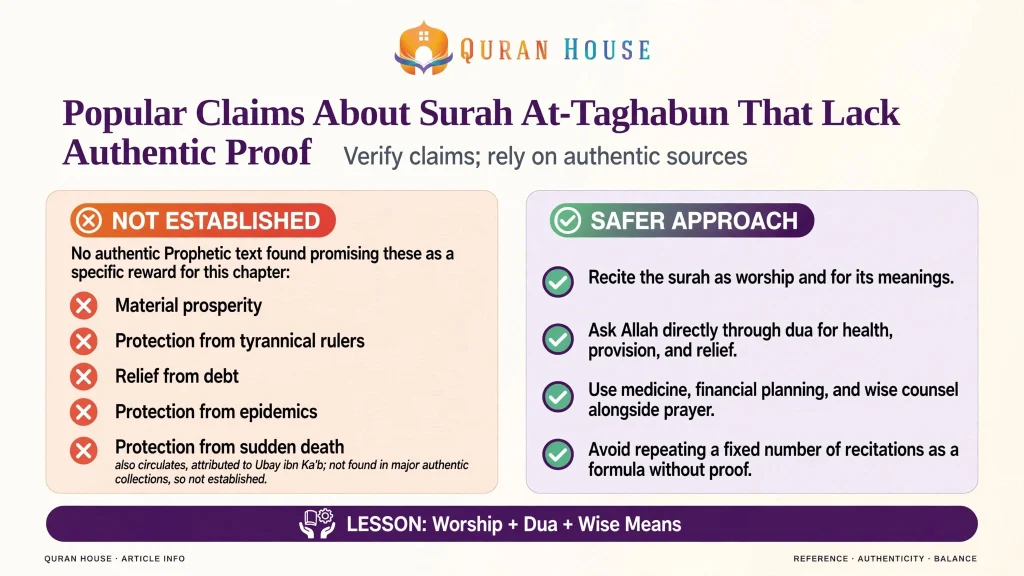
Reports of protection from sudden death, attributed to Ubay ibn Ka’b, also circulate widely. To our knowledge, they are not found in the major authentic collections, so we do not present them as established.
A safer approach keeps worship and means together:
- Recite the surah as worship and for its meanings.
- Ask Allah directly through dua for health, provision, and relief.
- Use medicine, financial planning, and wise counsel alongside prayer.
- Avoid repeating a fixed number of recitations as a formula without proof.
Reasons for the Revelation of Surah At-Taghabun
The surah has a clear identity within the Quran. The table below gathers the main facts in one place.
| Fact | Detail |
| Chapter number | 64. |
| Number of verses | 18. |
| Place of revelation | Madani according to most commentators, with some reporting a Makki origin. |
| Position in the Quran | Juz 28. |
| Group of chapters | The Musabbihat, which open with glorification of Allah. |
| Meaning of the name | Mutual loss and gain on the Day of Judgment. |
The disagreement about the place of revelation has a known explanation. Al-Qurtubi cites Ibn Abbas as saying the surah was revealed in Makkah, except for verses near its end, which were revealed in Madinah concerning Awf ibn Malik al-Ashja’i.
The word Taghabun comes from ghabn, the loss a person suffers in a bad deal. The name tells the reader that the Day of Judgment will expose who traded wisely and who did not.
Recite Surah At-Taghabun Correctly With Tajweed
Accurate recitation protects the meaning of every verse. Even in a short surah, small tajweed mistakes can change how a word sounds and how it is understood.
If you are new to the rules, our beginner guide on what is tajweed explains the foundations clearly. The table below shows three examples from this surah.
| Example | Rule | Verse |
| عَلِيمُۢ بِذَاتِ ٱلصُّدُورِ | Iqlab | 64:4 |
| مِن مُّصِيبَةٍ | Idgham with ghunnah | 64:11 |
| غَفُورٞ رَّحِيمٌ | Idgham without ghunnah | 64:14 |
Practice these three places slowly with a qualified teacher until the sound is natural. Repeating a correct model is more effective than repeating your own mistakes many times.
Quran House offers the Learn Quran Reading with Tajweed for Beginners course, where tutors correct pronunciation in real time during live one-on-one sessions.
Memorize Surah At-Taghabun in Six Simple Steps
Memorizing the 18 verses is realistic for most adults and teens, and the surah taghabun benefits discussed above deepen once the words live in your memory. A clear method keeps the process calm and consistent.
- Listen to a respected reciter and repeat each verse aloud.
- Read the meaning and a short tafseer so every verse has a picture in your mind.
- Divide the surah into three parts of six verses each.
- Repeat one part until it flows without looking at the page.
- Use your prayers as a chance to recite what you have learned.
- Review daily after Fajr or before sleep, so the surah stays fresh.
Pace varies with age, schedule, and recitation skill. A teacher who hears you recite each day catches errors early and keeps your review on track.
Quran House offers Quran Memorization for Adults with flexible scheduling, so working learners can build a steady daily routine.

Daily Habits Inspired by Surah At-Taghabun
The surah is meant to shape behavior, not only to be recited. Five small habits carry its lessons into a normal day:
- Say the words of verse 11 whenever difficult news arrives.
- Forgive one family member for a small offense each week.
- Give a fixed amount in charity on a regular schedule.
- Review your day for a few minutes before sleeping.
- Recite the Musabbihat before sleep as a recommended practice.
Consistency matters more than intensity. One sincere habit kept for a year changes a person more than ten habits abandoned in a month.
Inside Our Virtual Classrooms
We believe in full transparency and proven quality. Take a look at this actual snippet from our live classes to experience our modern learning platform, patient instructors, and interactive student participation.
Start Your Quran Journey With Quran House
Learn live and one-on-one with Al-Azhar-trained tutors, male and female, for children and adults, at a time that fits your timezone.
Try a Free SessionLearn Surah At-Taghabun With Quran House Teachers
Studying a surah alone can leave gaps in meaning, tajweed, and memorization. At Quran House, Al-Azhar-trained tutors guide students step by step, with live sessions that fit the learner’s schedule.
What sets Quran House apart:
- One-on-one live sessions with real-time feedback.
- Al-Azhar-trained tutors for kids and adults.
- Female tutors available for sisters who prefer a private learning space.
Our Quran Courses
- Quran Tafseer Course for All Levels.
- Understand the Quran Course.
- Learn Quran Reading with Tajweed for Beginners.
- Quran Memorization for Adults.
- Quran Reading Fluency Course.
- Online Quran Classes for Sisters and Women.
Conclusion
The Surah Taghabun benefits explored here share one theme: life is a test, and success belongs to those who trust Allah, give generously, and prepare for the Day of mutual loss and gain.
The strongest benefits come from the verses themselves. Trust in Allah’s decree, patience in trials, balance with family and wealth, and sincere obedience are all taught in plain words and can be practiced today.
Unverified promises add nothing to that guidance. Recite with understanding, correct your tajweed, memorize steadily, and ask Allah for acceptance. May Allah make the Quran a source of guidance and light for us all.
FAQs
How Many Verses Does Surah At-Taghabun Have?
Surah At-Taghabun has 18 verses and is the 64th chapter of the Quran. It appears in Juz 28 and is one of the Musabbihat, the chapters that open with the glorification of Allah.
Is Surah At-Taghabun Makki or Madani?
Most commentators classify it as Madani, while some report a Makki origin. Al-Qurtubi cites Ibn Abbas as saying it was revealed in Makkah except for verses near the end, which were revealed in Madinah.
What Does Taghabun Mean in the Quran?
Taghabun means mutual loss and gain. The surah uses it for the Day of Judgment, when people see clearly who profited and who lost from the choices they made in this world.
Is There an Authentic Hadith About Reciting Surah At-Taghabun for Protection?
The main evidence is the Musabbihat hadith, which scholars grade differently. Popular claims, such as guaranteed protection from sudden death, are not established in the major authentic collections. Treat recitation as worship and ask Allah through dua.
How Long Does It Take to Memorize Surah At-Taghabun?
Pace varies with age and recitation skill. With three sessions of six verses and daily review, many students finish in a week or two, and a teacher who corrects mistakes often shortens the process.