Reading Quran without hijab is a question many Muslim women ask, especially when they want to recite at home, on their phone, or during a quiet moment of the day. Reading the Quran is a significant practice for Muslims, as it is the word of Allah revealed to Prophet Muhammad ﷺ, and we should follow its etiquette when listening to it or reciting it.
Many Muslim women wear the hijab as an expression of their faith and to fulfill the Islamic teachings on modesty, and they naturally wonder whether this covering is also required when they read the Quran alone.
In this guide, we answer the question directly with the rulings of trusted scholars, then explain how the hijab is viewed in Islam, the etiquette of reciting the Quran, and the great rewards of reading it.
Can a Woman Read Quran Without Hijab?
Yes, a woman can read the Quran without hijab when no non-mahram men can see her. There is no evidence from the Quran or the Sunnah that a woman must cover her hair in order to recite the Quran.
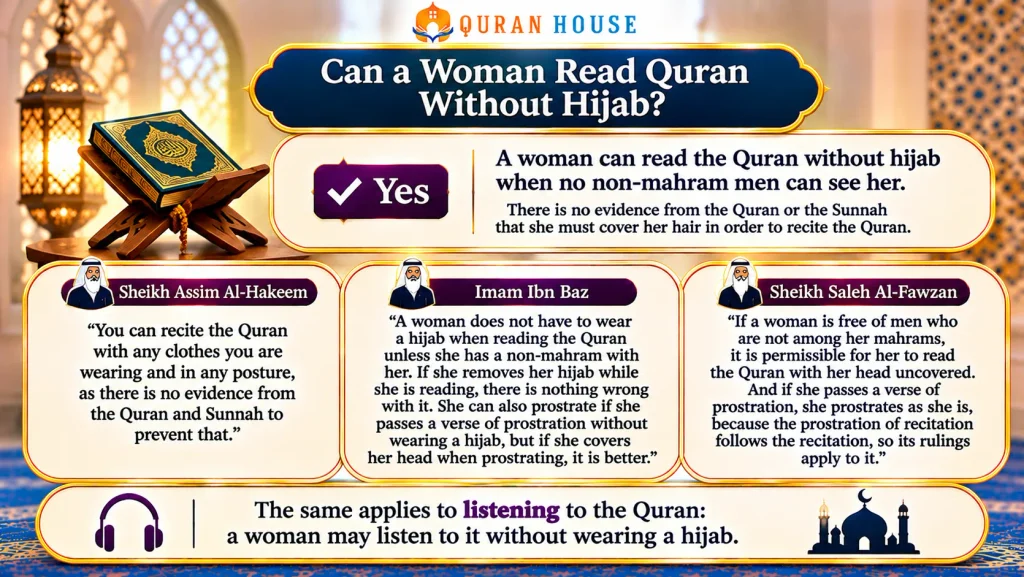
Sheikh Assim Al-Hakeem says: You can recite the Quran with any clothes you are wearing and in any posture, as there is no evidence from the Quran and Sunnah to prevent that.
Imam Ibn Baz says: A woman does not have to wear a hijab when reading the Quran unless she has a non-mahram with her, and if she removes her hijab while she is reading, there is nothing wrong with it. She can also prostrate if she passes a verse of prostration without wearing a hijab, but if she covers her head when prostrating, it is better.
Sheikh Saleh Al-Fawzan says: If a woman is free of men who are not among her mahrams, it is permissible for her to read the Quran with her head uncovered.
And if she passes a verse of prostration, she prostrates as she is, because the prostration of recitation follows the recitation, so its rulings apply to it.The same applies to listening to the Quran: a woman may listen to it without wearing a hijab.
Is Hijab Required for Reading the Quran?
No, the hijab is not a condition for reading the Quran. According to Shaykh Ibn Uthaymin: “Reciting the Quran does not require covering the head with hijab.”
However, wearing modest clothing while reciting is recommended out of respect for the sacredness of the Quran. A woman who chooses to cover her head while reading does a good thing, but she is not sinful if she reads without it in private.
It is important to distinguish between the conditions of reciting the Quran and the requirements of Salah. Covering the hair is required for a Muslim woman during prayer, but it is not a prerequisite for ordinary Quran recitation outside prayer. Therefore, a woman can read from a Mushaf or a Quran application without wearing a hijab, provided she observes the other relevant rulings.
Can I Read the Quran on My Phone Without Hijab?
Yes. Sheikh Muhammad Al-Asadi was asked whether it is okay to read the Quran on electronic devices without wearing a hijab, and he answered that it is correct to read the Quran from the phone or other electronic devices without wudu’ or wearing a hijab, and that there is a reward for that.
Sheikh Othman Al-Khamees says: A person will be rewarded for reading the Quran, whether from a Mushaf, a phone, an iPad, a computer, or from memory, and all good deeds are multiplied tenfold. Some scholars mention that reading from the Mushaf itself has extra merit, but reading by any means is far better than not reading at all. Allah says:
﴿فَاقْرَءُوا مَا تَيَسَّرَ مِنَ الْقُرْآنِ﴾
“So recite what is easy for you of the Quran.”
How Is the Hijab Viewed in Islamic Tradition?
In the early days of Islam, the word hijab also referred to a curtain or barrier placed between men and the wives of Prophet Muhammad ﷺ when they spoke to each other. Over time, the word came to describe the modest covering that Muslim women wear.
The hijab is also considered a form of protection and dignity for women. The Quran instructs believing women to cover themselves and dress modestly, so that they are recognized as believers. Allah says:
﴿وَقُل لِّلْمُؤْمِنَاتِ يَغْضُضْنَ مِنْ أَبْصَارِهِنَّ وَيَحْفَظْنَ فُرُوجَهُنَّ وَلَا يُبْدِينَ زِينَتَهُنَّ إِلَّا مَا ظَهَرَ مِنْهَا ۖ وَلْيَضْرِبْنَ بِخُمُرِهِنَّ عَلَىٰ جُيُوبِهِنَّ﴾
“And tell the believing women to lower their gaze, guard their chastity, and not reveal their adornment except what normally appears of it, and to draw their head coverings over their chests.”
Allah also says:
﴿يَا أَيُّهَا النَّبِيُّ قُل لِّأَزْوَاجِكَ وَبَنَاتِكَ وَنِسَاءِ الْمُؤْمِنِينَ يُدْنِينَ عَلَيْهِنَّ مِن جَلَابِيبِهِنَّ ۚ ذَٰلِكَ أَدْنَىٰ أَن يُعْرَفْنَ فَلَا يُؤْذَيْنَ ۗ وَكَانَ اللَّهُ غَفُورًا رَّحِيمًا﴾
“O Prophet, tell your wives, your daughters, and the women of the believers to draw their outer garments over themselves. That is more suitable so that they will be known and not be harmed. And Allah is Forgiving and Merciful.”
Ibn Kathir explained that the jilbab distinguished the believing women, so that they would be recognized and protected from harassment. You can read more about the surahs that address these themes in our article on the surahs that talk about hijab and the names of Allah.
Inside an Interactive One-on-One Session
Every class is live and personal. See how our tutor uses on-screen tools, quick reviews, and gentle correction to help a student build confidence with every new word.
Start Your Quran Journey With Quran House
Learn live and one-on-one with Al-Azhar-trained tutors, male and female, for children and adults, at a time that fits your timezone.
Try a Free SessionUnderstanding Hijab in Islam
The word hijab appears several times in the Quran, with the meaning of a curtain or barrier, anything that hides or protects something. But the meaning of hijab in Islam is broader, as it covers the Islamic rules of modesty in dress and behavior.
What Is the Definition and Purpose of Hijab in Islam?
The most common meaning of the hijab today is the head covering that many Muslim women wear. It is an essential part of Islamic dress and is obligatory for Muslim women who have reached puberty, in the presence of men who are not their mahrams. The word used for the head covering in the Quran is khimar (خِمار).
It protects a woman’s dignity by covering her body, and women are advised to wear clothing that is loose rather than form-fitting. The majority of scholars hold that a woman covers her whole body except her face and hands in front of non-mahram men, while other scholars hold that the face should also be covered, which is why some Muslim women wear the niqab.
The purpose of the hijab is to fulfill the requirement of modesty laid down in the Holy Quran. Modesty is an essential characteristic for both men and women, and the hijab is one way women maintain it. Wearing it is an act of obedience to Allah, and it shifts the focus from external appearance to inner qualities and values.
What Are the Etiquettes of Reciting the Quran for Women?
In Islam, men and women are equally encouraged to recite and memorize the Holy Quran. The purpose of recitation is to seek a deeper understanding of the sacred text, reflect on its meanings, and apply its teachings.
Scholars mention several recommended etiquettes for reciting the Quran: being in a state of purity, facing the Qibla when possible, sitting in a respectful way, and being away from distractions.
These are recommendations that perfect the recitation, not conditions without which it is invalid. Many people also ask whether reciting silently counts, a question we answer in our guide on whether you can read the Quran in your head.
What Is the Significance of Reading, Listening to, and Reciting the Quran in Islam?
In Islam, reading, listening to, and reciting the Quran hold immense significance, which is why no woman should let a question about her clothing keep her away from it.
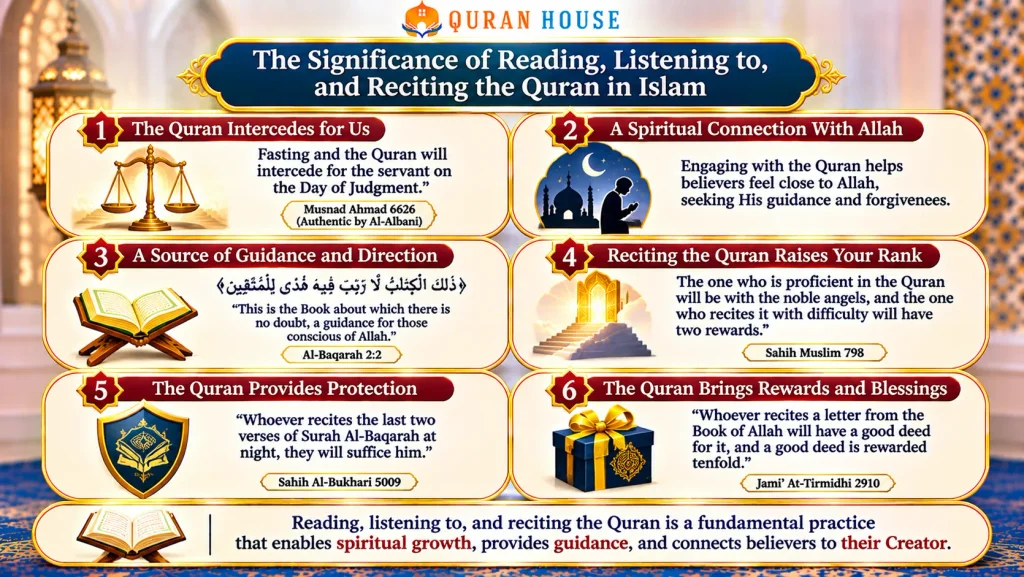
Here are some of the reasons, from the Quran and the authentic Sunnah:
The Quran Intercedes for Us on the Day of Judgment
’Abdullah ibn ’Amr narrated that the Prophet ﷺ said that fasting and the Quran will intercede for a person on the Day of Judgment:
«الصِّيَامُ وَالْقُرْآنُ يَشْفَعَانِ لِلْعَبْدِ يَوْمَ الْقِيَامَةِ، يَقُولُ الصِّيَامُ: أَيْ رَبِّ، مَنَعْتُهُ الطَّعَامَ وَالشَّهَوَاتِ بِالنَّهَارِ فَشَفِّعْنِي فِيهِ، وَيَقُولُ الْقُرْآنُ: مَنَعْتُهُ النَّوْمَ بِاللَّيْلِ فَشَفِّعْنِي فِيهِ، فَيُشَفَّعَانِ»
“Fasting and the Quran will intercede for the servant on the Day of Judgment. Fasting will say: My Lord, I prevented him from food and desires during the day, so let me intercede for him. And the Quran will say: I prevented him from sleep at night, so let me intercede for him. And their intercession will be accepted.”
(Musnad Ahmad 6626, graded authentic by Al-Albani)
Establishing a Spiritual Connection With Allah
Engaging with the Quran helps believers establish a profound spiritual connection with Allah. Reciting and reflecting on its verses allows Muslims to feel close to Him, seeking His guidance and forgiveness.
A Source of Guidance and Direction
The Quran serves as a source of guidance for Muslims. It clarifies moral and legal matters and helps believers live according to the teachings of Islam. Allah sent His book to guide humanity to happiness in this world and the Hereafter:
﴿ذَٰلِكَ الْكِتَابُ لَا رَيْبَ ۛ فِيهِ ۛ هُدًى لِّلْمُتَّقِينَ﴾
“This is the Book about which there is no doubt, a guidance for those conscious of Allah.”
Reciting the Quran Raises Your Rank, Even If It Is Difficult for You
The Prophet ﷺ promised a great reward for those who recite the Quran, whether they recite it fluently or with difficulty:
«الْمَاهِرُ بِالْقُرْآنِ مَعَ السَّفَرَةِ الْكِرَامِ الْبَرَرَةِ، وَالَّذِي يَقْرَأُ الْقُرْآنَ وَيَتَتَعْتَعُ فِيهِ، وَهُوَ عَلَيْهِ شَاقٌّ، لَهُ أَجْرَانِ»
“The one who is proficient in the Quran will be with the noble and righteous angels, and the one who recites the Quran and stumbles over it, finding it difficult, will have two rewards.”
This hadith encourages every woman who finds reading difficult to keep going, and our online Tajweed classes help you move from struggling to reading fluently.
The Quran Provides Protection
The Quran protects Muslims from evil and harm, and some of its verses are recited specifically for protection. The Prophet ﷺ said:
«مَنْ قَرَأَ بِالْآيَتَيْنِ مِنْ آخِرِ سُورَةِ الْبَقَرَةِ فِي لَيْلَةٍ كَفَتَاهُ»
“Whoever recites the last two verses of Surah Al-Baqarah at night, they will suffice him.”
The Quran Brings Rewards and Blessings
The more one recites the Quran, the greater the reward. ’Abdullah ibn Mas’ud narrated that the Prophet ﷺ said:
«مَنْ قَرَأَ حَرْفًا مِنْ كِتَابِ اللَّهِ فَلَهُ بِهِ حَسَنَةٌ، وَالْحَسَنَةُ بِعَشْرِ أَمْثَالِهَا، لَا أَقُولُ الم حَرْفٌ، وَلَكِنْ أَلِفٌ حَرْفٌ، وَلَامٌ حَرْفٌ، وَمِيمٌ حَرْفٌ»
“Whoever recites a letter from the Book of Allah will have a good deed for it, and a good deed is rewarded tenfold. I do not say that Alif-Lam-Mim is one letter; rather, Alif is a letter, Lam is a letter, and Mim is a letter.”
Reading, listening to, and reciting the Quran is a fundamental practice that enables spiritual growth, provides guidance, and connects believers to their Creator.
Practical Considerations for Reading in Different Settings
Scholars agree that the hijab is not a condition for reciting the Quran in private. What changes the ruling is the setting: whether a woman is alone at home, with her mahram family, or in a place where non-mahram men can see her, where the usual rules of hijab apply regardless of what she is doing.
Distinguishing between private recitation, where comfort and consistency matter most, and mixed settings, where the general rules of modesty naturally apply, helps make daily recitation easy and sustainable. If you have a specific situation, asking a knowledgeable scholar is always a good step.
Practical Tips for Building a Comfortable Recitation Habit
These simple tips help you keep a daily connection with the Quran without letting this question hold you back:
- Recite freely at home without hijab when no non-mahram men are present.
- Cover your head if you like when reciting or prostrating, as an act of respect, without feeling obliged to.
- Focus on building consistency in daily recitation rather than becoming preoccupied with this question.
- Ask a knowledgeable scholar about any specific situation you face.
Learning Through Play: A Live Kids Class
Young learners stay focused when lessons feel like a game. Watch a real Quran House class where interactive activities and a patient tutor keep a child engaged, reciting, and smiling from start to finish.
Start Your Quran Journey With Quran House
Learn live and one-on-one with Al-Azhar-trained tutors, male and female, for children and adults, at a time that fits your timezone.
Try a Free SessionLearn the Quran Comfortably With a Female Teacher at Quran House
Many sisters hesitate to join online Quran classes because they are not sure whether they need to wear hijab during the lesson. Learning with a female teacher removes this concern completely, so you can focus on your recitation at home, in comfort and privacy.
At Quran House, sisters can learn with a female Quran, Tajweed, and Arabic teacher trained at Al-Azhar, in live one-to-one sessions built around their level and schedule.
Whether you are starting to read the Quran for the first time or perfecting your Tajweed, you will have a trusted teacher by your side at every step.
Explore Our Arabic and Islamic Courses:
- Quran and Arabic Classes for Kids
- Quranic Arabic Course
- Quranic Arabic for Beginners
- Quran Tafseer Course for All Levels
- Quran Tafseer for Kids
- Understand the Quran Course
- Ijazah Course for Sisters

Final Thoughts
Reading Quran without hijab is allowed for a woman when no non-mahram men are present, as explained by scholars such as Ibn Baz, Ibn Uthaymin, and Al-Fawzan. The same applies to listening to the Quran, reading it on a phone, and making the prostration of recitation, while covering the head remains a recommended act of respect.
The Quran is a source of intercession, guidance, protection, and immense reward, so no woman should let a question about her clothing keep her away from it. Recite it daily, in whatever state you are in at home, and use a trusted source such as Quran.com to follow the Arabic text and its translation.
FAQs
Do I Have To Cover My Head While Reading the Quran?
No, you do not have to cover your head while reading the Quran, except in the presence of non-mahram men, though some women choose to as a sign of respect.
Does a Woman Have To Wear Hijab for Sajdah At-Tilawah?
No, Shaykh Ibn Uthaymin said that the prostration of recitation can be done even with the head uncovered, because it is not subject to the rulings of prayer.
Can I Listen to the Quran Without Hijab?
Yes, a woman may listen to the Quran without wearing a hijab, just as she may recite it.
Is Reading the Quran on a Device Rewarded Like Reading From the Mushaf?
Yes, reading the Quran from a phone or any device is rewarded, and every letter carries its reward, though some scholars mention extra merit for reading from the Mushaf itself.
Does the Setting of Recitation Affect This Ruling?
Yes, the hijab is only required when non-mahram men can see you, so the ruling depends on where you are, not on the act of reciting.