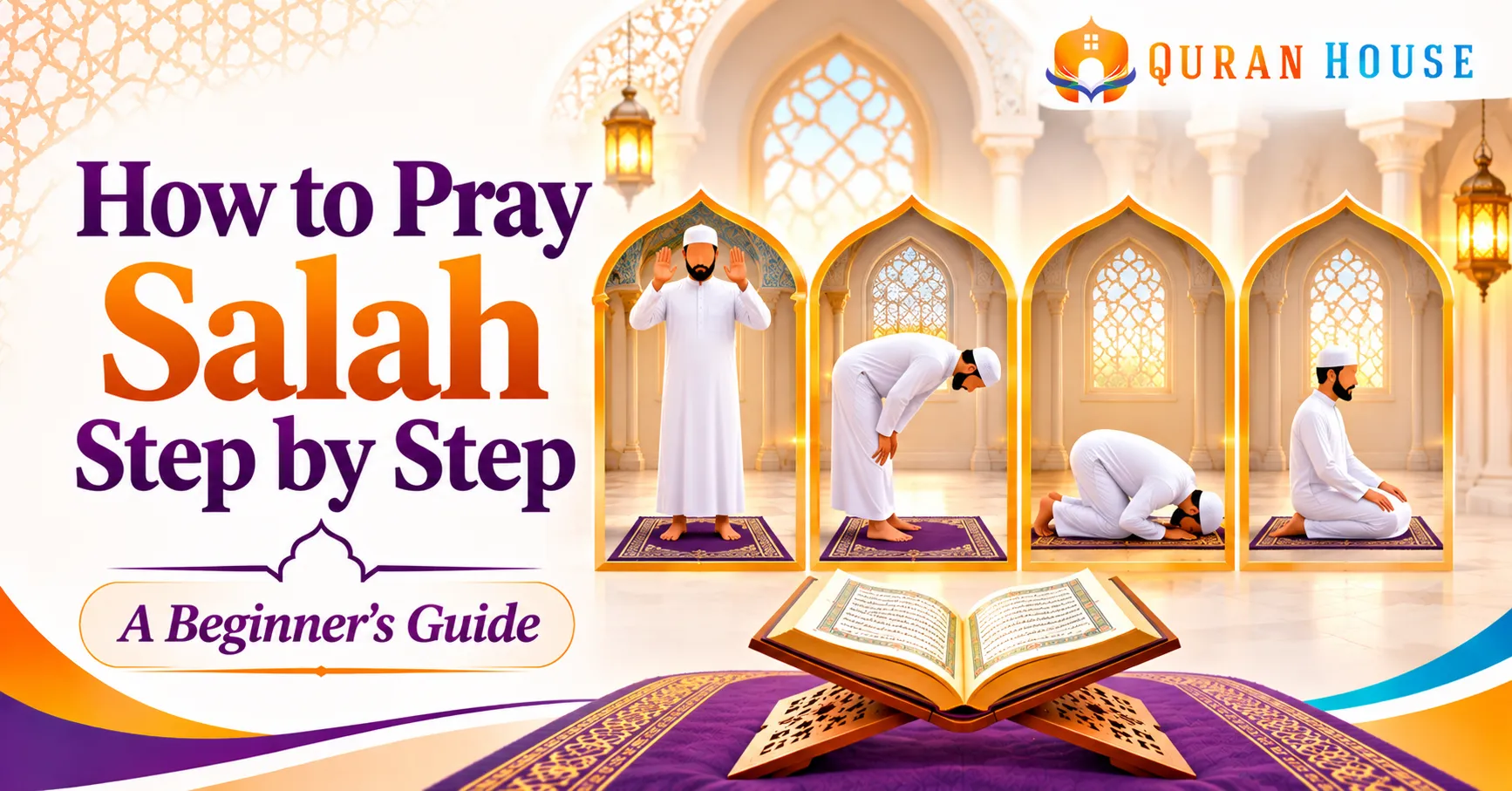
Learning how to pray salah is one of the most important steps in every Muslim’s life, whether you have just embraced Islam, are teaching your children, or want to make sure the prayer you have offered for years is correct. Salah is the second pillar of Islam and a direct meeting between you and Allah, five times every day.
The good news is that Salah is easier to learn than it looks. Every rakah follows the same pattern of standing, reciting, bowing, and prostrating, so once you master one rakah with its words, you can pray all five daily prayers with confidence, insha’Allah.
In this guide, we walk you through how to pray salah step by step, with the exact words to say in each position in Arabic, their transliteration, and their meaning, all taken from the authentic Sunnah.
After the steps, we answer the most common questions about praying in different situations, such as praying while sick or traveling.
Step 1: Make the Intention, Face the Qibla, and Say Allahu Akbar
Stand up straight facing the Qibla, with the intention in your heart of the specific prayer you are about to perform, such as the Dhuhr or Maghrib prayer. The intention does not need to be said out loud; it is enough to know in your heart which prayer you are starting.
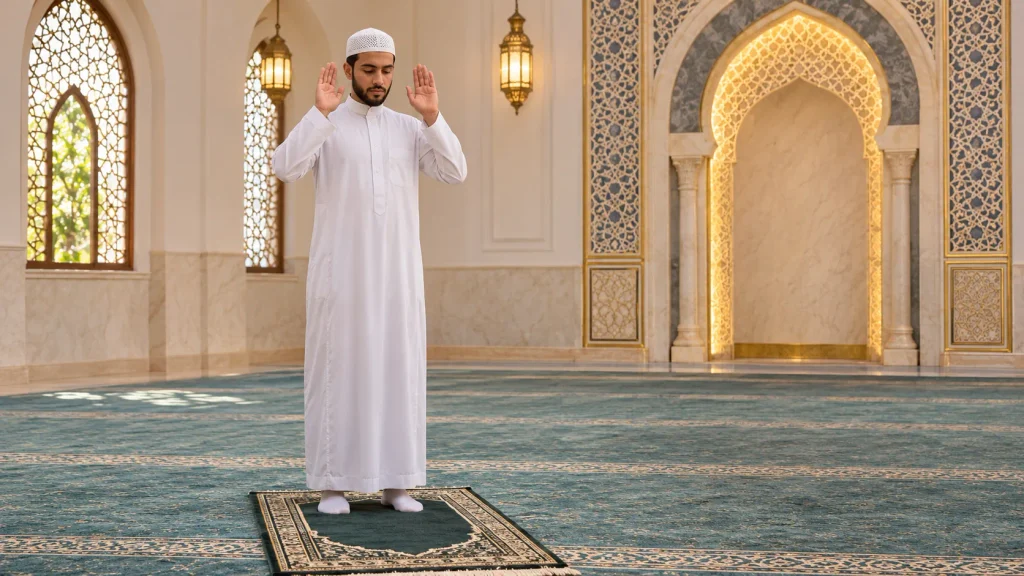
Raise your hands to the level of your ears or shoulders and say “Allahu Akbar” (اللَّهُ أَكْبَرُ), meaning “Allah is the Greatest.” This first Takbeer is called Takbeerat Al-Ihram because it begins the prayer, and from this moment talking, eating, and turning away are not allowed until the Tasleem.
Step 2: Place Your Hands on Your Chest and Recite the Opening Dua
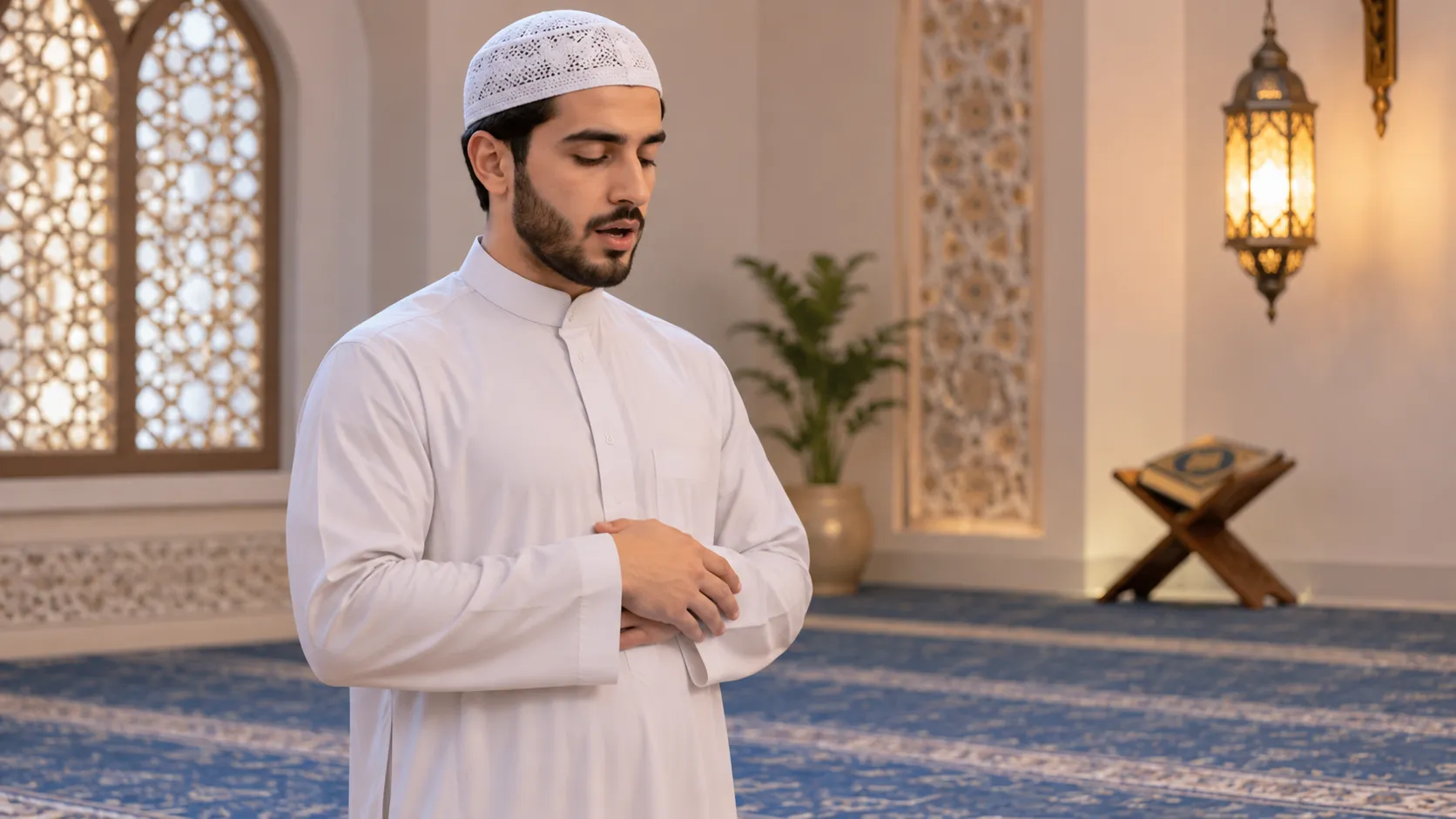
After the first Takbeer, place your right hand over your left hand on your chest and keep your eyes on the place of prostration. Then say the opening dua quietly, as the Prophet ﷺ used to pause briefly after the Takbeer and say:
«اللَّهُمَّ بَاعِدْ بَيْنِي وَبَيْنَ خَطَايَايَ كَمَا بَاعَدْتَ بَيْنَ الْمَشْرِقِ وَالْمَغْرِبِ، اللَّهُمَّ نَقِّنِي مِنَ الْخَطَايَا كَمَا يُنَقَّى الثَّوْبُ الْأَبْيَضُ مِنَ الدَّنَسِ، اللَّهُمَّ اغْسِلْ خَطَايَايَ بِالْمَاءِ وَالثَّلْجِ وَالْبَرَدِ»
“O Allah, distance me from my sins as You have distanced the east from the west. O Allah, cleanse me of sins as a white garment is cleansed of dirt. O Allah, wash away my sins with water, snow, and hail.”
This is one of several opening duas taught in the Sunnah, and you may use any of them. Its meaning is a beautiful start to the prayer: before you recite a single verse, you ask Allah to purify you from your sins so that you stand before Him clean.
Step 3: Recite Surah Al-Fatihah, Then a Short Surah
Seek refuge with Allah from Satan, say the Basmala, then recite Surah Al-Fatihah and say “Ameen” at its end. After that, recite a few verses or a short surah of your choice. Al-Fatihah is recited in every rakah, while the extra surah is recited in the first two rakahs only.
Because Al-Fatihah is a pillar of every rakah, mistakes in its pronunciation affect the whole prayer, so it is worth learning to recite it correctly. Our online Tajweed classes help you perfect every letter of Al-Fatihah and the short surahs with a qualified teacher.

Step 4: Bow in Rukou and Say Subhana Rabbiya Al-Azeem
Say “Allahu Akbar” and bow down, placing your hands on your knees with your fingers spread. Keep your back straight and level with your head, without raising or lowering it, and stay still in this position for a moment before saying the dhikr.
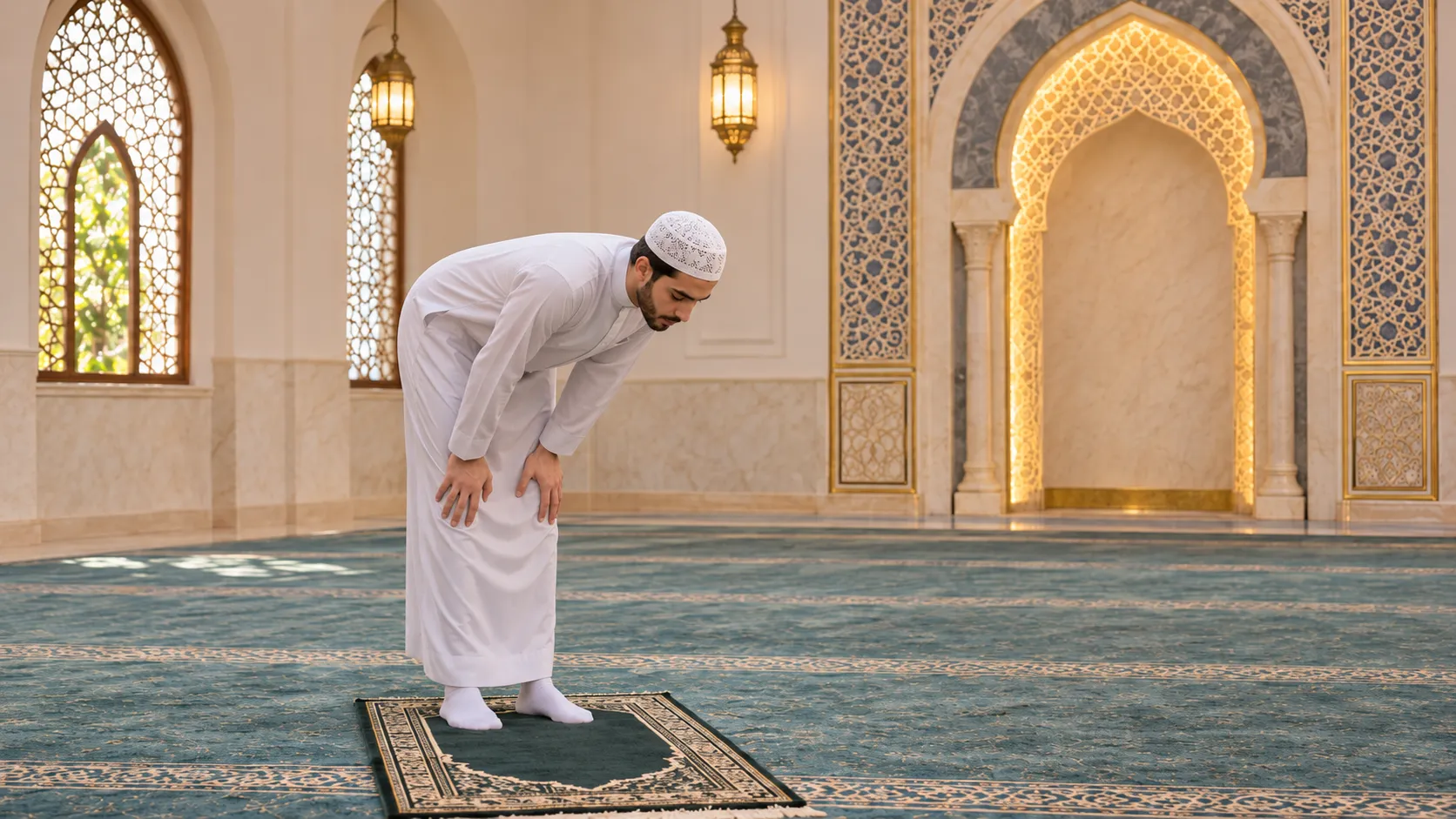
In Rukou, say “Subhana Rabbiya Al-Azeem” (سُبْحَانَ رَبِّيَ الْعَظِيمِ) at least one time, which means “Glory be to my Lord, the Most Great.” It is recommended to repeat it three times or more, calmly, as rushing through Rukou takes away from the tranquility the prayer requires.
Step 5: Rise From Rukou Saying Sami’a Allahu Liman Hamidah
Rise from Rukou to a standing position while saying “Sami’a Allahu Liman Hamidah” (سَمِعَ اللَّهُ لِمَنْ حَمِدَهُ), which means “Allah hears the one who praises Him.” Raise your hands as you did in the first Takbeer, and stand up fully straight.
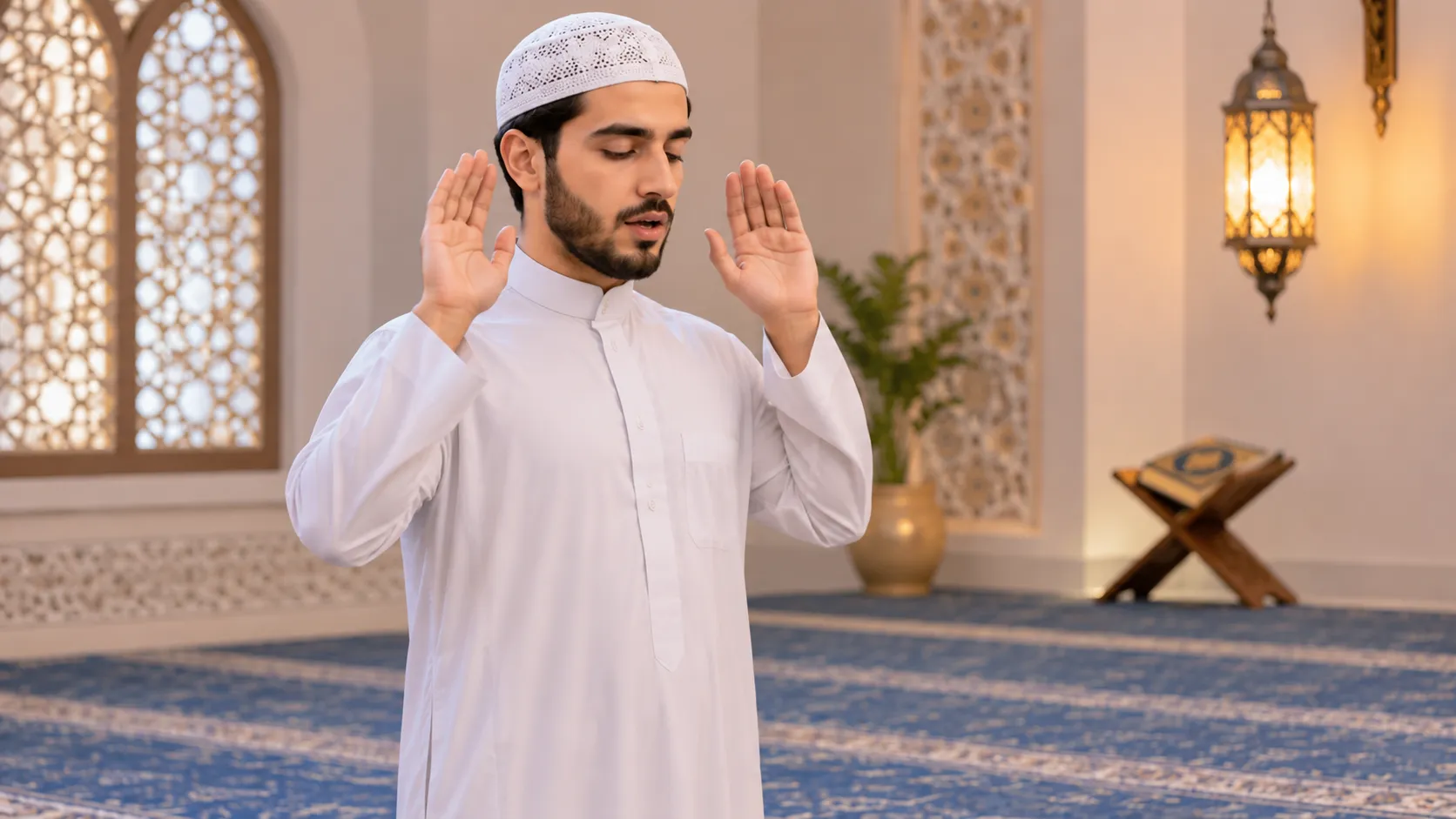
When you are fully standing, say “Rabbana Wa Laka Al-Hamd” (رَبَّنَا وَلَكَ الْحَمْدُ), meaning “Our Lord, all praise is Yours.” Stay standing until your body settles completely before going down, because standing still after Rukou is part of performing the prayer correctly.
Step 6: Prostrate in Sujood and Say Subhana Rabbiya Al-A’la
Say “Allahu Akbar” and go down into Sujood, with your forehead, nose, both palms, both knees, and the toes of both feet touching the ground. Keep your arms away from your sides and off the floor, and point your fingers and toes toward the Qibla.
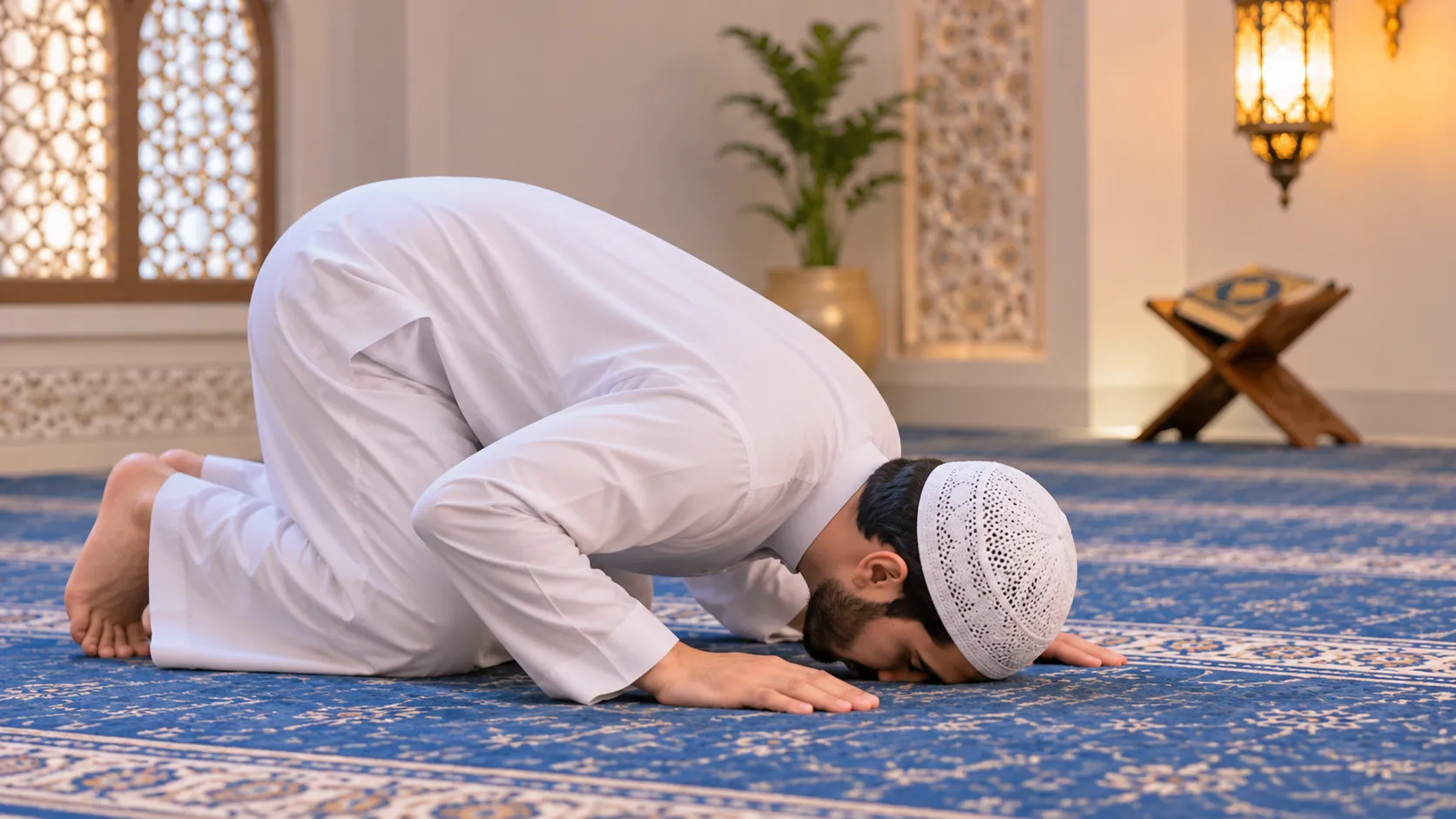
In Sujood, say “Subhana Rabbiya Al-A’la” (سُبْحَانَ رَبِّيَ الْأَعْلَى) at least one time, which means “Glory be to my Lord, the Most High.” Sujood is the position of greatest humility before Allah, and many Muslims add their own supplications here after the required dhikr.
Step 7: Sit Between the Two Prostrations and Ask Allah for Forgiveness
Say “Allahu Akbar” and rise from Sujood to a sitting position. Sit on your left foot with your right foot upright and its toes pointing toward the Qibla, and place your hands on your thighs or knees.
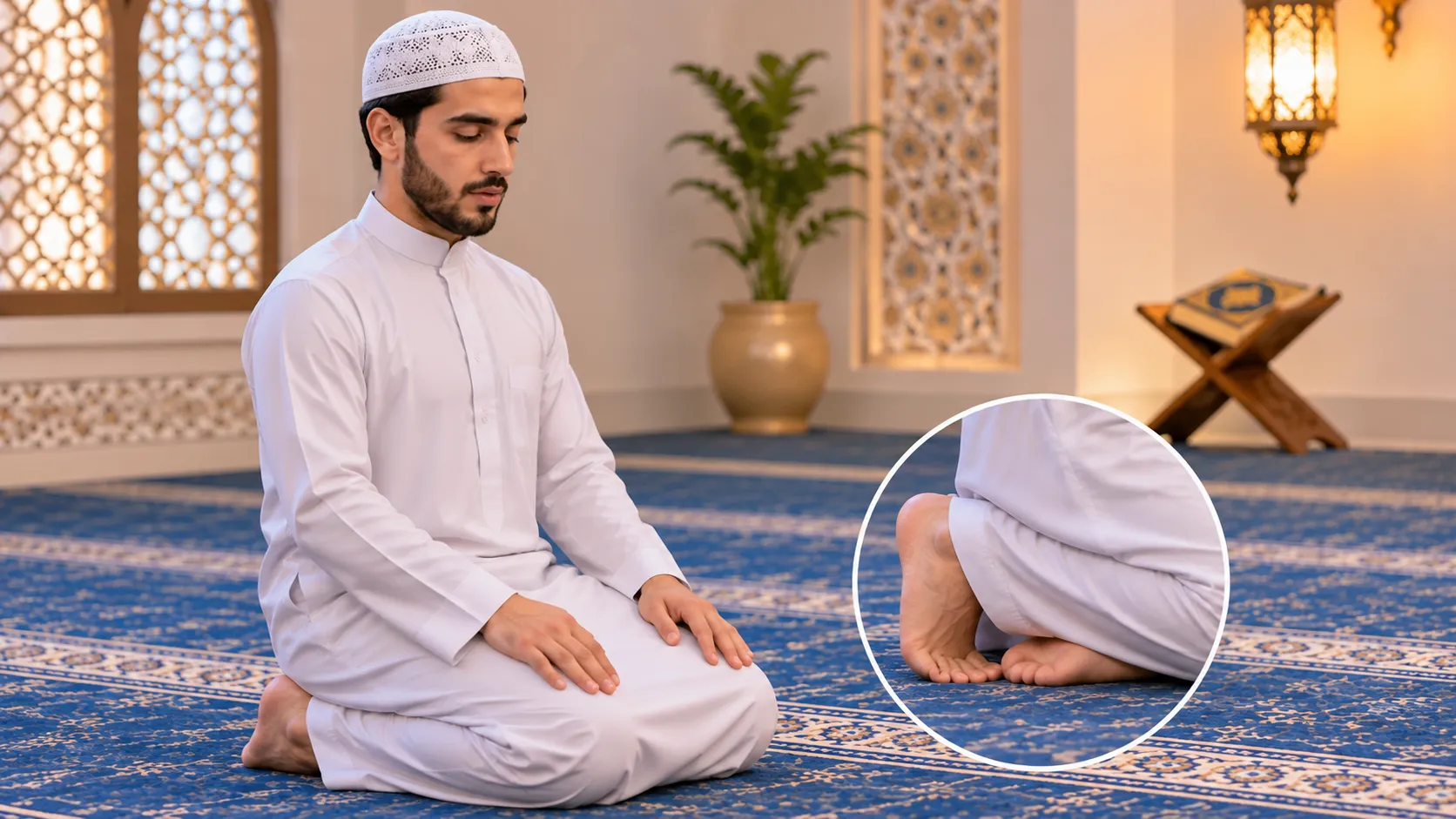
In this sitting, supplicate by saying “Rabbi Ighfir li” (رَبِّ اغْفِرْ لِي), which means “My Lord, forgive me,” and you may repeat it more than once. Sit calmly until your body settles before moving to the next prostration, as rushing this short sitting is a common mistake among beginners.
Step 8: Perform the Second Sujood To Complete the Rakah
Say “Allahu Akbar” and perform a second Sujood exactly like the first one. Place your forehead, nose, hands, knees, and toes on the ground in the same way, and say “Subhana Rabbiya Al-A’la” at least one time.
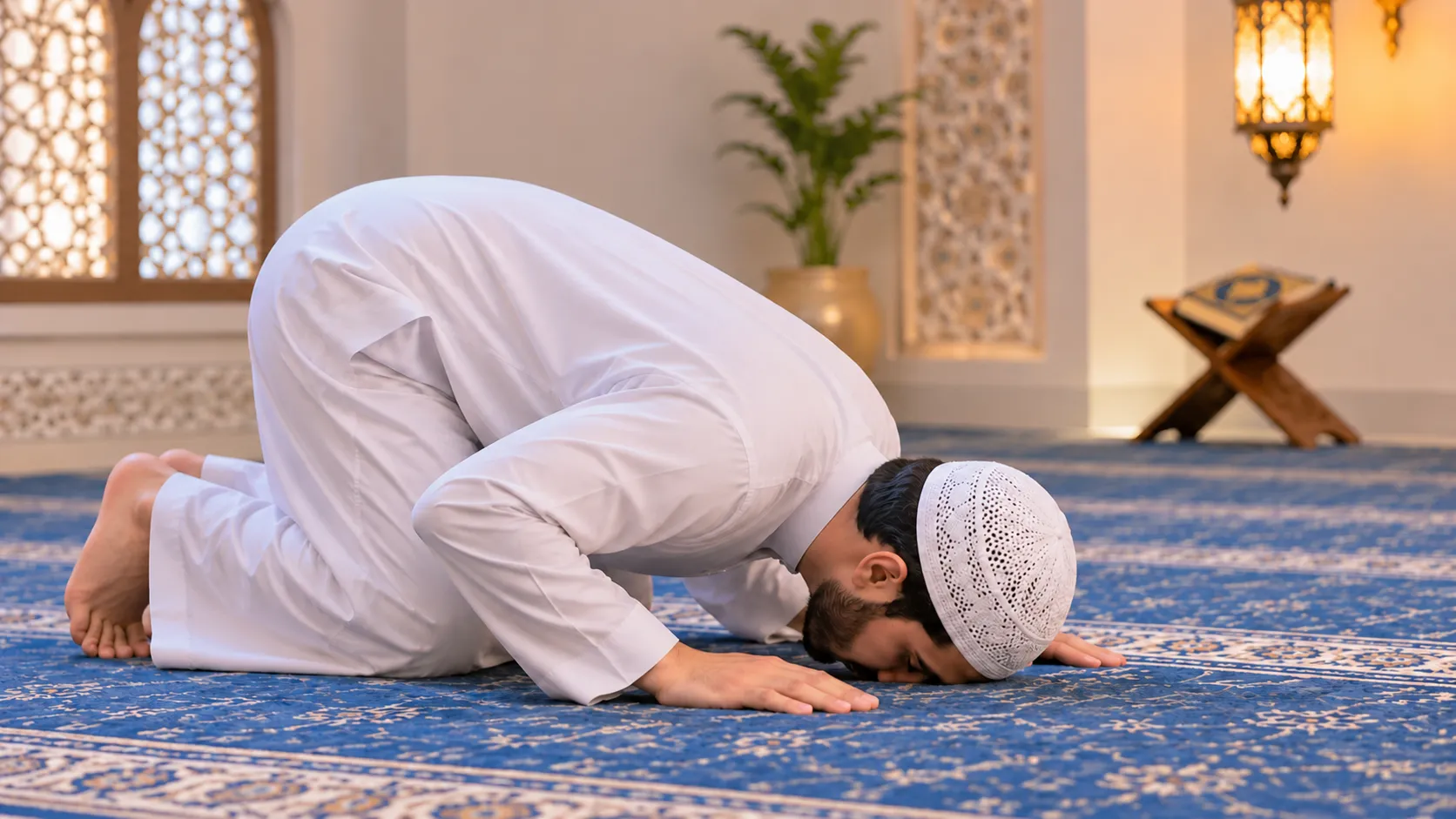
With this second Sujood, you have completed one full rakah of the prayer: standing, recitation, Rukou, rising, two prostrations, and the sitting between them. Every rakah of the prayer follows this same pattern, which makes Salah easy to learn once you master the first one.
Step 9: Stand Up for the Next Rakah or Sit for the Tashahhud
If you have finished the first or the third rakah, say “Allahu Akbar” and stand up again to repeat the steps from Al-Fatihah. However, if you have finished the second rakah of a longer prayer or the last rakah of any prayer, sit for the Tashahhud instead.
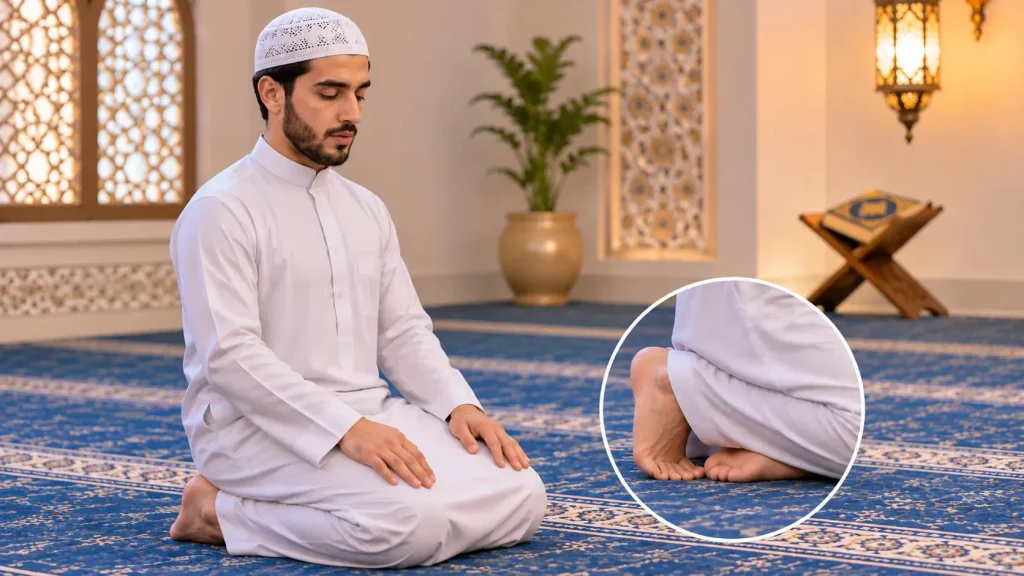
Since the Maghrib prayer is only 3 rakahs, we sit for the final Tashahhud after the third rakah. Remember also that in the third and the fourth rakahs, we recite Surah Al-Fatihah only during Qiyam, without adding another surah.
Step 10: Sit for the Middle Tashahhud After the Second Rakah
After the second rakah of a three- or four-rakah prayer, sit in the same way as between the two prostrations.
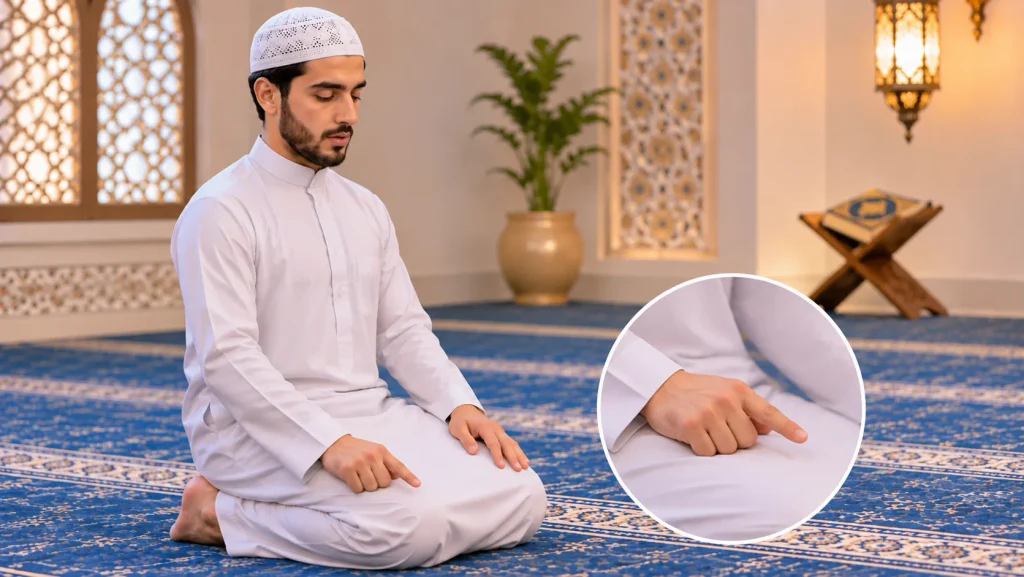
Place your right hand on your right thigh, point with your index finger, and recite the middle Tashahhud as the Prophet ﷺ taught:
«التَّحِيَّاتُ لِلَّهِ وَالصَّلَوَاتُ وَالطَّيِّبَاتُ، السَّلَامُ عَلَيْكَ أَيُّهَا النَّبِيُّ وَرَحْمَةُ اللَّهِ وَبَرَكَاتُهُ، السَّلَامُ عَلَيْنَا وَعَلَى عِبَادِ اللَّهِ الصَّالِحِينَ، أَشْهَدُ أَنْ لَا إِلَهَ إِلَّا اللَّهُ، وَأَشْهَدُ أَنَّ مُحَمَّدًا عَبْدُهُ وَرَسُولُهُ»
“Attahiyyatu lillahi wassalawatu wattayyibat, assalamu ’alayka ayyuhan-Nabiyyu wa rahmatullahi wa barakatuh, assalamu ’alayna wa ’ala ’ibadillahis-salihin. Ash-hadu an la ilaha illallah, wa ash-hadu anna Muhammadan ’abduhu wa rasuluh.”
The Prophet ﷺ explained in the same hadith that when you say “peace be upon us and upon the righteous servants of Allah,” it reaches every righteous servant of Allah in the heavens and the earth. In a two-rakah prayer like Fajr, you skip this step and go directly to the final Tashahhud.
If you are starting your journey in Islam, our guide on how to learn Islam step by step is a helpful next read. Here are the steps of Salah in order, from the first Takbeer to the final Tasleem.
Step 11: Recite the Final Tashahhud and Send Salawat on the Prophet ﷺ
In the last rakah of the prayer, which is the 2nd rakah of Fajr, the 3rd of Maghrib, or the 4th of any other prayer, sit and recite the same Tashahhud. Then add the Ibrahimi Salawat on Prophet Muhammad ﷺ:
«اللَّهُمَّ صَلِّ عَلَى مُحَمَّدٍ وَعَلَى آلِ مُحَمَّدٍ، كَمَا صَلَّيْتَ عَلَى إِبْرَاهِيمَ وَعَلَى آلِ إِبْرَاهِيمَ، إِنَّكَ حَمِيدٌ مَجِيدٌ، اللَّهُمَّ بَارِكْ عَلَى مُحَمَّدٍ وَعَلَى آلِ مُحَمَّدٍ، كَمَا بَارَكْتَ عَلَى إِبْرَاهِيمَ وَعَلَى آلِ إِبْرَاهِيمَ، إِنَّكَ حَمِيدٌ مَجِيدٌ»
“O Allah, send prayers upon Muhammad and the family of Muhammad, as You sent prayers upon Ibrahim and the family of Ibrahim; You are Praiseworthy, Glorious. O Allah, bless Muhammad and the family of Muhammad, as You blessed Ibrahim and the family of Ibrahim; You are Praiseworthy, Glorious.”
After the Salawat, you may make any dua you wish for this life and the Hereafter before ending the prayer. This moment, just before the Tasleem, is a valuable time for supplication, so take a few seconds to ask Allah for what you need.
Step 12: End the Prayer With Tasleem to the Right and Left
End the prayer by turning your head to the right and saying “Assalamu ’alaykum wa rahmatullah” (السَّلَامُ عَلَيْكُمْ وَرَحْمَةُ اللَّهِ), which means “Peace and the mercy of Allah be upon you.” Then turn your head to the left and say the same words.
With the Tasleem, your prayer is complete, and you are free to talk and move again. It is a Sunnah to stay seated for a few moments after the prayer to seek Allah’s forgiveness and remember Him with the adhkar that follow Salah.
Memorizing Surah Ad-Duha in Class
Memorization is easier with structure. See how a student reviews and recites Surah Ad-Duha in a live lesson, guided by a tutor who follows every step of their progress.
Start Your Quran Journey With Quran House
Learn live and one-on-one with Al-Azhar-trained tutors, male and female, for children and adults, at a time that fits your timezone.
Try a Free SessionWhat Is Salah in Islam?
Linguistically, Salah means supplication. In Islam, it is the act of worship that begins with Takbeer and ends with Tasleem, and it is the Muslim’s daily connection with Allah.
Salah starts with Takbeer (saying Allahu Akbar) and ends with Tasleem (saying assalamu alaykum wa rahmatullah). In between Takbeer and Tasleem, Muslims should not talk to one another, eat, drink, or turn away from the Qibla.
Salah is the second pillar of Islam after the Shahadah, owing to its great importance and high status, and it is the believer’s daily connection with Allah (SWT).
How Many Salahs Are There During the Day and Night?
There are five Salahs during the day and night: Fajr, Dhuhr, Asr, Maghrib, and Ishaa. It was narrated in the hadith of the Night Journey that Allah (SWT) obliged 50 prayers daily at first. However, by Allah’s mercy, it was reduced to 5 prayers a day, which carry the reward of 50 prayers (Sahih Al-Bukhari 349).
How Many Rakats Are There in Each Prayer?
The number of rakats varies among the five daily prayers:
- Fajr: 2 rakats
- Dhuhr: 4 rakats
- Asr: 4 rakats
- Maghrib: 3 rakats
- Ishaa: 4 rakats
This adds up to 17 obligatory rakats every day. In Fajr, Maghrib, and Ishaa, the recitation in the first two rakats is said aloud when praying in congregation, while in Dhuhr and Asr, and in the third and fourth rakats of the other prayers, the recitation is silent.
How Long Do Muslims Pray For?
A single prayer can vary in length from one Muslim to another, and from one salah to another. It can be lengthened with more Quran recitation and dua, and it can be shortened to the least required dhikr and Quran recitation. All in all, a single Salah can be as short as five to six minutes.
What matters most is not the length of the prayer but its calmness and correctness. The Prophet ﷺ also taught that the one leading others should keep the prayer light, while the one praying alone may lengthen it as he wishes:
«إِذَا صَلَّى أَحَدُكُمْ لِلنَّاسِ فَلْيُخَفِّفْ، فَإِنَّ مِنْهُمُ الضَّعِيفَ وَالسَّقِيمَ وَالْكَبِيرَ، وَإِذَا صَلَّى أَحَدُكُمْ لِنَفْسِهِ فَلْيُطَوِّلْ مَا شَاءَ»
“When one of you leads the people in prayer, let him keep it light, for among them are the weak, the sick, and the elderly. And when one of you prays alone, let him lengthen it as he wishes.”
This hadith shows the mercy of the Sunnah: the imam considers the needs of those behind him, and each person alone can give the prayer as much time as his heart desires.
What Do We Do Before Salah?
Before we start Salah with the Takbeer, we do a set of deeds in advance so that the salah is valid, insha’Allah.
- Have the intention to perform a specific prayer for the sake of Allah (SWT).
- Make sure you are pure of impurities and wash any of them away.
- Perform ablution (Wudu’).
- Dress properly for Salah. Men must cover at least from the navel to the knees, and it is recommended to cover the shoulders as well, while women cover the whole body except the face and hands.
- Face the Qibla (the direction of the Kaaba).
- Pray within the time of the specific prayer, as praying on time is a condition for Salah to be valid. Allah says:
﴿إِنَّ الصَّلَاةَ كَانَتْ عَلَى الْمُؤْمِنِينَ كِتَابًا مَّوْقُوتًا﴾
“Indeed, prayer has been decreed upon the believers at specified times.”
This verse shows that each prayer has its own time, and a prayer delayed beyond its time without an excuse is a serious sin.
What Do You Say During Salah?
During Salah, we recite the Quran, say specific dhikr, make dua, and send Salawat on Prophet Muhammad ﷺ. Each one of these is recited or said at a specific time during Salah, as explained in the step-by-step section above.
How To Pray Salah for Females?
Praying Salah for females is not different from that of males in terms of actions, duas, Quran recitation, and so on. However, a woman should be fully covered and should pray behind men in congregational (Jama’ah) prayer.
A woman cannot lead men in prayer, yet she can lead a group of women in prayer.
How To Pray Salah Sitting on a Chair or on the Floor?
Standing up while praying is a fundamental act in obligatory prayer as long as a Muslim is able to stand. However, if a Muslim is unable to stand, or standing causes him harm due to illness, he has an excuse to sit on a chair, on the floor, or on any other seat. The Prophet ﷺ said to ’Imran ibn Husayn, who was ill:
«صَلِّ قَائِمًا، فَإِنْ لَمْ تَسْتَطِعْ فَقَاعِدًا، فَإِنْ لَمْ تَسْتَطِعْ فَعَلَى جَنْبٍ»
“Pray standing; if you cannot, then sitting; and if you cannot, then on your side.”
This shows that if a Muslim cannot sit either, he can pray while lying down. It is permissible for ill people to pray while sitting or lying down, but it is not permissible to stop praying.
How To Pray Salah When Traveling?
Travelling can cause one or more prayer times to pass on the road. A Muslim should perform his prayers no matter what happens. That is why Allah has made a set of simple rulings in the Islamic Shariah to make prayer easier during travel:
﴿وَإِذَا ضَرَبْتُمْ فِي الْأَرْضِ فَلَيْسَ عَلَيْكُمْ جُنَاحٌ أَن تَقْصُرُوا مِنَ الصَّلَاةِ﴾
“And when you travel throughout the land, there is no blame upon you for shortening the prayer.”
- First: make sure you pray the most recent Salah before boarding, if that is possible.
- Second: if one prayer time will pass during your travel, you are permitted to combine two prayers. You can pray Dhuhr and Asr together, or Maghrib and Ishaa together, either in advance (in the time of the first prayer) or later (in the time of the second prayer).
- Third: if the travel time is much longer and both prayers will pass, you can pray on board in the most suitable way you can. You do not have to face the Qibla or stand up if that is not possible.
- Fourth: during travel, Allah (SWT) has permitted you to shorten any prayer of 4 rakahs to only 2 rakahs, as an ease for the traveler.
How To Pray Salah Janazah?
Unlike daily prayers, the Janazah prayer is performed while standing, without Rukou or Sujood. It has four Takbeers. After the first Takbeer, we recite Surah Al-Fatihah. After the second Takbeer, we send Salawat on Prophet Muhammad ﷺ. After the third Takbeer, we make dua for the deceased. Finally, after the fourth Takbeer, we make dua for all Muslims, then we make Tasleem.
How To Pray Salah Khusoof/Kusoof?
Salah Khusoof or Kusoof is a prayer performed during a solar or lunar eclipse. It differs from everyday prayers, as it consists of two rakahs, and each rakah consists of two Qiyams, two Rukous, and two Sujoods. Here are its steps:
- Takbeerat Al-Ihram.
- Qiyam with Quran recitation.
- First Rukou.
- Second Qiyam with Quran recitation.
- Second Rukou, then Qiyam from Rukou.
- Two Sujoods.
- Stand for the second rakah and repeat until Tashahhud.
How To Pray Salah Istikharah?
Istikharah prayer is a two-rakah prayer other than the obligatory prayers. Its rakahs are prayed just like daily prayers, then the Istikharah dua is said:
«اللَّهُمَّ إِنِّي أَسْتَخِيرُكَ بِعِلْمِكَ، وَأَسْتَقْدِرُكَ بِقُدْرَتِكَ، وَأَسْأَلُكَ مِنْ فَضْلِكَ الْعَظِيمِ، فَإِنَّكَ تَقْدِرُ وَلَا أَقْدِرُ، وَتَعْلَمُ وَلَا أَعْلَمُ، وَأَنْتَ عَلَّامُ الْغُيُوبِ. اللَّهُمَّ إِنْ كُنْتَ تَعْلَمُ أَنَّ هَذَا الْأَمْرَ خَيْرٌ لِي فِي دِينِي وَمَعَاشِي وَعَاقِبَةِ أَمْرِي فَاقْدُرْهُ لِي وَيَسِّرْهُ لِي ثُمَّ بَارِكْ لِي فِيهِ، وَإِنْ كُنْتَ تَعْلَمُ أَنَّ هَذَا الْأَمْرَ شَرٌّ لِي فِي دِينِي وَمَعَاشِي وَعَاقِبَةِ أَمْرِي فَاصْرِفْهُ عَنِّي وَاصْرِفْنِي عَنْهُ، وَاقْدُرْ لِيَ الْخَيْرَ حَيْثُ كَانَ ثُمَّ أَرْضِنِي بِهِ»
“O Allah, I seek Your guidance through Your knowledge, and I seek ability through Your power, and I ask You of Your great bounty. You are able and I am not; You know and I do not; and You are the Knower of the unseen. O Allah, if You know that this affair is good for me in my deen, my livelihood, and the end of my affair, then decree it for me, make it easy for me, and bless it for me. And if You know that this affair is bad for me, then avert it from me and avert me from it. Decree for me the good wherever it is, and then make me content with it.”
The person names the matter in place of “this affair.”
How To Get Motivated To Pray Salah?
You will certainly get motivated to pray Salah when you know that it is the most beloved deed to Allah when offered on time. ’Abdullah ibn Mas’ud asked the Prophet ﷺ which deed is most beloved to Allah, and he said:
«الصَّلَاةُ عَلَى وَقْتِهَا»
“Prayer offered on its time.”
Prayer is also a means of earning Allah’s love. Prophet Muhammad ﷺ reported that Allah (SWT) says:
«وَمَا تَقَرَّبَ إِلَيَّ عَبْدِي بِشَيْءٍ أَحَبَّ إِلَيَّ مِمَّا افْتَرَضْتُ عَلَيْهِ، وَمَا يَزَالُ عَبْدِي يَتَقَرَّبُ إِلَيَّ بِالنَّوَافِلِ حَتَّى أُحِبَّهُ»
“My servant does not draw near to Me with anything more beloved to Me than what I have made obligatory upon him, and My servant keeps drawing near to Me with voluntary deeds until I love him.”
When you consistently perform prayer, you stay away from bad deeds and wrongdoing. Allah (SWT) says in the Quran:
﴿وَأَقِمِ الصَّلَاةَ ۖ إِنَّ الصَّلَاةَ تَنْهَىٰ عَنِ الْفَحْشَاءِ وَالْمُنكَرِ﴾
“And establish prayer. Indeed, prayer prohibits immorality and wrongdoing.”
Common Mistakes Beginners Make While Learning Salah
New learners often rush through the movements and recitations of salah, focusing on completing the prayer quickly rather than performing each position with proper stillness and correct pronunciation.
Another frequent mistake involves uncertainty about the exact wording of required recitations, leading to hesitant or incorrect phrases that can be corrected through consistent practice and guidance.
Recognizing these common early struggles as a normal part of learning, rather than a sign of failure, helps beginners approach salah with patience rather than frustration.
Building Genuine Khushoo and Focus During Prayer
Beyond correctly performing the physical movements, developing genuine khushoo, or focused presence of heart, transforms salah from a mechanical routine into a meaningful spiritual connection.
Simple practices such as understanding the meaning of what is being recited, minimizing distractions in the prayer space, and pausing briefly before beginning to mentally prepare all contribute to deeper focus during prayer.
Building this quality gradually, rather than expecting immediate perfection, reflects the lifelong nature of developing a truly mindful prayer practice.
Understanding the verses you recite is one of the strongest ways to build khushoo, and our Understand the Quran Course helps you know the meaning of what you read in every prayer.
Practical Tips for Improving Salah as a Beginner
Improving your Salah does not require big changes all at once. Small, consistent habits make each prayer calmer and more focused over time, and these simple tips help beginners build a strong prayer routine from the start:
- Slow down each movement and recitation rather than rushing through the prayer.
- Learn the meaning of recited phrases to deepen focus and understanding during prayer.
- Minimize distractions in your prayer space to support genuine concentration.
- Be patient with early mistakes, recognizing them as a normal part of the learning process.
A Real Surah Lesson: Surah Ash-Shams
Watch a student work through Surah Ash-Shams step by step with their tutor, practicing each ayah until the recitation flows clearly and correctly.
Start Your Quran Journey With Quran House
Learn live and one-on-one with Al-Azhar-trained tutors, male and female, for children and adults, at a time that fits your timezone.
Try a Free SessionLearn How To Pray Salah With a Qualified Teacher
Reading the steps of Salah is a good start, but many beginners still wonder whether they are pronouncing the Fatihah correctly, saying the right words in each position, or moving in the right order. A teacher who watches and listens to you can correct these small mistakes before they become habits.
At Quran House, our Al-Azhar-trained teachers help students of all ages learn salah with patience, correcting common mistakes gently over time in live one-to-one sessions. You can also build a strong foundation in the basics of your faith through our Islamic Studies courses, for adults and kids alike.
Whether you are a new Muslim, a parent teaching your children, or someone who wants to perfect a prayer you have offered for years, you will have a trusted teacher by your side at every step.
Explore Our Arabic and Islamic Courses:
- Quran and Arabic Classes for Kids
- Quranic Arabic Course
- Quranic Arabic for Beginners
- Quran Tafseer Course for All Levels
- Quran Tafseer for Kids
- Understand the Quran Course
- Ijazah Course for Sisters

Conclusion
Praying Salah is the second pillar of Islam and the most important deed after the Shahadah. Allah (SWT) gave Salah a great status, as it was made obligatory for Muslims during the journey of Al-Isra’ and Al-Mi’raj above the seven heavens.
Salah is very beautiful, as it is a permanent connection between you and Allah as long as you perform it on time. It is also easy to perform once you learn its steps by heart: the Takbeer, the opening dua, Al-Fatihah, Rukou, Sujood, the Tashahhud, and the Tasleem.
Learning to pray salah correctly takes time, patience, and consistent practice, with common early mistakes naturally resolving through guided repetition. Building genuine khushoo alongside correct movements transforms prayer from routine into meaningful spiritual connection, and with patience and proper guidance, salah becomes a deeply personal and rewarding practice.
FAQs
Is It Normal To Make Mistakes While Learning To Pray Salah?
Yes, mistakes are a normal part of learning, and consistent practice with guidance gradually corrects these early struggles.
How Can I Develop Better Focus During Prayer?
Understanding the meaning of recitations and minimizing distractions in your prayer space both help build deeper concentration over time.
Should Children Be Taught Salah With the Same Expectations as Adults?
No, children benefit from patient, age-appropriate guidance from teachers such as our Quran teachers for kids, building gradually toward full understanding and consistency.
How Many Rakats Are in the Five Daily Prayers?
The five daily prayers have 17 obligatory rakats in total: Fajr 2, Dhuhr 4, Asr 4, Maghrib 3, and Ishaa 4.
Can I Pray Salah Sitting if I Am Sick?
Yes, if you cannot stand you may pray sitting, and if you cannot sit you may pray lying on your side, as the Prophet ﷺ taught.