| Key Takeaways |
| The tashahhud is the sitting recitation of greetings, peace, and the testimony of faith, and every authentic wording the Prophet ﷺ taught is valid. |
| Sahih al-Bukhari 6265 and Sahih Muslim 403a preserve two authentic wordings, one from Ibn Mas’ud and one from Ibn Abbas. |
| The first tashahhud is shorter, while the final tashahhud adds the salawat upon the Prophet ﷺ and his family before the closing salam. |
| The right index finger is raised at the testimony of faith, and a short dua seeking refuge from four trials is recommended before the salam. |
Attahiyat is the opening word of the tashahhud, the recitation every Muslim says while sitting in prayer. It begins with greetings to Allah, sends peace upon the Prophet ﷺ, and ends with the testimony of faith.
Many worshippers memorize these words as children and then recite them thousands of times without pausing on the meaning. The wording comes from several authentic narrations, which is why a person may hear slightly different versions behind different imams.
This guide gives the Arabic text, transliteration, and English translation. It then explains the first and final tashahhud, the sitting positions, the index finger, and the dua before salam, and it corrects a popular story about the origin of the wording.
Significance of the Tashahhud in Islamic Prayer
The tashahhud is the part of Salah where a Muslim honors Allah, greets the Prophet ﷺ, and declares the two testimonies of faith. It is recited while sitting, both in the middle and at the end of the prayer.
Below, a table summarizes where the tashahhud sits in the prayer, how scholars rule on it, and why the Prophet ﷺ taught it with such care.
| Aspect | Description |
| Position in Salah | Recited while sitting after the second unit of three and four unit prayers, and again at the end of every prayer. |
| Ruling | The Shafi’i and Hanbali schools count the final tashahhud as a pillar, the Hanafi school calls it wajib, and the Maliki school treats it as sunnah. |
| Wording | Several authentic wordings are narrated, and the core meaning stays the same in all of them. |
| Importance | It affirms the oneness of Allah, honors the Prophet ﷺ, and prepares the worshipper for the closing salam. |
Because of that weight, the Prophet ﷺ taught the wording as carefully as a surah, as the narrations below show. Ask a qualified teacher about the exact ruling in the school you follow.
Attahiyat in Arabic With Transliteration and Meaning
This section gives the full recitation first, then the two authentic narrations that preserve its wording, each presented in Arabic, transliteration, and a clear English translation.
Full Final Tashahhud Recitation for Daily Prayer
The recitation below joins the tashahhud taught in Sahih al-Bukhari 6265 with the salawat taught in Sahih Muslim 405. Read it slowly and compare each line with the meaning table later in this guide.
التَّحِيَّاتُ لِلَّهِ وَالصَّلَوَاتُ وَالطَّيِّبَاتُ، السَّلاَمُ عَلَيْكَ أَيُّهَا النَّبِيُّ وَرَحْمَةُ اللَّهِ وَبَرَكَاتُهُ، السَّلاَمُ عَلَيْنَا وَعَلَى عِبَادِ اللَّهِ الصَّالِحِينَ، أَشْهَدُ أَنْ لاَ إِلَهَ إِلاَّ اللَّهُ وَأَشْهَدُ أَنَّ مُحَمَّدًا عَبْدُهُ وَرَسُولُهُ، اللَّهُمَّ صَلِّ عَلَى مُحَمَّدٍ وَعَلَى آلِ مُحَمَّدٍ كَمَا صَلَّيْتَ عَلَى آلِ إِبْرَاهِيمَ وَبَارِكْ عَلَى مُحَمَّدٍ وَعَلَى آلِ مُحَمَّدٍ كَمَا بَارَكْتَ عَلَى آلِ إِبْرَاهِيمَ فِي الْعَالَمِينَ إِنَّكَ حَمِيدٌ مَجِيدٌ
(At-tahiyyatu lillahi was-salawatu wat-tayyibat, as-salamu ‘alayka ayyuhan-nabiyyu wa rahmatullahi wa barakatuh, as-salamu ‘alayna wa ‘ala ‘ibadillahis-saliheen, ash-hadu an la ilaha illallah wa ash-hadu anna Muhammadan ‘abduhu wa rasuluh, Allahumma salli ‘ala Muhammad wa ‘ala aali Muhammad kama sallayta ‘ala aali Ibrahim, wa barik ‘ala Muhammad wa ‘ala aali Muhammad kama barakta ‘ala aali Ibrahim fil-‘alameen, innaka hameedun majeed)
(“All greetings, prayers, and good things belong to Allah. Peace be upon you, O Prophet, and the mercy of Allah and His blessings. Peace be upon us and upon the righteous servants of Allah. I bear witness that there is no god but Allah, and I bear witness that Muhammad is His servant and His Messenger. O Allah, send blessings upon Muhammad and the family of Muhammad, as You sent blessings upon the family of Ibrahim. And bless Muhammad and the family of Muhammad, as You blessed the family of Ibrahim, in all the worlds. Indeed, You are Praiseworthy and Glorious.”)
Other authentic wordings exist, including the narration of Ibn Abbas below. Learn one version well, recite it consistently, and ask a qualified teacher which wording your school follows.
Sahih al-Bukhari 6265 on the Tashahhud of Ibn Mas’ud
Ibn Mas’ud described how closely the Prophet ﷺ taught him this supplication, holding his hand between his own hands as a teacher guides a student.
عَلَّمَنِي رَسُولُ اللَّهِ صلى الله عليه وسلم وَكَفِّي بَيْنَ كَفَّيْهِ التَّشَهُّدَ، كَمَا يُعَلِّمُنِي السُّورَةَ مِنَ الْقُرْآنِ التَّحِيَّاتُ لِلَّهِ وَالصَّلَوَاتُ وَالطَّيِّبَاتُ، السَّلاَمُ عَلَيْكَ أَيُّهَا النَّبِيُّ وَرَحْمَةُ اللَّهِ وَبَرَكَاتُهُ، السَّلاَمُ عَلَيْنَا وَعَلَى عِبَادِ اللَّهِ الصَّالِحِينَ، أَشْهَدُ أَنْ لاَ إِلَهَ إِلاَّ اللَّهُ وَأَشْهَدُ أَنَّ مُحَمَّدًا عَبْدُهُ وَرَسُولُهُ، وَهْوَ بَيْنَ ظَهْرَانَيْنَا، فَلَمَّا قُبِضَ قُلْنَا السَّلاَمُ، يَعْنِي عَلَى النَّبِيِّ صلى الله عليه وسلم
(‘Allamani Rasulullahi sallallahu ‘alayhi wa sallam wa kaffi bayna kaffayhi at-tashahhuda, kama yu’allimunis-surata minal-Qur’an, at-tahiyyatu lillahi was-salawatu wat-tayyibat, as-salamu ‘alayka ayyuhan-nabiyyu wa rahmatullahi wa barakatuh, as-salamu ‘alayna wa ‘ala ‘ibadillahis-saliheen, ash-hadu an la ilaha illallah wa ash-hadu anna Muhammadan ‘abduhu wa rasuluh, wa huwa bayna zahraniyna, falamma qubida qulnas-salam, ya’ni ‘alan-nabiyy sallallahu ‘alayhi wa sallam)
(“The Messenger of Allah ﷺ taught me the tashahhud, with my hand between his hands, just as he taught me a surah of the Quran: All greetings, prayers, and good things belong to Allah. Peace be upon you, O Prophet, and the mercy of Allah and His blessings. Peace be upon us and upon the righteous servants of Allah. I bear witness that there is no god but Allah, and I bear witness that Muhammad is His servant and His Messenger. We said this while he was among us, and when he passed away we said, ‘Peace be upon the Prophet’.”)
The final lines record that the Companions changed the greeting to the third person after the Prophet ﷺ passed away. Most scholars still teach the original second person wording, since it is the wording he taught directly.
Sahih Muslim 403a on the Tashahhud of Ibn Abbas
Ibn Abbas narrated a second wording that adds the word mubarakat, meaning blessed, and also ends the testimony with Muhammad as the Messenger of Allah.
كَانَ رَسُولُ اللَّهِ صلى الله عليه وسلم يُعَلِّمُنَا التَّشَهُّدَ كَمَا يُعَلِّمُنَا السُّورَةَ مِنَ الْقُرْآنِ فَكَانَ يَقُولُ التَّحِيَّاتُ الْمُبَارَكَاتُ الصَّلَوَاتُ الطَّيِّبَاتُ لِلَّهِ السَّلاَمُ عَلَيْكَ أَيُّهَا النَّبِيُّ وَرَحْمَةُ اللَّهِ وَبَرَكَاتُهُ السَّلاَمُ عَلَيْنَا وَعَلَى عِبَادِ اللَّهِ الصَّالِحِينَ أَشْهَدُ أَنْ لاَ إِلَهَ إِلاَّ اللَّهُ وَأَشْهَدُ أَنَّ مُحَمَّدًا رَسُولُ اللَّهِ، وَفِي رِوَايَةِ ابْنِ رُمْحٍ كَمَا يُعَلِّمُنَا الْقُرْآنَ
(Kana Rasulullahi sallallahu ‘alayhi wa sallam yu’allimunat-tashahhuda kama yu’allimunas-surata minal-Qur’an, fakana yaqul: at-tahiyyatul-mubarakatus-salawatut-tayyibatu lillah, as-salamu ‘alayka ayyuhan-nabiyyu wa rahmatullahi wa barakatuh, as-salamu ‘alayna wa ‘ala ‘ibadillahis-saliheen, ash-hadu an la ilaha illallah wa ash-hadu anna Muhammadan Rasulullah, wa fi riwayati Ibni Rumhin kama yu’allimunal-Qur’an)
(“The Messenger of Allah ﷺ used to teach us the tashahhud just as he taught us a surah of the Quran, and he would say: All blessed greetings, prayers, and good things belong to Allah. Peace be upon you, O Prophet, and the mercy of Allah and His blessings. Peace be upon us and upon the righteous servants of Allah. I bear witness that there is no god but Allah, and I bear witness that Muhammad is the Messenger of Allah. In the narration of Ibn Rumh: just as he taught us the Quran.”)
Both narrations say the Prophet ﷺ taught the tashahhud like a surah, which shows the care a worshipper should take to learn the words accurately.
Salawat Ibrahimiyyah in the Final Tashahhud
The final tashahhud continues with a request for blessings upon the Prophet ﷺ and his family. Its basis is a Quranic command and a prophetic answer to the Companions.
Surah Al-Ahzab 33:56 on Sending Blessings Upon the Prophet
Allah commands believers to send blessings and peace upon the Prophet ﷺ in a verse that also mentions the angels. That command is the foundation for the salawat recited in the final tashahhud.
إِنَّ اللَّهَ وَمَلَائِكَتَهُ يُصَلُّونَ عَلَى النَّبِيِّ ۚ يَا أَيُّهَا الَّذِينَ آمَنُوا صَلُّوا عَلَيْهِ وَسَلِّمُوا تَسْلِيمًا
(Innallaha wa mala’ikatahu yusalloona ‘alan-nabiyy, ya ayyuhal-ladheena amanu sallu ‘alayhi wa sallimu tasleema)
(“Indeed, Allah and His angels send blessings upon the Prophet. O you who believe, ask Allah to send blessings upon him and greet him with peace.”)
From Allah, these blessings mean praise and mercy for the Prophet ﷺ. From believers, they mean a sincere request that Allah continue to honor him further.
Sahih Muslim 405 on the Wording of the Salawat
Abu Mas’ud al-Ansari reported that the Companions asked how to send blessings upon the Prophet ﷺ, and he answered with the wording used in the final tashahhud.
أَتَانَا رَسُولُ اللَّهِ صلى الله عليه وسلم وَنَحْنُ فِي مَجْلِسِ سَعْدِ بْنِ عُبَادَةَ فَقَالَ لَهُ بَشِيرُ بْنُ سَعْدٍ أَمَرَنَا اللَّهُ تَعَالَى أَنْ نُصَلِّيَ عَلَيْكَ يَا رَسُولَ اللَّهِ فَكَيْفَ نُصَلِّي عَلَيْكَ قَالَ فَسَكَتَ رَسُولُ اللَّهِ صلى الله عليه وسلم حَتَّى تَمَنَّيْنَا أَنَّهُ لَمْ يَسْأَلْهُ ثُمَّ قَالَ رَسُولُ اللَّهِ صلى الله عليه وسلم قُولُوا اللَّهُمَّ صَلِّ عَلَى مُحَمَّدٍ وَعَلَى آلِ مُحَمَّدٍ كَمَا صَلَّيْتَ عَلَى آلِ إِبْرَاهِيمَ وَبَارِكْ عَلَى مُحَمَّدٍ وَعَلَى آلِ مُحَمَّدٍ كَمَا بَارَكْتَ عَلَى آلِ إِبْرَاهِيمَ فِي الْعَالَمِينَ إِنَّكَ حَمِيدٌ مَجِيدٌ، وَالسَّلاَمُ كَمَا قَدْ عَلِمْتُمْ
(Ataana Rasulullahi sallallahu ‘alayhi wa sallam wa nahnu fi majlisi Sa’di ibni ‘Ubadah, faqala lahu Basheerun ibnu Sa’d, amarana Allahu ta’ala an nusalliya ‘alayka ya Rasulallah, fakayfa nusalli ‘alayk, qala fasakata Rasulullahi sallallahu ‘alayhi wa sallam hatta tamannayna annahu lam yas’alhu, thumma qala Rasulullahi sallallahu ‘alayhi wa sallam, qooloo, Allahumma salli ‘ala Muhammad wa ‘ala aali Muhammad kama sallayta ‘ala aali Ibrahim, wa barik ‘ala Muhammad wa ‘ala aali Muhammad kama barakta ‘ala aali Ibrahim fil-‘alameen, innaka hameedun majeed, wassalamu kama qad ‘alimtum)
(“The Messenger of Allah ﷺ came to us while we were in the gathering of Sa’d ibn Ubadah. Bashir ibn Sa’d said to him: Allah has commanded us to send blessings upon you, O Messenger of Allah, so how should we send blessings upon you? The Messenger of Allah ﷺ stayed silent until we wished he had not been asked. Then he said: Say, O Allah, send blessings upon Muhammad and the family of Muhammad, as You sent blessings upon the family of Ibrahim, and bless Muhammad and the family of Muhammad, as You blessed the family of Ibrahim, in all the worlds. You are indeed Praiseworthy and Glorious. And the greeting of peace is as you already know it.”)
The phrase about peace refers to the greeting already taught in the tashahhud, which is why the two parts are recited together in the final sitting.
Where the Wording of the Tashahhud Comes From
Several companions narrated slightly different versions of the tashahhud, the sitting recitation that opens with the word Attahiyat. The wording most often taught comes from Abdullah ibn Mas’ud, while Ibn Abbas and others narrated small variations.
Scholars across the major schools accept several of these narrations as valid. A person praying behind an imam from a different background may hear different wording, and that is not a mistake.
Although the wording varies slightly, every authentic narration shares the same four part structure, listed below in the order the worshipper recites it during the sitting.
- Praise is directed entirely to Allah.
- Peace is sent upon the Prophet ﷺ, then upon the worshipper and the righteous servants everywhere.
- The testimony of faith, the shahada, is declared.
- Blessings are requested for the Prophet ﷺ and his family, mirrored by the same request for Ibrahim and his family.
This structure moves the worshipper from praise to peace, then to testimony, and finally to supplication, all within a few short and carefully chosen lines of recitation.
Inside an Interactive One-on-One Session
Every class is live and personal. See how our tutor uses on-screen tools, quick reviews, and gentle correction to help a student build confidence with every new word.
How Different Schools of Thought Approach the Wording
The four major Sunni schools favor different authentic narrations of the tashahhud, yet they accept the others as valid. The table below shows the preferred wording of each school.
| School | Preferred Wording | Note |
| Hanafi | Narration of Ibn Mas’ud | Matches Sahih al-Bukhari 6265 above. |
| Maliki | Narration of Umar ibn al-Khattab | Recorded in the Muwatta of Imam Malik. |
| Shafi’i | Narration of Ibn Abbas | Matches Sahih Muslim 403a above. |
| Hanbali | Narration of Ibn Mas’ud | Imam Ahmad chose this wording. |
For a student, the practical takeaway is simple. Learn one authentic version well and recite it consistently. Meeting a different wording from someone raised in another school reflects the diversity of authentic transmission, not an error on either side.
Some teachers also encourage learning a second authentic version and using it on different occasions. This revives more than one Sunnah, but it is optional and should never replace accuracy in the wording you already know.
Word by Word Meaning of the Tashahhud
Breaking the supplication into smaller parts makes it easier to memorize with real understanding instead of repetition alone. The table gives each phrase with its meaning.
| Wording | Meaning |
| At-tahiyyatu | All greetings, honor, and respectful expressions. |
| Lillahi | Belong to Allah alone. |
| Was-salawatu wat-tayyibat | And all prayers and every good, pure word and deed. |
| As-salamu ‘alayka ayyuhan-nabiyyu | Peace be upon you, O Prophet. |
| Wa rahmatullahi wa barakatuh | And the mercy of Allah and His blessings. |
| As-salamu ‘alayna wa ‘ala ‘ibadillahis-saliheen | Peace be upon us and upon the righteous servants of Allah. |
| Ash-hadu an la ilaha illallah | I bear witness that there is no god but Allah. |
| Wa ash-hadu anna Muhammadan ‘abduhu wa rasuluh | And I bear witness that Muhammad is His servant and Messenger. |
| Allahumma salli ‘ala Muhammad | O Allah, send blessings upon Muhammad. |
The opening phrase says that every true form of honor and greeting ultimately belongs to Allah alone, not to any created being. The worshipper then turns to address the Prophet ﷺ with the greeting exactly as he taught it.
Next, the supplication widens to include every righteous servant of Allah, whether in this life or the next. A worshipper therefore sends peace to righteous people across history, not only to those praying beside them.
Linking Muhammad to Ibrahim carries deep meaning, since Ibrahim is remembered as the father of monotheism and a model of complete submission to Allah that every Muslim honors.
Quran House offers Quranic Arabic classes for beginners that explain vocabulary through the short texts you already recite in prayer.

Try Two Free Sessions With a Teacher
How and When the Tashahhud Is Recited During Salah
The number of tashahhuds depends on how many units the prayer has, so it helps to know where each one falls before learning the details.
First Tashahhud and Final Tashahhud Compared
A prayer of two units, such as Fajr, has one tashahhud at the very end. Prayers of three or four units have a first tashahhud after the second unit and a final tashahhud at the end.
| Prayer | Tashahhuds | Where They Fall |
| Fajr | One final tashahhud | After the second unit. |
| Maghrib | First and final | After the second unit and after the third unit. |
| Dhuhr, Asr, and Isha | First and final | After the second unit and after the fourth unit. |
In the first tashahhud, most schools stop after the testimony of faith, while the Shafi’i school adds the short salawat upon the Prophet ﷺ. The final tashahhud continues with the full salawat before the closing salam.
If you are still learning the full sequence of positions, read the Quran House guide on how to pray Salah step by step before focusing on the tashahhud itself.
Iftirash and Tawarruk Sitting Positions
Iftirash means sitting on the left foot with the right foot upright, toes pointing toward the qiblah. Tawarruk means sitting on the floor with the left foot brought out beneath the right leg.
Scholars differ on which position suits each tashahhud. The Hanafi school uses iftirash in both, while the Shafi’i school uses iftirash in the first and tawarruk in the final. A person who is ill may sit in any comfortable way.
Raising the Index Finger During the Shahada
The Sunnah is to point with the right index finger while saying the testimony of faith, as a physical sign of the oneness of Allah. This small gesture joins inner meaning with outward action.
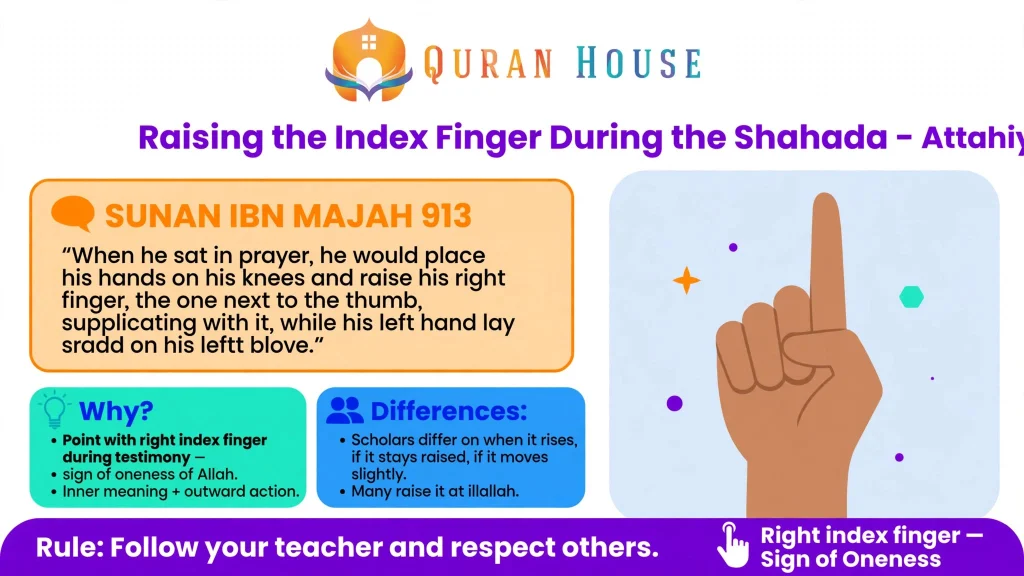
Ibn Umar described how the Prophet ﷺ sat in prayer, placing his hands on his knees and raising the finger beside his thumb while making supplication.
كَانَ إِذَا جَلَسَ فِي الصَّلاَةِ وَضَعَ يَدَيْهِ عَلَى رُكْبَتَيْهِ وَرَفَعَ إِصْبَعَهُ الْيُمْنَى الَّتِي تَلِي الإِبْهَامَ فَيَدْعُو بِهَا وَالْيُسْرَى عَلَى رُكْبَتِهِ بَاسِطَهَا عَلَيْهَا
(Kana idha jalasa fis-salati wada’a yadayhi ‘ala rukbatayhi wa rafa’a isba’ahul-yumna allati taliyl-ibhama fayad’u biha wal-yusra ‘ala rukbatihi basitaha ‘alayha)
(“When he sat in prayer, he would place his hands on his knees and raise his right finger, the one next to the thumb, supplicating with it, while his left hand lay spread on his left knee.”)
Scholars differ on the details: when exactly the finger rises, whether it stays raised, and whether it moves slightly. Many raise it at the words illallah. Follow the method your teacher taught and respect the practice of others.
Dua After the Tashahhud Before the Salam
After the final tashahhud and the salawat, a worshipper may make dua before ending the prayer. The Prophet ﷺ specifically recommended seeking refuge from four trials at this moment.
Abu Hurairah reported this instruction from the Prophet ﷺ. Many worshippers recite it in every final sitting because it covers the most serious trials a believer can face.
إِذَا تَشَهَّدَ أَحَدُكُمْ فَلْيَسْتَعِذْ بِاللَّهِ مِنْ أَرْبَعٍ يَقُولُ اللَّهُمَّ إِنِّي أَعُوذُ بِكَ مِنْ عَذَابِ جَهَنَّمَ وَمِنْ عَذَابِ الْقَبْرِ وَمِنْ فِتْنَةِ الْمَحْيَا وَالْمَمَاتِ وَمِنْ شَرِّ فِتْنَةِ الْمَسِيحِ الدَّجَّالِ
(Idha tashahhada ahadukum falyasta’idh billahi min arba’in, yaqool, Allahumma inni a’oodhu bika min ‘adhabi jahannam, wa min ‘adhabil-qabr, wa min fitnatil-mahya wal-mamat, wa min sharri fitnatil-maseehid-dajjal)
(“When one of you recites the tashahhud, let him seek refuge with Allah from four things, saying: O Allah, I seek refuge in You from the punishment of Hellfire, from the punishment of the grave, from the trials of life and death, and from the evil of the trial of the False Messiah.”)
The four things named in the hadith are listed below in the order the Prophet ﷺ mentioned them, so that they are easy to memorize and recite.
- The punishment of Hellfire.
- The punishment of the grave.
- The trials of life and death.
- The evil of the trial of the False Messiah, known as al-Masih al-Dajjal.
After this dua, a worshipper may add other supplications taught in the Sunnah, then end the prayer with the salam to the right and to the left.
Quran House offers a guided course on understanding the Quran that connects the duas you recite to their meanings.

Try Two Free Sessions With a Teacher
Isra and Mi’raj and the Origin of the Tashahhud
Isra and Mi’raj refers to two connected events in a single night. The Prophet ﷺ traveled from Mecca to Jerusalem, then ascended through the heavens.
Many historians place it in the years before the migration to Medina, a time when he faced intense hardship and rejection in Mecca. The five daily prayers were established during that night.
During the ascension, tradition holds that the Prophet ﷺ led earlier prophets in prayer at Al-Aqsa Mosque and then met figures such as Adam, Yahya, Isa, Yusuf, Idris, Harun, Musa, and Ibrahim at different levels of the heavens.
A popular story says the words of the tashahhud came from a conversation between Allah and the Prophet ﷺ on that night. This account does not appear in the authentic collections that teach the tashahhud.
Those narrations instead show the Prophet ﷺ teaching the wording to his Companions, as the hadiths of Ibn Mas’ud and Ibn Abbas confirm. The night of Isra and Mi’raj still deepens appreciation of prayer, but it is not the stated source of the wording.
Pronunciation Tips for Difficult Letters in the Tashahhud
Several letters in the tashahhud have no match in English, so small errors are common among new learners. The table lists the letters that need the most attention.
| Letter | Example Word | Tip |
| ح | At-tahiyyat, rahmatullah | Release a soft, breathy sound from the middle of the throat, unlike the light English h. |
| ع | ‘Alayka, ‘ibad | Tighten the throat gently and produce the sound from deep inside, without replacing it with a hamza. |
| ص | As-salawat, as-saliheen | Keep the mouth full and the sound heavy, unlike a plain s. |
| ط | At-tayyibat | Press the tongue firmly against the upper palate and keep the sound heavy. |
Practice each difficult letter slowly with a teacher who can hear the difference. Recording yourself and comparing the recording with a qualified reciter also helps.
Quran House also offers Noorani Qaida lessons for adults that train the ear and tongue to produce Arabic letters correctly from the very first lesson.
Try Two Free Sessions With a Teacher
Common Mistakes Worth Avoiding
These mistakes appear again and again among new learners and lifelong worshippers alike, and each one has a simple fix that takes only a little practice.
- Rushing through the words without pausing to consider their meaning, which turns a rich supplication into a habitual mumble.
- Mixing up the shortened first tashahhud with the full final version, especially in longer prayers.
- Forgetting to raise the index finger during the shahada, a small Sunnah that is easy to overlook when first learning.
- Mispronouncing heavy letters such as sad and ta, which is why reviewing the heavy and light letters in Tajweed matters even outside Quran recitation.
- Memorizing the sounds without ever learning the translation, which limits the emotional and spiritual impact of the prayer.
- Raising the voice during the tashahhud, since it is recited quietly.
Most of these mistakes come from reciting Attahiyat on autopilot, so slow, mindful practice with feedback from a qualified teacher usually corrects them quickly and builds lasting accuracy.
A Seven Day Plan to Memorize the Tashahhud
A beginner can memorize the full final tashahhud in a week by learning one short portion each day and reviewing every earlier portion before adding a new one.
| Day | Task | Time |
| Day 1 | Learn the first line, at-tahiyyatu lillahi was-salawatu wat-tayyibat, with its meaning. | 10 minutes |
| Day 2 | Add the greeting upon the Prophet ﷺ and review Day 1. | 10 minutes |
| Day 3 | Add the greeting upon the righteous servants and review Days 1 and 2. | 10 minutes |
| Day 4 | Add the two testimonies of faith and practice raising the finger. | 10 minutes |
| Day 5 | Learn the first part of the salawat, upon Muhammad and his family. | 10 minutes |
| Day 6 | Learn the second part of the salawat, upon Ibrahim and his family. | 10 minutes |
| Day 7 | Recite the full tashahhud in the correct sitting position and record yourself. | 15 minutes |
Recite aloud during practice, then quietly in prayer. Ask a teacher to listen once during the week so mistakes are caught before they become habits.
Quran House offers Basic Tajweed lessons for non-Arabic speakers where a teacher corrects pronunciation line by line in live one-on-one sessions.

Try Two Free Sessions With a Teacher
Why Reflection Matters More Than Speed
It is easy, especially for someone who has prayed since childhood, to recite the tashahhud automatically. Teachers often encourage students to slow down at this point, because it contains the shahada, the declaration that defines a person as Muslim.
One helpful exercise is to translate the recitation silently into your own language once, outside of prayer. Picture each part: praise belonging only to Allah, peace extended to the Prophet ﷺ and righteous people across time, and a personal declaration of belief.
Carrying that mental picture back into the next prayer often makes the recitation feel more sincere. Taking a few extra seconds here can change the entire quality of a prayer.
It’s Never Too Late to Learn
Adults learn with us too. Watch a real session with one of our adult learners and see how calm, one-on-one guidance makes Quran recitation feel achievable at any age.
Start Your Quran Journey With Quran House
Learn live and one-on-one with Al-Azhar-trained tutors, male and female, for children and adults, at a time that fits your timezone.
Try a Free SessionStart Learning the Tashahhud With Quran House Expert Teachers
Reciting the tashahhud correctly is only part of the picture. Knowing why each phrase is structured the way it is turns Salah from a routine into a reflective act of worship.
At Quran House, Al-Azhar-trained tutors explain the meaning of every part of the prayer, correct pronunciation letter by letter, and answer the practical questions that come up once you listen closely to what you say five times a day.
Classes are one on one and scheduled around your routine, so busy adults, working parents, and children can build a stronger connection to their daily prayers without traveling or joining a rigid group schedule.
Try Two Free Sessions With Quran House
Our Quran Courses
- Basic Tajweed for Non-Arabic Speakers.
- Noorani Qaida for Adults.
- Quranic Arabic for Beginners.
- Understand the Quran Course.
- Practical (Amali) Tajweed Course.
- Learn to Read Quran for Beginners.
Conclusion
Attahiyat may take only a few seconds to recite, yet it carries centuries of meaning, from the teaching of the Prophet ﷺ to the daily prayers of well over a billion Muslims around the world.
Learning the translation, the authentic narrations, and the details of the sitting and the index finger turns familiar words into a deeper act of worship, repeated many times each day.
Choose one authentic wording, memorize it with its meaning, and recite it slowly. A worshipper who does this brings fuller presence to every sitting for a lifetime.
FAQs
Is the Tashahhud Part of the Quran?
No, it is not a verse of the Quran. It is a prophetic supplication that the Prophet ﷺ taught his Companions as carefully as a surah, and it became part of the structure of Salah.
Can I Recite the Tashahhud in My Own Language?
Most scholars say the tashahhud, like the rest of the prayer, should be recited in Arabic. Learning the translation is encouraged for reflection, but the Arabic wording itself is recited in Salah.
What Happens If I Forget Part of the Tashahhud?
Pause briefly and recall the missing words. In some cases the prostration of forgetfulness, sujud as-sahw, is required, depending on what was forgotten and the school you follow, so ask a qualified teacher about your situation.
Why Is Ibrahim Mentioned in the Final Tashahhud?
Ibrahim is remembered as the father of monotheism and a model of submission to Allah. Mentioning him beside Muhammad ﷺ connects the final messenger to the chain of prophets who called people to the same truth.
Which Version of the Tashahhud Should I Recite?
Recite the authentic wording taught by your school, such as the narration of Ibn Mas’ud or Ibn Abbas. Scholars agree every authentic wording is valid, so learn one well and add others later if you wish.
When Should I Raise My Finger in the Tashahhud?
Many scholars raise the right index finger when saying the testimony of faith, at the words illallah. Practices differ on whether it stays raised or moves slightly, so follow the method your teacher taught.