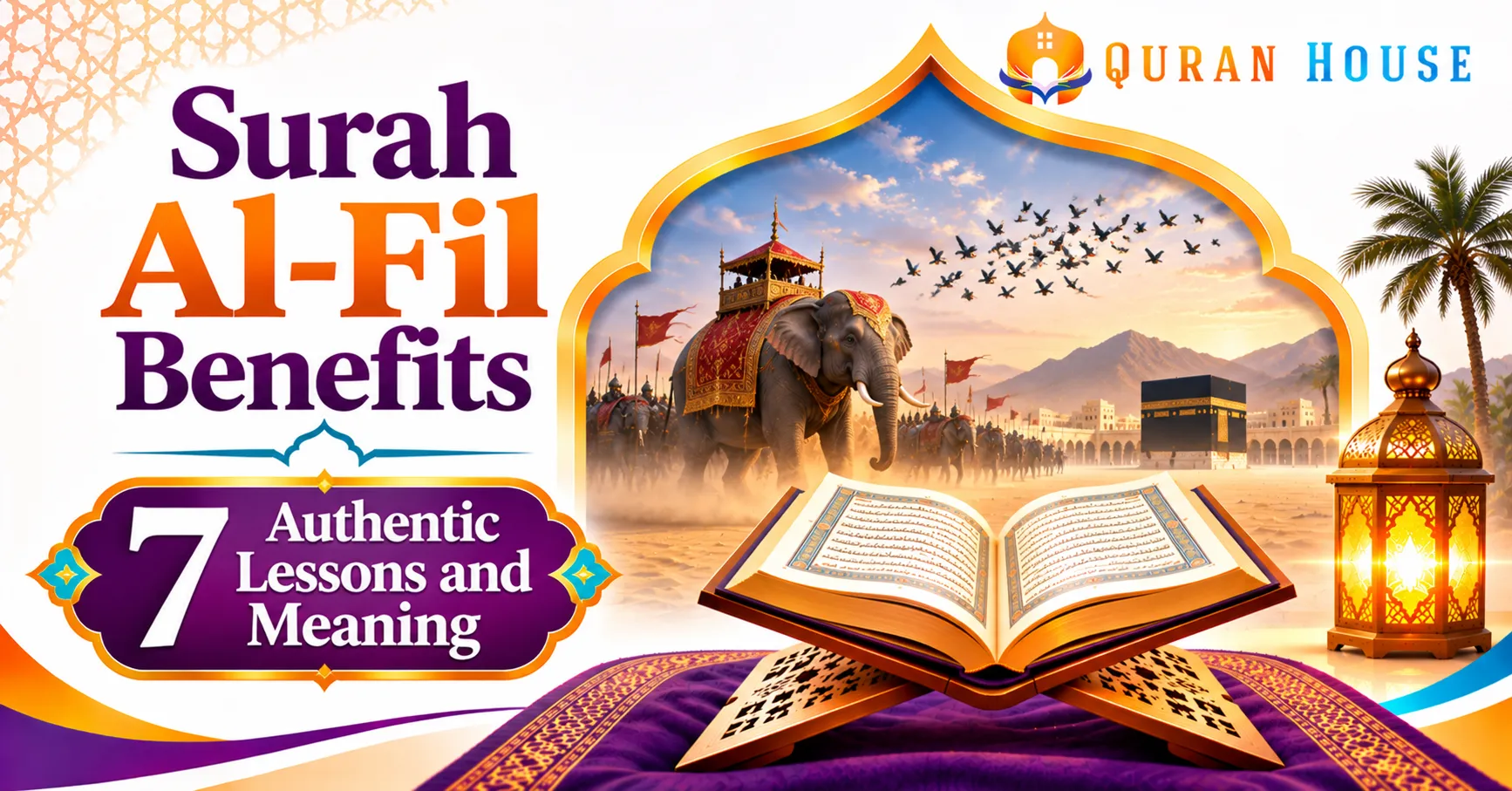
The benefits of Surah Fil come from one of the most remarkable events in the history of Makkah: the year an army came with elephants to destroy the Kaaba, and Allah destroyed the army instead. Al-Fil means “the elephant,” and Surah Al-Fil is the 105th chapter of the Quran, a short Makki surah of only five verses.
The story is brief and easy to remember, which is why Surah Al-Fil is one of the first surahs children memorize. Yet behind its five verses lie deep lessons about Allah’s protection, the fate of arrogance, and the blessings He gave to Makkah, the city where the Prophet ﷺ was born in that very year.
In this guide, we go straight to the 7 authentic Surah Fil benefits, each supported by its verse or by an authentic hadith. After that, you will find the full text of the surah, its context, an honest look at the popular claims about it, and practical tips for teaching it to children.
1. It Shows That Allah Protects His Sacred House
The surah opens by asking the reader to reflect on what Allah did to the army that came to destroy the Kaaba:
﴿أَلَمْ تَرَ كَيْفَ فَعَلَ رَبُّكَ بِأَصْحَابِ الْفِيلِ﴾
“Have you not considered how your Lord dealt with the companions of the elephant?”
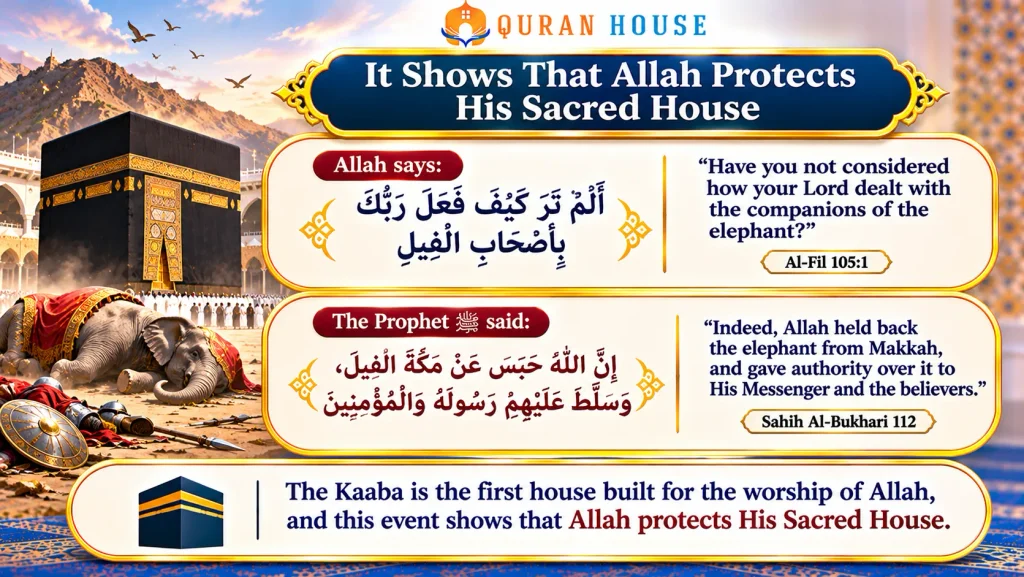
The Prophet ﷺ himself referred to this event when he spoke about the sanctity of Makkah on the day of its conquest:
«إِنَّ اللَّهَ حَبَسَ عَنْ مَكَّةَ الْفِيلَ، وَسَلَّطَ عَلَيْهِمْ رَسُولَهُ وَالْمُؤْمِنِينَ»
“Indeed, Allah held back the elephant from Makkah, and gave authority over it to His Messenger and the believers.”
The Kaaba is the first house built for the worship of Allah, and this event shows that Allah protects it Himself. It reminds the believer to honor sacred places and to submit to Allah’s supreme control over all things.
2. It Teaches That the Plots of Oppressors Always Fail
Abrahah, the ruler of Yemen, built a grand church to draw the Arabs away from the Kaaba, then marched to destroy it. The surah describes how his plan ended:
﴿أَلَمْ يَجْعَلْ كَيْدَهُمْ فِي تَضْلِيلٍ﴾
“Did He not make their plan go astray?”
No matter how well planned or well equipped, a plot against the truth is doomed. This stands as a cautionary lesson against oppressing or harming others unjustly, because Allah is a witness to every action, and a comfort for anyone who is wronged.
3. It Reminds You That Allah Has Soldiers No One Can Defeat
The army did not fall to a stronger army, but to small birds:
﴿وَأَرْسَلَ عَلَيْهِمْ طَيْرًا أَبَابِيلَ تَرْمِيهِم بِحِجَارَةٍ مِّن سِجِّيلٍ﴾
“And He sent against them birds in flocks, striking them with stones of hard-baked clay.”
Scholars of tafsir explain “sijjil” as clay hardened like stone. The lesson is that Allah does not need great forces to defend the truth; regardless of the odds, the one who seeks shelter in Him is never defeated. This builds faith and trust in Allah’s wisdom and protection in times of need.
4. It Shows the Humiliating Fate of Arrogance
The surah ends with a powerful image of what became of the mighty army:
﴿فَجَعَلَهُمْ كَعَصْفٍ مَّأْكُولٍ﴾
“And He made them like eaten straw.”
An army that came with elephants and pride was reduced to something like chewed, scattered straw. It is a reminder to stay humble and grateful: no matter how advanced or powerful a person or a civilization sees itself, it remains completely dependent on Allah.
5. It Connects You to the Story of the Prophet ﷺ
The event of the elephant took place in the same year the Prophet ﷺ was born, which is why historians call it the Year of the Elephant. Decades later, the Prophet ﷺ remembered it when his camel knelt and refused to move near Makkah at Al-Hudaybiyyah:
«مَا خَلَأَتِ الْقَصْوَاءُ، وَمَا ذَاكَ لَهَا بِخُلُقٍ، وَلَكِنْ حَبَسَهَا حَابِسُ الْفِيلِ»
“Al-Qaswa’ has not become stubborn, for that is not her nature; rather, she was held back by the One who held back the elephant.”
The same Lord who stopped the elephant from entering Makkah stopped the Prophet’s ﷺ camel, because He had decreed peace that year instead of fighting. Reciting the surah connects you to the life of the Prophet ﷺ and shows how Allah prepared Makkah for his message.
6. It Teaches Gratitude, as Explained by Surah Quraysh
Surah Al-Fil is closely linked to the surah that follows it, Surah Quraysh, which reminds the people of Makkah of the blessings that came from this protection:
﴿فَلْيَعْبُدُوا رَبَّ هَٰذَا الْبَيْتِ الَّذِي أَطْعَمَهُم مِّن جُوعٍ وَآمَنَهُم مِّنْ خَوْفٍ﴾
“Let them worship the Lord of this House, who has fed them against hunger and made them safe from fear.”
Allah saved Makkah from the army, and the right response was to worship Him alone. The same lesson applies to every believer: the blessings of safety and provision call for gratitude and worship, not for forgetting the One who gave them.
7. It Is Easy To Memorize and Brings the Reward of Every Letter
With only five short verses and a vivid story, Surah Al-Fil is one of the easiest surahs to memorize, and many Muslims recite it often in their prayers. Every letter recited carries a reward, as the Prophet ﷺ said:
«مَنْ قَرَأَ حَرْفًا مِنْ كِتَابِ اللَّهِ فَلَهُ بِهِ حَسَنَةٌ، وَالْحَسَنَةُ بِعَشْرِ أَمْثَالِهَا»
“Whoever recites a letter from the Book of Allah will have a good deed for it, and a good deed is rewarded tenfold.”
This is the authentic reward of reciting Surah Al-Fil. It is also a wonderful surah to start children on, and our Quran teachers for kids teach it with its story so children remember both the words and the meaning.
Memorizing Surah Ad-Duha in Class
Memorization is easier with structure. See how a student reviews and recites Surah Ad-Duha in a live lesson, guided by a tutor who follows every step of their progress.
Start Your Quran Journey With Quran House
Learn live and one-on-one with Al-Azhar-trained tutors, male and female, for children and adults, at a time that fits your timezone.
Try a Free SessionSurah Al-Fil in Arabic, Transliteration, and Translation
Here is the full surah, short enough to read and memorize in a few minutes:
﴿أَلَمْ تَرَ كَيْفَ فَعَلَ رَبُّكَ بِأَصْحَابِ الْفِيلِ أَلَمْ يَجْعَلْ كَيْدَهُمْ فِي تَضْلِيلٍ وَأَرْسَلَ عَلَيْهِمْ طَيْرًا أَبَابِيلَ تَرْمِيهِم بِحِجَارَةٍ مِّن سِجِّيلٍ فَجَعَلَهُمْ كَعَصْفٍ مَّأْكُولٍ﴾
“Have you not considered how your Lord dealt with the companions of the elephant? Did He not make their plan go astray? And He sent against them birds in flocks, striking them with stones of hard-baked clay, and He made them like eaten straw.”
Have you not considered how your Lord dealt with the companions of the elephant? Did He not make their plan go astray? And He sent against them birds in flocks, striking them with stones of hard-baked clay, and He made them like eaten straw.
Surah Al-Fil Overview
Surah Al-Fil recounts a historical incident that took place before the Prophet Muhammad ﷺ began spreading the message. The story is brief, so it is quite easy for children to memorize.
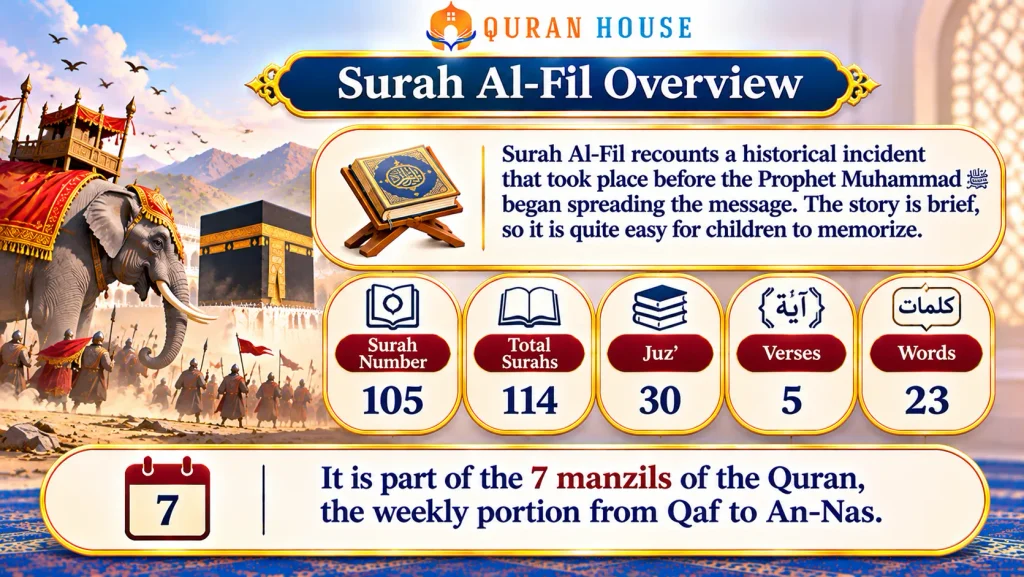
Surah Al-Fil is the 105th surah of the 114 surahs in the Quran, and it is found in the 30th Juz. It consists of 5 verses and a total of 23 words. It is also part of the seventh of the 7 manzils of the Quran, the weekly portion from Qaf to An-Nas.
The Context of Surah Al-Fil
The surah tells the story of Abrahah, the ruler of Yemen, who was displeased that the Arabs made pilgrimage to the Kaaba in Makkah rather than to the church he had built in Yemen. He marched with a large army, accompanied by elephants, to demolish the Kaaba.
This historical event happened in the Year of the Elephant, around 570 CE, the year in which the Prophet Muhammad ﷺ was born. The Makkans withdrew to the mountains, unable to face such an army, and historical reports describe the elephant refusing to march toward the Kaaba.
Then a miraculous intervention took place as Abrahah drew near to Makkah. Allah protected the Kaaba and sent flocks of birds carrying stones of hard-baked clay, which struck Abrahah’s army until it became like eaten straw. To study this story and its lessons verse by verse, our Quran Tafseer Course explains it with qualified teachers.

Summary of Key Messages in Surah Al-Fil
Although Surah Al-Fil is only five verses long, its story carries clear messages for every believer. Here are the key lessons it leaves with the reader:
- Allah governs all things, so submit to His will.
- Trust Allah’s wisdom and have faith in His protection.
- Seek shelter in Allah, whatever the odds.
- Stay humble, whatever power you have.
- Be grateful for the blessings of safety and provision.
- Do not oppress others, for oppression always fails.
Popular Surah Al-Fil Benefits That Have No Authentic Evidence
Many websites list benefits of Surah Al-Fil that promise specific worldly results. None of them is supported by an authentic hadith, and some come from sources that are not relied upon in Sunni scholarship. Reciting the Quran is always rewarded, and you may ask Allah for anything after reciting, but these specific promises should not be attributed to the Prophet ﷺ.
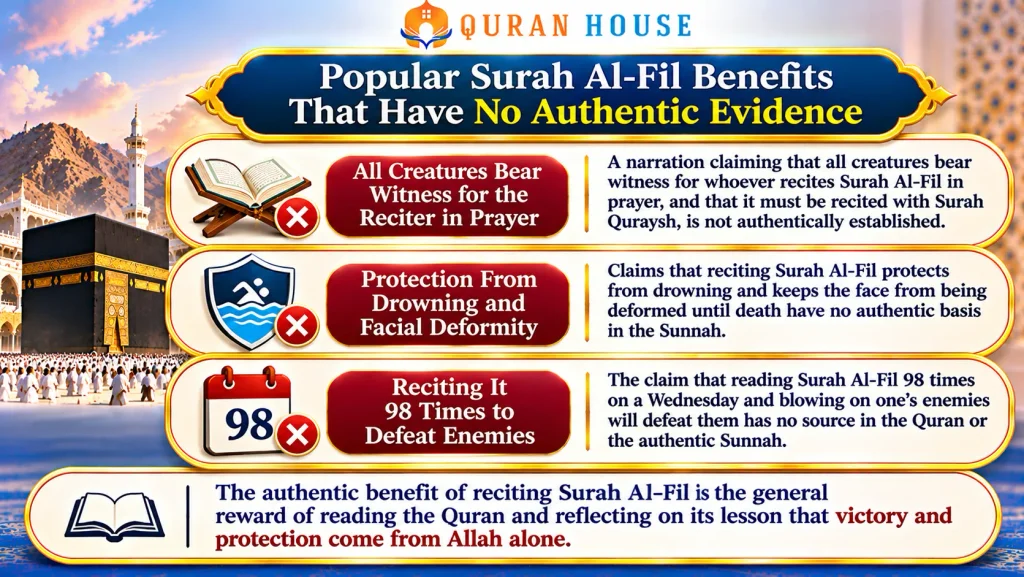
The Claim That All Creatures Bear Witness for Whoever Recites It in Prayer
A narration attributed to Ja’far As-Sadiq claims that all creatures of the universe bear witness for whoever recites Surah Al-Fil in obligatory prayers, and that it must be recited together with Surah Quraysh. This narration comes from sources that are not authenticated in Sunni hadith collections, and the ruling about joining the two surahs is not a requirement in Sunni fiqh.
A Muslim may recite Surah Al-Fil in prayer on its own, like any other surah, and the authentic reward is the reward of reciting the Quran.
The Claims of Protection From Drowning and Facial Deformity
Some articles attribute to the Prophet ﷺ that reciting Surah Al-Fil protects from drowning and keeps the face from being deformed until death. There is no authentic hadith with these promises.
The protection a Muslim seeks is found in the authentic adhkar of the morning and evening and in relying on Allah, which is the lesson the surah itself teaches.
The Claim of Reciting It 98 Times To Defeat Enemies
The claim that reading Surah Al-Fil 98 times on a Wednesday and blowing on one’s enemies will defeat them has no source in the Quran or the authentic Sunnah.
The surah teaches that victory comes from Allah alone, as He defeated the army of the elephant without any human effort. The authentic way to face enemies and hardship is to rely on Allah, make sincere dua, and avoid oppression.
Teaching Surah Al-Fil to Children Effectively
Surah Al-Fil offers an especially engaging entry point for teaching children about Allah’s protection, since its short length and vivid imagery of birds and elephants naturally capture young attention.
Parents and teachers often find success by pairing recitation with a simple retelling of the story behind the surah, helping children connect the words to a memorable historical event rather than treating memorization as an abstract exercise.
Short surahs with a clear story work well together, and after Al-Fil many children move on to surahs like Surah Al-Masad, whose story and benefits of Surah Lahab are just as easy to remember.
Recitation Etiquette and Appropriate Tajweed Focus
When reciting Surah Al-Fil, paying particular attention to the correct pronunciation of its distinctive vocabulary, such as “ababil” and “sijjil,” helps preserve the meaning and rhythm of the original Arabic.
Beginners are often encouraged to slow down through these specific words rather than rushing through the shorter surah simply because of its brevity.
Treating even brief surahs with the same Tajweed care applied to longer ones builds consistent recitation habits that carry over into more complex portions of the Quran. Our online Tajweed classes help you and your children perfect every letter of the short surahs with a qualified teacher.

Practical Tips for Learning Surah Al-Fil
These simple tips help children and adults learn Surah Al-Fil with both correct recitation and understanding:
- Pair recitation with the historical story to make memorization more meaningful for children.
- Slow down deliberately through unfamiliar vocabulary rather than rushing due to the surah’s short length.
- Reflect on the protection and gratitude themes during personal recitation, not just group study.
- Practice reciting the surah in daily prayers to reinforce both memorization and meaning together.
A Real Surah Lesson: Surah Ash-Shams
Watch a student work through Surah Ash-Shams step by step with their tutor, practicing each ayah until the recitation flows clearly and correctly.
Start Your Quran Journey With Quran House
Learn live and one-on-one with Al-Azhar-trained tutors, male and female, for children and adults, at a time that fits your timezone.
Try a Free SessionLearn Surah Al-Fil and Its Story With Quran House
Short surahs like Al-Fil are often the first verses a child memorizes, and the first a new Muslim learns to recite in prayer. Learning them correctly from the start, with their meaning and story, builds a foundation that lasts a lifetime.
At Quran House, our Al-Azhar-trained teachers guide students through short surahs like Al-Fil with careful attention to both Tajweed and meaning, making memorization genuinely meaningful. In live one-to-one sessions, they correct recitation, tell the stories behind the surahs, and build a plan around each student’s level and schedule, for adults and kids alike.
Whether you are teaching your child their first surahs or perfecting your own recitation, you will have a trusted teacher by your side at every step.
Explore Our Quran Courses:
- Quran Reading Course Online for Kids and Adults
- Learn to Read Quran in Arabic
- Learn to Read Quran for Beginners
- Quran Reading for Kids
- Quran Reading for Adults
- Quran Reading for Sisters
- Noorani Qaida for Beginners
- Noorani Qaida for Adults

Final Thoughts
The benefits of Surah Fil come from its verses and from the authentic Sunnah: it shows that Allah protects His House, that the plots of oppressors fail, that Allah has soldiers no one can defeat, and that arrogance ends in humiliation. It connects the reader to the Year of the Elephant, the year the Prophet ﷺ was born, and to the gratitude explained in Surah Quraysh.
We also separated the authentic from the unfounded: there is no evidence for reciting it a set number of times to defeat enemies, or for promises of protection from drowning. Its real value lies in its message and in the reward of every letter recited.
Surah Al-Fil offers rich lessons in protection and gratitude that become even more meaningful when paired with careful Tajweed and an understanding of its historical context. Teaching children through storytelling and reciting it regularly in prayer both help its message take lasting root. Use a trusted source such as Quran.com to follow the text and its translation.
FAQs
Why Do We Recite Surah Al-Fil?
We recite it to remember Allah’s protection of the Kaaba, learn its lessons about arrogance and gratitude, and earn the reward of reciting the Quran.
How To Memorize Surah Al-Fil?
Recite it daily with its story and meaning, and if you plan to memorize more, our guide on how long it takes to memorize the Quran helps you set a realistic plan.
Why Was Surah Al-Fil Revealed?
It was revealed to remind Quraysh and all people of how Allah protected the Kaaba from Abrahah’s army in the Year of the Elephant.
What Is Surah Al-Fil About?
It tells how Abrahah’s army came with elephants to destroy the Kaaba, and how Allah destroyed them with birds carrying stones of hard-baked clay.
Is Surah Al-Fil a Good Starting Point for Teaching Children?
Yes, its short length and vivid story make it an accessible and memorable surah for introducing children to Quran memorization.