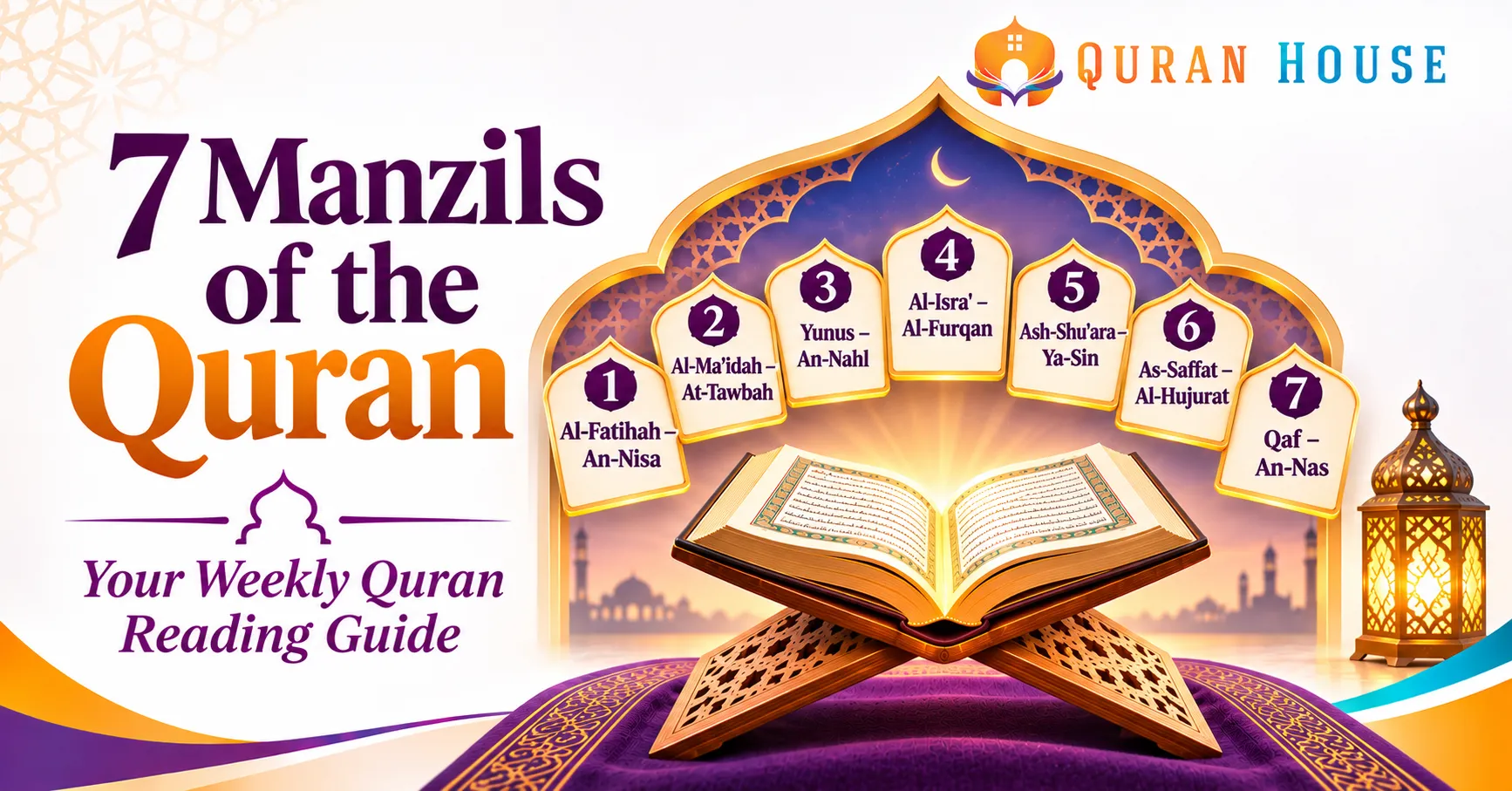
Each manzil of the Quran marks one of seven weekly recitation portions, a method used by countless students to complete a full reading of the Quran every week.
The Quran has 114 surahs, and reading all of them can feel overwhelming without a plan. The seven manzils solve this by giving you one fixed portion for each day of the week.
The Companions of the Prophet ﷺ followed a weekly division very close to this one, and Muslims still use it today to keep a steady connection with the Book of Allah.
In this guide to the 7 manzils of the Quran, we explain what a manzil is, list the exact surahs in each of the seven manzils, show how manzils differ from juz and hizb, and give you practical plans to finish the Quran in a week, two weeks, or a month.
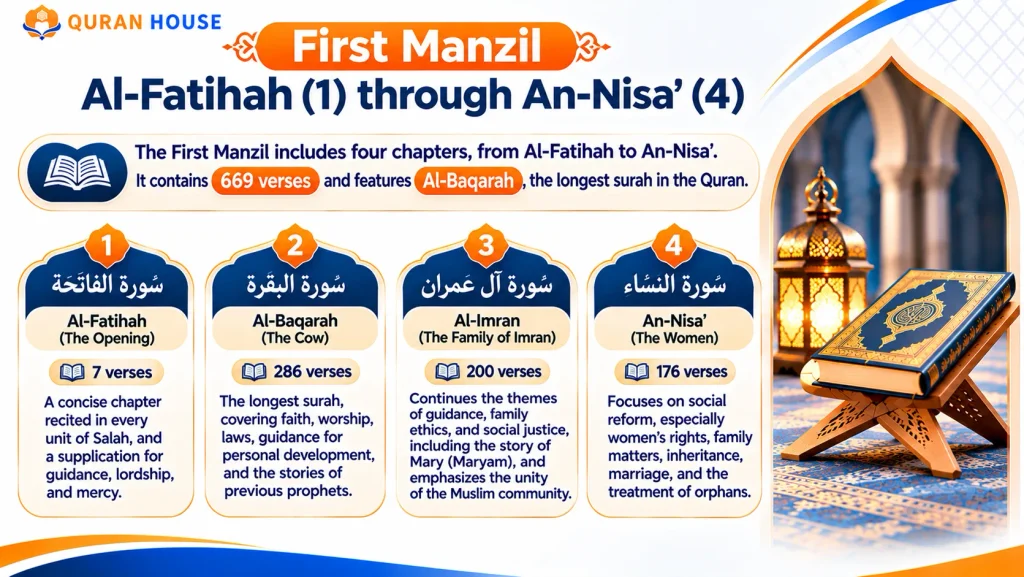
First Manzil: Al-Fatihah (1) through An-Nisa’ (4)
The First Manzil of the Quran encompasses four chapters, starting with Al-Fatihah and extending through An-Nisa’. It contains 669 verses and includes Al-Baqarah, the longest surah in the Quran, with its foundations of faith, worship, and law.
Al-Fatihah (Chapter 1)
Al-Fatihah, known as “The Opening,” is a concise chapter consisting of seven verses. It is recited in every unit of Muslims’ prayers (Salah). This chapter is a beautiful supplication for guidance, lordship, and mercy from Allah.
The Prophet ﷺ made its recitation a condition of every prayer:
«لَا صَلَاةَ لِمَنْ لَمْ يَقْرَأْ بِفَاتِحَةِ الْكِتَابِ»
“There is no prayer for the one who does not recite the Opening of the Book.”
This is why Al-Fatihah is the most recited surah in a Muslim’s life, and the natural opening of the first manzil.
Al-Fatihah is a Makki surah of 7 verses. It is also called Umm Al-Kitab (the Mother of the Book) because it sums up the main themes of the whole Quran: praise of Allah, His lordship and mercy, the Day of Judgment, sincere worship, and the request for guidance.
Al-Baqarah (Chapter 2)
Al-Baqarah, “The Cow,” is the longest chapter in the Quran. It covers various themes, including guidance for personal development, laws for social justice, and narratives of previous prophets. It also emphasizes the importance of faith, morality, and community life.
Al-Baqarah is a Madani surah of 286 verses. It contains Ayat Al-Kursi (2:255), the closing verses that many Muslims recite every night (2:285–286), and the longest verse in the Quran, the verse of debt (2:282). It takes its name from the story of the cow that Allah commanded the Children of Israel to slaughter.
The Prophet ﷺ highlighted the blessing of reciting it at home:
«لَا تَجْعَلُوا بُيُوتَكُمْ مَقَابِرَ، إِنَّ الشَّيْطَانَ يَنْفِرُ مِنَ الْبَيْتِ الَّذِي تُقْرَأُ فِيهِ سُورَةُ الْبَقَرَةِ»
“Do not turn your houses into graves. Satan flees from the house in which Surah Al-Baqarah is recited.”
When you follow the weekly manzil plan, you recite Al-Baqarah at home every week, which brings this blessing into your house on a regular basis.
Al-Imran (Chapter 3)
Named after the family of Imran, this chapter continues the themes of guidance, family ethics, and social justice. It includes the story of Jesus’s mother, Mary, and emphasizes the unity of the Muslim community.
Al-Imran is a Madani surah of 200 verses. It tells the stories of the birth of Maryam, the birth of Yahya, and the birth of Isa, and it reflects on the lessons of the Battles of Badr and Uhud. It also addresses the delegation of the Christians of Najran and invites the People of the Book to a common word of worshipping Allah alone.
An-Nisa’ (Chapter 4)
An-Nisa’, “The Women,” focuses on social reform, particularly regarding women’s rights and family matters. It provides detailed guidance on inheritance, marriage, and the treatment of orphans.
An-Nisa’ is a Madani surah of 176 verses. Its inheritance verses set out the shares of each heir in detail, and it repeatedly calls for justice, even against oneself or one’s relatives. It also protects the property of orphans and sets the rules of marriage and family life.
Second Manzil: Al-Ma’idah (5) through At-Tawbah (9)
The Second Manzil of the Quran consists of five chapters and 695 verses, from Al-Ma’idah to At-Tawbah. This section is particularly significant for its focus on legal matters, ethics, and personal responsibility.
Al-Ma’idah (Chapter 5)
Al-Ma’idah, “The Table Spread,” provides detailed guidance on dietary laws, legal matters, and moral conduct. It emphasizes the importance of fulfilling covenants and the proper conduct of relationships, both with fellow human beings and with Allah.
Al-Ma’idah is a Madani surah of 120 verses and one of the last surahs revealed. It takes its name from the table of food that the disciples of Isa asked to be sent down from heaven, and it sets out rulings on lawful food, ablution, oaths, and fair testimony.
Al-An’am (Chapter 6)
Al-An’am, “The Cattle,” delves into the themes of monotheism and the rejection of polytheism. It also discusses various aspects of guidance and the natural signs that point to the existence and oneness of Allah.
Al-An’am is a Makki surah of 165 verses. It presents one of the longest arguments for the oneness of Allah in the Quran, including Ibrahim’s reasoning as he looked at the star, the moon, and the sun and turned away from worshipping anything that sets.
Al-A’raf (Chapter 7)
Al-A’raf, “The Heights,” explores the stories of several prophets, including Adam, Noah, and Moses. It emphasizes the importance of following divine guidance and the consequences of turning away from it.
Al-A’raf is a Makki surah of 206 verses. Its name refers to the heights between Paradise and Hell, where a group of people will stand on the Day of Judgment. It also contains one of the most detailed accounts of Musa and Pharaoh in the Quran.
Al-Anfal (Chapter 8)
Al-Anfal, “The Spoils of War,” provides guidelines for conduct during warfare, including the treatment of prisoners and the distribution of spoils. It emphasizes the importance of unity, discipline, and trust in Allah during times of conflict.
Al-Anfal is a Madani surah of 75 verses, revealed after the Battle of Badr. It reminds the believers that victory comes from Allah, describes how the angels supported them, and lists the qualities of true believers whose hearts tremble when Allah is mentioned.
At-Tawbah (Chapter 9)
At-Tawbah, “The Repentance,” is unique as it does not begin with the phrase “In the name of Allah, the Most Gracious, the Most Merciful.” This chapter deals with issues related to warfare, treaties, and the responsibilities of the Muslim community. It calls for sincerity in faith and action.
At-Tawbah is a Madani surah of 129 verses, also known as Bara’ah. It covers the expedition of Tabuk, exposes the hypocrites who stayed behind, and tells how Allah accepted the repentance of the three Companions who stayed behind sincerely.
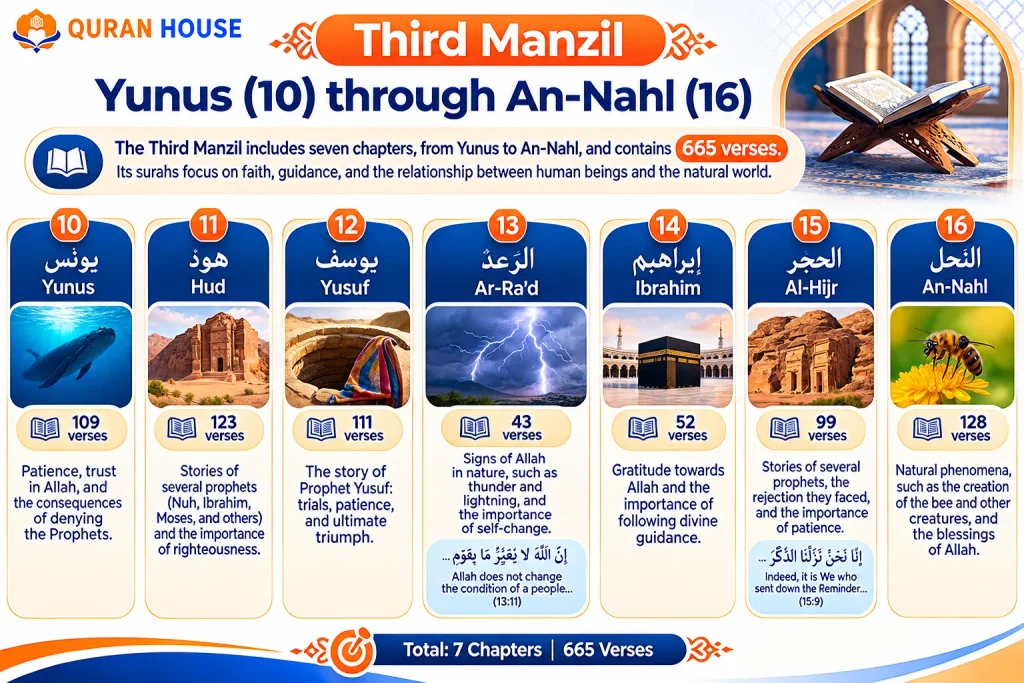
Third Manzil: Yunus (10) through An-Nahl (16)
The Third Manzil of the Quran encompasses seven chapters and 665 verses, from Yunus to An-Nahl. Its surahs focus on faith, guidance, and the relationship between human beings and the natural world.
Yunus (Chapter 10)
Named after the Prophet Yunus (Jonah), this chapter emphasizes the importance of patience, trust in Allah, and the consequences of denying the Prophets. It also illustrates the signs of Allah’s existence in the natural world.
Yunus is a Makki surah of 109 verses. It mentions that the people of Yunus believed before the punishment reached them, so Allah lifted it from them. It also recounts the drowning of Pharaoh and his belated declaration of faith.
Hud (Chapter 11)
This chapter, named after the Prophet Hud, focuses on the stories of several prophets, including Noah, Abraham, and Moses. It emphasizes the importance of righteousness, adherence to Allah’s guidance, and the consequences of rejecting the truth.
Hud is a Makki surah of 123 verses. It tells the stories of Nuh, Hud, Salih, Ibrahim, Lut, Shu’ayb, and Musa one after another, showing how each nation received a clear warning before its end.
Yusuf (Chapter 12)
Yusuf (Joseph) is the only chapter in the Quran that focuses on the detailed story of a single prophet. It narrates the story of Prophet Yusuf’s trials, patience, and ultimate triumph, providing lessons in trust, patience, and reliance on Allah.
Yusuf is a Makki surah of 111 verses. It follows his life from a childhood dream, through his brothers’ betrayal, slavery, and prison, to his rise as a minister in Egypt and his reunion with his father Ya’qub.
Ar-Ra’d (Chapter 13)
Ar-Ra’d, “The Thunder,” discusses the signs of Allah’s existence in nature, such as thunder and lightning. It emphasizes the importance of recognizing these signs and reflecting on the greatness of the Creator.
Ar-Ra’d has 43 verses. It contains one of the best-known principles of change in the Quran:
﴿إِنَّ اللَّهَ لَا يُغَيِّرُ مَا بِقَوْمٍ حَتَّىٰ يُغَيِّرُوا مَا بِأَنفُسِهِمْ﴾
“Indeed, Allah will not change the condition of a people until they change what is within themselves.”
The verse places responsibility on people to change themselves first, which applies to building any good habit, including regular recitation.
Ibrahim (Chapter 14)
Named after the Prophet Ibrahim (Abraham), this chapter focuses on the importance of gratitude towards Allah and the consequences of ingratitude. It also emphasizes the importance of following divine guidance.
Ibrahim is a Makki surah of 52 verses. It includes the dua of Ibrahim for Makkah and his descendants, and the parable of the good word as a good tree whose roots are firm and whose branches reach the sky.
Al-Hijr (Chapter 15)
Al-Hijr, named after the ancient city of the people of Thamud, discusses the stories of several prophets and the rejection they faced. It emphasizes the importance of patience and trust in Allah’s wisdom.
Al-Hijr is a Makki surah of 99 verses. It contains Allah’s promise to preserve the Quran:
﴿إِنَّا نَحْنُ نَزَّلْنَا الذِّكْرَ وَإِنَّا لَهُ لَحَافِظُونَ﴾
“Indeed, it is We who sent down the Reminder, and indeed, We will be its guardian.”
This divine promise is why the text of the Quran has reached us unchanged for more than fourteen centuries, recited and memorized by millions in every generation.
An-Nahl (Chapter 16)
An-Nahl, “The Bee,” explores various natural phenomena, such as the creation of the bee and other creatures. It emphasizes the importance of reflecting on these signs and recognizing Allah’s wisdom and creativity.
An-Nahl is a Makki surah of 128 verses. It lists so many of Allah’s blessings, from cattle and rain to honey that contains healing, that some scholars call it Surat An-Ni’am, the surah of blessings.
Fourth Manzil: Al-Isra’ (17) through Al-Furqan (25)
The Fourth Manzil of the Quran consists of nine chapters and 903 verses, from Al-Isra’ to Al-Furqan. It is full of stories of the prophets and lessons about faith, patience, and the Hereafter.
Al-Isra’ (Chapter 17)
Al-Isra’, “The Night Journey,” recounts the miraculous night journey of the Prophet Muhammad ﷺ. It emphasizes the importance of prayer, the relationship between parents and children, and the principles of justice and morality.
Among its best-known commands is kindness to parents:
﴿وَقَضَىٰ رَبُّكَ أَلَّا تَعْبُدُوا إِلَّا إِيَّاهُ وَبِالْوَالِدَيْنِ إِحْسَانًا﴾
“Your Lord has decreed that you worship none but Him, and that you be good to your parents.”
The verse places kindness to parents directly after worshipping Allah alone, which shows how high its rank is.
Al-Isra’ is a Makki surah of 111 verses, also called Bani Isra’il. It opens with the journey of the Prophet ﷺ from Al-Masjid Al-Haram to Al-Masjid Al-Aqsa, and it includes a series of commands on justice, honesty in weights and measures, and avoiding wastefulness.
Al-Kahf (Chapter 18)
Al-Kahf, “The Cave,” contains various narratives, including the story of the People of the Cave, Moses and Khidr, and Dhul-Qarnayn. It emphasizes faith, patience, knowledge, and reliance on Allah.
Al-Kahf is a Makki surah of 110 verses built around four stories: the youths of the cave, the owner of the two gardens, Musa and Al-Khidr, and Dhul-Qarnayn. Scholars note that they deal with four trials: faith, wealth, knowledge, and power.
The Prophet ﷺ described a special protection in its opening verses:
«مَنْ حَفِظَ عَشْرَ آيَاتٍ مِنْ أَوَّلِ سُورَةِ الْكَهْفِ عُصِمَ مِنَ الدَّجَّالِ»
“Whoever memorizes ten verses from the beginning of Surah Al-Kahf will be protected from the Dajjal.”
This is a strong reason to memorize these verses, not only to read them in the weekly plan.
Maryam (Chapter 19)
Named after Mary, the mother of Jesus, this chapter focuses on the stories of several prophets, including Zachariah, John, Abraham, and Moses. It emphasizes the importance of compassion, mercy, and trust in Allah.
Maryam is a Makki surah of 98 verses, and Maryam is the only woman mentioned by name in the Quran. The surah describes the miraculous birth of Yahya to the elderly Zakariya and the birth of Isa without a father.
Ta-Ha (Chapter 20)
Ta-Ha narrates the story of Moses and his mission to free the Children of Israel. It emphasizes the importance of reliance on Allah, patience, and steadfastness in the face of adversity.
Ta-Ha is a Makki surah of 135 verses. It tells how Allah called Musa in the sacred valley of Tuwa, how Musa faced Pharaoh’s magicians who then believed, and how the Samiri led the Children of Israel to worship the golden calf.
Al-Anbiya (Chapter 21)
Al-Anbiya, “The Prophets,” discusses the stories of various prophets and the common message they brought. It emphasizes the oneness of Allah and the importance of following His guidance.
Al-Anbiya is a Makki surah of 112 verses. It mentions more prophets by name than almost any other surah, including Ibrahim, Lut, Nuh, Dawud, Sulayman, Ayyub, Isma’il, Idris, Dhul-Kifl, Yunus, Zakariya, and Yahya, and it includes the famous dua of Yunus in the belly of the whale.
Al-Hajj (Chapter 22)
Al-Hajj, “The Pilgrimage,” discusses various aspects of the Hajj pilgrimage and the spiritual significance of this important Islamic practice. It also emphasizes the unity of the Muslim community.
Al-Hajj has 78 verses. It describes Ibrahim’s call to the people to come for pilgrimage, the rites of sacrifice, and the terror of the Hour, and it is one of the surahs that contain a verse of prostration.
Al-Mu’minun (Chapter 23)
Al-Mu’minun, “The Believers,” focuses on the characteristics of true believers and the importance of moral conduct, prayer, and humility.
The surah opens by describing the successful believers, starting with humility in prayer:
﴿قَدْ أَفْلَحَ الْمُؤْمِنُونَ الَّذِينَ هُمْ فِي صَلَاتِهِمْ خَاشِعُونَ﴾
“Successful indeed are the believers, those who are humble in their prayers.”
Success here is tied to the quality of worship, not only to performing it.
Al-Mu’minun is a Makki surah of 118 verses. It also describes the stages of human creation in the womb, then moves to the stories of Nuh, Musa, and Isa, and ends with the regret of those who wish to return to this world after death.
An-Nur (Chapter 24)
An-Nur, “The Light,” provides guidance on social ethics, including modesty, chastity, and the proper conduct of relationships. It emphasizes the importance of following Allah’s guidance in all aspects of life.
An-Nur is a Madani surah of 64 verses. It contains the Verse of Light, which describes Allah’s light with the parable of a lamp in a niche, and it declares the innocence of Aisha, may Allah be pleased with her, from the slander spread against her.
Al-Furqan (Chapter 25)
Al-Furqan, “The Criterion,” emphasizes the importance of recognizing the truth and distinguishing it from falsehood. It encourages reflection on the natural world and adherence to divine guidance.
Al-Furqan is a Makki surah of 77 verses. It ends with a detailed portrait of ‘Ibad Ar-Rahman, the servants of the Most Merciful: they walk humbly, pray at night, spend moderately, and avoid false testimony.
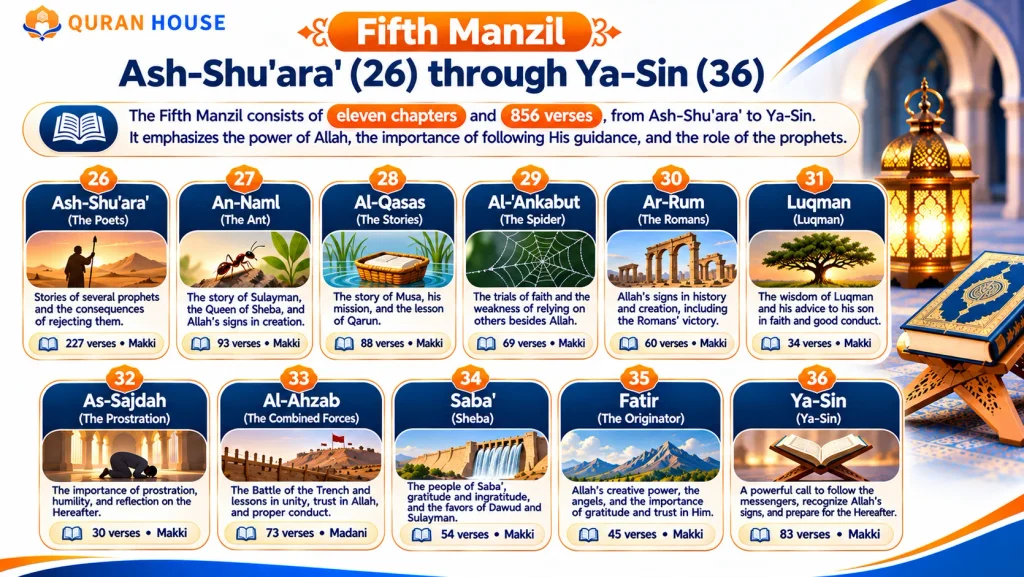
Fifth Manzil: Ash-Shu’ara’ (26) through Ya-Sin (36)
The Fifth Manzil of the Quran consists of eleven chapters and 856 verses, from Ash-Shu’ara’ to Ya-Sin. This section emphasizes the power of Allah, the importance of following His guidance, and the role of the prophets in conveying His message.
Ash-Shu’ara’ (Chapter 26)
Ash-Shu’ara’, “The Poets,” recounts the stories of various prophets, including Moses, Abraham, and Noah. It emphasizes the importance of following divine guidance and the consequences of rejecting the prophets.
Ash-Shu’ara’ is a Makki surah of 227 verses, the second longest surah by number of verses after Al-Baqarah. After each prophet’s story, it repeats the same closing line about Allah being the Almighty, the Most Merciful, which gives the surah a strong rhythm in recitation.
An-Naml (Chapter 27)
An-Naml, “The Ant,” includes the story of Solomon, his ability to understand the speech of animals, and his meeting with the Queen of Sheba. It emphasizes wisdom, gratitude, and the signs of Allah’s existence in the natural world.
An-Naml is a Makki surah of 93 verses. It is the only surah in which the Basmala appears twice: once at its start and once inside the letter Sulayman sent to the Queen of Sheba. The surah also tells of the ant that warned its colony as Sulayman’s army approached.
Al-Qasas (Chapter 28)
Al-Qasas, “The Stories,” focuses on the story of Moses and his mission to guide the Children of Israel. It emphasizes trust in Allah, patience, and the importance of following divine guidance.
Al-Qasas is a Makki surah of 88 verses. It tells Musa’s story from his birth and rescue from the river to his years in Madyan, and it ends with the story of Qarun, whose wealth and arrogance led to his ruin.
Al-‘Ankabut (Chapter 29)
Al-‘Ankabut, “The Spider,” discusses the fragility of associating partners with Allah and the importance of true faith. It emphasizes the trials of faith and the importance of perseverance.
Al-‘Ankabut has 69 verses. It opens by stating that people will be tested in their faith, and it compares those who take protectors other than Allah to a spider whose house is the weakest of houses.
Ar-Rum (Chapter 30)
Ar-Rum, “The Romans,” emphasizes the signs of Allah’s existence in the natural world and human history. It encourages reflection on these signs and recognition of Allah’s power and wisdom.
Ar-Rum is a Makki surah of 60 verses. It opens with the prophecy that the Romans, after being defeated by the Persians, would be victorious within a few years, a prophecy that came true. It also lists many signs of Allah, including the creation of spouses with love and mercy between them.
Luqman (Chapter 31)
Named after the wise Luqman, this chapter emphasizes wisdom, gratitude, and proper conduct. It includes Luqman’s advice to his son, providing timeless guidance for personal development.
Luqman is a Makki surah of 34 verses. Luqman’s advice to his son covers worshipping Allah alone, honoring parents, establishing prayer, patience, humility, and lowering one’s voice, a complete short curriculum in character.
As-Sajdah (Chapter 32)
As-Sajdah, “The Prostration,” emphasizes the importance of humility, prostration, and recognition of Allah’s greatness. It encourages reflection on the creation and the Hereafter.
As-Sajdah is a Makki surah of 30 verses. The Prophet ﷺ made it part of his Friday routine:
«كَانَ النَّبِيُّ ﷺ يَقْرَأُ فِي الْجُمُعَةِ فِي صَلَاةِ الْفَجْرِ: الم تَنْزِيلُ السَّجْدَةَ، وَهَلْ أَتَى عَلَى الْإِنْسَانِ»
“The Prophet ﷺ used to recite in the Fajr prayer on Friday: Alif Lam Mim Tanzil (As-Sajdah) and Hal Ata ‘ala Al-Insan (Al-Insan).”
Reciting these two surahs in Fajr on Friday is a Sunnah that many mosques still follow today.
Al-Ahzab (Chapter 33)
Al-Ahzab, “The Combined Forces,” discusses various social and historical events, including the Battle of the Trench. It emphasizes the importance of unity, trust in Allah, and proper conduct.
Al-Ahzab is a Madani surah of 73 verses. Besides the Battle of the Trench, it contains rulings related to the Prophet’s household and the command to send blessings upon the Prophet ﷺ.
Saba’ (Chapter 34)
Saba’, “Sheba,” tells the story of the people of Saba’, who were blessed with gardens and prosperity but turned away in ingratitude, so Allah sent upon them the flood of the dam. It also mentions the favors Allah granted to Dawud and Sulayman, and emphasizes gratitude and reflection on Allah’s signs.
Saba’ is a Makki surah of 54 verses. It also describes how the jinn kept working for Sulayman after his death, unaware that he had died, until a creature of the earth ate through his staff.
Fatir (Chapter 35)
Fatir, “The Originator,” emphasizes Allah’s creative power and the importance of recognizing His signs in the natural world. It encourages gratitude and trust in Allah’s wisdom.
Fatir is a Makki surah of 45 verses, also called Al-Mala’ikah (The Angels), because it opens by describing the angels as messengers with wings, two, three, and four.
Ya-Sin (Chapter 36)
Ya-Sin is often referred to as the “Heart of the Quran.” It emphasizes the importance of following the prophets, recognizing Allah’s signs, and preparing for the Hereafter.
The title “Heart of the Quran” comes from this narration:
«إِنَّ لِكُلِّ شَيْءٍ قَلْبًا، وَقَلْبُ الْقُرْآنِ يس»
“Everything has a heart, and the heart of the Quran is Ya-Sin.”
We should be careful here: Imam At-Tirmidhi described this narration as gharib, and hadith scholars, including Al-Albani, graded it weak. Ya-Sin is a beloved surah, but this title should not be attributed to the Prophet ﷺ with certainty.
Ya-Sin is a Makki surah of 83 verses. It tells the story of a man who came running from the farthest end of a city to support the messengers and was granted Paradise, and it ends with strong proofs of the Resurrection.
Inside an Interactive One-on-One Session
Every class is live and personal. See how our tutor uses on-screen tools, quick reviews, and gentle correction to help a student build confidence with every new word.
Start Your Quran Journey With Quran House
Learn live and one-on-one with Al-Azhar-trained tutors, male and female, for children and adults, at a time that fits your timezone.
Try a Free SessionSixth Manzil: As-Saffat (37) through Al-Hujurat (49)
The Sixth Manzil of the Quran consists of thirteen chapters and 842 verses, from As-Saffat to Al-Hujurat. Most of these surahs were revealed in Makkah, and they focus on the oneness of Allah, the truth of revelation, and the stories of earlier nations, ending with the social manners taught in Al-Hujurat.
As-Saffat (Chapter 37)
As-Saffat, “Those Ranged in Ranks,” opens with the angels standing in rows. It tells the stories of Noah, Abraham and the sacrifice of his son, Moses and Aaron, Elias, Lot, and Jonah.
As-Saffat is a Makki surah of 182 verses. Its short, rhythmic verses make it one of the most moving surahs to recite, and it ends by declaring Allah free of everything the disbelievers attribute to Him.
Sad (Chapter 38)
Sad recounts the stories of Dawud, Sulayman, and Ayyub, and the refusal of Iblis to prostrate to Adam. It emphasizes repentance and patience in the face of trials.
Sad is a Makki surah of 88 verses and contains a verse of prostration in the story of Dawud’s repentance. It also describes how the mountains and birds joined Dawud in glorifying Allah.
Az-Zumar (Chapter 39)
Az-Zumar, “The Groups,” calls for sincere worship of Allah alone. It ends with the scene of people led in groups to Paradise or Hell, and it contains one of the greatest verses of hope in Allah’s mercy.
The verse of hope in this surah reads:
﴿قُلْ يَا عِبَادِيَ الَّذِينَ أَسْرَفُوا عَلَىٰ أَنفُسِهِمْ لَا تَقْنَطُوا مِن رَّحْمَةِ اللَّهِ ۚ إِنَّ اللَّهَ يَغْفِرُ الذُّنُوبَ جَمِيعًا﴾
“Say: O My servants who have wronged themselves, do not despair of Allah’s mercy. Indeed, Allah forgives all sins.”
It speaks to those who sinned excessively and keeps the door of repentance open for anyone who turns back to Allah.
Az-Zumar is a Makki surah of 75 verses. Near its end, it describes the blowing of the Trumpet and the earth shining with the light of its Lord as the records of deeds are laid open.
Ghafir (Chapter 40)
Ghafir, “The Forgiver,” is also known as Al-Mu’min. It includes the story of the believing man from Pharaoh’s family who defended Moses, and it emphasizes that Allah answers those who call upon Him.
The promise of response comes in this verse:
﴿وَقَالَ رَبُّكُمُ ادْعُونِي أَسْتَجِبْ لَكُمْ﴾
“And your Lord said: Call upon Me; I will respond to you.”
The rest of the verse calls supplication an act of worship, so turning to Allah in dua is itself rewarded.
Ghafir is a Makki surah of 85 verses and the first of the seven surahs that begin with Ha-Mim (Chapters 40–46), often called Al-Hawamim.
Fussilat (Chapter 41)
Fussilat, “Explained in Detail,” describes the clarity of the Quran and the creation of the heavens and the earth. It recalls the fate of ‘Ad and Thamud and teaches repelling evil with what is better.
Its lesson in good character is summed up in this verse:
﴿ادْفَعْ بِالَّتِي هِيَ أَحْسَنُ فَإِذَا الَّذِي بَيْنَكَ وَبَيْنَهُ عَدَاوَةٌ كَأَنَّهُ وَلِيٌّ حَمِيمٌ﴾
“Repel evil with what is better, and the one with whom you had enmity will become like a close friend.”
The verse shows that answering harm with kindness can turn an enemy into a friend.
Fussilat is a Makki surah of 54 verses, also called Ha-Mim As-Sajdah because it contains a verse of prostration.
Ash-Shura (Chapter 42)
Ash-Shura, “The Consultation,” praises believers who manage their affairs by mutual consultation. It emphasizes that all prophets brought the same core message.
The surah takes its name from this description of the believers:
﴿وَأَمْرُهُمْ شُورَىٰ بَيْنَهُمْ﴾
“…and whose affairs are decided by consultation among themselves.”
Consultation is listed in the same verse as prayer and spending in charity, which shows its weight in community life.
Ash-Shura is a Makki surah of 53 verses. It also describes the ways Allah speaks to His messengers: by inspiration, from behind a veil, or by sending an angel.
Az-Zukhruf (Chapter 43)
Az-Zukhruf, “Ornaments of Gold,” contrasts the passing decorations of this world with the lasting reward of the Hereafter. It mentions Abraham, Moses, and Jesus.
Az-Zukhruf is a Makki surah of 89 verses. It criticizes blindly following the ways of one’s forefathers and teaches the dua for riding a mount or vehicle, which Muslims still recite when they start a journey.
Ad-Dukhan (Chapter 44)
Ad-Dukhan, “The Smoke,” speaks of the blessed night in which the Quran was sent down. It recounts how Pharaoh and his army were drowned.
It opens with the night of revelation:
﴿إِنَّا أَنزَلْنَاهُ فِي لَيْلَةٍ مُّبَارَكَةٍ﴾
“Indeed, We sent it down on a blessed night.”
Most scholars of tafsir explain this blessed night as Laylat Al-Qadr in Ramadan.
Ad-Dukhan is a Makki surah of 59 verses. It also warns of a day when the sky will bring a visible smoke covering the people.
Al-Jathiyah (Chapter 45)
Al-Jathiyah, “The Kneeling,” describes every nation kneeling on the Day of Judgment. It invites reflection on Allah’s signs in the heavens, the earth, and human creation.
The surah’s name comes from this scene:
﴿وَتَرَىٰ كُلَّ أُمَّةٍ جَاثِيَةً ۚ كُلُّ أُمَّةٍ تُدْعَىٰ إِلَىٰ كِتَابِهَا﴾
“And you will see every nation kneeling; every nation will be called to its record.”
It reminds the reader that every deed is recorded and will be presented on that Day.
Al-Jathiyah is a Makki surah of 37 verses. It also warns against taking one’s own desires as a god.
Al-Ahqaf (Chapter 46)
Al-Ahqaf, “The Sand Dunes,” tells the story of the people of ‘Ad. It stresses kindness to parents and describes a group of jinn who listened to the Quran and believed.
Its command of kindness to parents reads:
﴿وَوَصَّيْنَا الْإِنسَانَ بِوَالِدَيْهِ إِحْسَانًا﴾
“And We have enjoined upon man kindness to his parents.”
The verse goes on to mention the mother’s hardship in pregnancy and nursing as a reason for this kindness.
Al-Ahqaf is a Makki surah of 35 verses and the last of the Hawamim.
Muhammad (Chapter 47)
Named after the Prophet Muhammad ﷺ, this chapter contrasts the paths of believers and disbelievers. It urges Muslims to reflect deeply on the Quran.
Its call to reflection reads:
﴿أَفَلَا يَتَدَبَّرُونَ الْقُرْآنَ أَمْ عَلَىٰ قُلُوبٍ أَقْفَالُهَا﴾
“Do they not reflect upon the Quran, or are there locks upon their hearts?”
This verse is a good reminder that the aim of a weekly recitation plan is understanding, not only finishing.
Muhammad is a Madani surah of 38 verses, also called Al-Qital (Fighting). It describes the rivers of Paradise, of water, milk, wine that does not intoxicate, and pure honey.
Al-Fath (Chapter 48)
Al-Fath, “The Victory,” was revealed after the Treaty of Al-Hudaybiyyah. It describes the pledge of the Companions under the tree and Allah’s pleasure with them.
Allah mentions the pledge in this verse:
﴿لَّقَدْ رَضِيَ اللَّهُ عَنِ الْمُؤْمِنِينَ إِذْ يُبَايِعُونَكَ تَحْتَ الشَّجَرَةِ﴾
“Allah was pleased with the believers when they pledged allegiance to you under the tree.”
This pledge is known as Bay’at Ar-Ridwan, and the verse is an honor for every Companion who took part in it.
Al-Fath is a Madani surah of 29 verses, revealed as the Prophet ﷺ returned from Al-Hudaybiyyah. Allah called that treaty a clear victory, and it opened the way to the peaceful conquest of Makkah two years later.
Al-Hujurat (Chapter 49)
Al-Hujurat, “The Private Chambers,” teaches manners with the Prophet ﷺ, verifying news before acting on it, and brotherhood among believers. It forbids mockery, suspicion, and backbiting.
Its rule on verifying news reads:
﴿يَا أَيُّهَا الَّذِينَ آمَنُوا إِن جَاءَكُمْ فَاسِقٌ بِنَبَإٍ فَتَبَيَّنُوا﴾
“O you who believe, if a wrongdoer brings you news, verify it.”
The principle of checking information before acting on it is just as needed today.
Al-Hujurat is a Madani surah of 18 verses. Despite its short length, it is often called the surah of manners, and it teaches that the most honored in the sight of Allah is the most righteous, not the one of the best lineage.
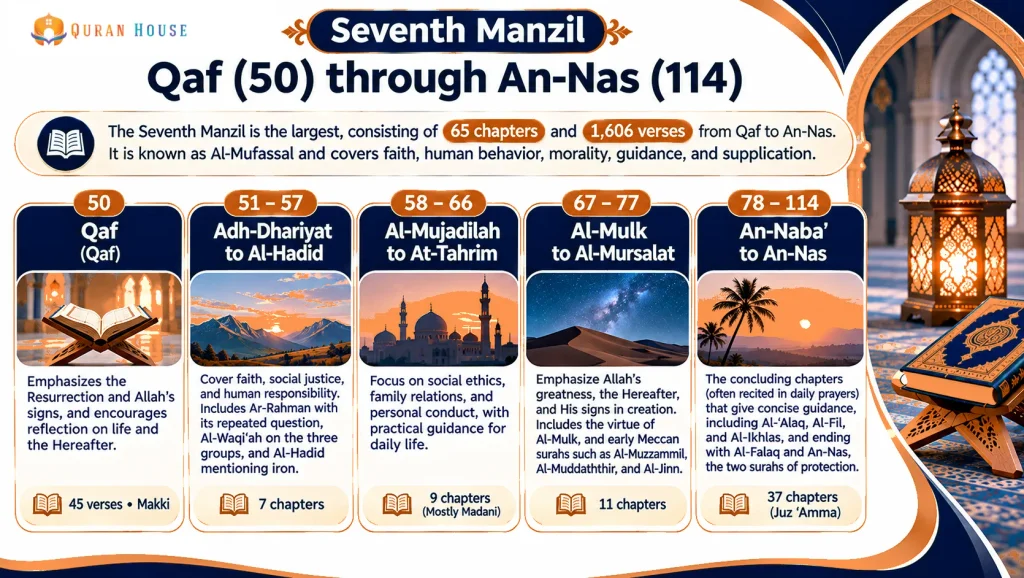
Seventh Manzil: Qaf (50) through An-Nas (114)
The Seventh Manzil of the Quran is the largest by number, consisting of 65 chapters and 1,606 verses from Qaf to An-Nas. This part is known as Al-Mufassal, and it covers a wide range of themes, including divine wisdom, human behavior, morality, guidance, and supplication.
Qaf (Chapter 50)
Qaf emphasizes the reality of the Resurrection and the signs of Allah’s existence in the natural world. It encourages reflection on life, death, and the Hereafter.
Qaf is a Makki surah of 45 verses and the opening of Al-Mufassal. The Prophet ﷺ recited it often in his Friday sermon, as one of the female Companions reported:
«مَا أَخَذْتُ ﴿ق وَالْقُرْآنِ الْمَجِيدِ﴾ إِلَّا عَنْ لِسَانِ رَسُولِ اللَّهِ ﷺ، يَقْرَؤُهَا كُلَّ يَوْمِ جُمُعَةٍ عَلَى الْمِنْبَرِ إِذَا خَطَبَ النَّاسَ»
“I only learned Qaf, by the Glorious Quran, from the tongue of the Messenger of Allah ﷺ, who used to recite it every Friday on the pulpit when he addressed the people.”
The hadith shows that Qaf was recited so often in public that a Companion memorized it just by listening, which is a good example of how regular recitation builds memorization.
Adh-Dhariyat to Al-Hadid (Chapters 51–57)
These chapters cover various aspects of faith, social justice, divine wisdom, and human responsibility. They emphasize the importance of recognizing Allah’s signs and following His guidance.
This group includes Ar-Rahman, which repeats the question
﴿فَبِأَيِّ آلَاءِ رَبِّكُمَا تُكَذِّبَانِ﴾
“Which of the favors of your Lord will you deny?”
31 times, Al-Waqi’ah, which divides people on the Day of Judgment into three groups, and Al-Hadid, which mentions iron as a material of great strength sent down by Allah.
Al-Mujadilah to At-Tahrim (Chapters 58–66)
This section focuses on social ethics, family relations, and personal conduct. It provides guidance on various aspects of daily life, emphasizing the importance of morality and righteousness.
Most of these are Madani surahs. Al-Mujadilah opens with the woman who argued with the Prophet ﷺ about her husband and was answered by revelation, Al-Hashr tells of the expulsion of Banu An-Nadir, Al-Jumu’ah commands leaving trade for the Friday prayer, and At-Talaq sets out the rules of divorce and the waiting period.
Al-Mulk to Al-Mursalat (Chapters 67–77)
These chapters emphasize the greatness of Allah, the reality of the Hereafter, and the importance of recognizing Allah’s signs in the natural world. They encourage reflection, gratitude, and trust in Allah’s wisdom.
This group opens with Al-Mulk, whose virtue the Prophet ﷺ described:
«إِنَّ سُورَةً مِنَ الْقُرْآنِ ثَلَاثُونَ آيَةً شَفَعَتْ لِرَجُلٍ حَتَّى غُفِرَ لَهُ، وَهِيَ سُورَةُ تَبَارَكَ الَّذِي بِيَدِهِ الْمُلْكُ»
“There is a surah in the Quran of thirty verses that interceded for a man until he was forgiven: Tabarak Alladhi Biyadihil-Mulk.”
At-Tirmidhi graded this hadith hasan, and it is the reason many Muslims recite Al-Mulk every night. The same group also includes Al-Muzzammil and Al-Muddaththir, among the earliest surahs revealed, and Al-Jinn, which tells of the jinn who heard the Quran and believed.
An-Naba’ to An-Nas (Chapters 78–114)
The concluding chapters of the Quran are often recited in daily prayers. They cover various themes, including the Resurrection, divine mercy, protection from evil, and supplication. They provide concise guidance for personal development and spiritual growth. Many of them, such as Surah Al-Fil, which tells how Allah protected the Kaaba from the army of the elephant, are among the first surahs children memorize.
This group is known as Juz ‘Amma. It includes Al-‘Alaq, whose opening verses were the first revelation, and Al-Ikhlas, whose great weight the Prophet ﷺ explained:
«وَالَّذِي نَفْسِي بِيَدِهِ، إِنَّهَا لَتَعْدِلُ ثُلُثَ الْقُرْآنِ»
“By the One in whose hand is my soul, it is equal to one third of the Quran.”
Scholars explain that Al-Ikhlas equals a third of the Quran in meaning, because it is entirely about the oneness of Allah, not that reciting it replaces reading the whole Quran. The group ends with Al-Falaq and An-Nas, the two surahs of seeking refuge with Allah.
Manzil vs Juz vs Hizb: What Is the Difference?
Many readers confuse the manzil with the juz and the hizb, but they are three separate ways of dividing the same text. The key difference is the number of parts and the reading plan each one serves.
| Division | Number of parts | Based on | Built for |
|---|---|---|---|
| Manzil | 7 | Complete surahs | Finishing the Quran in 1 week |
| Juz | 30 | Roughly equal length (about 20 pages each) | Finishing the Quran in 1 month, especially in Ramadan |
| Hizb | 60 (2 in every juz) | Half of a juz | Daily or twice-daily recitation |
| Rub’ al-Hizb | 240 (4 in every hizb) | A quarter of a hizb | Short daily portions and memorization reviews |
Notice that a manzil always starts and ends with a complete surah, while a juz or hizb can start in the middle of a surah. This is why manzils are not equal in their number of surahs, even though they are close in length.
What Is the Purpose of Manzil in the Quran?
The purpose of dividing the Quran into manzils is to make it easy to recite the entire Quran over one week. Each manzil represents the portion for one day, so the reader completes a full recitation in seven days. Here is a closer look at what this division offers:
- Structured Recitation: The manzils give a clear daily target. By following them, a person can complete the recitation of the Quran in a week without having to plan each day.
- Ease of Recitation: The daily portions are close in length, which makes a consistent daily routine manageable.
- Spiritual Practice: Many Muslims aim to complete the Quran regularly, and especially during Ramadan. The manzils provide a clear and systematic plan to reach this goal.
- Accessibility: Breaking the Quran into seven portions makes a full recitation feel achievable, even for readers with less experience. If you are still learning to read Arabic, these tips for learning the Noorani Qaida faster will help you reach the point where you can follow a daily manzil.
- Connection with the Quran: Regular recitation is a virtuous act that builds a deeper connection with Allah’s words. The manzils support this habit by keeping the reader engaged with the whole Quran, not only familiar surahs.
The weekly completion has a strong basis in the Sunnah. When Abdullah ibn Amr ibn Al-As wanted to recite the whole Quran more often, the Prophet ﷺ told him:
«فَاقْرَأْهُ فِي سَبْعٍ وَلَا تَزِدْ عَلَى ذَلِكَ» “Then recite it in seven days, and do not do more than that.” (Sahih Al-Bukhari 5054; Sahih Muslim 1159)
When Did the Manzils of the Quran Start?
The weekly division of the Quran goes back to the practice of the Companions. Aws ibn Hudhayfah reported that he asked the Companions of the Prophet ﷺ how they divided the Quran for their recitation, and they said:
«ثَلَاثٌ، وَخَمْسٌ، وَسَبْعٌ، وَتِسْعٌ، وَإِحْدَى عَشْرَةَ، وَثَلَاثَ عَشْرَةَ، وَحِزْبُ الْمُفَصَّلِ وَحْدَهُ» “Three, five, seven, nine, eleven, thirteen, and the section of Al-Mufassal on its own.” (Sunan Abi Dawud 1393)
Imam Ibn Kathir explained that the three surahs are Al-Baqarah, Al-Imran, and An-Nisa’, the five are Al-Ma’idah to At-Tawbah, and so on, until Al-Mufassal, which starts from Surah Qaf. This matches the seven manzils exactly, with Al-Fatihah added to the first one. You can read his full explanation in Tafsir Ibn Kathir on Surah Qaf.
We should be clear about the strength of this narration. Ibn Kathir graded it hasan (good), while Shaykh Al-Albani graded it da’if (weak). The division into seven portions of roughly equal length is also attributed to the early Quran reciter Hamzah Az-Zayyat (d. 156 AH). In either case, the manzils are a practical aid and not an act of worship in themselves.
Help your kids connect with their faith with the Online Quran Classes for Kids, a program that makes learning the Quran accessible and enjoyable for young learners.

How Can You Recite the Quran in a Week?
Recite one manzil every day, in order, for seven days. That is about 86 pages of the Madinah Mushaf a day, and it completes the whole Quran in exactly one week.
- Day 1: Al-Fatihah to An-Nisa’.
- Day 2: Al-Ma’idah to At-Tawbah.
- Day 3: Yunus to An-Nahl.
- Day 4: Al-Isra’ to Al-Furqan.
- Day 5: Ash-Shu’ara’ to Ya-Sin.
- Day 6: As-Saffat to Al-Hujurat.
- Day 7: Qaf to An-Nas.
A practical tip: split each day’s manzil across your five daily prayers. That is about 17 pages after each prayer, or roughly 30 minutes, depending on your reading speed.
How Can You Recite the Quran in Two Weeks?
Read half a manzil every day for 14 days. That is about 43 pages a day of the 604-page Madinah Mushaf.
- Days 1–2: the First Manzil, half each day.
- Days 3–4: the Second Manzil.
- Days 5–6: the Third Manzil.
- Days 7–8: the Fourth Manzil.
- Days 9–10: the Fifth Manzil.
- Days 11–12: the Sixth Manzil.
- Days 13–14: the Seventh Manzil.
A practical tip: read about 9 pages after each of the five daily prayers: Fajr, Dhuhr, Asr, Maghrib, and Isha.
How Can You Recite the Quran in a Month?
Read one juz every day for 30 days. Each juz is about 20 pages, and this is the plan most Muslims follow in Ramadan.
- Daily target: 1 juz, about 20 pages.
- After each prayer: 4 pages after Fajr, Dhuhr, Asr, Maghrib, and Isha.
- Catching up: if you miss a day, add one hizb (half a juz) to each of the next two days.
Whatever plan you choose, remember that Allah has made recitation easy and flexible:
﴿فَاقْرَءُوا مَا تَيَسَّرَ مِنَ الْقُرْآنِ﴾ “So recite what is easy for you of the Quran.” (Al-Muzzammil 73:20)
This verse was revealed to lighten the long night prayer that was first asked of the believers. Its lesson for any recitation plan is clear: choose the amount you can keep up steadily, because a small regular portion is better than a large one you abandon.
Why Do You Need to Use the Manzils of the Quran?
You do not have to use them, but they are the easiest way to complete the Quran every week. The manzils are a matter of arrangement, not revelation. They are reported from the practice of the Companions of the Prophet ﷺ, and they are not an act of worship in themselves; they exist to make reciting the whole Quran easier and more regular.
The manzils are most useful if you want a weekly khatm. Each manzil is one day’s portion, so you never have to work out where to stop, and every day ends with a complete surah.
They also help if you struggle with consistency. A fixed daily target is easier to keep than a page count, because you always know what today’s reading is and when you have finished it.
Following the manzils in order also takes you through the whole Quran, including the long surahs that many readers tend to skip in favor of familiar ones. This is why many huffaz use the manzils to revise the entire Quran every week.
If you want to go deeper into the sciences of the Quran, you can join our Quranic Arabic courses and study with a qualified teacher.
Learning Through Play: A Live Kids Class
Young learners stay focused when lessons feel like a game. Watch a real Quran House class where interactive activities and a patient tutor keep a child engaged, reciting, and smiling from start to finish.
Start Your Quran Journey With Quran House
Learn live and one-on-one with Al-Azhar-trained tutors, male and female, for children and adults, at a time that fits your timezone.
Try a Free SessionStart Your Weekly Khatm With a Qualified Tutor
Many Muslims start a weekly khatm full of motivation, then miss one day, then another, until the plan quietly fades. Reading alone also means small mistakes in pronunciation and Tajweed go unnoticed and become habits that are hard to fix later.
At Quran House, our Al-Azhar-trained tutors turn the seven manzils into a plan built around your level and your schedule. In live one-to-one sessions, your tutor listens to your recitation, corrects your Tajweed as you read, and follows up with you every week so you stay on track. We teach adults and kids, and sisters who prefer a female tutor can learn with a female Quran, Tajweed, and Arabic teacher.
Whether your goal is to complete your first khatm, recite more fluently, or review what you have memorized, you will have a teacher by your side at every step. The result is a steady, lasting connection with the Quran, not a plan that stops after the first week.
Book your free session today and start your first manzil with a qualified tutor.
Explore Our Quran Courses:
- Noorani Qaida for Beginners
- Noorani Qaida for Adults
- Noor Al-Bayan Course
- Quran Reading Fluency Course
- Word-by-Word Quran Reading Course
- Complete Quran Reading (Khatma) Program
- Intensive Quran Course
- Online Quran Classes for Sisters and Women
- Online Quran Classes for Men and Brothers

Conclusion
The 7 manzils of the Quran turn the goal of completing the Quran from a large, vague task into a clear daily habit. You now know what a manzil is, the exact surahs in each of the seven portions, and how the manzil differs from the juz and the hizb.
We also saw that the weekly completion is rooted in the Prophet’s ﷺ advice to Abdullah ibn Amr and in the practice of the Companions, while the division itself remains a tool for ease, not an act of worship. Whether you choose a weekly plan with the manzils, a two-week plan, or one juz a day, consistency matters more than speed.
Start with the plan that fits your life today, and use a trusted Mushaf or Quran.com to follow the Arabic text. If you want support along the way, our tutors at Quran House are ready to guide your recitation step by step.
FAQs
Are there 6 or 7 manzils in the Quran?
There are 7 manzils. The sixth runs from As-Saffat (37) to Al-Hujurat (49), and the seventh from Qaf (50) to An-Nas (114). Some sources merge them by mistake, which makes it look like there are only six.
Is reading the Quran by manzils obligatory?
No. The manzils are a helpful arrangement, not a religious obligation. You can recite the Quran by juz, by pages, or by any plan that suits you, as long as you keep a regular connection with it.
Can I finish the Quran in less than a week?
Scholars generally discourage finishing it in less than three days, based on the hadith of Abdullah ibn Amr that whoever recites the Quran in less than three days does not understand it (Sunan Abi Dawud 1394). A week is the plan the Prophet ﷺ recommended to him.
What is Al-Mufassal?
Al-Mufassal is the last part of the Quran, made of many short surahs. According to the most widely held view, it starts from Surah Qaf, so it is the same as the seventh manzil.
Is the “Manzil” for protection the same as the seven manzils?
No. The word “Manzil” is also used for a separate collection of 33 verses recited for protection and ruqyah. It is a different topic from the seven weekly portions of the Quran explained in this guide.
Do I have to start the first manzil on a specific day?
No. You can start on any day of the week. What matters is reading the manzils in order and keeping the routine every week.