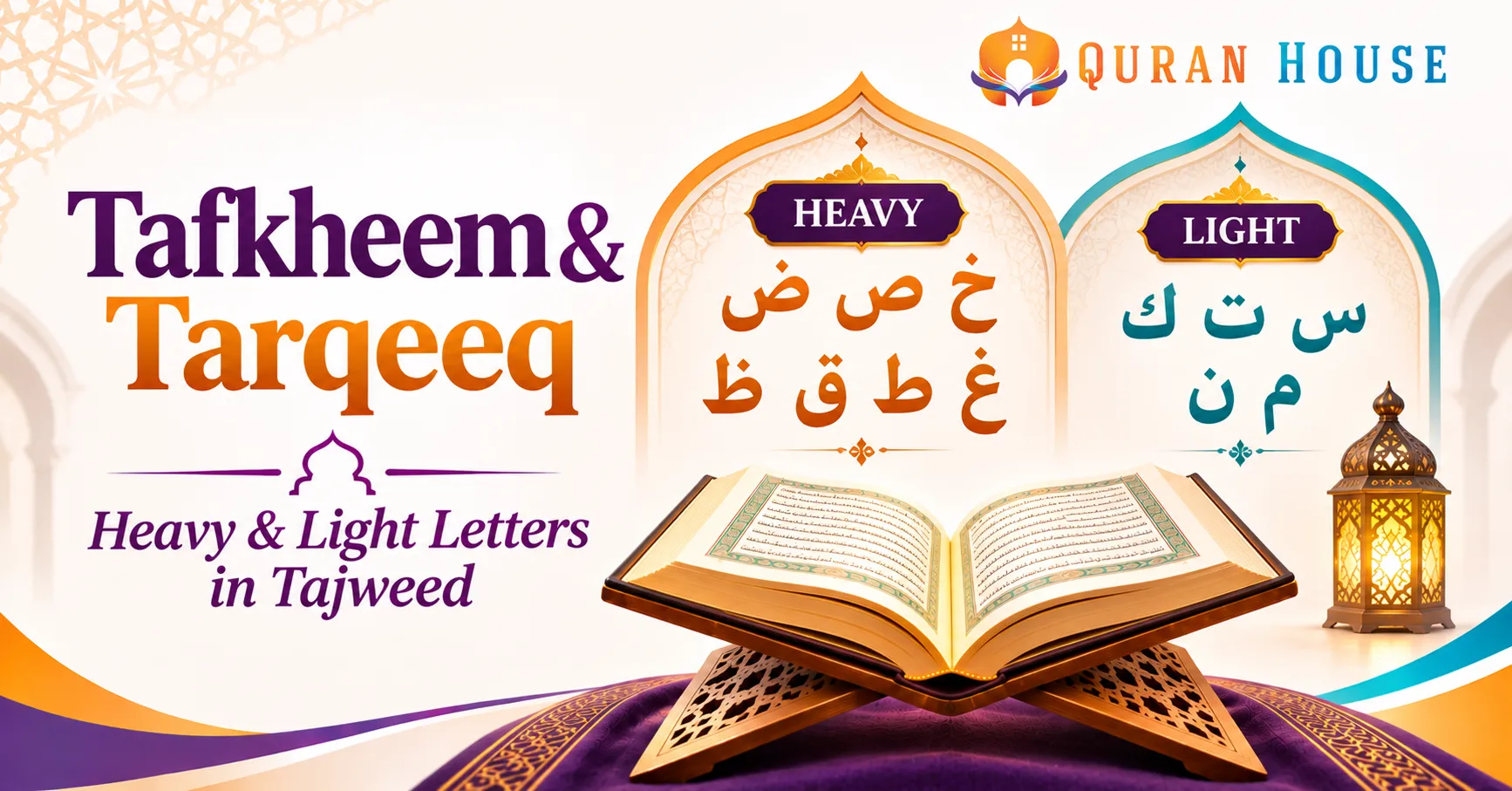
Tafkheem and Tarqeeq are essential Tajweed rules that determine whether Arabic letters are pronounced with a heavy or light sound during Quran recitation. Tafkheem refers to making a letter sound full and heavy, while Tarqeeq means pronouncing it with a lighter, thinner sound.
There are seven Arabic letters that always have Tafkheem: خ، ص، ض، غ، ط، ق، ظ. Most other letters are pronounced lightly, while Raa (ر), the Laam in the name of Allah (ل), and Alif Maddiyyah (ا) follow specific rules depending on their context.
In this guide, you will learn the rules of Tafkheem and Tarqeeq, identify heavy and light letters, understand the different levels of Tafkheem, and practice Quranic examples to improve your pronunciation.
What You’ll Learn:
- The meaning of Tafkheem and Tarqeeq in Tajweed.
- The seven heavy letters and their Quranic examples.
- The five levels of Tafkheem.
- The letters that are pronounced lightly.
- When Raa, Laam, and Alif are heavy or light.
- Common pronunciation mistakes and practical exercises.
Tafkheem and Tarqeeq Rules in Tajweed
Tafkheem and Tarqeeq are two important characteristics of Arabic pronunciation that help preserve the correct articulation of Quranic letters.
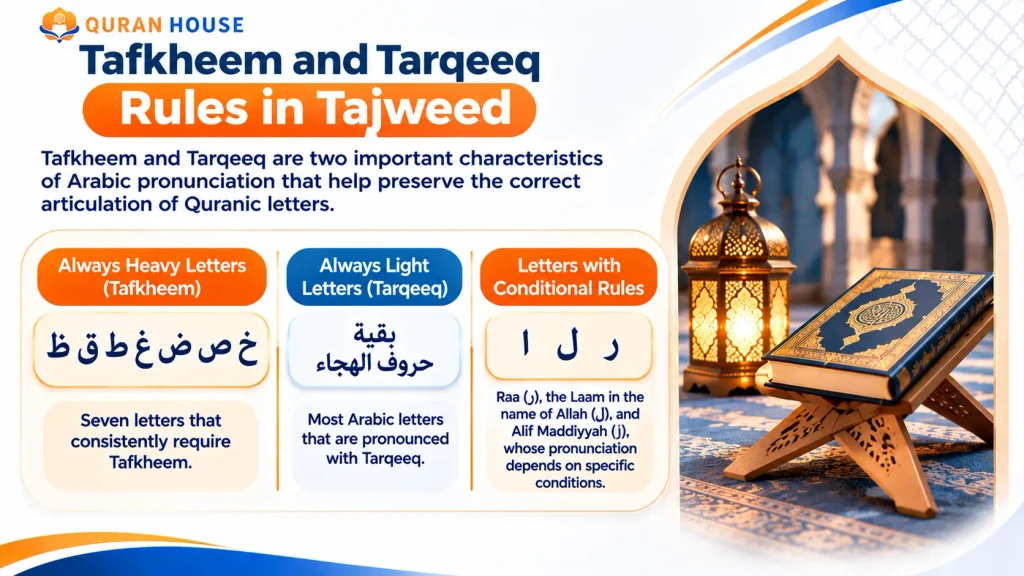
In Tajweed, Arabic letters can be divided into three main groups:
- Always Heavy Letters: Seven letters that consistently require Tafkheem, although the strength of their heaviness varies.
- Always Light Letters: Most Arabic letters that are pronounced with Tarqeeq.
- Letters with Conditional Rules: Raa (ر), the Laam in the name of Allah (ل), and Alif Maddiyyah (ا), whose pronunciation depends on specific conditions.
Understanding these categories helps learners distinguish similar sounds and avoid pronunciation mistakes.
What Is Tafkheem?
Tafkheem (التفخيم) means heaviness or fullness in pronunciation. In Tajweed, it describes the characteristic of certain Arabic letters that produces a deep, full sound during recitation.
When pronouncing a heavy letter, the back of the tongue rises toward the roof of the mouth, creating the distinctive fullness associated with Tafkheem.
The seven heavy letters are known as Huroof Al-Isti’laa (حروف الاستعلاء) because they involve elevation of the tongue during articulation.
Tafkheem should not be confused with Qalqalah. Tafkheem refers to the heaviness of a letter, while Qalqalah is a distinct articulation characteristic involving a slight release or bounce when certain letters carry Sukoon.
Tafkheem Letters: The Seven Heavy Letters in Arabic
There are seven letters of Tafkheem in the Arabic alphabet. They are commonly remembered through the phrase:
خُصَّ ضَغْطٍ قِظْ
These letters remain heavy regardless of their vowel, although the degree of Tafkheem changes.
The following table provides examples of each heavy letter from the Quran.
| Heavy Letter | Quranic Example | Reference |
|---|---|---|
| ط (Taa) | الطَّرِيقَةِ | Surah Al-Jinn, 72:16 |
| ض (Daad) | قَرْضًا حَسَنًا | Surah Al-Muzzammil, 73:20 |
| ص (Saad) | الصِّرَاطَ | Surah Al-Fatihah, 1:6 |
| ظ (Dhaa) | ظَلَمُوا | Surah At-Tur, 52:47 |
| ق (Qaaf) | قَدِيرٌ | Surah Al-Baqarah, 2:20 |
| غ (Ghayn) | غَيْرِ | Surah Al-Fatihah, 1:7 |
| خ (Khaa) | خَالِدِينَ | Surah Al-Bayyinah, 98:6 |
Although all seven letters are heavy, they do not have identical articulation points. Each letter must be pronounced from its correct Makhraj while maintaining its characteristic heaviness.
The Five Levels of Tafkheem
The strength of Tafkheem varies depending on the vowel accompanying the heavy letter. Tajweed scholars describe different classifications, including three-level and five-level systems.
In the commonly taught five-level classification, the levels are arranged from strongest to weakest as follows:
- Heavy Letter with Fatha Followed by Alif: This is the strongest level of Tafkheem, as in قَالَ (Surah Al-Baqarah, 2:30).
- Heavy Letter with Fatha: A heavy letter carrying Fatha is pronounced with strong Tafkheem, as in خَلَقَ (Surah Al-Alaq, 96:2).
- Heavy Letter with Damma: The letter retains its heaviness, as in قُتِلَ (Surah Abasa, 80:17).
- Heavy Letter with Sukoon: A heavy letter carrying Sukoon remains heavy, with its degree influenced by the preceding vowel, as in أَطْعَمَهُم (Surah Quraysh, 106:4).
- Heavy Letter with Kasra: This is the weakest level of Tafkheem, but the letter remains heavy, as in الصِّرَاطَ (Surah Al-Fatihah, 1:6).
The fourth level requires particular attention because the strength of a Saakin heavy letter is influenced by the vowel before it. Teachers may explain the levels differently according to the classification they follow.
Listening to a qualified Qari and practicing with a Tajweed teacher can help you distinguish these levels accurately.
Tafkheem Examples from the Quran
Recognizing heavy letters in Quranic words helps learners apply Tafkheem during recitation.
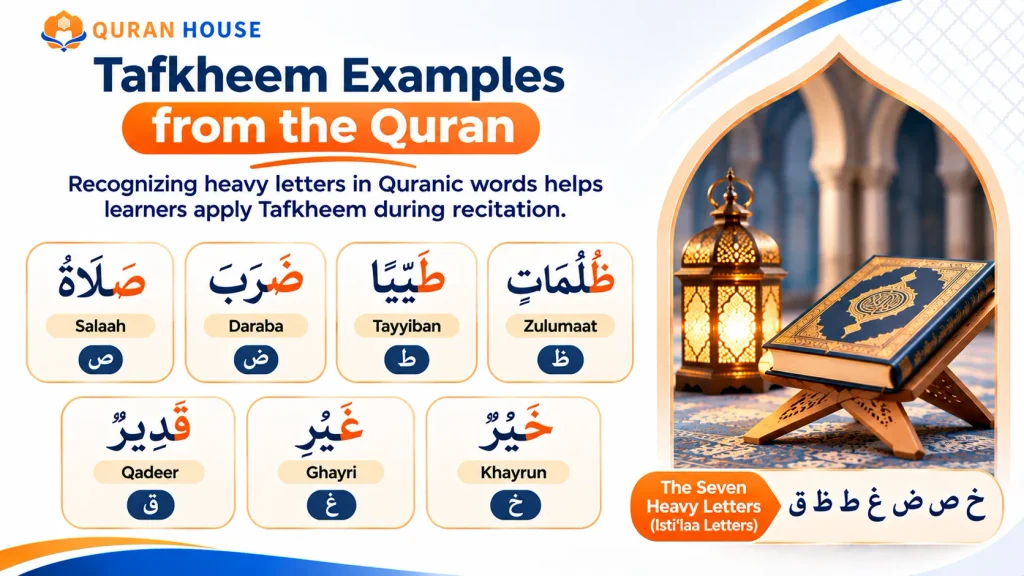
Consider these examples:
- صَلَاة (Salaah): The letter ص is pronounced heavily, even though its sound is close to the lighter letter س.
- ضَرَبَ (Daraba): The letter ض retains its distinctive heavy pronunciation.
- طَيِّبًا (Tayyiban): The letter ط is heavy and must not be confused with the lighter ت.
- ظُلُمَاتٍ (Zulumaat): The letter ظ is pronounced heavily.
- قَدِيرٌ (Qadeer): The letter ق requires Tafkheem and should not be pronounced like ك.
- غَيْرِ (Ghayri): The letter غ retains its heavy characteristic.
- خَيْرٌ (Khayrun): The letter خ is pronounced with Tafkheem.
These examples demonstrate how the seven Isti’laa letters maintain their heavy quality across different Quranic words.
What Is Tarqeeq?
Tarqeeq (الترقيق) means thinness or lightness in pronunciation. In Tajweed, it refers to pronouncing a letter without the fullness associated with Tafkheem.
Most Arabic letters are pronounced with Tarqeeq. These are associated with the characteristic of Istifaal (الاستفال), in which the tongue does not rise in the manner required for the seven Isti’laa letters.
Correct Tarqeeq is particularly important when a light letter appears beside a heavy one. The reciter must avoid allowing the heaviness of one letter to affect another letter that should remain light.
Tarqeeq Letters: Light Letters in Arabic
Most Arabic letters are pronounced lightly. They include:
ء، ب، ت، ث، ج، ح، د، ذ، ز، س، ش، ع، ف، ك، م، ن، ه، و، ي
The letters ر and ل have additional conditions, while the long Alif follows the heaviness or lightness of the letter before it.
Here are some examples of light letters from the Quran:
| Light Letter | Quranic Example | Reference |
|---|---|---|
| ت (Taa) | تَوَّابًا | Surah An-Nasr, 110:3 |
| س (Seen) | السَّمَاوَاتِ | Surah An-Naba, 78:37 |
| م (Meem) | الرَّحْمَٰنُ | Surah Ar-Rahman, 55:1 |
| ك (Kaaf) | كَانَ | Surah Al-Ikhlas, 112:4 |
| ب (Baa) | بِسْمِ | Surah Al-Fatihah, 1:1 |
These letters should maintain their natural light pronunciation without unnecessary heaviness.
It’s Never Too Late to Learn
Adults learn with us too. Watch a real session with one of our adult learners and see how calm, one-on-one guidance makes Quran recitation feel achievable at any age.
Start Your Quran Journey With Quran House
Learn live and one-on-one with Al-Azhar-trained tutors, male and female, for children and adults, at a time that fits your timezone.
Try a Free SessionLetters That Can Be Heavy or Light
Some Arabic letters require special attention because their pronunciation changes according to the surrounding vowels or other Tajweed conditions.
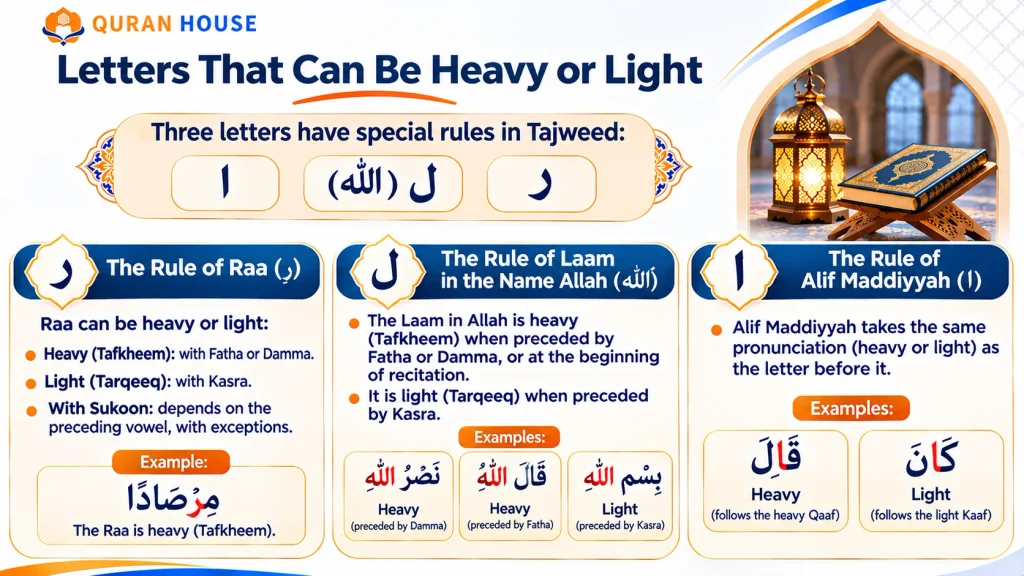
The three principal cases are Raa (ر), the Laam in the name Allah (ل), and Alif Maddiyyah (ا).
The Rule of Raa (ر)
Raa may be pronounced with Tafkheem or Tarqeeq depending on its vowel and, when it is Saakin, other conditions involving the surrounding letters and vowels.
A Raa carrying Fatha or Damma is generally heavy, while a Raa carrying Kasra is light A Raa carrying Sukoon often depends on the vowel before it, but there are important exceptions.
For example, in مِرْصَادًا, the Raa is heavy despite the preceding Kasra because it is followed by an Isti’laa letter with Fatha in the same word.
The Rule of Laam in the Name of Allah (الله)
The letter Laam is generally light. However, the Laam in the name Allah follows special rules It is pronounced heavily when the name Allah is preceded by Fatha or Damma, or when beginning recitation with the name itself.
Examples include:
- نَصْرُ اللَّهِ: The Laam is heavy because the preceding letter carries Damma (Surah An-Nasr, 110:1).
- قَالَ اللَّهُ: The Laam is heavy because the preceding vowel is Fatha (Surah Al-Ma’idah, 5:110).
- بِسْمِ اللَّهِ: The Laam is light because it follows Kasra (Surah Al-Fatihah, 1:1).
The Rule of Alif Maddiyyah (ا)
Alif Maddiyyah follows the pronunciation of the letter immediately before it If the preceding letter is heavy, the long Alif follows its heaviness. If the preceding letter is light, the Alif follows its lightness.
For example, in قَالَ, the Alif follows the heavy Qaaf. In كَانَ, it follows the light Kaaf This rule helps preserve the correct sound of long vowels during Quran recitation.
Tarqeeq Examples from the Quran
Practicing light letters alongside heavy letters helps learners recognize the difference between Tafkheem and Tarqeeq.
Consider the following examples:
- رِجَالٌ: The Raa is light because it carries Kasra (Surah An-Nur, 24:37).
- سَمَاءً: The Seen and Meem are pronounced lightly (Surah Al-Baqarah, 2:22).
- بِسْمِ: The Baa, Seen, and Meem retain their light pronunciation (Surah Al-Fatihah, 1:1).
- شِفَاءٌ: The Sheen and Faa are pronounced lightly (Surah Yunus, 10:57).
- فِرْعَوْنَ: The Saakin Raa is pronounced lightly because it follows an original Kasra in the same word (Surah Al-Baqarah, 2:49).
These examples show that Tarqeeq depends on the nature of the letter and, in certain cases, the surrounding vowels.
Other Tafkheem and Tarqeeq Examples
Comparing heavy and light letters side by side can make their pronunciation differences easier to recognize.
| Heavy Letter | Light Letter | Main Difference |
|---|---|---|
| ص | س | Saad is heavy, while Seen is light |
| ط | ت | Taa (ط) is heavy, while Taa (ت) is light |
| ظ | ذ | Dhaa (ظ) is heavy, while Dhaal (ذ) is light |
| ق | ك | Qaaf is heavy, while Kaaf is light |
These pairs are useful for pronunciation practice, but each letter also has a distinct articulation point or set of characteristics. Correct recitation requires more than simply making one sound deeper.
Examples of Tafkheem and Tarqeeq of Raa
The letter Raa (ر) requires particular attention because it can be heavy or light depending on its vowel and the conditions surrounding it.
Tafkheem of Raa (ر)
Raa is generally pronounced heavily when it carries Fatha or Damma. A Saakin Raa is also heavy in several cases, including when it follows Fatha or Damma.
Examples include:
- رَبِّ: The Raa is heavy because it carries Fatha (Surah Al-Fatihah, 1:2).
- رُزِقُوا: The Raa is heavy because it carries Damma (Surah Al-Baqarah, 2:25).
- أَرْضِ: The Saakin Raa is heavy because it follows Fatha (Surah Al-Baqarah, 2:11).
- الْقُرْآنَ: The Saakin Raa is heavy because it follows Damma (Surah Ar-Rahman, 55:2).
The presence of another heavy letter nearby does not automatically make Raa heavy. Its ruling must be determined according to the established Tajweed conditions.
Tarqeeq of Raa (ر)
Raa is generally pronounced lightly when it carries Kasra or when a Saakin Raa follows an original Kasra in the same word, provided no exception applies.
Examples include:
- رِجَالٌ: The Raa is light because it carries Kasra (Surah An-Nur, 24:37).
- رِزْقًا: The Raa is light because it carries Kasra (Surah Al-Baqarah, 2:25).
- فِرْعَوْنَ: The Saakin Raa is light because it follows an original Kasra (Surah Al-Baqarah, 2:49).
Some situations, especially when stopping at the end of a word, require additional rules. Certain Quranic words also have recognized exceptional readings in the Hafs recitation.
Learning these details with a qualified teacher helps prevent confusion between the general rules and their exceptions.
For guided pronunciation practice, explore the Practical Tajweed Course at Quran House, where students receive individual feedback on Tajweed rules during live recitation.
Common Tafkheem and Tarqeeq Mistakes to Avoid
Even learners who understand the theoretical rules may make mistakes when applying them during continuous Quran recitation.
Some common mistakes include:
- Pronouncing Saad (ص) Like Seen (س): Saad requires Tafkheem, while Seen remains light.
- Pronouncing Taa (ط) Like Taa (ت): These letters have different articulation characteristics and should not be confused.
- Making Every Raa Heavy: Raa carrying Kasra is light, and certain Saakin Raa cases also require Tarqeeq.
- Making the Laam in Bismillah Heavy: In بِسْمِ اللَّهِ, the Laam of Allah follows Kasra and must be light.
- Losing Tafkheem with Kasra: A heavy letter remains heavy even when it carries Kasra, although its heaviness is weaker.
- Making Neighboring Light Letters Heavy: A heavy letter should not cause surrounding light letters to lose their correct pronunciation.
Correcting these mistakes requires careful listening, regular practice, and attention to the articulation of each letter.
How to Practice Heavy and Light Letters in Tajweed?
Learning the definitions of Tafkheem and Tarqeeq is only the first step. Applying them consistently requires listening and practical recitation.
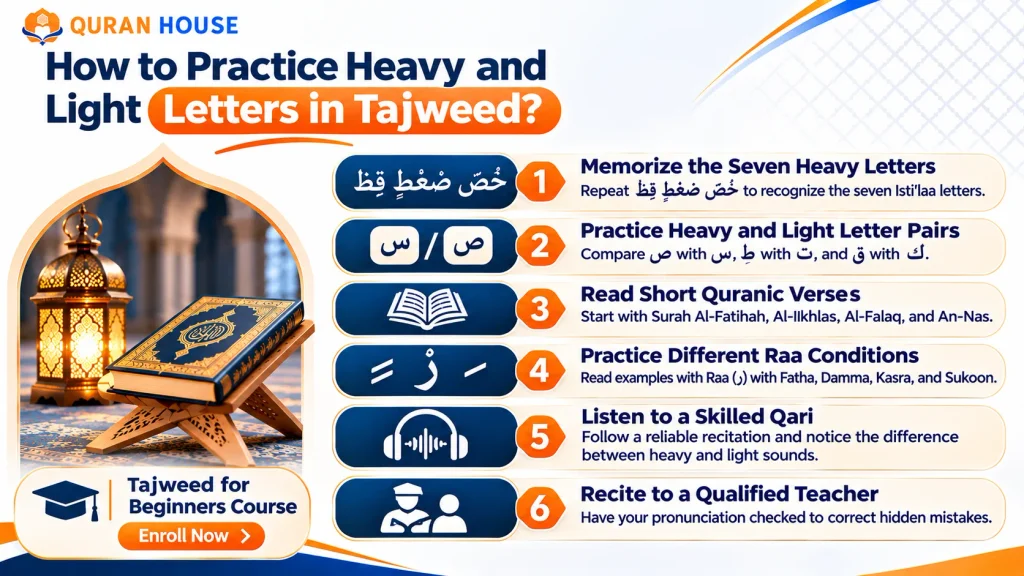
Follow these steps to improve your pronunciation:
- Memorize the Seven Heavy Letters: Repeat خُصَّ ضَغْطٍ قِظْ until you can recognize the seven Isti’laa letters without hesitation.
- Practice Heavy and Light Letter Pairs: Compare ص with س, ط with ت, and ق with ك while maintaining their correct articulation points.
- Read Short Quranic Verses: Begin with Surah Al-Fatihah, Al-Ikhlas, Al-Falaq, and An-Nas to identify heavy and light letters.
- Practice Different Raa Conditions: Read examples containing Raa with Fatha, Damma, Kasra, and Sukoon.
- Listen to a Skilled Qari: Follow a reliable recitation and pay attention to the differences between heavy and light sounds.
- Recite to a Qualified Teacher: Have your pronunciation checked to correct mistakes that may be difficult to recognize independently.
For beginners who want structured instruction, the Tajweed for Beginners Course offers guidance on applying Tajweed rules during Quran reading.
Quick Tafkheem and Tarqeeq Rules Chart
The following chart summarizes the most important rules discussed in this guide.
| Letter Category | Rule | Example |
|---|---|---|
| Seven Isti’laa letters | Always heavy, with varying degrees | ص، ض، ط، ظ، ق، غ، خ |
| Most other letters | Pronounced lightly | س، ت، ك، م |
| Raa with Fatha or Damma | Heavy | رَبِّ، رُزِقُوا |
| Raa with Kasra | Light | رِجَالٌ |
| Saakin Raa | Depends on preceding vowels and exceptions | أَرْضِ، فِرْعَوْنَ |
| Laam in Allah after Fatha or Damma | Heavy | نَصْرُ اللَّهِ |
| Laam in Allah after Kasra | Light | بِسْمِ اللَّهِ |
| Alif Maddiyyah | Follows the preceding letter | قَالَ، كَانَ |
This chart provides a quick reference for recognizing the rules, but correct pronunciation is best developed through listening and supervised practice.
Memorizing Surah Ad-Duha in Class
Memorization is easier with structure. See how a student reviews and recites Surah Ad-Duha in a live lesson, guided by a tutor who follows every step of their progress.
Start Your Quran Journey With Quran House
Learn live and one-on-one with Al-Azhar-trained tutors, male and female, for children and adults, at a time that fits your timezone.
Try a Free SessionImprove Your Tafkheem and Tarqeeq with Quran House
Understanding heavy and light letters is an important part of Tajweed, but applying these rules correctly during recitation often requires practical guidance. At Quran House, our Al-Azhar-trained teachers help students develop accurate pronunciation through personalized online Quran and Tajweed lessons.
Since 2018, Quran House has provided live one-on-one classes for children and adults in Quran reading, Tajweed, memorization, Quranic Arabic, and Tafseer. Whether you are learning the seven heavy letters for the first time or working on the more detailed rules of Raa and Laam, our teachers help you practice and correct pronunciation errors at your level.
Ready to improve your Quran recitation? Book your 2 free sessions and start practicing Tajweed with a qualified Al-Azhar tutor.
Explore Our Quran Courses:
- Noorani Qaida for Adults
- Noor Al-Bayan Course
- Quran Reading Fluency Course
- Word-by-Word Quran Reading Course
- Complete Quran Reading (Khatma) Program
- Intensive Quran Course
- Online Quran Classes for Sisters and Women
- Online Quran Classes for Men and Brothers
Conclusion
Tafkheem and Tarqeeq are fundamental Tajweed rules that help Muslims pronounce Arabic letters accurately during Quran recitation. Understanding the seven heavy letters, the light letters, and the special rules of Raa, Laam, and Alif provides a strong foundation for correct pronunciation.
The distinction between heavy and light sounds becomes clearer through Quranic examples and consistent practice. Paying attention to articulation points, vowel movements, and the different levels of Tafkheem helps learners avoid common pronunciation errors.
By studying these rules carefully and applying them during daily recitation, learners can improve their Quran reading and develop greater confidence in Tajweed. Regular revision and guidance from a qualified teacher can make these skills more consistent over time.
Frequently Asked Questions About Tafkheem and Tarqeeq
1. What Are Tafkheem Letters in Arabic?
The seven letters that always require Tafkheem are خ، ص، ض، غ، ط، ق، and ظ. They are known as the letters of Isti’laa and are remembered through the phrase خُصَّ ضَغْطٍ قِظْ.
2. What Are Tarqeeq Letters in Arabic?
Tarqeeq letters are generally pronounced with a light or thin sound. Most Arabic letters have this characteristic, including س، ت، ك، م، ن، and ب. However, Raa, the Laam in the name Allah, and Alif Maddiyyah require specific rules.
3. What Is the Difference Between Tafkheem and Tarqeeq?
Tafkheem refers to pronouncing a letter with heaviness and fullness, while Tarqeeq refers to pronouncing it lightly. Both are important for distinguishing Arabic sounds and maintaining correct Tajweed.
4. Is Raa Always a Heavy Letter?
No. Raa may be heavy or light depending on its vowel and the surrounding conditions. It is generally heavy with Fatha or Damma and light with Kasra, while Saakin Raa has additional rules and exceptions.
5. When Is the Laam in Allah Pronounced Heavily?
The Laam in the name Allah is heavy when preceded by Fatha or Damma, as in نَصْرُ اللَّهِ. It is light after Kasra, as in بِسْمِ اللَّهِ. When starting with the name Allah, the Laam is heavy.
6. How Can Beginners Practice Tafkheem and Tarqeeq?
Beginners should start by memorizing the seven heavy letters, practicing heavy and light letter pairs, listening to accurate Quran recitations, and reading short surahs. Reciting to a qualified Tajweed teacher helps identify and correct pronunciation mistakes.