Fasting in Islam (Sawm) is the fourth pillar of Islam, which Allah prescribed in the second year after the Hijrah. Muslims are obliged to fast the month of Ramadan, while voluntary fasting on other days allows them to follow the Sunnah of the Messenger of Allah ﷺ and earn extra reward.
So what are the types of fasting in Islam? What is its purpose, and what are its benefits? In this article, we start directly with the 5 types of fasting in Islam, then explain its purpose and its virtues from authentic hadith, followed by its history, its rules, and the days Muslims fast.
1. Obligatory Fasting (Fard): Ramadan and Its Make-Up Days
The first and most important type of fasting in Islam is the obligatory fast of Ramadan, which every adult, sane, and able Muslim must observe. It is one of the five pillars of Islam, and leaving it without a valid excuse is a major sin.
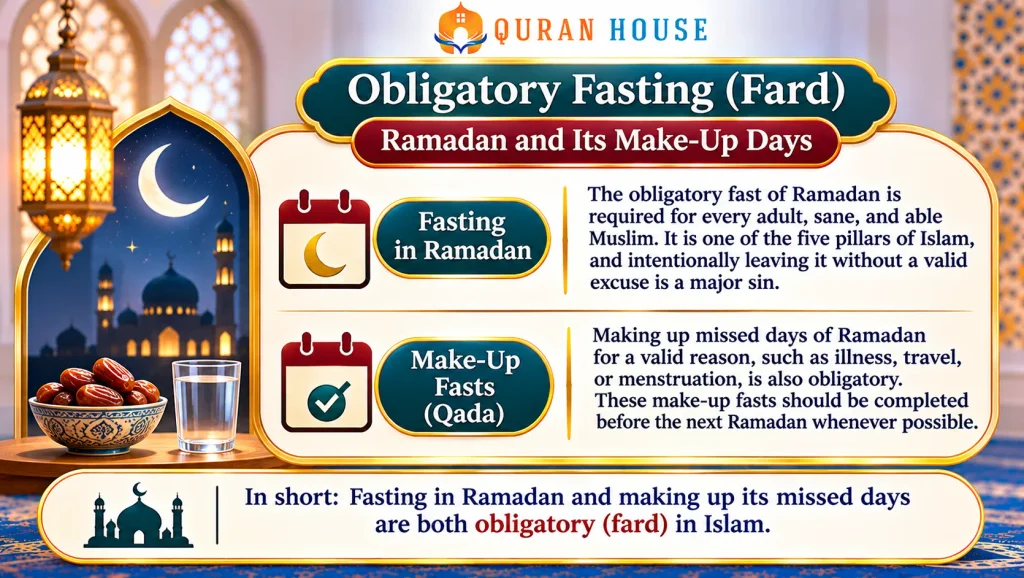
Making up the days of Ramadan that were missed for a valid reason, such as illness, travel, or menstruation, is also obligatory. These make-up fasts, known as Qada, should be completed before the next Ramadan whenever possible.
2. Required Fasting (Wajib): Vows and Expiation
The second type is fasting that becomes binding for a specific reason. If a Muslim vows to fast for Allah, fulfilling that vow becomes required. Fasting can also be required as an expiation (Kaffarah), such as for breaking an oath when one cannot feed or clothe the needy:
﴿فَمَن لَّمْ يَجِدْ فَصِيَامُ ثَلَاثَةِ أَيَّامٍ ۚ ذَٰلِكَ كَفَّارَةُ أَيْمَانِكُمْ إِذَا حَلَفْتُمْ﴾
“But whoever cannot find [the means], then a fast of three days. That is the expiation for oaths when you have sworn.”
Other expiations include the long fast required for deliberately breaking a Ramadan fast through intimate relations. These fasts are not chosen freely; they are a way of making amends that Allah has prescribed.
3. Sunnah and Voluntary Fasting (Nafl)
The third type is voluntary fasting, which follows the example of the Prophet ﷺ and brings extra reward. It includes fasting Mondays and Thursdays, six days of Shawwal, the Day of Arafah, the Day of Ashura, and the three White Days of every lunar month.
Voluntary fasts are a way to draw closer to Allah, make up for shortcomings in obligatory worship, and keep the spirit of Ramadan alive throughout the year. A person who starts a voluntary fast may break it if needed, unlike an obligatory fast.
4. Disliked Fasting (Makrooh)
The fourth type is fasting that is disliked, though not forbidden. An example is singling out Friday alone for a voluntary fast, without fasting the day before or after it. Many scholars also dislike fasting every single day of the year without a break, because it is harder than the moderate Sunnah.
The wisdom behind these rulings is balance. Islam encourages voluntary fasting, but it does not want worship to become a burden that harms the body or leads to neglecting other duties.
5. Forbidden Fasting (Haram)
The fifth type is fasting that is forbidden. It is forbidden to fast on the two days of Eid, Eid Al-Fitr and Eid Al-Adha, as these are days of celebration, eating, and gratitude. Most scholars also forbid fasting on the days of Tashreeq, the three days after Eid Al-Adha, except for a pilgrim who has no sacrificial animal.
It is also forbidden for a woman to fast during menstruation or postpartum bleeding. She makes up the missed days of Ramadan later, and she is rewarded for following Allah’s command in both cases.
Inside an Interactive One-on-One Session
Every class is live and personal. See how our tutor uses on-screen tools, quick reviews, and gentle correction to help a student build confidence with every new word.
Start Your Quran Journey With Quran House
Learn live and one-on-one with Al-Azhar-trained tutors, male and female, for children and adults, at a time that fits your timezone.
Try a Free SessionWhat Is the Purpose of Fasting in Islam?
The purpose of prescribing fasting in Islam is to train believers to control their desires, get used to patience and endurance, overcome bad habits, obey Allah, seek His pleasure, and draw closer to Him.
Moreover, fasting is a chance for Muslims to free themselves from attachment to material things and learn how to manage their cravings.
Fasting in Ramadan is a spiritual act of worship that reminds Muslims of Allah’s blessings of food and drink, which they give up from dawn to sunset every day of the month. It is also the month in which the Quran was revealed, and our Understand the Quran Course helps you connect your fast with the meanings of what you recite.
What Are the Virtues of Fasting in Islam?
Fasting in Islam carries many virtues for Muslims, which explain why it holds such an important place in the religion.
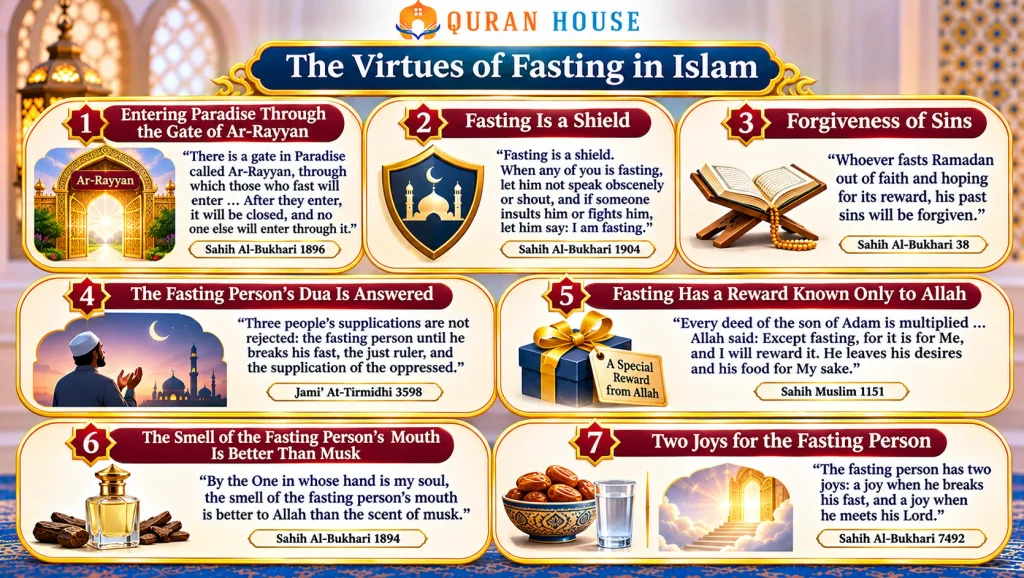
Here are the most significant ones, each with its authentic hadith:
1. Entering Paradise Through the Gate of Ar-Rayyan
Fasting is one of the deeds rewarded with Paradise. In the Hereafter, those who fast will enter Paradise through a special gate called Ar-Rayyan. Sahl ibn Sa’d reported that the Prophet ﷺ said:
«إِنَّ فِي الْجَنَّةِ بَابًا يُقَالُ لَهُ الرَّيَّانُ، يَدْخُلُ مِنْهُ الصَّائِمُونَ يَوْمَ الْقِيَامَةِ، لَا يَدْخُلُ مِنْهُ أَحَدٌ غَيْرُهُمْ، يُقَالُ: أَيْنَ الصَّائِمُونَ؟ فَيَقُومُونَ لَا يَدْخُلُ مِنْهُ أَحَدٌ غَيْرُهُمْ، فَإِذَا دَخَلُوا أُغْلِقَ فَلَمْ يَدْخُلْ مِنْهُ أَحَدٌ»
“There is a gate in Paradise called Ar-Rayyan, through which those who fast will enter on the Day of Resurrection, and none but them will enter through it. It will be said: Where are those who used to fast? They will stand up, and none but them will enter through it. After they enter, it will be closed, and no one else will enter through it.”
The name Ar-Rayyan comes from the Arabic word for quenched thirst, a fitting reward for those who endured thirst for the sake of Allah.
2. Fasting Is a Shield
Fasting protects the believer from sins in this life and from the Fire in the Hereafter. The Prophet ﷺ said, in a hadith reporting the words of Allah:
«الصِّيَامُ جُنَّةٌ، وَإِذَا كَانَ يَوْمُ صَوْمِ أَحَدِكُمْ فَلَا يَرْفُثْ وَلَا يَصْخَبْ، فَإِنْ سَابَّهُ أَحَدٌ أَوْ قَاتَلَهُ فَلْيَقُلْ: إِنِّي امْرُؤٌ صَائِمٌ»
“Fasting is a shield. When any of you is fasting, let him not speak obscenely or shout, and if someone insults him or fights him, let him say: I am fasting.”
Scholars explain that fasting is a shield because it restrains desires that lead to sin, and the Fire is surrounded by desires. The hadith also shows that true fasting includes guarding the tongue, not only the stomach.
3. Forgiveness of Sins
Allah rewards those who fast Ramadan with sincere faith with the forgiveness of their sins. Abu Hurayrah narrated that the Messenger of Allah ﷺ said:
«مَنْ صَامَ رَمَضَانَ إِيمَانًا وَاحْتِسَابًا غُفِرَ لَهُ مَا تَقَدَّمَ مِنْ ذَنْبِهِ»
“Whoever fasts Ramadan out of faith and hoping for its reward, his past sins will be forgiven.”
The two conditions in this hadith, faith and seeking reward, mean that the fast must be done sincerely for Allah, not out of habit or to follow others.
4. The Fasting Person’s Dua Is Answered
The fasting person is among those whose supplication is especially hoped to be answered. The Prophet ﷺ said:
«ثَلَاثَةٌ لَا تُرَدُّ دَعْوَتُهُمْ: الصَّائِمُ حَتَّى يُفْطِرَ، وَالْإِمَامُ الْعَادِلُ، وَدَعْوَةُ الْمَظْلُومِ»
“Three people’s supplications are not rejected: the fasting person until he breaks his fast, the just ruler, and the supplication of the oppressed.”
Scholars differ on the grading of this wording: Ibn Hajr graded it hasan, while Al-Albani graded this wording weak and authenticated another narration that mentions the fasting person alongside the traveler and the oppressed. In both cases, the dua of the fasting person is among those most hoped to be answered.
5. Fasting Has a Reward Known Only to Allah
Every good deed is multiplied, but fasting has a special reward. The Prophet ﷺ said:
«كُلُّ عَمَلِ ابْنِ آدَمَ يُضَاعَفُ، الْحَسَنَةُ عَشْرُ أَمْثَالِهَا إِلَى سَبْعِمِائَةِ ضِعْفٍ، قَالَ اللَّهُ عَزَّ وَجَلَّ: إِلَّا الصَّوْمَ فَإِنَّهُ لِي وَأَنَا أَجْزِي بِهِ، يَدَعُ شَهْوَتَهُ وَطَعَامَهُ مِنْ أَجْلِي»
“Every deed of the son of Adam is multiplied: a good deed is rewarded ten to seven hundred times. Allah, the Mighty and Majestic, said: Except fasting, for it is for Me, and I will reward it. He leaves his desires and his food for My sake.”
Scholars explain that Allah attributed fasting to Himself because it is a hidden act that is rarely mixed with showing off, and its reward is beyond the usual multiplication.
6. The Smell of the Fasting Person’s Mouth Is Better Than Musk
The Prophet ﷺ swore by Allah about the special status of the fasting person’s breath:
«وَالَّذِي نَفْسِي بِيَدِهِ، لَخُلُوفُ فَمِ الصَّائِمِ أَطْيَبُ عِنْدَ اللَّهِ تَعَالَى مِنْ رِيحِ الْمِسْكِ»
“By the One in whose hand is my soul, the smell of the fasting person’s mouth is better to Allah than the scent of musk.”
The change in the breath of a fasting person may be unpleasant to people, but because it comes from obeying Allah, it is beloved to Him.
7. Two Joys for the Fasting Person
The Prophet ﷺ described two moments of happiness that belong to every fasting person:
«وَلِلصَّائِمِ فَرْحَتَانِ: فَرْحَةٌ حِينَ يُفْطِرُ، وَفَرْحَةٌ حِينَ يَلْقَى رَبَّهُ»
“The fasting person has two joys: a joy when he breaks his fast, and a joy when he meets his Lord.”
The first joy is felt every evening at iftar, and the second, greater joy is when the person sees the reward of fasting on the Day of Judgment.
Health Benefits of Fasting in Islam
Fasting is first and foremost an act of worship, but research on fasting in general suggests it may also bring several health benefits for healthy people, such as:
- Helping regulate blood sugar.
- Improving cholesterol levels and supporting heart health.
- Helping regulate blood pressure.
- Giving the digestive system a regular period of rest.
- Lowering mental stress through routine and spiritual calm.
- Supporting brain health.
- Helping with weight management and metabolism.
These effects vary from person to person, and anyone with a medical condition, such as diabetes or a heart condition, should consult a doctor before fasting. Islam itself exempts the sick from fasting when it would harm them.
What Is Fasting in Islam?
Fasting in Islam (Sawm) is the fourth pillar of Islam, coming after the Shahadah, prayer, and Zakat. It means abstaining from food, drink, and intimate relations from dawn until sunset with the intention of worshipping Allah.
The obligatory fast takes place in Ramadan, the ninth month of the Hijri calendar, a month in which Muslims also recite the Quran, pray Taraweeh and Qiyam Al-Layl, and give charity.
Muslims fast the whole month of Ramadan in obedience to Allah, who commanded His believers to perform this worship:
﴿يَا أَيُّهَا الَّذِينَ آمَنُوا كُتِبَ عَلَيْكُمُ الصِّيَامُ كَمَا كُتِبَ عَلَى الَّذِينَ مِن قَبْلِكُمْ لَعَلَّكُمْ تَتَّقُونَ﴾
“O believers! Fasting is prescribed for you, as it was for those before you, so perhaps you will become mindful of Allah.”
The verse explains the goal of fasting in one word: taqwa, being mindful of Allah. To study this verse and the rest of the fasting verses in Surah Al-Baqarah in depth, our Quran Tafseer Course explains them with qualified teachers.
Fasting is a key to entering Paradise and being saved from the Fire in the Hereafter, and it carries countless rewards for Muslims. For learners who are starting their journey, our guide on how to learn Islam step by step explains the pillars of Islam in order.
The History of Fasting in Islam
The history of fasting in Islam as an obligation starts in the second year after the Hijrah, when Allah prescribed fasting by revealing the verse of fasting in Surah Al-Baqarah quoted above.
Before Ramadan was prescribed, the Quraysh used to fast on the day of Ashura in the pre-Islamic period, and the Prophet ﷺ fasted it too. ’Aishah, may Allah be pleased with her, described what happened next:
«كَانَ يَوْمُ عَاشُورَاءَ تَصُومُهُ قُرَيْشٌ فِي الْجَاهِلِيَّةِ، وَكَانَ رَسُولُ اللَّهِ ﷺ يَصُومُهُ، فَلَمَّا قَدِمَ الْمَدِينَةَ صَامَهُ وَأَمَرَ بِصِيَامِهِ، فَلَمَّا فُرِضَ رَمَضَانُ تَرَكَ يَوْمَ عَاشُورَاءَ، فَمَنْ شَاءَ صَامَهُ وَمَنْ شَاءَ تَرَكَهُ»
“The Quraysh used to fast on the day of Ashura in the pre-Islamic period, and the Messenger of Allah ﷺ used to fast it. When he came to Madinah, he fasted it and ordered others to fast it. When Ramadan was made obligatory, he left the day of Ashura: whoever wished fasted it, and whoever wished did not.”
This hadith shows that fasting Ashura was commanded before Ramadan, and once Ramadan was prescribed, Ashura became a voluntary fast that remains a beloved Sunnah.
How To Practice Fasting in Islam?
Muslims fast by refraining from eating, drinking, smoking, and intimate relations, with the intention of fasting for Allah.
The fast starts at dawn (Fajr) and ends at sunset (Maghrib), as Allah says in the Quran:
﴿وَكُلُوا وَاشْرَبُوا حَتَّىٰ يَتَبَيَّنَ لَكُمُ الْخَيْطُ الْأَبْيَضُ مِنَ الْخَيْطِ الْأَسْوَدِ مِنَ الْفَجْرِ ۖ ثُمَّ أَتِمُّوا الصِّيَامَ إِلَى اللَّيْلِ﴾
“Eat and drink until you see the light of dawn breaking the darkness of night, then complete the fast until nightfall.”
The “white thread” and “black thread” in the verse refer to the first light of dawn against the darkness of night, which marks the start of the fast each day.
Who Must Fast Ramadan?
Those who must fast Ramadan are:
- Muslims.
- Adults who have reached puberty.
- Sane people.
- Those who are physically able to fast.
- Women who are free from menstruation and postpartum bleeding.
Allah made exceptions for those who cannot fast, out of His mercy:
﴿وَمَن كَانَ مَرِيضًا أَوْ عَلَىٰ سَفَرٍ فَعِدَّةٌ مِّنْ أَيَّامٍ أُخَرَ ۗ يُرِيدُ اللَّهُ بِكُمُ الْيُسْرَ وَلَا يُرِيدُ بِكُمُ الْعُسْرَ﴾ “And whoever is ill or on a journey, then an equal number of other days. Allah intends ease for you and does not intend hardship for you.” (Al-Baqarah 2:185)
So the sick and the traveler may break the fast and make up the days later, and those who are permanently unable to fast, such as the very elderly, feed a poor person for each day instead.
What Are the Fasting Days in Islam?
According to the Hijri calendar, Muslims fast the obligatory days and many voluntary days, which include:
- The 29 or 30 days of Ramadan (obligatory).
- Six days of Shawwal after Ramadan.
- Mondays and Thursdays.
- The Day of Arafah (the 9th of Dhul-Hijjah), for those not performing Hajj.
- Many days of Sha’ban, as the Prophet ﷺ used to fast much of this month.
- The 13th, 14th, and 15th of each lunar month (the White Days).
- The Day of Ashura (the 10th of Muharram), preferably with the 9th.
It is forbidden to fast on the two days of Eid (Eid Al-Fitr and Eid Al-Adha). During the last ten days of Ramadan, many Muslims also observe I’tikaf in the mosque alongside their fast.
Voluntary Fasts in Islam
Voluntary fasts are called “Sunnah” or “Nafl” fasts, as the Prophet Muhammad ﷺ used to observe them in addition to Ramadan. For instance, fasting on the Day of Ashura and the Day of Arafah are voluntary fasts.
Muslims perform non-obligatory fasting to follow the Sunnah, draw closer to Allah, and seek the expiation of their sins.
The Etiquette of Breaking One’s Fast (Iftar)
Islamic tradition encourages breaking one’s fast promptly at sunset rather than delaying it unnecessarily, following the example of breaking the fast with dates and water before the Maghrib prayer and a fuller meal afterward.
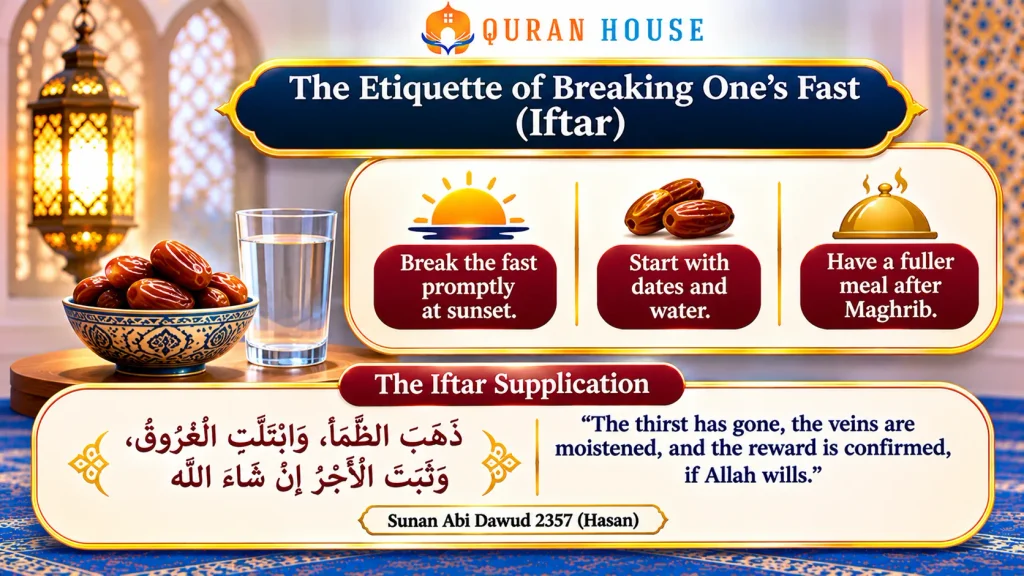
This practice balances spiritual discipline with practical wisdom, recognizing the body’s need for gentle, gradual refeeding after a full day without food or drink.
The Prophet ﷺ used to say a short supplication when he broke his fast:
«ذَهَبَ الظَّمَأُ، وَابْتَلَّتِ الْعُرُوقُ، وَثَبَتَ الْأَجْرُ إِنْ شَاءَ اللَّهُ»
“The thirst has gone, the veins are moistened, and the reward is confirmed, if Allah wills.”
Al-Albani graded this hadith hasan. Saying it adds a layer of gratitude and mindfulness to what might otherwise become a purely physical transition from hunger to satisfaction: the hardship of the day is gone, and the reward remains.
Making Up Missed Fasts and Expiation
Muslims who miss obligatory fasts due to valid reasons such as illness, travel, or menstruation are required to make up the missed days at a later time, known as Qada, preferably before the next Ramadan begins.
In cases where a fast is deliberately broken without a valid excuse, additional expiation, known as Kaffarah, may be required, which can involve fasting for an extended period or feeding a specified number of needy people. Understanding these provisions helps believers approach missed fasts with clear guidance rather than uncertainty.
The Psychological and Disciplinary Benefits of Fasting
Beyond its spiritual and physical dimensions, fasting cultivates significant psychological discipline, training practitioners to manage impulses, delay gratification, and maintain composure despite physical discomfort.
This disciplined training extends naturally into other areas of life, helping fasting individuals develop greater self-control over anger, harmful speech, and other behaviors the fasting period specifically encourages avoiding.
Many practitioners report that the mental discipline built during structured fasting periods carries forward into improved habits throughout the rest of the year.
Common Misconceptions About Fasting in Islam
Some common ideas about fasting are not accurate, and correcting them helps Muslims and non-Muslims understand this worship better:
- Fasting is sometimes mistakenly thought to be primarily about physical health rather than spiritual discipline and devotion, though both dimensions genuinely matter.
- Some assume fasting requires complete isolation from normal daily activities, when in fact most people continue working and studying as usual while fasting.
- Children are sometimes pressured into fasting before reaching an age of physical and spiritual readiness, though Islamic guidance encourages a gradual, supportive introduction.
Fasting as a Shared Communal Experience
Beyond its individual spiritual benefits, fasting during Ramadan creates a distinctive shared communal experience, as entire families, neighborhoods, and communities adjust their daily rhythms around the fast, from shared pre-dawn meals to communal iftar gatherings each evening. You can read more about the spirit of this month in our article on what Ramadan Kareem means.
This collective dimension often strengthens social bonds and mutual support, since the shared experience of hunger and the shared joy of breaking the fast together create a sense of solidarity across an entire community. Many Muslims describe it as one of the most cherished features of fasting.
Learning Through Play: A Live Kids Class
Young learners stay focused when lessons feel like a game. Watch a real Quran House class where interactive activities and a patient tutor keep a child engaged, reciting, and smiling from start to finish.
Start Your Quran Journey With Quran House
Learn live and one-on-one with Al-Azhar-trained tutors, male and female, for children and adults, at a time that fits your timezone.
Try a Free SessionDeepen Your Understanding of Fasting With Quran House
Understanding the full scope of fasting’s rulings, virtues, and practical application benefits greatly from structured, guided study. Questions come up every Ramadan, from what breaks the fast to how to make up missed days, and a qualified teacher can answer them with well-grounded, nuanced answers.
At Quran House, our Islamic Studies courses help students explore the Quranic verses on fasting alongside their practical rulings, guided by instructors trained at Al-Azhar in live one-to-one sessions, for adults and kids alike.
Whether you are preparing for your first Ramadan or deepening the worship you have practiced for years, you will have a trusted teacher by your side at every step.
Explore Our Arabic and Islamic Courses:
- Quran and Arabic Classes for Kids
- Quranic Arabic Course
- Quranic Arabic for Beginners
- Quran Tafseer Course for All Levels
- Quran Tafseer for Kids
- Understand the Quran Course
- Ijazah Course for Sisters
Final Thoughts
Fasting in Islam combines physical discipline, spiritual devotion, and psychological growth into a single, comprehensive practice observed by Muslims worldwide. Its virtues are confirmed in authentic hadith: a special gate in Paradise, a shield from sin and the Fire, the forgiveness of past sins, and a reward that Allah has kept for Himself.
Understanding its proper etiquette, its provisions for missed fasts, and its broader benefits helps believers approach this pillar of faith with both practical clarity and genuine sincerity. Regular reflection on fasting’s deeper purpose, taqwa, beyond mere abstention from food and drink, offers lasting spiritual and personal growth throughout the year.
FAQs
Can Someone Fast Voluntarily Outside of Ramadan Without a Specific Occasion?
Yes, voluntary fasting on days such as Mondays and Thursdays is encouraged and carries additional reward beyond the obligatory Ramadan fast.
What Happens if Someone Forgets They Are Fasting and Eats Accidentally?
The fast remains valid, and the person continues fasting once they remember, as the Prophet ﷺ said that Allah fed him and gave him drink (Sahih Al-Bukhari 1933).
Is It Necessary To Make a Specific Intention Before Each Fast?
Yes, an intention, even a simple one in the heart, is a condition for the fast to be valid.
Who Is Exempt From Fasting Ramadan?
The sick, travelers, menstruating women, and those unable to fast are exempt, and most of them make up the days later.
Is It Allowed To Fast on the Day of Eid?
No, fasting on the days of Eid Al-Fitr and Eid Al-Adha is forbidden.