
| Key Takeaways |
| Surah Taha is the 20th chapter of the Quran, a Makki surah of 135 verses that falls entirely within Juz 16. |
| The only authentic narration naming Surah Taha specifically is Sunan Ibn Majah 3856, which places the Greatest Name of Allah in Al-Baqarah, Al Imran, and Taha. |
| Popular claims linking Surah Taha to marriage, pregnancy, or skin healing have no authentic basis in the Sunnah. |
| The dua of Musa in verses 25 to 28 and the request for knowledge in verse 114 are ideal supplications for students. |
Surah Taha benefits reach every Muslim who has felt anxious, overwhelmed, or uncertain about the road ahead. The 20th chapter of the Quran opens by telling the Prophet ﷺ that revelation came to bring relief, not distress.
Revealed in Makkah during years of fierce opposition, Surah Taha contains 135 verses and devotes more than 80 of them to the story of Prophet Musa. It also recounts the story of Adam and describes the Day of Judgment.
Not every claim circulating online about this surah is authentic, so this guide separates established evidence from weak narrations. It covers the spiritual lessons, the revelation context, the dua of Musa, and a memorization plan. The benefits are as follows.
A. Spiritual Benefits of Reading Surah Taha Through Musa
Surah Taha follows Musa from his calling at the valley of Tuwa to the exodus of the Children of Israel. Each stage of the story carries a lesson every believer can apply in daily life.
1. Strengthen Trust in Allah Through Musa’s Divine Assurance
When Allah commanded Musa and Harun to go to Pharaoh, both expressed fear of his tyranny. The reply came with a promise of divine companionship that every believer facing hardship can hold onto:
قَالَ لَا تَخَافَآ ۖ إِنَّنِى مَعَكُمَآ أَسْمَعُ وَأَرَىٰ
(Qāla lā takhāfā innanī ma’akumā asma’u wa arā)
(“[Allah] said, ‘Fear not. Indeed, I am with you both; I hear and I see.'”)
Musa did not receive a promise that the task would be easy; he received the assurance that Allah was with him at every step. This is how Surah Taha teaches trust in Allah’s presence during hardship.
2. Build Perseverance by Following Musa Through Hardship
There is no turning back for Prophet Musa, even when the matter becomes very difficult. The trials he went through and the patience he showed in them are an inspiration in themselves for every believer.
From facing the magicians to leading his people across the sea, Musa met every obstacle with steady effort. Readers of Surah Taha learn that perseverance means continuing to act while trusting Allah with the outcome.
3. Rely on Allah’s Power Through the Miracle of the Staff
The staff of Prophet Musa, which turned into a moving serpent by Allah’s command, is a clear sign of Allah’s mighty power. Musa had leaned on that same staff and used it to herd his sheep for years.
A true believer depends on Allah’s power, which intervenes when it is needed. Excessive self-reliance asks more of a person than human ability can carry, while reliance on Allah keeps effort and trust in balance.
4. Keep Salah Central to Your Remembrance of Allah
Surah Taha ties the remembrance of Allah to every part of life. At the valley of Tuwa, Allah introduced Himself to Musa and commanded prayer in one of the clearest statements of Tawheed in the Quran:
إِنَّنِىٓ أَنَا ٱللَّهُ لَآ إِلَـٰهَ إِلَّآ أَنَا۠ فَٱعْبُدْنِى وَأَقِمِ ٱلصَّلَوٰةَ لِذِكْرِىٓ
(Innanī anallāhu lā ilāha illā ana fa’budnī wa aqimiṣ-ṣalāta li-dhikrī)
(“Indeed, I am Allah. There is no deity except Me, so worship Me and establish prayer for My remembrance.”)
Regular prayer and frequent mention of Allah keep the heart anchored to its spiritual purpose and bring peace of mind. Salah is a non-negotiable part of connecting to Allah, and Surah Taha presents it as the purpose of remembrance.
Quran House offers an Understand the Quran Course that helps students grasp the meaning of verses like these directly, so every recitation of Surah Taha becomes an act of reflection.

Start Learning the Meaning of the Quran With a Free Trial
B. Surah Taha Benefits for Repentance and the Hereafter
Beyond the story of Musa, Surah Taha also speaks to the sinner seeking a way back and to the believer preparing for the Hereafter. Two lessons stand out in these closing passages of the surah.
5. Find Hope in Allah’s Forgiveness Through the Story of Adam
Surah Taha presents a short account of Prophet Adam, highlighting Allah’s mercy after humanity’s first slip. Adam and his wife ate from the forbidden tree, then turned back to Allah in sincere repentance.
Allah’s response, recorded in the verse below, shows that a mistake does not close the door of forgiveness for anyone who returns to Him with sincerity and humility:
ثُمَّ ٱجْتَبَـٰهُ رَبُّهُۥ فَتَابَ عَلَيْهِ وَهَدَىٰ
(Thummaj-tabāhu rabbuhū fatāba ‘alayhi wa hadā)
(“Then his Lord chose him and turned to him in forgiveness and guided [him].”)
The story then moves to scenes of the Resurrection, where the obedient return to Paradise and the disobedient face the consequence of turning away. This contrast frames the remaining verses of the surah.
6. Prioritize the Hereafter Through Reflection on Judgment Day
Surah Taha describes the Day of Judgment in detail, reminding people that life in this world is brief compared with the Hereafter. Reflecting on this helps the believer prioritize spiritual growth over material pursuits.
The surah also warns, in clear terms, of the hardship that follows turning away from Allah’s remembrance, both in this life and on the Day of Resurrection:
وَمَنْ أَعْرَضَ عَن ذِكْرِى فَإِنَّ لَهُۥ مَعِيشَةً ضَنكًا وَنَحْشُرُهُۥ يَوْمَ ٱلْقِيَـٰمَةِ أَعْمَىٰ
(Wa man a’raḍa ‘an dhikrī fa-inna lahū ma’īshatan ḍankan wa naḥshuruhū yawmal-qiyāmati a’mā)
(“And whoever turns away from My remembrance, indeed, he will have a depressed life, and We will gather him on the Day of Resurrection blind.”)
Revelation of Surah Taha in Makkah Before the Hijrah
Surah Taha was revealed in Makkah before the Prophet Muhammad ﷺ migrated to Madinah, at a time when he faced intense opposition from the Quraysh and the early believers were few in number.
That opposition ranged from verbal accusations to physical persecution of the early Muslims. When the surah was revealed, it comforted the Prophet ﷺ and the believers, urging patience and trust in Allah’s plan.
The surah opens with reassurance addressed directly to the Prophet ﷺ, making clear that revelation was sent as a reminder and a relief rather than a burden:
مَآ أَنزَلْنَا عَلَيْكَ ٱلْقُرْءَانَ لِتَشْقَىٰٓ
(Mā anzalnā ‘alaykal-Qur’āna litashqā)
(“We have not sent down to you the Qur’an that you be distressed”)
Scholars differ on the meaning of Taha. At-Tabari reports the view that Taha means “O man” in the Nabatean language, an address to the Prophet ﷺ, while many scholars count it among the disconnected opening letters.
The key facts about Surah Taha, from its position in the Mushaf to its order of revelation, are summarized in the table below for quick reference.
| Feature | Detail |
| Surah number | 20 |
| Number of verses | 135 |
| Place of revelation | Makkah (Makki surah) |
| Juz | Entirely within Juz 16 |
| Order of revelation | 45th, according to the commonly cited order |
| Main narrative | Prophet Musa, across more than 80 verses |
| Other stories | Prophet Adam and scenes of the Day of Judgment |
A Real Surah Lesson: Surah Ash-Shams
Watch a student work through Surah Ash-Shams step by step with their tutor, practicing each ayah until the recitation flows clearly and correctly.
Start Your Quran Journey With Quran House
Learn live and one-on-one with Al-Azhar-trained tutors, male and female, for children and adults, at a time that fits your timezone.
Try a Free SessionSurah Taha Hadith and the Greatest Name of Allah
Many online lists attribute large rewards to Surah Taha, yet only a small amount of evidence is authentic. Separating the two protects readers from attaching hopes to narrations that the scholars of hadith rejected.
Sunan Ibn Majah 3856 on the Greatest Name of Allah
The clearest authentic evidence linked to Surah Taha concerns the Greatest Name of Allah, the name by which a supplication is answered. Ibn Majah records it from Al-Qasim, with a second chain through Abu Umamah to the Prophet ﷺ.
اسْمُ اللَّهِ الأَعْظَمُ الَّذِي إِذَا دُعِيَ بِهِ أَجَابَ فِي سُوَرٍ ثَلاَثٍ الْبَقَرَةِ وَآلِ عِمْرَانَ وَطَهَ
(Ismullāhil-a’ẓamul-ladhī idhā du’iya bihī ajāba fī suwarin thalāthin al-Baqarati wa Āli ‘Imrāna wa Ṭāhā)
(“The Greatest Name of Allah, if He is called by which He will respond, is in three Surah: Al-Baqarah, Al ‘Imran and Ta-Ha.”)
Scholars graded this narration Hasan. Al-Qasim explained that he searched these three surahs and found the name Al-Hayy Al-Qayyum, which appears in Surah Taha 20:111. This is among the most meaningful benefits of reading Surah Taha for anyone making dua.
Every verse a believer learns from Surah Taha becomes part of a lifelong relationship with the Quran, which explains why memorizing the Quran carries such lasting value in this life and the next.
Weak Narrations About Surah Taha Rewards
Several narrations circulate claiming that whoever recites Surah Taha receives the reward of the Muhajirun and Ansar, or that Allah recited Taha and Yasin before creating the heavens. Hadith scholars graded these narrations as extremely weak or fabricated.
Popular instructions about writing the surah on green cloth or washing its ink for marriage have no chain to the Prophet ﷺ at all. Authentic benefit comes from reciting, understanding, and acting on the verses themselves.
Distinct Significance of Surah Taha Among Makki Surahs
Surah Taha holds deep significance for Muslims because of its direct and empowering message. Its structure demonstrates Allah’s power and mercy, guiding believers through the stories of earlier prophets.
Those stories strengthen the values of patience, trust, and submission to Allah’s will. Each narrative shows a prophet facing pressure and responding with faith rather than fear or doubt.
Surah Taha is also distinguished by its detailed narrative of Prophet Musa, which covers more than 80 verses. Few surahs follow a single prophet through so many stages of his mission in one sitting.
The milestones include the call of Musa at Tuwa, the mission to Pharaoh, the signs and miracles, the contest with the magicians, the exodus, the drowning of Pharaoh’s army, and the trial of the golden calf.
Quran House offers a Quran Tafseer Course for All Levels that walks students through long Makki surahs like Surah Taha verse by verse, explaining context, wording, and scholarly commentary.

Book Your Free Tafseer Trial Session
Classical and Modern Exegetical Views on Surah Taha
Scholars across the centuries have read Surah Taha through different lenses. Classical commentators focused on the inner meaning of each verse, while modern scholars emphasize application to present-day life.
Classical Exegesis of Musa’s Love for Allah
Classical scholars such as Ibn Kathir and Al-Suyuti drew deeper meanings from Surah Taha. The love Allah expressed for Prophet Musa in verses 39 and 41 is a central focus of their commentary.
Scholars also note how Musa hastened to meet Allah, leaving his people behind for a short time. They read this as a sign of intense love and longing for his Lord.
Al-Qurtubi explains the same scene on an emotional and spiritual level. Musa was ready to leave his people to meet Allah, even though putting one’s priorities in order can be very trying.
For Al-Qurtubi, the episode shows how committed Musa was and how he loved Allah more than anything else in his life, a model of devotion for every reader.
Modern Exegesis and Application to Daily Life
Modern scholars point to the relevance of these lessons for contemporary challenges. They urge believers to draw strength from the faith, steadfastness, and trust that Prophet Musa showed in Allah amid adversity.
This approach helps Muslims apply the major teachings of Surah Taha to personal and communal life, so the eternal wisdom of the Quran guides daily decisions more effectively.
Surah Taha as a Source of Comfort in Difficult Seasons
Many readers return to Surah Taha during periods of personal anxiety or hardship, since the surah was itself revealed in response to the Prophet’s distress. This origin gives it a distinctly comforting tone.
The surah pairs sweeping narrative with gentle reassurance. Reciting it during moments of worry, and reflecting on how Allah addressed the Prophet’s fears, offers a model for managing anxiety through faith rather than avoidance or despair.
Is Surah Taha for Marriage Supported by Islamic Evidence?
No authentic hadith links reciting Surah Taha to finding a spouse or speeding up marriage. Formulas such as reciting it a set number of times for 11 days do not trace back to the Prophet ﷺ or the Companions.
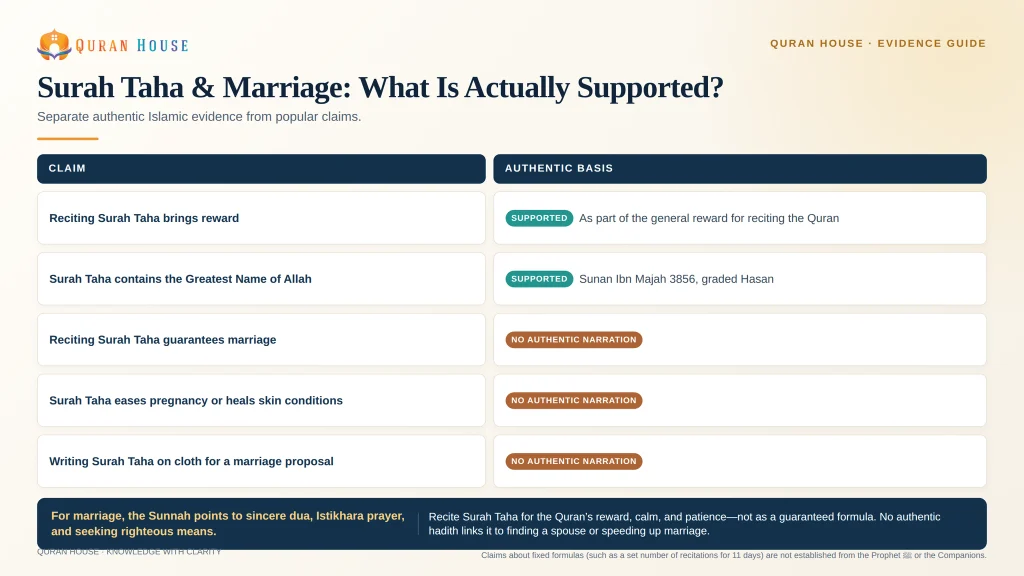
Reciting Surah Taha while waiting for marriage is still a rewarded act, because it is recitation of the Quran. The problem lies only in promising a specific outcome from a specific formula without evidence.
The table below compares the most common claims about the benefits of reading Surah Taha with their actual standing in authentic Islamic sources, so readers can judge each one clearly.
| Claim | Authentic Basis |
| Reciting Surah Taha brings reward for every recitation | Supported, as part of the general reward for reciting the Quran |
| Surah Taha contains the Greatest Name of Allah | Supported, Sunan Ibn Majah 3856, graded Hasan |
| Reciting Surah Taha guarantees marriage | No authentic narration |
| Surah Taha eases pregnancy or heals skin conditions | No authentic narration |
| Writing Surah Taha on cloth for a marriage proposal | No authentic narration |
For marriage, the Sunnah points to sincere dua, Istikhara prayer, and seeking righteous means. Surah Taha can support that journey as a source of calm and patience, not as a guaranteed formula.
Gentle Speech Lessons From Musa’s Confrontation With Pharaoh
The details of Musa’s confrontation with Pharaoh offer practical guidance for facing intimidating opposition. Allah instructed Musa and Harun to speak gently to Pharaoh, despite his tyranny and arrogance:
فَقُولَا لَهُۥ قَوْلًا لَّيِّنًا لَّعَلَّهُۥ يَتَذَكَّرُ أَوْ يَخْشَىٰ
(Faqūlā lahū qawlan layyinan la’allahū yatadhakkaru aw yakhshā)
(“And speak to him with gentle speech that perhaps he may be reminded or fear [Allah].”)
Scholars often highlight this command as a model for approaching even hostile figures with wisdom rather than aggression. If gentle speech was required before Pharaoh, it is required all the more with family, colleagues, and neighbors.
This nuance shows that the lessons of Surah Taha extend into concrete guidance on conduct under pressure, favoring measured speech over confrontation whenever possible in daily life.
Dua From Surah Taha for Students and Confident Speech
Surah Taha contains two of the most loved supplications for anyone who studies, teaches, or speaks in public. The first is the dua Musa made before facing Pharaoh, asking Allah for ease and clear speech:
قَالَ رَبِّ ٱشْرَحْ لِى صَدْرِى (٢٥) وَيَسِّرْ لِىٓ أَمْرِى (٢٦) وَٱحْلُلْ عُقْدَةً مِّن لِّسَانِى (٢٧) يَفْقَهُوا۟ قَوْلِى (٢٨)
(Qāla rabbish-raḥ lī ṣadrī, wa yassir lī amrī, waḥlul ‘uqdatan min lisānī, yafqahū qawlī)
(“[Moses] said, ‘My Lord, expand for me my breast [with assurance] and ease for me my task and untie the knot from my tongue that they may understand my speech.'”)
Students often recite this dua before exams, presentations, and difficult conversations. The second supplication comes in a verse that teaches patience with revelation and ends with a request every learner can repeat daily:
فَتَعَـٰلَى ٱللَّهُ ٱلْمَلِكُ ٱلْحَقُّ ۗ وَلَا تَعْجَلْ بِٱلْقُرْءَانِ مِن قَبْلِ أَن يُقْضَىٰٓ إِلَيْكَ وَحْيُهُۥ ۖ وَقُل رَّبِّ زِدْنِى عِلْمًا
(Fata’ālallāhul-malikul-ḥaqq, wa lā ta’jal bil-Qur’āni min qabli an yuqḍā ilayka waḥyuhū, wa qur-rabbi zidnī ‘ilmā)
(“So high [above all] is Allah, the Sovereign, the Truth. And, [O Muhammad], do not hasten with [recitation of] the Qur’an before its revelation is completed to you, and say, ‘My Lord, increase me in knowledge.'”)
At Quran House, students preparing to recite before a teacher often begin with the dua of Musa. Learning the Arabic meaning of each phrase turns it from a memorized formula into a heartfelt request.
Quran House offers a Quranic Arabic Course that teaches the vocabulary and grammar behind supplications like these, so students understand every word they ask of Allah.

Try a Free Quranic Arabic Lesson Today
Narrative Structure Behind the Central Message of Surah Taha
The structure of Surah Taha moves from a direct address to the Prophet ﷺ, into the extended narrative of Musa, and back to judgment and remembrance. This order is deliberate and serves the message of the surah.
Each section reinforces the central message of trust in Allah amid hardship, with the Musa narrative serving as a detailed illustration of abstract principles. Trust and perseverance become vivid and memorable when tied to a dramatic story.
Surah Taha Compared With Other Prophetic Narrative Surahs
Several surahs, including Surah Yusuf and Surah Al-Anbiya, draw on the stories of earlier prophets to teach spiritual lessons. Each brings its own distinct focus and emotional tone to the reader.
Surah Yusuf follows a single continuous narrative centered on patience and forgiveness. Surah Taha weaves the story of Musa together with a direct address to the Prophet Muhammad ﷺ, combining history with immediate personal comfort.
This dual framing is part of why Surah Taha feels especially personal, since its storytelling responds directly to the emotional state of the Prophet ﷺ at the time of revelation.
Surah Taha and Early Muslim Resilience in Makkah
Beyond comforting the Prophet ﷺ, Surah Taha strengthened the resolve of the early Muslim community during sustained hardship in Makkah. Musa’s trials gave the believers a clear precedent for their own struggle.
Musa faced Pharaoh’s tyranny, endured his people’s doubts, and persisted despite repeated setbacks. Scholars note that drawing strength from earlier prophets became a recurring pattern in the Quran, with Surah Taha among its most detailed examples.
The Sirah of Ibn Ishaq also reports that Umar ibn al-Khattab was moved toward Islam after reading the opening of Surah Taha at his sister’s home. Some scholars consider the chain of this report weak, though it remains widely cited.
Musa’s Humility Before Allah in Surah Taha
Commentary on Surah Taha often highlights the humility Musa shows throughout his encounters with Allah, despite being entrusted with a major mission. He openly acknowledged his limitations rather than relying on his own abilities.
Musa asked Allah to send his brother Harun with him as a helper. This request teaches a balance between sincere effort and humility, since success in any worthwhile task depends on Allah’s support rather than personal capability alone.
How to Memorize Surah Taha in Manageable Portions
Surah Taha is a strong intermediate goal for students who have already memorized Juz Amma. Its clear story flow makes long passages easier to retain than surahs built on rulings or short, unconnected themes.
Before setting a timeline, it helps to know how long it takes to memorize the Quran at different daily paces. For Surah Taha, the narrative divides naturally into six portions:
- Verses 1 to 24: the opening address and the calling of Musa at Tuwa.
- Verses 25 to 48: the dua of Musa and his commission with Harun.
- Verses 49 to 76: the debate with Pharaoh and the contest with the magicians.
- Verses 77 to 98: the exodus, the crossing of the sea, and the golden calf.
- Verses 99 to 114: the scenes of the Day of Judgment and the command to seek knowledge.
- Verses 115 to 135: the story of Adam and the closing guidance to the Prophet ﷺ.
At three to five verses a day with steady revision, most adult students complete the surah in about six to nine weeks. Linking each portion to its scene in the story keeps the verses connected in memory.
Quran House offers a Quran Memorization for Adults program that builds daily Hifz routines around portions like these, with one-on-one revision and Tajweed correction from qualified tutors.

Begin Memorizing Surah Taha With a Free Trial
Practical Ways to Apply Surah Taha Lessons Every Day
The lessons of Surah Taha become most valuable when they shape daily habits. These practical steps turn reflection on the surah into consistent, measurable action throughout the week:
- Recite the surah during moments of fear or uncertainty, reflecting on Allah’s words of reassurance to Musa.
- Study the story of Musa and Pharaoh as a model for handling difficult confrontations with patience and measured speech.
- Reflect regularly on the Day of Judgment passages as a reminder to prioritize spiritual growth.
- Build the emphasis of the surah on remembrance and prayer into a consistent daily routine.
- Recite the dua of Musa from verses 25 to 28 before exams, interviews, and important conversations.
- Repeat “My Lord, increase me in knowledge” before every study session.
Memorizing Surah Ad-Duha in Class
Memorization is easier with structure. See how a student reviews and recites Surah Ad-Duha in a live lesson, guided by a tutor who follows every step of their progress.
Start Your Quran Journey With Quran House
Learn live and one-on-one with Al-Azhar-trained tutors, male and female, for children and adults, at a time that fits your timezone.
Try a Free SessionStudy Surah Taha With Quran House Al-Azhar Trained Tutors
Surah Taha rewards careful, guided study because of its rich narrative and the depth of scholarly commentary around it. Quran House tutors walk students through its structure, historical context, and the classical and modern readings of its key verses.
Instructors trained at Al-Azhar help students connect the story of Musa to daily life, correct recitation in real time, and build memorization plans that fit busy schedules. Every lesson is live and one-on-one.
Our Quran Courses
- Understand the Quran Course.
- Quran Tafseer Course for All Levels.
- Quranic Arabic Course.
- Quran Memorization for Adults.
- Quran Tafseer for Kids.
- Online Quran Classes for Sisters and Women.
Book Your Free Trial Lesson With Quran House
Conclusion
The benefits of reading Surah Taha begin with its opening promise that the Quran was revealed to bring relief, not distress. From that promise, the surah builds lessons on trust, perseverance, repentance, and remembrance of Allah.
The story of Musa turns those lessons into living examples, while the authentic narration in Sunan Ibn Majah 3856 adds the honor of containing the Greatest Name of Allah. Weak claims about marriage or healing add nothing to that value.
Reading Surah Taha with understanding, memorizing it portion by portion, and repeating the dua of Musa daily keeps its guidance active. Its verses continue to offer renewed strength for whatever hardship life brings.
FAQs
Why Was Surah Taha Revealed?
Surah Taha was revealed in Makkah to comfort and reassure the Prophet Muhammad ﷺ during intense opposition from the Quraysh. Its opening verses declare that the Quran was not sent to cause him distress but as a reminder for those who fear Allah
What Is the Central Story Told in Surah Taha?
The central story is that of Prophet Musa, told across more than 80 verses. It follows his calling at Tuwa, his confrontation with Pharaoh, the contest with the magicians, the exodus of the Children of Israel, and the trial of the golden calf.
What Does the Name Taha Mean?
Taha is made of two Arabic letters, Ta and Ha, that open the surah. At-Tabari reports a view that it means “O man” in Nabatean, addressed to the Prophet ﷺ, while many scholars treat it as disconnected letters whose meaning Allah knows best
Are There Authentic Benefits of Reading Surah Taha?
Yes. Sunan Ibn Majah 3856, graded Hasan, states that the Greatest Name of Allah is found in Al-Baqarah, Al Imran, and Taha. Narrations promising the reward of the Muhajirun and Ansar for reciting it are extremely weak or fabricated.
How Do Modern Scholars Approach Surah Taha Differently?
Modern scholars emphasize the practical relevance of the lessons in the surah on faith and steadfastness. They encourage believers to apply the example of Musa directly to personal challenges, family life, and communal responsibilities in contemporary settings.
What Role Does Harun Play in Surah Taha?
Musa asked Allah to make his brother Harun a helper in his mission, and Allah granted the request. Scholars cite this as evidence of Musa’s humility and wisdom in seeking support rather than carrying a heavy responsibility alone.