The benefits of Surah Alam Nashrah come from a short Makki surah of eight verses that carries one of the most comforting promises in the Quran: with hardship comes ease. The surah is called in the Quran “Ash-Sharh,” and in it, Allah addresses Prophet Muhammad ﷺ to support him against the hardships he faced from the disbelievers.
According to the Sunnah, there is no authentic hadith that sets a special reward for reciting this surah in particular. Its real benefits come from its verses, together with the general reward of reciting the Quran: reassurance, closeness to Allah, and the reward of every letter.
In this guide, we go straight to the 7 benefits of Surah Alam Nashrah taken from its verses and the authentic Sunnah. After that, you will find its name, the reasons for its revelation, its full text in Arabic and English, and practical tips to memorize it.
1. It Promises That Ease Always Comes With Hardship
The heart of the surah is a promise that Allah repeats twice:
﴿فَإِنَّ مَعَ الْعُسْرِ يُسْرًا إِنَّ مَعَ الْعُسْرِ يُسْرًا﴾
“So, surely with hardship comes ease. Surely with that hardship comes more ease.”
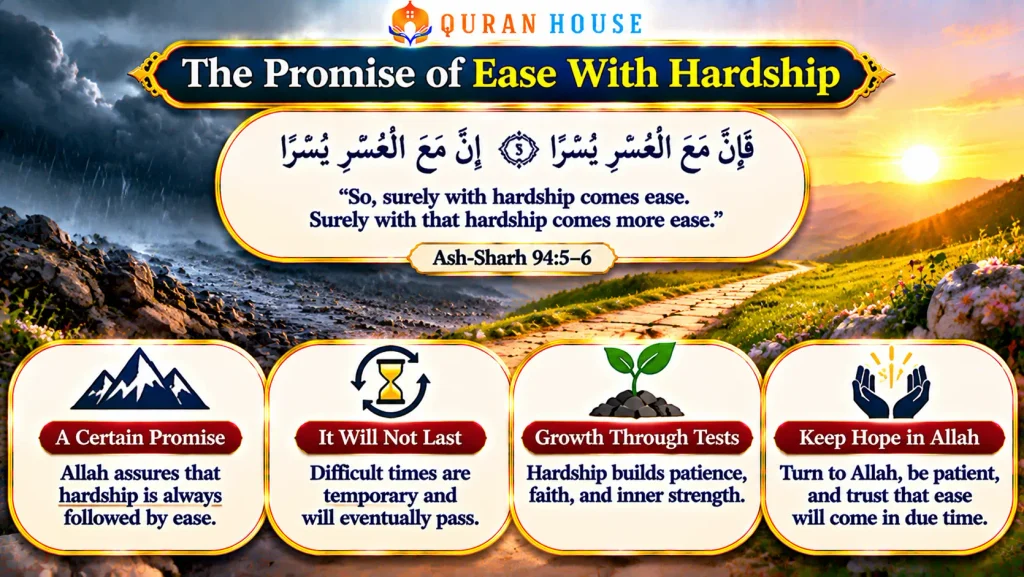
The surah reassures Prophet Muhammad ﷺ, and every believer after him, that hardships do not stay forever, and that ease inevitably comes with them. Notice that the verse says “with” hardship, not “after” it: ease is already present alongside the difficulty, even before the difficulty ends.
2. It Reminds You That Allah Expands the Heart
The surah opens with a question that reminds the Prophet ﷺ of a great blessing:
﴿أَلَمْ نَشْرَحْ لَكَ صَدْرَكَ﴾
“Have We not uplifted your heart for you, O Prophet?”
This surah demonstrates that Allah gave Prophet Muhammad ﷺ the blessing of opening his chest, preparing him to receive the prophethood. Scholars explain that this includes the expansion of his heart with faith, wisdom, and patience, and some also connect it to the authentic account of the splitting of his chest in childhood:
«أَنَّ رَسُولَ اللَّهِ ﷺ أَتَاهُ جِبْرِيلُ وَهُوَ يَلْعَبُ مَعَ الْغِلْمَانِ، فَأَخَذَهُ فَصَرَعَهُ، فَشَقَّ عَنْ قَلْبِهِ، فَاسْتَخْرَجَ الْقَلْبَ، فَاسْتَخْرَجَ مِنْهُ عَلَقَةً، فَقَالَ: هَذَا حَظُّ الشَّيْطَانِ مِنْكَ، ثُمَّ غَسَلَهُ فِي طَسْتٍ مِنْ ذَهَبٍ بِمَاءِ زَمْزَمَ»
“Jibril came to the Messenger of Allah ﷺ while he was playing with the other boys. He took him, laid him down, split open his chest, took out his heart, and removed a clot from it, saying: This is the share of Satan in you. Then he washed it in a golden basin with Zamzam water.”
﴿رَبِّ اشْرَحْ لِي صَدْرِي﴾
“My Lord, expand for me my chest”
(Taha 20:25).
For the believer, the lesson is that a calm, open heart is a gift from Allah, and that we should ask Him for it, as Prophet Musa did:
3. It Teaches That Allah Lifts Heavy Burdens
The surah then reminds the Prophet ﷺ of another blessing:
﴿وَوَضَعْنَا عَنكَ وِزْرَكَ الَّذِي أَنقَضَ ظَهْرَكَ﴾
“And We removed from you your burden, which had weighed upon your back.”
The burden was heavy enough to “weigh upon his back,” yet Allah removed it. Reflecting on these verses reminds the believer that no burden is too heavy for Allah to lift, and invites gratitude for the burdens He has already removed, even during ongoing struggles.
4. It Shows How Allah Raised the Prophet’s Mention
The surah shows another blessing, which is raising the status of Prophet Muhammad ﷺ:
﴿وَرَفَعْنَا لَكَ ذِكْرَكَ﴾
“And elevated your renown for you.”
We can see this blessing whenever we hear his name come right after Allah’s name in the Shahadah, the Adhan, the Iqamah, and the Tashahhud of every prayer. Day and night, somewhere in the world, his name is mentioned with honor, a promise made at a time when he was mocked and opposed in Makkah.
5. It Teaches You To Turn to Worship After Finishing Your Work
The importance of worship is one of the lessons of this surah, as Allah commanded His Messenger ﷺ to devote his time to worship after he finished his duties:
﴿فَإِذَا فَرَغْتَ فَانصَبْ﴾
“So once you have fulfilled your duty, strive in devotion.”
Scholars explain that when you finish the affairs of this world, you should turn to worship and dua, and when you finish one act of worship, move on to another. It teaches the believer never to leave his free time empty, and to keep a share of every busy day for Allah.
A Comfortable Space for Every Learner
Watch a student recite in a live Quran House class, and remember that sisters can choose a female tutor for a private, supportive one-on-one learning space.
Start Your Quran Journey With Quran House
Learn live and one-on-one with Al-Azhar-trained tutors, male and female, for children and adults, at a time that fits your timezone.
Try a Free Session6. It Directs All Your Hopes to Allah Alone
The surah ends with a short command that sums up its message:
﴿وَإِلَىٰ رَبِّكَ فَارْغَب﴾
“And to your Lord direct your longing.”
After all the promises of ease and relief, the believer is reminded that every hope should be directed to Allah alone, not to people or means. This is the meaning of true reliance on Allah, explained in our guide to the meaning of tawakkul.
7. It Brings the Reward of Every Letter Recited
Like every surah of the Quran, reciting Surah Alam Nashrah brings a reward for every letter, as the Prophet ﷺ said:
«مَنْ قَرَأَ حَرْفًا مِنْ كِتَابِ اللَّهِ فَلَهُ بِهِ حَسَنَةٌ، وَالْحَسَنَةُ بِعَشْرِ أَمْثَالِهَا»
“Whoever recites a letter from the Book of Allah will have a good deed for it, and a good deed is rewarded tenfold.”
Because the surah is short and easy to memorize, many Muslims recite it often in their prayers, which multiplies this reward every day.
Is There an Authentic Hadith About the Virtue of Surah Alam Nashrah?
There is no authentic hadith that sets a special reward for reciting Surah Alam Nashrah in particular. The narrations about its specific virtues come from weak hadiths, and some of them come from Shiite sources.
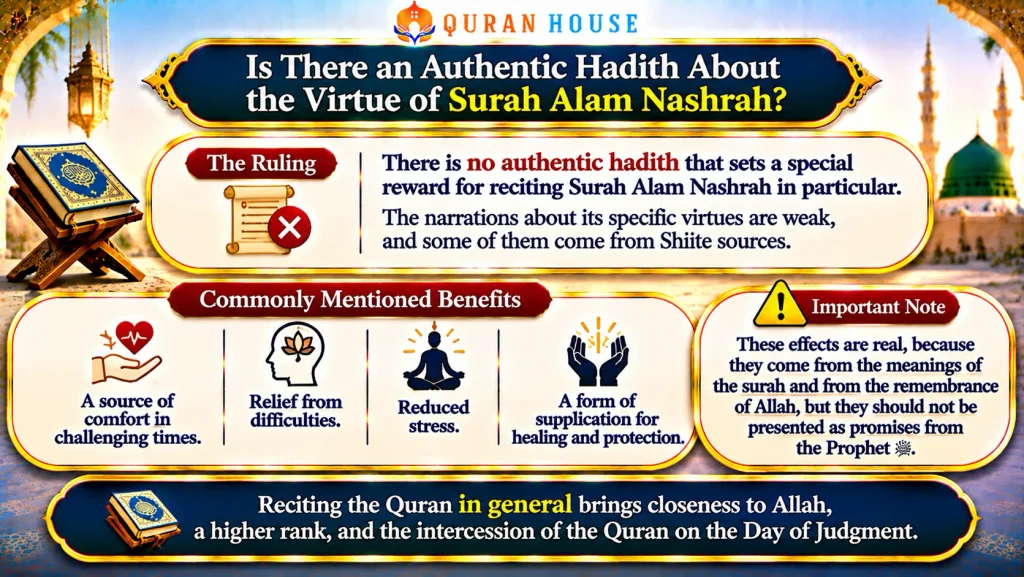
Many people describe the recitation of this surah as a source of comfort in challenging times, relief from difficulties, reduced stress, and a form of supplication for healing and protection. The comfort is real, because it comes from the meanings of the surah and from the remembrance of Allah.
But these effects should not be presented as promises from the Prophet ﷺ, since no authentic hadith states them. Reciting the Quran in general, however, brings closeness to Allah, a higher rank, and the intercession of the Quran on the Day of Judgment.
What Is the Name of Surah Alam Nashrah?
Surah Alam Nashrah is called in the Quran “Ash-Sharh.” It is a short surah that is made up of eight verses. It is a Makki surah, sent down in Makkah, and according to a well-known order of revelation, Allah revealed it after Surah Ad-Duha and before Surah Al-Asr.
Ash-Sharh means the expansion, relief, and consolation. Surah Alam Nashrah is one of the shortest surahs Allah revealed before the Prophet’s ﷺ migration, at the beginning of his prophetic mission, and it is one of the surahs that supported him through his hardships while calling his people to Islam.
Understanding words like “sharh” and “yusr” directly in Arabic deepens the meaning of the surah, and our Quranic Arabic Course helps you understand the language of the Quran itself.
The Reasons for Surah Alam Nashrah’s Revelation
Some commentators mention that the disbelievers of Quraysh mocked the poverty of the Muslims, and that Allah revealed this surah to relieve their grief. This is one of the reports mentioned in books of tafsir, rather than an established hadith.
What the verses themselves make clear is that the surah was revealed to remind Prophet Muhammad ﷺ of the blessings he received, opening his chest, removing his burden, and raising his mention, and to support him in his prophetic mission.
Surah Alam Nashrah in Arabic and English
Here is the full surah in Arabic, followed by its transliteration and meaning:
﴿أَلَمْ نَشْرَحْ لَكَ صَدْرَكَ وَوَضَعْنَا عَنكَ وِزْرَكَ الَّذِي أَنقَضَ ظَهْرَكَ وَرَفَعْنَا لَكَ ذِكْرَكَ فَإِنَّ مَعَ الْعُسْرِ يُسْرًا إِنَّ مَعَ الْعُسْرِ يُسْرًا فَإِذَا فَرَغْتَ فَانصَبْ وَإِلَىٰ رَبِّكَ فَارْغَب﴾
“Did We not expand for you, O Muhammad, your breast? And We removed from you your burden which had weighed upon your back, and raised high for you your repute. For indeed, with hardship will be ease. Indeed, with hardship will be ease. So when you have finished your duties, then stand up for worship. And to your Lord direct your longing.”
Transliteration: Alam nashrah laka sadrak. Wa wada’na ’anka wizrak. Alladhi anqada zahrak. Wa rafa’na laka dhikrak. Fa inna ma’al-’usri yusra. Inna ma’al-’usri yusra. Fa idha faraghta fansab. Wa ila rabbika farghab.
Why the Repetition of “Ease” Carries Special Weight
One detail scholars frequently highlight is the repetition of the phrase about ease with hardship, appearing twice in close succession within the surah. This deliberate repetition is understood as emphasis rather than simple restatement, reinforcing to the Prophet ﷺ, and to every reader since, that relief is not merely possible but certain and near at hand.
Many commentators also note a linguistic detail: “al-’usr” (the hardship) comes with the definite article both times, so it refers to the same hardship, while “yusr” (ease) comes without it, suggesting two different forms of ease. This is why scholars said that one hardship will never overcome two eases, a layered and deep reassurance for anyone going through difficulty.
How This Surah Connects to the Surah That Precedes It
Surah Ash-Sharh is closely linked in theme and tone to Surah Ad-Duha, the chapter revealed immediately before it, both addressing the Prophet ﷺ during a period of emotional difficulty and reassuring him of Allah’s continued care and support.
Reading the two surahs together offers a fuller picture of this period in the Prophet’s life, moving from reassurance that he has not been forsaken in Ad-Duha to reassurance about relief from hardship in Ash-Sharh. Many scholars treat this pairing as one continuous message of comfort delivered across two connected revelations.
Memorizing Surah Alam Nashrah
If you aspire to start memorizing the Quran through the short surahs, these tips help you memorize Surah Alam Nashrah and retain it:
- Make a weekly schedule for regular memorizing.
- Repeat the verses until you have memorized them well.
- Listen to a qualified reciter to learn to recite with Tajweed and correct pronunciation.
- Practice what you have memorized while performing prayer.
- Learn the meaning of each verse to memorize it more easily.
- Stay away from distractions while memorizing to concentrate better.
- Test your memorization by reciting the verses to others.
Because it is only eight verses with a clear, comforting message, Surah Alam Nashrah is an ideal surah for children starting their memorization, and our Quran teachers for kids teach it with its meaning.

Practical Ways To Apply the Surah’s Lessons in Daily Life
The lessons of Surah Alam Nashrah are meant to be lived, not only recited. Here are some practical ways to apply them:
- Recite the surah during moments of personal hardship, reflecting on its repeated promise that ease comes with difficulty.
- Use the surah’s emphasis on turning to worship after completing responsibilities as a reminder to keep up your spiritual practice even during busy periods.
- Reflect on the blessing of having burdens lifted as a prompt for personal gratitude, even during ongoing struggles.
- Pair memorization of this short surah with reflection on its meaning, rather than treating it as a purely mechanical exercise.

Why This Short Surah Has Such a Deep Impact
Unlike longer surahs that build their message across many verses, Surah Alam Nashrah delivers its entire message of reassurance in just eight concise verses. This brevity makes it accessible for memorization, even for young children or beginners, while still carrying a depth of meaning that rewards reflection throughout a believer’s life.
The surah also fits within a broader pattern in the early Makkan surahs, in which Allah repeatedly reassured the Prophet ﷺ during periods of intense difficulty and opposition. Seeing it as part of this compassionate dialogue between Allah and His Messenger helps readers today find in it the same comfort when they face hardship of their own.
It’s Never Too Late to Learn
Adults learn with us too. Watch a real session with one of our adult learners and see how calm, one-on-one guidance makes Quran recitation feel achievable at any age.
Start Your Quran Journey With Quran House
Learn live and one-on-one with Al-Azhar-trained tutors, male and female, for children and adults, at a time that fits your timezone.
Try a Free SessionStudy Surah Alam Nashrah With Quran House
Despite its brevity, Surah Alam Nashrah rewards careful, guided study, given the depth of meaning packed into its eight verses. Its historical context, its connection to Surah Ad-Duha, and the layered meaning behind its repeated promise of ease all open up more when a teacher explains them.
At Quran House, our Quran Tafseer Course helps students explore surahs like this one verse by verse, with instructors trained at Al-Azhar who connect this timeless reassurance to modern personal struggles in live one-to-one sessions, for adults and kids alike.
Whether you want to memorize Surah Alam Nashrah, recite it correctly, or understand its meaning, you will have a trusted teacher by your side at every step.
Explore Our Quran Courses:
- Quran Reading Course Online for Kids and Adults
- Learn to Read Quran in Arabic
- Learn to Read Quran for Beginners
- Quran Reading for Kids
- Quran Reading for Adults
- Quran Reading for Sisters
- Noorani Qaida for Beginners
- Noorani Qaida for Adults
Final Thoughts
Surah Alam Nashrah offers a compact yet profound message of reassurance, reminding believers that hardship is always accompanied by ease, and that devotion to worship and sincere gratitude remain essential even in the most difficult seasons of life.
Its benefits come from its verses: an expanded heart, lifted burdens, a raised mention for the Prophet ﷺ, and the command to turn every hope to Allah. Its brevity belies the depth of comfort it has offered believers across the centuries, from the Prophet ﷺ himself during his early mission to anyone today facing their own struggles.
Regular reflection on its verses offers a lasting reminder that relief is never far from those who remain patient, grateful, and sincerely turn to Allah in every circumstance of life.
FAQs
Is Surah Alam Nashrah a Meccan or Medinan Surah?
Surah Alam Nashrah is a Makki surah, revealed in Makkah before the Prophet’s ﷺ migration, during the early period of his mission.
Are the Spiritual Benefits of Surah Alam Nashrah Confirmed in Authentic Hadith?
No, the specific benefits often linked to this surah come from weak hadiths, though the general benefits of reciting the Quran remain well established.
Why Is the Surah Also Called Al-Inshirah?
Al-Inshirah and Ash-Sharh both come from the same root meaning expansion or relief, referring to the surah’s opening image of the Prophet’s ﷺ chest being expanded.
What Historical Circumstance Prompted This Surah’s Revelation?
Some commentators mention the Quraysh mocking the early Muslims’ poverty, and the verses themselves show it was revealed to comfort the Prophet ﷺ during a difficult period.
Why Is This Surah Recommended for Beginners Memorizing the Quran?
Its eight short verses and clear message make it an easy starting point, and our guide on how long it takes to memorize the Quran helps you plan what comes next.
Where Is Surah Alam Nashrah in the Quran?
It is the 94th surah, found in the 30th Juz and in the last of the 7 manzils of the Quran.