The benefits of Surah Al-Kafirun begin with a short but powerful declaration: a believer’s worship belongs to Allah alone, with no compromise. Surah Al-Kafirun, also known as “The Disbelievers,” is a short yet profound surah of six verses, and it creates a clear and unmistakable boundary between belief and disbelief.
It is a surah that deepens the spiritual understanding of Islam and aligns Muslims’ lives with its teachings. The Prophet ﷺ recited it often, in his prayers and before sleep, and he taught his companions to do the same.
In this guide, we go straight to the 6 authentic Surah Al-Kafirun benefits, each supported by an authentic hadith or by the verses of the surah. After that, you will find its full text, the story of its revelation, and practical ways to apply it in daily life.
1. It Is a Declaration of Freedom From Shirk Before Sleep
The Prophet ﷺ taught his companion Nawfal Al-Ashja’i to end his day with this surah:
«اقْرَأْ ﴿قُلْ يَا أَيُّهَا الْكَافِرُونَ﴾ ثُمَّ نَمْ عَلَى خَاتِمَتِهَا، فَإِنَّهَا بَرَاءَةٌ مِنَ الشِّرْكِ»
“Recite ‘Say: O disbelievers,’ then sleep at its end, for it is a declaration of freedom from shirk.”
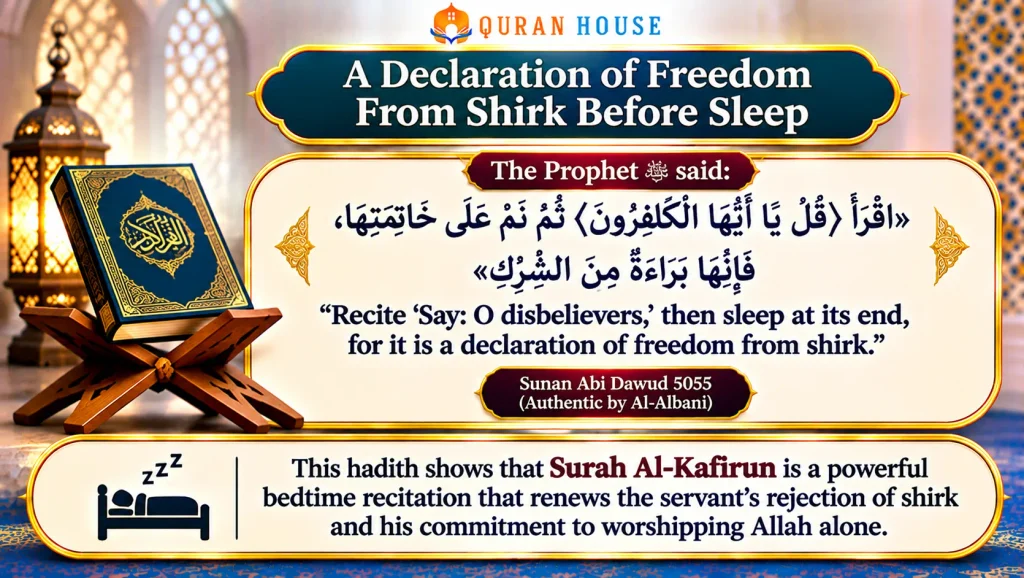
Al-Albani graded this hadith authentic. It makes Surah Al-Kafirun one of the authentic bedtime adhkar: a believer closes the day by renewing his commitment to worship Allah alone and disowning anything that could compromise his monotheistic faith.
2. The Prophet ﷺ Recited It in the Sunnah of Fajr
Surah Al-Kafirun was one of the surahs the Prophet ﷺ chose most often for his voluntary prayers. Abu Hurayrah narrated:
«أَنَّ رَسُولَ اللَّهِ ﷺ قَرَأَ فِي رَكْعَتَيِ الْفَجْرِ ﴿قُلْ يَا أَيُّهَا الْكَافِرُونَ﴾ وَ﴿قُلْ هُوَ اللَّهُ أَحَدٌ﴾»
“The Messenger of Allah ﷺ recited ‘Say: O disbelievers’ and ‘Say: He is Allah, the One’ in the two rak’ahs of Fajr.”
Scholars explain that he chose these two surahs because Al-Kafirun rejects every false object of worship, and Al-Ikhlas affirms the oneness of Allah. Starting the day with them is a complete statement of tawhid, and you can learn where they fit in the prayer in our guide on how to pray salah.
3. It Is Reported To Equal a Quarter of the Quran
Anas ibn Malik narrated that the Prophet ﷺ described the great reward of reciting this surah:
«وَمَنْ قَرَأَ ﴿قُلْ يَا أَيُّهَا الْكَافِرُونَ﴾ عُدِلَتْ لَهُ بِرُبُعِ الْقُرْآنِ»
“And whoever recites ‘Say: O disbelievers,’ it will be equal for him to a quarter of the Quran.”
Al-Albani graded this part of the narration hasan, while other scholars considered its chain weak, so it should be mentioned with this caution. What is established beyond doubt is that Surah Al-Ikhlas equals a third of the Quran, and the two surahs together carry the core message of tawhid in very few words.
4. It Strengthens Tawhid and Rejects Any Compromise in Worship
Surah Al-Kafirun reinforces tawhid, the oneness of Allah, and unwavering faith in Him. It shields the believer against doubts and empowers Muslims to stand firm in their convictions. The opening verses declare:
﴿قُلْ يَا أَيُّهَا الْكَافِرُونَ لَا أَعْبُدُ مَا تَعْبُدُونَ﴾
“Say, O Prophet: O disbelievers, I do not worship what you worship.”
The surah teaches steadfastness, urging Muslims not to water down Islamic teachings for anyone or to let outside pressure disrupt their relationship with Allah. The repetition in its verses is a deliberate rhetorical device that leaves no doubt about the finality of this stance.
5. It Draws a Clear Line in Belief Without Compulsion
Even at the very beginning of Islam’s spread, the surah set a clear principle, summed up in its closing verse:
﴿لَكُمْ دِينُكُمْ وَلِيَ دِينِ﴾
“For you is your religion, and for me is my religion.”
Scholars explain that this verse is a declaration of disavowal from the worship of the disbelievers, not an acceptance that all religions are equally true. At the same time, it agrees with the principle that no one is forced into Islam: each person bears the responsibility for his own beliefs.
This is one of the clearest responses to the claim that Islam promotes hostility toward people of other faiths, since the surah separates beliefs firmly without calling for compulsion or hatred.
A Comfortable Space for Every Learner
Watch a student recite in a live Quran House class, and remember that sisters can choose a female tutor for a private, supportive one-on-one learning space.
Start Your Quran Journey With Quran House
Learn live and one-on-one with Al-Azhar-trained tutors, male and female, for children and adults, at a time that fits your timezone.
Try a Free Session6. It Builds Humility and a United Muslim Community
The verses highlight the importance of unifying believers around the worship of Allah alone. In doing so, the surah promotes a strong sense of community and belonging, reminding believers that they share one greater cause that binds them together, regardless of background or nationality.
Al-Kafirun also cleanses the hearts of believers from pride and arrogance. Firmness in faith does not mean superiority over people; it is paired with humility before Allah and good character toward others, which is how the Prophet ﷺ himself lived with those who disagreed with him.
Surah Al-Kafirun in Arabic and English
Surah Al-Kafirun is the 109th surah of the Quran, made up of six verses. Here is its full text, followed by its transliteration:
﴿قُلْ يَا أَيُّهَا الْكَافِرُونَ لَا أَعْبُدُ مَا تَعْبُدُونَ وَلَا أَنتُمْ عَابِدُونَ مَا أَعْبُدُ وَلَا أَنَا عَابِدٌ مَّا عَبَدتُّمْ وَلَا أَنتُمْ عَابِدُونَ مَا أَعْبُدُ لَكُمْ دِينُكُمْ وَلِيَ دِينِ﴾
“Say, O Prophet: O you disbelievers, I do not worship what you worship, nor are you worshippers of what I worship, nor will I be a worshipper of what you worship, nor will you be worshippers of what I worship. For you is your religion, and for me is my religion.”
Transliteration: Qul ya ayyuhal-kafirun. La a’budu ma ta’budun. Wa la antum ’abiduna ma a’bud. Wa la ana ’abidum-ma ’abadtum. Wa la antum ’abiduna ma a’bud. Lakum dinukum wa liya din.
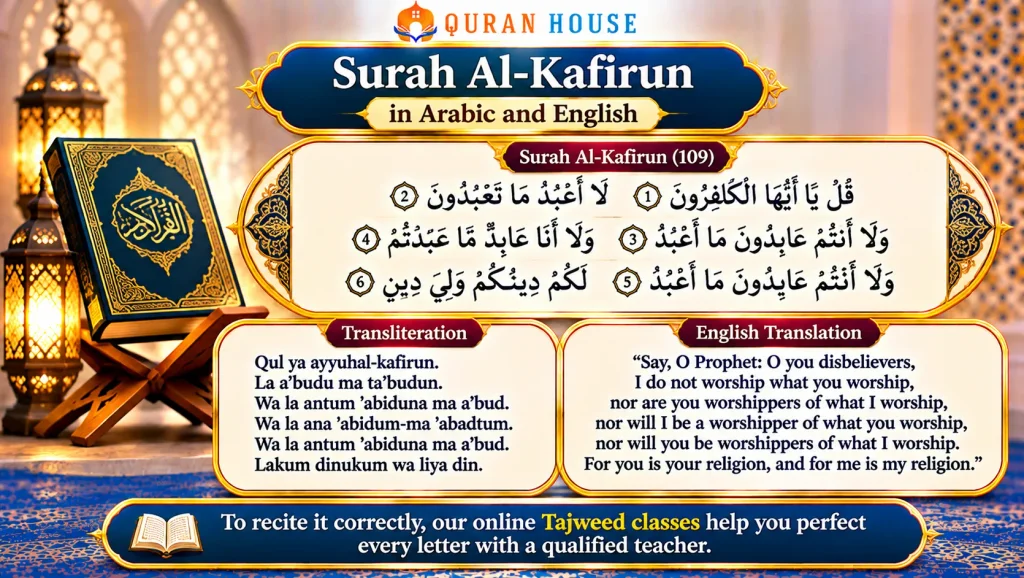
This short chapter is one of the most repetitive surahs in the Quran in terms of structure, with the theme of separation between belief and disbelief restated from several angles across just a handful of lines. To recite it correctly, our online Tajweed classes help you perfect every letter with a qualified teacher.
Why Was Surah Al-Kafirun Revealed?
Surah Al-Kafirun was revealed in Makkah, during a period when the leaders of Quraysh, who worshipped idols, felt increasingly threatened by the Prophet’s ﷺ message. Many of these leaders profited directly from idol worship and the pilgrimage economy built around the Kaaba, which gave them strong motivation to silence or redirect the new call to worship Allah alone.
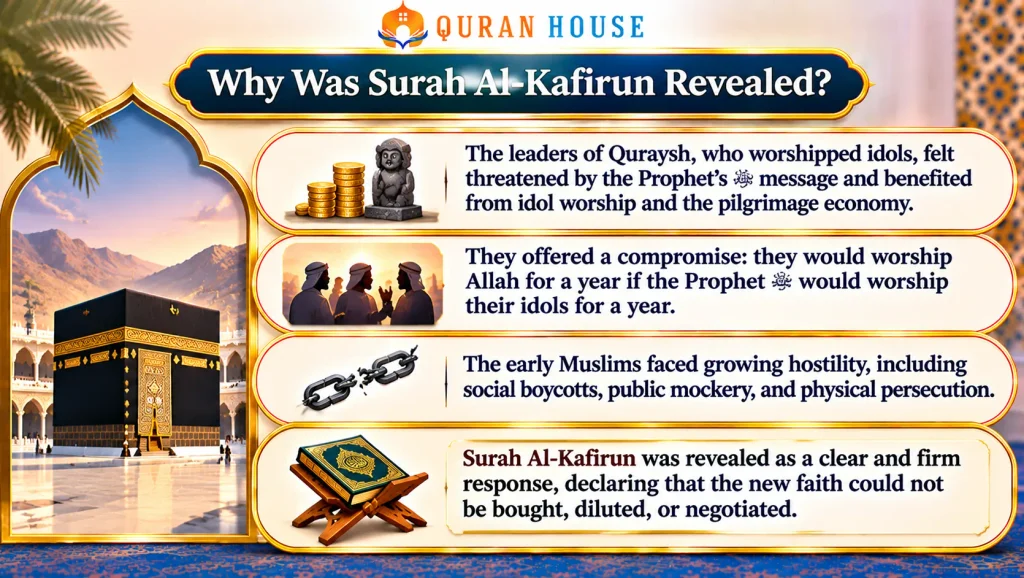
Ibn Ishaq and other historians reported from Ibn ’Abbas that a group of Quraysh leaders, including Al-Walid ibn Al-Mughirah and Al-’As ibn Wa’il, came to the Prophet ﷺ with an offer: they would worship his God for a year if he would worship their idols for a year. This report is mentioned in books of tafsir and seerah rather than in the authentic hadith collections, but it fits the message of the surah closely.
The early Muslims at the time faced growing hostility, from social boycotts and public mockery to physical persecution of the most vulnerable converts. Against this backdrop, the compromise offer was not a friendly gesture but an attempt to neutralize the message, and the surah’s firm response made clear to the whole city that the new faith could not be bought, diluted, or negotiated.
The Meaning Behind the Word Kafirun
The word Kafirun comes from the Arabic root kafara, which carries the core meaning of covering or concealing something. In a religious context, it came to describe someone who conceals or rejects the truth of faith after it has been made clear to them.
This linguistic nuance matters, since the surah addressed specific Makkan leaders who had heard the Prophet’s ﷺ message directly, understood it, and consciously chose to reject it in favor of protecting their social and economic position.
Understanding this distinction helps clarify why the surah’s tone is firm rather than harsh: it addresses deliberate rejection paired with an attempt to negotiate away the very core of the message.
How Surah Al-Kafirun Compares to Surah Al-Ikhlas
The two surahs are often studied together, and the Prophet ﷺ recited them together in the Sunnah of Fajr. Surah Al-Ikhlas focuses inward, describing who Allah is: His oneness, His self-sufficiency, and His nature as entirely without equal.
Surah Al-Kafirun focuses outward, describing how a believer relates to those who reject that oneness, drawing a firm line without resorting to hostility.
Both belong to a group of short Makkan surahs that carry weight far beyond their length, and many teachers recommend memorizing them together for a fuller picture of tawhid, both what it affirms and what it rejects.
Practical Ways To Apply This Surah Today
The message of Surah Al-Kafirun can be part of a believer’s daily routine. Here are some practical ways to apply it:
- Recite it before sleeping as a nightly declaration of freedom from shirk, as the Prophet ﷺ taught Nawfal Al-Ashja’i.
- Recite it with Surah Al-Ikhlas in the two Sunnah rak’ahs before Fajr, following the Prophet ﷺ.
- Reflect on its closing verse whenever navigating disagreements with people of different beliefs, as a reminder that firm conviction does not require hostility.
- Use it as a memorization starting point for children or new Muslims, given its short length and clear, repeated structure, with the help of our Quran teachers for kids.
Together with Surah Al-Ikhlas and the Mu’awwidhatayn, it is part of a complete nightly routine of protection, explained in our guide to the benefits of Surah An-Naas.
It’s Never Too Late to Learn
Adults learn with us too. Watch a real session with one of our adult learners and see how calm, one-on-one guidance makes Quran recitation feel achievable at any age.
Start Your Quran Journey With Quran House
Learn live and one-on-one with Al-Azhar-trained tutors, male and female, for children and adults, at a time that fits your timezone.
Try a Free SessionStudy Surah Al-Kafirun in Depth With Quran House
Short surahs like Al-Kafirun often carry more depth than their length suggests, and understanding the full historical and linguistic context behind them transforms simple memorization into genuine comprehension.
At Quran House, our Quran Tafseer Course walks students through exactly this kind of context, connecting each surah to the events surrounding its revelation and the lessons scholars have drawn from it, guided by instructors trained at Al-Azhar in live one-to-one sessions.
Whether you want to memorize Surah Al-Kafirun, recite it correctly, or understand its meaning, you will have a trusted teacher by your side at every step.
Explore Our Quran Courses:
- Quran Reading Course Online for Kids and Adults
- Learn to Read Quran in Arabic
- Learn to Read Quran for Beginners
- Quran Reading for Kids
- Quran Reading for Adults
- Quran Reading for Sisters
- Noorani Qaida for Beginners
- Noorani Qaida for Adults
- Noor Al-Bayan Course
- Quran Reading Fluency Course
- Word-by-Word Quran Reading Course

Final Thoughts
The benefits of Surah Al-Kafirun come from the authentic Sunnah and its verses: it is a declaration of freedom from shirk before sleep, the Prophet ﷺ recited it in the Sunnah of Fajr, and it is reported to equal a quarter of the Quran.
Its six verses teach Muslims to hold their faith with complete sincerity and to reject compromise on core belief, without resorting to hatred toward those who believe differently.
Understanding the story behind its revelation gives this brief chapter a weight far beyond its length, and turns a few seconds of nightly recitation into a genuine renewal of faith, one that connects a modern believer directly to the resolve shown in Makkah centuries ago.
FAQs
Is It Recommended To Recite Surah Al-Kafirun Every Night?
Yes, the Prophet ﷺ told Nawfal Al-Ashja’i to recite it before sleeping, describing it as a declaration of freedom from shirk (Sunan Abi Dawud 5055).
Does Surah Al-Kafirun Mean Muslims Should Avoid All Interaction With Non-Muslims?
No, the surah concerns core belief and worship, and it does not prevent social interaction, kindness, or fair dealing with people of other faiths.
Why Does the Surah Repeat Similar Phrases So Many Times?
The repetition is a deliberate rhetorical device that emphasizes the total rejection of any compromise in worship, leaving no ambiguity.
How Many Verses Does Surah Al-Kafirun Contain?
It contains six verses and is the 109th surah of the Quran, found in the 30th Juz and in the last of the 7 manzils of the Quran.
Was the Compromise Offer From Quraysh Ever Taken Seriously?
No, the firm response of the surah made clear that no negotiation on the fundamentals of tawhid would ever be entertained, whatever the pressure.