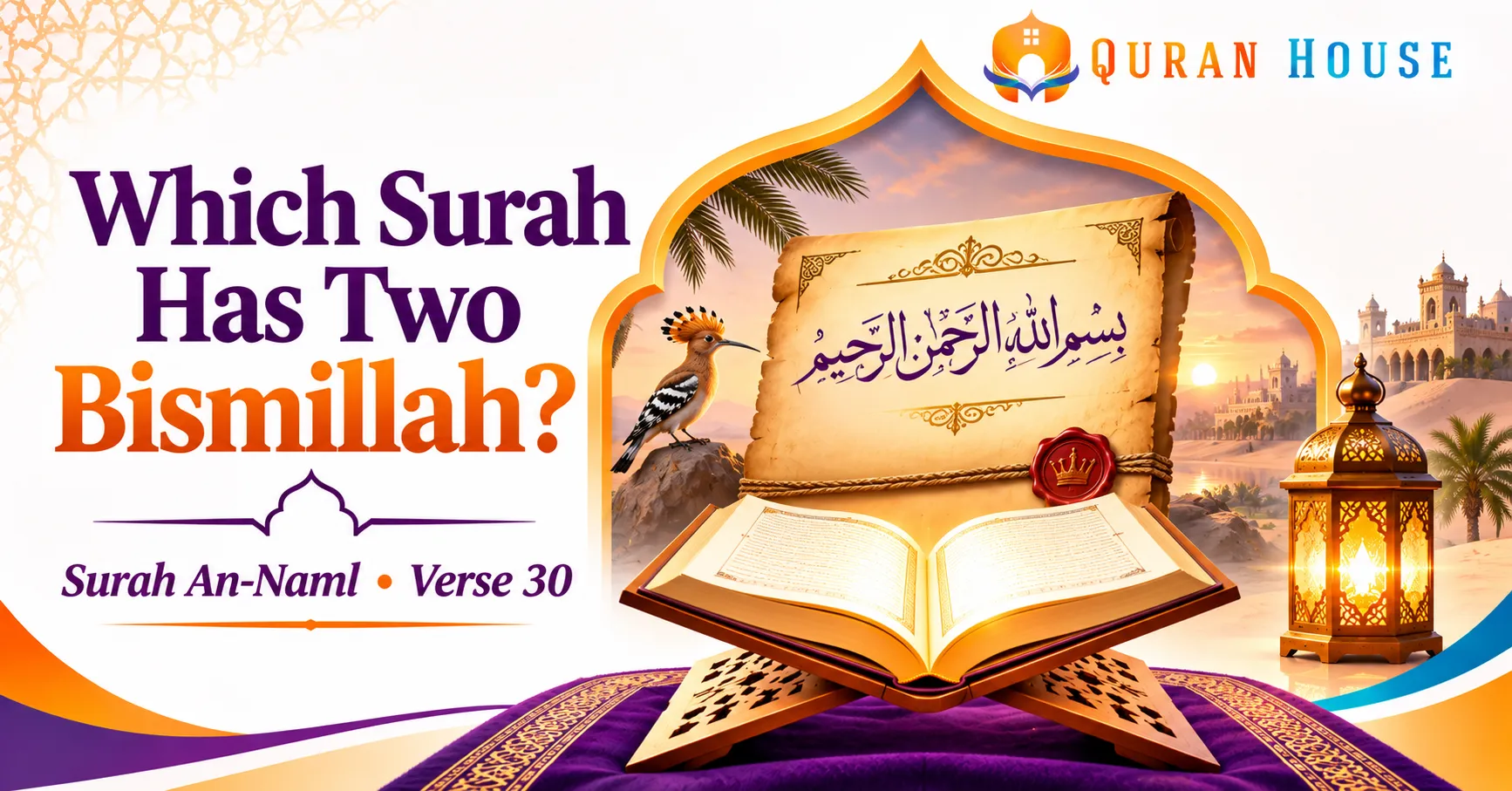
Which surah has two Bismillah? The answer is Surah An-Naml (The Ant), the 27th chapter of the Quran. Like almost every other surah, it opens with “Bismillah Ar-Rahman Ar-Raheem,” and the same phrase appears a second time inside verse 30, as the opening of the letter Prophet Sulayman sent to the Queen of Sheba.
This small detail is connected to other questions Muslims often ask about the Basmala: which surah has no Bismillah at all, how many times it appears in the Quran, and which surah equals one-third of the Quran.
In this guide, we answer each of these questions directly, with the verses in Arabic and the authentic hadith behind each answer, and we point out which popular explanations are weak so you know exactly what you can rely on.
Which Surah Has Two Bismillah?
Surah An-Naml is the only surah in the Quran that contains the Bismillah twice. The first is at the beginning of the surah, like other surahs, and the second is part of verse 30, in the story of Prophet Sulayman and the Queen of Sheba.
When the queen received Sulayman’s letter, she described it to her advisers, and the Quran quotes her words:
﴿إِنَّهُ مِن سُلَيْمَانَ وَإِنَّهُ بِسْمِ اللَّهِ الرَّحْمَٰنِ الرَّحِيمِ﴾
“Indeed, it is from Sulayman, and indeed, it reads: In the name of Allah, the Most Gracious, the Most Merciful.”
Notice that the second Bismillah is not placed before verse 30 as a separate line; it is part of the verse itself. This is why scholars agree that it is a verse of the Quran without any difference of opinion, unlike the Bismillah at the start of surahs, which they discuss in more detail.
Why the Second Bismillah Appears in Surah An-Naml
The second Bismillah comes in the middle of a story. Prophet Sulayman learned from the hoopoe that the people of Sheba worshipped the sun, so he sent their queen a short letter inviting her to submit to Allah. That letter began with the name of Allah, and continued:
﴿أَلَّا تَعْلُوا عَلَيَّ وَأْتُونِي مُسْلِمِينَ﴾
“Do not be arrogant toward me, but come to me in submission.”
Scholars draw a clear lesson from this: a prophet opened an official letter to a powerful ruler with the name of Allah, so believers should open their important matters, including their writing and correspondence, in the same way. The letter is also a model of brevity, carrying a complete message in just two verses.
Explore the full story of Sulayman and the Queen of Sheba, and the meaning of every verse, with our online Quran Tafseer course, taught by Al-Azhar-trained instructors.
Which Surah Has No Bismillah?
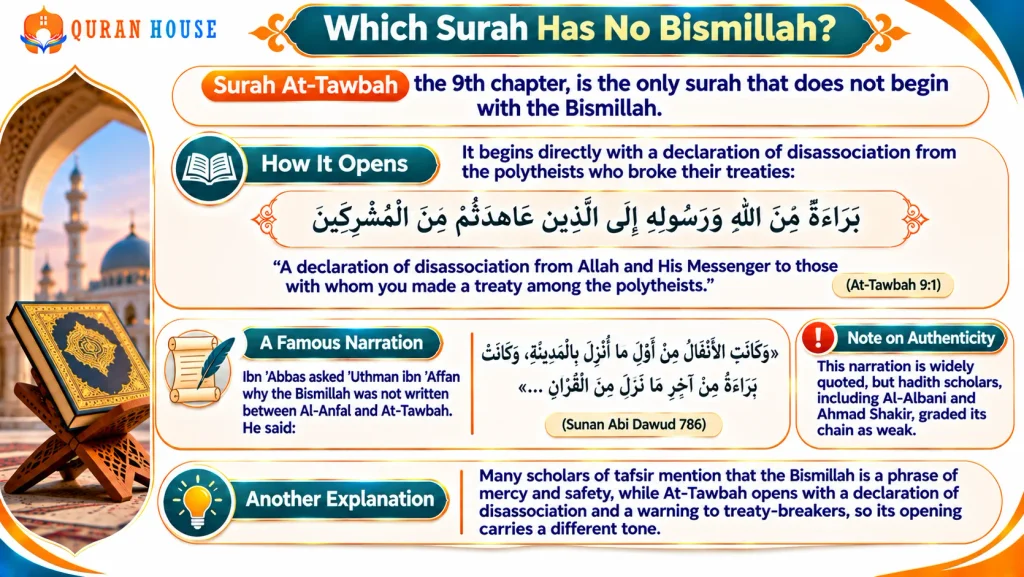
Surah At-Tawbah, the 9th chapter, is the only surah that does not begin with the Bismillah. It opens directly with a declaration of disassociation from the polytheists who broke their treaties:
﴿بَرَاءَةٌ مِّنَ اللَّهِ وَرَسُولِهِ إِلَى الَّذِينَ عَاهَدتُّم مِّنَ الْمُشْرِكِينَ﴾
“A declaration of disassociation from Allah and His Messenger to those with whom you made a treaty among the polytheists.”
The most famous narration on the reason comes from Ibn ’Abbas, who asked ’Uthman ibn ’Affan why the Bismillah was not written between Al-Anfal and At-Tawbah:
«وَكَانَتِ الأَنْفَالُ مِنْ أَوَّلِ مَا أُنْزِلَ بِالْمَدِينَةِ، وَكَانَتْ بَرَاءَةُ مِنْ آخِرِ مَا نَزَلَ مِنَ الْقُرْآنِ، وَكَانَتْ قِصَّتُهَا شَبِيهَةً بِقِصَّتِهَا، فَظَنَنْتُ أَنَّهَا مِنْهَا، فَمِنْ هُنَاكَ وَضَعْتُهَا فِي السَّبْعِ الطِّوَالِ وَلَمْ أَكْتُبْ بَيْنَهُمَا سَطْرَ بِسْمِ اللَّهِ الرَّحْمَنِ الرَّحِيمِ»
“Al-Anfal was among the first revealed in Madinah, and Bara’ah (At-Tawbah) was among the last revealed of the Quran, and its content resembled it, so I thought it was part of it. For that reason I placed it among the seven long surahs and did not write the line ‘In the name of Allah, the Most Gracious, the Most Merciful’ between them.”
This narration is widely quoted, but hadith scholars, including Al-Albani and Ahmad Shakir, graded its chain as weak, so it should not be presented as a certain explanation. Many scholars of tafsir mention another reason: the Bismillah is a phrase of mercy and safety, while At-Tawbah opens with a declaration of disassociation and a warning to treaty-breakers, so its opening carries a different tone.
When you begin reciting At-Tawbah from its first verse, the common practice of reciters is to seek refuge with Allah from Satan without saying the Bismillah.
Reciting with care like this is part of honoring the Quran, and our guide on the reward of learning the Quran with Tajweed explains why correct recitation brings such a great reward.
It’s Never Too Late to Learn
Adults learn with us too. Watch a real session with one of our adult learners and see how calm, one-on-one guidance makes Quran recitation feel achievable at any age.
Start Your Quran Journey With Quran House
Learn live and one-on-one with Al-Azhar-trained tutors, male and female, for children and adults, at a time that fits your timezone.
Try a Free SessionHow Many Bismillah Are in the Quran?
The Bismillah appears 114 times in the Quran. It opens 113 surahs, since At-Tawbah has none, and it appears once more inside verse 30 of Surah An-Naml. The missing Bismillah of At-Tawbah and the extra one in An-Naml balance each other, so the total matches the number of surahs, 114.
Scholars differ about the Bismillah at the start of surahs. In the common Hafs numbering used in most printed copies, it is counted as the first verse of Al-Fatihah only.
For the other surahs, some scholars consider it a verse revealed to separate the surahs, while others see it as an opening formula that is not part of the surah itself. The Bismillah in An-Naml 27:30, however, is a verse by agreement of all scholars.
Which Surah Equals One-Third of the Quran?
Surah Al-Ikhlas equals one-third of the Quran. The Prophet ﷺ explained the reason himself:
«إِنَّ اللَّهَ جَزَّأَ الْقُرْآنَ ثَلَاثَةَ أَجْزَاءٍ، فَجَعَلَ ﴿قُلْ هُوَ اللَّهُ أَحَدٌ﴾ جُزْءًا مِنْ أَجْزَاءِ الْقُرْآنِ»
“Allah divided the Quran into three parts, and He made ‘Say: He is Allah, the One’ one of the parts of the Quran.”
Scholars explain that the Quran’s content falls into three broad categories: rulings for life, stories of earlier nations, and the oneness of Allah with His names and attributes. Surah Al-Ikhlas is devoted entirely to the third category, which is why it equals a third of the Quran. This is a great virtue, but it does not mean that reciting it three times replaces reading the whole Quran.
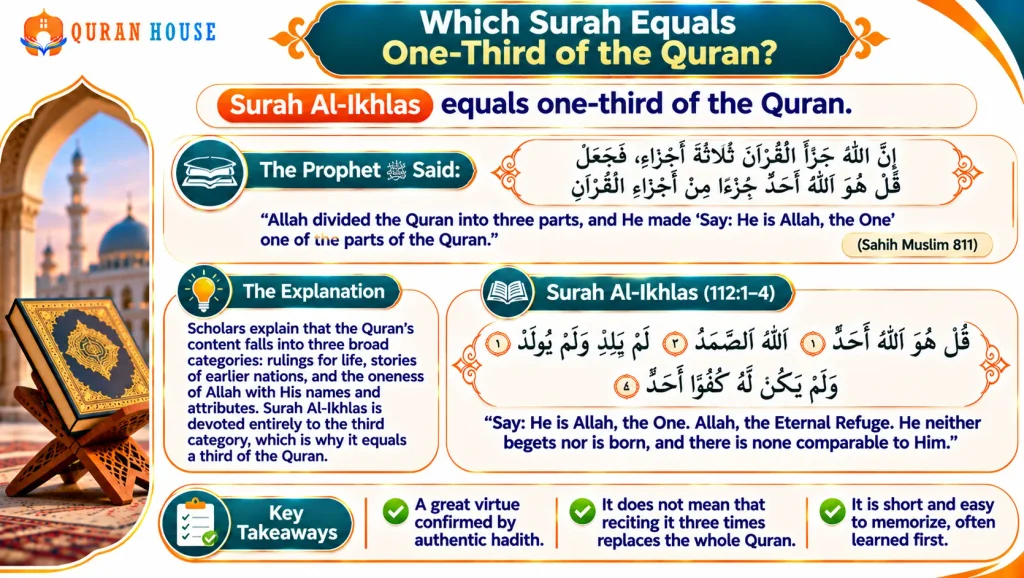
The whole surah is only four verses:
﴿قُلْ هُوَ اللَّهُ أَحَدٌ اللَّهُ الصَّمَدُ لَمْ يَلِدْ وَلَمْ يُولَدْ وَلَمْ يَكُن لَّهُ كُفُوًا أَحَدٌ﴾
“Say: He is Allah, the One. Allah, the Eternal Refuge. He neither begets nor is born, and there is none comparable to Him.”
Because it is so short, Al-Ikhlas is usually one of the first surahs a Muslim memorizes. If you are planning to memorize more after it, our guide on how long it takes to memorize the Quran will help you set a realistic plan.
What to Say If You Forget to Say Bismillah
If you forget to say Bismillah at the start of eating, say “Bismillahi awwalahu wa akhirahu” as soon as you remember. The Prophet ﷺ taught this directly:
«إِذَا أَكَلَ أَحَدُكُمْ فَلْيَذْكُرِ اسْمَ اللَّهِ تَعَالَى، فَإِنْ نَسِيَ أَنْ يَذْكُرَ اسْمَ اللَّهِ تَعَالَى فِي أَوَّلِهِ فَلْيَقُلْ: بِسْمِ اللَّهِ أَوَّلَهُ وَآخِرَهُ»
“When one of you eats, let him mention the name of Allah. If he forgets to mention the name of Allah at the beginning, let him say: In the name of Allah at its beginning and its end.”
Al-Albani graded this hadith authentic. Forgetting the Bismillah does not invalidate the meal or the action; this phrase simply lets you bring the remembrance of Allah back into it. Scholars such as An-Nawawi applied the same guidance to anyone who misses the Bismillah at the start and remembers partway through.
The Meaning of Bismillah Ar-Rahman Ar-Raheem
The phrase is built from three connected parts. “Bism” means “in the name of,” and it signals that the action that follows is done seeking Allah’s help and blessing. “Allah” is the proper name of the one true God. The last two words, “Ar-Rahman” and “Ar-Raheem,” both come from the root of mercy.
Scholars generally explain Ar-Rahman as Allah’s vast mercy that embraces all of creation in this life, and Ar-Raheem as His special mercy for the believers, especially in the Hereafter. Mentioning both together reminds the reader, at the start of almost every surah, that the Quran is first and foremost a message of mercy.
Understanding words like these directly in Arabic changes how you experience your recitation. Our Quranic Arabic courses help you understand the language of the Quran itself, rather than relying only on translation.
How to Apply These Lessons in Your Recitation
The next time you recite Surah An-Naml, pause at verse 30 and remember that the Bismillah you are reading is the opening of a prophet’s letter. Let it remind you to begin your own important work, messages, and decisions in the name of Allah.
When you reach the start of At-Tawbah, notice the absence of the Bismillah and the change in tone. Small details like this help you recite with attention instead of moving through the pages out of habit.
Make Surah Al-Ikhlas part of your daily recitation, and teach it to your children with its meaning and virtue. Children who learn these short surahs with correct recitation from an early age build a strong foundation, and our Ijazah program for kids takes them step by step toward a certified, connected recitation of the Quran.
Memorizing Surah Ad-Duha in Class
Memorization is easier with structure. See how a student reviews and recites Surah Ad-Duha in a live lesson, guided by a tutor who follows every step of their progress.
Start Your Quran Journey With Quran House
Learn live and one-on-one with Al-Azhar-trained tutors, male and female, for children and adults, at a time that fits your timezone.
Try a Free SessionLearn the Quran’s Details With a Qualified Tutor
Questions like which surah has two Bismillah are a sign of a curious, attentive reader. But reading answers online is very different from understanding the Quran with someone who can explain the context, correct your recitation, and answer your follow-up questions as they come.
At Quran House, our Quran teachers are Al-Azhar-trained and teach in live one-to-one sessions. They guide you through recitation with correct Tajweed, explain the meanings and stories behind the verses, and build a plan around your level and schedule, for adults and kids alike.
Whether you want to perfect your recitation, understand the surahs you read every day, or start memorizing, you will have a trusted teacher by your side at every step, relying only on authentic sources.
Explore Our Quran Courses:
- Quran Reading for Adults
- Quran Reading for Sisters
- Noorani Qaida for Beginners
- Noorani Qaida for Adults
- Noor Al-Bayan Course
- Quran Reading Fluency Course
- Word-by-Word Quran Reading Course
- Complete Quran Reading (Khatma) Program

Final Thoughts
Surah An-Naml is the surah that has two Bismillah: one at its beginning and one inside verse 30, opening the letter of Prophet Sulayman to the Queen of Sheba. Surah At-Tawbah is the only surah without a Bismillah, which keeps the total at 114, the same as the number of surahs. And Surah Al-Ikhlas, devoted entirely to the oneness of Allah, equals a third of the Quran.
We also separated what is certain from what is weak: the famous narration from ’Uthman about At-Tawbah is widely quoted, but its chain is graded weak, while the hadith about Al-Ikhlas and the Sunnah of saying “Bismillahi awwalahu wa akhirahu” are authentic.
Details like these turn familiar recitation into an act of reflection. The next time you begin any task, or open your Mushaf, remember that a prophet opened his most important letter with the same words. Use a trusted source such as Quran.com to follow the Arabic text and its translation as you recite.
Frequently Asked Questions About the Bismillah in the Quran
In which verse is the second Bismillah in Surah An-Naml?
It is in verse 30. It is part of the verse itself, as the opening of Prophet Sulayman’s letter to the Queen of Sheba.
Is the Bismillah considered a verse of every surah?
Scholars differ on this. In the common Hafs numbering, it is counted as the first verse of Al-Fatihah only, while its status at the start of other surahs is discussed among the schools. The Bismillah in An-Naml 27:30 is a verse by agreement.
Should I say Bismillah when starting Surah At-Tawbah?
When starting from its first verse, reciters seek refuge with Allah without saying the Bismillah. Scholars differ about saying it when beginning from the middle of the surah.
Why is Surah Al-Ikhlas equal to one-third of the Quran?
Because it is devoted entirely to the oneness of Allah, one of the Quran’s three main themes. The Prophet ﷺ said that Allah divided the Quran into three parts and made Al-Ikhlas one of them (Sahih Muslim 811).
Does forgetting Bismillah invalidate an action?
No, it does not. If you forget it at the start of eating, say “Bismillahi awwalahu wa akhirahu” when you remember, as taught in the Sunnah.