| Key Takeaways |
| Surah Al-Imran is the third surah of the Quran, a Madani chapter of 200 verses, and the Prophet ﷺ called it, together with Al-Baqarah, the two radiant ones. |
| Sahih Muslim 804a says both surahs will come on the Day of Resurrection and plead for the people who recite them. |
| Verses 3:31, 3:173, 3:185, and 3:200 teach love for Allah, reliance on Him, accountability, and patience in practical terms. |
| Reading three anchor passages daily and reviewing them with a qualified tutor builds a lasting habit faster than rushing through the full surah. |
Surah Al Imran benefits reach every part of a believer’s life, from the reward promised on the Day of Resurrection to calm and clarity in daily struggles. This third chapter of the Quran carries 200 verses of guidance.
Named after the family of Imran, the surah tells the story of Maryam, answers the grief that followed the Battle of Uhud, and calls believers to love Allah. The benefits of reciting Surah Al-Imran are spiritual, emotional, and practical.
Each benefit below rests on authentic evidence from the Quran and Sunnah, with practical steps for applying it. The ten benefits are as follows.
1. Gain Intercession on the Day of Resurrection
The Prophet ﷺ placed Surah Al-Imran beside Al-Baqarah and called them the two radiant ones. Their intercession is the most clearly documented reward of the surah, and it is promised to every person who recites them.
Abu Umamah al-Bahili reported that he heard the Messenger of Allah ﷺ say the following words, recorded in Sahih Muslim, one of the two most authentic collections of hadith.
اقْرَءُوا الْقُرْآنَ فَإِنَّهُ يَأْتِي يَوْمَ الْقِيَامَةِ شَفِيعًا لأَصْحَابِهِ اقْرَءُوا الزَّهْرَاوَيْنِ الْبَقَرَةَ وَسُورَةَ آلِ عِمْرَانَ فَإِنَّهُمَا تَأْتِيَانِ يَوْمَ الْقِيَامَةِ كَأَنَّهُمَا غَمَامَتَانِ أَوْ كَأَنَّهُمَا غَيَايَتَانِ أَوْ كَأَنَّهُمَا فِرْقَانِ مِنْ طَيْرٍ صَوَافَّ تُحَاجَّانِ عَنْ أَصْحَابِهِمَا اقْرَءُوا سُورَةَ الْبَقَرَةِ فَإِنَّ أَخْذَهَا بَرَكَةٌ وَتَرْكَهَا حَسْرَةٌ وَلاَ تَسْتَطِيعُهَا الْبَطَلَةُ
(Iqra’ul-Qur’aana fa’innahu ya’ti yawmal-qiyaamati shafee’an li-ashaabihi, iqra’uz-zahraawayni al-Baqarata wa Soorata Aali ‘Imraana fa’innahumaa ta’tiyaani yawmal-qiyaamati ka’annahumaa ghamaamataani aw ka’annahumaa ghayaayataani aw ka’annahumaa firqaani min tayrin sawaaffa tuhaajjaani ‘an ashaabihimaa, iqra’u Soorata al-Baqarati fa’inna akhdhahaa barakatun wa tarkahaa hasratun wa laa tastatee’uhal-batalah)
(“Recite the Qur’an, for on the Day of Resurrection it will come as an intercessor for those who recite it. Recite the two bright ones, al-Baqara and Surah Al ‘Imran, for on the Day of Resurrection they will come as two clouds or two shades, or two flocks of birds in ranks, pleading for those who recite them. Recite Surah al-Baqara, for to take recourse to it is a blessing and to give it up is a cause of grief, and the magicians cannot confront it.”)
Among all Surah Al Imran benefits, this intercession is the one that most motivates regular recitation, because it turns a daily habit into lasting preparation for the Hereafter and for meeting Allah.
The pleading described here is a promise of defense on a day when every soul needs help. Sincere intention and steady effort place a believer under that promise.
2. Prove Love for Allah by Following the Prophet
Love for Allah is proven by action, and verse 3:31 states the standard clearly. The verse addresses people who claimed to love Allah and gives them a direct way to confirm that claim through following the Prophet ﷺ.
Allah instructs the Prophet ﷺ to tell his people the following, a verse that is often described as the test of true love for Allah and His Messenger.
قُلْ إِن كُنتُمْ تُحِبُّونَ اللَّهَ فَاتَّبِعُونِي يُحْبِبْكُمُ اللَّهُ وَيَغْفِرْ لَكُمْ ذُنُوبَكُمْ وَاللَّهُ غَفُورٌ رَّحِيمٌ
(Qul in kuntum tuhibboonallaha fattabi’oonee yuhbibkumullahu wa yaghfir lakum dhunoobakum wallahu Ghafoorur-Raheem)
(“Say, ‘If you should love Allah, then follow me, [so] Allah will love you and forgive you your sins. And Allah is Forgiving and Merciful.’”)
Reciting this verse regularly keeps your own claim honest. When a prayer is delayed or a sunnah is neglected, the verse works like a mirror and pushes you toward correction before the habit settles in.
The reward attached to it is just as clear: Allah loves the follower and forgives sins. Few promises in the Quran connect obedience, divine love, and forgiveness in a single verse.
3. Build Tawakkul When Fear and Pressure Rise
Tawakkul means relying on Allah after taking every reasonable step, and verse 3:173 shows it under real pressure. After Uhud, the believers were warned that a large force had gathered against them.
Allah describes their response in the following verse, and Muslims have repeated its closing phrase through fear, illness, and uncertainty ever since that day.
الَّذِينَ قَالَ لَهُمُ النَّاسُ إِنَّ النَّاسَ قَدْ جَمَعُوا لَكُمْ فَاخْشَوْهُمْ فَزَادَهُمْ إِيمَانًا وَقَالُوا حَسْبُنَا اللَّهُ وَنِعْمَ الْوَكِيلُ
(Alladheena qaala lahumun-naasu innan-naasa qad jama’oo lakum fakhshawhum fazaadahum eemaanan wa qaaloo hasbunallahu wa ni’mal-wakeel)
(“Those to whom people said, ‘Indeed, the people have gathered against you, so fear them.’ But it increased them in faith, and they said, ‘Sufficient for us is Allah, and [He is] the best Disposer of affairs.’”)
The phrase hasbunallahu wa ni’mal wakeel means Allah is sufficient for us and the best protector to trust. Reciting it with understanding replaces panic with a calm decision to act and rely on Him.
Reading the full verse in context matters. The companions did not abandon preparation; they added trust to it, and the verse records that their faith grew stronger because of the threat.
Quran House offers a Quran Tafseer Course Online for All Levels that walks students through the meaning and historical context of verses like these with a live tutor.
Start Your Free Tafseer Trial Lesson
4. Learn Resilience From the Aftermath of Uhud
A large portion of Surah Al-Imran responds to the Battle of Uhud, where seventy companions were killed and rumors spread that the Prophet ﷺ had died. The surah addresses the loss honestly instead of avoiding it.
It explains that trials test sincerity, separate the steadfast from the wavering, and carry lessons for those who reflect. Believers learn that hardship is not proof of Allah’s displeasure or of a failed faith.
These lessons make the benefits of reciting Surah Al-Imran especially practical after a setback at work, in health, or in family life. A believer returns to the surah to process disappointment without despair.
The practical habit is simple: when something painful happens, read the Uhud passages with a short tafsir note. Seeing how the early community recovered gives your own recovery a clear pattern to follow.
5. Revive a Sunnah With the Last Ten Verses
Reciting the closing verses of the surah at night is a documented practice of the Prophet ﷺ. This is the section he read after waking and before standing to pray, beginning with the verse on the creation of the heavens and the earth.
Ibn Abbas, who spent the night in the home of his aunt Maymunah to observe the night prayer of the Prophet ﷺ, reported the following narration in Sahih al-Bukhari.
بِتُّ عِنْدَ خَالَتِي مَيْمُونَةَ فَقُلْتُ لأَنْظُرَنَّ إِلَى صَلاَةِ رَسُولِ اللَّهِ صلى الله عليه وسلم فَطُرِحَتْ لِرَسُولِ اللَّهِ صلى الله عليه وسلم وِسَادَةٌ، فَنَامَ رَسُولُ اللَّهِ صلى الله عليه وسلم فِي طُولِهَا، فَجَعَلَ يَمْسَحُ النَّوْمَ عَنْ وَجْهِهِ، ثُمَّ قَرَأَ الآيَاتِ الْعَشْرَ الأَوَاخِرَ مِنْ آلِ عِمْرَانَ حَتَّى خَتَمَ، ثُمَّ أَتَى شَنًّا مُعَلَّقًا، فَأَخَذَهُ فَتَوَضَّأَ، ثُمَّ قَامَ يُصَلِّي، فَقُمْتُ فَصَنَعْتُ مِثْلَ مَا صَنَعَ ثُمَّ جِئْتُ فَقُمْتُ إِلَى جَنْبِهِ، فَوَضَعَ يَدَهُ عَلَى رَأْسِي، ثُمَّ أَخَذَ بِأُذُنِي، فَجَعَلَ يَفْتِلُهَا، ثُمَّ صَلَّى رَكْعَتَيْنِ، ثُمَّ صَلَّى رَكْعَتَيْنِ، ثُمَّ صَلَّى رَكْعَتَيْنِ، ثُمَّ صَلَّى رَكْعَتَيْنِ، ثُمَّ صَلَّى رَكْعَتَيْنِ، ثُمَّ صَلَّى رَكْعَتَيْنِ، ثُمَّ أَوْتَرَ
(Bitto ‘inda khaalatee Maymoonah, faqultu la’andhurranna ilaa salaati Rasoolillahi sallallahu ‘alayhi wa sallam, fatuhirat li-Rasoolillahi sallallahu ‘alayhi wa sallam wisaadah, fanaama Rasoolullahi sallallahu ‘alayhi wa sallam fee toolihaa, faja’ala yamsahun-nawma ‘an wajhihi, thumma qara’al-aayaatil-‘ashral-awaakhira min Aali ‘Imraana hattaa khatam, thumma ataa shannan mu’allaqan fa-akhadhahu fatawadda’a, thumma qaama yusalli, faqumtu fasana’tu mithla maa sana’a thumma ji’tu faqumtu ilaa janbihi, fawada’a yadahu ‘alaa ra’see, thumma akhadha bi-udhunee faja’ala yaftiluhaa, thumma salla rak’atayn, thumma salla rak’atayn, thumma salla rak’atayn, thumma salla rak’atayn, thumma salla rak’atayn, thumma salla rak’atayn, thumma awtar)
(“I stayed overnight in the house of my aunt Maimuna, and said to myself, ‘I will watch the prayer of Allah’s Messenger (ﷺ).’ My aunt placed a cushion for Allah’s Messenger (ﷺ) and he slept on it in its length-wise direction and woke up rubbing the traces of sleep off his face and then he recited the last ten Verses of Surat-al-Imran till he finished it. Then he went to a hanging water skin and took it, performed the ablution and then stood up to offer the prayer. I got up and did the same as he had done, and stood beside him. He put his hand on my head and held me by the ear and twisted it. He offered two rakat, then two rakat, then two rakat, then two rakat, then two rakat, then two rakat, and finally the witr (i.e. one raka) prayer.”)
Reviving this sunnah brings the reward of recitation and the reward of following the Prophet ﷺ. Even reading a portion of these verses after waking is a meaningful beginning for a beginner.
Start with the first verse of the section if the full passage feels long. Add a verse each week, and pair the recitation with wudu and a short prayer when time allows.
6. Reflect on Allah’s Signs in Creation
Reflection on creation turns recitation into contemplation, and verse 3:190 opens the door to it. The closing section of Surah Al-Imran begins by asking believers to look at the sky, the earth, and night and day.
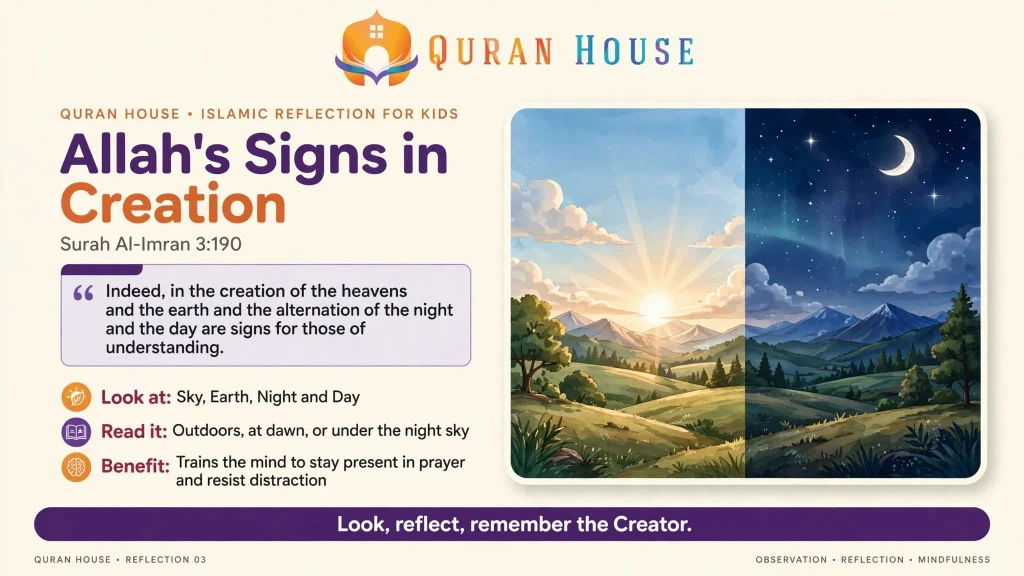
Allah introduces the closing passage with the following verse, which invites people of understanding to think carefully about the world around them every single day.
إِنَّ فِي خَلْقِ السَّمَاوَاتِ وَالْأَرْضِ وَاخْتِلَافِ اللَّيْلِ وَالنَّهَارِ لَآيَاتٍ لِّأُولِي الْأَلْبَابِ
(Inna fee khalqis-samaawaati wal-ardi wakhtilaafil-layli wan-nahaari la-aayaatin li-ulil-albaab)
(“Indeed, in the creation of the heavens and the earth and the alternation of the night and the day are signs for those of understanding.”)
Reading this verse outdoors, at dawn, or under the night sky changes how it lands. The sunrise, the seasons, and the stars become reminders of a Creator who is organized, merciful, and worthy of worship.
This benefit also protects against distraction. A mind trained to notice signs in creation finds it easier to stay present in prayer and to resist spending the morning on a phone screen.
A Real Surah Lesson: Surah Ash-Shams
Watch a student work through Surah Ash-Shams step by step with their tutor, practicing each ayah until the recitation flows clearly and correctly.
Start Your Quran Journey With Quran House
Learn live and one-on-one with Al-Azhar-trained tutors, male and female, for children and adults, at a time that fits your timezone.
Try a Free Session7. Remember Death and Reset Your Priorities
Remembering death is a spiritual benefit that clarifies priorities, and verse 3:185 delivers the reminder without exception. Every soul tastes death, and every soul receives its full reward on the Day of Resurrection.
Allah states this reality plainly in the following verse, then explains that real success means being saved from the Fire and admitted to Paradise.
كُلُّ نَفْسٍ ذَائِقَةُ الْمَوْتِ وَإِنَّمَا تُوَفَّوْنَ أُجُورَكُمْ يَوْمَ الْقِيَامَةِ فَمَن زُحْزِحَ عَنِ النَّارِ وَأُدْخِلَ الْجَنَّةَ فَقَدْ فَازَ وَمَا الْحَيَاةُ الدُّنْيَا إِلَّا مَتَاعُ الْغُرُورِ
(Kullu nafsin dhaa’iqatul-mawt, wa innamaa tuwaffawna ujoorakum yawmal-qiyaamah, faman zuhziha ‘anin-naari wa udkhilal-jannata faqad faaz, wa mal-hayaatud-dunyaa illaa mataa’ul-ghuroor)
(“Every soul will taste death, and you will only be given your full compensation on the Day of Resurrection. So he who is drawn away from the Fire and admitted to Paradise has attained [his desire]. And what is the life of this world except the enjoyment of delusion.”)
The verse is not meant to frighten; it is meant to focus. Status, comfort, and approval are temporary, so the believer asks what will remain when the time given in this life ends.
If you are also working on committing verses to heart, read our guide on why memorize the Quran to see how memorization keeps the Hereafter in view.
8. Grow in Patience, Steadfastness, and Taqwa
The surah closes with a four-part command that works as a blueprint for success. Verse 3:200 asks believers to persevere, to endure, to remain steadfast, and to keep taqwa, meaning awareness of Allah in every situation.
Allah ends Surah Al-Imran with the following verse, which gathers the lessons of faith, hardship, and reward into a single, short, clear instruction for believers.
يَا أَيُّهَا الَّذِينَ آمَنُوا اصْبِرُوا وَصَابِرُوا وَرَابِطُوا وَاتَّقُوا اللَّهَ لَعَلَّكُمْ تُفْلِحُونَ
(Yaa ayyuhal-ladheena aamanus-biroo wa saabiroo wa raabitoo wattaqullaha la’allakum tuflihoon)
(“O you who have believed, persevere and endure and remain stationed and fear Allah that you may be successful.”)
Among all Surah Al Imran benefits, patience may be the most practical, because it applies in easy times as well as hard ones. Al-Hasan al-Basri explained that believers must stay patient in Islam until they die as Muslims.
Practice this verse by choosing one daily act that requires patience, such as praying on time or lowering the gaze, and repeating the verse silently when it feels difficult.
Quran House offers Learn Quran Reading with Tajweed for Beginners, a live course that corrects pronunciation in real time so every ayah of the surah is recited with accuracy and confidence.
Book Your Free Tajweed Trial Lesson
9. Learn Devotion From the Family of Imran
The family of Imran offers a model of devotion across generations, and learning from it is a lasting benefit of the surah. Its verses introduce the mother of Maryam, Maryam herself, Zakariya, and the birth of Isa.
Maryam is described as a woman devoted to worship whose provision came directly from Allah. Her story shows that sincere devotion, even when hidden from people, is noticed and honored by the Lord of the worlds.
The narrative also clarifies belief about Isa, who is honored as a messenger of Allah born by His command. This accuracy matters for Muslims who answer questions about Jesus and Mary from the Quran.
For families, these passages are an easy bridge to conversation with children about prayer, trust, and honesty. Reading a short section aloud each week keeps the lessons alive at home.
10. Deepen Your Grasp of Tawheed and Earlier Scripture
Surah Al-Imran strengthens tawheed from its first lines. The opening verses declare that there is no deity except Allah and that He revealed earlier scripture as guidance before sending the Quran as the criterion between truth and falsehood.
The surah states its central truth in the second verse, using two names of Allah that express His perfect life and constant care for all of creation.
اللَّهُ لَا إِلَٰهَ إِلَّا هُوَ الْحَيُّ الْقَيُّومُ
(Allahu laa ilaaha illaa huwal-Hayyul-Qayyoom)
(“Allah, there is no deity except Him, the Ever-Living, the Sustainer of all existence.”)
Reciting these names, Al-Hayy and Al-Qayyum, keeps the heart anchored when relationships and plans change. Allah neither sleeps nor weakens, and everything else depends on Him for its existence.
Many commentators link the surah’s opening verses with the delegation of Najran, which explains the careful discussion of Isa and earlier scripture. Studying this context deepens the benefits of reciting Surah Al-Imran with understanding.
Quran House offers the Word-by-Word Quran Reading Course, a program that connects each Arabic word to its meaning so verses about tawheed become clear while you read.
Claim Your Free Word-by-Word Trial Lesson
Surah Al-Imran Facts at a Glance
Surah Al-Imran is a Madani chapter, which means it was revealed after the Hijrah while the Muslim community faced new tests. The table below gathers the basic facts every reader should know.
| Feature | Detail |
| Order in the Quran | Third surah |
| Number of verses | 200 |
| Place of revelation | Madinah (Madani) |
| Named after | The family of Imran, the father of Maryam |
| Companion surah | Al-Baqarah, together called the two radiant ones |
| Main themes | Tawheed, Uhud, Maryam and Isa, People of the Book, patience |
Because correct recitation protects the meaning of these verses, our guide to what Tajweed is is a helpful companion when you begin reading the surah aloud.
How to Apply Surah Al Imran Benefits in Daily Life
A daily plan makes the benefits last. Reading the full surah is not required in one sitting, so begin with focused passages that carry its main lessons, then widen your reading over time.
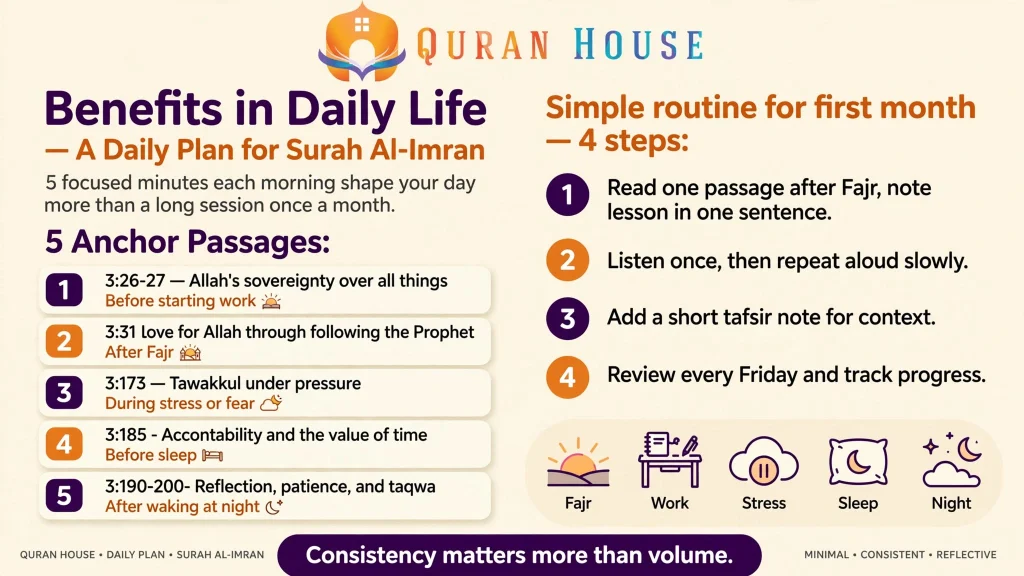
The table below lists five anchor passages, the lesson each one teaches, and the moment where it fits best in an ordinary day.
| Passage | Lesson | Best Daily Moment |
| 3:26 to 27 | Allah’s sovereignty over all things | Before starting work |
| 3:31 | Love for Allah through following the Prophet ﷺ | After Fajr |
| 3:173 | Tawakkul under pressure | During stress or fear |
| 3:185 | Accountability and the value of time | Before sleep |
| 3:190 to 200 | Reflection, patience, and taqwa | After waking at night |
Follow this simple routine for the first month:
- Read one anchor passage after Fajr and note its lesson in one sentence.
- Listen to a reciter once, then repeat the verses aloud slowly.
- Add a short tafsir note so the historical context is clear.
- Review the week’s passages every Friday and track your progress.
Consistency matters more than volume. Five focused minutes each morning will shape your day more than a long session once a month, and the habit grows stronger with every repetition.
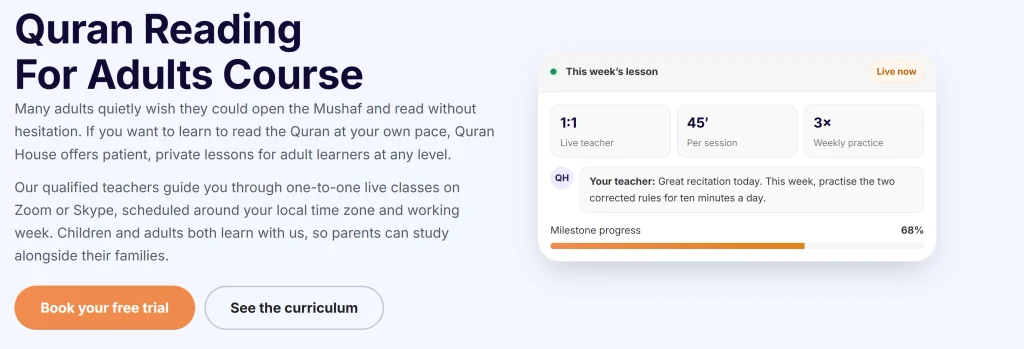
Quran House offers a Quran Reading For Adults Course, a flexible one-on-one program that helps adult learners build a steady daily reading habit at their own pace.
Start Your Free Adult Trial Lesson
How to Memorize Surah Al-Imran Step by Step
Memorizing Surah Al-Imran is easiest in small, repeated steps. The surah is long, so a clear method protects your progress and keeps revision manageable.
- Read the section slowly with its translation until the meaning is clear.
- Repeat the first verse ten times while looking at the text.
- Recite it from memory, then add the next verse and recite both.
- Revise the previous day’s portion before starting anything new.
- Recite to a qualified tutor weekly so mistakes are corrected early.
A qualified tutor catches errors in pronunciation and flow that self-study misses. Weekly review also keeps motivation steady during the long middle stretch of a surah that has 200 verses.
Inside an Interactive One-on-One Session
Every class is live and personal. See how our tutor uses on-screen tools, quick reviews, and gentle correction to help a student build confidence with every new word.
Start Your Quran Journey With Quran House
Learn live and one-on-one with Al-Azhar-trained tutors, male and female, for children and adults, at a time that fits your timezone.
Try a Free SessionStart Learning Surah Al-Imran With Quran House Instructors
Quran House teaches Quran, Tajweed, and Arabic online to kids and adults through live sessions with Al-Azhar-trained tutors. Every student receives correction, encouragement, and a plan that fits their level.
What Sets Quran House Apart:
- Live one-on-one sessions that adapt to each learner’s level.
- Al-Azhar-trained tutors who correct pronunciation in real time.
- Female tutors available for sisters who prefer a private learning space.
- Flexible scheduling for kids, adults, and busy families.
Our Quran Courses
- Quran Tafseer Course Online for All Levels
- Learn Quran Reading with Tajweed for Beginners
- Word-by-Word Quran Reading Course
- Quran Reading For Adults Course
- Quran Reading For Kids Course
- Quran Reading For Sisters Course
Conclusion
Surah Al-Imran combines intercession, tawheed, resilience, and practical guidance in one chapter. Its virtues come from clear evidence in the Quran and Sunnah, and its lessons are as relevant today as they were after Uhud.
The Surah Al Imran benefits covered here, from the plea of the two radiant surahs to the command of patience in verse 200, reward steady reading more than occasional bursts of effort.
Begin with the anchor passages, return to them each morning, and seek a teacher to refine your recitation. A small daily habit with sincere intention is how great chapters become part of the heart.
FAQs
What Is the Greatest Reward of Reading Surah Al-Imran?
The best-documented reward is intercession. Sahih Muslim 804a says Al-Baqarah and Al-Imran will come on the Day of Resurrection like clouds or flocks of birds and plead for those who recite them.
Is Surah Al-Imran Makki or Madani?
Surah Al-Imran is Madani. It was revealed in Madinah, has 200 verses, and is the third surah in the Quran. Its verses address the Battle of Uhud and the People of the Book.
Which Verses of Surah Al-Imran Should I Read Every Day?
Begin with 3:26 to 27, 3:31, 3:173, and 3:185, then add the closing verses that begin at 3:190. These passages cover sovereignty, love for Allah, tawakkul, accountability, and reflection.
Do I Need to Read Surah Al-Imran in Arabic to Gain Its Reward?
The reward described in the hadith applies to recitation of the Arabic text. Reading a translation deepens understanding and is encouraged, but it should accompany Arabic recitation rather than replace it.
How Can I Learn to Recite Surah Al-Imran Correctly?
Study Tajweed with a qualified tutor who listens to you recite and corrects mistakes immediately. Quran House offers live one-on-one classes for kids and adults that guide you from basic reading to confident recitation.