| Key Takeaways |
| Surah Ash-Shams is the 91st chapter of the Quran, revealed in Mecca, containing 15 verses and located in the 30th juz. |
| The Prophet ﷺ recited Surah Ash-Shams in the Isha prayer and told Mu’adh ibn Jabal to recite it when leading people in prayer. |
| Verses 9 and 10 teach that whoever purifies the soul succeeds, while whoever corrupts it fails, which is the core message of the surah. |
| The story of Thamud and the she-camel warns that arrogance toward divine guidance leads to destruction, while the surah’s steady rhythm makes it easy to memorize. |
Surah Shams benefits go far beyond a short recitation from the 30th juz. In only fifteen verses, Surah Ash-Shams combines a sequence of powerful oaths, a clear teaching on purifying the soul, and the warning story of the people of Thamud.
Many readers ask what reward and guidance come from reciting it regularly. The answer is found in authentic hadith about the Isha prayer, in the verses themselves, and in the habits of reflection that the surah builds over time.
This guide explains the benefits of reciting Surah Ash-Shams, supported by Quranic verses and authentic hadith. The benefits appear below in the order a learner is most likely to experience them.
1. Follow the Sunnah of Reciting Surah Ash-Shams in Isha
The most direct benefit is following a practice recorded from the Prophet ﷺ. Two reports connect Surah Ash-Shams to the Isha prayer, one describing his own habit and one giving his instruction to a companion.
Sunan an-Nasa’i 999 on Reciting Ash-Shams in Isha
This report from Buraidah describes what the Prophet ﷺ used to recite in the last evening prayer. It shows that Surah Ash-Shams belonged to his regular Isha recitation rather than being an occasional choice.
عَنْ عَبْدِ اللَّهِ بْنِ بُرَيْدَةَ، عَنْ أَبِيهِ، أَنَّ رَسُولَ اللَّهِ صلى الله عليه وسلم كَانَ يَقْرَأُ فِي صَلاَةِ الْعِشَاءِ الآخِرَةِ بِالشَّمْسِ وَضُحَاهَا وَأَشْبَاهِهَا مِنَ السُّوَرِ
(‘An ‘Abdillah ibn Buraydah, ‘an abihi, anna Rasulallahi sallallahu ‘alayhi wa sallam kana yaqra’u fi salatil-‘isha’il-akhirati bish-shamsi wa duhaha wa ashbahiha minas-suwar)
(“It was narrated from Abdullah bin Buraidah, from his father, that: The Messenger of Allah (ﷺ) used to recite ‘By the sun and its brightness’ and similar surahs in Isha’.”)
The phrase “similar surahs” includes chapters such as Al-Layl and Al-Ala, which the second report below names alongside Ash-Shams. Darussalam grades this narration Hasan.
Sunan Ibn Majah 986 on Mu’adh and the Isha Prayer
This report shows the Prophet ﷺ correcting a long Isha prayer led by Mu’adh ibn Jabal. His instruction names Surah Ash-Shams first among several surahs suitable for leading a congregation.
عَنْ جَابِرٍ، قَالَ صَلَّى مُعَاذُ بْنُ جَبَلٍ الأَنْصَارِيُّ بِأَصْحَابِهِ صَلاَةَ الْعِشَاءِ فَطَوَّلَ عَلَيْهِمْ فَانْصَرَفَ رَجُلٌ مِنَّا فَصَلَّى فَأُخْبِرَ مُعَاذٌ عَنْهُ فَقَالَ إِنَّهُ مُنَافِقٌ، فَلَمَّا بَلَغَ ذَلِكَ الرَّجُلَ دَخَلَ عَلَى رَسُولِ اللَّهِ صلى الله عليه وسلم فَأَخْبَرَهُ مَا قَالَ لَهُ مُعَاذٌ فَقَالَ النَّبِيُّ صلى الله عليه وسلم أَتُرِيدُ أَنْ تَكُونَ فَتَّانًا يَا مُعَاذُ إِذَا صَلَّيْتَ بِالنَّاسِ فَاقْرَأْ بِالشَّمْسِ وَضُحَاهَا وَسَبِّحِ اسْمَ رَبِّكَ الأَعْلَى وَاللَّيْلِ إِذَا يَغْشَى وَاقْرَأْ بِاسْمِ رَبِّكَ
(‘An Jabir, qala salla Mu’adh ibn Jabal al-Ansari bi-ashabihi salatal-‘isha’i fa-tawwala ‘alayhim fa-ansarafa rajulun minna fa-salla fa-ukhbira Mu’adhun ‘anhu fa-qala innahu munafiq, fa-lamma balagha dhalikar-rajula dakhala ‘ala Rasulillahi sallallahu ‘alayhi wa sallam fa-akhbarahu ma qala lahu Mu’adh, fa-qalan-Nabiyyu sallallahu ‘alayhi wa sallam: a-turidu an takuna fattanan ya Mu’adh, idha sallayta bin-nasi faqra’ bish-shamsi wa duhaha wa sabbihisma Rabbikal-A’la wal-layli idha yaghsha waqra’ bismi Rabbik)
(“It was narrated that Jabir said: Mu’adh bin Jabal Al-Ansari led his companions in the ‘Isha’ prayer and he made it long. A man among us went away and prayed by himself. Mu’adh was told about that and he said: ‘He is a hypocrite.’ When the man heard about that, he went to the Messenger of Allah (ﷺ) and told him what Mu’adh had said to him. The Prophet (ﷺ) said: ‘Do you want to be a cause of Fitnah (trial, tribulation), O Mu’adh? When you lead the people in prayer, recite “By the sun and its brightness,” and “Glorify the Name of your Lord, the Most High,” and “By the night as it envelopes,” and “Recite in the Name of your Lord.”'”)
Darussalam grades this narration Sahih. For anyone leading family prayers or praying behind an imam, the lesson is practical: a moderate, well-recited surah serves the worshipper better than a long recitation that burdens others.
2. Reflect on the Oath Sequence That Opens the Surah
Surah Ash-Shams opens with a rapid series of oaths, each pointing to a visible creation of Allah. Oaths in the Quran direct attention to a sign the listener already knows well, which prepares the heart for the message that follows.
Reciting these verses slowly trains the reader to pause on what is usually taken for granted. The first four verses pair the sun with the moon and the day with the night, as Allah says:
وَالشَّمْسِ وَضُحَاهَا • وَالْقَمَرِ إِذَا تَلَاهَا • وَالنَّهَارِ إِذَا جَلَّاهَا • وَاللَّيْلِ إِذَا يَغْشَاهَا
(Wash-shamsi wa duhaha. Wal-qamari idha talaha. Wan-nahari idha jallaha. Wal-layli idha yaghshaha)
(“By the sun and its brightness, and the moon as it follows it, and the day as it unveils it, and the night as it conceals it!”)
Each pair shows a relationship of light and following. The moon trails the sun, and the day reveals what the night conceals. This balance of opposites gives the opening its rhythm and prepares the contrast between purification and corruption later in the surah.
Quran House offers a Quran Tafseer Course for All Levels that helps students study the meaning of surahs like Ash-Shams verse by verse with Al-Azhar-trained tutors.

Book Your Free Tafseer Trial Lesson
3. Notice Allah’s Signs in the Sun, Moon, Day, and Night
Another benefit of reciting Surah Ash-Shams is a renewed awareness of creation. Verses five and six extend the oaths from the sun and moon to the sky and the earth, covering everything a person sees on an ordinary day.
Allah continues the oaths with these two verses:
وَالسَّمَاءِ وَمَا بَنَاهَا • وَالْأَرْضِ وَمَا طَحَاهَا
(Was-sama’i wa ma banaha. Wal-ardi wa ma tahaha)
(“By the sky and He who constructed it, and the earth and He who spread it.”)
Because the sun rises daily, people rarely stop to appreciate it. Allah swearing by these signs invites the reader to look again and to treat the sky overhead and the ground underfoot as evidence of a Creator.
A simple practice follows from this. After reciting these verses, spend one minute looking at the sky or the morning light and reflect on who made it. Over time, recitation and observation reinforce each other.
A Real Surah Lesson: Surah Ash-Shams
Watch a student work through Surah Ash-Shams step by step with their tutor, practicing each ayah until the recitation flows clearly and correctly.
Start Your Quran Journey With Quran House
Learn live and one-on-one with Al-Azhar-trained tutors, male and female, for children and adults, at a time that fits your timezone.
Try a Free Session4. Surah Shams Benefits Include Purifying the Soul
The center of Surah Ash-Shams is verses seven through ten, where Allah swears by the soul and then describes its two possible ends. This passage turns the opening oaths into a personal question for every reader.
Allah states the principle of purification plainly in these verses:
وَنَفْسٍ وَمَا سَوَّاهَا • فَأَلْهَمَهَا فُجُورَهَا وَتَقْوَاهَا • قَدْ أَفْلَحَ مَنْ زَكَّاهَا • وَقَدْ خَابَ مَنْ دَسَّاهَا
(Wa nafsin wa ma sawwaha. Fa-alhamaha fujooraha wa taqwaha. Qad aflaha man zakkaha. Wa qad khaba man dassaha)
(“And [by] the soul and He who proportioned it, and inspired it [with discernment of] its wickedness and its righteousness. He has succeeded who purifies it, and he has failed who instills it [with corruption].”)
The word zakkaha, translated here as purifies, refers to tazkiyah, the ongoing effort to cleanse the heart of pride, envy, and disobedience. Success in the surah is measured by the state of the soul, not by wealth or status.
Reciting this passage regularly keeps the question of self-purification in front of the believer. It encourages honest self-assessment after each prayer, which is where lasting character change begins.
Quran House offers the Understand the Quran Course that guides students through the meanings of verses like these, so recitation turns into reflection and daily practice.

Start Your Free Trial With a Teacher
5. Learn to Tell Righteousness From Corruption
Verse eight teaches that Allah inspired every soul with an awareness of both wickedness and piety. This means each person already carries an inner compass, and the surah calls the believer to follow it.
Among the most practical surah shams benefits is this clarity about moral choice. The verse removes the excuse of confusion and places responsibility on the individual, which is why the surah continues immediately with success and failure.
Many commentators explain that guidance and warning work together. Allah gives the soul awareness, then sends revelation to confirm it, so conscience and scripture point in the same direction.
Reciting verse eight correctly also requires attention to the long and short vowels in words like fujooraha and taqwaha. A short guide on what Tajweed is is a good starting point for readers who want to recite these verses accurately.
A useful exercise after reciting is to ask two honest questions. Which habit is pulling my soul toward corruption, and which act of obedience is strengthening it?
6. Take Warning From the Story of Thamud
The final third of the surah turns from principle to history. Allah recalls Thamud, a people who rejected their messenger, to show what happens when a community chooses corruption over guidance.
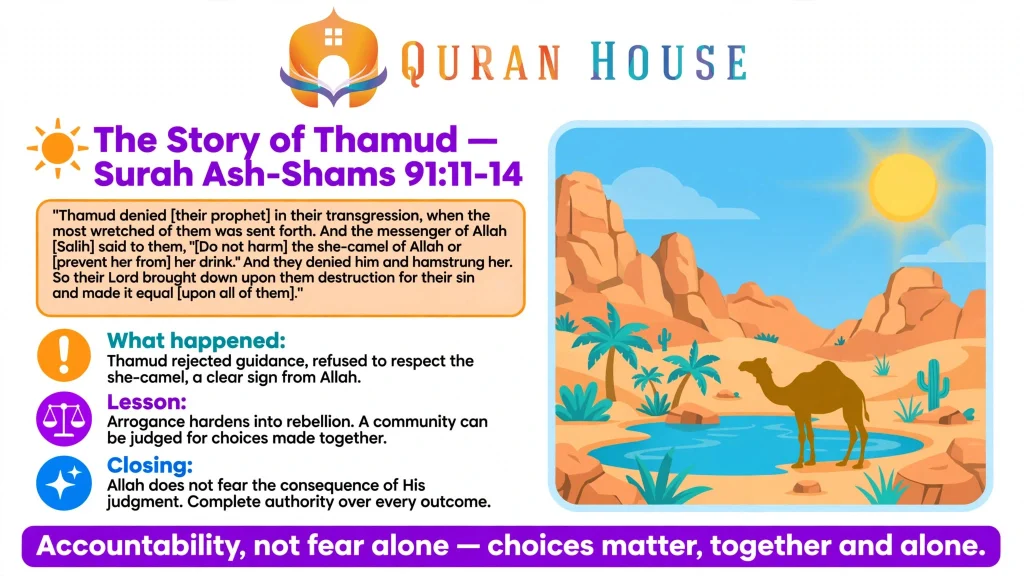
The surah describes the fate of Thamud in these verses:
كَذَّبَتْ ثَمُودُ بِطَغْوَاهَا • إِذِ انْبَعَثَ أَشْقَاهَا • فَقَالَ لَهُمْ رَسُولُ اللَّهِ نَاقَةَ اللَّهِ وَسُقْيَاهَا • فَكَذَّبُوهُ فَعَقَرُوهَا فَدَمْدَمَ عَلَيْهِمْ رَبُّهُمْ بِذَنْبِهِمْ فَسَوَّاهَا
(Kadhdhabat Thamudu bitaghwaha. Idhimba’atha ashqaha. Faqala lahum Rasulullahi naqatallahi wa suqyaha. Fakadhdhabuhu fa’aqaruha fadamdama ‘alayhim Rabbuhum bidhanbihim fasawwaha)
(“Thamud denied [their prophet] in their transgression, when the most wretched of them was sent forth. And the messenger of Allah [Salih] said to them, ‘[Do not harm] the she-camel of Allah or [prevent her from] her drink.’ And they denied him and hamstrung her. So their Lord brought down upon them destruction for their sin and made it equal [upon all of them].”)
The she-camel was a clear sign sent to the people of Thamud. Their willful refusal to respect it, and the act of hamstringing her, shows how arrogance hardens into open rebellion against divine guidance.
The destruction that followed reached the whole community. The lesson for readers is accountability rather than fear alone, since a people can be judged for choices made together as well as choices made alone.
The closing verse states that Allah does not fear the consequence of this judgment. It is a reminder of His complete authority over every outcome.
7. Memorize a Short, Rhythmic Surah From Juz Amma
Surah Ash-Shams is a practical first step for memorization. It has only fifteen verses, appears in the 30th juz known as Juz Amma, and carries a steady rhythm that helps both the tongue and the ear.
Every verse ends with the same sound, ha, as in duhaha, talaha, and sawwaha. This consistent rhyme acts as a built-in memory aid, so students often find the surah easier to retain than prose-style chapters of similar length.
A simple memorization plan works well for beginners:
- Recite verses one through four ten times with a teacher’s correction.
- Add verses five through eight the next day and review the first four.
- Learn verses nine through fifteen over the following days, then connect the full surah.
- Review the complete surah once daily for a week to secure it.
Memorization stays accurate when a teacher listens and corrects mistakes in real time, especially in the repeated ha endings.
Quran House offers a Juz Amma Memorization Course that guides students through the short surahs of the 30th juz with structured review and live correction.

Claim Your Free Memorization Trial
8. Build a Daily Recitation Habit Around Surah Ash-Shams
Regular recitation turns knowledge into habit. Surah Ash-Shams is short enough to fit into any daily schedule, yet meaningful enough to reward repeated reflection.
Learners searching for surah shams benefits will find that consistency matters more than length. Reciting the surah once a day with attention gives more lasting benefit than occasional long sessions.
Reflection works best when recitation stays slow and measured. Rushing through the verses may finish the surah quickly but leaves little room for the meaning to settle, especially in the passage on purification.
Try this simple routine:
- Recite Surah Ash-Shams after the Isha prayer, following the Sunnah described above.
- Read a short translation of each verse before reciting the next one.
- Choose one verse to reflect on and write down a single action it inspires.
- Review your recitation weekly with a teacher to correct pronunciation.
Daily recitation often grows into a larger goal. Readers who feel drawn to memorize more of the Quran can read about the benefits and importance of Quran memorization to see how Hifz changes a person’s relationship with the Book of Allah.
9. Teach Children the Lessons of Surah Ash-Shams Early
Children are naturally drawn to nature, light, and stories, which makes Surah Ash-Shams a good surah to teach early. The sun, moon, and camel in its verses give young learners concrete images to hold onto.
Parents can begin by reciting two verses together at bedtime, then ask simple questions such as what the sun does and who made it. Short, repeated sessions build confidence without pressure.
Correct pronunciation matters from the start, because early habits are hard to change later. A patient teacher can guide a child through makharij and short vowels in a friendly one-on-one setting.
Quran House offers a Quran Reading for Kids course that builds recitation skills through live, one-on-one lessons adapted to young learners.

Book Your Child’s Free Trial Lesson
Seeing a real lesson often helps parents decide how to begin. The clip below shows how a live Quran House class keeps a young learner focused, supported, and steadily progressing.
Memorizing Surah Ad-Duha in Class
Memorization is easier with structure. See how a student reviews and recites Surah Ad-Duha in a live lesson, guided by a tutor who follows every step of their progress.
Start Your Quran Journey With Quran House
Learn live and one-on-one with Al-Azhar-trained tutors, male and female, for children and adults, at a time that fits your timezone.
Try a Free SessionStart Learning Surah Ash-Shams With Quran House Teachers
Quran House has taught online Quran, Tajweed, and Arabic classes to kids and adults since 2018. Every lesson is live and one-on-one with Al-Azhar-trained tutors, and sisters can choose a female tutor for a private learning space.
What sets Quran House apart:
- Live one-on-one sessions with immediate pronunciation correction.
- Al-Azhar-trained tutors for kids, adults, and sisters.
- A free trial so students can meet a teacher before committing.
Our Quran Courses
- Quran Tafseer Course for All Levels
- Understand the Quran Course
- Juz Amma Memorization Course
- Quran Reading for Kids
- Learn Quran Reading with Tajweed for Beginners
- Quran Memorization for Adults
Conclusion
Surah shams benefits cover worship, character, memorization, and family learning. The surah teaches Muslims to follow the Sunnah of Isha recitation, to notice the signs of Allah, and to measure success by the purity of the soul.
Its warning about Thamud keeps that lesson serious, showing that arrogance toward guidance carries real consequences. At the same time, its short length and steady rhythm make it one of the most approachable surahs for beginners and children.
Reciting it with understanding, correct pronunciation, and daily consistency is the best way to experience the benefits of Surah Shams. With a qualified teacher beside you, every verse becomes easier to read, remember, and apply.
FAQs
How Many Verses Does Surah Ash-Shams Have?
Surah Ash-Shams has fifteen verses. It is the 91st chapter of the Quran, a Meccan surah, and it is located in the 30th juz, also known as Juz Amma.
Did the Prophet Recite Surah Ash-Shams in Prayer?
Yes, the Prophet ﷺ used to recite Surah Ash-Shams in the Isha prayer, as reported in Sunan an-Nasa’i 999. He also told Mu’adh ibn Jabal to recite it when leading people in prayer, as reported in Sunan Ibn Majah 986.
What Is the Main Message of Surah Ash-Shams?
The main message is that success belongs to the one who purifies the soul, and failure belongs to the one who corrupts it. Verses nine and ten state this directly, and the story of Thamud illustrates the consequence.
Who Were the People of Thamud in Surah Ash-Shams?
Thamud were a people who rejected their messenger and hamstrung the she-camel that Allah sent as a sign. Allah destroyed them for their sin, and the surah recalls their fate as a warning to later generations.
Is Surah Ash-Shams Easy to Memorize?
Yes, Surah Ash-Shams is one of the easier surahs to memorize because it has only fifteen verses and every verse ends with the same ha sound. A qualified teacher helps ensure accurate pronunciation from the first lesson.