| Key Takeaways |
| Surah At-Talaq is the 65th chapter of the Quran, a Medinan surah of 12 verses that ties its divorce rulings to repeated reminders of taqwa (God-consciousness). |
| Verses 2 and 3 promise a way out of hardship, provision from unexpected sources, and sufficiency for the one who relies on Allah. |
| No hadith is reported that assigns this surah a specific reward, so its virtues come from the promises inside its verses. |
| A short daily routine of recitation, translation study, reflection, and dua keeps the surah’s lessons present in everyday decisions. |
The Benefits of Reciting Surah Talaq reach far beyond the rulings on divorce that give the chapter its name. Alongside those rulings, the surah repeats promises of relief, provision, and ease for the person who fears Allah.
Surah At-Talaq is the 65th chapter of the Quran, revealed in Madinah, with 12 verses. Many readers look up Surah Talaq benefits during hard seasons, so it helps to separate what the verses clearly promise from what people only assume.
Each section below takes one blessing, ties it to the wording of the surah, and shows how to act on it. The eight benefits are as follows.
1. Find a Way Out of Hardship Through Taqwa
Surah At-Talaq promises that whoever fears Allah will find a way out of difficulty, and that promise arrives right inside the divorce rulings. The timing matters, because hardship in family life is exactly where people feel trapped.
Allah ends the second verse with the line that sets the tone for the entire surah, after the instructions on keeping or releasing a wife with honor.
فَإِذَا بَلَغْنَ أَجَلَهُنَّ فَأَمْسِكُوهُنَّ بِمَعْرُوفٍ أَوْ فَارِقُوهُنَّ بِمَعْرُوفٍ وَأَشْهِدُوا ذَوَيْ عَدْلٍ مِنكُمْ وَأَقِيمُوا الشَّهَادَةَ لِلَّهِ ۚ ذَٰلِكُمْ يُوعَظُ بِهِ مَن كَانَ يُؤْمِنُ بِاللَّهِ وَالْيَوْمِ الْآخِرِ ۚ وَمَن يَتَّقِ اللَّهَ يَجْعَل لَّهُ مَخْرَجًا
(Fa-idha balaghna ajalahunna fa-amsikuhunna bima’rufin aw fariquhunna bima’rufin wa-ashhidu dhawai ‘adlin minkum wa-aqimu ash-shahadata lillah. Dhalikum yu’adhu bihi man kana yu’minu billahi wal-yawmil-akhir. Wa man yattaqillaha yaj’al lahu makhraja)
(“Then when they have almost reached the end of their waiting period, either retain them in a good manner or part with them in a good manner, and bring to witness two just persons from among you, and establish the testimony for Allah. That is an admonition for whoever believes in Allah and the Last Day. And whoever fears Allah, He will make for him a way out.”)
Ibn Mas’ud is reported to have said that this is the greatest verse in the Quran in terms of relief. Whether a person faces a broken marriage, a debt, or a closed door, taqwa is the stated cause of the exit.
Taqwa here means acting within Allah’s limits when anger or fear pushes the other way. A reciter who rehearses this verse learns to ask, before every decision, what Allah’s limits allow.
2. Receive Provision From Where You Never Expected
Verse 3 promises that Allah will provide for the one who fears Him from sources the person never anticipated. That is the central comfort of Surah At-Talaq for anyone anxious about income or stability.
Read the verse as the direct continuation of verse 2, because provision and reliance are presented as the fruit of the same taqwa described there.
وَيَرْزُقْهُ مِنْ حَيْثُ لَا يَحْتَسِبُ ۚ وَمَن يَتَوَكَّلْ عَلَى اللَّهِ فَهُوَ حَسْبُهُ ۚ إِنَّ اللَّهَ بَالِغُ أَمْرِهِ ۚ قَدْ جَعَلَ اللَّهُ لِكُلِّ شَيْءٍ قَدْرًا
(Wa yarzuqhu min haythu la yahtasib. Wa man yatawakkal ‘alallahi fahuwa hasbuh. Innallaha balighu amrih. Qad ja’alallahu likulli shay’in qadra)
(“And will provide for him from where he does not expect. And whoever relies upon Allah, then He is sufficient for him. Indeed, Allah will accomplish His purpose. Allah has already set for everything a decreed measure.”)
Provision is a wider idea than money. It can include health, time, family peace, and opportunity. Seen this way, the benefits of reciting Surah Talaq include a heart that stops measuring security only by a salary.
A practical step is to pair recitation with action: work honestly, avoid forbidden earnings, and make dua (supplication). Taqwa in this verse includes how income is earned, not only how it is prayed for.
3. Build Tawakkul Through the Promise of Sufficiency
Tawakkul, meaning complete reliance on Allah after taking the available means, is the subject of the second half of verse 3. The verse says that whoever relies on Allah will find Him sufficient.
Allah then adds that He will accomplish His purpose and has set a measure for everything. Waiting is part of that measure. Reliance does not mean results arrive on the day a person decides to trust.
Tawakkul has three practical parts:
- Take lawful, realistic steps toward the goal.
- Ask Allah sincerely and keep asking.
- Accept the outcome with patience and good expectations of Allah.
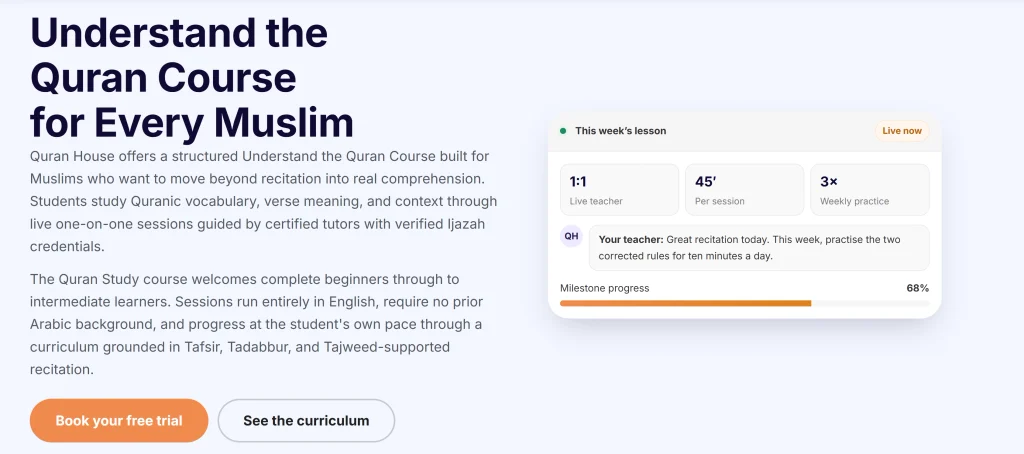
Quran House offers an Understand the Quran Course that helps students follow the meaning behind verses like these, with live one-on-one guidance from Al-Azhar-trained tutors.
4. Earn Forgiveness of Sins and a Greater Reward
Verse 5 states that whoever fears Allah will have misdeeds removed and a reward made great. This gives recitation of Surah At-Talaq a clear spiritual purpose: renewing taqwa, which is tied to forgiveness.
Here the promise pattern of verses 2 and 4 repeats, tying a different blessing to taqwa each time. This time the blessing is forgiveness and a greater reward.
ذَٰلِكَ أَمْرُ اللَّهِ أَنزَلَهُ إِلَيْكُمْ ۚ وَمَن يَتَّقِ اللَّهَ يُكَفِّرْ عَنْهُ سَيِّئَاتِهِ وَيُعْظِمْ لَهُ أَجْرًا
(Dhalika amrullahi anzalahu ilaykum, wa man yattaqillaha yukaffir ‘anhu sayyi’atihi wa yu’zim lahu ajra)
(“That is the command of Allah, which He has sent down to you. And whoever fears Allah, He will remove from him his misdeeds and make great for him his reward.”)
Forgiveness in this verse is not limited to divorce. A husband who restrains his tongue, a wife who protects her dignity, and a parent who stays fair are all acting on the same command.
Readers can make this practical by ending each recitation with istighfar, or asking Allah’s forgiveness, and one concrete act of fairness toward someone at home. The reward grows when the verse changes behavior, not only the tongue.
A Real Surah Lesson: Surah Ash-Shams
Watch a student work through Surah Ash-Shams step by step with their tutor, practicing each ayah until the recitation flows clearly and correctly.
Start Your Quran Journey With Quran House
Learn live and one-on-one with Al-Azhar-trained tutors, male and female, for children and adults, at a time that fits your timezone.
Try a Free Session5. Learn That Ease Follows Hardship in Every Trial
Verse 7 closes with the promise that Allah will bring ease after hardship, and it comes right after the discussion of spending, nursing, and financial strain. The placement offers comfort exactly where pressure is highest.
The verse first sets a rule of fair spending, according to what each person has been given, and only then ends with the line of hope.
لِيُنفِقْ ذُو سَعَةٍ مِّن سَعَتِهِ ۖ وَمَن قُدِرَ عَلَيْهِ رِزْقُهُ فَلْيُنفِقْ مِمَّا آتَاهُ اللَّهُ ۚ لَا يُكَلِّفُ اللَّهُ نَفْسًا إِلَّا مَا آتَاهَا ۚ سَيَجْعَلُ اللَّهُ بَعْدَ عُسْرٍ يُسْرًا
(Liyunfiq dhu sa’atin min sa’atihi, wa man qudira ‘alayhi rizquhu falyunfiq mimma atahullah. La yukallifullahu nafsan illa ma ataha. Sayaj’alullahu ba’da ‘usrin yusra)
(“Let the man of wealth spend from his wealth, and the one whose provision is restricted, let him spend from what Allah has given him. Allah does not burden a soul except with what He has given it. Allah will bring about, after hardship, ease.”)
Allah does not burden a soul beyond what it has been given, so the ease promised here comes with realistic expectations. A person is asked to do what is within capacity, not the impossible.
Ease arrives in many forms: clarity of mind, a changed situation, or strength to endure. In every case the reciter is asked to keep acting with taqwa while waiting.
Students who want to strengthen this habit of patience can also read our guide on why memorize the Quran through Hifz, which explains the spiritual value of staying with the Quran over the long term.
6. Strengthen Family Life Through Fairness and Kindness
Surah At-Talaq teaches that a marriage should end, if it must, with the same kindness it began with. The surah gives specific duties around housing, spending, and nursing that protect every person involved.
Verse 6 gives one of the clearest examples, because it addresses housing during the waiting period, spending during pregnancy, and the payment of a nursing mother.
أَسْكِنُوهُنَّ مِنْ حَيْثُ سَكَنتُم مِّن وُجْدِكُمْ وَلَا تُضَارُّوهُنَّ لِتُضَيِّقُوا عَلَيْهِنَّ ۚ وَإِن كُنَّ أُولَاتِ حَمْلٍ فَأَنفِقُوا عَلَيْهِنَّ حَتَّىٰ يَضَعْنَ حَمْلَهُنَّ ۚ فَإِنْ أَرْضَعْنَ لَكُمْ فَآتُوهُنَّ أُجُورَهُنَّ وَأْتَمِرُوا بَيْنَكُم بِمَعْرُوفٍ ۖ وَإِن تَعَاسَرْتُمْ فَسَتُرْضِعُ لَهُ أُخْرَىٰ
(Askinuhunna min haythu sakantum min wujdikum wa la tudarruhunna litudayyiqu ‘alayhinna. Wa in kunna ulati hamlin fa-anfiqu ‘alayhinna hatta yada’na hamlahunna. Fa-in arda’na lakum fa-atuhunna ujurahunna wa-tamiru baynakum bima’ruf. Wa in ta’asartum fasaturdi’u lahu ukhra)
(“Let them live where you live during their waiting period, according to your means. And do not harass them to make their stay unbearable. If they are pregnant, then spend on them until they deliver. And if they nurse your child, give them their payment, and consult together with kindness. But if you fail to reach an agreement, then another woman will nurse the child for the father.”)
The verse sets out three duties:
- Provide housing according to one’s means, without harassment.
- Spend on a pregnant wife until she delivers.
- Consult with kindness on nursing arrangements and payment.
These duties explain why Surah Talaq benefits are often described in terms of family peace. A household that follows them replaces bitterness with accountability, which protects children from becoming a battleground.
Quran House offers a Quran Tafseer Course for All Levels that explains the context and legal wisdom behind verses like these, taught live and one-on-one, with sisters able to choose a female tutor.
7. Deepen Awe of Allah’s Power and Knowledge
The final verse of the surah ends on Allah’s power and knowledge, which grounds every earlier promise in His complete control. The reciter finishes the chapter reminded that nothing escapes His awareness.
Verse 12 closes the surah with a statement about creation, command, and knowledge, and it explains why the earlier promises of relief can be trusted.
اللَّهُ الَّذِي خَلَقَ سَبْعَ سَمَاوَاتٍ وَمِنَ الْأَرْضِ مِثْلَهُنَّ يَتَنَزَّلُ الْأَمْرُ بَيْنَهُنَّ لِتَعْلَمُوا أَنَّ اللَّهَ عَلَىٰ كُلِّ شَيْءٍ قَدِيرٌ وَأَنَّ اللَّهَ قَدْ أَحَاطَ بِكُلِّ شَيْءٍ عِلْمًا
(Allahul-ladhi khalaqa sab’a samawatin wa minal-ardi mithlahunna, yatanazzalul-amru baynahunna litalamu anna-llaha ‘ala kulli shay’in qadir, wa anna-llaha qad ahata bikulli shay’in ‘ilma)
(“It is Allah who has created seven heavens and of the earth, the like of them. His command descends among them, so that you may know that Allah is over all things competent, and that Allah has encompassed all things in knowledge.”)
Among the benefits of reciting Surah Talaq is a steadier heart: a person who knows that Allah encompasses everything in knowledge speaks more carefully, forgives more easily, and worries less about outcomes outside personal control.
Reflecting on this verse after the daily recitation gives a short, steady way to renew awareness of Allah. It also connects the surah’s rules back to Allah, which is the Quranic way of teaching fiqh.
8. Protect Communities by Upholding the Limits of Allah
Verse 8 warns that many societies rebelled against the command of their Lord and His messengers and faced a severe reckoning, so the surah protects communities as well as households.
Divorce rules in the surah are called the limits of Allah, and verse 1 states that whoever transgresses them has wronged his own soul. Cruelty toward a spouse therefore harms the one who commits it.
Four standards from the surah can guide relatives, mediators, and scholars who help a family through separation:
- Honor the waiting period without rushing the decision.
- Avoid harassment and pressure inside the home.
- Call upright witnesses and keep testimony honest.
- Settle financial rights with kindness.
Seen this way, the surah gives the wider Muslim community a standard of conduct, not only a private ruling. Fairness, courtesy, and honest witness protect trust long after a marriage ends.
To read the surah’s legal vocabulary, including iddah, the waiting period, directly in Arabic, Quran House offers a Quranic Arabic Course with live tutors who build vocabulary step by step.

Iddah Rules and the Context of Revelation
Surah At-Talaq makes the waiting period, called iddah, the central structure of its divorce rulings, and it was revealed in Madinah to give the young Muslim community clear family law.
Surah Al-Baqarah introduces the broader principles of marriage and separation, while Surah At-Talaq narrows in on the procedure and its emotional aftermath. Together they give a complete picture.
The table below summarizes the waiting periods the Quran specifies in these two surahs.
| Situation | Waiting Period | Where It Appears |
| A woman who still has menstrual cycles | Three menstrual cycles | Surah Al-Baqarah 2:228 |
| A woman who no longer menstruates or has not yet menstruated | Three months | Surah At-Talaq 65:4 |
| A pregnant woman | Until she gives birth | Surah At-Talaq 65:4 |
The waiting period allows time for reconciliation, confirms whether the wife is pregnant, and gives both sides space for reflection. Verse 1 therefore commands believers to count it carefully.
What Do the Sources Say About Surah Talaq Virtues?
No hadith is reported that assigns Surah At-Talaq a specific reward, so its virtue rests on its place in the Quran and the promises inside its verses.
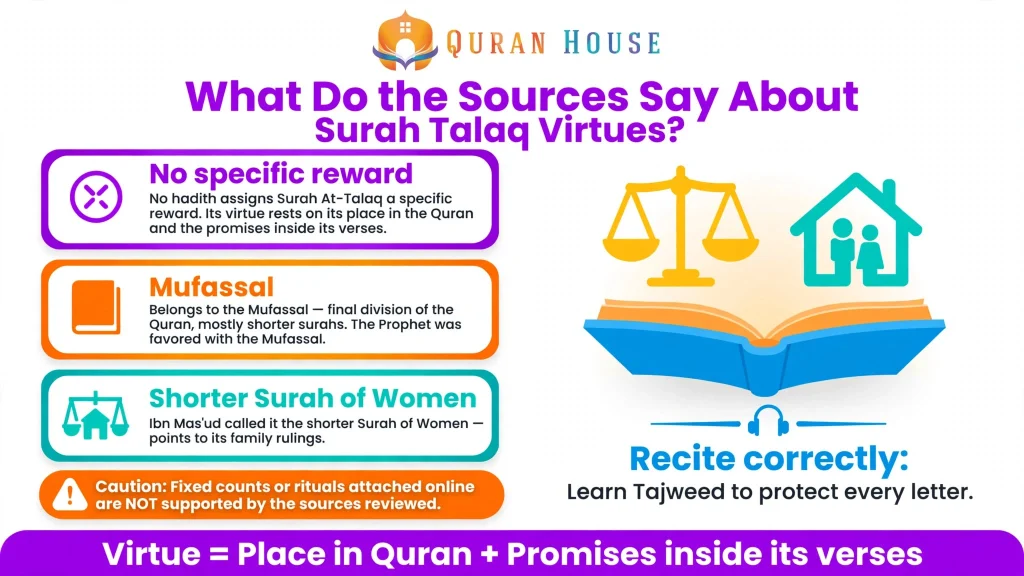
Scholars note that it belongs to the Mufassal, the final division of the Quran made up mostly of shorter surahs, and a hadith reports that the Prophet was favored with the Mufassal.
Ibn Mas’ud called it the shorter Surah of Women, a name that points to its family rulings. Some websites attach fixed counts or rituals to the surah, but the sources reviewed do not support them.
Readers who want to recite these verses correctly can start with our guide on what Tajweed is, which explains the rules that protect every letter of the Quran.
Gaining Surah Talaq Benefits Through Daily Recitation
A short daily routine delivers the surah’s lessons best, and it only needs four ingredients: slow recitation, a trusted translation, reflection on one verse, and sincere dua.
Follow this simple sequence each day:
- Recite the 12 verses slowly with correct Tajweed, ideally after Fajr or before sleep.
- Read a trusted translation of the same verses.
- Choose one verse, such as 65:2, 65:3, or 65:7, and reflect on it for a few minutes.
- End with istighfar and a sincere dua about a specific difficulty.
- Take one action that matches the verse, such as paying a debt, speaking kindly, or keeping a promise.
In our experience at Quran House, students who recite a little every day retain more than students who recite for long stretches once in a while. Ten focused minutes can anchor the whole day.
Quran House offers a Learn Quran Reading with Tajweed for Beginners course that corrects pronunciation in real time, so recitation of verses like these becomes accurate and confident.
Reserve Your Free Trial Lesson
Mistakes to Avoid When Reading for Worldly Needs
The most common mistake is treating the surah as a charm that works by repetition alone, when its verses tie every promise to taqwa and reliance.
Avoid these four mistakes when reciting for a worldly need:
- Reciting a fixed number of times while ignoring lawful effort.
- Concluding that a delayed answer means a rejected one.
- Adding special rituals that no source supports.
- Quoting the divorce rulings to pressure or harm a spouse.
Verse 3 answers the second mistake directly, because Allah has set a measure for everything and timing belongs to Him. A qualified teacher can also advise before any new practice is added.
Memorizing Surah Ad-Duha in Class
Memorization is easier with structure. See how a student reviews and recites Surah Ad-Duha in a live lesson, guided by a tutor who follows every step of their progress.
Start Your Quran Journey With Quran House
Learn live and one-on-one with Al-Azhar-trained tutors, male and female, for children and adults, at a time that fits your timezone.
Try a Free SessionStart Learning Surah At-Talaq With Quran House Teachers
Learning Surah At-Talaq with a qualified teacher turns reading into understanding and practice. At Quran House, every class is live and one-on-one, with Al-Azhar-trained tutors who correct recitation and explain meaning.
What sets Quran House apart:
- Live one-on-one classes with tutors trained at Al-Azhar.
- Female tutors available for sisters who prefer a private learning space.
- Quran reading, Tajweed, Hifz, Quranic Arabic, and Tafseer paths for kids and adults.
- Two free sessions before you decide.
Our Quran Courses
- Understand the Quran Course.
- Quran Tafseer Course for All Levels.
- Quranic Arabic Course.
- Learn Quran Reading with Tajweed for Beginners.
- Quran Memorization for Adults.
- Quran Reading for Sisters.
Conclusion
The benefits of reciting Surah Talaq come from a clear source: the promises Allah attaches to taqwa and reliance in its own verses. Relief, provision, forgiveness, and ease are each tied to a way of living, not to repetition alone.
Surah At-Talaq also teaches that families deserve fairness even when a marriage ends. Its rulings on housing, spending, and nursing protect the vulnerable and remind every reader that Allah’s limits are a mercy.
Anyone searching for Surah Talaq benefits should leave with a practical plan: recite slowly, study the meaning, make dua, and act with taqwa. With a qualified teacher and steady practice, the surah becomes a lasting source of calm.
FAQs
What Is the Main Lesson of Surah At-Talaq?
The main lesson is that taqwa and reliance on Allah bring relief, provision, and ease. The surah teaches this while setting out the rulings on divorce, the waiting period, nursing, maintenance, and housing.
Is There a Hadith About the Reward for Surah At-Talaq?
No hadith is reported that assigns this surah a specific reward. Its virtues come from its place in the Mufassal and from the promises in its verses, so avoid fixed counts or special rituals.
Can You Recite Surah At-Talaq Without Facing Divorce?
Yes, any Muslim may recite it. Its promises of relief, provision, and forgiveness apply to everyone who fears Allah, and its family rulings teach a fairness that every household can practice.
How Many Verses Does Surah At-Talaq Have?
Surah At-Talaq has 12 verses and is the 65th chapter of the Quran. It was revealed in Madinah, and Ibn Mas’ud described it as the shorter Surah of Women.
Why Is Surah At-Talaq Called the Divorce?
It takes its name from its central subject: the rulings on divorce, the waiting period, nursing, maintenance, and housing. These rulings are joined throughout to repeated reminders to fear Allah and rely on Him.