| Key Takeaways |
| Surah Al-Balad is the 90th chapter of the Quran, a Meccan surah of 20 verses that opens with an oath by Makkah. |
| No authentic hadith assigns a special reward to this surah, so its value lies in reciting, understanding, and applying its message. |
| The surah defines the steep path through four deeds: freeing a slave, feeding the hungry, caring for an orphan, and helping a needy person. |
| Reciting the surah in Salah or a daily routine builds patience, gratitude, and generosity when recitation is paired with reflection on meaning. |
Surah Balad benefits grow when a believer reads it with reflection, because few chapters speak as directly about hardship and responsibility. Its twenty verses join a sacred oath to a clear call for action.
Surah Al-Balad is the 90th chapter of the Quran, revealed in Makkah before the Hijrah. It takes its name from the city mentioned in its first verse, and it sits in Juz Amma beside Surah Al-Fajr and Surah Ash-Shams.
Honesty matters here. No authentic hadith assigns a special reward to this chapter, so every virtue below comes from the verses themselves. The following benefits are drawn directly from the text of the surah.
1. Remember That Hardship Is Part of Human Life
The first benefit is perspective, because the surah states plainly that struggle is built into human existence. Allah says in the fourth verse of the chapter:
لَقَدْ خَلَقْنَا الْإِنسَانَ فِي كَبَدٍ
(Laqad khalaqnā al-insāna fī kabad)
(“We have certainly created man into hardship.”)
Kabad, the Arabic word used here, describes toil, effort, and difficulty. A believer who absorbs it stops treating every hardship as personal failure and starts seeing it as an expected part of life’s test.
This outlook protects the heart from despair. When illness, exams, or financial pressure arrive, the surah reminds the reader that difficulty is neither random nor meaningless, and that patience remains the believer’s steady response.
2. Build Accountability Through Awareness of Allah’s Sight
The second benefit is accountability, because the surah challenges the habit of boasting about wealth while forgetting that Allah sees every action. The next three verses address this directly:
أَيَحْسَبُ أَن لَّن يَقْدِرَ عَلَيْهِ أَحَدٌ • يَقُولُ أَهْلَكْتُ مَالًا لُّبَدًا • أَيَحْسَبُ أَن لَّمْ يَرَهُ أَحَدٌ
(A-yaḥsabu an lan yaqdira ‘alayhi aḥad • Yaqūlu ahlaktu mālan lubadā • A-yaḥsabu an lam yarahu aḥad)
(“Does he think that no one has power over him? He says, ‘I have spent wealth in abundance.’ Does he think that no one sees him?”)
Wealth tends to create a false sense of immunity. The speaker in the verse boasts of spending lavishly, and the surah answers by reminding him that Allah sees the intention behind every expense.
Regular reflection on these verses trains a quiet habit of self-checking. Before spending money, making a promise, or speaking harshly, the reader learns to ask whether the action would stand if Allah’s sight were fully present.
Quran House offers a Quran Tafseer Course for All Levels that explains verses like these with qualified tutors, so students move from simple recitation to genuine comprehension.
Start Your Free Tafseer Trial With Expert Tutors
3. Show Gratitude for Eyes, Tongue, and Lips
The third benefit is gratitude, because the surah lists ordinary blessings that people rarely notice until they are lost. Allah asks in verses eight and nine:
أَلَمْ نَجْعَل لَّهُ عَيْنَيْنِ • وَلِسَانًا وَشَفَتَيْنِ
(Alam naj‘al lahu ‘aynayn • Wa lisānan wa shafatayn)
(“Have We not made for him two eyes, and a tongue and two lips?”)
Sight, speech, and the ability to form words are gifts that make every good deed possible. Surah Balad benefits readers who pause on this question, because gratitude turns blessings into responsibilities instead of entitlements.
Practical gratitude can be simple. Thank Allah aloud after reciting, use the tongue for truthful speech, and use the eyes to notice people who need help, since the verses link these faculties to the choice that follows.
4. Choose the Right Path With Clear Moral Guidance
The fourth benefit is moral clarity, because Allah reminds the reader that guidance has already been provided to every person. The tenth verse says:
وَهَدَيْنَاهُ النَّجْدَيْنِ
(Wa hadaynāhu an-najdayn)
(“And shown him the two ways?”)
An-najdayn means the two clear roads, the way of good and the way of evil. The verse removes the excuse of confusion, since every person receives a conscience and revealed guidance.
This clarity brings relief as well as responsibility. A reader who recites the surah regularly learns to stop waiting for perfect certainty and to act on what is already known to be right.
A Real Surah Lesson: Surah Ash-Shams
Watch a student work through Surah Ash-Shams step by step with their tutor, practicing each ayah until the recitation flows clearly and correctly.
Start Your Quran Journey With Quran House
Learn live and one-on-one with Al-Azhar-trained tutors, male and female, for children and adults, at a time that fits your timezone.
Try a Free Session5. Practice Generosity by Climbing the Steep Path
The fifth benefit is generosity, because the surah defines the steep path through concrete acts rather than abstract ideas. The eleventh to sixteenth verses explain it:
فَلَا اقْتَحَمَ الْعَقَبَةَ • وَمَا أَدْرَاكَ مَا الْعَقَبَةُ • فَكُّ رَقَبَةٍ • أَوْ إِطْعَامٌ فِي يَوْمٍ ذِي مَسْغَبَةٍ • يَتِيمًا ذَا مَقْرَبَةٍ • أَوْ مِسْكِينًا ذَا مَتْرَبَةٍ
(Fa-lā iqtaḥama al-‘aqabah • Wa mā adrāka mā al-‘aqabah • Fakku raqabah • Aw iṭ‘āmun fī yawmin dhī masghabah • Yatīman dhā maqrabah • Aw miskīnan dhā matrabah)
(“But he has not attempted the steep path. And what can make you know what the steep path is? It is freeing a slave, or feeding on a day of severe hunger an orphan of near relationship, or a needy person in misery.”)
Al-‘Aqabah is a steep mountain path, a fitting picture for deeds that cost effort and comfort. The surah names four deeds that define this climb:
- Freeing a slave from bondage.
- Feeding people on a day of severe hunger.
- Caring for an orphan who is a relative.
- Supporting a needy person in deep hardship.
Each deed asks for real sacrifice. That is why the surah calls it a climb: kindness here is measured by cost, not by good intentions that remain private.
Where slavery no longer exists, many contemporary teachers apply the same principle to freeing people from crushing debt or unjust confinement. The principle remains the same: real sacrifice for another person’s freedom.
The benefits of Surah Balad become visible when this climb turns into steady giving, such as monthly charity, sponsoring a family, or volunteering time at a food program.
Quran House offers an Understand the Quran Course that helps learners connect verses like these to everyday decisions through guided, live sessions.
Book a Free Trial Class With Quran House
6. Grow in Patience and Compassion With Others
The sixth benefit is a community habit, because the surah describes believers who encourage one another toward patience and compassion rather than walking the path alone. Allah says:
ثُمَّ كَانَ مِنَ الَّذِينَ آمَنُوا وَتَوَاصَوْا بِالصَّبْرِ وَتَوَاصَوْا بِالْمَرْحَمَةِ
(Thumma kāna mina alladhīna āmanū wa tawāṣaw biṣ-ṣabr wa tawāṣaw bil-marḥamah)
(“And then being among those who believed and advised one another to patience and advised one another to compassion.”)
Tawāṣaw means mutual advising, so faith here is a shared effort. Believers remind each other to endure hardship and to show mercy, which makes patience a social practice instead of a private struggle.
Learners experience this in a study circle. Patient students begin with what Tajweed is, correct one sound at a time, and encourage one another, which mirrors the mutual advice in the verse.
Surah Balad benefits families as well, since parents who recite and discuss it with children model patience at home. A short evening conversation about one verse can make mercy a family habit.
7. Gain Hope for the Companions of the Right
The seventh benefit is hope, because the surah ends by dividing people according to faith and action, not wealth or status. Allah says:
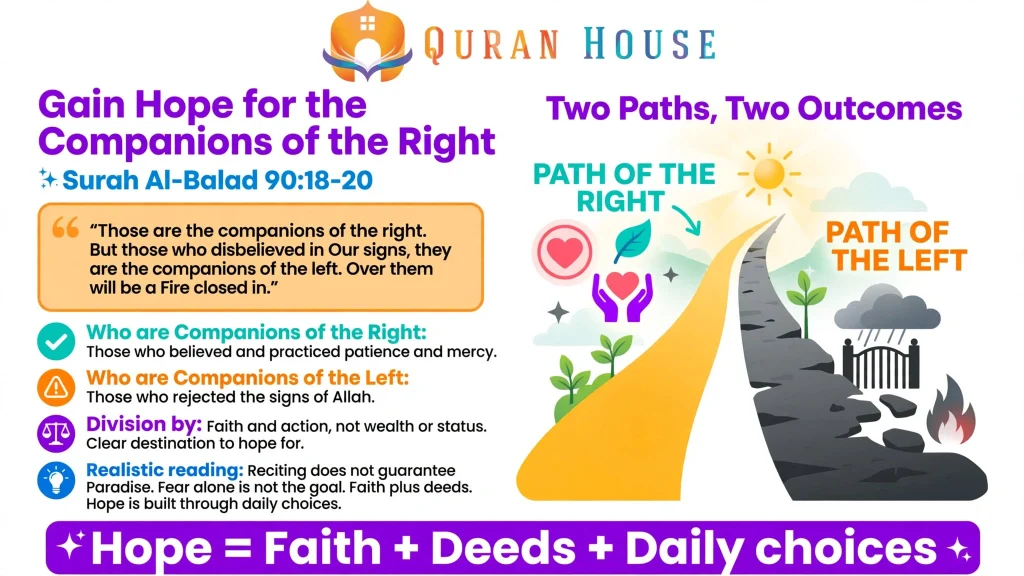
أُولَٰئِكَ أَصْحَابُ الْمَيْمَنَةِ • وَالَّذِينَ كَفَرُوا بِآيَاتِنَا هُمْ أَصْحَابُ الْمَشْأَمَةِ • عَلَيْهِمْ نَارٌ مُّؤْصَدَةٌ
(Ulā’ika aṣḥābul-maymanah • Wa alladhīna kafarū bi-āyātinā hum aṣḥābul-mash’amah • ‘Alayhim nārun mu’ṣadah)
(“Those are the companions of the right. But those who disbelieved in Our signs, they are the companions of the left. Over them will be a Fire closed in.”)
Companions of the right are those who believed and practiced patience and mercy, while the companions of the left rejected the signs of Allah. The surah therefore gives believers a clear destination to hope for.
A realistic reading avoids two extremes. Reciting the surah does not guarantee Paradise, and fear alone is not the goal. The verses ask for faith plus deeds, so hope is built through daily choices.
Reciting Surah Balad With Correct Tajweed Rules
Correct pronunciation protects the meaning of every verse, and Surah Al-Balad offers clear practice material for beginners. Four patterns deserve special attention during recitation, and the table below summarizes them.
| Word or Phrase | Rule | How to Apply It |
| كَبَدٍ and أَحَدٌ when stopping | Qalqalah | Release the silent dal with a clear echo and no extra vowel. |
| أَن لَّن and أَن لَّمْ | Idgham without Ghunnah | Merge the noon into the lam with no nasal sound. |
| مَالًا لُّبَدًا | Idgham without Ghunnah | Merge the tanween into the lam smoothly. |
| نَارٌ مُّؤْصَدَةٌ | Idgham with Ghunnah | Merge the tanween into the meem with a nasal sound for two counts. |
In our experience at Quran House, students who practice these four patterns slowly, one verse per session, finish the surah with fewer articulation errors than students who rush through it.
Learners who ask about the benefits of Surah Balad should also remember that precision is part of the answer. Each rule preserves the sound of Allah’s words, and reflection follows more easily when recitation flows without hesitation.
Quran House offers the Learn Quran Reading with Tajweed for Beginners course, where tutors correct articulation in real time and build each rule step by step.
Start Your Free Tajweed Trial With Expert Tutors
Why Was Surah Balad Revealed in Makkah?
Surah Al-Balad belongs to the early Meccan period, when believers in Makkah faced pressure, mockery, and social isolation. Two angles explain its message best.
Early Meccan Setting of Surah Balad
Surah Al-Balad is a Meccan chapter, revealed before the Hijrah. Revelation order places it thirty-fifth, after Surah Qaf and before Surah At-Tariq, when hardship, generosity, and accountability were pressing themes for the early Muslims.
Because the early believers faced pressure daily, the reminder that hardship is built into life offered comfort and direction. It told them struggle was expected, and that the steep path of good deeds remained open.
Meaning of the Oath by Makkah
The surah opens with an oath by the sacred city, a rhetorical device the Quran uses to draw attention to the weight of what follows. Allah says:
لَا أُقْسِمُ بِهَٰذَا الْبَلَدِ • وَأَنتَ حِلٌّ بِهَٰذَا الْبَلَدِ • وَوَالِدٍ وَمَا وَلَدَ
(Lā uqsimu bihādhā al-balad • Wa anta ḥillun bihādhā al-balad • Wa wālidin wa mā walad)
(“I swear by this city, and you are free of restriction in this city, and by the father and that which was born of him.”)
Commentators offer more than one reading of the second verse. Some link it to the Prophet’s brief permission at the conquest of Makkah, while others say the city’s sanctity did not stop enemies from harming him.
For the third verse, a widely cited view identifies the father and that which was born as Adam and his descendants. Either way, the oath moves from a place to humanity itself, preparing the reader for the verse on hardship.
Surah Balad Compared With Other Short Meccan Surahs
Neighboring surahs in Juz Amma explore related questions from different angles, and the table below briefly shows where Surah Balad stands among them.
| Surah | Central Theme | Practical Emphasis |
| Al-Fajr | Trials of wealth and the fate of earlier nations | Honor orphans and feed the poor. |
| Al-Balad | Hardship and the steep path | Free, feed, and care for the vulnerable. |
| Ash-Shams | Purification of the soul | Cleanse the self from wrongdoing. |
| Al-Layl | Giving and God-consciousness | Give generously and fear Allah. |
Surah Balad benefits readers most when it is studied beside Surah Al-Layl, which also praises generous giving, and Surah Al-Fajr, which condemns neglecting orphans. Together they form a consistent teaching about wealth and mercy.
Al-Asr and At-Takathur address related themes of time and wealth, yet Al-Balad stands out for naming specific deeds. Its vocabulary is concrete: freeing a slave, hunger, orphans, and poverty.
Quran House offers a Juz Amma Memorization Course that guides students through these short surahs with structured revision and one-on-one tutor feedback.

Book Your Free Juz Amma Trial Class
How to Get Surah Balad Benefits Every Day
A few small habits convert reading into lasting change, and the steps below fit a busy schedule. Each one connects directly to a lesson in the surah.
- Recite the surah slowly after Fajr or before sleep, pausing at the verses on the steep path.
- Read one translation and one short tafsir so each verse has a clear meaning.
- Choose one concrete act of giving each week, such as feeding a neighbor or sponsoring an orphan.
- Memorize two verses per session, review the earlier verses, and keep the pace calm.
- Write down one hardship and how patience and compassion answered it.
No specific hour or number of repetitions is prescribed for this surah, and Muslims often include it in voluntary prayers. Consistency with understanding matters more than counting repetitions.
Memorization becomes easier when its purpose is clear, and why memorizing the Quran matters explains the spiritual value of keeping Allah’s words in the heart.
Inside Our Virtual Classrooms
We believe in full transparency and proven quality. Take a look at this actual snippet from our live classes to experience our modern learning platform, patient instructors, and interactive student participation.
Memorization is easier with structure. See how a student reviews and recites Surah Ad-Duha in a live lesson, guided by a tutor who follows every step of their progress.
Start Your Quran Journey With Quran House
Learn live and one-on-one with Al-Azhar-trained tutors, male and female, for children and adults, at a time that fits your timezone.
Try a Free SessionLearn Surah Balad With Quran House Expert Instructors
Quran House pairs each student with an Al-Azhar-trained tutor in live, one-on-one sessions, and sisters can choose a female tutor for a private, supportive learning space. Lessons combine recitation, meaning, and real-time correction.
What sets Quran House apart:
- Live one-on-one classes with patient, Al-Azhar-trained tutors.
- Courses for kids, adults, brothers, and sisters at every level.
- Lessons that connect Tajweed, memorization, and meaning in one path.
Our Quran Courses
- Quran Tafseer Course for All Levels.
- Understand the Quran Course.
- Learn Quran Reading with Tajweed for Beginners.
- Juz Amma Memorization Course.
- Quran Reading Fluency Course.
- Quran Memorization for Adults.
Conclusion
Consistent reflection reveals the benefits of Surah Balad in everyday life: perspective in hardship, gratitude for simple blessings, moral clarity, generosity, patience, and hope for the companions of the right.
Because no hadith assigns a special reward to this chapter, its value rests on understanding and action. A believer who recites it slowly, studies its meaning, and gives steadily has already climbed part of the steep path.
Begin with one verse today, pair it with one concrete act of kindness, and return to it weekly. Over time, the short chapter becomes a practical guide for patience, mercy, and trust in Allah.
FAQs
Is Surah Balad Makki or Madani?
Surah Al-Balad is Makki, meaning it was revealed in Makkah before the Hijrah. It is the 90th chapter of the Quran, contains 20 verses, and appears in Juz Amma beside Surah Al-Fajr and Surah Ash-Shams.
Is There a Hadith About the Reward of Surah Al-Balad?
No authentic hadith assigns a specific reward to this surah. Its value comes from reciting it correctly, understanding its verses, and acting on its teachings, as with any other part of the Quran.
What Is the Steep Path in Surah Al-Balad?
The steep path, al-‘aqabah, is the difficult road of righteous action. The surah defines it as freeing a slave, feeding people on a day of severe hunger, caring for an orphan, and helping a needy person.
Can Surah Al-Balad Be Recited in Salah?
Yes, you may recite Surah Al-Balad in obligatory or voluntary prayers, since the Quran may be recited in Salah and no specific restriction applies. Its short length makes it practical for regular use.
What Does Al-Balad Mean?
Al-Balad means the city, referring to Makkah, which is mentioned in the opening verse. The chapter is also called La Uqsimu, taken from its first words, which begin the oath.