| Key Takeaways |
| The firmly established virtue of Surah Dahr is the Prophet’s Friday Fajr recitation, narrated by Abu Hurairah in Sahih al-Bukhari 891, alongside Surah As-Sajdah. |
| Surah Dahr, also called Surah Al-Insan, is the 76th chapter, contains 31 verses, and appears in Juz 29 of the Quran. |
| Its lessons on gratitude, sincere giving, patience, and accountability apply directly to daily worship, marriage, and family life. |
| Popular claims about wealth, marriage, or counted recitations come from amaliyyat books, not from authentic prophetic narrations, so they should not be taught as established rulings. |
The benefits of Surah Dahr draw many readers each Friday and at family gatherings, yet the clearest answers come from the verses themselves and from one firmly established practice of the Prophet ﷺ. That practice shapes everything that follows in this guide.
Surah Dahr benefits fall into two groups: a verified Sunnah recited in Friday Fajr, and spiritual lessons drawn from the text, such as gratitude, sincere giving, and patience. Surah Dahr is also called Surah Al-Insan, the 76th chapter of the Quran.
Each benefit below rests on the Quran or a verified narration, and the list moves from the best established virtue to the practical lessons for daily life.
1. Revive the Friday Fajr Sunnah With Surah Al-Insan
The strongest virtue connected to Surah Dahr is not a promise attached by later authors but a practice of the Prophet ﷺ himself. Abu Hurairah reported it, and Imam al-Bukhari recorded it in the chapter on what is recited in Friday Fajr.
Sahih al-Bukhari 891 on Friday Fajr Recitation
Imam al-Bukhari placed this narration in the Book of Friday Prayer, under a chapter on what should be recited in Fajr on Friday. It shows the Prophet ﷺ pairing Surah As-Sajdah with Surah Al-Insan, which is why Muslims revive it each week.
كَانَ النَّبِيُّ صلى الله عليه وسلم يَقْرَأُ فِي الْجُمُعَةِ فِي صَلاَةِ الْفَجْرِ الم • تَنْزِيلُ السَّجْدَةَ وَهَلْ أَتَى عَلَى الإِنْسَانِ
(Kana an-Nabiyyu salla Allahu ‘alayhi wa sallam yaqra’u fil-jumu’ati fi salatil-fajri Alif Lam Mim, Tanzilu as-Sajdata wa Hal ata ‘alal-insani)
(“The Prophet ﷺ used to recite in the Fajr prayer on Friday, Alif Lam Mim Tanzil (Surah As-Sajdah) and Hal ata ala al-Insan (Surah Ad-Dahr).”)
Scholars derive from this narration that reciting both surahs in Friday Fajr is a recommended Sunnah. Because the report describes a practice rather than a command, scholars caution against presenting it as a required part of the prayer.
Reciting Surah Al-Insan on Friday morning links a believer to the Prophet’s own routine and begins the day widely described as the best of the week with a reminder of creation, accountability, and reward.
Practical Ways to Apply the Friday Fajr Sunnah
Anyone praying Fajr on Friday can apply this Sunnah, whether in congregation or at home. Recite Surah As-Sajdah in the first rak’ah and Surah Al-Insan in the second, following the order in the narration.
Students who find the longer surah difficult can begin by reading it slowly with a translation during the week. With 31 verses, it is a manageable goal, and repetition makes the Friday recitation smoother.
2. Gain Humility From the Opening Reminder of Human Origin
Surah Dahr opens with a question that corrects arrogance at its root: there was a time when humanity was not even mentioned. This opening reminder gives every reader a humble starting point before any other lesson begins.
The first verse reads:
هَلْ أَتَىٰ عَلَى الْإِنسَانِ حِينٌ مِّنَ الدَّهْرِ لَمْ يَكُن شَيْئًا مَّذْكُورًا
(Hal ata ‘alal-insani heenun minad-dahri lam yakun shay’am-madhkoora)
(“Has there not come upon man a period of time when he was not a thing even mentioned?”)
The word Dahr refers to a long stretch of time, and the verse points to the period before human existence. Reflecting on it sincerely shifts a believer’s attention from status and achievement to dependence on Allah.
The surah then recalls creation from a mixed drop and the gifts of hearing and sight, which makes humility practical. Every ability a person uses in worship was first given to them as a trust.
Quran House offers a Quran Tafseer Course Online for All Levels that helps students move from reading verses like these to understanding their meaning with guided explanation.

Book Your Free Tafseer Session
3. Choose Gratitude Over Ingratitude Through Divine Guidance
Surah Dahr states that Allah showed humanity the way, and each person then responds with gratitude or ingratitude. The choice is real, and the surah places responsibility on the individual rather than on circumstances.
The verse says:
إِنَّا هَدَيْنَاهُ السَّبِيلَ إِمَّا شَاكِرًا وَإِمَّا كَفُورًا
(Inna hadaynahus-sabeela imma shakiran wa imma kafoora)
(“Indeed, We guided him to the way, be he grateful or ungrateful.”)
Gratitude here is more than words. It shows in worship, in honest speech, and in the way a person treats others, which is why the surah follows this verse with the portrait of the righteous.
A believer who keeps this verse in mind during hardship can replace complaint with a practical question: how can I respond to this test in a way that pleases Allah?
4. Learn Sincere Charity From the Example of the Abrar
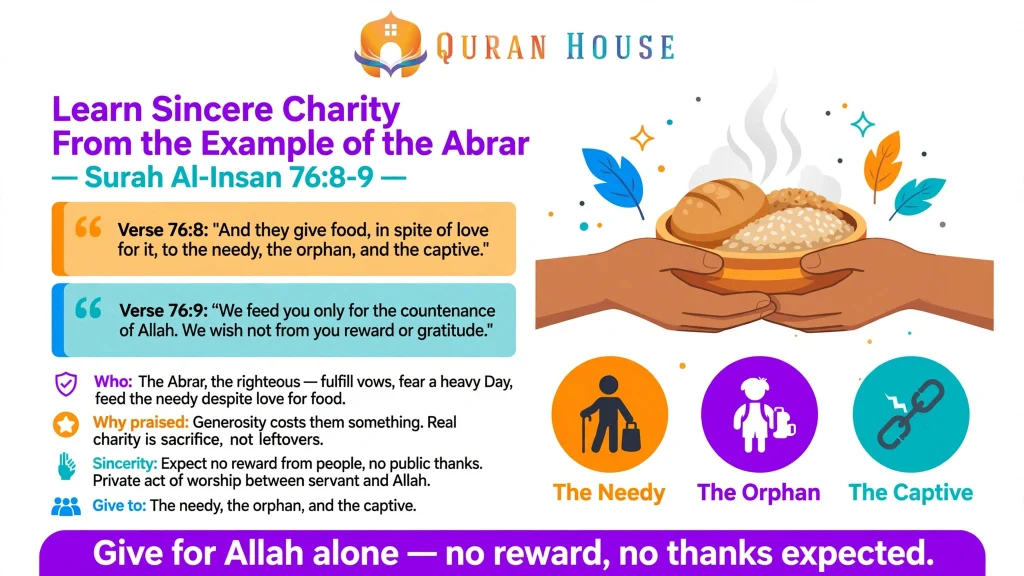
The middle of Surah Dahr describes the Abrar, the righteous, who fulfill vows, fear a heavy Day, and feed the needy despite their own love for food. Their generosity costs them something, which is exactly why it is praised.
The verse describes them like this:
وَيُطْعِمُونَ الطَّعَامَ عَلَىٰ حُبِّهِ مِسْكِينًا وَيَتِيمًا وَأَسِيرًا
(Wa yut’imoonat-ta’ama ‘ala hubbihi miskeenan wa yateeman wa aseera)
(“And they give food, in spite of love for it, to the needy, the orphan, and the captive.”)
Commentators explain that love for it can mean love for the food itself, or love for Allah. Either meaning teaches that real charity involves sacrifice rather than leftovers.
The next verse states the intention behind the giving:
إِنَّمَا نُطْعِمُكُمْ لِوَجْهِ اللَّهِ لَا نُرِيدُ مِنكُمْ جَزَاءً وَلَا شُكُورًا
(Innama nut’imukum li-wajhillahi la nureedu minkum jazaa’an wa la shukoora)
(“We feed you only for the countenance of Allah. We wish not from you reward or gratitude.”)
Sincerity is the lesson here. The giver expects no reward from people and no public thanks, so charity stays a private act of worship between the servant and Allah.
5. Strengthen Patience Through the Benefits of Surah Dahr
Among the benefits of Surah Dahr is a clear link between patience and reward. After describing the generosity of the Abrar, the surah announces what Allah gave them in return for their steadfastness.
The verse states:
وَجَزَاهُم بِمَا صَبَرُوا جَنَّةً وَحَرِيرًا
(Wa jazahum bima sabaru jannatan wa hareera)
(“And He rewarded them for their patience with a garden and silk.”)
Patience here covers more than enduring hardship. It includes staying consistent in giving, in worship, and in obedience when circumstances are difficult and gratitude from people is absent.
Students of the Quran meet the same lesson in their own studies, because memorizing and reciting well require steady daily effort rather than occasional bursts of enthusiasm.
Quran House offers Quran Memorization for Adults, a course that builds this patience through live one-on-one sessions and steady review with a patient tutor.

6. Find Hope in the Quranic Description of Paradise
Surah Dahr gives some of the Quran’s most detailed pictures of Paradise, which turns abstract hope into something a believer can picture. These descriptions move from the drink of the righteous to gardens, couches, and clothing.
The text mentions silk garments, shaded gardens with fruit within easy reach, silver vessels, and a drink flavored with ginger from a spring called Salsabil. The details are sensory on purpose, so the promise feels near.
One verse describes the drink given to them:
وَيُسْقَوْنَ فِيهَا كَأْسًا كَانَ مِزَاجُهَا زَنجَبِيلًا
(Wa yusqawna feeha ka’san kana mizajuha zanjabeela)
(“And they will be given to drink there a cup whose mixture is ginger.”)
Reflecting on these scenes regularly renews motivation during difficult periods. A believer who struggles to wake for Fajr or to give while short of money can recall that the surah ties present effort to lasting reward.
7. Develop Balanced Awareness of the Day of Judgment
Surah Dahr does not describe Paradise alone. It also names the Day the Abrar fear, and this balance keeps hope from turning into complacency and fear from turning into despair.
The surah introduces the righteous with this verse:
يُوفُونَ بِالنَّذْرِ وَيَخَافُونَ يَوْمًا كَانَ شَرُّهُ مُسْتَطِيرًا
(Yoofoona bin-nadhri wa yakhafoona yawman kana sharruhu mustateera)
(“They fulfill their vows and fear a Day whose evil will be widespread.”)
The Abrar fear that Day, yet they keep their vows and feed others. Their fear produces action, which is the healthy form of accountability that the Quran invites every believer to develop.
In practice, this means checking promises made to Allah and to people, repaying what is owed, and remembering that every act of worship is seen. A short evening review of the day can build this awareness gently.
A Real Surah Lesson: Surah Ash-Shams
Watch a student work through Surah Ash-Shams step by step with their tutor, practicing each ayah until the recitation flows clearly and correctly.
Start Your Quran Journey With Quran House
Learn live and one-on-one with Al-Azhar-trained tutors, male and female, for children and adults, at a time that fits your timezone.
Try a Free Session8. Apply the Lessons of Surah Dahr to Marriage and Family
Many people search for the marriage benefits of this chapter because it is often recited at weddings. No narration prescribes it for weddings, but its themes of gratitude, patience, and giving speak directly to married life.
Shared Gratitude Between Spouses
Verse 3 reminds each partner that guidance is a blessing to be answered with thanks. Spouses who name the good in their home daily, and thank Allah and each other for it, build a calmer atmosphere.
Gratitude also protects against comparison, which quietly damages many marriages. Reciting Surah Al-Insan together and discussing its verses gives a couple a shared spiritual reference point.
Shared Patience During Marital Hardship
Hardship tests every household, and the surah links steadfastness with reward. Couples can use the verses on patience as a reminder to respond to conflict with wisdom, to speak calmly, and to seek reconciliation before resentment settles.
Seeking advice from a trusted elder or scholar remains important in difficult periods. Recitation and reflection support that effort by softening the heart, but practical communication and fairness still do the real work of repair.
Shared Generosity Toward Extended Family
The Abrar fed the needy out of love for Allah, and families can practice the same spirit together. Feeding a neighbor, supporting a relative, or sponsoring an orphan as a household turns the surah’s lesson into a family habit.
Children who see their parents give quietly and sincerely learn that generosity is worship. Over time, this habit spreads kindness through the wider family and extends the household’s care beyond its own walls.
9. Separate Authentic From Unverified Surah Dahr Benefits
Popular websites attach many promises to this chapter, so careful readers should separate what is established from what is only repeated. The Quran and verified hadith form the foundation, and everything else needs a clear source.
What the Sunnah Establishes About Surah Dahr
The verified Sunnah establishes the Friday Fajr recitation reported in Sahih al-Bukhari 891. Beyond that, the Quran itself provides lessons on humility, gratitude, sincere giving, patience, and accountability, and these are the benefits of Surah Dahr every student can verify directly.
Both Sahih al-Bukhari and Sahih Muslim record the Friday practice, which places it among the soundest narrations in Islamic scholarship and makes it the safest virtue to teach children and new Muslims.
Why Counted Recitation Formulas Are Not Prophetic Narrations
Some books of amaliyyat prescribe recitations of Surah Dahr a set number of times for wealth, marriage, or protection. These formulas are attributed to later authors and are not narrations from the Prophet ﷺ, so they should not be presented as established rulings.
A believer may still recite the Quran at any time seeking Allah’s blessing, since recitation is always rewarded. The problem begins only when a specific number, time, or outcome is promised without a source.
For more on Friday recitation, see our guide on which surah to read on Friday, which complements the practice discussed above.
Why Surah Dahr Is Also Called Surah Al-Insan
Both names come from the surah itself, and each highlights a different side of its message. Dahr points to time, while Insan points to the human being who lives within that time.
Surah Dahr and the Meaning of Time
The word Dahr means a long stretch of time. The name comes from the opening verse, which asks whether there was a period when humanity was not mentioned, and the surah continues to reflect on creation, life, and the Hereafter.
Surah Al-Insan and the Meaning of Man
Insan means human being or mankind. The surah names the human in its first verse and then follows the human story from creation through the choice between gratitude and ingratitude to the final outcome.
How the Two Names Fit Together
Time frames the story, and the human lives inside it. Together, the names present one lesson: a person’s short period of existence is a test, and its result depends on the choices made within it.
Quran House offers a Learn Quran Reading with Tajweed for Beginners course that helps new students recite surahs accurately with live correction from their tutor.

Book Your Free Tajweed Session
Is Surah Dahr Meccan or Medinan?
Scholars differ on this point, and the surah is classified as Meccan by some commentators and as Medinan by others. Many printed copies of the Quran list it as Medinan, while a number of classical authorities favor a Meccan origin.
The difference does not affect its meaning or the Friday Sunnah, since the practice is established regardless of where the chapter was first revealed. Arguments on each side rest on the surah’s themes and on reports about its revelation, which is why the question remains open.
The Narration Behind the Revelation of Surah Dahr
Some commentators link the verses on feeding the needy to a report about the family of the Prophet ﷺ, who fasted for three days and gave their food to a poor man, an orphan, and a captive on successive evenings.
Many hadith scholars consider the chain of this report weak, so it should be shared as a commentators’ report rather than as an established historical fact. The verses stand on their own authority regardless.
The lesson remains valid either way: true generosity gives even when the giver has little. Parents can teach it to children as a story about sincerity, while being clear about the status of the report.
Quran House offers an Understand the Quran Course that teaches students to read verses with their context, so reports like this are weighed carefully.

Surah Dahr Structure at a Glance
The 31 verses of Surah Dahr follow a clear progression from human origin to guidance, reward, and final reminder. The table below summarizes each movement so readers can recite and reflect with the structure in mind.
| Verses | Main Theme | Key Lesson |
| 1 to 3 | Human origin and free choice | Humility and gratitude begin with remembering creation. |
| 4 to 6 | Two outcomes of life | Accountability gives every choice weight. |
| 7 to 12 | Qualities of the Abrar | Sincere giving and patience bring reward. |
| 13 to 22 | Description of Paradise | Hope grows when the reward is pictured clearly. |
| 23 to 31 | The Quran as a reminder | Patience and a chosen path to the Lord. |
When hardship tests that patience, the reflections in our guide to the benefits of Surah Alam Nashrah offer a helpful companion on ease after difficulty.
Practical Ways to Apply Surah Dahr Every Day
The following steps turn the lessons of the surah into daily habits, and each one stays within what the Quran and the established Sunnah support.
- Recite Surah As-Sajdah and Surah Al-Insan in Friday Fajr, whether at the mosque or at home.
- Read a reliable translation of Surah Al-Insan once a week and note one verse that speaks to your situation.
- Give a small, sincere charity each Friday, even when your own resources feel limited.
- Pair patience with action by finishing a daily portion of the Quran, however short.
- Teach children the surah’s lessons on gratitude and generosity through simple, accurate stories.
- Check any claimed virtue of a surah against Sahih al-Bukhari, Sahih Muslim, or Sunnah.com before sharing it.
Memorizing Surah Ad-Duha in Class
Memorization is easier with structure. See how a student reviews and recites Surah Ad-Duha in a live lesson, guided by a tutor who follows every step of their progress.
Start Your Quran Journey With Quran House
Learn live and one-on-one with Al-Azhar-trained tutors, male and female, for children and adults, at a time that fits your timezone.
Try a Free SessionStart Learning Surah Dahr With Quran House Instructors
Learning Surah Dahr with a qualified tutor makes the recitation, meaning, and daily application easier to retain. At Quran House, our Al-Azhar-trained tutors teach live, one-on-one sessions for kids and adults, and sisters can choose a female tutor.
What sets Quran House apart:
- Live one-on-one sessions built around each student’s pace and goals.
- Al-Azhar-trained tutors who correct recitation gently and in real time.
- Female tutors available for sisters who want a private learning space.
- Two free sessions to meet a tutor before you commit.
Our Quran Courses
- Quran Tafseer Course Online for All Levels
- Quran Memorization for Adults
- Learn Quran Reading with Tajweed for Beginners
- Understand the Quran Course
- Quran Reading Course Online for Kids and Adults
- Juz Amma Memorization Course
Conclusion
Surah Dahr benefits rest on a rare combination of a verified Sunnah and deeply practical lessons. The Prophet’s Friday Fajr recitation, together with the surah’s guidance on humility, gratitude, and sincere giving, gives students a clear and reliable foundation.
The benefits of Surah Dahr are strongest when they are built on sources a student can verify. Patience, accountability, and hope for Paradise then become daily habits rather than slogans, and avoiding unsupported claims protects both knowledge and sincerity.
Whether you recite it on Friday, study its meaning, or teach it to your children, approach the surah with sincerity and a trusted teacher. Small, steady steps will carry its lessons from the page into everyday life.
FAQs
Is Surah Dahr the Same as Surah Al-Insan?
Yes, Surah Dahr and Surah Al-Insan are two names for the 76th chapter of the Quran. Dahr, meaning time, comes from its opening verse, while Insan, meaning man, reflects its central focus on human creation and accountability.
How Many Verses Does Surah Dahr Have?
Surah Dahr has 31 verses and appears in Juz 29. Its moderate length makes it a practical early goal for students who are moving from short surahs toward longer recitation and memorization.
Is It Sunnah to Recite Surah Dahr on Friday?
Yes, it is a Sunnah to recite Surah As-Sajdah and Surah Al-Insan in Friday Fajr, as reported in Sahih al-Bukhari 891. Scholars advise against treating it as a required part of the prayer.
Are Surah Dahr Benefits for Marriage Authentic?
No authentic hadith that we know of connects Surah Dahr specifically to marriage or weddings. Its lessons on gratitude, patience, and generosity still benefit married life, but they should be taught as general lessons, not as a prophetic ritual.
Can I Recite Surah Dahr for Wealth or Protection?
No specific prophetic narration promises wealth or protection for reciting Surah Dahr a set number of times. You may recite the Quran at any time seeking Allah’s blessing, but avoid claiming guaranteed results.