| Key Takeaways |
| Surah Al-Furqan is the 25th chapter of the Quran, a Makki surah of 77 verses named after the Criterion that separates truth from falsehood. |
| Verses 25:63 to 25:76 describe the servants of Ar-Rahman, covering humility, night prayer, balanced spending, repentance, and a family Dua, which makes them the surah’s strongest source of practical guidance. |
| No authentic hadith is known to promise a unique reward for reciting this surah, so its confirmed virtue lies in its message and the Sahih al-Bukhari narration that mentions it. |
| Measured recitation with Tajweed, one verse of reflection per week, and one new habit at a time turn the surah’s lessons into lasting change. |
The Benefits of Surah Furqan reach the mind, the heart, and daily conduct, because this Makki chapter of 77 verses gives a clear standard for truth and a detailed portrait of ideal character.
Surah Al-Furqan is the 25th chapter of the Quran and was revealed in Mecca. Readers who look up Surah Furqan benefits deserve an answer that separates authentic evidence from popular but unverified claims.
Below, every benefit comes with Quranic evidence and practical steps, supported by verified hadith where authentic narrations exist, so readers can apply each lesson with confidence. The benefits are as follows.
1. Gain a Clear Criterion Between Truth and Falsehood
The first benefit of Surah Furqan is clarity: the word Furqan comes from the Arabic root farq, meaning to separate, and the Quran is the Criterion that separates right from wrong.
Allah announces this purpose in the opening verse, which is also the source of the surah’s name and sets the theme for every lesson that follows in the chapter.
تَبَارَكَ الَّذِي نَزَّلَ الْفُرْقَانَ عَلَىٰ عَبْدِهِ لِيَكُونَ لِلْعَالَمِينَ نَذِيرًا
(Tabarakal-ladhi nazzalal-Furqana ‘ala ‘abdihi liyakuna lil-‘alamina nadhira)
(“Blessed is He who sent down the Criterion upon His Servant that he may be to the worlds a warner.”)
A criterion matters because people face competing claims every day. The Quran gives believers a fixed reference, so decisions about money, speech, worship, and family can be tested against revelation instead of mood or trend.
In our experience at Quran House, students who memorize a verse together with its meaning recall both for longer than those who learn sounds alone. The Benefits of Surah Furqan become practical when meaning travels with recitation.
2. Strengthen Tawhid by Rejecting Powerless Gods
Tawhid, the belief that Allah alone is Lord and deserves worship, is strengthened in this surah by contrasting the Creator with idols that can neither create, harm, nor benefit anyone.
Early verses state that Allah owns the heavens and the earth, has no son or partner, and determined everything He created. Worshipped idols, by contrast, control neither life, death, nor resurrection.
For a believer today, the lesson reaches beyond statues. Anything placed above Allah’s guidance, such as status, approval, or appetite, competes with Tawhid, and the surah trains the heart to notice that competition early.
One verse names this hidden idolatry directly, asking the Prophet ﷺ about the person who takes his own desire as a god and warning every reader to guard the heart.
أَرَأَيْتَ مَنِ اتَّخَذَ إِلَٰهَهُ هَوَاهُ أَفَأَنتَ تَكُونُ عَلَيْهِ وَكِيلًا
(Ara’ayta manittakhadha ilahahu hawahu afa’anta takunu ‘alayhi wakila)
(“Have you seen the one who takes his own desire as his god? Would you then be a guardian over him?”)
Spiritual freedom follows from this verse. A person who tests every impulse against revelation stops being ruled by whim, and worship becomes a choice made with open eyes rather than a habit repeated without thought.
3. Reflect on Allah’s Signs in Night and Day
Reflection on creation is a clear benefit of the surah, because it repeatedly points to shade, night, day, the sun, and the moon as signs that invite remembrance and gratitude.
Verse 25:62 states the purpose of this daily rhythm plainly, linking the succession of night and day to remembrance and thankfulness for anyone willing to pause and think.
وَهُوَ الَّذِي جَعَلَ اللَّيْلَ وَالنَّهَارَ خِلْفَةً لِّمَنْ أَرَادَ أَن يَذَّكَّرَ أَوْ أَرَادَ شُكُورًا
(Wa huwal-ladhi ja’alal-layla wan-nahara khilfatan liman arada an yadhdhakkara aw arada shukura)
(“And it is He who made the night and the day in succession for whoever desires to remember or desires gratitude.”)
A practical habit supports this reflection. Step outside at sunset or before Fajr, observe the sky for two minutes, and recite one verse about creation, so scenery becomes worship instead of background.
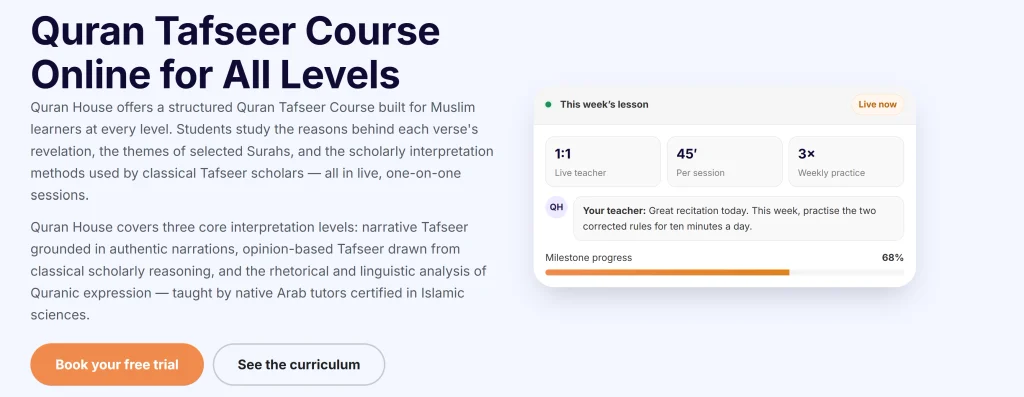
Quran House offers the Quran Tafseer Course for All Levels that explains verses about creation and revelation with Al-Azhar-trained tutors, so every reflection rests on sound knowledge.
Start Your Tafseer Journey with Expert Tutors
4. Answer False Accusations With Calm Evidence
Confidence under criticism is a benefit rooted in the surah’s historical setting, because Meccan opponents attacked the Prophet ﷺ and the Quran with mockery, accusations, and impossible demands, and the revelation answered each one directly.
One accusation questioned his humanity: why does this messenger eat food and walk in the markets? Verse 25:7 records the complaint, and verse 25:20 replies that earlier messengers also ate food and walked in the markets.
وَقَالُوا مَالِ هَٰذَا الرَّسُولِ يَأْكُلُ الطَّعَامَ وَيَمْشِي فِي الْأَسْوَاقِ لَوْلَا أُنزِلَ إِلَيْهِ مَلَكٌ فَيَكُونَ مَعَهُ نَذِيرًا
(Wa qalu mali hadhar-rasuli ya’kulut-ta’ama wa yamshi fil-aswaq lawla unzila ilayhi malakun fayakuna ma’ahu nadhira)
(“And they say, ‘What is this messenger who eats food and walks in the markets? Why was there not sent down to him an angel to be with him a warner?’”)
The pattern of the reply is worth copying. The surah does not trade insults; it states facts, points to creation, and reminds readers that guidance comes from Allah, not from wealth or spectacle.
Modern readers face a similar test online. Before answering a hostile comment, ask whether a calm explanation or silence serves the truth better, and let evidence, not ego, set the tone.
5. Revive Measured Recitation Through Tarteel
Tarteel, the slow and clear recitation that gives every letter its right, is echoed in verse 25:32, which says the Quran was revealed in stages and arranged in a measured way.
Disbelievers asked why the Quran was not sent down all at once. Allah answered that gradual revelation steadies the Prophet’s heart, and the same verse describes the recitation as measured.
وَقَالَ الَّذِينَ كَفَرُوا لَوْلَا نُزِّلَ عَلَيْهِ الْقُرْآنُ جُمْلَةً وَاحِدَةً ۚ كَذَٰلِكَ لِنُثَبِّتَ بِهِ فُؤَادَكَ ۖ وَرَتَّلْنَاهُ تَرْتِيلًا
(Wa qalal-ladhina kafaru lawla nuzzila ‘alayhil-Qur’anu jumlatan wahidah kadhalika linuthabbita bihi fu’adak wa rattalnahu tartila)
(“And those who disbelieve say, ‘Why was the Quran not revealed to him all at once?’ Thus [it is] that We may strengthen thereby your heart. And We have spaced it distinctly.”)
Tajweed is the discipline that makes tarteel accurate, covering where each letter is pronounced and how long each sound is held. Beginners can start with our guide on what Tajweed is before practicing aloud.
Short sessions work best. Ten focused minutes on one verse, repeated slowly and recorded for self-review, usually beat an hour of rushed reading. Consistency matters more than length.
Quran House offers the Learn Quran Reading with Tajweed for Beginners course, which trains students to apply tarteel through live sessions where instructors correct pronunciation in real time.
Book a Tajweed Trial with Qualified Tutors
6. Walk With Humility and Answer Ignorance With Peace
Humility is the first quality Allah mentions in the servants of Ar-Rahman, the Most Merciful, who walk on the earth gently and respond to hostile words with peace.
Verse 25:63 opens the portrait of Ibad-ur-Rahman and gives believers a simple test of character: how they walk through life and how they answer insults in public or in private.
وَعِبَادُ الرَّحْمَٰنِ الَّذِينَ يَمْشُونَ عَلَى الْأَرْضِ هَوْنًا وَإِذَا خَاطَبَهُمُ الْجَاهِلُونَ قَالُوا سَلَامًا
(Wa ‘ibadur-Rahmanil-ladhina yamshuna ‘alal-ardi hawnan wa idha khatabahumul-jahiluna qalu salama)
(“And the servants of the Most Merciful are those who walk upon the earth easily, and when the ignorant address them [harshly], they say [words of] peace.”)
Gentle walking describes dignity without arrogance; it does not mean weakness or slowness for show. A humble person can be firm, decisive, and strong while remaining free from the desire to impress.
Answering with peace does not mean agreeing with falsehood. It means refusing to be dragged into pointless arguments, protecting the heart from resentment, and keeping speech clean when others choose otherwise.
Try one small practice this week: before replying to any irritating message, pause for ten seconds, say salam silently, and then decide whether a reply is needed at all.
A Real Surah Lesson: Surah Ash-Shams
Watch a student work through Surah Ash-Shams step by step with their tutor, practicing each ayah until the recitation flows clearly and correctly.
Start Your Quran Journey With Quran House
Learn live and one-on-one with Al-Azhar-trained tutors, male and female, for children and adults, at a time that fits your timezone.
Try a Free Session7. Build a Night Prayer Habit Like Ar-Rahman’s Servants
Night worship, mentioned in verse 25:64, is a benefit of private devotion: the servants of Ar-Rahman spend part of the night prostrating and standing before their Lord, away from public view.
The verse is short, yet it describes a life whose public gentleness is built on private worship, and it follows directly after the description of their humble walk.
وَالَّذِينَ يَبِيتُونَ لِرَبِّهِمْ سُجَّدًا وَقِيَامًا
(Wal-ladhina yabituna lirabbihim sujjadan wa qiyama)
(“And those who spend [part of] the night to their Lord prostrating and standing [in prayer].”)
Tahajjud, the voluntary night prayer, is the natural way to practice this verse. Even two short rak’ahs before Fajr count as a beginning, and consistency matters more than length.
Memorizing a few of these verses makes night prayer easier, because the words are ready on the tongue when sleepiness is strongest. Verses 25:63 to 25:76 form a short, memorable passage for exactly this purpose.
Quran House offers the Online Hifz School for Kids and Adults, where patient tutors guide students step by step to memorize passages such as this one and review them with confidence.

Start Memorizing with a Live Tutor
8. Practice Balanced Spending Without Waste or Greed
Financial balance is a benefit drawn from verse 25:67, which describes believers who spend without extravagance and without stinginess, keeping a just middle between the two extremes.
The Quran treats money as a trust, so even spending becomes an act of character. The verse gives a clear rule that applies to a modest salary and a large income alike.
وَالَّذِينَ إِذَا أَنفَقُوا لَمْ يُسْرِفُوا وَلَمْ يَقْتُرُوا وَكَانَ بَيْنَ ذَٰلِكَ قَوَامًا
(Wal-ladhina idha anfaqu lam yusrifu wa lam yaqturu wa kana bayna dhalika qawama)
(“And [they are] those who, when they spend, do so not excessively or sparingly but are ever, between that, [justly] moderate.”)
Israf means going beyond need or right, and iqtar means holding back what should be given. Both distort the heart, one by feeding appetite and the other by fear of poverty.
A simple monthly review keeps this verse practical, and four short steps are enough to begin without turning budgeting into a burden for any household:
- List fixed needs such as rent, food, and school costs.
- Mark purchases that served appetite rather than need.
- Identify one area where generosity or savings is too low.
- Adjust one habit and review again next month.
Balanced spending also brings peace. A person who is neither anxious about every coin nor careless with wealth finds it easier to give charity, keep promises, and sleep without financial dread.
9. Return to Allah Through Sincere Repentance
Repentance is the benefit that keeps every servant hopeful, because the surah pairs warnings about grave sins with an open door for anyone who turns back sincerely.
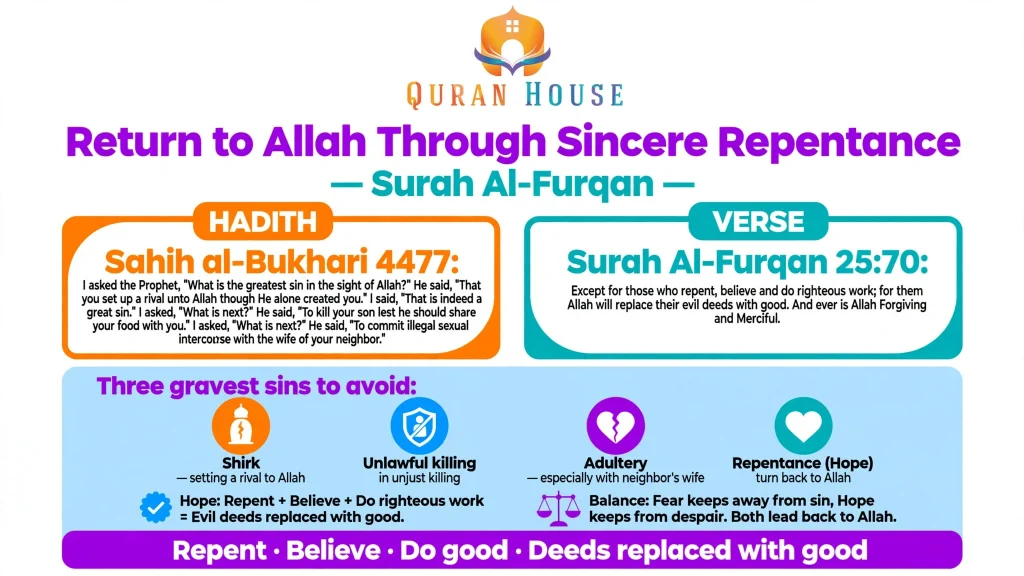
Sahih al-Bukhari 4477 on the Three Gravest Sins
Verse 25:68 names shirk, meaning associating partners with Allah, unlawful killing, and adultery among sins the servants of Ar-Rahman avoid. Ibn Mas’ud’s question to the Prophet ﷺ about the greatest sins received an answer that echoes those categories.
سَأَلْتُ النَّبِيَّ صلى الله عليه وسلم أَىُّ الذَّنْبِ أَعْظَمُ عِنْدَ اللَّهِ قَالَ أَنْ تَجْعَلَ لِلَّهِ نِدًّا وَهْوَ خَلَقَكَ، قُلْتُ إِنَّ ذَلِكَ لَعَظِيمٌ، قُلْتُ ثُمَّ أَىُّ قَالَ وَأَنْ تَقْتُلَ وَلَدَكَ تَخَافُ أَنْ يَطْعَمَ مَعَكَ، قُلْتُ ثُمَّ أَىُّ قَالَ أَنْ تُزَانِيَ حَلِيلَةَ جَارِكَ
(Sa’altun-Nabiyya sallallahu ‘alayhi wa sallam ayyudh-dhanbi a’zamu ‘indallahi qala an taj’ala lillahi nidda wa huwa khalaqak, qultu inna dhalika la’azim, qultu thumma ayy qala wa an taqtula waladaka takhafu an yat’ama ma’ak, qultu thumma ayy qala an tuzaniya halilata jarik)
(“I asked the Prophet, ‘What is the greatest sin in the sight of Allah?’ He said, ‘That you set up a rival unto Allah though He alone created you.’ I said, ‘That is indeed a great sin.’ I asked, ‘What is next?’ He said, ‘To kill your son lest he should share your food with you.’ I asked, ‘What is next?’ He said, ‘To commit illegal sexual intercourse with the wife of your neighbor.’”)
The hadith shows how seriously Tawhid and the sanctity of life, family, and neighbors are treated. It also helps explain why a surah about the Criterion lists such sins among the traits believers avoid.
Surah Al-Furqan 25:70 on Repentance and Replaced Deeds
Forgiveness remains open, since the same passage that warns about grave sins promises something remarkable in verse 25:70 to those who repent, believe, and do righteous work.
إِلَّا مَن تَابَ وَآمَنَ وَعَمِلَ عَمَلًا صَالِحًا فَأُولَٰئِكَ يُبَدِّلُ اللَّهُ سَيِّئَاتِهِمْ حَسَنَاتٍ ۗ وَكَانَ اللَّهُ غَفُورًا رَّحِيمًا
(Illa man taba wa amana wa ‘amila ‘amalan salihan fa ula’ika yubaddilullahu sayyi’atihim hasanat wa kanallahu ghafuran rahima)
(“Except for those who repent, believe and do righteous work; for them Allah will replace their evil deeds with good. And ever is Allah Forgiving and Merciful.”)
Hope and caution work together here. Fear keeps a believer away from sin, while hope keeps the believer from despair after a slip, and both lead the servant back to Allah.
10. Ask Allah for a Righteous Family and Leadership
A righteous family and a life of leadership in piety are the benefit of verse 25:74, the Dua that completes the portrait of the servants of Ar-Rahman.
This Dua asks for spouses and children who bring joy to the eyes, and then raises the ambition higher by asking to lead the God-fearing by example.
وَالَّذِينَ يَقُولُونَ رَبَّنَا هَبْ لَنَا مِنْ أَزْوَاجِنَا وَذُرِّيَّاتِنَا قُرَّةَ أَعْيُنٍ وَاجْعَلْنَا لِلْمُتَّقِينَ إِمَامًا
(Wal-ladhina yaquluna Rabbana hab lana min azwajina wa dhurriyyatina qurrata a’yunin waj’alna lilmuttaqina imama)
(“And those who say, ‘Our Lord, grant us from among our spouses and offspring comfort to our eyes and make us an example for the righteous.’”)
Qurrata a’yun, literally coolness of the eyes, describes the deep contentment found in a family walking together toward Allah. Parents who make this Dua are asking for faith in the home, not only comfort.
Leadership here means example, not power. Children copy what they see, so the most effective way to answer this Dua is to recite, pray, and speak kindly in front of them every day.
Quran House offers the Quran Reading for Kids course, where children learn to read the Quran with patient tutors in a live one-on-one setting that keeps them engaged.

Try 2 Free Sessions for Your Child
Authentic Hadith on Surah Furqan and Recitation Virtues
Readers researching Surah Furqan benefits often ask whether a specific reward is promised for reciting it, so the evidence deserves a careful look before any claim is repeated.
Sahih al-Bukhari 4992 on Surah Furqan and Seven Ahruf
Umar ibn al-Khattab heard Hisham ibn Hakim reciting Surah Al-Furqan differently from the way he had learned it, and the Prophet ﷺ settled the matter. This narration is the best-known authentic hadith that mentions the surah by name.
سَمِعْتُ هِشَامَ بْنَ حَكِيمٍ، يَقْرَأُ سُورَةَ الْفُرْقَانِ فِي حَيَاةِ رَسُولِ اللَّهِ صلى الله عليه وسلم فَاسْتَمَعْتُ لِقِرَاءَتِهِ فَإِذَا هُوَ يَقْرَأُ عَلَى حُرُوفٍ كَثِيرَةٍ لَمْ يُقْرِئْنِيهَا رَسُولُ اللَّهِ صلى الله عليه وسلم فَكِدْتُ أُسَاوِرُهُ فِي الصَّلاَةِ فَتَصَبَّرْتُ حَتَّى سَلَّمَ فَلَبَّبْتُهُ بِرِدَائِهِ فَقُلْتُ مَنْ أَقْرَأَكَ هَذِهِ السُّورَةَ الَّتِي سَمِعْتُكَ تَقْرَأُ، قَالَ أَقْرَأَنِيهَا رَسُولُ اللَّهِ صلى الله عليه وسلم، فَقُلْتُ كَذَبْتَ فَإِنَّ رَسُولَ اللَّهِ صلى الله عليه وسلم قَدْ أَقْرَأَنِيهَا عَلَى غَيْرِ مَا قَرَأْتَ، فَانْطَلَقْتُ بِهِ أَقُودُهُ إِلَى رَسُولِ اللَّهِ صلى الله عليه وسلم فَقُلْتُ إِنِّي سَمِعْتُ هَذَا يَقْرَأُ بِسُورَةِ الْفُرْقَانِ عَلَى حُرُوفٍ لَمْ تُقْرِئْنِيهَا، فَقَالَ رَسُولُ اللَّهِ صلى الله عليه وسلم أَرْسِلْهُ اقْرَأْ يَا هِشَامُ، فَقَرَأَ عَلَيْهِ الْقِرَاءَةَ الَّتِي سَمِعْتُهُ يَقْرَأُ، فَقَالَ رَسُولُ اللَّهِ صلى الله عليه وسلم كَذَلِكَ أُنْزِلَتْ، ثُمَّ قَالَ اقْرَأْ يَا عُمَرُ، فَقَرَأْتُ الْقِرَاءَةَ الَّتِي أَقْرَأَنِي، فَقَالَ رَسُولُ اللَّهِ صلى الله عليه وسلم كَذَلِكَ أُنْزِلَتْ، إِنَّ هَذَا الْقُرْآنَ أُنْزِلَ عَلَى سَبْعَةِ أَحْرُفٍ فَاقْرَءُوا مَا تَيَسَّرَ مِنْهُ
(Sami’tu Hisham ibn Hakim yaqra’u surat al-Furqan fi hayati Rasulillahi sallallahu ‘alayhi wa sallam fastama’tu liqira’atihi fa idha huwa yaqra’u ‘ala hurufin kathiratin lam yuqri’nihaa Rasulullahi sallallahu ‘alayhi wa sallam fakidtu usawiruhu fis-salati fatasabbartu hatta sallam falabbabtuhu biridaa’ihi faqultu man aqra’aka hadhihis-surata allati sami’tuka taqra’, qala aqra’anihaa Rasulullahi sallallahu ‘alayhi wa sallam, faqultu kadhabta fa inna Rasulallahi sallallahu ‘alayhi wa sallam qad aqra’anihaa ‘ala ghayri ma qara’ta, fantalaqtu bihi aquduhu ila Rasulillahi sallallahu ‘alayhi wa sallam faqultu inni sami’tu hadha yaqra’u bi-suratil-Furqani ‘ala hurufin lam tuqri’nihaa, faqala Rasulullahi sallallahu ‘alayhi wa sallam arsilhu iqra’ ya Hisham, faqara’a ‘alayhil-qira’atal-lati sami’tuhu yaqra’, faqala Rasulullahi sallallahu ‘alayhi wa sallam kadhalika unzilat, thumma qala iqra’ ya ‘Umar, faqara’tul-qira’atal-lati aqra’ani, faqala Rasulullahi sallallahu ‘alayhi wa sallam kadhalika unzilat, inna hadhal-Qur’ana unzila ‘ala sab’ati ahruf faqra’u ma tayassara minhu)
(“I heard Hisham bin Hakim reciting Surat Al-Furqan during the lifetime of Allah’s Messenger (ﷺ) and I listened to his recitation and noticed that he recited in several different ways which Allah’s Messenger (ﷺ) had not taught me. I was about to jump over him during his prayer, but I controlled my temper, and when he had completed his prayer, I put his upper garment around his neck and seized him by it and said, ‘Who taught you this Sura which I heard you reciting?’ He replied, ‘Allah’s Messenger (ﷺ) taught it to me.’ I said, ‘You have told a lie, for Allah’s Messenger (ﷺ) has taught it to me in a different way from yours.’ So I dragged him to Allah’s Messenger (ﷺ) and said, ‘I heard this person reciting Surat Al-Furqan in a way which you haven’t taught me!’ On that Allah’s Messenger (ﷺ) said, ‘Release him, O Umar! Recite, O Hisham!’ Hisham then recited in the same way as I heard him reciting. Then Allah’s Messenger (ﷺ) said, ‘It was revealed in this way,’ and added, ‘Recite, O Umar!’ I recited it as he had taught me. Then he said, ‘It was revealed in this way. This Quran has been revealed to be recited in seven different ways, so recite of it whichever (way) is easier for you.’”)
Scholars have long distinguished the seven ahruf, the modes in which the Quran was revealed for ease, from the seven famous qira’at later compiled by Ibn Mujahid.
The lesson for students is respect for authentic recitation. Learn from qualified teachers, follow the Hafs reading that most Muslims recite, and avoid arguing over variations without knowledge.
Weak Narrations About Surah Furqan Rewards
Assabile’s compilation of Quran virtues notes that no hadith reports a virtue specific to Surah Al-Furqan. Circulating promises of Paradise without reckoning for reciting it are not supported by authentic evidence, so this guide does not repeat them.
The Benefits of Surah Furqan are real even without a special promised reward, because it is a Makki surah of 77 verses, carries the name of the Criterion, and holds the Quran’s fullest portrait of true servants.
Daily Ways to Apply Surah Furqan Benefits
Putting Surah Furqan benefits into practice works best one quality at a time, because the portrait of the servants is a lifelong curriculum, not a checklist to finish in a week.
The table below turns each quality into one small, realistic habit, so learners can choose a starting point and track progress honestly over the coming weeks.
| Quality | Verse | Daily Habit |
| Humility and peace | 25:63 | Pause and say salam before replying to irritation. |
| Night worship | 25:64 | Pray two rak’ahs before Fajr on three nights each week. |
| Fear of the Fire | 25:65 | Recite the Dua of this verse after each Salah. |
| Balanced spending | 25:67 | Review one month of expenses and adjust one habit. |
| Honest speech | 25:72 | Avoid gatherings and content built on falsehood. |
| Responsive hearts | 25:73 | Reflect on one verse after Fajr and act on it that day. |
| Family Dua | 25:74 | Make the Dua in sujood for your spouse and children. |
Memorization strengthens every habit above, since verses recited from memory return at the moment of need. Our article on why memorizing the Quran matters explains how Hifz shapes the heart and daily life.
Progress, not perfection, is the goal. Choose one habit, practice it for two weeks, and add another only when the first feels natural and sincere, so the lessons last beyond a single season of motivation.
Memorizing Surah Ad-Duha in Class
Memorization is easier with structure. See how a student reviews and recites Surah Ad-Duha in a live lesson, guided by a tutor who follows every step of their progress.
Start Your Quran Journey With Quran House
Learn live and one-on-one with Al-Azhar-trained tutors, male and female, for children and adults, at a time that fits your timezone.
Try a Free SessionLearn the Quran with Quran House Al-Azhar-Trained Tutors
Quran House has taught Quran, Tajweed, and Arabic online since 2018, with Al-Azhar-trained tutors who teach kids and adults in live one-on-one sessions and guide every learner step by step.
What sets Quran House apart:
- Al-Azhar-trained tutors who correct recitation in real time.
- Live one-on-one sessions for kids, adults, and sisters, including female tutors on request.
- Courses covering Quran reading, Tajweed, Hifz, Quranic Arabic, and Tafseer.
Try 2 Free Sessions with Quran House
Our Quran Courses
- Quran Tafseer Course for All Levels
- Learn Quran Reading with Tajweed for Beginners
- Online Hifz School for Kids and Adults
- Quran Reading for Kids
- Understand the Quran Course
- Quran Reading Course Online for Kids and Adults
Conclusion
The Benefits of Surah Furqan come together in one idea: Allah gave believers a Criterion, and the surah shows what a life guided by it looks like.
From the clear standard in verse 25:1 to the humble walk, night prayer, balanced spending, repentance, and family Dua in the closing verses, every lesson points toward a servant who is gentle with people and firm with truth.
Anyone searching for Surah Furqan benefits will find the strongest ones in practice: recite with tarteel, reflect on one verse each week, and change one habit at a time. Allah is the source of all success.
FAQs
What Are the Main Surah Furqan Benefits?
The main benefits are clarity between truth and falsehood, stronger Tawhid, reflection on creation, and a detailed character model in verses 25:63 to 25:76 covering humility, night prayer, moderation, repentance, and family Dua.
Is Surah Al-Furqan Makki or Madani?
Surah Al-Furqan is Makki, meaning it was revealed in Mecca before the migration. Ibn Abbas and Qatadah excepted three verses, from 25:68 to 25:70, which they said were revealed in Medina.
Which Juz Contains Surah Al-Furqan?
Surah Al-Furqan begins in Juz 18 and continues into Juz 19, where it ends. It is the 25th surah of the Quran and contains 77 verses, which makes it a medium-length chapter.
Is There an Authentic Hadith About Reciting Surah Al-Furqan?
No authentic hadith is known to promise a unique reward for reciting it. Sahih al-Bukhari 4992 mentions the surah in the story of Umar and Hisham, which concerns the modes of recitation rather than a special reward.
How Can I Memorize Surah Al-Furqan?
Memorize one verse at a time: read the verse slowly with a teacher or reciter, repeat it, recite it from memory, then link it to the previous verses and review daily.