| Key Takeaways |
| The only virtue tied to Surah Al-Hadid by a hadith is the Prophet’s ﷺ habit of reciting the Musabbihat before sleep, recorded in Jami at-Tirmidhi 2921. |
| Verse 3 gathers four names of Allah, and Ibn Abbas taught reciting it whenever doubt enters the heart, as reported in Sunan Abi Dawud 5110. |
| Verse 16 reached the Companions only four years after they embraced Islam, which shows that hardness of heart can affect even sincere believers. |
| Claims that Surah Al-Hadid brings a husband, wealth, or hidden secrets have no authentic source, so its real value lies in recitation and reflection. |
Many Muslims search for surah hadid benefits hoping to find a short list of rewards. What they often find instead are viral claims with no source. This guide separates what is authentic from what is not, verse by verse.
Surah Al-Hadid is the 57th chapter of the Quran, with 29 verses revealed in Madinah. It belongs to the Musabbihat, the surahs that open with the glorification of Allah, and it speaks to faith, wealth, hearts, and the Hereafter.
Every benefit below rests on a verified verse, an authentic narration, or the explanation of classical scholars. These are the benefits of Surah Hadid that a reciter can count on, along with practical ways to live by each one.
1. Follow the Prophet’s Nightly Musabbihat Sunnah Before Sleep
The clearest benefit of Surah Al-Hadid is that reciting it revives a habit of the Prophet ﷺ. He recited a group of surahs called the Musabbihat every night before sleeping, and Al-Hadid is one of them.
Two points explain this benefit in detail: the narration that records the practice, and the list of surahs that scholars include in the Musabbihat.
Jami at-Tirmidhi 2921 on Reciting the Musabbihat
Al-Irbad ibn Sariyah described a nightly routine of the Prophet ﷺ that included Surah Al-Hadid. His report also mentions a single verse within these surahs that is better than a thousand verses.
أَنَّ النَّبِيَّ صلى الله عليه وسلم كَانَ يَقْرَأُ الْمُسَبِّحَاتِ قَبْلَ أَنْ يَرْقُدَ وَيَقُولُ إِنَّ فِيهِنَّ آيَةً خَيْرٌ مِنْ أَلْفِ آيَةٍ
(Anna an-Nabiyya sallallahu alayhi wa sallam kana yaqra’ul-musabbihati qabla an yarquda wa yaqulu inna fihinna ayatan khayrun min alfi ayah)
(“That the Prophet (ﷺ) would recite the Musabbihat (Chapters 17, 57, 59, 61, 62, 64 & 87) before sleep and say ‘Indeed there is an Ayah in them that is better than one thousand Ayat.'”)
Imam at-Tirmidhi graded this narration hasan gharib, and Darussalam graded it hasan. Some later scholars weakened its chain, so we present it as the strongest report available rather than as a rigorously authentic hadith.
Which Seven Surahs Make Up the Musabbihat?
Scholars define the Musabbihat as the surahs that begin with a form of the word tasbih, meaning glorification of Allah. The seven chapters are listed below with their opening word.
| Surah | Number | Opening Word | Place of Revelation |
| Al-Isra | 17 | Subhana | Makkah |
| Al-Hadid | 57 | Sabbaha | Madinah |
| Al-Hashr | 59 | Sabbaha | Madinah |
| As-Saff | 61 | Sabbaha | Madinah |
| Al-Jumu’ah | 62 | Yusabbihu | Madinah |
| At-Taghabun | 64 | Yusabbihu | Madinah |
| Al-A’la | 87 | Sabbih | Makkah |
Reciting all seven every night may feel heavy for beginners. In our experience at Quran House, students who start with Al-Hadid alone, then add one Musabbihah each week, keep the habit far longer.
2. Renew Belief in Allah’s Sovereignty Over Heavens and Earth
Surah Al-Hadid opens by declaring that everything in the heavens and the earth glorifies Allah. This opening renews Tawhid, the belief in the oneness of Allah, every time the surah is recited.
سَبَّحَ لِلَّهِ مَا فِي السَّمَاوَاتِ وَالْأَرْضِ وَهُوَ الْعَزِيزُ الْحَكِيمُ
(Sabbaha lillahi ma fis-samawati wal-ard, wa huwal-azizul-hakim)
(“Whatever is in the heavens and earth exalts Allah, and He is the Exalted in Might, the Wise.”)
The verb sabbaha is in the past tense, while Al-Jumu’ah and At-Taghabun use the present yusabbihu. Scholars explain that together they show creation glorifying Allah in the past, present, and future without pause.
Verses 2 to 6 continue with dominion over life and death, the creation of the heavens in six days, and knowledge of every hidden thought. A reciter who reflects on these lines learns to see daily events through Allah’s control.
Quran House offers an Understand the Quran Course that helps learners grasp opening verses like these word by word, so every recitation of Al-Hadid carries meaning instead of sound alone.
Start Reflecting on Every Verse You Recite
3. Reflect on Verse 3 and the Four Names That Answer Doubt
Verse 3 of Surah Al-Hadid gathers four names of Allah in one line: the First, the Last, the Ascendant, and the Intimate. Ibn Kathir mentions that some scholars considered it the verse better than a thousand verses.
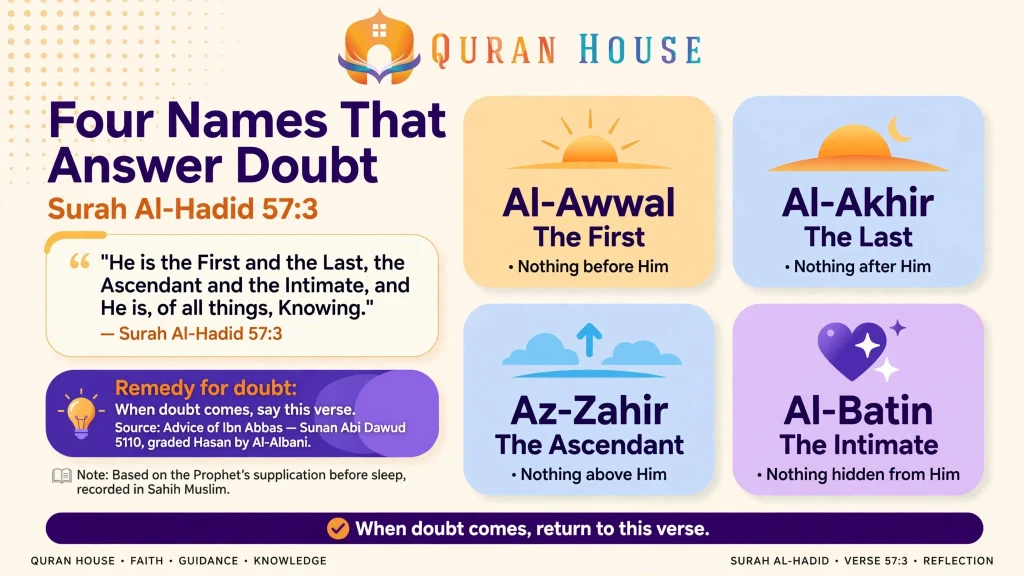
Two sources explain the weight of this verse: the verse itself and the advice Ibn Abbas gave about using it.
Surah Al-Hadid 57:3 on Four Names of Allah
This verse describes Allah’s relationship with time and with all of creation. Nothing came before Him, nothing remains after Him, nothing is above Him, and nothing is hidden from Him.
هُوَ الْأَوَّلُ وَالْآخِرُ وَالظَّاهِرُ وَالْبَاطِنُ وَهُوَ بِكُلِّ شَيْءٍ عَلِيمٌ
(Huwal-awwalu wal-akhiru waz-zahiru wal-batin, wa huwa bikulli shay’in alim)
(“He is the First and the Last, the Ascendant and the Intimate, and He is, of all things, Knowing.”)
The table below summarizes what each name means, based on the explanation the Prophet ﷺ gave of these names in his supplication before sleep, recorded in Sahih Muslim.
| Name | Arabic | Meaning |
| Al-Awwal | الأول | The First, with nothing before Him |
| Al-Akhir | الآخر | The Last, with nothing after Him |
| Az-Zahir | الظاهر | The Ascendant, with nothing above Him |
| Al-Batin | الباطن | The Intimate, with nothing hidden from Him |
Sunan Abi Dawud 5110 on Answering Doubts With Verse 3
A student of Ibn Abbas once felt a doubt he was ashamed to speak about. Ibn Abbas did not scold him; he gave him a short Quranic remedy from Surah Al-Hadid to recite.
سَأَلْتُ ابْنَ عَبَّاسٍ فَقُلْتُ مَا شَىْءٌ أَجِدُهُ فِي صَدْرِي قَالَ مَا هُوَ قُلْتُ وَاللَّهِ مَا أَتَكَلَّمُ بِهِ، قَالَ فَقَالَ لِي أَشَىْءٌ مِنْ شَكٍّ قَالَ وَضَحِكَ، قَالَ مَا نَجَا مِنْ ذَلِكَ أَحَدٌ قَالَ حَتَّى أَنْزَلَ اللَّهُ عَزَّ وَجَلَّ فَإِنْ كُنْتَ فِي شَكٍّ مِمَّا أَنْزَلْنَا إِلَيْكَ فَاسْأَلِ الَّذِينَ يَقْرَءُونَ الْكِتَابَ مِنْ قَبْلِكَ الآيَةَ قَالَ فَقَالَ لِي إِذَا وَجَدْتَ فِي نَفْسِكَ شَيْئًا فَقُلْ هُوَ الأَوَّلُ وَالآخِرُ وَالظَّاهِرُ وَالْبَاطِنُ وَهُوَ بِكُلِّ شَىْءٍ عَلِيمٌ
(Sa’altu Ibna Abbasin fa-qultu ma shay’un ajiduhu fi sadri, qala ma huwa, qultu wallahi ma atakallamu bihi, qala fa-qala li a-shay’un min shakk, qala wa dahik, qala ma naja min dhalika ahad, qala hatta anzalallahu azza wa jall: fa-in kunta fi shakkin mimma anzalna ilayka fas’alil-ladhina yaqra’unal-kitaba min qablik, al-ayah, qala fa-qala li idha wajadta fi nafsika shay’an fa-qul huwal-awwalu wal-akhiru waz-zahiru wal-batinu wa huwa bikulli shay’in alim)
(“AbuZumayl said: I asked Ibn Abbas, saying: What is that I find in my breast? He asked: What is it? I replied: I swear by Allah, I cannot speak about it. He asked me: Is it something doubtful? and he laughed. He then said: No one could escape that, until Allah, the exalted, revealed: ‘If thou went in doubt as to what we have revealed unto thee, and ask those who have been reading the Book from before thee.’ He said: If you find something in your heart, say: He is the first and the Last, the Evident and the Immanent, and He has full knowledge of all things.”)
Al-Albani graded this report hasan in its chain. It is a statement of Ibn Abbas rather than a saying of the Prophet ﷺ, yet it gives believers a calm, practical way to meet passing doubts with remembrance.
4. Soften a Hardened Heart Through Verse 16 of Surah Al-Hadid
Verse 16 asks believers a direct question: has the time not come for their hearts to humble themselves at Allah’s remembrance? This verse is one of the most quoted surah al hadid benefits among scholars of purification.
Two texts show how strongly this verse affected the first generation: the verse itself and the report of Ibn Mas’ud about its timing.
Surah Al-Hadid 57:16 on Humility at Allah’s Remembrance
The verse compares careless believers to earlier communities whose hearts hardened after a long period passed. Its warning is that hardness grows slowly, not in a single moment.
أَلَمْ يَأْنِ لِلَّذِينَ آمَنُوا أَنْ تَخْشَعَ قُلُوبُهُمْ لِذِكْرِ اللَّهِ وَمَا نَزَلَ مِنَ الْحَقِّ وَلَا يَكُونُوا كَالَّذِينَ أُوتُوا الْكِتَابَ مِنْ قَبْلُ فَطَالَ عَلَيْهِمُ الْأَمَدُ فَقَسَتْ قُلُوبُهُمْ وَكَثِيرٌ مِنْهُمْ فَاسِقُونَ
(Alam ya’ni lilladhina amanu an takhsha’a qulubuhum lidhikrillahi wa ma nazala minal-haqq, wa la yakunu kalladhina utul-kitaba min qablu fa-tala alayhimul-amadu fa-qasat qulubuhum, wa kathirun minhum fasiqun)
(“Has the time not come for those who have believed that their hearts should become humbly submissive at the remembrance of Allah and what has come down of the truth? And let them not be like those who were given the Scripture before, and a long period passed over them, so their hearts hardened; and many of them are defiantly disobedient.”)
Sahih Muslim 3027 on the Four-Year Reminder to the Companions
Ibn Mas’ud reported that this verse came only four years after his group of Companions embraced Islam. His words show that the reminder was addressed to sincere believers, not only to hypocrites.
مَا كَانَ بَيْنَ إِسْلاَمِنَا وَبَيْنَ أَنْ عَاتَبَنَا اللَّهُ بِهَذِهِ الآيَةِ أَلَمْ يَأْنِ لِلَّذِينَ آمَنُوا أَنْ تَخْشَعَ قُلُوبُهُمْ لِذِكْرِ اللَّهِ إِلاَّ أَرْبَعُ سِنِينَ
(Ma kana bayna islamina wa bayna an atabanallahu bi-hadhihil-ayah: alam ya’ni lilladhina amanu an takhsha’a qulubuhum lidhikrillah, illa arba’u sinin)
(“Since our acceptance of Islam and the revelation of this verse in which Allah has shown annoyance to us: ‘Has not the time yet come for the believers that their hearts should be humble for the remembrance of Allah?’ (lvii. 16), there was a gap of four years.”)
Adult students often tell us their worship faded quietly over months of busy work and family life. Verse 16 names that exact pattern, and reciting it regularly acts as a personal audit of the heart.
Quran House offers a Quran Tafseer Course for All Levels that walks students through verses such as 57:16 with classical commentary, so reflection turns into real change in daily worship.

Begin Your Tafseer Journey With a Free Lesson
5. Turn Charity Into a Goodly Loan Promised Multiplied Reward
Surah Al-Hadid describes spending for Allah’s sake as a loan given to Allah Himself. This framing turns giving from a feeling of loss into a guaranteed investment with a noble return.
مَنْ ذَا الَّذِي يُقْرِضُ اللَّهَ قَرْضًا حَسَنًا فَيُضَاعِفَهُ لَهُ وَلَهُ أَجْرٌ كَرِيمٌ
(Man dhal-ladhi yuqridullaha qardan hasanan fa-yuda’ifahu lahu wa lahu ajrun karim)
(“Who is it that would loan Allah a goodly loan so He will multiply it for him and he will have a noble reward?”)
Verse 7 adds that wealth is something Allah has made people successors over, not true owners of. Verse 10 then honors those who spent and fought before the conquest, while promising good to every sincere giver.
A practical step drawn from these verses is to fix a small, regular amount of charity rather than waiting for large means. Consistent giving keeps the meaning of the goodly loan alive throughout the year.
A Real Surah Lesson: Surah Ash-Shams
Watch a student work through Surah Ash-Shams step by step with their tutor, practicing each ayah until the recitation flows clearly and correctly.
Start Your Quran Journey With Quran House
Learn live and one-on-one with Al-Azhar-trained tutors, male and female, for children and adults, at a time that fits your timezone.
Try a Free Session6. Seek the Light Believers Carry on the Day of Judgment
Verse 12 describes believing men and women walking with light before them and on their right on the Day of Judgment. This promise motivates the reciter to collect deeds that become light on that day.
يَوْمَ تَرَى الْمُؤْمِنِينَ وَالْمُؤْمِنَاتِ يَسْعَى نُورُهُمْ بَيْنَ أَيْدِيهِمْ وَبِأَيْمَانِهِمْ بُشْرَاكُمُ الْيَوْمَ جَنَّاتٌ تَجْرِي مِنْ تَحْتِهَا الْأَنْهَارُ خَالِدِينَ فِيهَا ذَلِكَ هُوَ الْفَوْزُ الْعَظِيمُ
(Yawma taral-mu’minina wal-mu’minati yas’a nuruhum bayna aydihim wa bi-aymanihim, bushrakumul-yawma jannatun tajri min tahtihal-anharu khalidina fiha, dhalika huwal-fawzul-azim)
(“On the Day you see the believing men and believing women, their light proceeding before them and on their right, [it will be said], ‘Your good tidings today are [of] gardens beneath which rivers flow, wherein you will abide eternally.’ That is what is the great attainment.”)
Verses 13 to 15 contrast this scene with the hypocrites, who ask believers to wait so they can borrow some light. A wall then separates the two groups, with mercy inside and punishment outside.
This scene pairs naturally with the description of the Day in the surah right before Al-Hadid. Our tafseer of Surah Al-Waqiah verse by verse shows how the two chapters complete each other in describing the Hereafter.
7. Build Patience in Trials Through Belief in Divine Decree
Verses 22 and 23 teach that every hardship was written before it happened. This belief protects the heart from despair over loss and from arrogance over success, which is a core form of patience.
مَا أَصَابَ مِنْ مُصِيبَةٍ فِي الْأَرْضِ وَلَا فِي أَنْفُسِكُمْ إِلَّا فِي كِتَابٍ مِنْ قَبْلِ أَنْ نَبْرَأَهَا إِنَّ ذَلِكَ عَلَى اللَّهِ يَسِيرٌ • لِكَيْلَا تَأْسَوْا عَلَى مَا فَاتَكُمْ وَلَا تَفْرَحُوا بِمَا آتَاكُمْ وَاللَّهُ لَا يُحِبُّ كُلَّ مُخْتَالٍ فَخُورٍ
(Ma asaba min musibatin fil-ardi wa la fi anfusikum illa fi kitabin min qabli an nabra’aha, inna dhalika alallahi yasir. Likayla ta’saw ala ma fatakum wa la tafrahu bima atakum, wallahu la yuhibbu kulla mukhtalin fakhur)
(“No disaster strikes upon the earth or among yourselves except that it is in a register before We bring it into being. Indeed that, for Allah, is easy. In order that you not despair over what has eluded you and not exult [in pride] over what He has given you. And Allah does not like everyone self-deluded and boastful.”)
Scholars note that these verses do not forbid natural sadness or happiness. They forbid sadness that becomes despair and joy that becomes boasting, keeping the believer balanced through illness, loss, and sudden success.
8. See Worldly Life Through the Parable of Rain and Crops
Verse 20 lists five stages of worldly attachment and then compares this life to crops that grow green after rain, turn yellow, and become debris. The parable resets priorities toward what lasts.
اعْلَمُوا أَنَّمَا الْحَيَاةُ الدُّنْيَا لَعِبٌ وَلَهْوٌ وَزِينَةٌ وَتَفَاخُرٌ بَيْنَكُمْ وَتَكَاثُرٌ فِي الْأَمْوَالِ وَالْأَوْلَادِ كَمَثَلِ غَيْثٍ أَعْجَبَ الْكُفَّارَ نَبَاتُهُ ثُمَّ يَهِيجُ فَتَرَاهُ مُصْفَرًّا ثُمَّ يَكُونُ حُطَامًا وَفِي الْآخِرَةِ عَذَابٌ شَدِيدٌ وَمَغْفِرَةٌ مِنَ اللَّهِ وَرِضْوَانٌ وَمَا الْحَيَاةُ الدُّنْيَا إِلَّا مَتَاعُ الْغُرُورِ
(I’lamu annamal-hayatud-dunya la’ibun wa lahwun wa zinatun wa tafakhurun baynakum wa takathurun fil-amwali wal-awlad, kamathali ghaythin a’jabal-kuffara nabatuhu thumma yahiju fa-tarahu musfarran thumma yakunu hutama, wa fil-akhirati adhabun shadidun wa maghfiratun minallahi wa ridwan, wa mal-hayatud-dunya illa mata’ul-ghurur)
(“Know that the life of this world is but amusement and diversion and adornment and boasting to one another and competition in increase of wealth and children, like the example of a rain whose [resulting] plant growth pleases the tillers; then it dries and you see it turned yellow; then it becomes [scattered] debris. And in the Hereafter is severe punishment and forgiveness from Allah and approval. And what is the worldly life except the enjoyment of delusion.”)
Many classical scholars read the five stages as the order in which people grow attached to the world:
- Play, which dominates early childhood.
- Amusement, which fills the years of youth.
- Adornment, which grows with appearance and possessions.
- Boasting, which appears with status and achievement.
- Competition in wealth and children, which marks later life.
Verse 21 follows immediately with a call to race toward forgiveness and a Paradise as wide as the heavens and earth. The surah never leaves the reader with warning alone; it always offers a better goal.
9. Reflect on Iron as Divine Provision for Strength
Verse 25 gives the surah its name and links three gifts: revealed scripture, the balance of justice, and iron. Together they describe what a just society needs, guidance, fair measure, and the strength to protect both.
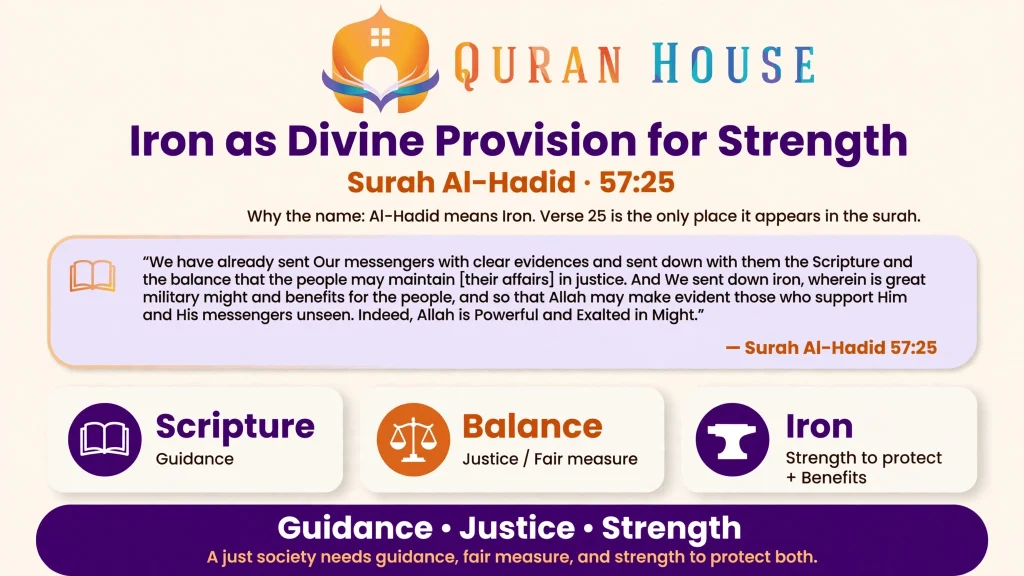
Two angles help explain this verse: the reason behind the surah’s name and what scholars past and present have said about iron.
Why Is Surah Al-Hadid Named After Iron?
The word hadid means iron in Arabic, and verse 25 is the only place in the surah where it appears. Naming a chapter after a distinctive word inside it is a common pattern across the Quran.
لَقَدْ أَرْسَلْنَا رُسُلَنَا بِالْبَيِّنَاتِ وَأَنْزَلْنَا مَعَهُمُ الْكِتَابَ وَالْمِيزَانَ لِيَقُومَ النَّاسُ بِالْقِسْطِ وَأَنْزَلْنَا الْحَدِيدَ فِيهِ بَأْسٌ شَدِيدٌ وَمَنَافِعُ لِلنَّاسِ وَلِيَعْلَمَ اللَّهُ مَنْ يَنْصُرُهُ وَرُسُلَهُ بِالْغَيْبِ إِنَّ اللَّهَ قَوِيٌّ عَزِيزٌ
(Laqad arsalna rusulana bil-bayyinati wa anzalna ma’ahumul-kitaba wal-mizana liyaqooman-nasu bil-qist, wa anzalnal-hadida fihi ba’sun shadidun wa manafi’u lin-nas, wa liya’lamallahu man yansuruhu wa rusulahu bil-ghayb, innallaha qawiyyun aziz)
(“We have already sent Our messengers with clear evidences and sent down with them the Scripture and the balance that the people may maintain [their affairs] in justice. And We sent down iron, wherein is great military might and benefits for the people, and so that Allah may make evident those who support Him and His messengers unseen. Indeed, Allah is Powerful and Exalted in Might.”)
Classical Tafsir and Modern Reflections on Iron
Ibn Kathir explains that iron serves two purposes in this verse: strength for defense and countless benefits in daily life, from tools to construction. Some commentators read “sent down” as created and provided.
Several contemporary writers point out that iron forms inside stars, not on Earth, and reached the planet from space. This reflection is interesting, but the verse’s main lesson remains justice supported by both guidance and strength.
What Is Surah Al-Hadid Talking About?
Surah Al-Hadid moves through faith, spending, the Hereafter, and justice in a carefully connected order. The table below maps its main themes to their verses for quick reference during recitation or study.
| Verses | Main Theme |
| 1 to 6 | Glorification of Allah and His names, dominion, and knowledge |
| 7 to 11 | Call to believe and spend, with the goodly loan |
| 12 to 15 | Light of believers and darkness of hypocrites on the Day of Judgment |
| 16 to 19 | Warning against hard hearts and praise of the truthful |
| 20 to 21 | Parable of worldly life and the race toward forgiveness |
| 22 to 24 | Divine decree, patience, and the danger of stinginess |
| 25 to 27 | Messengers, scripture, the balance, and iron |
| 28 to 29 | Double mercy and light for believers who fear Allah |
The main purpose that connects these themes is moving the reader from belief to action. Faith in Allah’s names leads to spending, spending leads to light, and light leads to a heart that stays soft.
Quran House offers a Practical (Amali) Tajweed Course that trains students to recite long Madani surahs like Al-Hadid with correct rules, so nightly recitation stays accurate and confident.
Recite Surah Al-Hadid With Correct Tajweed
Historical Context of Surah Al-Hadid’s Revelation
Most scholars classify Surah Al-Hadid as Madani, revealed after the migration to Madinah. Many place it in the period before the conquest of Makkah, when the young community needed both firm faith and financial support.
Verse 10 confirms this setting by distinguishing those who spent and fought before the conquest from those who did so afterward. Both receive good, yet the earlier group holds a higher rank for sacrificing when Islam was weaker.
This context explains why charity, patience, and soft hearts appear side by side. They were not separate lessons for the Companions; they were daily needs of a community building itself under pressure.
Authentic and Unverified Surah Hadid Benefits Compared
Online lists of surah hadid benefits often mix verified evidence with claims that have no source. The comparison below helps readers keep the authentic and set aside the unverified before building any routine.
| Claim | Source | Status |
| Prophet ﷺ recited the Musabbihat before sleep | Jami at-Tirmidhi 2921 | Graded hasan by at-Tirmidhi |
| Verse 3 helps against doubts | Sunan Abi Dawud 5110, statement of Ibn Abbas | Hasan chain |
| Verse 16 reproached the Companions after four years | Sahih Muslim 3027 | Sahih |
| Surah revealed on a Tuesday, cupping forbidden that day | Later collections like Ad-Durr al-Manthur | Weak, not reliable |
| Recitation for a husband, marriage, or wealth | No known source | No basis |
| Hidden secrets or wazifa counts | No known source | No basis |
Claims about husbands, marriage, or secret numbers do not appear in any recognized hadith collection. Attaching invented promises to the Quran risks speaking about Allah without knowledge, which scholars warn against strongly.
Some surahs do carry specific authentic rewards tied to certain days. Our guide on which surah to read on Friday explains those proven practices, which helps readers see why Al-Hadid’s virtue rests on the Musabbihat instead.
Practical Ways to Apply Surah Al-Hadid in Daily Life
Surah hadid benefits only grow when they become habits. The plan below turns the lessons of Surah Al-Hadid into a simple weekly routine that fits a busy schedule.
| Day | Practice | Time Needed |
| Monday | Recite verses 1 to 6 and reflect on Allah’s names | 10 minutes |
| Tuesday | Read verses 7 to 11 and give a small charity | 10 minutes |
| Wednesday | Recite verses 12 to 15 and review one daily good deed | 10 minutes |
| Thursday | Read verses 16 to 19 and check the state of your heart | 10 minutes |
| Friday | Recite verses 20 to 24 after Jumu’ah | 10 minutes |
| Saturday | Read verses 25 to 29 and reflect on justice | 10 minutes |
| Sunday | Recite the full surah before sleep | 15 minutes |
Quran House offers an Online Hifz School for Kids and Adults where students can memorize Surah Al-Hadid and the other Musabbihat in steady portions, guided by a teacher who checks every recitation.

Memorize Surah Al-Hadid With a Personal Teacher
Alongside the weekly plan, these habits keep the surah’s lessons active:
- Recite verse 3 whenever a doubt or unsettling thought appears.
- Set a fixed monthly charity and call it your goodly loan.
- Read verse 16 when worship starts to feel routine or heavy.
- Repeat verses 22 and 23 during illness, loss, or disappointment.
- Recall verse 20 before major purchases or competitive decisions.
Families can share this routine at home. Parents reading one passage after dinner and explaining one word from it often find that children remember the parable of rain and crops for years.
It’s Never Too Late to Learn
Adults learn with us too. Watch a real session with one of our adult learners and see how calm, one-on-one guidance makes Quran recitation feel achievable at any age.
Start Your Quran Journey With Quran House
Learn live and one-on-one with Al-Azhar-trained tutors, male and female, for children and adults, at a time that fits your timezone.
Try a Free SessionStudy Surah Al-Hadid With Quran House Certified Instructors
Reading about Surah Al-Hadid is a start, but reciting, memorizing, and reflecting on it with a qualified teacher builds lasting results. Quran House offers live one-on-one classes with Al-Azhar trained instructors for kids, adults, and sisters.
What sets Quran House apart:
- One-on-one live sessions with real-time correction of every verse.
- Al-Azhar trained teachers, with female tutors available for sisters.
- Flexible schedules across time zones, with two free trial sessions.
Explore the programs that fit your goals:
- Understand the Quran Course.
- Quran Tafseer Course for All Levels.
- Practical (Amali) Tajweed Course.
- Online Hifz School for Kids and Adults.
- Quran Reading for Adults.
- Online Quran Classes for Sisters and Women.
Final Thoughts on the Benefits of Surah Hadid
Authentic surah hadid benefits begin with a Sunnah: reciting the Musabbihat before sleep as the Prophet ﷺ did. From there, the surah offers four names of Allah that calm doubt and a verse that softens hard hearts.
Its lessons extend to daily life through the goodly loan of charity, patience grounded in divine decree, and a clear view of worldly life as crops that fade. Iron and justice complete a picture of faith supported by strength.
Approaching Surah Al-Hadid with verified sources protects the reciter from invented promises. Steady recitation, honest reflection, and guided study turn its 29 verses into a lifelong companion rather than a one-time read.
FAQs
Is Surah Al-Hadid Makki or Madani?
Surah Al-Hadid is Madani according to most scholars, revealed after the migration to Madinah. Verse 10 refers to spending before and after the conquest, which supports a Madinan setting, although a minority of scholars considered parts of it Makki.
Is There an Authentic Hadith About Surah Al-Hadid?
Yes, Jami at-Tirmidhi 2921 reports that the Prophet ﷺ recited the Musabbihat, including Al-Hadid, before sleep. At-Tirmidhi graded it hasan gharib, while some later scholars weakened it, so it remains the main report about the surah’s virtue.
Can Surah Al-Hadid Be Recited for a Husband or Marriage?
No authentic narration links Surah Al-Hadid to a husband, marriage, or wealth. Any Muslim may recite it and make sincere supplication afterward, but promising specific worldly results from it has no basis in the Quran or Sunnah.
What Is the Best Time to Recite Surah Al-Hadid?
Night before sleep is the best time, following the Prophet’s ﷺ practice of reciting the Musabbihat. Reciting it at any other time remains rewarded, since every letter of the Quran carries reward regardless of the hour.