| Key Takeaways |
| Surah Al-Hajj is the 22nd chapter of the Quran, and it is the only surah named after a pillar of Islam, linking worship to taqwa and tawheed. |
| Scholars describe it as a mixed chapter with Meccan and Medinan verses, which explains its blend of warning, proof of resurrection, and practical rulings. |
| It is authentically reported that Umar ibn al-Khattab prostrated twice in it, while the narration threatening those who skip both prostrations has a weak chain. |
| Sahih al-Bukhari 1521 and 1773 promise forgiveness and Paradise to the pilgrim whose Hajj is accepted, so sincerity and good conduct matter throughout the journey. |
The benefits of Surah Hajj reach far beyond the days of pilgrimage, because this chapter shapes how a believer thinks about Allah, worship, and the Day of Judgment. Muslims who have never traveled to Makkah still return to it for guidance.
Surah Al-Hajj is the 22nd chapter of the Quran and the only one named after a pillar of Islam. Readers who search for surah hajj benefits usually want clear lessons, authentic evidence, and a practical way to apply them.
Below are ten benefits drawn from its verses and from authentic hadith on Hajj, followed by its main themes, its background, and a simple study plan. The benefits are as follows.
1. Surah Hajj Benefits Start With Taqwa Awareness
Taqwa, the conscious fear and love of Allah that keeps a believer away from sin, is the first benefit of this chapter. The surah opens by calling all of humanity to it before describing anything else.
The very first verse sets the tone with a direct command and a warning about the Hour.
يَا أَيُّهَا النَّاسُ اتَّقُوا رَبَّكُمْ إِنَّ زَلْزَلَةَ السَّاعَةِ شَيْءٌ عَظِيمٌ
(Ya ayyuhan-nasut-taqu rabbakum inna zalzalat as-sa’ati shay’un ‘azim)
(“O people, fear your Lord. Indeed, the quaking of the Hour is a tremendous thing.”)
Taqwa works like a protective shield. A heart that remembers the quaking of the Hour thinks twice before wronging others, cutting corners in worship, or delaying repentance.
Hajj itself trains this awareness. The pilgrim leaves work, comfort, and status behind, and every step of the journey asks the same question: is this action pleasing to Allah?
2. Strengthen Tawheed and Reject Every Form of Shirk
Tawheed, the oneness of Allah, is the backbone of Surah Al-Hajj, and it teaches the believer to direct every prayer, hope, and fear to Allah alone.
The surah uses scenes from creation to make the point: life emerging from dust, rain reviving dead land, and the helplessness of false gods who cannot even create a fly. Each image invites reflection instead of blind acceptance.
The Talbiyah recited during Hajj carries the same message. It is a declaration that no partner shares Allah’s sovereignty, and a pilgrim who understands it brings that clarity home.
Quran House offers the Quran Tafseer Course for All Levels that explains the meaning and context of verses like these in live one-on-one sessions with Al-Azhar trained tutors.

3. Prepare Honestly for the Day of Judgment
The surah prepares the believer for the Hereafter by describing the quaking of the Hour, then reminding listeners that resurrection is as certain as the stages of their own creation.
That reminder is a benefit because it replaces vague worry with preparation. The Quran points to the human journey from dust to a drop to a clot, then asks how the One who began it could not repeat it.
Honest reflection leads to repentance, fairer dealings, and urgency in good deeds. A believer who keeps the Day of Judgment in mind stops postponing the changes that matter most.
4. Honor the Sacred Rites of Allah in Everyday Life
Honoring the sacred rites of Allah is a sign of a living heart, according to the Quran. This is one of the practical benefits of Surah Hajj, because respect for worship shapes behavior far beyond Makkah.
Surah Al-Hajj states the principle in a single verse.
ذَلِكَ وَمَنْ يُعَظِّمْ شَعَائِرَ اللَّهِ فَإِنَّهَا مِنْ تَقْوَى الْقُلُوبِ
(Dhalika wa man yu’azzim sha’a’iral-lahi fa-innaha min taqwal-qulub)
(“That is so. And whoever honors the symbols of Allah, indeed, they are from the piety of hearts.”)
The rites include Safa and Marwah, the sacrificial animals, and the sanctity of the Kaaba. Treating them with care teaches discipline, humility, and respect for everything Allah has made sacred.
That attitude carries into daily life. The person who honors prayer times, the Quran, and the rights of others is practicing the same piety the verse describes.
5. Learn the Real Meaning of Sacrifice and Sincerity
Sacrifice in Surah Al-Hajj is about the heart, not the animal. Allah makes clear that sincerity and piety are what reach Him, while meat and blood do not.
The verse that explains this is among the most quoted in the surah.
لَنْ يَنَالَ اللَّهَ لُحُومُهَا وَلَا دِمَاؤُهَا وَلَكِنْ يَنَالُهُ التَّقْوَى مِنْكُمْ كَذَلِكَ سَخَّرَهَا لَكُمْ لِتُكَبِّرُوا اللَّهَ عَلَى مَا هَدَاكُمْ وَبَشِّرِ الْمُحْسِنِينَ
(Lan yanalal-laha luhumuha wa la dima’uha wa lakin yanaluhut-taqwa minkum. Kadhalika sakh-kharaha lakum li-tukabbirul-laha ‘ala ma hadakum, wa bashshiril-muhsinin)
(“Their meat will not reach Allah, nor will their blood, but what reaches Him is piety from you. Thus He has subjected them to you that you may glorify Allah for that to which He has guided you; and give good tidings to the doers of good.”)
This shifts the focus from outward ritual to inner intention. A pilgrim who sacrifices with pride or show loses the point, while a sincere offering of small means carries full value.
Sacrifice also teaches generosity, since the meat is shared with the poor and the neighbor. Giving becomes an act of gratitude for what Allah has provided.
Quran House offers the Understand the Quran Course that helps learners grasp verses like these directly, so sincerity and intention become part of daily practice.

6. Feel Unity and Equality Through the Call of Ibrahim
Surah Al-Hajj teaches that the House of Allah belongs to all believers equally, and the pilgrimage is the clearest picture of that equality.
The call that started the pilgrimage is recorded in the surah.
وَأَذِّنْ فِي النَّاسِ بِالْحَجِّ يَأْتُوكَ رِجَالًا وَعَلَى كُلِّ ضَامِرٍ يَأْتِينَ مِنْ كُلِّ فَجٍّ عَمِيقٍ
(Wa adh-dhin fin-nasi bil-hajji ya’tuka rijalan wa ‘ala kulli damirin ya’tina min kulli fajjin ‘amiq)
(“And proclaim to the people the pilgrimage; they will come to you on foot and on every lean camel, coming from every distant pass.”)
People answered this call from every distant land, and they still do. In ihram, rich and poor wear the same simple cloth, stand in the same places, and make the same supplications.
Among the benefits of Surah Hajj, unity stands out. Language, color, and rank fade as millions turn to one Lord, giving every believer a living example of brotherhood and shared purpose.
See Us in Action!
Curious about what our online classrooms look like? Watch the short clip below to see how our interactive, one-on-one sessions bring learning to life with real-time feedback and engaging teaching methods.
Start Your Quran Journey With Quran House
Learn live and one-on-one with Al-Azhar-trained tutors, male and female, for children and adults, at a time that fits your timezone.
Try a Free Session7. Heal the Heart by Learning the Four Spiritual States
Surah Al-Hajj describes several conditions of the heart, which helps believers diagnose their own spiritual health before it is too late.
It speaks of blind hearts, diseased hearts, hardened hearts, and humble hearts that submit. The Quran locates real blindness in the chest, not in the eyes, as the verse below shows.
The surah makes this point right after urging people to travel and reflect.
أَفَلَمْ يَسِيرُوا فِي الْأَرْضِ فَتَكُونَ لَهُمْ قُلُوبٌ يَعْقِلُونَ بِهَا أَوْ آذَانٌ يَسْمَعُونَ بِهَا فَإِنَّهَا لَا تَعْمَى الْأَبْصَارُ وَلَكِنْ تَعْمَى الْقُلُوبُ الَّتِي فِي الصُّدُورِ
(Afalam yasiru fil-ardi fa-takuna lahum qulubun ya’qiluna biha aw adhanun yasma’una biha, fa-innaha la ta’mal-absaru wa lakin ta’mal-qulubul-lati fis-sudur)
(“Have they not traveled through the land so that they have hearts with which to reason and ears with which to hear? For indeed, it is not eyes that are blinded, but blinded are the hearts which are within the breasts.”)
A hardened heart ignores warnings, while a humble heart softens when reminded. Knowing the difference lets a believer act early through dhikr, recitation, and honest repentance.
These states connect to accountability. Readers can see how the Quran describes the final reckoning in our tafseer of Surah Al-Waqiah verse by verse, which complements this lesson.
8. Find Justice and Divine Support for the Oppressed
Surah Al-Hajj reassures believers that Allah supports those who are wronged and protects places of worship from destruction.
The permission to defend the faith came with a clear reason.
أُذِنَ لِلَّذِينَ يُقَاتَلُونَ بِأَنَّهُمْ ظُلِمُوا وَإِنَّ اللَّهَ عَلَى نَصْرِهِمْ لَقَدِيرٌ
(Udhina lilladhina yuqataluna bi-annahum zulimu wa inna-llaha ‘ala nasrihim laqadir)
(“Permission is given to those who are being fought, because they were wronged. And indeed, Allah is competent to give them victory.”)
Scholars note that this is reported as the first verse revealed about fighting, after believers were driven from their homes. It frames defense as protection of religious freedom, never as aggression.
Among the surah hajj benefits that readers value most is steadiness. Facing injustice with patience, lawful means, and trust in Allah’s help keeps the believer’s conduct just even under pressure.
9. Persevere in Worship Through Migration and Good Deeds
The surah closes by calling believers to bow, prostrate, worship their Lord, and do good, and it promises fair provision for those who migrate for His sake.
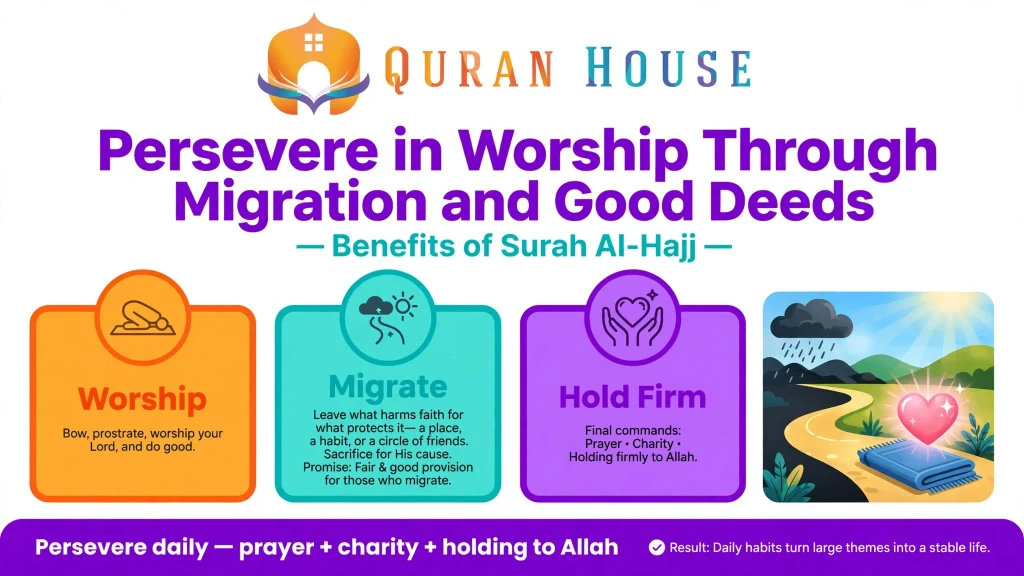
Migration here also carries a personal meaning: leaving what harms faith for what protects it, whether a place, a habit, or a circle of friends. Allah promises a good provision to those who sacrifice for His cause.
The final commands tie everything together: prayer, charity, and holding firmly to Allah. These daily habits turn the large themes of the surah into a stable life.
10. Gain Forgiveness and Reward for the Accepted Pilgrim
Authentic hadith describe what Allah grants to the pilgrim whose Hajj is accepted. These two narrations from Sahih al-Bukhari explain the forgiveness and the reward.
Sahih al-Bukhari 1521 on Returning Free From Sins
Abu Hurairah reported a prophetic promise that gives every pilgrim a reason to guard sincerity and good conduct throughout the journey.
مَنْ حَجَّ لِلَّهِ فَلَمْ يَرْفُثْ وَلَمْ يَفْسُقْ رَجَعَ كَيَوْمِ وَلَدَتْهُ أُمُّهُ
(Man hajja lillahi falam yarfuth walam yafsuq raja’a kayawmi waladat-hu ummuh)
(“Whoever performs Hajj for Allah, without obscenity and without disobedience, returns like the day his mother bore him.”)
The hadith ties forgiveness to conditions: sincerity for Allah and avoiding obscenity and disobedience. Scholars discuss what exactly is forgiven, so readers should ask a trusted scholar about personal cases.
Sahih al-Bukhari 1773 on Hajj Mabrur and Paradise
Another narration from Abu Hurairah links the accepted pilgrimage to the highest reward and shows how Umrah and Hajj work together.
الْعُمْرَةُ إِلَى الْعُمْرَةِ كَفَّارَةٌ لِمَا بَيْنَهُمَا، وَالْحَجُّ الْمَبْرُورُ لَيْسَ لَهُ جَزَاءٌ إِلاَّ الْجَنَّةُ
(Al-umratu ilal-umrati kaffaratun lima baynahuma, wal-hajjul-mabruru laysa lahu jazaa’un illal-jannah)
(“(The performance of) `Umra is an expiation for the sins committed (between it and the previous one). And the reward of Hajj Mabrur (the one accepted by Allah) is nothing except Paradise.”)
Hajj mabrur means an accepted pilgrimage free from sin and show. It is a reminder that reward follows the quality of intention, not only the completion of the rites.
Two Prostrations Make Surah Hajj Distinct in Recitation
Surah Al-Hajj is favored among the surahs with two verses of prostration, which affects how it is recited and heard.
It is authentically reported that Umar ibn al-Khattab prostrated twice in it and said it was favored over other surahs with two prostrations. His son Abdullah did the same.
A widely repeated narration says that whoever does not make both prostrations should not recite the surah. Hadith scholars consider that chain weak, so what stands firm is the practice of Umar and his son.
Reciting with correct rules makes the experience more precise. Beginners can start with our guide to what Tajweed is before attempting a long surah such as this one.
Quran House offers the Learn Quran Reading with Tajweed for Beginners course that trains students to recite accurately through live sessions with tutors who correct articulation in real time.

What Is Surah Al-Hajj About?
Surah Al-Hajj has 78 verses in the common Kufan count, and scholars describe it as a mixed chapter with verses revealed in both Makkah and Madinah.
The table below summarizes its main themes and the practical lesson each one carries.
| Theme | Where It Appears | Practical Lesson |
| Warning of the Hour and call to taqwa | 22:1 | Prepare for the Hereafter. |
| Proof of resurrection | 22:5 | Reflect on creation and renewal. |
| Call of Ibrahim to the pilgrimage | 22:27 | Respond with sincerity and unity. |
| Honoring the sacred rites | 22:32 | Respect every act of worship. |
| Sacrifice and piety | 22:37 | Purify the intention. |
| Permission to defend the wronged | 22:39 | Stand for justice with patience. |
| Reward for those who migrate | 22:58 | Sacrifice for faith. |
Early scholars called it one of the wonders of the Quran, because it brings together Meccan and Medinan material, travel and residence, war and peace, night and day.
Why Was Surah Al-Hajj Revealed?
Surah Al-Hajj addressed three groups at once: idolaters who blocked people from the Sacred Mosque, wavering believers, and sincere Muslims who needed guidance on worship and defense.
For the idolaters, it offered proof of resurrection and warnings from earlier nations. For wavering believers, it warned against worshipping Allah only while life is easy.
For sincere believers, it brought comfort, rulings on pilgrimage, and the promise of victory. Some reports say its opening verses were recited aloud during a journey, which fits its travel setting.
How to Study Surah Hajj Step by Step
A structured plan helps these lessons become habits. Here are four steps readers can follow over a few weeks.
- Read the surah once in Arabic with a trusted translation to see the overall flow.
- Study one theme per day with a reliable tafseer, starting with taqwa and tawheed.
- Write one action from each theme, such as improving prayer or giving charity.
- Review the verses with a qualified teacher to correct both recitation and meaning.
Quran House offers the Quran Memorization for Adults program that helps adult learners memorize passages from surahs like this one with a clear plan and regular revision.

Consistency matters more than speed. Ten focused minutes daily, with reflection after each reading, builds understanding that lasts longer than a single long session.
Inside Our Virtual Classrooms
We believe in full transparency and proven quality. Take a look at this actual snippet from our live classes to experience our modern learning platform, patient instructors, and interactive student participation.
Start Your Quran Journey With Quran House
Learn live and one-on-one with Al-Azhar-trained tutors, male and female, for children and adults, at a time that fits your timezone.
Try a Free SessionStart Learning Surah Hajj With Quran House Expert Instructors
At Quran House, students learn with Al-Azhar trained tutors in live one-on-one sessions that include real-time correction. Sisters can choose a female tutor, and lessons fit different schedules and time zones.
Our Quran Courses
- Quran Tafseer Course for All Levels.
- Understand the Quran Course.
- Learn Quran Reading with Tajweed for Beginners.
- Quran Memorization for Adults.
- Quranic Arabic Course.
- Quran Reading Course Online for Kids and Adults.
Conclusion
The benefits of Surah Hajj connect worship with character: taqwa, tawheed, sincerity, unity, and readiness for the Hereafter. Each verse turns a ritual into a lesson that shapes daily conduct.
Authentic hadith add to this picture by promising forgiveness and Paradise to the accepted pilgrim. The practice of Umar also shows how closely the early Muslims honored the special status of this surah.
Reading it with reflection, correct recitation, and qualified guidance helps these lessons stay with the believer long after the pilgrimage season. May Allah make us among those who benefit from His Book.
FAQs
What Are the Main Lessons of Surah Hajj?
The main lessons are taqwa, tawheed, sincerity in worship, unity among believers, and preparation for the Hereafter. These surah hajj benefits come from verses that link ritual to character and accountability.
Why Is Surah Al-Hajj Named After Hajj?
It is named Al-Hajj because it describes how Ibrahim was commanded to call people to the pilgrimage and explains the rites and their virtues. It is the only surah named after a pillar of Islam.
Does Surah Al-Hajj Have Two Prostrations?
Yes, scholars recognize two prostration verses in it. It is authentically reported that Umar prostrated twice and said the surah was favored with them, though the narration threatening those who skip them is weak.
Is Surah Al-Hajj Meccan or Medinan?
Scholars differ, and the majority view is that it is mixed. The verses on fighting and pilgrimage are Medinan, while its opening style resembles Meccan chapters, so the exact verses are not always fixed.
Can Non-Pilgrims Benefit From Surah Hajj?
Yes, because its lessons on taqwa, tawheed, sincerity, and accountability apply to every believer. Reading it with tafseer helps non-pilgrims apply them in prayer, charity, and daily conduct.