| Key Takeaways |
| Surah Hud is the 11th surah of the Quran, Meccan, with 123 verses, and it carries lessons on patience, repentance, and accountability. |
| An authentic hadith in Jami` at-Tirmidhi 3297 says Surah Hud turned the Prophet’s hair gray because of its warnings about the Last Day. |
| Verse 112 commands steadfastness, and verse 114 teaches that good deeds erase bad ones, which makes both central to surah hud benefits. |
| Narrations about ten times the reward, written charms, and Friday recitation of this surah are not established, so rely on the Quran and authentic hadith. |
The benefits of Surah Hud go beyond its fame as the surah that turned the Prophet’s hair gray. Revealed in Makkah, it gives believers a clear path toward patience, repentance, and trust in Allah.
Surah Hud is the 11th chapter of the Quran and holds 123 verses. Many readers search for surah hud benefits because the surah mixes powerful warnings, comforting stories of seven prophets, and direct commands for daily life.
This guide separates verified virtues from weak reports and explains how to apply each lesson in daily life. The following benefits are drawn from authentic Quranic and prophetic evidence.
1. Receive a Powerful Reminder of the Day of Judgment
Surah Hud reminds the believer of the Last Day more forcefully than almost any other chapter. Its verses describe past nations, the seizure of wrongdoers, and the day when every soul stands before Allah.
Abu Bakr noticed gray hair on the Prophet ﷺ and asked about it. The answer, recorded by At-Tirmidhi from Ibn Abbas, names Hud first among the surahs that left such a mark.
قَالَ أَبُو بَكْرٍ رَضِيَ اللَّهُ عَنْهُ: يَا رَسُولَ اللَّهِ، قَدْ شِبْتَ، قَالَ: شَيَّبَتْنِي هُودٌ، وَالْوَاقِعَةُ، وَالْمُرْسَلَاتُ، وَعَمَّ يَتَسَاءَلُونَ، وَإِذَا الشَّمْسُ كُوِّرَتْ
(Qala Abu Bakrin radiyallahu ‘anhu: ya Rasulallah, qad shibta. Qala: shayyabatni Hudun, wal-Waqi’atu, wal-Mursalatu, wa ‘amma yatasa’alun, wa idha ash-shamsu kuwwirat)
(“Abu Bakr said: ‘O Messenger of Allah! You have become gray.’ He said: ‘I have gone gray from (Surat) Hud, Al-Waqiah, Al-Mursalat and Amma Yatasa’alun and Idhash-Shamsu Kuwwirat.’”)
At-Tirmidhi graded the hadith hasan gharib, and Al-Albani graded it sahih. Scholars explain that these surahs describe the Day of Judgment and the punishment of earlier nations, which weighed heavily on the Prophet ﷺ.
Reading Surah Hud with that weight in mind softens a careless heart. It trains the reader to measure daily choices against the accountability described in the surah, which is one of the clearest surah hud benefits.
2. Build Steadfastness From the Command in Verse 112
Verse 112 commands the Prophet ﷺ and every believer with him to stay firm on the straight path. Steadfastness in this verse means obeying Allah consistently, without crossing the limits He set.
Commentators mention that this verse weighed heavily on the Prophet ﷺ, because it demands steady obedience without exaggeration or neglect, and the wording leaves no room for shortcuts.
فَاسْتَقِمْ كَمَا أُمِرْتَ وَمَنْ تَابَ مَعَكَ وَلَا تَطْغَوْا إِنَّهُ بِمَا تَعْمَلُونَ بَصِيرٌ
(Fastaqim kama umirta wa man taba ma’aka wa la tatghaw, innahu bima ta’malouna basir)
(“So remain on a right course as you have been commanded, you and those who have turned back with you, and do not transgress. Indeed, He is Seeing of what you do.”)
In practice, steadfastness means praying on time, avoiding sins, and returning to the Quran after every lapse. Small actions repeated daily protect faith better than occasional bursts of effort.
Correct recitation supports steadfast worship, and Quran House offers a Learn Quran Reading with Tajweed for Beginners course that trains new readers to recite verses like these accurately with live teacher feedback.

Start Your Free Tajweed Lesson Today
3. Erase Past Mistakes Through Good Deeds
Verse 114 teaches that good deeds wipe away bad deeds, which gives every sinner a practical way back to Allah. The verse links prayer, dhikr, and repentance into one path of renewal.
Allah first commands regular prayer at both ends of the day and during part of the night. He then states the principle that good deeds remove misdeeds, followed by a reminder for those who remember Him.
وَأَقِمِ الصَّلَاةَ طَرَفَيِ النَّهَارِ وَزُلَفًا مِنَ اللَّيْلِ إِنَّ الْحَسَنَاتِ يُذْهِبْنَ السَّيِّئَاتِ ذَلِكَ ذِكْرَى لِلذَّاكِرِينَ
(Wa aqimis-salata tarafayin-nahari wa zulafam minal-layl, innal-hasanati yudhhibnas-sayyi’at, dhalika dhikra lildh-dhakirin)
(“And establish prayer at the two ends of the day and at the approach of the night. Indeed, good deeds do away with misdeeds. That is a reminder for those who remember.”)
Among the benefits of Surah Hud, this verse stands out because it offers hope without encouraging carelessness. Good deeds erase minor wrongs, while sincere repentance remains the path for every serious sin.
The surah also teaches the sinner not to despair. A believer who slips can pray, give charity, make dua, and begin again, because Allah accepts those who return to Him sincerely.
4. Learn Patience From the Stories of Seven Prophets
Surah Hud narrates the stories of seven prophets, and each story teaches patience in the face of rejection. Noah, Hud, Salih, Ibrahim, Lot, Shuayb, and Moses all met denial, yet none abandoned the mission.
The table below lists each prophet in the order the surah presents them, with the approximate verse range and the main lesson for readers today.
| Prophet | Approximate Verses | Main Lesson |
| Noah | 25-49 | Persistence through long rejection, and love for family kept within Allah’s limits. |
| Hud | 50-60 | Trust in Allah alone against arrogant power. |
| Salih | 61-68 | Respect for Allah’s signs and the cost of defiance. |
| Ibrahim | 69-76 | Mercy, hospitality, and hope in Allah’s promise. |
| Lot | 77-83 | Courage in defending purity against corruption. |
| Shuayb | 84-95 | Honesty in trade and fairness in business. |
| Moses | 96-99 | Clear proof, and the fate of arrogant rulers. |
Noah’s story shows the longest endurance, since he called his people for centuries. Even the loss of his own son did not shake his obedience, and Allah taught him to ask only with knowledge.
Hud, Salih, and Shuayb each faced a different kind of arrogance, namely military pride, material comfort, and economic dishonesty. Their calm responses show that patience is not weakness but a form of trust in Allah.
To study these stories verse by verse, Quran House offers a Quran Tafseer Course for All Levels where teachers explain the meaning, context, and lessons behind each narration in clear English.

Book a Free Tafseer Trial Class
5. Strengthen Belief in Tawhid and the Hereafter
Surah Hud strengthens belief in Tawhid by repeating one message through every story, which is to worship Allah alone. Each prophet begins with the same call, and each community that rejects it meets a clear consequence.
The surah also affirms resurrection and accountability. Verses about the Day of Judgment describe a day when people are gathered, and Allah’s justice is complete, so no deed is lost and no wrong is ignored.
Belief in the Hereafter changes ordinary behavior. A reader who remembers accountability pays debts on time, speaks honestly, and treats family fairly, because every action will be weighed.
Scholars also highlight how the surah opens by describing the Quran as a book whose verses are perfected and then explained in detail. That opening builds confidence that the guidance comes from a wise and fully aware Lord.
See Us in Action!
Watch a student work through Surah Ash-Shams step by step with their tutor, practicing each ayah until the recitation flows clearly and correctly.
Start Your Quran Journey With Quran House
Learn live and one-on-one with Al-Azhar-trained tutors, male and female, for children and adults, at a time that fits your timezone.
Try a Free Session6. Find Hope in Allah’s Mercy Through Repentance
Surah Hud repeatedly invites people to seek forgiveness and turn back to Allah. Its message is that no sin is too heavy for sincere repentance, and no servant is too far to return.
The dua of Noah in this surah is a model for that return. After asking Allah about his son, Noah realized he had asked without knowledge and immediately sought refuge, forgiveness, and mercy.
Some pages label this supplication as the dua of Hud, but verse 47 records it as the words of Noah. It is a short dua that every believer can memorize and repeat.
قَالَ رَبِّ إِنِّي أَعُوذُ بِكَ أَنْ أَسْأَلَكَ مَا لَيْسَ لِي بِهِ عِلْمٌ وَإِلَّا تَغْفِرْ لِي وَتَرْحَمْنِي أَكُنْ مِنَ الْخَاسِرِينَ
(Qala rabbi inni a’udhu bika an as’alaka ma laysa li bihi ‘ilm, wa illa taghfir li wa tarhamni akun minal-khasirin)
(“He said, ‘My Lord, I seek refuge in You from asking You that of which I have no knowledge. And unless You forgive me and have mercy upon me, I will be among the losers.’”)
Reciting this dua teaches humility before requesting anything from Allah. A believer who asks with awareness avoids demanding what may harm them, and trusts that Allah’s wisdom is greater than personal wishes.
7. Gain Honest Moral Direction for Daily Life
Surah Hud gives clear moral direction through the story of Shuayb and his people. He called them to stop cheating in measures and weights, which makes the surah a lesson in honest business.
Fair dealing is not a minor matter in the surah. Shuayb tells his people that what Allah leaves for them after honest trade is better, and the community’s refusal to change ended in destruction.
Lot’s story teaches moral courage. He protected his guests, spoke firmly against corruption, and trusted Allah when his community rejected him, showing that purity of character matters more than popularity.
The benefits of Surah Hud become practical when a reader applies these examples at work, at home, and in the community. For better recitation of these verses, read our guide to what Tajweed is before starting daily practice.
8. Rely on Allah Fully as the Surah Closes
The final verse of Surah Hud ends with a call to worship Allah and rely on Him completely. This ending sums up the lesson of every story that came before it.
Worship and reliance work together in the verse. A believer performs the duty, then leaves the outcome to Allah, who knows the hidden matters of the heavens and the earth.
Allah ends the surah with a reminder that nothing escapes His knowledge, and every matter returns to Him, so the believer should act with that awareness. The verse reads as follows.
وَلِلَّهِ غَيْبُ السَّمَاوَاتِ وَالْأَرْضِ وَإِلَيْهِ يُرْجَعُ الْأَمْرُ كُلُّهُ فَاعْبُدْهُ وَتَوَكَّلْ عَلَيْهِ وَمَا رَبُّكَ بِغَافِلٍ عَمَّا تَعْمَلُونَ
(Wa lillahi ghaybus-samawati wal-ard, wa ilayhi yurja’ul-amru kulluh, fa’budhu wa tawakkal ‘alayh, wa ma rabbuka bighafilin ‘amma ta’malun)
(“And to Allah belongs the unseen of the heavens and the earth, and to Him the whole matter will be returned, so worship Him and rely upon Him. And your Lord is not unaware of what you do.”)
Reliance on Allah brings calm when plans fail. This is among the most valuable surah hud benefits for students, parents, and workers who feel pressure and need steady hearts.
Quran House offers the Understand the Quran Course that explains the meanings of verses like this in simple English, with a live teacher who connects each lesson to daily life.

Try Two Free Sessions With a Teacher
Surah Hud Facts Every Reader Should Know
Knowing the background of a surah deepens the way it is read. The facts below come from the standard scholarly sources on revelation, structure, and naming.
Where and When Surah Hud Was Revealed
Surah Hud is a Meccan surah, the 11th in the Quran and the 52nd in the order of revelation. It was revealed after Surah Yunus and contains 123 verses.
Several scholars place its revelation in one of the hardest periods of the call in Makkah, after the loss of Khadijah and Abu Talib. Verses of comfort for the Prophet ﷺ fit that painful setting.
In the standard division of the Quran, Surah Hud begins in Juz 11 and continues into Juz 12. Readers who follow a daily juz plan will therefore meet it across two days.
Why the Surah Is Named After Prophet Hud
The surah carries the name of Prophet Hud, who is mentioned five times in it. Yet his story fills only a short section, because the name works as a title rather than a summary.
Hud was sent to the people of Aad, who were known for strength and building. Their story in verses 50 to 60 shows how pride in worldly power fails before Allah’s decree.
Weak Narrations About Surah Hud You Should Avoid
Several popular claims about Surah Hud do not rest on authentic evidence, so they should not be presented as hadith. Authentic benefits come from the Quran itself and from sound reports like the one in At-Tirmidhi.
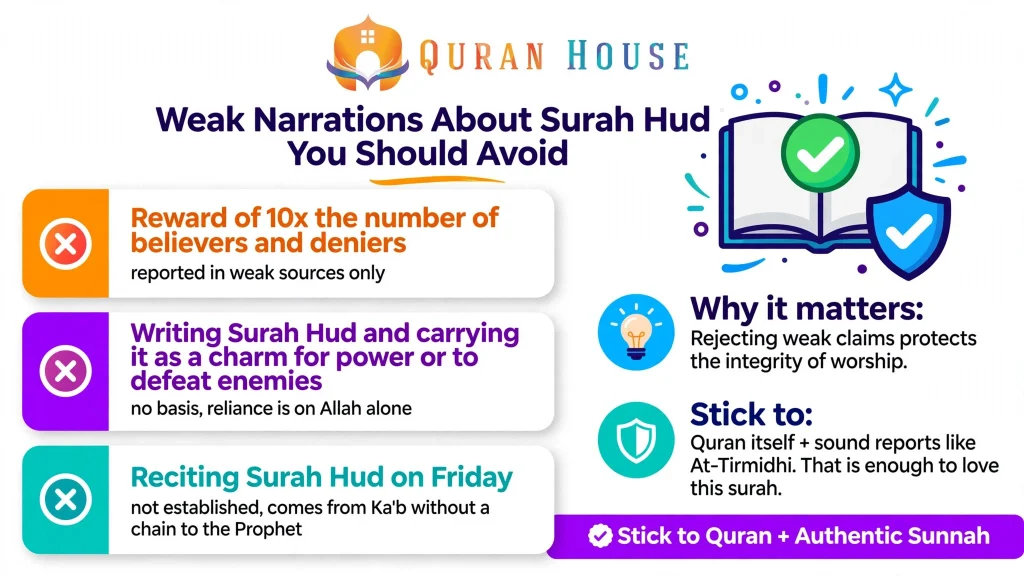
Three claims appear often on websites and social media, yet none is established as the saying of the Prophet ﷺ, so careful readers avoid repeating them.
- The reward of ten times the number of everyone who believed or denied the prophets in the surah is reported in weak sources, not in authentic collections.
- Writing Surah Hud and carrying it as a charm to gain power or defeat enemies has no basis in authentic Islamic teaching, and reliance belongs to Allah alone.
- The instruction to recite Surah Hud on Friday is not established as the Prophet’s word, since it comes from Ka’b without a chain reaching the Prophet ﷺ.
Rejecting weak claims protects the integrity of worship. The Quran and the authenticated Sunnah already offer ample reasons to love this surah, so nothing needs to be added.
Is It Sunnah to Recite Surah Hud on Fridays?
No, the better known Friday practice is reciting Surah Al-Kahf, and no authentic prophetic text names Surah Hud for that day.
Nothing prevents a Muslim from reading Surah Hud on Friday as part of ordinary Quran reading. The error lies only in claiming a special fixed reward for that day without authentic evidence.
For the full Friday routine, including the sunnah of Surah Al-Kahf, read our guide on which surah to read on Friday before planning your weekly schedule.
Memorize Surah Hud Step by Step
Surah Hud can be memorized by dividing its 123 verses into small portions and reviewing them daily. A pace of three to five new verses per session works well for many adult learners.
The method below keeps new memorization connected to meaning and correct pronunciation, which helps the verses stay in the heart. Follow the steps in order for the best results.
- Listen to a trusted reciter and read the portion slowly while following the text.
- Read the meaning of the portion in English so that the story or lesson is clear.
- Repeat the first verse ten times, then recite it from memory.
- Add the next verse, then recite both verses together without looking.
- Recite the full new portion to a teacher for correction of pronunciation.
- Review the previous days’ portions before adding anything new.
Daily review keeps the verses alive in prayer, and that regular recall strengthens the practical surah hud benefits of reflection and remembrance. Verses that remain in the heart are available whenever a believer needs patience.
Quran House offers a Quran Memorization for Adults program with live one-on-one revision, so every verse is checked for accuracy and mistakes are corrected early.

Reserve Your Free Hifz Trial Session
Practical Ways to Apply Surah Hud Benefits
Knowledge becomes valuable only when it shapes habits. The following plan turns the lessons of the surah into small daily actions that a busy believer can keep.
- Read one section of the surah each day, such as one prophet’s story, and write down one lesson from it.
- Recite verse 112 after Fajr and ask Allah for steadfastness in the coming day.
- Pray two units of voluntary prayer after any mistake, then make istighfar sincerely.
- Memorize the dua of Noah from verse 47 and repeat it before asking Allah for anything uncertain.
- Review verse 123 before stressful meetings or exams as a reminder to rely on Allah.
- Share one lesson from the surah with your family each week.
These actions take under ten minutes a day. Consistency matters more than length, and a short daily habit will outlast a rushed weekly reading session.
Inside Our Virtual Classrooms
We believe in full transparency and proven quality. Take a look at these actual snippets from our live classes to experience our modern learning platform, patient instructors, and interactive student participation.
Memorizing Surah Ad-Duha in Class
Memorization is easier with structure. See how a student reviews and recites Surah Ad-Duha in a live lesson, guided by a tutor who follows every step of their progress.
Start Your Quran Journey With Quran House
Learn live and one-on-one with Al-Azhar-trained tutors, male and female, for children and adults, at a time that fits your timezone.
Try a Free SessionLearn Surah Hud With Quran House Certified Teachers
Learning with a qualified teacher turns reading into understanding. At Quran House, Al-Azhar-trained tutors teach live one-on-one sessions for kids, adults, and sisters, with female tutors available for private, comfortable lessons.
What sets Quran House apart:
- Live one-on-one sessions with real-time correction of pronunciation and memorization.
- Al-Azhar-trained tutors who follow each student’s progress closely.
- Courses in Tajweed, Hifz, Tafseer, and Quran reading for children, adults, and sisters.
- Two free sessions to try the classroom before enrolling.
Book your free trial lesson with Quran House
Our Quran Courses
- Quran Tafseer Course for All Levels.
- Quran Memorization for Adults.
- Learn Quran Reading with Tajweed for Beginners.
- Understand the Quran Course.
- Online Hifz School for Kids and Adults.
- Quran Reading Fluency Course.
Conclusion
The benefits of Surah Hud include a powerful reminder of the Day of Judgment, steadfastness, forgiveness through good deeds, and patience drawn from seven prophets. Each lesson rests on the Quran or on authentic hadith.
Readers should also avoid weak claims such as charms, invented rewards, and unproven Friday rules. True benefit comes from understanding the verses, reciting them correctly, and acting on their lessons.
Start today with one verse, one lesson, and one small habit, then build gradually with a qualified teacher. May Allah make the Quran a source of light, patience, and success for every reader.
FAQs
Is Surah Hud Meccan or Madani?
Surah Hud is Meccan. It was revealed in Makkah before the migration to Madinah, during a difficult stage of the call, and it contains 123 verses focused on patience, accountability, and trust in Allah.
Which Juz Contains Surah Hud?
Surah Hud begins in Juz 11 and ends in Juz 12. The first five verses fall in Juz 11, and the remaining verses continue in Juz 12 of the Quran.
Why Did Surah Hud Turn the Prophet’s Hair Gray?
The Prophet ﷺ named Hud among the surahs that turned his hair gray. Scholars explain that its warnings about the Day of Judgment and the destruction of earlier nations carried that weight.
Can I Memorize Surah Hud as a Beginner?
Yes, with patience. Beginners should start with Tajweed basics, then memorize a few verses a day and recite them to a qualified teacher. Surah Hud is long, so steady review matters more than speed.
Is Writing Surah Hud as a Charm Supported by Evidence?
No authentic evidence supports writing Surah Hud as a charm for power or protection. Protection comes through sincere reliance on Allah, regular daily dhikr, and reciting the Quran with understanding.