Surah Noor Benefits And Lessons From The Verse Of Light
Surah Noor benefits begin with the Verse of Light and reach every home through its rulings on honor, privacy, and modesty. It takes its name from the Light Verse (24:35) and begins by emphasizing the importance of following the rulings and guidance revealed by Allah.
﴿سُورَةٌ أَنزَلْنَاهَا وَفَرَضْنَاهَا﴾
“A surah which We have sent down and made obligatory” (24:1).
The benefits of Surah An-Nur come from two sources: the reward of reciting the Quran, and the guidance its verses bring to the believer, the family, and society. Here are nine benefits of Surah An-Nur, each with the verse behind it.
Surah An-Nur strengthens faith through the Light Verse and protects society through clear rulings on zina, false accusations, rumors, privacy, and modesty, while keeping the door of repentance and forgiveness wide open.
1. Strengthening Faith Through the Verse of Light
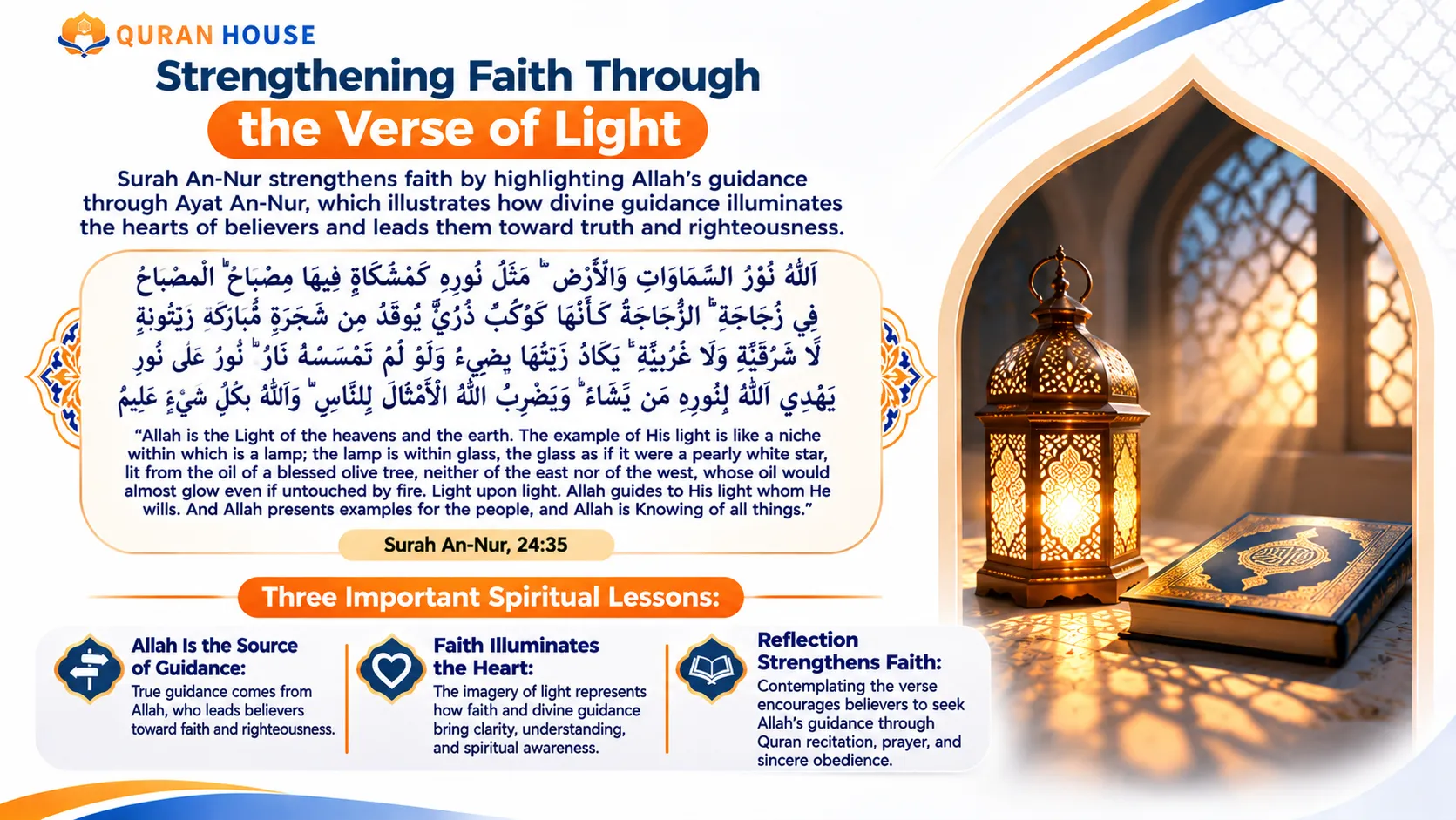
Surah An-Nur strengthens faith by highlighting Allah’s guidance through one of the Quran’s most profound verses, known as Ayat An-Nur (the Verse of Light). This verse illustrates how divine guidance illuminates the hearts of believers and leads them toward truth and righteousness.
“Allah is the Light of the heavens and the earth. The example of His light is like a niche within which is a lamp; the lamp is within glass, the glass as if it were a pearly white star, lit from the oil of a blessed olive tree, neither of the east nor of the west, whose oil would almost glow even if untouched by fire. Light upon light. Allah guides to His light whom He wills. And Allah presents examples for the people, and Allah is Knowing of all things.” (Surah An-Nur, 24:35)
Classical Quran commentators explain this verse as a powerful illustration of divine guidance. Ibn Abbas is reported to have interpreted Allah’s light as His guidance to the inhabitants of the heavens and the earth. Other interpretations relate the imagery of the niche, lamp, and pure oil to faith and guidance within the believer’s heart.
The verse offers three important spiritual lessons:
Allah Is the Source of Guidance: True guidance comes from Allah, who leads believers toward faith and righteousness.
Faith Illuminates the Heart: The imagery of light represents how faith and divine guidance bring clarity, understanding, and spiritual awareness.
Reflection Strengthens Faith: Contemplating the verse encourages believers to seek Allah’s guidance through Quran recitation, prayer, and sincere obedience.
Reflecting on Ayat An-Nur during moments of uncertainty reminds Muslims to turn to Allah for guidance and strengthen their connection with the Quran.
2. Protecting the Family Through the Ruling on Zina
Surah An-Nur begins its rulings by addressing zina, emphasizing the seriousness of this sin and the importance of protecting marriage, family relationships, and moral values in Islamic society.
“The woman and the man guilty of zina, lash each of them one hundred lashes, and do not let pity for them prevent you from carrying out the law of Allah, if you truly believe in Allah and the Last Day. And let a group of the believers witness their punishment.” (Surah An-Nur, 24:2)
Scholars explain that this punishment applies to unmarried offenders, while the Sunnah details the ruling for married offenders. Its implementation requires strict evidence and a legitimate Islamic authority, never private individuals.
The ruling serves as a deterrent and aims to protect lineage, marriage, and trust within the family.
3. Protecting People’s Honor from False Accusations
Surah An-Nur emphasizes the importance of protecting people’s honor and reputation by strictly prohibiting false accusations of zina. It requires anyone making such an accusation to provide four witnesses, highlighting the seriousness of spreading allegations without sufficient evidence.
“And those who accuse chaste women and then do not produce four witnesses, lash them with eighty lashes and do not accept from them testimony ever after. And those are the defiantly disobedient.” (Surah An-Nur, 24:4)
The surah also establishes the procedure of mutual oaths (li’an) when a husband accuses his wife without witnesses (Surah An-Nur, 24:6–9).
It further emphasizes Allah’s mercy by allowing repentance and reform, as stated in Surah An-Nur, 24:5. These teachings reinforce the importance of justice, protecting reputations, and avoiding harmful accusations.
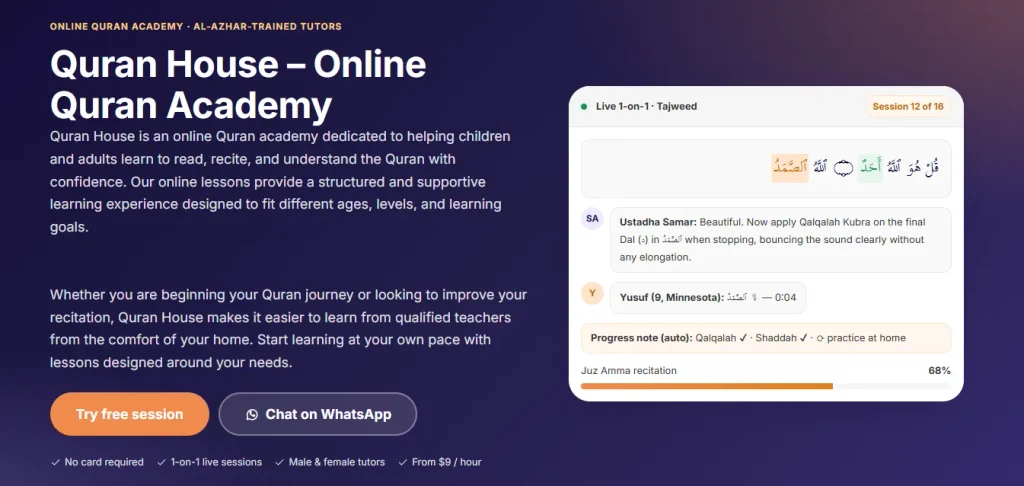
Inside an Interactive One-on-One Session
Every class is live and personal. See how our tutor uses on-screen tools, quick reviews, and gentle correction to help a student build confidence with every new word.
Start Your Quran Journey With Quran House
Learn live and one-on-one with Al-Azhar-trained tutors, male and female, for children and adults, at a time that fits your timezone.
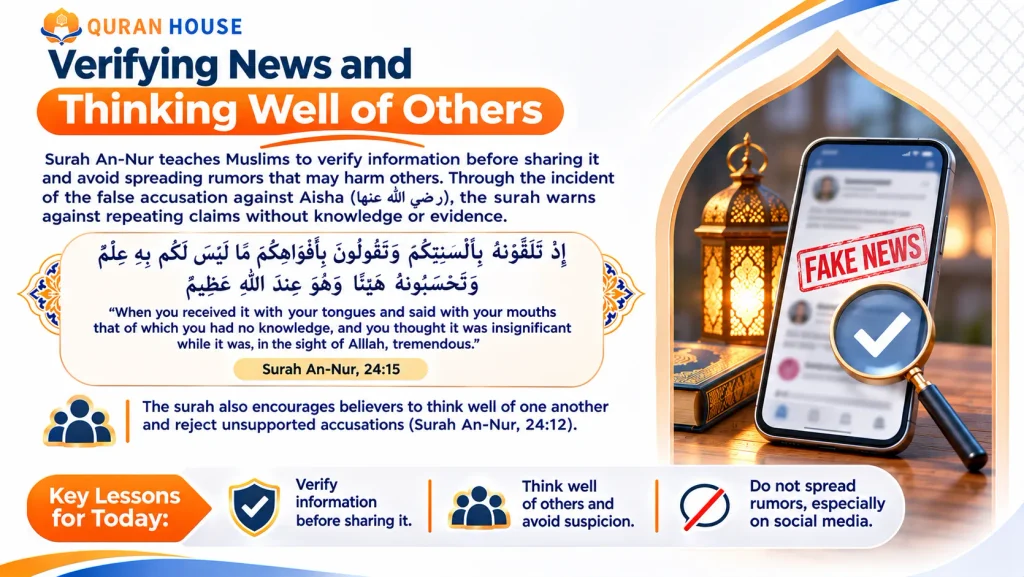
Surah An-Nur teaches Muslims to verify information before sharing it and avoid spreading rumors that may harm others. Through the incident of the false accusation against Aisha (رضي الله عنها), the surah warns against repeating claims without knowledge or evidence.
“When you received it with your tongues and said with your mouths that of which you had no knowledge, and you thought it was insignificant while it was, in the sight of Allah, tremendous.” (Surah An-Nur, 24:15)
The surah also encourages believers to think well of one another and reject unsupported accusations (Surah An-Nur, 24:12). This lesson is especially relevant in the age of social media, where unverified information spreads quickly. Muslims should avoid sharing rumors, verify claims, and protect others from unjust accusations.
5. Encouraging Repentance and Forgiveness
Surah An-Nur highlights the importance of forgiveness through the story of Abu Bakr (رضي الله عنه) and Mistah, a relative whom he financially supported. After Mistah became involved in spreading the false accusation against Aisha, Abu Bakr decided to stop supporting him. Allah then revealed:
“And let not those of virtue and wealth among you swear not to give to their relatives, the needy, and the emigrants for the cause of Allah, and let them pardon and overlook. Would you not like Allah to forgive you? And Allah is Forgiving and Merciful.” (Surah An-Nur, 24:22)
After hearing this verse, Abu Bakr expressed his desire for Allah’s forgiveness and resumed supporting Mistah (Sahih al-Bukhari 4750). The surah further encourages all believers to seek forgiveness and return sincerely to Allah through repentance (Surah An-Nur, 24:31).
To improve your Quran recitation and understand the proper pronunciation of verses like these, explore the Tajweed Courses at Quran House, where experienced tutors provide step-by-step guidance.
6. Protecting the Privacy of Every Home
Surah An-Nur emphasizes the importance of respecting personal privacy and protecting the dignity of every household. It teaches Muslims to seek permission before entering someone else’s home and to respect the boundaries established by Islam.
“O you who believe, do not enter houses other than your own until you ask permission and greet their inhabitants. That is best for you; perhaps you will be reminded.” (Surah An-Nur, 24:27)
The surah establishes three essential rules for respecting privacy:
Seek Permission Before Entering: Always ask permission and greet the household with Salam before entering.
Respect the Right to Refuse: If someone asks you to leave or return later, accept their decision without insisting (Surah An-Nur, 24:28).
Maintain Privacy Within the Family: Children and household members are instructed to seek permission at three specific times: before Fajr prayer, during midday rest, and after Isha prayer (Surah An-Nur, 24:58).
By following these teachings, Muslims can create homes built on mutual respect, modesty, and personal dignity.
7. Teaching Modesty for Men and Women
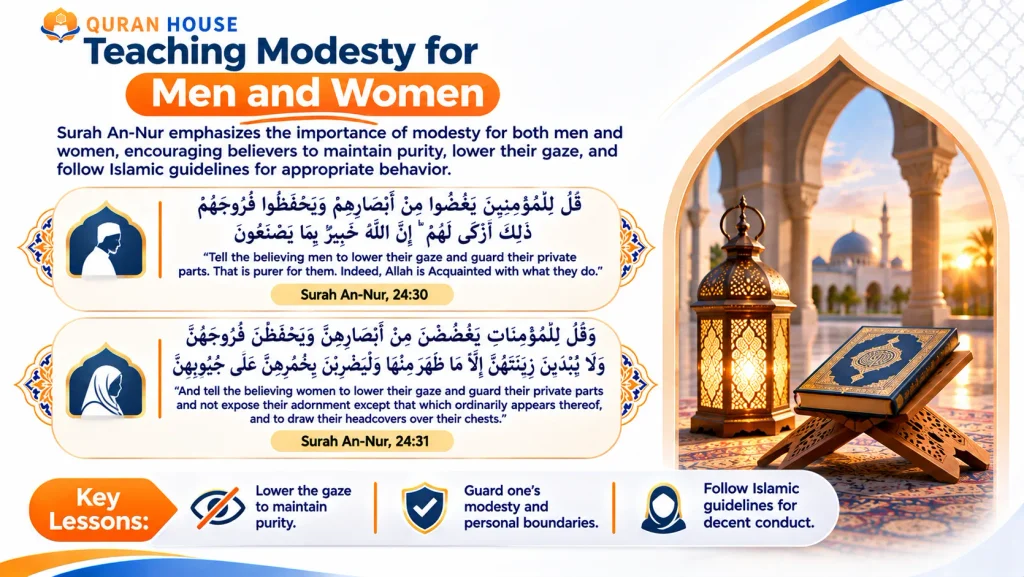
Surah An-Nur emphasizes the importance of modesty for both men and women, encouraging believers to maintain purity, lower their gaze, and follow Islamic guidelines for appropriate behavior. The surah begins by addressing men:
“Tell the believing men to lower their gaze and guard their private parts. That is purer for them. Indeed, Allah is Acquainted with what they do.” (Surah An-Nur, 24:30)
The following verse provides similar guidance for believing women, instructing them to lower their gaze, preserve their modesty, and draw their head coverings over their chests (Surah An-Nur, 24:31). The women among the Companions demonstrated their commitment to this command by promptly covering themselves when the verse was revealed, as reported in Sahih al-Bukhari 4758 and 4759.
8. Balancing Justice with Mercy
Surah An-Nur demonstrates how Islamic teachings balance justice, accountability, and compassion. While the surah establishes serious consequences for zina and false accusations, it also emphasizes repentance, forgiveness, and the opportunity to return to Allah.
The surah opens the door to repentance for those who make false accusations and sincerely reform (Surah An-Nur, 24:5). It also encourages believers to forgive those who have wronged them, reminding them of Allah’s mercy (Surah An-Nur, 24:22). Together, these teachings show that justice and forgiveness are essential principles for maintaining a responsible and compassionate Muslim community.
9. Promising Strength and Security to the Righteous
Surah An-Nur highlights Allah’s promise of security and stability to believers who combine sincere faith with righteous actions. This promise emphasizes the importance of worshipping Allah alone and remaining committed to His guidance.
“Allah has promised those who have believed among you and done righteous deeds that He will surely grant them succession in the land, just as He granted it to those before them, and that He will surely establish for them their religion which He has preferred for them, and that He will surely substitute for them, after their fear, security, for they worship Me, not associating anything with Me.” (Surah An-Nur, 24:55)
This verse connects faith, righteous deeds, and sincere worship with Allah’s promise of stability and security. It reminds Muslims that building a strong community requires commitment to justice, moral responsibility, and obedience to Allah.
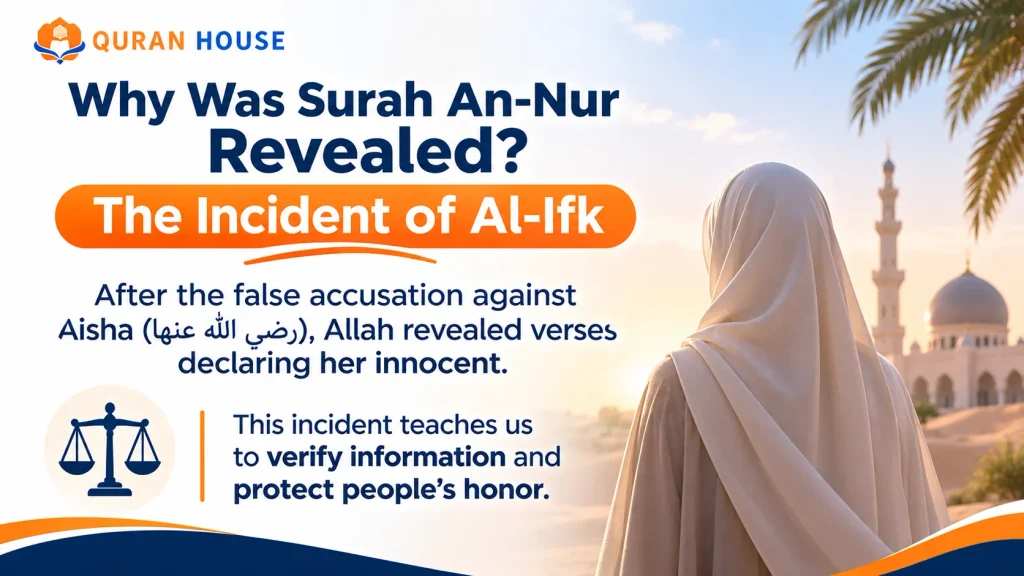
Why Was Surah An-Nur Revealed? The Incident of Al-Ifk
A significant portion of Surah An-Nur was revealed in connection with the incident of Al-Ifk, the false accusation against Aisha (رضي الله عنها), the wife of Prophet Muhammad ﷺ. This event highlights the importance of justice, verifying information, and protecting people’s honor.
Aisha narrated the events leading to the revelation:
The Journey: Aisha accompanied the Prophet ﷺ on an expedition. During the return journey, she left the camp to search for a lost necklace. Meanwhile, the army departed, mistakenly believing she was inside her covered howdah.
The False Accusation: Safwan ibn al-Mu’attal found Aisha and escorted her back to the army. Abdullah ibn Ubayy ibn Salul, the leader of the hypocrites, spread a false accusation against her.
The Difficult Trial: The rumor circulated in Madinah for approximately a month. Aisha became ill and only later discovered the accusations being made against her.
Allah’s Declaration of Innocence: Allah revealed verses declaring Aisha innocent of the accusations. The Prophet ﷺ informed her:
This incident demonstrates the seriousness of spreading false accusations and establishes important principles for protecting dignity, maintaining justice, and avoiding harmful rumors.
Surah Noor Benefits and Main Themes
Surah An-Nur addresses essential principles that guide individual behavior, family relationships, and social responsibility. Its teachings emphasize moral conduct, justice, and spiritual guidance.
The main themes include:
Morality and Modesty: Encouraging chastity, lowering the gaze, and maintaining appropriate behavior.
Protection of Honor and Justice: Prohibiting false accusations and requiring strict evidence before making allegations.
Family Privacy: Teaching the importance of seeking permission before entering homes and respecting personal boundaries.
Mercy and Repentance: Encouraging forgiveness and sincere repentance after wrongdoing.
Divine Guidance: Presenting Allah as the Light of the heavens and the earth and emphasizing His guidance.
Together, these themes provide a framework for building a community based on faith, dignity, justice, and mutual respect.
How Does Surah An-Nur Compare to Other Surahs with Legal Rulings?
Surah An-Nur shares several themes with other Madani surahs, particularly Surah Al-Baqarah and Surah An-Nisa, which combine Islamic legal rulings with moral and spiritual guidance.
While Surah Al-Baqarah addresses broad aspects of worship, family law, and community responsibilities, Surah An-Nisa emphasizes family relationships, inheritance, and social justice. Surah An-Nur focuses more specifically on modesty, protecting reputations, household privacy, and ethical conduct.
One of its distinguishing features is its connection to the incident of Al-Ifk, which establishes lasting lessons about evidence, rumors, justice, and forgiveness. These teachings remain relevant to modern challenges involving personal privacy, social media, and public accusations.
How to Apply Surah An-Nur’s Lessons in Daily Life
Surah An-Nur provides practical guidance for maintaining respectful relationships, protecting personal dignity, and strengthening faith. Muslims can apply its teachings through everyday actions.
Respect Household Privacy: Seek permission and greet others before entering their homes, as instructed in Surah An-Nur, 24:27.
Verify Information Before Sharing: Avoid spreading rumors or accusations without reliable evidence (Surah An-Nur, 24:15).
Think Well of Others: Avoid assuming wrongdoing based on unsupported claims and maintain a positive opinion of fellow believers (Surah An-Nur, 24:12).
Practice Forgiveness: Follow the example of Abu Bakr by showing mercy and maintaining kindness toward those who have wronged you (Surah An-Nur, 24:22).
Reflect on Allah’s Guidance: Contemplate the Verse of Light to strengthen faith and seek clarity during difficult moments (Surah An-Nur, 24:35).
Understanding these lessons helps Muslims develop stronger moral values and build relationships based on trust, forgiveness, and respect.
To explore the deeper meanings of Surah An-Nur and understand its verses with qualified guidance, join the Online Tafseer Course at Quran House.
Learning Through Play: A Live Kids Class
Young learners stay focused when lessons feel like a game. Watch a real Quran House class where interactive activities and a patient tutor keep a child engaged, reciting, and smiling from start to finish.
Start Your Quran Journey With Quran House
Learn live and one-on-one with Al-Azhar-trained tutors, male and female, for children and adults, at a time that fits your timezone.
Deepen Your Understanding of Surah An-Nur with Quran House
Surah An-Nur teaches valuable lessons about modesty, justice, family privacy, and divine guidance. Understanding these teachings through authentic Quranic interpretation helps Muslims apply them correctly in daily life. At Quran House, our Al-Azhar-trained teachers guide students through the meanings, historical context, and practical lessons of Surah An-Nur through personalized online Quran and Tafseer classes.
Since 2018, Quran House has offered live one-on-one lessons for children and adults in Quran reading, Tajweed, memorization, Quranic Arabic, and Tafseer. Whether you want to explore Surah An-Nur verse by verse, improve your recitation, or memorize its verses, our teachers provide structured guidance tailored to your level and learning goals.
Ready to deepen your connection with the Quran?Book your 2 free sessions and start learning with a qualified Al-Azhar tutor from the comfort of your home.
Surah An-Nur provides essential guidance on faith, morality, justice, and social responsibility. Its teachings on modesty, family privacy, and protecting people’s honor help build a society based on dignity, trust, and mutual respect.
The incident of Al-Ifk highlights the importance of verifying information, avoiding false accusations, and thinking well of others. The surah also emphasizes repentance and forgiveness, reminding believers that justice and mercy are both essential to maintaining strong relationships and peaceful communities.
Above all, the Verse of Light reminds Muslims that true guidance comes from Allah alone. By reading Surah An-Nur with understanding and applying its lessons in daily life, believers can strengthen their faith, improve their conduct, and develop a deeper connection with the Quran.
Frequently Asked Questions About Surah An-Nur
1. What Are the Main Benefits of Surah An-Nur?
Surah An-Nur provides guidance on faith, modesty, justice, and social responsibility. Its teachings emphasize protecting family relationships, respecting privacy, avoiding false accusations, verifying information, and practicing forgiveness. The Verse of Light (24:35) also encourages believers to reflect on Allah’s guidance.
2. What Does the Name An-Nur Mean?
An-Nur means “The Light” in Arabic. The surah takes its name from the famous Verse of Light, which describes Allah as the Light of the heavens and the earth (Surah An-Nur, 24:35).
3. What Event Is Connected to the Revelation of Surah An-Nur?
A significant portion of Surah An-Nur was revealed following the incident of Al-Ifk, when Aisha (رضي الله عنها) was falsely accused. Allah revealed verses declaring her innocence and establishing important lessons about justice and protecting people’s reputations (Sahih al-Bukhari 4750).
4. Why Does Surah An-Nur Require Four Witnesses for Accusations of Zina?
Surah An-Nur requires four witnesses to establish accusations of zina under Islamic law. This strict evidentiary standard protects individuals from false allegations and safeguards their honor and reputation (Surah An-Nur, 24:4).
5. Is There an Authentic Hadith About Teaching Women Surah An-Nur?
The commonly circulated narration encouraging people to teach women spinning and Surah An-Nur is considered fabricated by hadith scholars. A separate report attributed to Umar ibn al-Khattab (رضي الله عنه) encourages teaching women Surah An-Nur, but it should not be presented as an authentic saying of the Prophet ﷺ.
6. How Many Verses Does Surah An-Nur Have?
Surah An-Nur contains 64 verses and is the 24th chapter of the Quran. It is a Madani surah, revealed after the Hijrah of Prophet Muhammad ﷺ, and is located in Juz 18.