| Key Takeaways |
| Surah At-Tahrim is the 66th chapter, a Medinan surah of 12 verses that teaches repentance, family responsibility, and personal accountability before Allah. |
| Sincere repentance, called tawbah nasuha, is promised forgiveness and Gardens in verse 8, which makes it the central spiritual benefit of the surah. |
| No authentic hadith assigns a special reward to reciting Surah At-Tahrim, so every benefit here comes from the verses and their meanings. |
| Asiyah and Maryam show that faith can survive tyranny, while the wives of Nuh and Lut show that family ties cannot replace personal belief. |
Surah Tahrim benefits are rooted in twelve Medinan verses that connect the private life of the Prophet to lessons for every home. The surah teaches believers to respect Allah’s limits, protect their families, and return to Him with sincere repentance.
Many readers look up the benefits of Surah Tahrim hoping to find a fixed recitation reward. The reality is more valuable. No authentic hadith assigns one, yet the verses give clear spiritual, moral, and family guidance.
This guide connects each benefit to its verse, the authentic report behind its revelation, and a practical step for daily life. The benefits are as follows.
1. Respect the Limits Allah Sets for Halal and Haram
Surah At-Tahrim opens by teaching that no believer, not even the Prophet, should forbid what Allah has made lawful. This protects religion from both excess and invention.
Sahih al-Bukhari 4912 on the Honey Incident
Aisha reported the incident that stands behind the opening verses. Her account shows how a private oath became a public lesson about lawful things.
كَانَ رَسُولُ اللَّهِ صلى الله عليه وسلم يَشْرَبُ عَسَلاً عِنْدَ زَيْنَبَ ابْنَةِ جَحْشٍ وَيَمْكُثُ عِنْدَهَا فَوَاطَيْتُ أَنَا وَحَفْصَةُ عَنْ أَيَّتُنَا دَخَلَ عَلَيْهَا فَلْتَقُلْ لَهُ أَكَلْتَ مَغَافِيرَ إِنِّي أَجِدُ مِنْكَ رِيحَ مَغَافِيرَ، قَالَ لاَ وَلَكِنِّي كُنْتُ أَشْرَبُ عَسَلاً عِنْدَ زَيْنَبَ ابْنَةِ جَحْشٍ فَلَنْ أَعُودَ لَهُ وَقَدْ حَلَفْتُ لاَ تُخْبِرِي بِذَلِكِ أَحَدًا
(Kaana Rasoolullaahi sallallaahu ‘alayhi wa sallam yashrabu ‘asalan ‘inda Zaynaba ibnati Jahsh wa yamkuthu ‘indahaa, fawaatayto ana wa Hafsatu ‘an ayyatinaa dakhala ‘alayhaa falataqul lahu akalta maghaafeera innee ajidu minka reeha maghaafeera, qaala laa wa laakinnee kuntu ashrabu ‘asalan ‘inda Zaynaba ibnati Jahsh falan a’ooda lahu wa qad halaftu laa tukhbiree bidhaalika ahadan)
(“Allah’s Messenger (ﷺ) used to drink honey in the house of Zainab, the daughter of Jahsh, and would stay there with her. So Hafsa and I agreed secretly that, if he come to either of us, she would say to him, ‘It seems you have eaten Maghafir (a kind of bad-smelling resin), for I smell in you the smell of Maghafir,’ (We did so) and he replied, ‘No, but I was drinking honey in the house of Zainab, the daughter of Jahsh, and I shall never take it again. I have taken an oath as to that, and you should not tell anybody about it.’”)
Surah At-Tahrim 66:1 on Prohibiting What Allah Allows
The first verse addresses the Prophet with tenderness. It corrects the oath while reminding him that Allah is forgiving and merciful, so correction and mercy arrive together.
يَا أَيُّهَا النَّبِيُّ لِمَ تُحَرِّمُ مَا أَحَلَّ اللَّهُ لَكَ تَبْتَغِي مَرْضَاتَ أَزْوَاجِكَ وَاللَّهُ غَفُورٌ رَحِيمٌ
(Yaa ayyuhan-Nabiyyu lima tuharrimu maa ahallal-laahu laka, tabtaghee mardaata azwaajika, wallaahu Ghafoorur-Raheem)
(“O Prophet, why do you prohibit [yourself from] what Allah has made lawful for you, seeking the approval of your wives? And Allah is Forgiving and Merciful.”)
The benefit here is a balanced mindset. A believer neither forbids the lawful to please people nor permits the forbidden to please desire, because halal and haram belong to Allah alone.
The next verse confirms that Allah prescribed a way to release oaths of this kind. Religion stays practical, and believers are never trapped by a hasty promise.
2. Surah Tahrim Benefits for Sincere Repentance and Hope
The greatest spiritual gift of the surah is the open door of tawbah nasuha, sincere repentance that Allah promises to answer with forgiveness and Gardens.
Verse 8 speaks to every believer and attaches a clear promise to repentance. No sin is too large for a sincere return.
يَا أَيُّهَا الَّذِينَ آمَنُوا تُوبُوا إِلَى اللَّهِ تَوْبَةً نَّصُوحًا عَسَىٰ رَبُّكُمْ أَن يُكَفِّرَ عَنكُمْ سَيِّئَاتِكُمْ وَيُدْخِلَكُمْ جَنَّاتٍ تَجْرِي مِن تَحْتِهَا الْأَنْهَارُ يَوْمَ لَا يُخْزِي اللَّهُ النَّبِيَّ وَالَّذِينَ آمَنُوا مَعَهُ نُورُهُمْ يَسْعَىٰ بَيْنَ أَيْدِيهِمْ وَبِأَيْمَانِهِمْ يَقُولُونَ رَبَّنَا أَتْمِمْ لَنَا نُورَنَا وَاغْفِرْ لَنَا إِنَّكَ عَلَىٰ كُلِّ شَيْءٍ قَدِيرٌ
(Yaa ayyuhal-ladheena aamanoo toobooo ilallaahi tawbatan nasoohan, ‘asaa rabbukum ay yukaffira ‘ankum sayyi’aatikum wa yudkhilakum jannaatin tajree min tahtihal-anhaaru yawma laa yukhzillaahun-Nabiyya wal-ladheena aamanoo ma’ahu nooruhum yas’aa bayna aydeehim wa bi-aymaanihim yaqooloona rabbanaa atmim lanaa noorana waghfir lanaa innaka ‘alaa kulli shay’in qadeer)
(“O you who have believed, repent to Allah with sincere repentance. Perhaps your Lord will remove from you your misdeeds and admit you into gardens beneath which rivers flow [on] the Day when Allah will not disgrace the Prophet and those who believed with him. Their light will proceed before them and on their right; they will say, ‘Our Lord, perfect for us our light and forgive us. Indeed, You are over all things competent.’”)
Scholars explain the word nasuha through conditions that turn regret into real change. Sincere repentance includes the following steps:
- Stop the sin immediately.
- Feel real regret for what happened.
- Resolve firmly not to return to it.
- Ask Allah for forgiveness with the tongue.
- Return any right owed to another person, or ask that person’s forgiveness.
- Leave the habits and company that pull you back.
Repentance in this surah is never a burden. It is an invitation, and the promised light on the Day of Judgment gives every struggling believer a reason to begin again.
Quran House offers an Understand the Quran Course that helps students connect verses like this one to their meanings through live, one-on-one lessons with Al-Azhar-trained tutors.
3. Protect Yourself and Your Family from the Fire
Verse 6 gives every believer a duty that begins at home: protect yourself first, then guide the family that Allah placed in your care.
The command is direct and applies to parents, spouses, and guardians alike. Responsibility here means teaching, not only providing.
يَا أَيُّهَا الَّذِينَ آمَنُوا قُوا أَنفُسَكُمْ وَأَهْلِيكُمْ نَارًا وَقُودُهَا النَّاسُ وَالْحِجَارَةُ عَلَيْهَا مَلَائِكَةٌ غِلَاظٌ شِدَادٌ لَّا يَعْصُونَ اللَّهَ مَا أَمَرَهُمْ وَيَفْعَلُونَ مَا يُؤْمَرُونَ
(Yaa ayyuhal-ladheena aamanoo qoo anfusakum wa ahleekum naaran waqooduhan-naasu wal-hijaaratu ‘alayhaa malaa’ikatun ghilaazun shidaadun laa ya’soonallaaha maa amarahum wa yaf’aloona maa yu’maroon)
(“O you who have believed, protect yourselves and your families from a Fire whose fuel is people and stones, over which are appointed angels, harsh and severe; they do not disobey Allah in what He commands them but do what they are commanded.”)
Many scholars, including Ibn Kathir, connect the verse to teaching children prayer and good character early. Protection begins with knowledge, because a family cannot practice what it was never taught.
One of the most practical surah tahrim benefits is a family routine built around shared worship, honest speech, and gentle correction. Small habits repeated daily protect a home more than occasional lectures.
4. Overlook Small Faults to Protect Family Peace
Verse 3 shows the Prophet overlooking part of a matter that had been revealed to him. His dignity teaches believers how to protect relationships from needless conflict.
Allah describes how the Prophet handled a breach of confidence within his household. He mentioned part of the matter and let the rest go.
وَإِذْ أَسَرَّ النَّبِيُّ إِلَىٰ بَعْضِ أَزْوَاجِهِ حَدِيثًا فَلَمَّا نَبَّأَتْ بِهِ وَأَظْهَرَهُ اللَّهُ عَلَيْهِ عَرَّفَ بَعْضَهُ وَأَعْرَضَ عَنْ بَعْضٍ فَلَمَّا نَبَّأَهَا بِهِ قَالَتْ مَنْ أَنبَأَكَ هَٰذَا قَالَ نَبَّأَنِيَ الْعَلِيمُ الْخَبِيرُ
(Wa idh asarran-Nabiyyu ilaa ba’di azwaajihee hadeethan, falammaa nabba’at bihee wa azharahullaahu ‘alayhi ‘arrafa ba’dahoo wa a’rada ‘am ba’din, falammaa nabba’ahaa bihee qaalat man anba’aka haadhaa, qaala nabba’aniyal-‘Aleemul-Khabeer)
(“And [remember] when the Prophet confided to one of his wives a statement; and when she informed [another] of it and Allah showed it to him, he made known part of it and ignored a part. And when he informed her about it, she said, ‘Who told you this?’ He said, ‘I was informed by the Knowing, the Acquainted.’”)
Overlooking does not mean ignoring serious harm. It means refusing to turn every small mistake into a trial, which keeps affection alive and leaves room for forgiveness.
The verse also warns about guarding private conversations. A secret shared in trust becomes a sacred responsibility, and carelessness with it can damage a home.
Quran House offers a Quran Tafseer for Kids program that helps children learn Quranic stories and manners, including honesty and kindness at home.
5. Choose Spouses of Faith, Repentance, and Devotion
Verse 5 names qualities that reflect deep faith and a preference for the Hereafter: submission, belief, devout obedience, repentance, worship, and sa’ihat, a term commentators explain as fasting or traveling for Allah’s sake.
The verse warns the Prophet’s wives that Allah could replace them with women of these qualities. Its words reveal what Allah values most in a household.
عَسَىٰ رَبُّهُ إِن طَلَّقَكُنَّ أَن يُبْدِلَهُ أَزْوَاجًا خَيْرًا مِّنكُنَّ مُسْلِمَاتٍ مُّؤْمِنَاتٍ قَانِتَاتٍ تَائِبَاتٍ عَابِدَاتٍ سَائِحَاتٍ ثَيِّبَاتٍ وَأَبْكَارًا
(‘Asaa rabbuhoo in tallaqakunna an yubdilahoo azwaajan khayram minkunna muslimaatin mu’minaatin qaanitaatin taa’ibaatin ‘aabidaatin saa’ihaatin thayyibaatin wa abkaaraa)
(“Perhaps his Lord, if he divorced you [all], would substitute for him wives better than you, submitting [to Allah], believing, devoutly obedient, repentant, worshiping, and traveling, [ones] previously married and virgins.”)
The verse addressed the Prophet’s household, so scholars draw guidance from it carefully rather than treating it as a ruling on divorce. Its lasting benefit is a clear checklist for choosing a spouse.
The same list works as honest self-assessment inside marriage. Each spouse can ask which of these qualities they are building, and how the couple can support one another.
6. Rely on Personal Faith, Not Family Ties
Verse 10 teaches that marriage to a righteous person cannot save a disbeliever, because every soul answers for its own choices before Allah.
The surah gives two examples of women who lived beside prophets yet did not follow them. Their story removes any hope of borrowed salvation.
ضَرَبَ اللَّهُ مَثَلًا لِّلَّذِينَ كَفَرُوا امْرَأَتَ نُوحٍ وَامْرَأَتَ لُوطٍ كَانَتَا تَحْتَ عَبْدَيْنِ مِنْ عِبَادِنَا صَالِحَيْنِ فَخَانَتَاهُمَا فَلَمْ يُغْنِيَا عَنْهُمَا مِنَ اللَّهِ شَيْئًا وَقِيلَ ادْخُلَا النَّارَ مَعَ الدَّاخِلِينَ
(Darabal-laahu mathalan lil-ladheena kafaroomra’ata Noohin wamra’ata Lootin, kaanataa tahta ‘abdayni min ‘ibaadinaa saalihayni fakhaanataahumaa falam yughniyaa ‘anhumaa minal-laahi shay’an wa qeelad-khulan-naara ma’ad-daakhileen)
(“Allah presents an example of those who disbelieved: the wife of Noah and the wife of Lot. They were under two of Our righteous servants but betrayed them, so those prophets did not avail them from Allah at all, and it was said, ‘Enter the Fire with those who enter.’”)
Scholars explain that the betrayal in this verse concerned faith, not chastity. The lesson is humbling: guidance comes from Allah, and a believer’s duty is to teach sincerely and then trust Him.
A Real Surah Lesson: Surah Ash-Shams
Watch a student work through Surah Ash-Shams step by step with their tutor, practicing each ayah until the recitation flows clearly and correctly.
Start Your Quran Journey With Quran House
Learn live and one-on-one with Al-Azhar-trained tutors, male and female, for children and adults, at a time that fits your timezone.
Try a Free Session7. Stay Steadfast Under Pressure Like Asiyah
Asiyah, the wife of Pharaoh, proves that a believer can protect faith inside the harshest environment. Allah presents her as a model for every believer facing pressure.
Her short prayer in verse 11 carries deep awareness. She asked for closeness to Allah before asking for a home.
وَضَرَبَ اللَّهُ مَثَلًا لِّلَّذِينَ آمَنُوا امْرَأَتَ فِرْعَوْنَ إِذْ قَالَتْ رَبِّ ابْنِ لِي عِندَكَ بَيْتًا فِي الْجَنَّةِ وَنَجِّنِي مِن فِرْعَوْنَ وَعَمَلِهِ وَنَجِّنِي مِنَ الْقَوْمِ الظَّالِمِينَ
(Wa darabal-laahu mathalan lil-ladheena aamanumra’ata Fir’awna idh qaalat rabbibni lee ‘indaka baytan fil-jannati wa najjinee min Fir’awna wa ‘amalihee wa najjinee minal-qawmiz-zaalimeen)
(“And Allah presents an example of those who believed: the wife of Pharaoh when she said, ‘My Lord, build for me near You a house in Paradise and save me from Pharaoh and his deeds and save me from the wrongdoing people.’”)
She lived in a palace yet chose the proximity of Allah over comfort, status, and safety. Her example reminds believers that environment tests faith but never has the final word.
Faith like hers grows through daily contact with the Quran, which is why many families explore why memorizing the Quran matters before choosing a study plan.
8. Follow Maryam as a Model of Devotion and Purity
Verse 12 closes the surah with Maryam, daughter of Imran, whom Allah describes as chaste, firm in belief, and devoutly obedient.
Her mention completes the contrast that began with the wives of Nuh and Lut. Righteousness is a personal choice, not an inheritance.
وَمَرْيَمَ ابْنَتَ عِمْرَانَ الَّتِي أَحْصَنَتْ فَرْجَهَا فَنَفَخْنَا فِيهِ مِن رُّوحِنَا وَصَدَّقَتْ بِكَلِمَاتِ رَبِّهَا وَكُتُبِهِ وَكَانَتْ مِنَ الْقَانِتِينَ
(Wa Maryama-bnata ‘Imraanal-latee ahsanat farjahaa fanafakhnaa feehi min roohinaa wa saddaqat bi-kalimaati rabbihaa wa kutubihee wa kaanat minal-qaaniteen)
(“And [the example of] Mary, the daughter of ‘Imran, who guarded her chastity, so We blew into it [i.e., her garment] through Our angel [Gabriel], and she believed in the words of her Lord and His scriptures and was of the devoutly obedient.”)
Together, Asiyah and Maryam show that sacrifice and devotion are not limited to men. Women carry the message of Islam in private worship, family life, and public service.
Quran House offers a Quran Memorization for Sisters and Women course that gives women a private, supportive space to memorize and review with qualified tutors.
9. Rely on Authentic Reports About Virtue and Rewards
No authentic hadith assigns a fixed reward to reciting Surah At-Tahrim, so the trustworthy approach is to value it through its verses and meanings.
The surah does belong to the Mufassal, the final section of the Quran. A report in Musnad Ahmad, graded hasan, says the Prophet was favored with the Mufassal.
Some books attribute special formulas and rewards to this surah without a sound chain. The table below separates common claims from what can be relied on.
| Common Claim | Status | Safer Approach |
| A fixed reward for reciting the surah | No authentic hadith found | Recite with understanding and reflection. |
| Cures, sleep formulas, or debt relief | Not established in authentic Sunnah | Seek treatment and make authentic dua. |
| Numbered repetitions for jobs or release | Not established in Quran or Sunnah | Avoid inventing fixed rituals. |
| Belonging to the Mufassal | Supported by a hasan report | Mention it with its grading. |
Being honest about this protects readers from invented rituals. It also keeps attention on the benefits of Surah Tahrim that Allah Himself describes in its verses.
10. Memorize and Recite Surah At-Tahrim with Tajweed
Surah At-Tahrim sits in Juz 28 and has only twelve verses, so it is manageable for students building a regular recitation habit.
Accurate recitation depends on correct articulation and rules. A student who understands what tajweed is and why it matters recites with more confidence and fewer errors.
The table below groups the verses by theme, so each study session has a clear focus.
| Verses | Theme | Study Focus |
| 1 to 5 | Lawful limits and the household incident | Revelation context and repentance. |
| 6 to 8 | Protecting family and sincere repentance | Duties of guidance and tawbah. |
| 9 to 10 | Striving against hypocrisy and the wives of Nuh and Lut | Accountability and personal faith. |
| 11 to 12 | Asiyah and Maryam | Dua, devotion, and steadfastness. |
A simple plan is to learn one verse every two days and review earlier verses each morning. At that pace, a student finishes the surah in about three to four weeks.
Quran House offers a Learn Quran Reading with Tajweed for Beginners course where tutors correct pronunciation in real time, so students build accuracy from the first lesson.
Why Was Surah At-Tahrim Revealed in Madinah?
Surah At-Tahrim was revealed after the Prophet forbade himself something lawful to please his wives, and Allah corrected the matter with mercy.
The table below summarizes the key facts about the surah.
| Fact | Detail |
| Surah number | 66 |
| Meaning of the name | The Prohibition |
| Number of verses | 12 |
| Place of revelation | Madinah |
| Juz | 28 |
| Order of revelation | 105th, after Al-Hujurat and before Al-Jumuah |
The name comes from the words “lima tuharrimu” in the first verse. Al-Bukhari and Muslim report the honey incident from Aisha, and Ibn Kathir and Al-Qurtubi favor it as the cause of revelation.
Scholars also mention another narration involving Mariyah, but the honey account in the two Sahihs is the one most commonly relied on. Either way, the lesson stays the same.
The surah treats a household matter with honesty and gentleness. It then widens into guidance on repentance, family duty, and individual accountability that applies to every believer.
How to Apply Surah At-Tahrim in Daily Life
Reading about these benefits matters only when they change daily habits. The following steps turn the surah into a weekly practice:
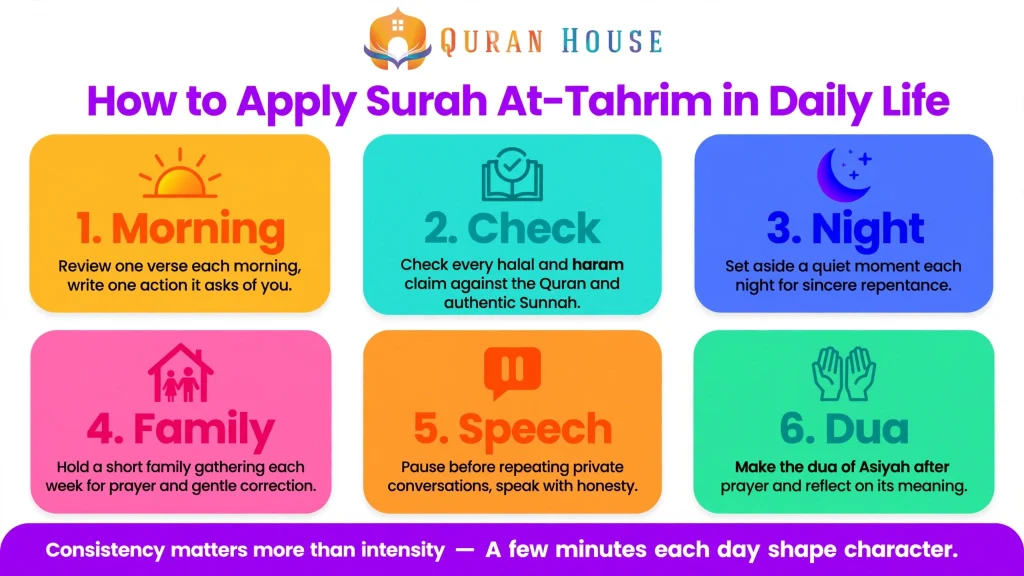
- Review one verse each morning and write one action it asks of you.
- Check every halal and haram claim against the Quran and authentic Sunnah.
- Set aside a quiet moment each night for sincere repentance.
- Hold a short family gathering each week for prayer and gentle correction.
- Pause before repeating private conversations, and speak with honesty.
- Make the dua of Asiyah after prayer and reflect on its meaning.
Consistency matters more than intensity. A few minutes each day with understanding will shape character more than a single long session once a month.
Inside an Interactive One-on-One Session
Every class is live and personal. See how our tutor uses on-screen tools, quick reviews, and gentle correction to help a student build confidence with every new word.
Start Your Quran Journey With Quran House
Learn live and one-on-one with Al-Azhar-trained tutors, male and female, for children and adults, at a time that fits your timezone.
Try a Free SessionStudy Surah At-Tahrim with Quran House Expert Instructors
At Quran House, students learn Quran reading, tajweed, memorization, and tafseer in live one-on-one sessions with Al-Azhar-trained tutors. Classes fit your schedule, and sisters can choose a female tutor for a private learning space.
Our Quran Courses
- Understand the Quran Course.
- Quran Tafseer Course for All Levels.
- Quran Tafseer for Kids.
- Quran Memorization for Sisters and Women.
- Quran Memorization for Adults.
- Learn Quran Reading with Tajweed for Beginners.
Conclusion
Surah Tahrim benefits reach every part of a believer’s life, from the way a person handles halal and haram to the way a family prays, forgives, and repents together.
The surah moves from a small household incident to universal lessons. It offers hope through repentance, responsibility through family guidance, and humility through the contrast between Asiyah, Maryam, and the wives of Nuh and Lut.
Studying the benefits of Surah Tahrim with sound sources and a qualified teacher turns reading into action. Begin with one verse, apply one lesson, and let the surah shape your home.
FAQs
What Is the Main Lesson of Surah At-Tahrim?
The main lesson is building a home on respect for Allah’s limits. The surah calls believers to protect their families, repent sincerely, and remember that every person answers for their own faith and deeds.
Is There an Authentic Hadith About the Virtue of Surah At-Tahrim?
No authentic hadith assigns a specific reward to reciting this surah. It belongs to the Mufassal, which a hasan report mentions, but its real benefit comes from its verses and guidance.
Why Is Surah At-Tahrim Called At-Tahrim?
The name means the prohibition. It comes from the opening verse, which asks why the Prophet forbade himself what Allah had made lawful, an incident reported by Aisha in Sahih al-Bukhari.
Which Juz Contains Surah At-Tahrim?
Surah At-Tahrim is in Juz 28 of the Quran. It is the 66th surah and has twelve verses, which makes it a practical choice for students building a memorization habit.
Why Are Asiyah and Maryam Mentioned in the Surah?
Allah presents them as examples of believing women who stayed faithful under pressure. They balance the examples of the wives of Nuh and Lut, showing that personal faith matters more than circumstances.