| Key Takeaways |
| Surah At-Tawbah teaches that Allah accepts sincere repentance, and verse 9:104 states this directly, so no believer should despair of returning to Him. |
| The surah protects faith by exposing hypocrisy, praising truthful people, and commanding believers to keep their promises even when a treaty becomes difficult. |
| Verses 9:122 and 9:128 link the surah to seeking religious knowledge and to loving a Messenger who deeply cared about the hardships of his community. |
| Reading Surah At-Tawbah with tafseer, Tajweed, and a qualified teacher turns each lesson into daily practice instead of general admiration. |
The benefits of Surah Tawbah reach every Muslim who wants to return to Allah after a mistake, strengthen sincerity, and live with honesty. Revealed in Madinah near the end of the Prophet’s mission, it speaks about repentance, loyalty, and trust.
Many readers who search for surah taubah benefits expect only a list of rewards. The surah offers more: a clear path to repentance, a test for sincerity, and guidance for building a trustworthy community.
Each section below explains one lesson using verses from the surah, authentic hadith, and practical reflection. The following benefits are drawn directly from the text of Surah At-Tawbah and its historical setting.
1. Receive Allah’s Acceptance of Sincere Repentance
The first and most visible benefit is the one that gives the surah its name. Allah announces in verse 104 that He accepts repentance from His servants, and the verse links this acceptance to charity.
The verse begins with a question that gently corrects a common doubt about forgiveness, and it shows how close Allah’s acceptance is for anyone who truly returns to Him.
أَلَمۡ يَعۡلَمُوٓاْ أَنَّ ٱللَّهَ هُوَ يَقۡبَلُ ٱلتَّوۡبَةَ عَنۡ عِبَادِهِۦ وَيَأۡخُذُ الصَّدَقَاتِ وَأَنَّ ٱللَّهَ هُوَ ٱلتَّوَّابُ ٱلرَّحِيمُ
(Alam ya‘lamoo anna Allaha huwa yaqbalu alttawbata ‘an ‘ibadihi wayakhuthu alssadaqati waanna Allaha huwa alttawwabu alrraheemu)
(“Do they not know that it is Allah who accepts repentance from His servants and receives charities and that it is Allah who is the Accepting of repentance, the Merciful.”)
This question reminds believers that forgiveness is not a rare favor given only to the righteous. Allah is At-Tawwab, the One who turns to His servants again and again and invites every sinner back to Him.
The Prophet ﷺ confirmed that this door of repentance stays open until the moment death approaches, which is why believers should return to Allah without delay and without despair.
إِنَّ اللَّهَ عَزَّ وَجَلَّ لَيَقْبَلُ تَوْبَةَ الْعَبْدِ مَا لَمْ يُغَرْغِرْ
(Inna Allaha ‘azza wa jalla layaqbalu tawbatal-‘abdi ma lam yugharghir)
(“Allah accepts the repentance of His slave so long as the death rattle has not yet reached his throat.”)
Scholars summarize sincere repentance as stopping the sin, feeling regret, and resolving not to return. Verse 104 shows that this return is received by Allah Himself, which turns guilt into hope instead of shame.
2. Find Hope for Forgiveness After Admitting Mistakes
Verse 102 describes believers who admitted their faults instead of making excuses. Commentators connect it to some of those who stayed behind from the Tabuk expedition and then confessed honestly.
Allah describes the situation of these believers in a balanced and merciful way, acknowledging both their sincere efforts and their serious mistake in a single verse.
وَءَاخَرُونَ ٱعۡتَرَفُواْ بِذُنُوبِهِمۡ خَلَطُواْ عَمَلٗا صَٰلِحٗا وَءَاخَرَ سَيِّئًا عَسَى ٱللَّهُ أَن يَتُوبَ عَلَيۡهِمۡۚ إِنَّ ٱللَّهَ غَفُورٞ رَّحِيمٌ
(Waakharoona i‘tarafoo bithunoobihim khalatoo ‘amalan salihan waakhara sayyian ‘asa Allahu an yatooba ‘alayhim inna Allaha ghafoorun raheemun)
(“And [there are] others who have acknowledged their sins. They had mixed a righteous deed with another that was bad. Perhaps Allah will turn to them in forgiveness. Indeed, Allah is Forgiving and Merciful.”)
The verse does not pretend these believers were perfect. It says they mixed a good deed with a bad one, which describes most people honestly, and it still offers hope through the word asa, meaning perhaps.
That hope matters for anyone trapped by past mistakes. Admitting the sin comes first, then comes the effort to correct it, and Allah is described as Ghafoor and Raheem, the Forgiving and the Merciful.
Quran House offers a Learn Quran Reading with Tajweed for Beginners course that helps new learners recite verses like these accurately, with a live tutor correcting every sound.
Start Your Free Trial Lesson Today
3. Purify Wealth and Heart Through Sincere Charity
Right after speaking about confession, the surah links repentance with action. Verse 103 tells the Prophet ﷺ to take charity from believers, because giving purifies the giver in both heart and property.
The verse explains charity in terms of spiritual cleansing, not only financial duty, and it shows that giving can heal the heart as well as help other people.
خُذۡ مِنۡ أَمۡوَٰلِهِمۡ صَدَقَةٗ تُطَهِّرُهُمۡ وَتُزَكِّيهِم بِهَا وَصَلِّ عَلَيۡهِمۡۖ إِنَّ صَلَوٰتَكَ سَكَنٞ لَّهُمۡۗ وَٱللَّهُ سَمِيعٌ عَلِيمٌ
(Khuth min amwalihim sadaqatan tutahhiruhum watuzakkeehim biha wasalli ‘alayhim inna salataka sakanun lahum waAllahu samee‘un ‘aleemun)
(“Take, [O, Muhammad], from their wealth a charity by which you purify them and cause them increase, and invoke [Allah’s blessings] upon them. Indeed, your invocations are reassurance for them. And Allah is Hearing and Knowing.”)
Charity here is described with two words, tutahhiruhum and tuzakkihim, meaning to purify and to cause growth. Money given sincerely cleans the soul from greed and increases the blessing in what remains.
The next verse, 9:104, connects charity directly with repentance, so a believer who wants to return to Allah can add a practical step. Giving sadaqah after a mistake shows that the regret is real.
4. Guard Your Faith Against Hypocrisy
A large portion of the surah describes hypocrites who professed belief but avoided sacrifice and spread doubt. The benefit for readers today is a clear standard for checking whether faith is real or only spoken.
The Prophet ﷺ gave a simple test of practical hypocrisy that fits the surah’s warning. Scholars explain that these traits do not remove a person from Islam, but they must be taken seriously and corrected.
The hadith below lists three habits that reveal a gap between belief and behavior, and each one is a practical warning that fits the surah’s long discussion of hypocrisy.
آيَةُ الْمُنَافِقِ ثَلاَثٌ إِذَا حَدَّثَ كَذَبَ، وَإِذَا وَعَدَ أَخْلَفَ، وَإِذَا اؤْتُمِنَ خَانَ
(Ayatul-munafiqi thalathun: idha haddatha kathaba, wa idha wa‘ada akhlafa, wa idha-’tumina khana)
(“The signs of a hypocrite are three: whenever he speaks, he tells a lie; whenever he promises, he always breaks it; and if you trust him, he proves to be dishonest.”)
Lying, breaking promises, and betraying trust are daily habits, not distant historical problems. Surah At-Tawbah teaches believers to examine these habits early, repent from them, and keep the heart and actions consistent.
Quran House offers an Understand the Quran Course that explains verses like these in clear language so students can apply their meaning to daily conduct.
Book Your Free Trial Class Now
5. Stay With the Truthful and Honor Every Promise
Truthfulness is a central benefit of the surah, and verse 119 gives a direct command to keep company with honest people. The command works together with the surah’s strong teaching about treaties and promises.
Allah addresses believers directly in a short and memorable command that joins two duties, fearing Him and choosing the company of honest people in daily life.
يَـٰٓأَيُّهَا ٱلَّذِينَ ءَامَنُواْ ٱتَّقُواْ ٱللَّهَ وَكُونُواْ مَعَ ٱلصَّـٰدِقِينَ
(Ya ayyuha allatheena amanoo ittaqoo Allaha wakoonoo ma‘a alssadiqeena)
(“O you who have believed, fear Allah and be with those who are true.”)
Notice that the verse joins taqwa with companionship. Fear of Allah is protected by the people around a believer, so choosing honest friends becomes part of worship and not only a social preference.
The same honesty appears in how the surah treats agreements, even with people who disagree with Muslims, because keeping a promise remains a duty whatever the circumstances.
إِلَّا ٱلَّذِينَ عَٰهَدتُّم مِّنَ ٱلۡمُشۡرِكِينَ ثُمَّ لَمۡ يَنقُصُوكُمۡ شَيۡـٔٗا وَلَمۡ يُظَٰهِرُواْ عَلَيۡكُمۡ أَحَدٗا فَأَتِمُّوٓاْ إِلَيۡهِمۡ عَهۡدَهُمۡ إِلَىٰ مُدَّتِهِمۡۚ إِنَّ ٱللَّهَ يُحِبُّ ٱلۡمُتَّقِينَ
(Illa allatheena ‘ahadtum mina almushrikeena thumma lam yanqusookum shayan walam yuthahiroo ‘alaykum ahadan faatimmoo ilayhim ‘ahdahum ila muddatihim inna Allaha yuhibbu almuttaqeena)
(“Excepted are those with whom you made a treaty among the polytheists and then they have not been deficient toward you in anything or supported anyone against you; so complete for them their treaty until their term [has ended]. Indeed, Allah loves the righteous [who fear Him].”)
Verse 4 commands Muslims to complete a treaty with those who did not break it, and it ends by saying that Allah loves the righteous. Keeping a promise is therefore a sign of taqwa, even when keeping it is inconvenient.
A Real Surah Lesson: Surah Ash-Shams
Watch a student work through Surah Ash-Shams step by step with their tutor, practicing each ayah until the recitation flows clearly and correctly.
Start Your Quran Journey With Quran House
Learn live and one-on-one with Al-Azhar-trained tutors, male and female, for children and adults, at a time that fits your timezone.
Try a Free Session6. Trust Allah When Hardship Feels Heavy
Surah At-Tawbah also teaches reliance on Allah during fear and pressure. The surah recalls the cave where the Prophet ﷺ calmed Abu Bakr with a sentence that every believer can repeat.
Allah reminds believers of that moment when the Prophet ﷺ and his companion were hiding from their enemies, and the verse shows how calm replaced fear in the cave.
إِلَّا تَنصُرُوهُ فَقَدۡ نَصَرَهُ ٱللَّهُ إِذۡ أَخۡرَجَهُ ٱلَّذِينَ كَفَرُواْ ثَانِيَ ٱثۡنَيۡنِ إِذۡ هُمَا فِي ٱلۡغَارِ إِذۡ يَقُولُ لِصَٰحِبِهِۦ لَا تَحۡزَنۡ إِنَّ ٱللَّهَ مَعَنَاۖ فَأَنزَلَ ٱللَّهُ سَكِينَتَهُۥ عَلَيۡهِ وَأَيَّدَهُۥ بِجُنُودٖ لَّمۡ تَرَوۡهَا وَجَعَلَ كَلِمَةَ ٱلَّذِينَ كَفَرُواْ ٱلسُّفۡلَىٰۗ وَكَلِمَةُ ٱللَّهِ هِيَ ٱلۡعُلۡيَاۗ وَٱللَّهُ عَزِيزٌ حَكِيمٌ
(Illa tansuroohu faqad nasarahu Allahu ith akhrajahu allatheena kafaroo thaniya ithnayni ith huma fee alghari ith yaqoolu lisahibihi la tahzan inna Allaha ma‘ana faanzala Allahu sakeenatahu ‘alayhi waayyadahu bijunoodin lam tarawha waja‘ala kalimata allatheena kafaroo alssufla wakalimatu Allahi hiya al‘ulya waAllahu ‘azeezun hakeemun)
(“If you do not aid the Prophet, Allah has already aided him when those who disbelieved had driven him out [of Makkah] as one of two, when they were in the cave and he said to his companion, ‘Do not grieve; indeed Allah is with us.’ And Allah sent down his tranquility upon him and supported him with angels you did not see and made the word of those who disbelieved the lowest, while the word of Allah, that is the highest. And Allah is Exalted in Might and Wise.”)
The words “Allah is with us” show tawakkul in practice. The Prophet ﷺ did not ignore the danger, but he placed his confidence in Allah’s care. Reliance is one of the quieter benefits of Surah Tawbah, yet it supports every other lesson.
The surah ends with the same message. The final verse tells the Prophet ﷺ to say that Allah is sufficient for him, a statement believers can use when plans fail or support disappears.
The closing verse of the surah repeats this reliance in short words that many Muslims recite daily when they feel pressure, worry, or uncertainty about the future.
فَإِن تَوَلَّوۡاْ فَقُلۡ حَسۡبِيَ ٱللَّهُ لَآ إِلَٰهَ إِلَّا هُوَۖ عَلَيۡهِ تَوَكَّلۡتُۖ وَهُوَ رَبُّ ٱلۡعَرۡشِ ٱلۡعَظِيمِ
(Fain tawallaw faqul hasbiya Allahu la ilaha illa huwa ‘alayhi tawakkaltu wahuwa rabbu al‘arshi al‘atheemi)
(“But if they turn away, [O Muhammad], say, ‘Sufficient for me is Allah; there is no deity except Him. On Him I have relied, and He is the Lord of the Great Throne.’”)
Memorizing short verses like these keeps comfort close during difficult days. Students who want a structured plan can read why memorizing the Quran matters and see how Hifz builds a lasting bond with such verses.
7. Build a Caring Community Through Shared Duty
Beyond personal growth, the surah describes the ideal Muslim community. Verse 71 explains how believers support one another, correct one another, and stay connected to Allah through prayer and zakah.
The verse describes believers as one team with shared responsibilities, and it lists the duties that keep a Muslim community strong, merciful, and connected to Allah.
وَٱلۡمُؤۡمِنُونَ وَٱلۡمُؤۡمِنَٰتُ بَعۡضُهُمۡ أَوۡلِيَآءُ بَعۡضٖۚ يَأۡمُرُونَ بِٱلۡمَعۡرُوفِ وَيَنۡهَوۡنَ عَنِ ٱلۡمُنكَرِ وَيُقِيمُونَ ٱلصَّلَوٰةَ وَيُؤۡتُونَ ٱلزَّكَوٰةَ وَيُطِيعُونَ ٱللَّهَ وَرَسُولَهُۥٓۚ أُوْلَـٰٓئِكَ سَيَرۡحَمُهُمُ ٱللَّهُۗ إِنَّ ٱللَّهَ عَزِيزٌ حَكِيمٞ
(Waalmuminoona waalmuminatu ba‘duhum awliyao ba‘din yamuroona bialma‘roofi wayanhawna ‘ani almunkari wayuqeemoona alssalata wayutoona alzzakata wayutee‘oona Allaha warasoolahu olaika sayarhamuhumu Allahu inna Allaha ‘azeezun hakeemun)
(“The believing men and believing women are allies of one another. They enjoin what is right and forbid what is wrong and establish prayer and give zakah and obey Allah and His Messenger. Those, Allah will have mercy upon them. Indeed, Allah is Exalted in Might and Wise.”)
The verse says believers are awliya of one another, meaning protectors and supporters. Their duties include enjoining good, forbidding wrong, praying, and giving zakah, and the promised result is Allah’s mercy.
This benefit matters in modern life, where isolation is common. A believer who joins a masjid, study circle, or family reading schedule receives encouragement and gentle correction that private effort rarely provides.
8. Seek Knowledge of the Religion for Your Community
Verse 122 gives one of the clearest Quranic encouragements to study religion. While believers prepared for expeditions, Allah reminded them that some should gain deep understanding and teach others when they return.
The verse treats learning as a shared responsibility of the community, so a few people study deeply and then return to guide and warn everyone else.
وَمَا كَانَ ٱلۡمُؤۡمِنُونَ لِيَنفِرُواْ كَآفَّةٗۚ فَلَوۡلَا نَفَرَ مِن كُلِّ فِرۡقَةٖ مِّنۡهُمۡ طَآئِفَةٞ لِّيَتَفَقَّهُواْ فِي ٱلدِّينِ وَلِيُنذِرُواْ قَوۡمَهُمۡ إِذَا رَجَعُوٓاْ إِلَيۡهِمۡ لَعَلَّهُمۡ يَحۡذَرُونَ
(Wama kana almuminoona liyanfiroo kaffatan falawla nafara min kulli firqatin minhum taifatun liyatafaqqahoo fee alddeeni waliyunthiroo qawmahum itha raja‘oo ilayhim la‘allahum yahtharoona)
(“And it is not for the believers to go forth [to battle] all at once. For there should separate from every division of them a group [remaining] to obtain understanding in the religion and warn their people when they return to them that they might be cautious.”)
The Arabic word liyatafaqqahoo points to deep understanding, not only memorizing information. The verse says teachers should warn their people so that they become cautious, which makes learning a form of care for others.
For beginners, this means following a structured path from correct reading to meaning. A tutor can explain context, such as the Battle of Tabuk, that makes the surah easier to understand.
Quran House offers a Quran Tafseer Course for All Levels where instructors explain the context, vocabulary, and lessons behind surahs like At-Tawbah step by step.
Claim Your Free Tafseer Trial Lesson
9. Look Forward to Allah’s Approval in the Hereafter
The surah repeatedly reminds believers that this world is temporary. Verse 72 describes the reward for faithful men and women, including gardens, pleasant homes, and something greater than both.
Allah describes this reward in three levels, beginning with gardens and homes and ending with a greater gift that exceeds everything that believers can truly imagine.
وَعَدَ ٱللَّهُ ٱلۡمُؤۡمِنِينَ وَٱلۡمُؤۡمِنَٰتِ جَنَّـٰتٖ تَجۡرِي مِن تَحۡتِهَا ٱلۡأَنۡهَٰرُ خَٰلِدِينَ فِيهَا وَمَسَٰكِنَ طَيِّبَةٗ فِي جَنَّـٰتِ عَدۡنٖۚ وَرِضۡوَٰنٞ مِّنَ ٱللَّهِ أَكۡبَرُۚ ذَٰلِكَ هُوَ ٱلۡفَوۡزُ ٱلۡعَظِيمُ
(Wa‘ada Allahu almumineena waalmuminati jannatin tajree min tahtiha alanharu khalideena feeha wamasakina tayyibatan fee jannati ‘adnin waridwanun mina Allahi akbaru thalika huwa alfawzu al‘atheemu)
(“Allah has promised the believing men and believing women gardens beneath which rivers flow, wherein they abide eternally, and pleasant dwellings in gardens of perpetual residence; but approval from Allah is greater. It is that which is the great attainment.”)
The greatest reward in the verse is ridwan, the approval of Allah. Gardens and rivers are wonderful, but the verse places divine pleasure above them, which teaches believers to aim for acceptance and not only comfort.
Verse 111 adds that Allah has purchased the lives and wealth of believers in exchange for Paradise. Remembering these promises is among the most motivating benefits of Surah Tawbah, because it keeps ambition pointed toward the Hereafter.
10. Grow Closer to the Messenger Who Cared for You
The surah closes with a gentle portrait of the Prophet ﷺ. After many verses of warning, verse 128 reminds believers that he was deeply concerned for them and kind toward them.
Allah describes the Prophet ﷺ with qualities that every reader can feel, including his concern for believers and his kindness toward them in every difficulty.
لَقَدۡ جَآءَكُمۡ رَسُولٞ مِّنۡ أَنفُسِكُمۡ عَزِيزٌ عَلَيۡهِ مَا عَنِتُّمۡ حَرِيصٌ عَلَيۡكُم بِٱلۡمُؤۡمِنِينَ رَءُوفٞ رَّحِيمٞ
(Laqad jaakum rasoolun min anfusikum ‘azeezun ‘alayhi ma ‘anittum hareesun ‘alaykum bialmumineena raoofun raheemun)
(“There has certainly come to you a Messenger from among yourselves. Grievous to him is what you suffer; [he is] concerned over you and to the believers is kind and merciful.”)
Allah describes the Prophet ﷺ as one who is pained by the hardship of his community. Reading this verse softens the heart toward his Sunnah and reminds believers that his message came from compassion.
That compassion is why sending salah upon him and following his example remain central acts of love. Knowing his care for the ummah makes obedience feel like gratitude and not a burden.
11. Respond to Success and Failure With Humility
Two events in the surah teach humility from opposite directions. Hunayn shows how pride can follow success, while the story of the three who stayed behind shows how honest repentance can follow failure.
Allah reminds the believers that numbers alone did not protect them at Hunayn, and the verse teaches that pride can weaken even a large and well prepared army.
لَقَدۡ نَصَرَكُمُ ٱللَّهُ فِي مَوَاطِنَ كَثِيرَةٖ وَيَوۡمَ حُنَيۡنٍ إِذۡ أَعۡجَبَتۡكُمۡ كَثۡرَتُكُمۡ فَلَمۡ تُغۡنِ عَنكُمۡ شَيۡـٔٗا وَضَاقَتۡ عَلَيۡكُمُ ٱلۡأَرۡضُ بِمَا رَحُبَتۡ ثُمَّ وَلَّيۡتُم مُّدۡبِرِينَ
(Laqad nasarakumu Allahu fee mawatina katheeratin wayawma hunaynin ith a‘jabatkum kathratukum falam tughni ‘ankum shayan wadaqat ‘alaykumu alardu bima rahubat thumma wallaytum mudbireena)
(“Allah has already given you victory in many regions and [even] on the day of Hunayn, when your great number pleased you, but it did not avail you at all, and the earth was confining for you with its vastness; then you turned back, fleeing.”)
Muslims felt pleased by their large army, yet the battle turned until Allah sent down tranquility on His Messenger and the believers. Victory comes from Allah, so success should produce gratitude and not arrogance.
The story of the three companions who stayed behind from Tabuk shows the other side of humility, where honest repentance replaces excuses after a serious mistake.
وَعَلَى ٱلثَّلَٰثَةِ ٱلَّذِينَ خُلِّفُواْ حَتَّىٰٓ إِذَا ضَاقَتۡ عَلَيۡهِمُ ٱلۡأَرۡضُ بِمَا رَحُبَتۡ وَضَاقَتۡ عَلَيۡهِمۡ أَنفُسُهُمۡ وَظَنُّوٓاْ أَن لَّا مَلۡجَأَ مِنَ ٱللَّهِ إِلَّآ إِلَيۡهِ ثُمَّ تَابَ عَلَيۡهِمۡ لِيَتُوبُوٓاْۚ إِنَّ ٱللَّهَ هُوَ ٱلتَّوَّابُ ٱلرَّحِيمُ
(Wa‘ala alththalathati allatheena khullifoo hatta itha daqat ‘alayhimu alardu bima rahubat wadaqat ‘alayhim anfusuhum wathannoo an la maljaa mina Allahi illa ilayhi thumma taba ‘alayhim liyatooboo inna Allaha huwa alttawwabu alrraheemu)
(“And [He also forgave] the three who were left behind [and regretted their error] to the point that the earth closed in on them in spite of its vastness and their souls confined them and they were certain that there is no refuge from Allah except in Him. Then He turned to them so they could repent. Indeed, Allah is the Accepting of repentance, the Merciful.”)
Ka’b ibn Malik and his two companions told the Prophet ﷺ the truth and accepted a long period of separation from the community. Their honesty led to forgiveness, and verse 118 records that Allah turned to them.
Quran House offers a Quranic Arabic Course that helps students recognize key words in verses like these and follow their meaning directly in the Arabic text.

Try Your Free Quranic Arabic Lesson
What Does Surah At-Tawbah Talk About?
Surah At-Tawbah is the ninth chapter of the Quran, a Madani surah of 129 verses that addresses repentance, hypocrisy, treaties, the Tabuk expedition, charity, and the character of true believers.
The table below maps these themes to the verses used in this article, so readers can study each theme with a clear reference and return to the original text easily.
| Theme | Verses | Core Message |
| Treaties and honesty | 9:4 and 9:119 | Keep agreements until their term ends and stay with truthful people. |
| Trust in Allah | 9:40 and 9:129 | Rely on Allah during fear, pressure, and loss. |
| Believers’ character | 9:71 | Support one another, enjoin good, and obey Allah and His Messenger. |
| Repentance and forgiveness | 9:102 to 9:104 and 9:118 | Admit mistakes, give charity, and return to Allah. |
| Seeking knowledge | 9:122 | Learn the religion deeply and teach others. |
| Mercy of the Prophet | 9:128 | He was concerned for believers and kind to them. |
Anyone studying surah taubah benefits should begin with these themes, because each benefit grows from the text. The surah also discusses obligatory charity, treaty rules, and the different categories of people in the early community.
Historical Context Behind Surah At-Tawbah
Surah At-Tawbah was revealed in Madinah around the ninth year after the Hijrah, closely connected to the Tabuk expedition, the last military campaign led by the Prophet ﷺ.
That timing explains the firm tone. The community was preparing for a long, difficult journey in extreme heat, and the surah separated sincere believers from people who made excuses or spread doubt.
A narration from Al-Bara ibn Azib records how early Muslims identified this surah among the final revelations, which helps readers place its guidance within the Prophet’s last years.
آخِرُ سُورَةٍ نَزَلَتْ بَرَاءَةَ، وَآخِرُ آيَةٍ نَزَلَتْ يَسْتَفْتُونَكَ
(Akhiru suratin nazalat Bara’ah, wa akhiru ayatin nazalat yastaftunaka)
(“The last Surah that was revealed was Bara’ah, and the last verse that was revealed was Yastaftunaka, they ask you for a legal verdict.”)
Commentators note that this means Surah At-Tawbah was among the last surahs revealed. Its guidance therefore reflects the mature stage of the Madinan community, which is why it feels so practical and direct.
Why Can’t You Say Bismillah in Surah Taubah?
Reciters who begin from the first verse of Surah At-Tawbah do not say Bismillah, because the surah does not open with it in the Uthmani mushaf. Scholars mention several reasons for this unique feature.
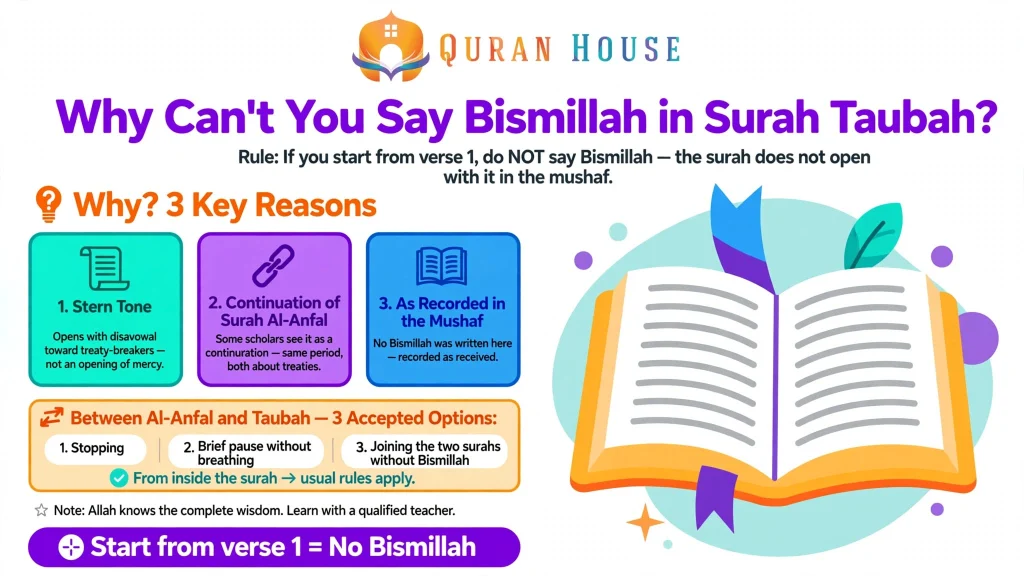
- The surah opens with a declaration of disavowal toward those who broke their treaties, a stern tone that scholars say does not suit an opening of mercy.
- Some scholars consider it a continuation of Surah Al-Anfal, since both surahs discuss treaties and belong to the same period.
- The mushaf was recorded as the Companions received it, and no Bismillah was written at this point.
- Allah knows the complete wisdom behind every detail of the Quran.
When reciting from inside the surah, the usual rules apply. Between Surah Al-Anfal and Surah At-Tawbah, reciters follow one of three accepted options: stopping, a brief pause without breathing, or joining the two surahs without Bismillah.
Learning these details becomes easier once a student understands what Tajweed is and how recitation rules work. A qualified teacher can confirm each option and correct pronunciation along the way.
Apply Surah Taubah Benefits in Daily Life
Knowing the benefits is only the first step, because the surah itself calls believers to action. A short daily routine helps turn each lesson into steady change.
Begin with the four conditions of sincere repentance taught by scholars, because every other habit becomes easier once the heart has made a clear and honest return to Allah:
- Stop the sin immediately.
- Feel sincere regret for what happened.
- Resolve firmly not to return to it.
- Return any right owed to another person, or ask for their forgiveness.
Then build small habits that keep the lessons alive throughout the week, since consistent daily practice protects the heart better than occasional bursts of strong enthusiasm:
- Read one page of Surah At-Tawbah each day with a trusted translation.
- Give a small amount of charity after repenting from a mistake.
- Review the three signs of hypocrisy every Friday and correct one habit.
- Join a weekly study circle or live class to learn the context of each section.
Memorizing Surah Ad-Duha in Class
Memorization is easier with structure. See how a student reviews and recites Surah Ad-Duha in a live lesson, guided by a tutor who follows every step of their progress.
Start Your Quran Journey With Quran House
Learn live and one-on-one with Al-Azhar-trained tutors, male and female, for children and adults, at a time that fits your timezone.
Try a Free SessionStudy Surah At-Tawbah With Quran House Expert Instructors
Quran House teaches Quran, Tajweed, Hifz, and Arabic through live one-on-one lessons with Al-Azhar-trained tutors, and sisters can choose a female tutor for a private, supportive learning space.
What sets Quran House apart:
- Every class is live and personal, with real-time correction from the tutor.
- Courses cover Quran reading, Tajweed, Hifz, tafseer, and Quranic Arabic for kids and adults.
- Families can start with a free trial lesson before choosing a plan.
Our Quran Courses
- Learn Quran Reading with Tajweed for Beginners.
- Understand the Quran Course.
- Quran Tafseer Course for All Levels.
- Quranic Arabic Course.
- Quran Reading Course Online for Kids and Adults.
- Quran Memorization for Adults.
Conclusion
The benefits of Surah Tawbah begin with mercy and extend to honesty, trust, community, knowledge, and humility. Each lesson comes directly from the verses, which is why the surah remains relevant to every generation.
From the open door of repentance in verse 104 to the compassion of the Prophet ﷺ in verse 128, the chapter gives believers both warning and hope. Sincere action turns that guidance into lasting change.
Studying the surah with context, correct recitation, and a qualified teacher helps these lessons settle in the heart. May Allah accept our repentance, protect us from hypocrisy, and make us among the truthful.
FAQs
What Are the Main Surah Taubah Benefits?
The main surah taubah benefits are accepted repentance, protection from hypocrisy, honesty, trust in Allah, community support, and motivation to seek knowledge. Each benefit is supported by specific verses in the surah.
Can a Sinner Still Repent According to Surah At-Tawbah?
Yes, verse 104 states that Allah accepts repentance from His servants, and verse 102 gives hope to believers who admit their sins. Sincere repentance requires stopping the sin, regretting it, and resolving not to return.
Is It Allowed to Start Surah At-Tawbah Without Bismillah?
Yes, a reciter who begins from the first verse of Surah At-Tawbah leaves out Bismillah, because the surah does not open with it. Starting from a later verse follows the usual rule, and a teacher can confirm details.
Why Is Surah At-Tawbah Also Called Bara’ah?
Surah At-Tawbah is also called Bara’ah, meaning disavowal, because it opens with a declaration of release from treaties with those who broke their agreements. The name Tawbah comes from its repeated emphasis on repentance.
Is Surah At-Tawbah Makki or Madani?
Surah At-Tawbah is Madani, revealed after the Hijrah and mostly connected to the Tabuk expedition in the ninth year. It contains 129 verses and addresses the Muslim community, treaties, hypocrisy, and repentance.