When you have a sincere desire to learn Islam step by step, you will begin to find the true meaning of your life, and you will come to know a great deal about the Creator of this universe. You will begin to walk toward the source of light, awareness, and guidance, and discover how the teachings of Islam can fill your life with peace.
Learning Islam does not mean memorizing everything at once. It is a gradual journey that starts with the foundations, the pillars of Islam and the articles of faith, and then grows through the Quran, the Sunnah, and practice in daily life.
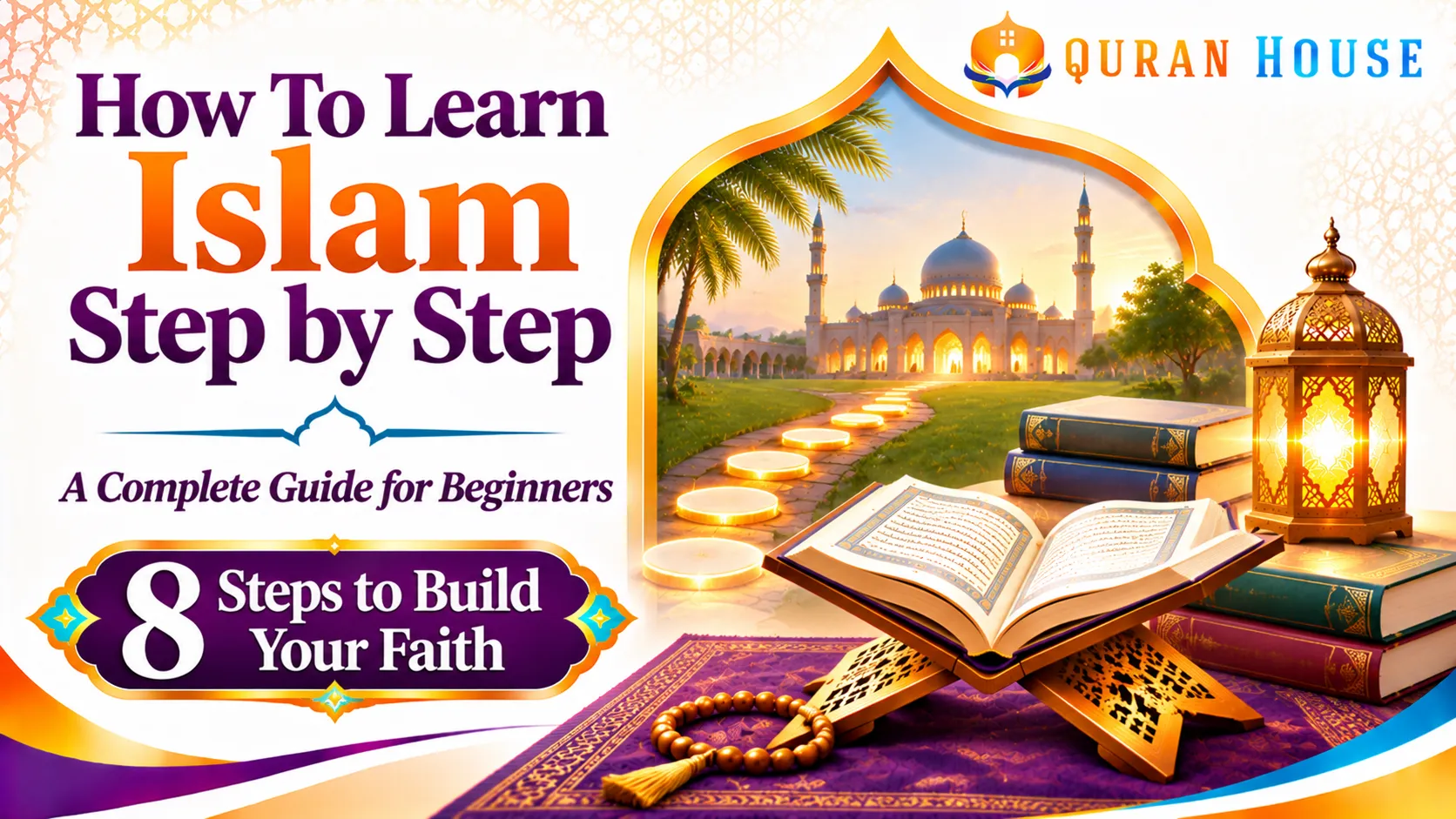
In this guide, we go straight to the 8 steps to learn Islam, from the basics every new Muslim needs to the attitudes that make the journey easier. Put these steps in your hands to help you learn Islam simply and correctly.
Step 1: Learn the Basics of Islam
When learning Islam step by step, new Muslims must first know the five pillars of Islam, which the Prophet ﷺ described in one short hadith:
«بُنِيَ الْإِسْلَامُ عَلَى خَمْسٍ: شَهَادَةِ أَنْ لَا إِلَهَ إِلَّا اللَّهُ وَأَنَّ مُحَمَّدًا رَسُولُ اللَّهِ، وَإِقَامِ الصَّلَاةِ، وَإِيتَاءِ الزَّكَاةِ، وَالْحَجِّ، وَصَوْمِ رَمَضَانَ»
“Islam is built upon five: testifying that there is no god but Allah and that Muhammad is the Messenger of Allah, establishing the prayer, giving zakah, Hajj, and fasting Ramadan.”
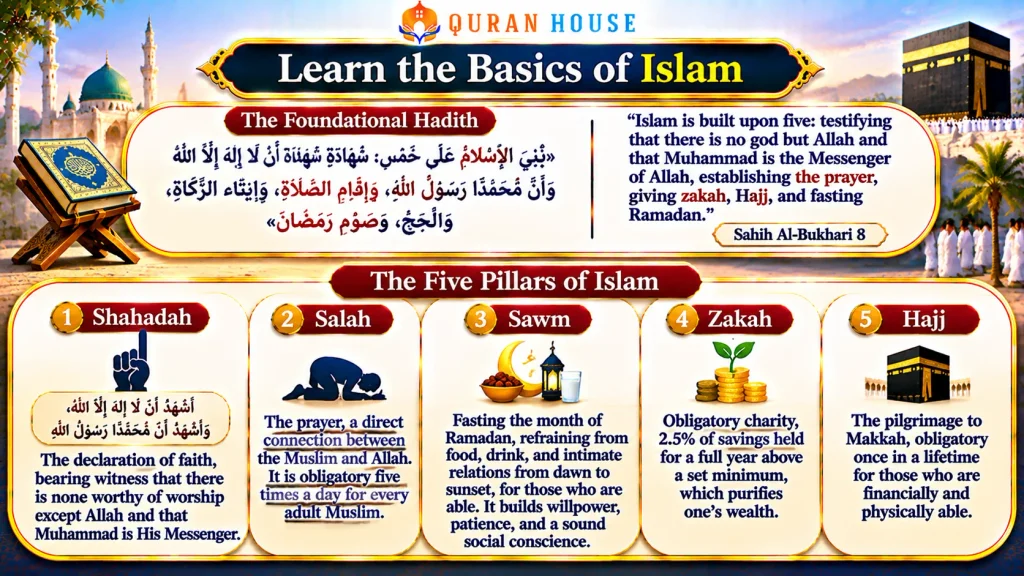
The five pillars of Islam are:
- Shahadah: the declaration of faith, bearing witness that there is none worthy of worship except Allah and that Muhammad is His Messenger to all human beings: «أَشْهَدُ أَنْ لَا إِلَهَ إِلَّا اللَّهُ، وَأَشْهَدُ أَنَّ مُحَمَّدًا رَسُولُ اللَّهِ» (Ash-hadu an la ilaha illallah, wa ash-hadu anna Muhammadan rasulullah). You must pronounce the Shahadah, believing in it, to enter Islam.
- Salah: the prayer, a direct connection between the Muslim and Allah. It is obligatory five times a day for every adult Muslim.
- Sawm: fasting the month of Ramadan, refraining from food, drink, and intimate relations from dawn to sunset, for those who are able. It builds willpower, patience, and a sound social conscience. You can learn its rules in our guide to fasting in Islam.
- Zakah: obligatory charity, 2.5% of savings held for a full year above a set minimum, which purifies one’s wealth.
- Hajj: the pilgrimage to Makkah, obligatory once in a lifetime for those who are financially and physically able.
Applying these pillars needs sincere faith in every action. They should be practiced consistently to see their positive impact on your soul and on every aspect of your daily life.
Step 2: Study the Basic Principles of Belief in Islam
When the angel Jibril asked the Prophet ﷺ about faith (iman), he answered:
«أَنْ تُؤْمِنَ بِاللَّهِ، وَمَلَائِكَتِهِ، وَكُتُبِهِ، وَرُسُلِهِ، وَالْيَوْمِ الْآخِرِ، وَتُؤْمِنَ بِالْقَدَرِ خَيْرِهِ وَشَرِّهِ»
“That you believe in Allah, His angels, His books, His messengers, and the Last Day, and that you believe in divine decree, its good and its bad.”
So Muslims must believe wholeheartedly in the following six articles of faith:
- Belief in Allah: the one and only God, who alone deserves worship.
- Belief in the angels: beings created from light, who do not sleep, eat, or drink, but spend their time in the worship of Allah and carrying out His commands.
- Belief in the revealed books: including the Scrolls (Suhuf) of Ibrahim, the Torah (Tawrat) of Musa, the Psalms (Zabur) of Dawud, the Gospel (Injil) of ’Isa, and the Quran, the final and preserved book.
- Belief in all the messengers of Allah: who were sent to the earlier nations, without distinction between them.
- Belief in the Day of Judgment: that there is a resurrection after death and a reckoning for all deeds.
- Belief in divine decree: that everything happens by Allah’s knowledge and will, and having complete trust that what Allah decrees is good for the believer, even if it appears otherwise.
Studying these principles of belief strengthens a Muslim’s relationship with Allah, and our Islamic Studies courses explain them step by step with qualified teachers.
Step 3: Learn the Quran as the Main Source of Islamic Teachings
The Noble Quran is the most important source of Islamic law, and from it, we derive a unique picture of the morals, principles, and way of living a good life that is pleasing to Allah. It is an accurate description of the essence of Islam and of what a true Muslim should and should not do.
In addition, there is a huge body of literature on its interpretation (tafsir and its types). One of the most famous books of interpretation is Tafsir Ibn Kathir, and English translations of it are available. Alongside the Quran comes the Sunnah, the example of the Prophet ﷺ, which explains and details it.
We suggest starting with a clear, easy translation of the Quran and its basic terminology. Then go deeper, side by side with the Arabic text and the context of the verses explained by trusted scholars. Our Quran Tafseer Course helps you do this with Al-Azhar-trained teachers.
When you start reading the Quran, you will learn more about Allah and how merciful, compassionate, and forgiving He is. Reading the Quran helps you learn a great deal about the religion, directly from the source of the faith.
Memorizing Surah Ad-Duha in Class
Memorization is easier with structure. See how a student reviews and recites Surah Ad-Duha in a live lesson, guided by a tutor who follows every step of their progress.
Start Your Quran Journey With Quran House
Learn live and one-on-one with Al-Azhar-trained tutors, male and female, for children and adults, at a time that fits your timezone.
Try a Free SessionStep 4: Avoid Focusing Only on Haram vs. Halal Early On
Focusing on what is forbidden more than on what is permissible early in one’s journey to Islam may weaken the desire to learn more later. That is why a new Muslim should start with the foundational aspects of the religion.
Learning what is halal and what is haram will come with time, and it should not be the only focus at the beginning. You will find many beautiful aspects of Islam, but if you only learn what is forbidden, you may wrongly think that the religion is restrictive.
Step 5: Study How To Respect and Love Prophet Muhammad ﷺ
Understand the sacred place of Prophet Muhammad ﷺ in the hearts of Muslims and how they respect him as the last messenger sent by Allah.
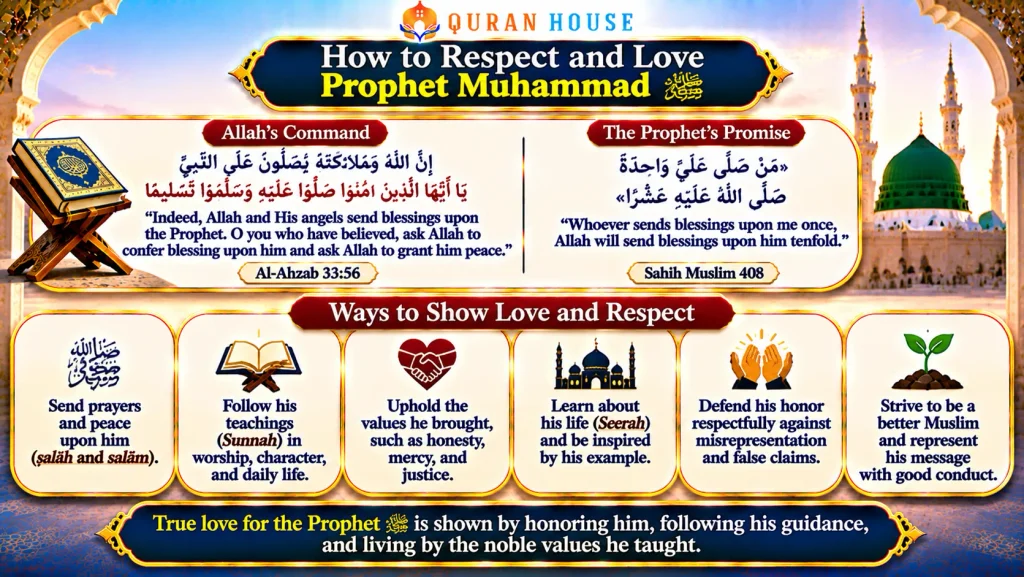
They do not worship him; they worship Allah, the Creator, alone, and they send prayers and peace upon the Prophet ﷺ, as Allah commanded:
﴿إِنَّ اللَّهَ وَمَلَائِكَتَهُ يُصَلُّونَ عَلَى النَّبِيِّ ۚ يَا أَيُّهَا الَّذِينَ آمَنُوا صَلُّوا عَلَيْهِ وَسَلِّمُوا تَسْلِيمًا﴾
“Indeed, Allah and His angels send blessings upon the Prophet. O you who have believed, ask Allah to confer blessing upon him and ask Allah to grant him peace.”
In return, Muslims obtain mercy, forgiveness, and higher ranks from Allah, as the Prophet ﷺ said:
«مَنْ صَلَّى عَلَيَّ وَاحِدَةً صَلَّى اللَّهُ عَلَيْهِ عَشْرًا»
“Whoever sends blessings upon me once, Allah will send blessings upon him tenfold.”
Loving the Prophet ﷺ also means following his teachings, which are preserved in the Hadith (الحديث).
Step 6: Free Yourself From Any Misconceptions About Islam
In the beginning, you have to know the true essence of Islam and what it calls for. Islam is the same message of the oneness of Allah that all the prophets brought, from Adam to Jesus, peace be upon them.
Then Allah completed the message by sending Prophet Muhammad ﷺ as the last messenger, bringing light and guidance for all mankind through the Holy Quran and the Hadith (the sayings, actions, and approvals of Prophet Muhammad ﷺ, which explain and elaborate on the Quranic verses). So Islam is the final and complete form of the divine message.
The Quran is the word of Allah, revealed to Prophet Muhammad ﷺ through the angel Jibril. It came as a complete source of Islamic law, setting the rules for the Muslim’s relationship with his Lord as well as with the society in which he lives.
Step 7: Have a True Intention and Willingness To Receive the Teachings of Islam
When you have a true intention and are willing to receive the teachings of Islam, you are already halfway there. A sincere intention makes the learning process easier and eventually leads to a smoother path in practicing the religion.
It is also one of the fundamental principles of Islam that no one is forced to enter the religion. Allah says:
﴿لَا إِكْرَاهَ فِي الدِّينِ ۖ قَد تَّبَيَّنَ الرُّشْدُ مِنَ الْغَيِّ﴾
“There shall be no compulsion in religion. The right course has become clear from the wrong.”
Step 8: Strengthen Your Belief That There Is Only One Creator of This Universe
In language, belief (iman) means affirmation, but as a term, it is true faith in the heart, confirmed by the tongue and shown in one’s actions. As a consequence, a Muslim must believe in the existence of Allah, in His Messenger ﷺ, in the Quran, and in the Day of Judgment, Paradise, and Hellfire.
There are also many ways to come to know Allah: by reflecting on yourself as well as on the universe around you. As your belief grows, so does your trust in Allah in every matter of life, which is the meaning of tawakkul.
Helpful Concepts for Learning Islam Step by Step
Here is a group of concepts that make your learning journey easier and more flexible:
- Deeply understand that there is no god but Allah, and no one is worthy of worship except Him.
- Be certain of the testimony of faith, without any doubt.
- Submit to Allah’s will.
- Know that Islam is the final message of Allah, confirming the truth brought by all the earlier prophets.
- Learn Surah Al-Fatihah and the shortest surahs of the Quran, as you need them in your prayer.
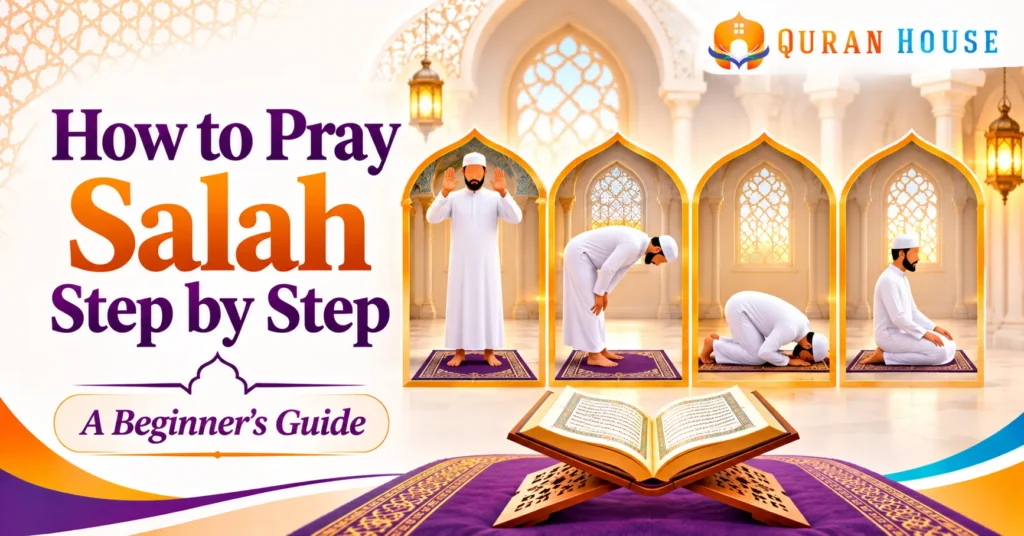
- Learn how to pray, step by step, as explained in our guide on how to pray salah.
- Learn the purification needed before prayer, especially ablution (Wudu’, الوضوء).
- Learn gradually, starting with the easiest and then moving on to the next.
- Find a trusted friend with whom you agree to follow the learning program.
Valuable Books To Help You Succeed in Your Learning Process
There are many useful religious books for beginners. For instance:
- The Way of the Muslim (Minhaj Al-Muslim – منهاج المسلم).
- Because He Is Allah (Li-annahu Allah – لأنه الله).
- The Road to the Quran (At-Tariq ila Al-Quran – الطريق إلى القرآن).
- In the Shade of the Quran (Fi Zilal Al-Quran – في ظلال القرآن).
- A Better Tomorrow (Ghadan Ajmal – غدًا أجمل).
All the previous steps are stages of Islamic education that guide you on how to learn Islam from the beginning, simply and in the best possible way.
Learn Islam Online for Kids
Online Islamic courses are designed to help children learn at a pace suited to their current level of knowledge, especially with the global shift toward online learning. Our classes for kids offer a step-by-step program dedicated to building a solid Islamic foundation for your child.
Here is what your child is expected to learn:
- How to apply the pillars of Islam.
- What prayer is and how it is performed.
- How to be a true Muslim, and the good qualities a Muslim should have.
- Important lessons from the life of Prophet Muhammad ﷺ and his companions.
- Stories from the Quran and Sunnah.
- The stories of the prophets.
- Other important lessons of good character.
A Real Surah Lesson: Surah Ash-Shams
Watch a student work through Surah Ash-Shams step by step with their tutor, practicing each ayah until the recitation flows clearly and correctly.
Start Your Quran Journey With Quran House
Learn live and one-on-one with Al-Azhar-trained tutors, male and female, for children and adults, at a time that fits your timezone.
Try a Free SessionLearn Islam Step by Step With a Qualified Teacher
Reading about Islam is a good start, but many new Muslims and beginners quickly find questions that a guide cannot answer: how to pronounce the Fatihah correctly, what to do when they make a mistake in prayer, or where to begin with the Quran. A patient teacher makes the journey clearer and safer.
At Quran House, our Al-Azhar-trained teachers guide new Muslims and beginners through the basics of Islam, the Quran, and prayer in live one-to-one sessions, at a pace that suits each student, for adults and kids alike.
Whether you have just embraced Islam or want to rebuild your knowledge from the foundations, you will have a trusted teacher by your side at every step.
Explore Our Quran Courses:
- Quran Reading for Sisters
- Noorani Qaida for Beginners
- Noorani Qaida for Adults
- Noor Al-Bayan Course
- Quran Reading Fluency Course
- Word-by-Word Quran Reading Course
- Complete Quran Reading (Khatma) Program
- Intensive Quran Course
- Online Quran Classes for Sisters and Women
- Online Quran Classes for Men and Brothers
Final Thoughts
Learning Islam is a gradual journey: it starts with the five pillars and the six articles of faith, grows through the Quran and the Sunnah, and is supported by a sincere intention, love for the Prophet ﷺ, and patience with yourself as you learn.
Islam is one of the fastest-growing religions in the world, and getting to know its tolerant principles and its highest values helps every learner discover the light of truth and peace. Take these steps one at a time, and Allah will make the path easy for you.
If you are wondering where to begin today, start small: understand the meaning of the Shahadah, learn Surah Al-Fatihah and how to pray, and keep a daily connection with the Quran, even if it is only a few verses. Surround yourself with people who encourage your learning, ask questions without hesitation, and remember that every small step you take toward Allah is valued and rewarded.
FAQs
What Is the First Step To Learn Islam?
The first step is to learn the five pillars of Islam, starting with the Shahadah, the declaration of faith.
How Long Does It Take To Learn the Basics of Islam?
Most beginners can learn the pillars, the articles of faith, and how to pray within a few weeks of steady study, while learning Islam continues for a lifetime.
Should New Muslims Focus on Halal and Haram First?
No, it is better to start with the foundations of belief and worship, and learn the details of halal and haram gradually.
Can I Learn Islam Online?
Yes, live one-to-one online classes with qualified teachers are an effective way to learn Islam, the Quran, and prayer at your own pace.
Do I Need To Learn Arabic To Learn Islam?
No, you can start learning Islam through reliable translations, but learning the Arabic you need for prayer, and gradually the language of the Quran, deepens your understanding over time.