| Key Takeaways |
| Idgham Mutaqaribain merges a silent first letter into a close second letter, so both read as one doubled sound with no pause between them. |
| In Hafs, Idgham Mutaqaribain applies to Lam into Ra, as in qul rabbi, and to Qaf into Kaf, as in nakhluqkum. |
| Hafs reads Ta and Tha, Dal and Sin, and Dhal and Jim clearly, while some other recitations merge these pairs. |
| Qaf into Kaf is an incomplete merge, so no Qalqalah is applied and a trace of the Qaf’s quality remains. |
Idgham Mutaqaribain is the Tajweed rule that merges a silent letter into a close, but not identical, letter that follows it. In Hafs, it applies to Lam into Ra and Qaf into Kaf, producing one smooth doubled sound.
Many students read the Quran fluently yet still separate these letters, which breaks the flow that classical teachers describe. Learning exactly which pairs merge, and which stay clear, turns careful recitation into a habit instead of guesswork.
This guide covers the meaning of the rule, the letter pairs, the three classical types, the Hafs ruling, Quranic examples, common mistakes, and practice steps, so every case is clear before you recite.
What Is Idgham Mutaqaribain in Tajweed?
Idgham Mutaqaribain is the merging of two close letters when the first is silent and the second carries a vowel, so both sound as one doubled letter.
The name has two parts. Idgham (إدغام) literally means to insert one thing into another, and in Tajweed it describes merging a silent letter into the letter after it.
Mutaqaribain (متقاربين) comes from the Arabic root قرب, which means closeness. It describes letters that sit near each other in Makhraj, the articulation point, or in Sifat, the lasting qualities of a sound.
Together, the two words point to letters that are close but not identical. That separates this rule from Idgham Mutamathilain, which merges identical letters, and from Idgham Mutajanisain, which merges letters that share one Makhraj.
Before the merge happens, four conditions must be present at the same time, and missing even one of them keeps the letters separate.
- The first letter carries a Sukun, so it is silent.
- The second letter carries a vowel, so it is voiced.
- The two letters are close in Makhraj, Sifat, or both.
- The result is read as one letter carrying a Shaddah.
This rule also belongs to the oral tradition of recitation, passed from teacher to student for generations. That is why a qualified teacher still checks these merges in live lessons, even for advanced readers.
Letter Pairs With Close Makhraj and Sifat
Hafs merges two pairs under Idgham Mutaqaribain, Lam into Ra and Qaf into Kaf, because each pair sits close together in Makhraj and shares key Sifat.
The table shows where each letter is produced, which qualities the two share, and what still separates them. Comparing these details helps your ear hear why the sounds can blend.
| Letter Pair | Makhraj | Shared Sifat | Main Difference |
| Lam (ل) and Ra (ر) | Both are produced with the tongue near the gum above the upper front teeth. | Jahr, Tawassut, Istifal, Infitah, and Idhlaq. | Ra has a slight trill (Takrir), while Lam does not. |
| Qaf (ق) and Kaf (ك) | Both are produced with the back of the tongue against the soft palate, Kaf slightly forward. | Shiddah. | Qaf is heavy and echoing, while Kaf is light and whispered. |
Notice that Qaf is produced from the back of the tongue against the soft palate, not from the throat. Kaf sits slightly forward of it, which is why the two feel like neighbors in the mouth.
Lam and Ra are even closer, since both are produced near the gum above the upper front teeth. Ra adds a slight trill (Takrir), while Lam does not, and that small difference is all that separates them.
Quran House offers a Basic Tajweed for Non-Arabic Speakers program that trains Makhraj and Sifat step by step, so close letter pairs become easy to hear.

Book Your Free Tajweed Trial Lesson
Types of Idgham Mutaqaribain by Letter Similarity
Classical Tajweed books divide Idgham Mutaqaribain into three types, depending on whether the two letters are close in Makhraj, in Sifat, or in both. The table below summarizes each type with its Hafs reading.
| Type | Letters | Phrase | Hafs Reading |
| Close in Makhraj and Sifat | Lam and Ra | قُل رَّبِّ | Merged. |
| Close in Makhraj and Sifat | Qaf and Kaf | نَخْلُقكُّم | Merged, but incomplete. |
| Close in Makhraj and Sifat | Ta and Tha | كَذَّبَتْ ثَمُودُ | Clear. |
| Close in Makhraj only | Dal and Sin | قَدْ سَمِعَ | Clear. |
| Close in Sifat only | Dhal and Jim | إِذْ جَاءَكُمْ | Clear. |
1. Close in Both Makhraj and Sifat
This type applies when the letters sit near each other and also share key qualities. Lam and Ra are the clearest case, followed by Qaf and Kaf in the word نَخْلُقكُّم.
Ta and Tha also fit this type in the phrase كَذَّبَتْ ثَمُودُ, since both use the tongue tip near the upper front teeth and share Hams and Istifal. Hafs reads this phrase clearly.
2. Close in Makhraj Only
Here the letters are produced from nearby points, yet their qualities differ. Dal and Sin show this in قَدْ سَمِعَ, where Dal is strong and echoing while Sin is soft and whistling. Hafs reads it clearly.
3. Close in Sifat Only
Dhal and Jim show this type in the phrase إِذْ جَاءَكُمْ. Their Makhraj are far apart, yet both are voiced (Jahr) and share lowered, open qualities (Istifal and Infitah).
Hafs reads this phrase clearly as well. Some other recitations, such as that of Abu Amr al-Basri, may merge it, which is why teachers always name the recitation they follow.
Correct Pronunciation of Lam Into Ra and Qaf Into Kaf
To apply Idgham Mutaqaribain, pronounce the silent first letter as part of the second letter, double the second with a Shaddah, and move straight into it without pausing.
Use the sequence below whenever you meet one of the two pairs, and repeat it slowly until the movement of the tongue feels natural.
- Spot the silent first letter, which is a Lam or a Qaf carrying a Sukun.
- Check that the next letter is a vowelled Ra or Kaf.
- Drop the separate sound of the first letter and move the tongue straight to the second.
- Double the second letter with a Shaddah, holding it slightly longer than a single letter.
- Keep the vowel of the second letter clear so the word still ends correctly.
Take قُلْ رَبِّ as an example. The Lam loses its Sukun and joins the Ra, so the phrase is read as qur-rabbi, with one doubled Ra.
The same logic applies to نَخْلُقكُّم. The Qaf joins the Kaf, and no Qalqalah is applied, because the Qaf no longer stands alone as a separate sound.
Keep the merge natural. A forced or distorted sound is a mistake, since the blend should sound like one clean doubled letter, and neither pair adds a nasal sound (Ghunnah).
Quran House offers a Practical (Amali) Tajweed Course where a teacher listens to your live recitation and corrects each merge as you read.

Try a Live Tajweed Session for Free
Quranic Examples You Can Practice in Hafs
Two verses below show each pair clearly in Hafs, followed by a table of further examples that you can practice from the Mushaf.
Surah Al-Mursalat gives the clearest example of Qaf into Kaf, in a verse where Allah reminds people of their humble origin and His power.
أَلَمْ نَخْلُقكُّم مِّن مَّآءٍ مَّهِينٍ
(Alam nakhluqkum min maa’in maheen)
(“Did We not create you from a humble fluid?”)
In نَخْلُقكُّم, the Qaf has no separate Sukun sound. It is absorbed into the Kaf, and because the merge is incomplete, a trace of the Qaf’s quality stays in the doubled Kaf.
For Lam into Ra, Surah An-Nisa offers a well-known example in the verse where Allah declares that He raised Isa to Himself.
بَل رَّفَعَهُ ٱللَّهُ إِلَيْهِ ۚ وَكَانَ ٱللَّهُ عَزِيزًا حَكِيمًۭا
(Bal rafa’ahullaahu ilayhi wa kaanallaahu ‘azeezan hakeemaa)
(“Rather, Allah raised him up to Himself. And Allah is Almighty, All-Wise.”)
In بَل رَّفَعَهُ, the Lam of بَل carries a Sukun and meets the vowelled Ra. The Lam disappears into the Ra, giving the reading bar-rafa’ahu.
More examples appear throughout the Quran, especially with the command قُلْ, meaning say. The table below lists five that learners meet often.
| Surah and Ayah | Arabic Phrase | Transliteration | How It Is Read |
| Ta-Ha 20:114 | وَقُل رَّبِّ | Wa qul rabbi | Wa qur-rabbi. |
| Al-Isra 17:24 | وَقُل رَّبِّ ارْحَمْهُمَا | Wa qul rabbi irhamhumaa | Wa qur-rabbi irhamhumaa. |
| Al-Isra 17:80 | وَقُل رَّبِّ أَدْخِلْنِي | Wa qul rabbi adkhilnee | Wa qur-rabbi adkhilnee. |
| Al-Kahf 18:22 | قُل رَّبِّي أَعْلَمُ | Qul rabbee a’lamu | Qur-rabbee a’lamu. |
| Al-An’am 6:147 | فَقُل رَّبُّكُمْ | Faqul rabbukum | Faqur-rabbukum. |
Each row follows the same pattern. The Lam carries a Sukun, the Ra carries a vowel, and the two read as one Ra with a Shaddah.
Inside an Interactive One-on-One Session
Every class is live and personal. See how our tutor uses on-screen tools, quick reviews, and gentle correction to help a student build confidence with every new word.
Start Your Quran Journey With Quran House
Learn live and one-on-one with Al-Azhar-trained tutors, male and female, for children and adults, at a time that fits your timezone.
Try a Free SessionHafs and Other Qiraat on Merging Close Letters
Hafs from Asim, the recitation most Muslims read today, merges Lam into Ra and Qaf into Kaf, and reads the other close pairs clearly.
Other recitations apply wider merging. Abu Amr al-Basri’s recitation, for example, includes a broader rule called Idgham Kabir, where both letters carry vowels, so some pairs read clearly in Hafs but merge there.
Because Qaf is a heavy letter, the trace it leaves in the Kaf depends on correct Tafkheem. Quran House explains how heavy letters behave in its guide to heavy and light letters.
Some Tajweed books also use a wider classical grouping. Under it, Noon Sakinah and Tanween merging into Ya, Ra, Meem, Lam, and Waw count as close-letter merging, and so does the definite article Lam before sun letters.
Those cases have their own named rules, so beginner courses usually teach them separately. This article focuses on the narrower Hafs rule that teachers usually mean by Idgham Mutaqaribain.
Follow these habits when your teacher uses a different recitation from Hafs, so the merges you practice match the reading you will actually recite.
- Follow the recitation your teacher uses, whether Hafs, Warsh, or another.
- Avoid mixing rules from different recitations in one session.
- Use a Mushaf printed in your recitation, since the marks differ.
Importance of Learning Close-Letter Merging in Tajweed
Learning Idgham Mutaqaribain matters because accurate merging is part of reciting the Quran as it was taught, with correct sounds and a steady rhythm.
- Precision in recitation. Correct merging helps readers pronounce each word as it was taught, which keeps the recitation accurate from the first verse to the last.
- Preserving authenticity. The rule belongs to the oral tradition of recitation, so learning it from a teacher keeps the transmission of the Quran intact.
- Better recitation quality. Smooth merges add melody and rhythm, making the recitation more pleasant to hear and easier to reflect on.
- Fewer recitation errors. Skipping the merge is a subtle error (Lahn Khafi) that rarely changes meaning, yet it weakens accuracy and polish.
Allah commands careful, measured recitation in Surah Al-Muzzammil, and accurate merging is one practical way to follow that command in every verse.
أَوْ زِدْ عَلَيْهِ وَرَتِّلِ ٱلْقُرْءَانَ تَرْتِيلًا
(Aw zid ‘alayhi wa rattilil-Qur’aana tarteela)
(“Or add to it, and recite the Quran with measured recitation.”)
Ibn Kathir explained this command as reading with deliberation, because slow, careful recitation helps the reader understand and reflect on the Quran.
How Merging Close Letters Improves Fluency and Rhythm
Merging close letters removes the small stop that a clear Lam or Qaf would create, so the recitation moves forward in one even line.
- Smoothness and continuity. The merge joins similar sounds, which improves the flow and fluency of every phrase.
- Rhythmic balance. Even timing between words makes listening more engaging and keeps the melody steady.
- Reflective recitation. Attention to small details keeps the reader engaged with the text and its message.
Once the tongue learns the movement from Lam to Ra, phrases like قُلْ رَبِّ stop feeling like two separate words and start to flow naturally.
Quran House offers an Advanced Tajweed Course that moves beyond basic rules into precise merging, recitation flow, and detailed teacher feedback.

Try an Advanced Tajweed Session for Free
Idgham Mutaqaribain vs Mutamathilain and Mutajanisain
Learners often mix up the three merging rules because all of them join a silent letter to a vowelled letter. The difference lies in how the two letters relate.
| Feature | Mutamathilain | Mutajanisain | Mutaqaribain |
| Letter relationship | Identical letters. | Same Makhraj, different Sifat. | Close Makhraj, close Sifat, or both. |
| Example letters | Ta and Ta | Ta and Dal | Lam and Ra |
| Example phrase | فَمَا رَبِحَت تِّجَارَتُهُمْ | قَد تَّبَيَّنَ | وَقُل رَّبِّ |
| Reference | Al-Baqarah 2:16 | Al-Baqarah 2:256 | Ta-Ha 20:114 |
| Hafs reading | Merged. | Merged. | Merged for Lam and Ra, and for Qaf and Kaf only. |
A common slip is to treat Ta and Dal as close letters. They share one Makhraj, so the pair belongs to Idgham Mutajanisain, not to Idgham Mutaqaribain.
Separating these rules clearly in your mind prevents applying the wrong technique. Each rule also has different Hafs readings, so memorizing the letter pairs for each one saves guesswork.
When Does Idgham Mutaqaribain Not Apply?
Idgham Mutaqaribain does not apply when a pause separates the letters, when you stop on the first word, or when Hafs reads the pair clearly.
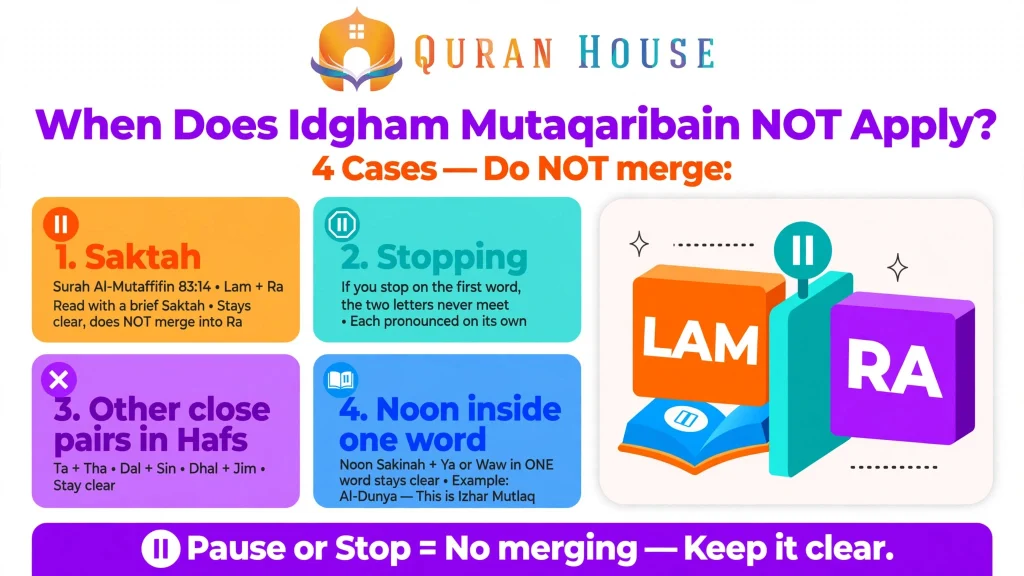
- Saktah. In Al-Mutaffifin 83:14, the Lam of بَلْ رَانَ is read with a brief Saktah, so it stays clear and does not merge into the Ra.
- Stopping. If you stop on the first word, the two letters never meet, so each one is pronounced on its own.
- Other close pairs. Ta and Tha, Dal and Sin, and Dhal and Jim stay clear in Hafs.
- Noon inside one word. A Noon Sakinah that meets Ya or Waw within a single word stays clear, as in الدُّنْيَا.
That last case is known as Izhar Mutlaq. Quran House explains it in its Izhar Mutlaq guide, which is a useful next read after this section.
Common Mistakes Learners Make With Close-Letter Merging
A frequent error with Idgham Mutaqaribain is failing to notice when a pair qualifies, so the letters are read as fully separate sounds. The opposite error is merging pairs that Hafs reads clearly.
- Reading قُلْ رَبِّ as two words, with a clear Lam before the Ra.
- Adding Qalqalah to the Qaf in نَخْلُقكُّم.
- Merging Dal into Sin in قَدْ سَمِعَ, which Hafs reads clearly.
- Merging across the Saktah in بَلْ رَانَ.
- Treating Ta and Dal as close letters when they share one Makhraj.
- Stretching the doubled letter with a nasal sound, as if it were Ghunnah.
Building familiarity with the specific letter pairs, rather than relying on general impressions, helps you apply the rule consistently. A qualified teacher can notice these slips quickly and correct them before they become habits.
Quran House offers a Tajweed Ijazah Course for students who want to certify their recitation after sustained, teacher-led Tajweed training.

Book a Free Trial and Ask About Ijazah
Practical Exercises for Applying Close-Letter Merging
Use the exercises below in order, and keep each session short so your attention stays on the sound rather than on speed.
- Memorize the two Hafs pairs, Lam into Ra and Qaf into Kaf, before anything else.
- Read the examples in this article slowly, focusing on the merge between each pair.
- Record yourself reciting قُلْ رَبِّ and نَخْلُقكُّم, then compare the recording with your teacher’s reading.
- Compare Idgham Mutaqaribain with Idgham Mutamathilain and Idgham Mutajanisain to reinforce the difference.
- Practice stopping and continuing at بَلْ رَانَ so the Saktah becomes automatic.
- Ask your teacher for regular feedback to confirm that your pronunciation is accurate.
Short daily sessions of around ten minutes are easier to sustain than occasional long ones. Regular review turns the movement from Lam to Ra and Qaf to Kaf into a habit.
A Real Surah Lesson: Surah Ash-Shams
Watch a student work through Surah Ash-Shams step by step with their tutor, practicing each ayah until the recitation flows clearly and correctly.
Start Your Quran Journey With Quran House
Learn live and one-on-one with Al-Azhar-trained tutors, male and female, for children and adults, at a time that fits your timezone.
Try a Free SessionLearn Idgham Mutaqaribain With Quran House Tajweed Teachers
Quran House teaches Tajweed in live one-to-one sessions with Al-Azhar-trained teachers who correct merges like Lam into Ra as you recite. Lessons suit kids, adults, and sisters, and you can start with a free trial.
What Sets Quran House Apart:
- Al-Azhar-trained teachers who specialize in precise recitation.
- Live one-to-one lessons with direct correction of every Makhraj and Sifat.
- Free trial sessions to check your level and meet a teacher.
Our Quran Courses
- Basic Tajweed for Non-Arabic Speakers.
- Practical (Amali) Tajweed Course.
- Advanced Tajweed Course.
- Tajweed Ijazah Course.
- Learn Quran Reading with Tajweed for Beginners.
- Online Tajweed Classes for Sisters and Women.
Conclusion
Idgham Mutaqaribain comes down to two pairs in Hafs, Lam into Ra and Qaf into Kaf. When the first letter is silent and the second carries a vowel, the two blend into one doubled sound.
The other close pairs, such as Ta and Tha or Dal and Sin, stay clear in Hafs, and a Saktah such as the one in بَلْ رَانَ blocks the merge. Qaf into Kaf also skips Qalqalah.
Practice slowly, record yourself, and compare your reading with a qualified teacher’s. With patient repetition, Idgham Mutaqaribain becomes a natural part of your recitation, and each verse flows with the accuracy classical scholars described.
FAQs
How Is Idgham Mutaqaribain Different From Mutamathilain?
Idgham Mutaqaribain merges close letters, such as Lam and Ra, while Idgham Mutamathilain merges identical letters, such as Ta and Ta. Both need a silent first letter and a vowelled second letter.
Is Idgham Mutaqaribain Advanced or Introductory in Tajweed?
It is usually taught at an intermediate stage, after learners understand basic letter Makhraj and the Noon Sakinah rules. Beginners can still learn the two Hafs pairs early, because they are short and easy to memorize.
What Happens If Idgham Mutaqaribain Is Missed or Overdone?
Incorrect application usually affects accuracy and polish rather than the literal meaning, and teachers classify it as a subtle error. Correction with a qualified teacher still matters for precise recitation.
Which Letters Does Hafs Merge Under Idgham Mutaqaribain?
Hafs merges Lam into Ra, as in qul rabbi, and Qaf into Kaf, as in nakhluqkum. Other close pairs, such as Dal and Sin, are read clearly.
Is Qalqalah Applied When Qaf Merges Into Kaf?
No. The Qaf is absorbed into the Kaf, so it carries no Qalqalah of its own. This merge is classed as incomplete, because a trace of the Qaf’s quality remains.