
Izhar Mutlaq (الإظهار المطلق) is an important Tajweed rule that helps learners pronounce Noon Sakinah (نْ) clearly when it is followed by Yaa (ي) or Waw (و) within the same word. Understanding this rule prevents confusion with Idgham and supports accurate Quran recitation.
In this guide, we explain the meaning of Izhar Mutlaq, its conditions, Quranic examples, and practical pronunciation techniques.
Izhar Mutlaq requires the clear pronunciation of Noon Sakinah before Yaa or Waw within the same word, without merging the two letters. It occurs in four well-known Quranic words.
What You’ll Learn:
- The meaning and conditions of Izhar Mutlaq.
- How Izhar Mutlaq differs from Idgham with Ghunnah.
- Quranic examples of the rule.
- Proper pronunciation techniques.
- Common mistakes and ways to avoid them.
What Is Izhar Mutlaq?
Izhar Mutlaq (الإظهار المطلق) means absolute or unrestricted clear pronunciation. In Tajweed, it refers to pronouncing Noon Sakinah (نْ) distinctly when it is followed by Yaa (ي) or Waw (و) within the same word.
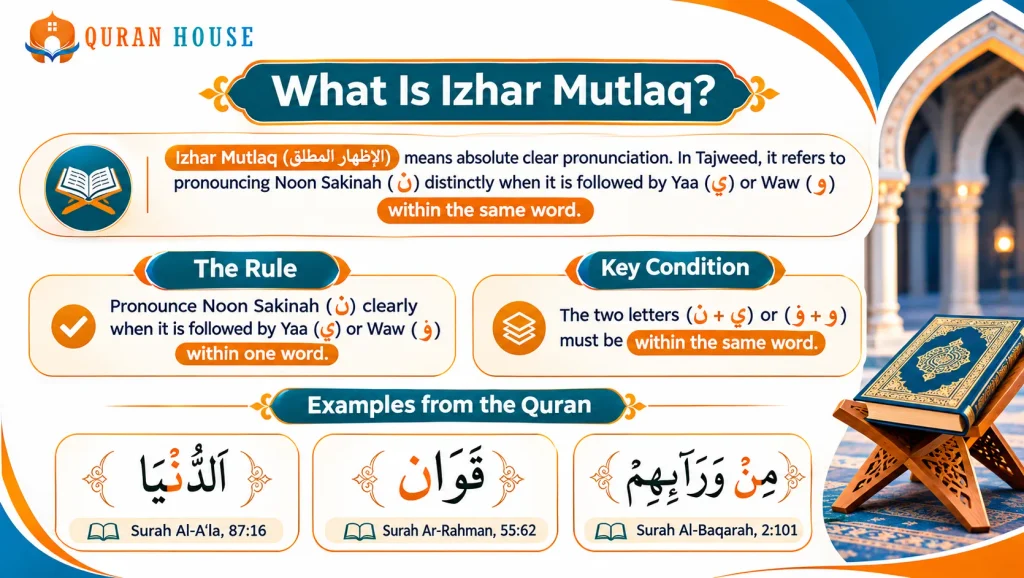
The essential condition is that both letters must occur within one word. When Noon Sakinah or Tanween meets Yaa or Waw across two separate words, the general rule is Idgham with Ghunnah. This distinction helps learners apply the correct Tajweed rule while preserving the pronunciation of Quranic words.
For a broader understanding of clear pronunciation rules, explore our guide to Izhar Halqi in Tajweed, which explains how Noon Sakinah and Tanween are pronounced before the six throat letters.
It’s Never Too Late to Learn
Adults learn with us too. Watch a real session with one of our adult learners and see how calm, one-on-one guidance makes Quran recitation feel achievable at any age.
Start Your Quran Journey With Quran House
Learn live and one-on-one with Al-Azhar-trained tutors, male and female, for children and adults, at a time that fits your timezone.
Try a Free SessionDetailed Explanation of Izhar Mutlaq
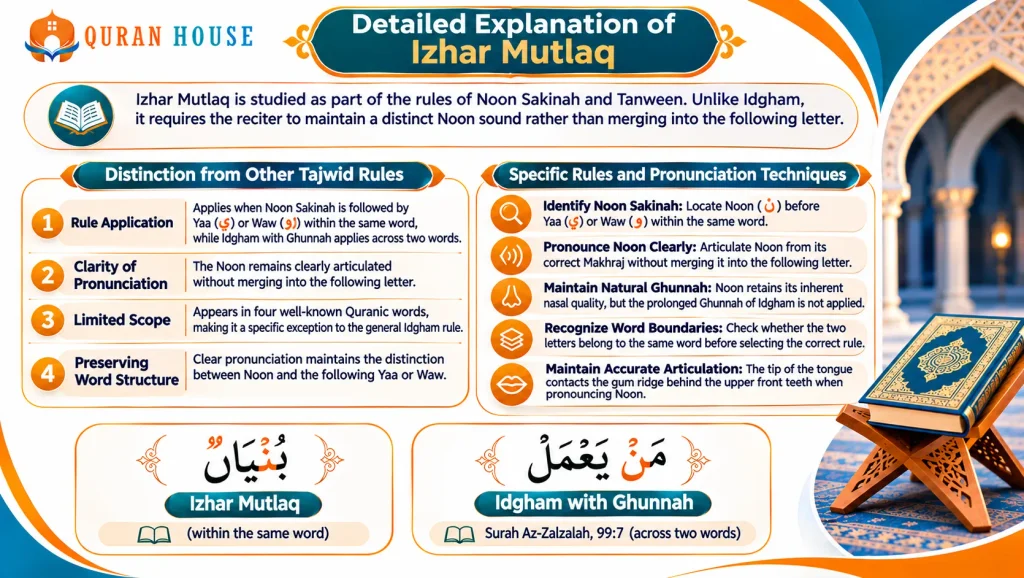
Izhar Mutlaq is studied as part of the rules of Noon Sakinah and Tanween. Unlike Idgham, it requires the reciter to maintain a distinct Noon sound rather than merging it into the following letter. For a broader understanding of these pronunciation principles, explore our beginner-friendly guide on what Tajweed is and how its rules work.
Distinction from Other Tajwid Rules
Izhar Mutlaq differs from other Noon Sakinah rules in several important ways:
- Rule Application: Izhar Mutlaq applies when Noon Sakinah is followed by Yaa or Waw within the same word. In contrast, Idgham with Ghunnah applies when Noon Sakinah or Tanween is followed by ي، ن، م، or و across two words.
- Clarity of Pronunciation: The Noon remains clearly articulated without merging into the following letter.
- Limited Scope: Izhar Mutlaq appears in four well-known Quranic words, making it a specific exception to the general Idgham rule.
- Preserving Word Structure: Clear pronunciation maintains the distinction between Noon and the following Yaa or Waw.
For example, in بُنْيَانٌ, the Noon Sakinah and Yaa occur within the same word, so Izhar Mutlaq applies.
However, in مَن يَعْمَلْ (Surah Az-Zalzalah, 99:7), Noon Sakinah occurs at the end of one word, while Yaa begins the next. Therefore, Idgham with Ghunnah applies during connected recitation.
Recognizing this difference is essential for accurate application of Tajweed rules.
Specific Rules and Pronunciation Techniques
Applying Izhar Mutlaq correctly requires attention to the position of Noon Sakinah, the following letter, and the natural characteristics of Noon.
The following techniques help learners pronounce the rule accurately:
- Identify Noon Sakinah: Locate Noon carrying Sukoon (نْ) before Yaa or Waw within the same word.
- Pronounce Noon Clearly: Articulate Noon from its correct Makhraj without merging it into the following letter.
- Maintain Natural Ghunnah: Noon retains its inherent nasal quality, but the prolonged Ghunnah associated with Idgham with Ghunnah is not applied.
- Recognize Word Boundaries: Check whether the two letters belong to the same word before selecting the correct pronunciation rule.
- Maintain Accurate Articulation: The tip of the tongue contacts the gum ridge behind the upper front teeth when pronouncing Noon.
Practicing these techniques helps learners develop greater control over pronunciation and avoid confusion between Izhar Mutlaq and Idgham.
Learning Tajweed is part of developing a stronger connection with the Quran and Islamic teachings. Alongside improving pronunciation, beginners can explore essential facts about Islam to build a broader understanding of the faith.
Izhar Mutlaq in the Quran
Izhar Mutlaq occurs in four well-known Quranic words. Two contain Noon Sakinah before Yaa, while the other two contain Noon Sakinah before Waw.
The following table presents these words with their Quranic references.
| Quranic Word | Surah and Verse | Explanation |
|---|---|---|
| الدُّنْيَا | Surah Al-Hadid, 57:20 | Noon Sakinah before Yaa |
| بُنْيَانٌ | Surah As-Saff, 61:4 | Noon Sakinah before Yaa |
| صِنْوَانٌ | Surah Ar-Ra’d, 13:4 | Noon Sakinah before Waw |
| قِنْوَانٌ | Surah Al-An’am, 6:99 | Noon Sakinah before Waw |
In each example, the Noon must remain clearly pronounced without merging into the following letter.
Learners can practice these words individually before reciting their complete Quranic verses. Listening to a qualified Qari and repeating the pronunciation helps reinforce the rule.
Common Izhar Mutlaq Mistakes to Avoid
Although Izhar Mutlaq follows a straightforward rule, beginners may confuse it with Idgham or overlook the correct articulation of Noon Sakinah.
The most common mistakes include:
- Merging Noon into Yaa or Waw: In words such as بُنْيَان and صِنْوَان, the Noon must remain distinct.
- Applying Idgham with Ghunnah: Some learners apply Idgham without recognizing that both letters occur within the same word.
- Exaggerating Nasalization: Noon retains its natural nasal quality, but learners should not extend it with the prolonged Ghunnah used in Idgham with Ghunnah.
- Ignoring Word Boundaries: Failing to distinguish between one word and two separate words may result in incorrect Tajweed application.
- Rushing Through the Word: Reciting too quickly can weaken or obscure the Noon sound.
To avoid these mistakes, practice slowly, focus on the articulation of Noon, and compare your pronunciation with a reliable Quran recitation.
For learners who want practical guidance, our Practical Tajweed Course offers structured exercises and personalized feedback to help improve Quran pronunciation.
Memorizing Surah Ad-Duha in Class
Memorization is easier with structure. See how a student reviews and recites Surah Ad-Duha in a live lesson, guided by a tutor who follows every step of their progress.
Start Your Quran Journey With Quran House
Learn live and one-on-one with Al-Azhar-trained tutors, male and female, for children and adults, at a time that fits your timezone.
Try a Free SessionMaster Izhar Mutlaq with Quran House
Learning the four Izhar Mutlaq words is an important step toward mastering Noon Sakinah rules, but applying Tajweed correctly requires regular practice and proper guidance. At Quran House, our Al-Azhar-trained teachers help students understand Tajweed rules and improve their pronunciation through personalized online Quran lessons.
Since 2018, Quran House has offered live one-on-one classes for children and adults in Quran reading, Tajweed, memorization, Quranic Arabic, and Tafseer. Whether you are learning Izhar Mutlaq for the first time or improving your recitation skills, our teachers provide guidance tailored to your level and learning goals.
Ready to improve your Quran recitation? Book your free session and start learning with a qualified Tajweed teacher.

Explore Our Tajweed Courses:
- Learn Quran Reading with Tajweed for Beginners
- Basic Tajweed for Non-Arabic Speakers
- Practical (Amali) Tajweed Course
- Online Tajweed Classes for Sisters and Women
- Advanced Tajweed Course
- Tajweed Ijazah Course
Conclusion
Izhar Mutlaq is an important Tajweed rule that preserves the clear pronunciation of Noon Sakinah before Yaa or Waw within the same word. Understanding its conditions and recognizing the four Quranic words helps learners distinguish this rule from Idgham with Ghunnah.
By practicing words such as الدُّنْيَا، بُنْيَان، صِنْوَان، and قِنْوَان, learners can develop a better understanding of Noon Sakinah pronunciation and avoid common recitation mistakes. Recognizing word boundaries and maintaining the natural characteristics of Noon are essential for applying the rule correctly.
Consistent practice, careful listening, and guidance from a qualified Tajweed teacher help learners strengthen their pronunciation and build greater confidence in reciting the Quran accurately.
Frequently Asked Questions About Izhar Mutlaq
1. What Is Izhar Mutlaq in Tajweed?
Izhar Mutlaq is a Tajweed rule that requires the clear pronunciation of Noon Sakinah when it is followed by Yaa or Waw within the same word, without merging the letters.
2. How Many Words Have Izhar Mutlaq in the Quran?
There are four well-known Quranic words containing Izhar Mutlaq: الدُّنْيَا، بُنْيَان، صِنْوَان، and قِنْوَان.
3. What Are the Letters of Izhar Mutlaq?
The two letters associated with Izhar Mutlaq are Yaa (ي) and Waw (و). The rule applies when either follows Noon Sakinah within the same word in the recognized Quranic examples.
4. What Is the Difference Between Izhar Mutlaq and Izhar Halqi?
Izhar Mutlaq applies to Noon Sakinah before Yaa or Waw within the same word. Izhar Halqi occurs when Noon Sakinah or Tanween is followed by one of the six throat letters: ء، ه، ع، ح، غ، or خ.
5. What Is the Difference Between Izhar Mutlaq and Idgham with Ghunnah?
Izhar Mutlaq preserves the clear Noon sound before Yaa or Waw within the same word. Idgham with Ghunnah involves merging Noon Sakinah or Tanween into a following ي، ن، م، or و across two words, with nasalization.
6. Does Izhar Mutlaq Have Ghunnah?
Noon naturally has a nasal quality, but Izhar Mutlaq does not involve the prolonged Ghunnah associated with Idgham with Ghunnah. The Noon is pronounced clearly from its correct articulation point.
7. How Can Beginners Practice Izhar Mutlaq?
Beginners can memorize the four Quranic words, identify Noon Sakinah before Yaa or Waw, and practice pronouncing each word clearly. Listening to reliable Quran recitations and receiving guidance from a qualified Tajweed teacher can help correct pronunciation mistakes.