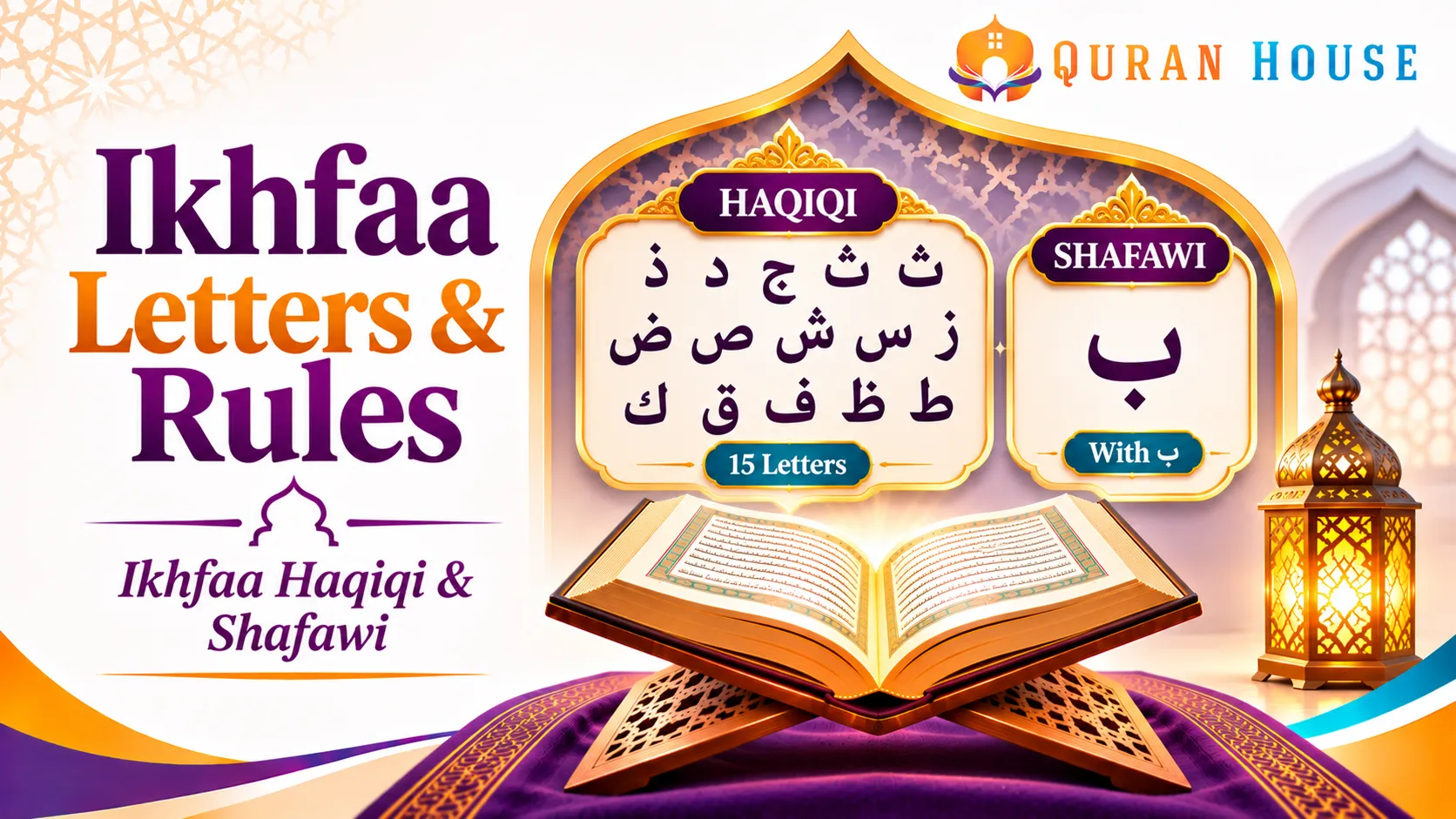
Ikhfaa (الإخفاء) is an essential Tajweed rule that helps Muslims recite the Quran with correct pronunciation. It involves concealing a letter’s sound while maintaining Ghunnah (nasalization), creating a pronunciation between Izhar (clear articulation) and Idgham (merging).
Understanding the rules of Ikhfaa Haqiqi and Ikhfaa Shafawi helps learners recognize the correct pronunciation of Noon Sakinah, Tanween, and Meem Sakinah.
The Prophet Muhammad (ﷺ) emphasized the virtue of Quran recitation. Aisha (رضي الله عنها) narrated that he said:
الْمَاهِرُ بِالْقُرْآنِ مَعَ السَّفَرَةِ الْكِرَامِ الْبَرَرَةِ
The one proficient in the Quran will be with the noble and righteous angels.
The hadith also mentions the reward of those who struggle while reciting, encouraging learners to continue improving their skills.
Ikhfaa Haqiqi occurs when Noon Sakinah or Tanween is followed by one of 15 specific letters, requiring Ghunnah for two counts. Ikhfaa Shafawi occurs when Meem Sakinah is followed by Baa (ب), with the Meem sound concealed and Ghunnah maintained.
What You’ll Learn:
- The meaning of Ikhfaa in Tajweed.
- The 15 letters of Ikhfaa Haqiqi.
- How to pronounce Ikhfaa correctly.
- Methods for memorizing the letters.
- Quranic examples of Ikhfaa Haqiqi and Shafawi.
- The three levels of Ikhfaa.
- Common mistakes and practical pronunciation exercises.
What Is Ikhfa?
The Arabic word Ikhfaa (الإخفاء) linguistically means hiding or concealing, while Haqiqi means real or true In Tajweed, Ikhfaa Haqiqi refers to pronouncing Noon Sakinah (نْ) or Tanween in a state between Izhar and Idgham. The Noon sound is concealed, while Ghunnah is maintained for two counts.
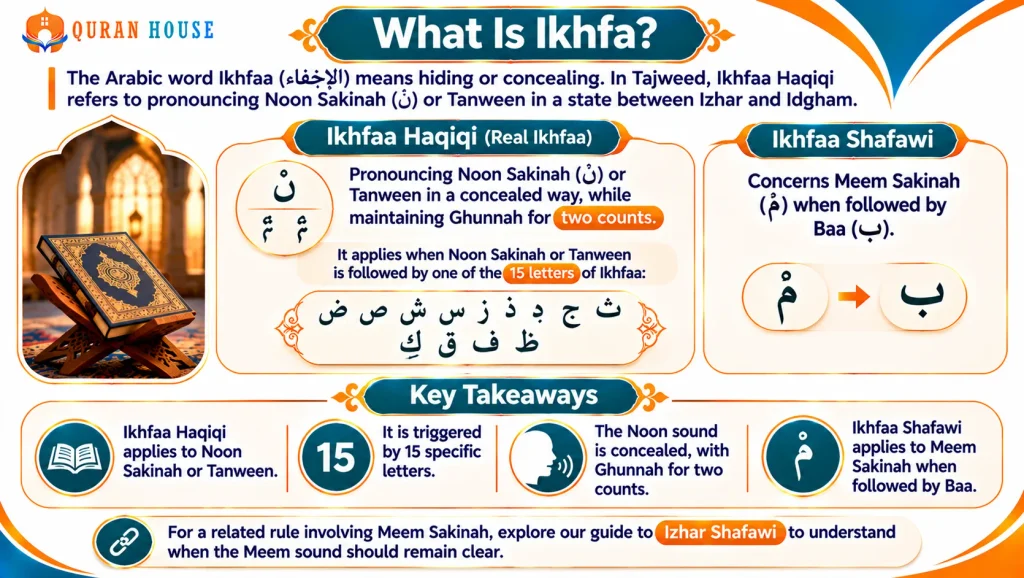
The rule applies when Noon Sakinah or Tanween is followed by one of the 15 letters of Ikhfaa Ikhfaa Shafawi, on the other hand, concerns Meem Sakinah (مْ) when followed by Baa (ب).
The distinction is important because each type of Ikhfaa has a different triggering letter or group of letters, even though both involve nasalization.
For a related rule involving Meem Sakinah, explore our guide to Izhar Shafawi to understand when the Meem sound should remain clear.
How Are Ikhfaa Letters Pronounced?
Correct Ikhfaa pronunciation requires concealing Noon Sakinah or Tanween while preparing the mouth to articulate the following letter.
The main pronunciation techniques include:
- Maintain Ghunnah for Two Counts: The concealed Noon or Tanween is accompanied by a nasal sound lasting approximately two Harakat.
- Avoid Fully Articulating Noon: During Ikhfaa, the tongue should not complete the normal articulation of Noon against the upper gum ridge.
- Prepare for the Following Letter: The tongue and mouth move toward the articulation position of the letter that follows Noon Sakinah or Tanween.
- Observe Heaviness and Lightness: The quality of Ghunnah is influenced by the following letter. It is pronounced with a heavier quality before heavy letters and a lighter quality before light letters.
- Avoid Complete Merging: Ikhfaa is not the same as Idgham. The Noon sound is concealed without becoming completely merged into the following letter.
Accurate pronunciation develops through careful listening and guided repetition rather than simply memorizing the rule.
What Are the Ikhfa Letters?
There are 15 letters of Ikhfaa Haqiqi. When any of these letters follows Noon Sakinah or Tanween, the reciter applies Ikhfaa with Ghunnah.
The 15 letters are:
ت ث ج د ذ ز س ش ص ض ط ظ ف ق ك
These letters include:
- ت — Taa
- ث — Thaa
- ج — Jeem
- د — Daal
- ذ — Dhaal
- ز — Zay
- س — Seen
- ش — Sheen
- ص — Saad
- ض — Daad
- ط — Taa (emphatic)
- ظ — Dhaa (emphatic)
- ف — Faa
- ق — Qaaf
- ك — Kaaf
Ikhfaa Haqiqi can occur within a single word or across two words when Noon Sakinah or Tanween is followed by one of these letters.
How to Memorize Ikhfa Letters?
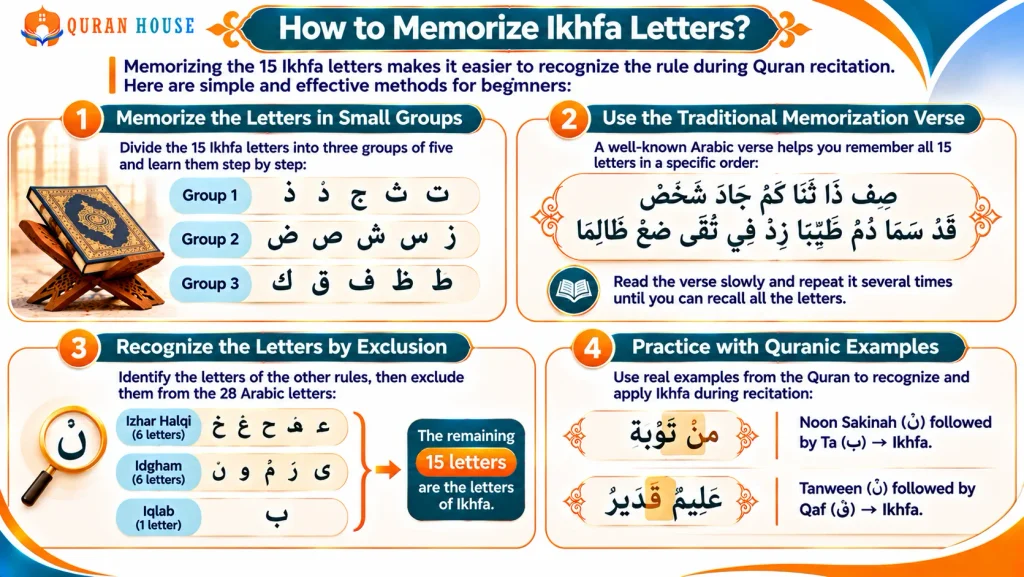
Memorizing the 15 Ikhfa letters makes it easier to recognize the rule during Quran recitation. Beginners can use simple memorization techniques, regular practice, and Quranic examples to remember these letters and apply Ikhfa Haqiqi correctly.
1. Memorize the Letters in Small Groups
Dividing the 15 Ikhfa letters into smaller groups makes memorization easier, especially for beginners who find it difficult to remember all the letters at once. Instead of learning them together, divide them into three groups of five:
- Group 1: ت، ث، ج، د، ذ
- Group 2: ز، س، ش، ص، ض
- Group 3: ط، ظ، ف، ق، ك
Start with the first group and repeat each letter aloud several times. Once you can recognize all five letters without looking, move to the second group and follow the same method.
After memorizing all three groups, practice recalling the complete set of 15 letters in different orders. You can also look for these letters after Noon Sakinah or Tanween in Quranic verses to connect memorization with practical Tajweed application.
2. Use the Traditional Memorization Verse
A traditional Arabic mnemonic helps students remember all 15 Ikhfa letters in a specific order. The first letter of each word represents one of the Ikhfa letters, making it easier to recall them without memorizing a random sequence.
The traditional memorization verse is:
صِفْ ذَا ثَنَا كَمْ جَادَ شَخْصٌ قَدْ سَمَا دُمْ طَيِّبًا زِدْ فِي تُقًى ضَعْ ظَالِمًا
Read the verse slowly and identify the first letter of each word. Repeat it several times until you can recall the complete sequence independently.
This method is particularly useful for students learning Tajweed because it combines rhythm, repetition, and letter recognition.
3. Recognize the Letters by Exclusion
Another effective way to memorize Ikhfa letters is to identify the letters that belong to the other rules of Noon Sakinah and Tanween.
The six Izhar Halqi letters are ء، هـ، ع، ح، غ، خ. The six Idgham letters are ي، ر، م، ل، و، ن, while the single Iqlab letter is ب After excluding these 13 letters from the 28 Arabic letters, the remaining 15 are the letters of Ikhfa Haqiqi.
This technique helps beginners understand how Ikhfa fits into the broader Tajweed system instead of memorizing the letters without context.
4. Practice with Quranic Examples
Practicing Ikhfa letters directly from the Quran helps students recognize the rule during actual recitation. Instead of focusing only on isolated letters, look for examples where Noon Sakinah or Tanween is followed by one of the 15 Ikhfa letters.
Start with short verses and identify the letter that follows Noon Sakinah or Tanween. Then practice pronouncing the combination with the correct Ghunnah.
Ikhfaa Letters With Examples
The Quran contains numerous examples of Ikhfaa Haqiqi. Learning these examples helps students move from recognizing the written rule to applying it in recitation.
The following examples demonstrate Noon Sakinah and Tanween before different Ikhfaa letters.
| Quranic Example | Ikhfaa Letter | Reference |
|---|---|---|
| جَنَّاتٍ تَجْرِي | ت | Al-Baqarah 2:25 |
| مِن تَحْتِهَا | ت | Al-Baqarah 2:25 |
| مِن ثَمَرَةٍ | ث | Al-Baqarah 2:25 |
| مِن قَبْلُ | ق | Al-Baqarah 2:25 |
In جَنَّاتٍ تَجْرِي, the Tanween is followed by Taa (ت), so Ikhfaa is applied when reciting the words together.
In مِن ثَمَرَةٍ, Noon Sakinah is followed by Thaa (ث). The Noon is concealed with Ghunnah for two counts before articulating the following letter.
In مِن قَبْلُ, Noon Sakinah comes before Qaaf (ق), a heavy letter that affects the quality of Ghunnah These examples show that Ikhfaa is not limited to a single letter or pronunciation pattern.
It’s Never Too Late to Learn
Adults learn with us too. Watch a real session with one of our adult learners and see how calm, one-on-one guidance makes Quran recitation feel achievable at any age.
Start Your Quran Journey With Quran House
Learn live and one-on-one with Al-Azhar-trained tutors, male and female, for children and adults, at a time that fits your timezone.
Try a Free SessionWhat Is the Difference Between Ikhfaa Haqiqi and Ikhfaa Shafawi?
Ikhfaa Haqiqi and Ikhfaa Shafawi both involve concealing a sound with Ghunnah, but they apply to different letters and pronunciation conditions.
The main differences are summarized below.
| Feature | Ikhfaa Haqiqi | Ikhfaa Shafawi |
|---|---|---|
| Letter involved | Noon Sakinah or Tanween | Meem Sakinah |
| Following letters | 15 Ikhfaa letters | Baa (ب) only |
| Ghunnah | Two counts | Two counts |
| Articulation | Conceal the Noon sound | Conceal the Meem sound at the lips |
| Example | مِن تَحْتِهَا | تَرْمِيهِم بِحِجَارَةٍ |
Ikhfaa Haqiqi occurs when Noon Sakinah or Tanween is followed by one of the 15 Ikhfaa letters.
Ikhfaa Shafawi occurs when Meem Sakinah is followed by Baa (ب). The Meem sound is concealed, with Ghunnah maintained for two counts.
Examples of Ikhfaa Shafawi include:
- تَرْمِيهِم بِحِجَارَةٍ — Surah Al-Fil, 105:4
- هُم بِمُؤْمِنِينَ — Surah Al-Baqarah, 2:8
In both examples, Meem Sakinah is followed by Baa, requiring Ikhfaa Shafawi during connected recitation It is called Shafawi because both Meem and Baa are articulated using the lips For a broader explanation of these pronunciation rules, read our guide to the rules of Meem Sakinah.
How Is Ikhfaa Written in the Quran?
Readers of a Mushaf that uses common Uthmani-script Tajweed conventions can recognize Ikhfaa through certain written signs.
These may include:
- Noon Sakinah Without a Visible Sukoon: The Noon may appear without the usual Sukoon sign when Ikhfaa applies.
- Tanween Markings: The arrangement of Tanween signs can indicate that the following letter requires Ikhfaa.
- No Shaddah on the Following Letter: Unlike complete Idgham, the letter following the concealed Noon is not marked with Shaddah to indicate complete merging.
These writing conventions help learners identify the rule, although their exact appearance can vary between Mushaf editions Recognizing the symbols is useful, but the actual pronunciation should be learned through listening and practice.
Why Do We Make Ikhfaa?
Ikhfaa is applied because the articulation points of its 15 letters are neither as close to Noon as those associated with Idgham nor as distant as those associated with Izhar.
As a result, Noon Sakinah or Tanween is pronounced between complete clarity and complete merging This middle pronunciation preserves the correct articulation pattern established in Tajweed.
Understanding why Ikhfaa occurs helps learners distinguish it from other Noon Sakinah rules rather than applying the same nasal sound in every situation.
For learners who need individual pronunciation correction, our online Tajweed classes provide guided practice with qualified Quran teachers.

What Are the Levels of Ikhfaa?
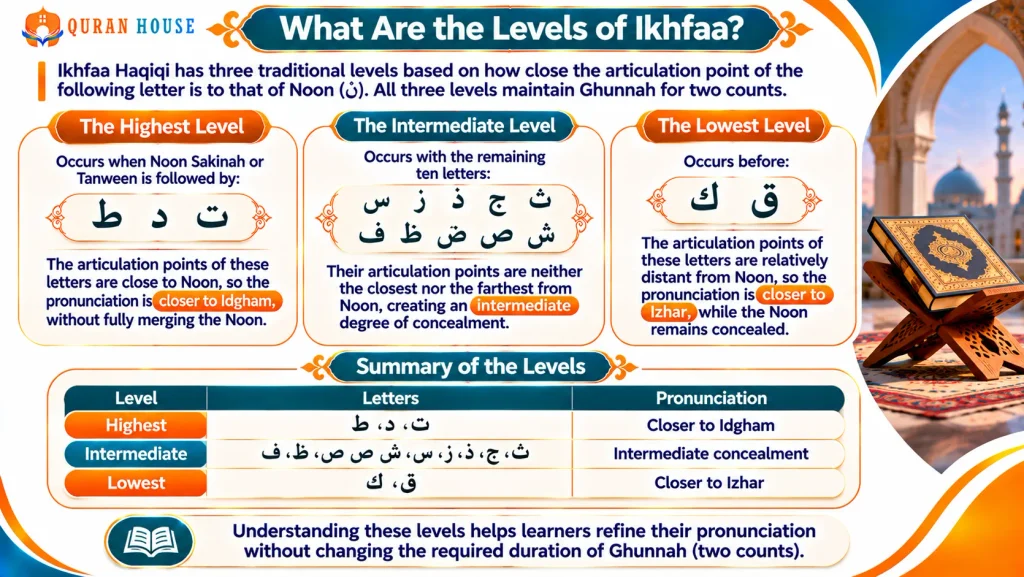
Ikhfaa Haqiqi has three traditional levels based on how close the articulation point of the following letter is to that of Noon These levels influence the degree of concealment, but Ghunnah is maintained for two counts in all three.
The Highest Level of Ikhfaa
The highest level occurs when Noon Sakinah or Tanween is followed by:
ت، د، ط
These letters have articulation points close to that of Noon, making the pronunciation of Ikhfaa closer to Idgham However, the Noon must not be completely merged into the following letter.
The Lowest Level of Ikhfaa
The lowest level occurs before:
ق، ك
The articulation points of these letters are relatively distant from Noon. Therefore, the pronunciation is closer to Izhar than in the highest level of Ikhfaa Nevertheless, the Noon remains concealed rather than being pronounced with complete clarity.
The Intermediate Level of Ikhfaa
The intermediate level occurs with the remaining ten letters:
ث، ج، ذ، ز، س، ش، ص، ض، ظ، ف
Their articulation points are neither the closest nor the farthest from Noon This creates an intermediate degree of concealment between the highest and lowest levels The following table summarizes the distinction.
| Level | Letters | Pronunciation |
|---|---|---|
| Highest | ت، د، ط | Closer to Idgham |
| Intermediate | ث، ج، ذ، ز، س، ش، ص، ض، ظ، ف | Intermediate concealment |
| Lowest | ق، ك | Closer to Izhar |
Understanding these levels helps learners refine their pronunciation without changing the required duration of Ghunnah.
Common Mistakes to Avoid While Making Ikhfaa
Learning the Ikhfaa letters is only the first step. Correct recitation also requires control over Ghunnah, articulation, and the transition to the next letter.
Common mistakes include:
- Exaggerating Ghunnah: Extending the nasal sound beyond the required two counts can make the pronunciation inaccurate.
- Pronouncing Noon Too Clearly: Fully articulating Noon changes the sound toward Izhar instead of Ikhfaa.
- Merging Noon Completely: When Noon is fully merged into the following letter, the sound becomes closer to Idgham.
- Ignoring Heaviness and Lightness: Ghunnah should reflect the pronunciation quality of the following letter.
- Applying the Wrong Rule: Learners sometimes confuse Ikhfaa Haqiqi with Ikhfaa Shafawi or other rules of Noon and Meem Sakinah.
- Reciting Too Quickly: Fast recitation can make it difficult to maintain the correct nasalization and distinguish one rule from another.
To avoid these mistakes, practice individual words slowly before applying the rule during continuous recitation.
How to Practice Ikhfaa for Accurate Quran Recitation?
Mastering Ikhfaa requires consistent practice until the correct pronunciation becomes natural during Quran recitation. Since Ikhfaa involves coordination between the tongue, mouth, and nasal passages, understanding the rule alone is not enough.
The most effective approach is to practice gradually, starting with individual words before moving to longer Quranic passages.
1. Start with Individual Quranic Words
Begin by selecting Quranic words containing Noon Sakinah or Tanween followed by an Ikhfaa letter. Pronounce each example slowly, focusing on maintaining the correct Ghunnah and avoiding clear articulation of Noon.
Repeat each word several times until you can produce the sound consistently without hesitation.
2. Progress to Short Quranic Phrases
Once you feel comfortable pronouncing individual words, practice short phrases containing Ikhfaa examples.
Focus on maintaining the two-count Ghunnah while transitioning smoothly to the following letter. This helps you apply Ikhfaa naturally without interrupting the flow of recitation.
3. Practice Complete Quranic Verses
After mastering short phrases, move on to complete Quranic verses. Identify each Ikhfaa occurrence before reciting and pay attention to how the rule fits within the surrounding words.
Repeat the verses until you can recognize and pronounce Ikhfaa correctly without stopping to recall the rule.
4. Listen, Repeat, and Correct Your Pronunciation
Listening to a qualified Quran reciter helps you understand how Ikhfaa should sound in actual recitation.
Choose a short passage, listen carefully, and repeat it while focusing on Ghunnah duration and pronunciation. Recording your recitation and comparing it with a reliable example can also help you identify mistakes.
Practical Tips for Developing Accurate Ikhfaa Pronunciation
Regular practice helps learners recognize the rule more quickly and pronounce it with greater confidence.
The following techniques can improve accuracy:
- Practice Slowly: Begin with individual Quranic words and focus on correct Ghunnah before increasing your recitation speed.
- Listen to Qualified Reciters: Pay attention to how the Noon sound is concealed and how the following letter is articulated.
- Record Your Recitation: Compare your pronunciation with a reliable recitation to identify differences in nasalization and timing.
- Practice the Three Levels: Recite examples involving ت، د، ط, then ق، ك, and finally the intermediate letters.
- Review Haqiqi and Shafawi: Practice both rules separately before comparing them.
- Seek Teacher Feedback: A qualified Tajweed teacher can identify mistakes that may be difficult to notice through independent practice.
Consistency is more useful than attempting to master every pronunciation detail in a single session.
Practice Identifying Ikhfaa Letters in Quranic Verses
Now that you have learned the rules of Ikhfaa Haqiqi and Ikhfaa Shafawi, it is time to test your understanding through practical Quranic examples. This exercise will help you recognize Ikhfaa letters, identify the correct Tajweed rule, and practice Ghunnah pronunciation.
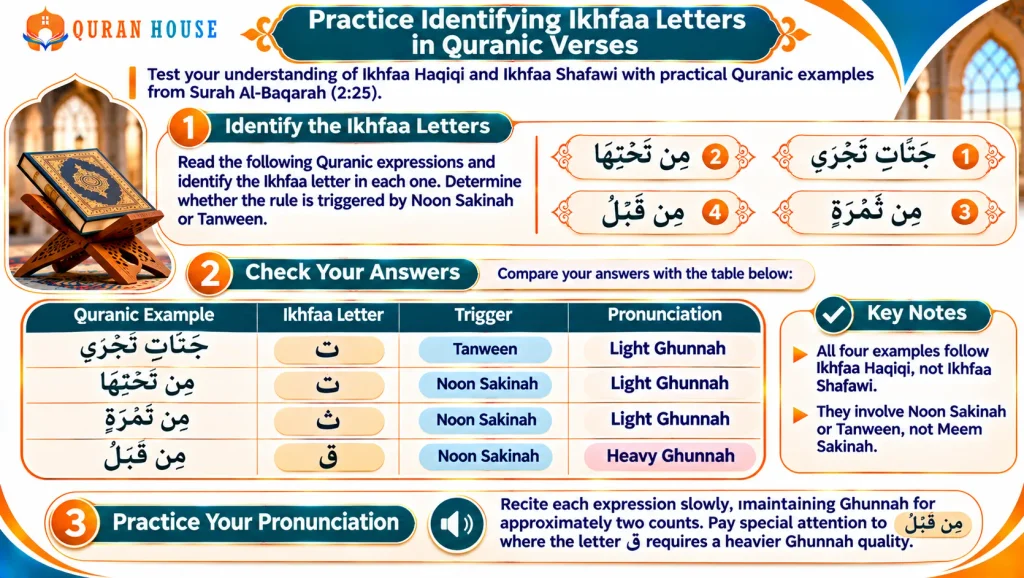
All four examples are taken from Surah Al-Baqarah (2:25).
1. Identify the Ikhfaa Letters
Read the following Quranic expressions carefully and identify the Ikhfaa letter in each one:
- جَنَّاتٍ تَجْرِي
- مِن تَحْتِهَا
- مِن ثَمَرَةٍ
- مِن قَبْلُ
Before checking the answers, determine whether Ikhfaa occurs because of Noon Sakinah or Tanween and identify the letter responsible for the rule.
2. Check Your Answers
The table below shows the correct Ikhfaa letter in each Quranic example, whether the rule is triggered by Noon Sakinah or Tanween, and whether the Ghunnah should have a heavy or light quality. Compare your answers with the table to check your understanding of Ikhfaa Haqiqi before practicing the pronunciation.
| Quranic Example | Ikhfaa Letter | Trigger | Pronunciation |
|---|---|---|---|
| جَنَّاتٍ تَجْرِي | ت | Tanween | Light Ghunnah |
| مِن تَحْتِهَا | ت | Noon Sakinah | Light Ghunnah |
| مِن ثَمَرَةٍ | ث | Noon Sakinah | Light Ghunnah |
| مِن قَبْلُ | ق | Noon Sakinah | Heavy Ghunnah |
All four examples follow Ikhfaa Haqiqi, not Ikhfaa Shafawi, because they involve Noon Sakinah or Tanween rather than Meem Sakinah.
3. Practice Your Pronunciation
After identifying the correct letters, recite each expression slowly while maintaining Ghunnah for approximately two counts. Pay particular attention to مِن قَبْلُ, where the following letter ق requires a heavier Ghunnah quality.
Repeat the examples until you can recognize the rule and pronounce each expression correctly without stopping to think about the individual letters.
How Ikhfaa Contributes to the Beauty of Recitation?
Beyond its technical function, Ikhfaa contributes to the smooth flow of Quranic recitation by allowing a controlled transition between Noon Sakinah or Tanween and the following letter.
Its partially concealed pronunciation creates a distinctive sound that is recognizable in accurate recitation When applied correctly, Ikhfaa helps maintain a balanced rhythm without exaggerating nasalization or disrupting articulation.
However, its primary purpose remains correct Quranic pronunciation rather than producing a particular musical effect Understanding this distinction encourages learners to prioritize accurate Tajweed while appreciating the clarity and harmony of recitation.
Memorizing Surah Ad-Duha in Class
Memorization is easier with structure. See how a student reviews and recites Surah Ad-Duha in a live lesson, guided by a tutor who follows every step of their progress.
Start Your Quran Journey With Quran House
Learn live and one-on-one with Al-Azhar-trained tutors, male and female, for children and adults, at a time that fits your timezone.
Try a Free SessionPerfect Your Tajweed with Quran House
Mastering Ikhfaa and other Tajweed rules requires more than understanding their definitions. At Quran House, our qualified teachers help students improve their Quran recitation through personalized online lessons, practical exercises, and direct pronunciation correction.
Whether you are a beginner or looking to refine your Tajweed skills, our one-on-one classes provide structured guidance tailored to your learning level, helping you recite the Quran with greater accuracy and confidence.
Ready to take the next step? Book Your Free Trial and start improving your Quran recitation with a qualified teacher.
Explore Our Tajweed Courses:
- Learn Quran Reading with Tajweed for Beginners
- Basic Tajweed for Non-Arabic Speakers
- Practical (Amali) Tajweed Course
- Online Tajweed Classes for Sisters and Women
- Advanced Tajweed Course
- Tajweed Ijazah Course

Final Thoughts
Mastering Ikhfaa Haqiqi and Ikhfaa Shafawi is essential for accurate Quran recitation. Understanding the 15 Ikhfaa letters, the three levels of concealment, and the correct application of Ghunnah helps learners recognize and avoid common Tajweed mistakes.
Although both types of Ikhfaa involve nasalization, they apply to different letters and pronunciation conditions. Practicing Quranic examples helps learners distinguish between them and apply each rule correctly during recitation.
With consistent practice, careful listening, and guidance from a qualified Tajweed teacher, learners can improve their pronunciation, strengthen their recitation skills, and develop greater confidence in reading the Quran.
Frequently Asked Questions About Ikhfaa
The following questions address common difficulties learners encounter when studying Ikhfaa Haqiqi and Ikhfaa Shafawi.
1. How Many Letters Are There in Ikhfaa Haqiqi?
There are 15 letters of Ikhfaa Haqiqi: ت، ث، ج، د، ذ، ز، س، ش، ص، ض، ط، ظ، ف، ق، and ك.
2. How Many Counts Is Ghunnah in Ikhfaa?
Ghunnah is maintained for two counts (Harakat) in both Ikhfaa Haqiqi and Ikhfaa Shafawi.
3. What Is the Difference Between Ikhfaa and Idgham?
Ikhfaa conceals Noon Sakinah or Tanween while maintaining Ghunnah without completely merging the sound into the next letter.
Idgham involves merging Noon Sakinah or Tanween into a following letter according to its specific Tajweed conditions.
4. Can Ikhfaa Occur Within One Word?
Yes. Ikhfaa Haqiqi can occur within one word or between two words when Noon Sakinah or Tanween is followed by an Ikhfaa letter.
5. Does Incorrect Ikhfaa Pronunciation Change the Meaning of Words?
An error in applying Ikhfaa may affect the accuracy of Tajweed without necessarily changing the word’s meaning. However, pronunciation errors that alter letters or vowels can potentially change meaning.
6. How Long Does It Take to Master Ikhfaa Pronunciation?
There is no fixed learning period. Progress depends on previous Tajweed knowledge, practice frequency, listening ability, and the guidance received from a qualified teacher.
7. Is It Necessary to Memorize Every Ikhfaa Letter?
Memorizing all 15 letters is strongly recommended because it makes the rule easier to recognize. Regular Quran recitation also helps learners identify the letters naturally.