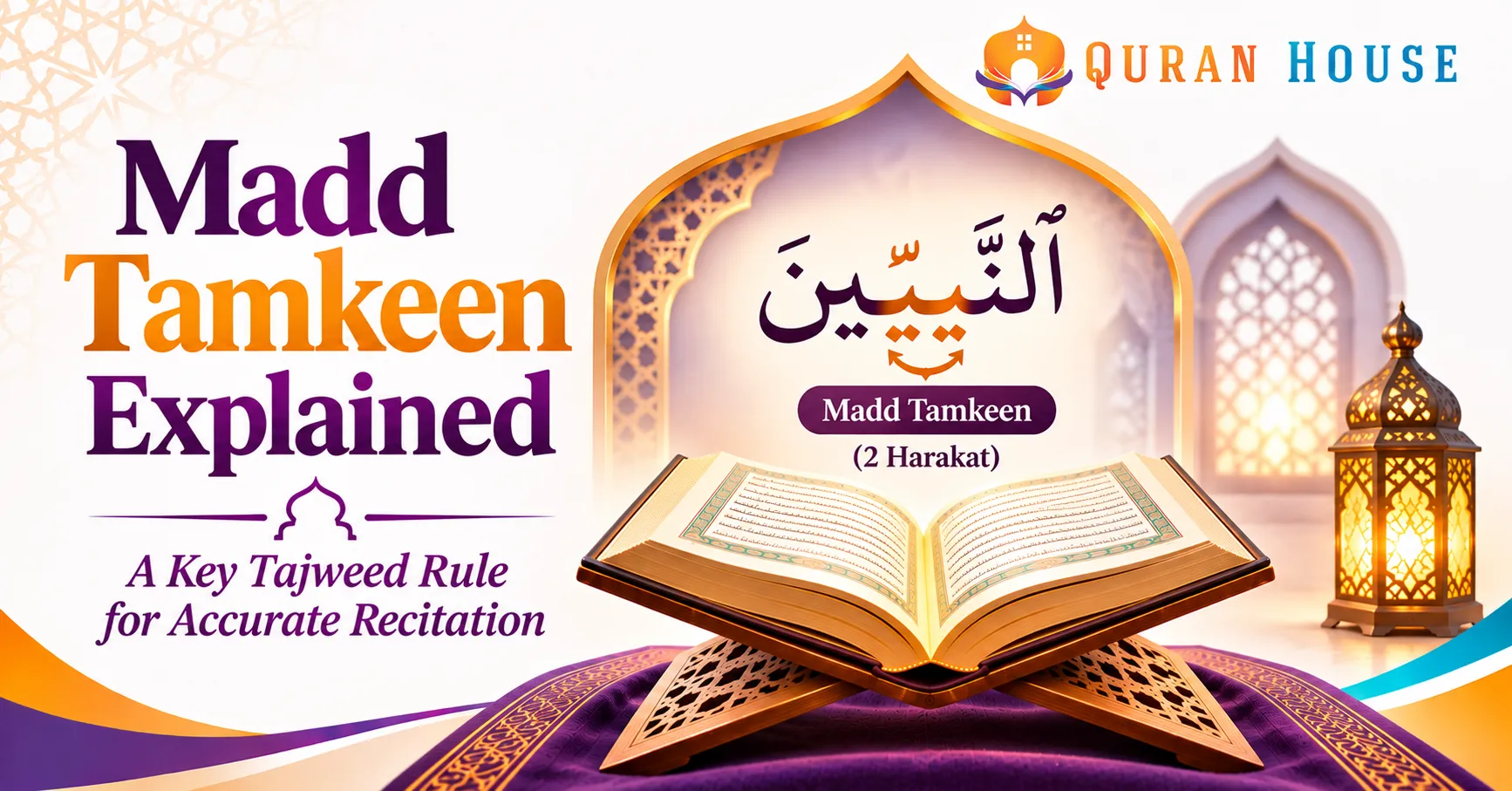
Madd Tamkeen is an important Tajweed rule that helps Quran learners pronounce repeated Yaa (ي) and Waw (و) letters correctly. It prevents the incorrect merging or omission of sounds and preserves the accuracy of Quranic recitation.
In one commonly taught form, Madd Tamkeen occurs when a Yaa with Shaddah and Kasra is followed by a Yaa Maddiyyah within the same word, as in النَّبِيِّينَ. This elongation is pronounced for two Harakat (counts), like Madd Tabee’i.
In this guide, we explain the meaning of Madd Tamkeen, its Quranic examples, pronunciation rules, common mistakes, and practical techniques for improving your Tajweed.
Madd Tamkeen helps preserve the correct pronunciation of consecutive Yaa or Waw letters. Its commonly taught form involves a Yaa Mushaddadah with Kasra followed by a Yaa Maddiyyah, pronounced for two counts. It is classified with natural Madd rather than being a separate long elongation.
What You’ll Learn:
- What Madd Tamkeen means in Tajweed.
- Why Madd Tamkeen is important for accurate recitation.
- How to identify Madd Tamkeen in Quranic words.
- The correct duration of Madd Tamkeen.
- How it differs from other Madd rules.
- Common mistakes and practical exercises.
What Is Madd Tamkeen?
Madd Tamkeen is a rule of Quranic recitation associated with the proper pronunciation of consecutive Yaa or Waw letters. It is commonly introduced through a word containing a Yaa with Shaddah and Kasra followed by a long Yaa.
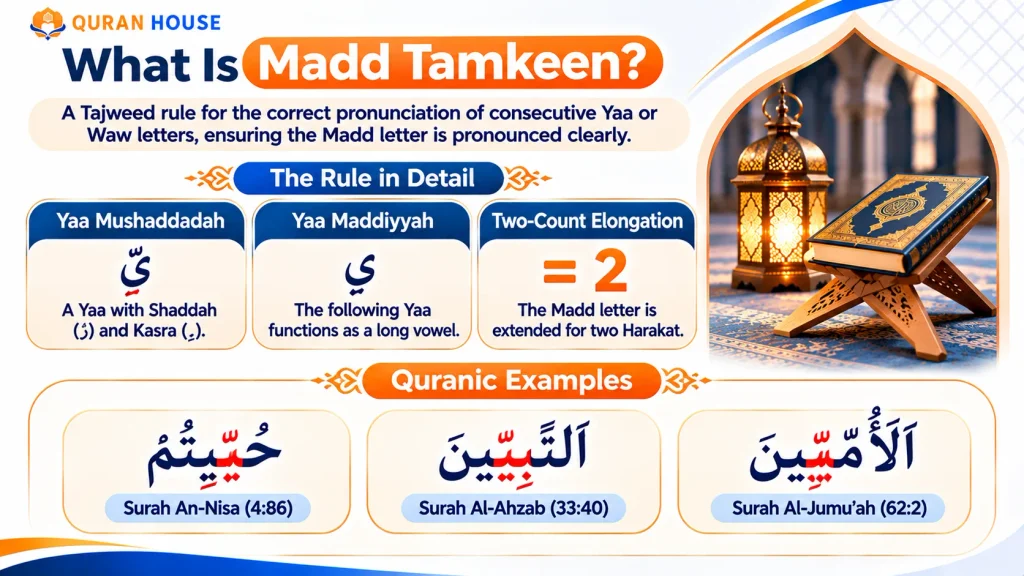
The rule prevents learners from merging these sounds incorrectly or failing to pronounce the Madd letter.
Detailed Explanation of Madd Tamkeen
Madd Tamkeen can be understood through three main elements in its commonly taught Yaa form:
- Yaa Mushaddadah: The first Yaa carries Shaddah (ّ) and Kasra (ِ), indicating a doubled consonant with the short vowel sound i.
- Yaa Maddiyyah: The following Yaa functions as a long vowel and is pronounced clearly.
- Two-Count Elongation: The Madd letter is extended for two Harakat, maintaining the distinction between the doubled consonant and the long vowel.
For example, the word النَّبِيِّينَ contains this arrangement The reciter must pronounce the doubled Yaa correctly and extend the following long Yaa for two counts.
The purpose is not to create an unusually long sound, but to preserve the correct pronunciation established in Quranic recitation.
Visual Representation with Arabic Script Examples
In the commonly taught form, Madd Tamkeen involves a Yaa Mushaddadah with Kasra followed by a Yaa Maddiyyah.
Examples from the Quran include:
- حُيِّيتُمْ: Found in Surah An-Nisa, 4:86. The long Yaa follows a doubled Yaa and is extended for two counts.
- النَّبِيِّينَ: Found in Surah Al-Ahzab, 33:40. The Yaa Maddiyyah follows a Yaa Mushaddadah with Kasra.
- الْأُمِّيِّينَ: Found in Surah Al-Jumu’ah, 62:2. The doubled Yaa is followed by a long Yaa.
In the Uthmani script, the long Yaa may be represented using a small Madd sign rather than appearing as two fully written Yaa letters.
Understanding the written representation and listening to accurate recitation can help learners recognize the rule more easily.
Importance of Madd Tamkeen for Proper Quranic Pronunciation
Understanding and applying Madd Tamkeen is important for several reasons:
- Accuracy in Recitation: It helps preserve the correct pronunciation of repeated letters and prevents the omission of required sounds.
- Beautification of Recitation: Correct application contributes to smooth and balanced Quranic recitation without unnecessary elongation.
- Preservation of Tradition: Applying Tajweed rules supports the accurate transmission of Quranic recitation. This accuracy is also important in Hifz, where learners can benefit from understanding why memorizing the Quran matters.
- Avoiding Pronunciation Mistakes: Madd Tamkeen helps distinguish the doubled consonant from the long vowel that follows it.
By practicing this rule, learners become more attentive to the structure of Quranic words and the precise pronunciation required by Tajweed.
For learners who want practical guidance, our Practical Tajweed Course provides live recitation exercises with individual pronunciation correction.
- Yaa Maddiyyah: The following Yaa functions as a long vowel and is pronounced clearly.
- Two-Count Elongation: The Madd letter is extended for two Harakat, maintaining the distinction between the doubled consonant and the long vowel.
For example, the word النَّبِيِّينَ contains this arrangement The reciter must pronounce the doubled Yaa correctly and extend the following long Yaa for two counts.
The purpose is not to create an unusually long sound, but to preserve the correct pronunciation established in Quranic recitation.
A Real Surah Lesson: Surah Ash-Shams
Watch a student work through Surah Ash-Shams step by step with their tutor, practicing each ayah until the recitation flows clearly and correctly.
Start Your Quran Journey With Quran House
Learn live and one-on-one with Al-Azhar-trained tutors, male and female, for children and adults, at a time that fits your timezone.
Try a Free SessionExamples of Madd Tamkeen in the Quran
Madd Tamkeen appears in Quranic words where the correct pronunciation of consecutive Yaa sounds must be preserved.
The following examples demonstrate the commonly taught form of the rule:
| Surah and Verse | Quranic Example | Madd Tamkeen Explanation |
|---|---|---|
| Surah An-Nisa, 4:86 | حُيِّيتُمْ | A Yaa Mushaddadah with Kasra is followed by a long Yaa |
| Surah Al-Ahzab, 33:40 | النَّبِيِّينَ | The long Yaa is pronounced for two counts after the doubled Yaa |
| Surah Al-Jumu’ah, 62:2 | الْأُمِّيِّينَ | The Yaa Maddiyyah follows a Yaa Mushaddadah with Kasra |
In each example, the long vowel should be pronounced for two Harakat without omitting the Shaddah or extending the Madd unnecessarily.
Other descriptions of Madd Tamkeen include consecutive Yaa or Waw letters across word boundaries, such as فِي يَوْمَيْنِ (Surah Fussilat, 41:9). In this case, the Madd letter is preserved before the following Yaa.
Recognizing these patterns helps learners identify Madd Tamkeen without confusing it with other elongation rules.
If you are beginning your Tajweed journey, our Tajweed for Beginners Course provides step-by-step lessons on Madd rules and accurate Quran pronunciation.

Practice Tips for Madd Tamkeen
Practicing Madd Tamkeen requires understanding its letter patterns, recognizing the correct duration, and applying the rule consistently during Quran recitation.
Here are practical steps to improve your pronunciation:
- Understand the Rule: Learn how consecutive Yaa or Waw letters can occur and recognize the commonly taught Yaa Mushaddadah pattern.
- Learn the Theory: Review the basic Madd letters and their vowel conditions before practicing Madd Tamkeen.
- Use Visual Aids: Read from a clearly printed Mushaf and identify words such as النَّبِيِّينَ and حُيِّيتُمْ.
- Listen to Expert Recitations: Follow a skilled Qari and pay attention to the doubled Yaa and the long vowel that follows it.
- Practice Two-Count Elongation: Extend the Yaa Maddiyyah for two Harakat without making it unnecessarily long.
- Slow Down: Begin with slow recitation so you can pronounce the Shaddah and Madd correctly.
- Seek Feedback: Recite the examples to a qualified Tajweed teacher who can identify pronunciation mistakes.
- Record and Listen: Compare your recorded recitation with a reliable Quran recitation to identify differences.
- Use Practice Materials: Work through Quranic verses containing Madd Tamkeen and repeat difficult words until the pronunciation becomes more consistent.
- Stay Patient and Persistent: Improving Tajweed requires regular practice. Focus on accuracy before increasing recitation speed.
The goal is not simply to memorize the definition of Madd Tamkeen, but to recognize and apply it naturally during Quran reading.
The Significance of Madd Tamkeen in Tajweed
Madd Tamkeen plays an important role in preserving the correct pronunciation of Quranic words. Its significance lies primarily in accurate articulation and maintaining the required distinction between consecutive letters.
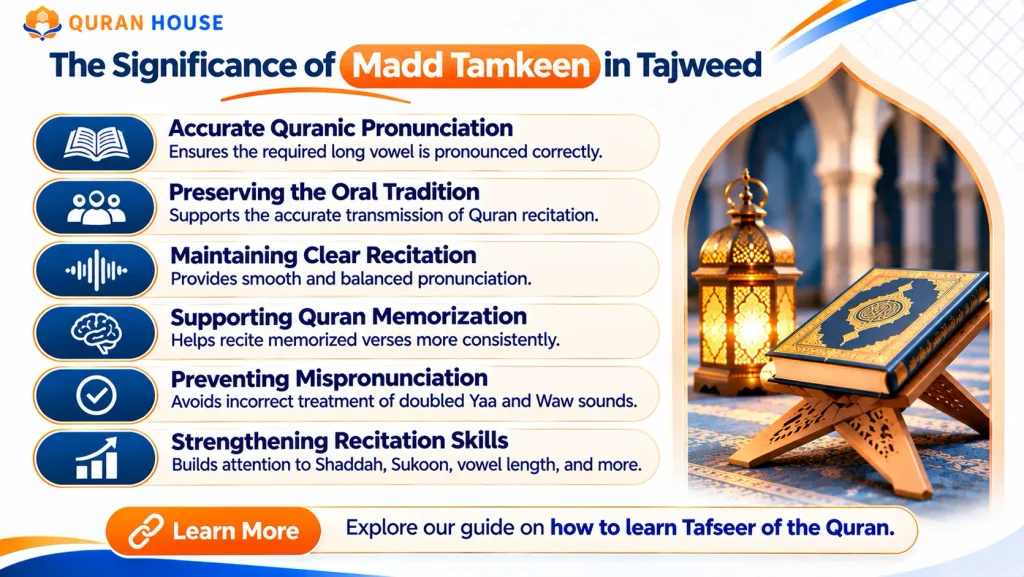
The main benefits of learning this rule include:
- Accurate Quranic Pronunciation: Madd Tamkeen ensures that the required long vowel is pronounced without being omitted or incorrectly merged.
- Preserving the Oral Tradition: Tajweed rules support the accurate transmission of Quran recitation through generations of qualified teachers and students.
- Maintaining Clear Recitation: Correct elongation contributes to smooth and balanced pronunciation without exaggerating the length of a sound.
- Supporting Quran Memorization: Recognizing the letter patterns and practicing their pronunciation can help learners recite memorized verses more consistently.
- Preventing Mispronunciation: The rule helps learners avoid incorrect treatment of doubled Yaa and Waw sounds.
- Strengthening Recitation Skills: Applying Madd Tamkeen encourages careful attention to Shaddah, Sukoon, vowel length, and other important pronunciation features.
While mastering Madd Tamkeen improves the accuracy of Quran recitation, understanding the meanings of the verses adds another dimension to Quran learning. Explore our guide on how to learn Tafseer of the Quran to discover practical steps for studying Quranic interpretation.
Interaction with Other Tajweed Rules
Madd Tamkeen is closely connected with natural Madd and the pronunciation of doubled letters. Understanding these relationships helps learners apply the rule correctly without confusing it with other Tajweed characteristics.
- Connection with Madd Tabee’i: Madd Tamkeen is classified with natural Madd in the commonly taught form, with an elongation of two Harakat.
- Relationship with Shaddah: The first Yaa carries Shaddah, so learners must pronounce the doubled consonant correctly before extending the long Yaa.
- Relationship with Sukoon: A Yaa Maddiyyah is a long-vowel letter that carries no independent short vowel. Its pronunciation must be preserved.
- Avoiding Incorrect Idgham: Madd Tamkeen helps prevent the incorrect merging of consecutive Yaa or Waw letters where the Madd sound must remain distinct.
- Distinction from Ghunnah and Qalqalah: Ghunnah involves nasalization, while Qalqalah concerns the release of specific consonants carrying Sukoon. These rules do not change the standard two-count duration of Madd Tamkeen.
- Relationship with Waqf: When stopping on a word, the reciter must apply the relevant stopping rules. Madd Tamkeen itself does not automatically become longer simply because the reciter stops.
Understanding these distinctions prevents confusion between Madd Tamkeen and unrelated Tajweed rules.
Distinguishing Madd Tamkeen from Other Types of Madd
Beginners sometimes confuse Madd Tamkeen with other elongation rules because several Madd types involve extending vowel sounds.
The important distinction is that Madd Tamkeen concerns the correct pronunciation of particular repeated-letter patterns, while other Madd rules may involve Hamzah or Sukoon as additional causes of elongation.
The following comparison shows the main differences:
| Type of Madd | Main Condition | Duration |
|---|---|---|
| Madd Tamkeen | Particular repeated Yaa or Waw patterns requiring clear pronunciation | 2 counts |
| Madd Tabee’i | A natural Madd letter without an additional cause for elongation | 2 counts |
| Madd Muttasil | A Madd letter followed by Hamzah in the same word | 4–5 counts |
| Madd Munfasil | A Madd letter at the end of one word followed by Hamzah at the beginning of the next | 4–5 counts in the commonly taught Shatibiyyah route |
The durations listed for Madd Muttasil and Madd Munfasil refer to a commonly taught route of Hafs ‘an Asim. Other recognized transmission routes may permit different durations.
Madd Tamkeen does not require a longer elongation than natural Madd in its usual form. Its purpose is to preserve the correct pronunciation of the consecutive letters.
Common Mistakes Learners Make with Madd Tamkeen
A frequent mistake among learners is overlooking the Madd Tamkeen pattern and treating the doubled consonant and following Madd letter as a single short sound.
Another common error is extending the Madd beyond its required duration without another Tajweed rule justifying the additional length.
Common mistakes include:
- Omitting the Long Yaa: Failing to pronounce the Yaa Maddiyyah clearly after the Yaa Mushaddadah.
- Ignoring the Shaddah: Pronouncing the first Yaa without its required doubling.
- Incorrect Elongation: Extending Madd Tamkeen beyond two counts without an applicable reason.
- Merging the Sounds: Failing to distinguish between the doubled Yaa and the long vowel that follows it.
- Confusing Madd Types: Treating Madd Tamkeen like Madd Muttasil or Madd Munfasil despite their different conditions.
Practicing examples such as النَّبِيِّينَ and حُيِّيتُمْ with a qualified teacher can help learners correct these mistakes.
Additional Practice Strategies for Mastering Madd Tamkeen
Once learners understand the basic rule, focused exercises can help them apply Madd Tamkeen more accurately during recitation.
- Review the Letter Patterns: Identify Yaa Mushaddadah followed by Yaa Maddiyyah in Quranic words.
- Practice Accurate Timing: Repeat the examples using a consistent two-count Madd.
- Compare Different Madd Types: Practice Madd Tamkeen alongside Madd Tabee’i and Madd Muttasil to recognize their differences.
- Use Quranic Examples: Repeat words from Surah An-Nisa, Surah Al-Ahzab, and Surah Al-Jumu’ah.
- Recite to a Teacher: Seek correction from a qualified Tajweed instructor to develop accurate pronunciation.
Regular practice helps learners move from recognizing the rule in writing to applying it during fluent Quran recitation.
A Comfortable Space for Every Learner
Watch a student recite in a live Quran House class, and remember that sisters can choose a female tutor for a private, supportive one-on-one learning space.
Start Your Quran Journey With Quran House
Learn live and one-on-one with Al-Azhar-trained tutors, male and female, for children and adults, at a time that fits your timezone.
Try a Free SessionMastering Madd Tamkeen and Other Tajweed Rules with Quran House
Understanding Madd Tamkeen is an important step toward accurate Quran recitation, but applying it consistently often requires guided practice. At Quran House, our Al-Azhar-trained teachers help students recognize Madd rules, correct pronunciation mistakes, and improve recitation through personalized online Tajweed lessons.
Our live one-on-one classes are designed for children and adults at different learning levels. Whether you are practicing Madd Tamkeen for the first time or working to improve your overall Tajweed, our teachers provide structured guidance suited to your goals and learning pace.
Ready to improve your Quran recitation? Book your 2 free sessions and begin practicing with a qualified Tajweed teacher.
Explore Our Quran Courses:
- Quran Reading Course Online for Kids and Adults
- Learn to Read Quran in Arabic
- Learn to Read Quran for Beginners
- Quran Reading for Kids
- Quran Reading for Adults
- Quran Reading for Sisters
- Noorani Qaida for Beginners
Final Thoughts
Madd Tamkeen is an important Tajweed rule that helps preserve the accurate pronunciation of repeated Yaa and Waw letters. Understanding its conditions, recognizing the correct letter patterns, and maintaining the required two-count elongation are essential for applying the rule correctly.
Through Quranic examples such as النَّبِيِّينَ and حُيِّيتُمْ, learners can understand how Madd Tamkeen works and distinguish it from other Madd rules. Careful attention to Shaddah, long vowels, and pronunciation timing helps prevent common recitation errors.
By practicing consistently, listening to skilled Quran reciters, and receiving guidance from a qualified Tajweed teacher, students can strengthen their pronunciation and develop greater confidence in reading the Quran.
Frequently Asked Questions About Madd Tamkeen
How Many Harakat Is Madd Tamkeen?
Madd Tamkeen is prolonged for two Harakat (counts) in its commonly taught form, following the same duration as Madd Tabee’i. The reciter should maintain the correct vowel length without extending it unnecessarily.
What Are the Quranic Examples of Madd Tamkeen?
Common examples of Madd Tamkeen include حُيِّيتُمْ in Surah An-Nisa, 4:86, النَّبِيِّينَ in Surah Al-Ahzab, 33:40, and الْأُمِّيِّينَ in Surah Al-Jumu’ah, 62:2. These words demonstrate the pronunciation of a Yaa Mushaddadah followed by a long Yaa.
Why Is Madd Tamkeen Called Tamkeen?
The Arabic word Tamkeen means establishing or making something firm. In Tajweed, the term refers to preserving the correct pronunciation of consecutive letters, ensuring that the Madd letter is clearly pronounced rather than omitted or incorrectly merged.
Is Madd Tamkeen a Natural Madd or a Secondary Madd?
Madd Tamkeen is generally classified as a form of Madd Tabee’i (natural Madd) because its standard elongation lasts two Harakat and does not require an additional cause such as Hamzah or Sukoon. Some Tajweed textbooks discuss it separately to explain its particular letter patterns.
Does Madd Tamkeen Apply to Both Yaa and Waw?
Yes. Some Tajweed classifications discuss Madd Tamkeen in relation to repeated Yaa or Waw letters. However, the most commonly taught example involves a Yaa Mushaddadah with Kasra followed by a Yaa Maddiyyah, as in النَّبِيِّينَ.