| Key Takeaways |
| Surah An-Naba is the 78th surah of the Quran, a Makki chapter of 40 verses, and the opening surah of Juz Amma, the thirtieth part of the Quran. |
| The Prophet ﷺ named “Amma Yatasa’alun” among five surahs that turned his hair gray, according to Jami at-Tirmidhi 3297, which Darussalam grades as Sahih. |
| Every letter recited from Surah An-Naba earns a good deed multiplied by ten, based on the general reward for Quran recitation in Jami at-Tirmidhi 2910. |
| Popular lists promising a fixed reward for reciting Amma, such as drinking cool water on Judgment Day, come from a report hadith scholars classified as fabricated. |
The benefits of reading Surah Naba reach far beyond its forty short verses. Muslims recite this surah in daily prayers, children memorize it early, and scholars return to it again and again because it answers one of the biggest questions any person can ask.
That question is what happens after death. Surah An-Naba, also called Surah Amma, responds to the people of Makkah who mocked the idea of resurrection, and it answers them with creation, rain, mountains, sleep, and a vivid scene of the Day of Judgment.
Every one of the Surah Naba benefits below is tied to the actual text of the surah or to an authentic hadith, so you can reflect on it with confidence. These are the benefits that reading and reflecting on Surah An-Naba delivers.
1. Strengthen Certainty in the Great News of Resurrection
Surah An-Naba opens by exposing a debate. The people of Makkah were questioning each other about “the great news,” meaning the resurrection and the final reckoning, and the surah answers that their doubt will end in certainty.
عَمَّ يَتَسَاءَلُونَ • عَنِ النَّبَإِ الْعَظِيمِ
(‘Amma yatasaa’aloon. ‘Anin-naba’il-‘azeem)
(“About what are they asking one another? About the great news.”)
Reading these opening verses regularly trains the heart to treat the Hereafter as real news, not a distant theory. Repetition matters here, because certainty grows when the same truth is heard, recited, and reflected on many times.
Scholars of Tafseer note that the word “Naba” refers to news of great importance, not ordinary information. That single word sets the tone for the whole chapter: what follows is the most consequential announcement a human being will ever receive.
2. Feel the Awe That Made the Prophet ﷺ Turn Gray
Surah An-Naba carried such weight that it affected the Prophet ﷺ physically. Abu Bakr noticed signs of gray in him, and the Prophet ﷺ named the surahs responsible, with Surah Amma among them.
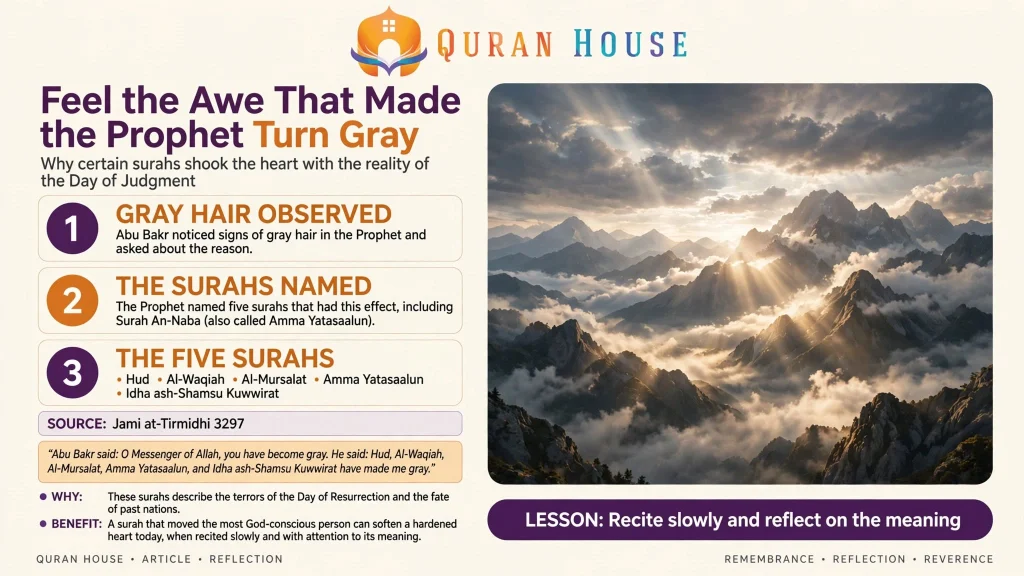
قَالَ أَبُو بَكْرٍ رضى الله عنه يَا رَسُولَ اللَّهِ قَدْ شِبْتَ، قَالَ شَيَّبَتْنِي هُودٌ وَالْوَاقِعَةُ وَالْمُرْسَلاَتُ وَ عمَّ يَتَسَاءَلُونَ وَإذَا الشَّمْسُ كُوِّرَتْ
(Qaala Abu Bakrin radiyallaahu ‘anhu: yaa Rasoolallaahi qad shibta. Qaala: shayyabatnee Hoodun wal-Waaqi‘atu wal-Mursalaatu wa ‘Amma yatasaa’aloona wa idhash-shamsu kuwwirat)
(“Abu Bakr, may Allah be pleased with him, said: O Messenger of Allah, you have become gray. He said: Hud, Al-Waqi‘ah, Al-Mursalat, ‘Amma Yatasa’alun, and Idha ash-Shamsu Kuwwirat have made me gray.”)
Commentators explain that these surahs describe the terrors of the Day of Resurrection and the fate of past nations. Reading Surah An-Naba with this hadith in mind changes the experience, since the reader knows the Prophet ﷺ himself felt its weight deeply.
This is a benefit few readers expect. A surah that moved the most God-conscious person who ever lived can soften a hardened heart today, provided it is recited slowly and with attention to its meaning.
3. Earn Ten Rewards for Every Letter of Surah An-Naba
Each letter recited from Surah An-Naba carries a reward multiplied tenfold. This is not a special virtue unique to this surah, but the general reward the Prophet ﷺ promised for reciting any part of the Book of Allah.
مَنْ قَرَأَ حَرْفًا مِنْ كِتَابِ اللَّهِ فَلَهُ بِهِ حَسَنَةٌ وَالْحَسَنَةُ بِعَشْرِ أَمْثَالِهَا لاَ أَقُولُ الم حَرْفٌ وَلَكِنْ أَلِفٌ حَرْفٌ وَلاَمٌ حَرْفٌ وَمِيمٌ حَرْفٌ
(Man qara’a harfan min Kitaabillaahi falahu bihi hasanatun, wal-hasanatu bi‘ashri amthaalihaa, laa aqoolu Alif-Laam-Meem harfun, walaakin Alifun harfun wa Laamun harfun wa Meemun harfun)
(“Whoever recites a letter from the Book of Allah receives a good deed for it, and a good deed is multiplied by ten. I do not say that Alif Lam Mim is one letter; rather, Alif is a letter, Lam is a letter, and Mim is a letter.”)
Because Surah An-Naba is short and easy to repeat, this reward accumulates quickly. A reader who recites it once a day in Salah gathers thousands of good deeds each week through a chapter that takes only a few minutes.
Correct pronunciation protects that reward and respects the words of Allah. Quran House teaches Quran reading with Tajweed for beginners, helping students recite surahs like An-Naba with accurate letters, proper Madd, and confident rhythm.
Book a Free Tajweed Session With Quran House
4. Reflect on Allah’s Power Through the Earth and Mountains
Surah An-Naba invites the reader to look at the ground beneath them before thinking about the Day of Judgment. The earth is described as a resting bed and the mountains as pegs holding it firm.
أَلَمْ نَجْعَلِ الْأَرْضَ مِهَادًا • وَالْجِبَالَ أَوْتَادًا
(Alam naj‘alil-arda mihaadaa. Wal-jibaala awtaadaa)
(“Have We not made the earth a resting place, and the mountains as pegs?”)
A peg holds most of its length below the surface. Many writers connect this image with the geological finding that mountains have deep roots extending beneath them, though scholars advise treating such links with humility rather than overreaching claims.
The core lesson is stability. The One who fixed the earth firmly enough for billions of people to live on it is fully capable of raising them again, and that reasoning sits at the heart of the surah’s argument.
5. Appreciate Sleep, Night, and Day as Signs of Design
Surah An-Naba points to the daily rhythm every human lives through. Sleep is described as rest that cuts off fatigue, night as a covering garment, and day as the time for earning a living.
وَجَعَلْنَا نَوْمَكُمْ سُبَاتًا • وَجَعَلْنَا اللَّيْلَ لِبَاسًا • وَجَعَلْنَا النَّهَارَ مَعَاشًا
(Wa ja‘alnaa nawmakum subaataa. Wa ja‘alnal-layla libaasaa. Wa ja‘alnan-nahaara ma‘aashaa)
(“And We made your sleep a means of rest, and We made the night a covering, and We made the day for livelihood.”)
Modern sleep science confirms how closely human health depends on the cycle of darkness and light. Reading these verses turns an ordinary routine into a reminder of design, mercy, and gratitude every evening and morning.
Many scholars also see a quiet sign of resurrection in sleep. Each night a person loses awareness and each morning wakes again, a small daily rehearsal of the greater awakening the surah describes.
6. Recognize Rain and Harvest as Proof of Revival
Surah An-Naba continues with rain pouring from heavy clouds and producing grain, plants, and dense gardens. Land that looked dead comes back to life, and the surah presents this as visible evidence for resurrection.
وَأَنزَلْنَا مِنَ الْمُعْصِرَاتِ مَاءً ثَجَّاجًا • لِّنُخْرِجَ بِهِ حَبًّا وَنَبَاتًا • وَجَنَّاتٍ أَلْفَافًا
(Wa anzalnaa minal-mu‘siraati maa’an thajjaajaa. Linukhrija bihee habban wa nabaataa. Wa jannaatin alfaafaa)
(“And We sent down from the rain clouds abundant pouring water, to bring forth by it grain and vegetation, and gardens of dense growth.”)
The sequence of verses 6 to 16 reads like a guided tour of creation. The table below shows how each sign connects to the surah’s central argument about life after death.
| Verse | Sign of Creation | Lesson for the Reader |
| 78:6 | Earth as a resting place | Allah prepared the world for human life |
| 78:7 | Mountains as pegs | Stability comes from His command |
| 78:8 | Humans created in pairs | Companionship is part of His design |
| 78:9-11 | Sleep, night, and day | Daily rhythm reflects mercy and order |
| 78:12-13 | Seven heavens and a blazing lamp | The sky displays precise power |
| 78:14-16 | Rain, grain, and gardens | Dead land revives, and so will the dead |
Memorizing Surah Ad-Duha in Class
Memorization is easier with structure. See how a student reviews and recites Surah Ad-Duha in a live lesson, guided by a tutor who follows every step of their progress.
Start Your Quran Journey With Quran House
Learn live and one-on-one with Al-Azhar-trained tutors, male and female, for children and adults, at a time that fits your timezone.
Try a Free Session7. Prepare for the Day of Sorting With Clear Accountability
After the signs of creation, Surah An-Naba turns to the appointed Day of Sorting. That day has a fixed time, and every deed has already been recorded in a precise register.
إِنَّ يَوْمَ الْفَصْلِ كَانَ مِيقَاتًا
(Inna yawmal-fasli kaana meeqaataa)
(“Indeed, the Day of Sorting is an appointed time.”)
The surah later confirms how complete that record is. Nothing is missed, forgotten, or misplaced, which pushes the reader to take small deeds and small sins seriously.
وَكُلَّ شَيْءٍ أَحْصَيْنَاهُ كِتَابًا
(Wa kulla shay’in ahsaynaahu kitaabaa)
(“And everything We have enumerated in writing.”)
Accountability becomes a practical habit through this surah. Readers often find themselves reviewing their speech, their salah, and their dealings with others after reciting it, which is exactly the effect the verses aim to produce.
Grasping the meaning of each verse makes that effect far stronger. Quran House runs a Quran Tafseer course online for all levels where Al-Azhar trained teachers explain surahs like An-Naba verse by verse, linking each scene to classical commentary.
Start Your Free Tafseer Lesson Today
8. Take the Warning About Hell Seriously Before Regret Arrives
Surah An-Naba describes Hell as a place lying in wait for those who transgressed, where they will remain for long ages. The deniers are told that nothing will be added to them except more punishment.
فَذُوقُوا فَلَن نَّزِيدَكُمْ إِلَّا عَذَابًا
(Fadhooqoo falan nazeedakum illaa ‘adhaabaa)
(“So taste the penalty, for We will not increase you except in punishment.”)
Some classical scholars described verse 30 as among the most severe verses in the Quran for the people of the Fire. Its purpose for the living reader is mercy: a clear warning given early enough to change course.
The surah also explains why this punishment is just. Its people did not expect any reckoning and denied the signs completely, so the warning is tied directly to denial, arrogance, and a life lived without accountability.
9. Find Motivation in the Rewards Promised to the Righteous
Surah An-Naba balances its warning with a vivid picture of success for the God-conscious. Gardens, grapevines, full cups, and companions are promised, along with a gift calculated by Allah Himself.
إِنَّ لِلْمُتَّقِينَ مَفَازًا • حَدَائِقَ وَأَعْنَابًا
(Inna lil-muttaqeena mafaazaa. Hadaa’iqa wa a‘naabaa)
(“Indeed, for the righteous is attainment: gardens and grapevines.”)
One detail stands out among these rewards. Verse 35 mentions that the people of Paradise will hear no idle talk and no lying there, a peace many people long for in a world full of noise and argument.
Hope and fear work together in this surah. Reflecting on the reward after the warning keeps the reader from despair, the same balance found in the surah that follows it, explained in our guide to the benefits of Surah Naziat and its scenes of the soul’s departure.
10. Learn Humility From the Scene of Angels Standing in Rows
Surah An-Naba presents one of the most solemn images of the Day of Judgment. The Ruh and the angels stand in rows, and no one speaks except the one granted permission by the Most Merciful.
يَوْمَ يَقُومُ الرُّوحُ وَالْمَلَائِكَةُ صَفًّا ۖ لَّا يَتَكَلَّمُونَ إِلَّا مَنْ أَذِنَ لَهُ الرَّحْمَٰنُ وَقَالَ صَوَابًا
(Yawma yaqoomur-roohu wal-malaa’ikatu saffaa, laa yatakallamoona illaa man adhina lahur-Rahmaanu wa qaala sawaabaa)
(“On the Day when the Spirit and the angels will stand in rows, they will not speak except one whom the Most Merciful permits, and he will say what is correct.”)
Many commentators understand “the Ruh” here as Jibreel, the greatest of the angels. If even he stands silent before Allah, every human argument, excuse, and boast loses its weight on that day.
This verse teaches humility in a lasting way. Reciting it reminds the reader that intercession belongs to Allah’s permission alone, and that speaking truthfully in this life matters for how one stands in the next.
11. Choose a Path Back to Allah Before the Final Regret
Surah An-Naba closes with an open invitation and a final warning. Whoever wills may take a path of return to his Lord, while the disbeliever on that day will wish he had been turned into dust.
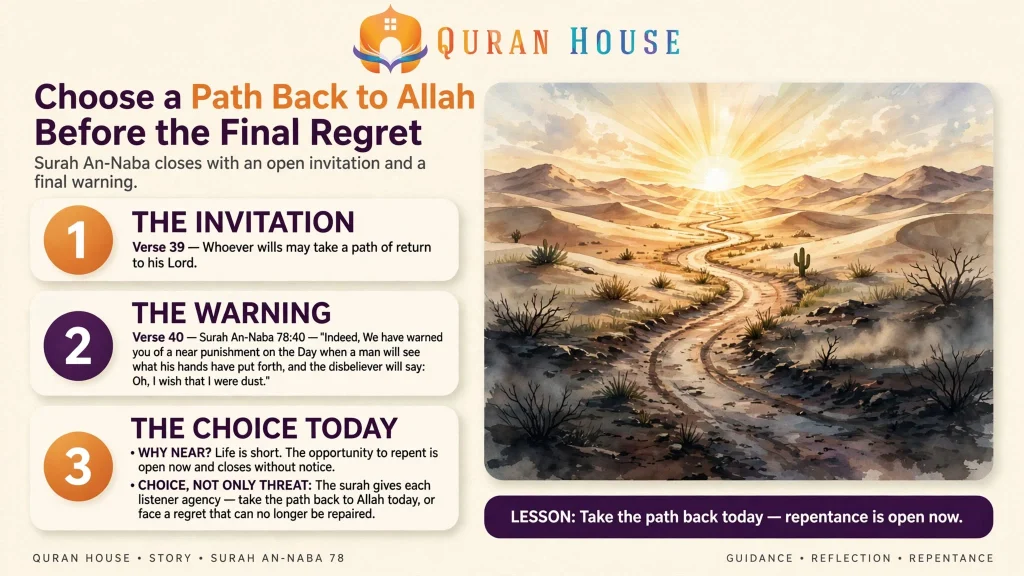
إِنَّا أَنذَرْنَاكُمْ عَذَابًا قَرِيبًا يَوْمَ يَنظُرُ الْمَرْءُ مَا قَدَّمَتْ يَدَاهُ وَيَقُولُ الْكَافِرُ يَا لَيْتَنِي كُنتُ تُرَابًا
(Innaa andharnaakum ‘adhaaban qareebaa, yawma yanzurul-mar’u maa qaddamat yadaahu wa yaqoolul-kaafiru yaa laytanee kuntu turaabaa)
(“Indeed, We have warned you of a near punishment on the Day when a man will see what his hands have put forth, and the disbeliever will say: Oh, I wish that I were dust.”)
The ending is designed to stay with the reader. Calling the punishment “near” reminds every person that life is short, and that the opportunity to repent is open now and closes without notice.
Verse 39 frames this as a choice rather than a threat alone. The surah gives each listener agency: take the path back to Allah today, or face a regret that can no longer be repaired.
12. Build an Easy Memorization Start With Juz Amma’s First Surah
Surah An-Naba opens Juz Amma, the part of the Quran most Muslims memorize first. Its rhythmic verse endings, mostly closing on a long “aa” sound, make it easier to retain than many longer chapters.
Memorizing Surah An-Naba gives a student a full surah to recite in Salah, especially in Fajr and Isha, where longer recitation is common. It also builds the confidence needed to continue through the rest of Juz Amma.
A simple plan works well for most learners:
- Memorize verses 1 to 16, which cover the opening question and the signs of creation.
- Add verses 17 to 30, covering the Day of Sorting and the warning about Hell.
- Finish with verses 31 to 40, covering Paradise, the angels, and the final warning.
- Recite the full surah in Salah for one week before moving to Surah An-Naziat.
Children benefit most when memorization comes with meaning. Quran House offers Quran Tafseer for kids online, where young learners hear the stories and lessons behind the Juz Amma surahs they memorize.

Book Your Child a Free Trial Class
Authentic Benefits of Reading Surah Naba Versus Weak Reports
Many websites list long rewards attached to Surah An-Naba, and readers deserve to know which ones are sound. Separating authentic evidence from weak or invented reports protects both the reader and the Sunnah.
The most widely shared example comes from a long report attributed to Ubayy ibn Ka‘b, assigning a fixed reward to almost every surah. For Surah Amma, it promises cool water to drink on the Day of Resurrection.
Hadith scholars rejected this report as fabricated, and Ibn al-Jawzi included it in his collection of invented narrations, Al-Mawdu‘at. Quoting it as a statement of the Prophet ﷺ is therefore not permitted.
| Claim About Surah An-Naba | Status | Source |
| Among the surahs that made the Prophet ﷺ gray | Authentic | Jami at-Tirmidhi 3297 |
| Ten rewards for every letter recited | Authentic, general to all Quran | Jami at-Tirmidhi 2910 |
| Cool water to drink on Judgment Day | Fabricated | Ubayy ibn Ka‘b report |
| Reciting it a set number of times for a wish | No known source | Not found in hadith collections |
The real benefits of reading Surah Naba are already rich without invented additions. Authentic reward, prophetic awe, and the surah’s own lessons on creation and accountability give the reader more than enough reason to recite it often.
Surah An-Naba Background, Names, and Revelation Context
Surah An-Naba is the 78th chapter of the Quran and was revealed in Makkah during the early years of the call to Islam. It contains 40 verses and falls at the start of the thirtieth part of the Quran.
| Detail | Information |
| Surah Number | 78 |
| Place of Revelation | Makkah |
| Number of Verses | 40 |
| Position in the Quran | First surah of Juz 30 (Juz Amma) |
| Other Names | Amma, Amma Yatasa’alun, At-Tasa’ul |
| Central Theme | Resurrection, accountability, reward, and punishment |
Its most common alternative name, Amma, comes from the opening word of the surah. That same word gave its name to the entire thirtieth part of the Quran, which is why the final Juz is widely called Juz Amma.
The surah addressed the Quraysh, who argued among themselves about the Prophet’s message. Some doubted out of confusion and others out of stubborn denial, and Surah An-Naba answered both groups with evidence drawn from everyday experience.
Several key words carry the surah’s message: “Naba” means momentous news, “Mihad” means a resting bed, “Awtad” means pegs, and “Yawm al-Fasl” means the Day of Sorting. Learning such words unlocks the surah instantly.
Quran House offers a word-by-word Quran reading course that teaches the meaning of each Quranic word as you read, so verses like those in Surah An-Naba become understood rather than only recited.
Try a Free Word-by-Word Reading Class
How Surah An-Naba Compares to Other Judgment Day Surahs
Several Makki surahs focus on the Day of Judgment, yet each approaches it from a different angle. Surah An-Naba stands out by answering a real public debate first, then building its case through creation before describing the Day itself.
| Surah | Main Angle on the Day of Judgment |
| An-Naba (78) | Answers doubt with signs of creation, then describes the Day of Sorting |
| Al-Waqi‘ah (56) | Divides people into three groups and their destinies |
| Al-Qiyamah (75) | Focuses on the self-blaming soul and denial of resurrection |
| Al-Mursalat (77) | Repeats a warning to deniers after each scene |
| Al-Qari‘ah (101) | Emphasizes the sudden shock of the striking hour |
Al-Waqi‘ah and Al-Mursalat also appear with An-Naba in the hadith about the Prophet’s gray hair. Our article on Surah Al-Waqiah lessons and benefits explains how that surah sorts humanity into its three final groups.
Reading these surahs together gives a fuller picture of the Hereafter. Surah An-Naba supplies the reasoning and the evidence, while its companion surahs add detail, emotion, and urgency to the same unavoidable truth.
Practical Ways to Turn Surah Naba Benefits Into Daily Habits
Knowing the Surah Naba benefits is only the first step; the real change comes from steady practice. Small, repeatable habits keep the surah’s message alive in the heart long after a single reading ends.
These habits work for beginners and experienced readers alike:
- Recite Surah An-Naba in Fajr or Isha at least twice a week to keep it fresh in memory.
- Pause on the creation verses, reading each sign slowly before moving to the next one.
- Read one verse of translation daily, then recall it while going about ordinary tasks.
- Use verse 29 as a nightly prompt to review the day’s words and actions honestly.
- Listen to a skilled reciter during your commute to absorb correct rhythm and Madd.
- Teach the meaning of one verse to a child or family member every week.
Consistency matters more than length. Five focused minutes with Surah An-Naba each day produce deeper reflection than an occasional long session, and they turn the surah into a familiar companion rather than a forgotten chapter.
A Real Surah Lesson: Surah Ash-Shams
Watch a student work through Surah Ash-Shams step by step with their tutor, practicing each ayah until the recitation flows clearly and correctly.
Start Your Quran Journey With Quran House
Learn live and one-on-one with Al-Azhar-trained tutors, male and female, for children and adults, at a time that fits your timezone.
Try a Free SessionLearn Surah An-Naba With Quran House Expert Instructors
Quran House connects students with Al-Azhar trained teachers for live, one-on-one lessons that cover recitation, Tajweed, memorization, and Tafseer. Every plan fits your schedule, and kids, adults, and sisters each get a learning path built for them.
What sets Quran House apart:
- Al-Azhar trained tutors who correct recitation in real time during every class.
- One-on-one sessions with flexible timing across all time zones.
- Female tutors available for sisters who prefer a private learning space.
- Structured progress through Juz Amma with regular review and feedback.
Book Your FREE Trial Lesson With Quran House
- Quran Reading Course Online for Kids and Adults.
- Learn Quran Reading with Tajweed for Beginners.
- Word-by-Word Quran Reading Course.
- Quran Tafseer Course Online for All Levels.
- Quran Tafseer for Kids Online.
- Quran Tafseer for Sisters Online.
Conclusion
Surah An-Naba carries far more weight than its forty verses suggest. It opens with a public debate, answers it through the signs of creation, and ends with a Day of Sorting that every person will witness without exception.
The benefits of reading Surah Naba include stronger certainty in the Hereafter, a reward for every letter, a heart softened by the same surah that moved the Prophet ﷺ, and a firm foundation for memorizing Juz Amma.
Recite it with correct Tajweed, reflect on its meanings, and rely only on authentic reports about its virtues. Taken this way, Surah An-Naba becomes a weekly reminder of where every life is heading and how to prepare for it.
FAQs
What Are the Benefits of Reading Surah Naba?
Reading Surah Naba strengthens belief in resurrection, encourages reflection on creation, and builds accountability. Each letter earns ten rewards, and the Prophet ﷺ named it among the surahs that turned his hair gray, according to Jami at-Tirmidhi 3297.
Is There an Authentic Hadith About a Special Reward for Surah Amma?
No authentic hadith assigns Surah Amma a unique reward of its own. Its authentic virtue appears in Jami at-Tirmidhi 3297, while the popular “cool water” reward comes from a report hadith scholars judged to be fabricated.
Why Is Surah An-Naba Also Called Surah Amma?
Surah An-Naba is called Amma because its first word is “Amma,” meaning “about what.” The same word gave its name to Juz Amma, the thirtieth part of the Quran, which Surah An-Naba opens.
How Many Verses Are in Surah Naba?
Surah Naba contains 40 verses. It was revealed in Makkah and is the 78th surah in the Quran, making it the longest of the short surahs that many Muslims memorize first in Juz Amma.
When Is the Best Time to Recite Surah An-Naba?
Surah An-Naba can be recited at any time, with no authentic hadith fixing a special time. Many Muslims recite it in Fajr or Isha prayers, where its length suits a single rak‘ah or two.