| Key Takeaways |
| Surah Al-Ala is the 87th chapter of the Quran, a Meccan surah of 19 verses in Juz 30 that the Prophet (ﷺ) recited in Friday, Eid, and Witr prayers. |
| The surah moves from glorifying Allah, to creation and guidance, to accountability, and ends with the promise of success for those who purify themselves and pray. |
| Because the surah is short, it suits memorization, lighter congregational prayers, and daily reflection, as the Prophet’s advice to Mu’adh ibn Jabal clearly shows. |
| A student of Hifz can learn the surah within one week using a fixed daily plan, a qualified tutor, and steady review of every verse. |
The benefits of Surah Al Ala begin with its very first command, which asks every believer to glorify the name of Allah, the Most High. This short Meccan chapter gathers worship, reflection, and hope into only nineteen verses.
Many readers search for Surah Al-Ala benefits after hearing it in Friday or Eid prayers, then wonder what it teaches. The Prophet (ﷺ) recited it often, and the Companions memorized it early, so its value is well documented.
Every benefit below rests on Quranic verses or authentic hadith, and each is explained in practical terms for daily worship and study. The benefits are as follows.
1. Glorify Allah With the Opening Command of the Surah
The first benefit is an act of worship: the surah commands tasbih, which means declaring Allah free from every flaw. Reciting the opening verses keeps that declaration alive on the tongue and in the heart.
The word tasbih comes from the root s-b-h, which carries the sense of moving swiftly and keeping something at a distance. The command appears first, followed by two signs of Allah’s power:
سَبِّحِ ٱسْمَ رَبِّكَ ٱلْأَعْلَى • ٱلَّذِى خَلَقَ فَسَوَّىٰ • وَٱلَّذِى قَدَّرَ فَهَدَىٰ
(Sabbihisma rabbikal-a’la • Alladhee khalaqa fasawwa • Walladhee qaddara fahada)
(“Exalt the name of your Lord, the Most High, Who created and proportioned, And who destined and [then] guided.”)
The name Al-A’la means the Most High. Muslims repeat this attribute in every prostration when they say Subhana Rabbiyal A’la, which means Glory be to my Lord, the Most High, at the moment the forehead touches the ground.
A sincere tasbih is more than a spoken phrase, because it engages three parts of the person at the same time and keeps the worshipper present:
- The mind reflects on Allah’s perfection and power.
- The heart feels awe and calm in His remembrance.
- The tongue repeats words of praise and gratitude.
2. Strengthen Faith Through Creation and Divine Guidance
The surah strengthens Tawhid, the belief in the oneness of Allah, by pointing to what believers can observe every day. Allah created every being, proportioned it, and guided it toward its purpose.
Look at a newborn animal that finds its mother without instruction, or a seed that pushes toward light. Such details show design and guidance working together, exactly as the second and third verses describe.
The surah then turns to the green pasture, a scene familiar to every farmer and shepherd, and shows how quickly fresh growth turns into dry, dark stubble:
وَٱلَّذِىٓ أَخْرَجَ ٱلْمَرْعَىٰ • فَجَعَلَهُۥ غُثَآءً أَحْوَىٰ
(Walladhee akhrajal-mar’a • Faja’alahu ghuthaa’an ahwa)
(“And who brings out the pasture, And [then] makes it black stubble.”)
This cycle carries two lessons. Life that appears from lifeless ground points to resurrection, and the withering of plants reminds the believer that worldly beauty is temporary and that every person is returning to Allah.
3. Follow the Prophet in Friday and Eid Prayer Recitation
Following the Sunnah is one of the clearest benefits. Authentic reports show the Prophet (ﷺ) choosing this surah for the most important congregations of the week and the year.
Sunan Abi Dawud 1125 on Friday Prayer Recitation
Samurah ibn Jundub reported that the Prophet (ﷺ) recited Surah Al-Ala together with Surah Al-Ghashiyah in the Friday prayer. The wording below is taken directly from the narration:
أَنَّ رَسُولَ اللَّهِ صلى الله عليه وسلم كَانَ يَقْرَأُ فِي صَلاَةِ الْجُمُعَةِ سَبِّحِ اسْمَ رَبِّكَ الأَعْلَى وَ هَلْ أَتَاكَ حَدِيثُ الْغَاشِيَةِ
(Anna rasoolallahi sallallahu alayhi wasallam kana yaqra’u fi salatil-jumu’ati: Sabbihisma rabbikal-a’la wa hal ataka hadeethul-ghashiyah)
(“The Messenger of Allah (ﷺ) used to recite in the Friday prayer: Glorify the name of your most high Lord (Surah 87) and Has the story of the overwhelming event reached you? (Surah 88).”)
Because the Friday sermon and prayer gather the whole community, this hadith shows how much the Prophet valued placing these verses in the hearts of ordinary worshippers.
Sahih Muslim 878a on Eid and Friday Prayers Together
An-Nu’man ibn Bashir confirmed the same practice and added the Eid prayers. His report also covers the rare day when Eid and Friday fall together:
كَانَ رَسُولُ اللَّهِ صلى الله عليه وسلم يَقْرَأُ فِي الْعِيدَيْنِ وَفِي الْجُمُعَةِ بِـ سَبِّحِ اسْمَ رَبِّكَ الأَعْلَى وَ هَلْ أَتَاكَ حَدِيثُ الْغَاشِيَةِ قَالَ وَإِذَا اجْتَمَعَ الْعِيدُ وَالْجُمُعَةُ فِي يَوْمٍ وَاحِدٍ يَقْرَأُ بِهِمَا أَيْضًا فِي الصَّلاَتَيْنِ
(Kana rasoolullahi sallallahu alayhi wasallam yaqra’u fil-‘eedayni wa fil-jumu’ati bi: Sabbihisma rabbikal-a’la wa hal ataka hadeethul-ghashiyah. Qala: wa idha ajtama’al-‘eedu wal-jumu’atu fi yawmin wahidin yaqra’u bihima aydan fis-salatayn)
(“The Messenger of Allah (ﷺ) used to recite on two ‘Ids and in Friday prayer: ‘Glorify The name of Thy Lord, the Most High’ (Surah lxxxvii.), and: ‘Has there come to thee the news of the overwhelming event’ (lxxxviii.). And when the ‘Id and Jumu’a combined on a day he recited these two (surah) in both the prayers.”)
Two gatherings on one day are an honor for the community, and the Prophet (ﷺ) used the same two surahs in both. Reciting them yourself revives a practice that has continued for centuries.
4. Complete the Witr Prayer With a Surah the Prophet Recited
Witr is the closing prayer of the night, and the Prophet (ﷺ) used Surah Al-Ala to open it. Ubayy ibn Ka’b described the three surahs the Prophet used for it:
كَانَ رَسُولُ اللَّهِ ـ صلى الله عليه وسلم ـ يُوتِرُ بِـ سَبِّحِ اسْمَ رَبِّكَ الأَعْلَى وَ قُلْ يَا أَيُّهَا الْكَافِرُونَ وَ قُلْ هُوَ اللَّهُ أَحَدٌ
(Kana rasoolullahi sallallahu alayhi wasallam yootiru bi: Sabbihisma rabbikal-a’la wa qul ya ayyuhal-kafiroon wa qul huwa Allahu ahad)
(“The Messenger of Allah (ﷺ) used to perform Witr and recite: ‘Glorify the Name of your Lord the Most High.’ [Al-A’la (87)] ‘Say: O you disbelievers!’ [Al-Kafirun (109)] and ‘Say: Allah is One.’ [Al-Ikhlas (112)]”)
Reciting Al-Ala first, then Al-Kafirun, then Al-Ikhlas gives Witr a clear pattern: glorification, disavowal of false worship, and pure belief in One God. A worshipper who follows it can end every night with Tawhid.
The table below summarizes the three prayers covered so far, together with the Companion who reported each practice and the collection where it appears, so readers can verify each one.
| Prayer | Companion | Collection |
| Friday prayer | Samurah ibn Jundub | Sunan Abi Dawud 1125 |
| Eid and Friday prayers | An-Nu’man ibn Bashir | Sahih Muslim 878a |
| Witr prayer | Ubayy ibn Ka’b | Sunan Ibn Majah 1171 |
Worshippers who recite these surahs in congregation or in Witr benefit from reading smoothly and accurately, a skill that grows with guided practice rather than guesswork.
Quran House offers the Learn to Read Quran for Beginners course, which builds the letter recognition and fluency needed to recite surahs like this one confidently in prayer.

Start Your Free Beginner Reading Lesson
5. Learn From the Companions Who Memorized the Surah Early
The Companions treated this surah as one of the first they learned. Al-Bara reported that he had learned it before the Prophet (ﷺ) arrived in Medina, as recorded in Sahih al-Bukhari:
تَعَلَّمْتُ سَبِّحِ اسْمَ رَبِّكَ قَبْلَ أَنْ يَقْدَمَ النَّبِيُّ صلى الله عليه وسلم
(Ta’allamtu sabbihisma rabbika qabla an yaqdama an-nabiyyu sallallahu alayhi wasallam)
(“I learnt, ‘Glorify the Name of your Lord the Most High’ (Surat al-A’la) No 87, before the Prophet (ﷺ) came (to Medina).”)
Its nineteen short verses make memorization realistic for children, new Muslims, and busy adults. Most verses end with the same long a sound, which helps the tongue and the ear hold the words.
Memorizing a surah in a company of learners also builds discipline. A student who recites to a tutor each day receives correction, encouragement, and a shared goal, which makes retention far stronger than solitary effort.
Memorizing Surah Ad-Duha in Class
Memorization is easier with structure. See how a student reviews and recites Surah Ad-Duha in a live lesson, guided by a tutor who follows every step of their progress.
Start Your Quran Journey With Quran House
Learn live and one-on-one with Al-Azhar-trained tutors, male and female, for children and adults, at a time that fits your timezone.
Try a Free Session6. Choose a Short Surah to Keep Congregational Prayer Light
Mercy toward the congregation is another benefit of this surah. When Mu’adh ibn Jabal led a very long prayer, the Prophet (ﷺ) asked him three times whether he was putting the people to trial, then advised:
يَا مُعَاذُ أَفَتَّانٌ أَنْتَ ـ ثَلاَثًا ـ اقْرَأْ وَالشَّمْسِ وَضُحَاهَا وَسَبِّحِ اسْمَ رَبِّكَ الأَعْلَى وَنَحْوَهَا
(Ya Mu’adhu afattanun anta, thalathan: iqra’ wash-shamsi wa duhaha wa sabbihisma rabbikal-a’la wa nahwaha)
(“O Mu’adh! You are putting the people to trials? Recite ‘Washshamsi wad-uhaha’ (91) or ‘Sabbih isma Rabbi ka-l-A’la’ (87) or the like.”)
The elderly, the sick, and workers who rise early all pray behind an imam. A surah of nineteen verses lets the prayer stay focused and complete while respecting the strength of every worshipper.
Imams often pair this surah with Surah Ash-Shams, which the same hadith names beside it. Readers who want to study that companion surah can read our guide on the benefits of reciting Surah Ash-Shams.
7. Find Comfort in the Promise That Allah Will Ease Your Path
Surah Al-Ala offers reassurance to every learner who fears forgetting or failing. Allah promised the Prophet (ﷺ) that he would recite without forgetting, and then promised ease. Both promises appear together in these verses:
سَنُقْرِئُكَ فَلَا تَنسَىٰٓ • إِلَّا مَا شَآءَ ٱللَّهُ ۚ إِنَّهُۥ يَعْلَمُ ٱلْجَهْرَ وَمَا يَخْفَىٰ • وَنُيَسِّرُكَ لِلْيُسْرَىٰ
(Sanuqri’uka fala tansa • Illa ma shaa’a Allah, innahu ya’lamul-jahra wa ma yakhfa • Wa nuyassiruka lil-yusra)
(“We will make you recite, [O Muhammad], and you will not forget, Except what Allah should will. Indeed, He knows what is declared and what is hidden. And We will ease you toward ease.”)
Commentators explain that the ease in verse 8 includes a Sharia that is clear, balanced, and free of needless hardship, as well as ease in remembering revelation.
For a student of the Quran, this verse is practical encouragement. Difficulty in learning is temporary, effort is rewarded, and Allah is the One who makes the path easy when a servant sincerely tries.
The words except what Allah wills also remind every learner that memory and understanding remain gifts from Allah, so humility must always sit beside effort and sincere practice.
8. Gain Inner Calm Through Repeated Listening and Recitation
Reciting and listening to the Quran can bring a sense of calm, and short surahs such as Al-Ala are easy to repeat in quiet moments. The verses remind the believer that Allah knows every spoken and hidden matter.
Knowing that Allah is aware of what is declared and what is hidden relieves the heart of the need to impress people. It also encourages honest intentions, which is a quiet form of peace.
Researchers have also begun to study the effect of Quran listening on the brain. A review in Heliyon, titled A review of the holy Quran listening and its neural correlation for its potential as a psycho-spiritual therapy, discusses this possibility.
Such findings are early and should not replace professional care when someone is struggling. Still, building a habit of calm recitation, especially before sleep, is a gentle step that many believers find grounding.
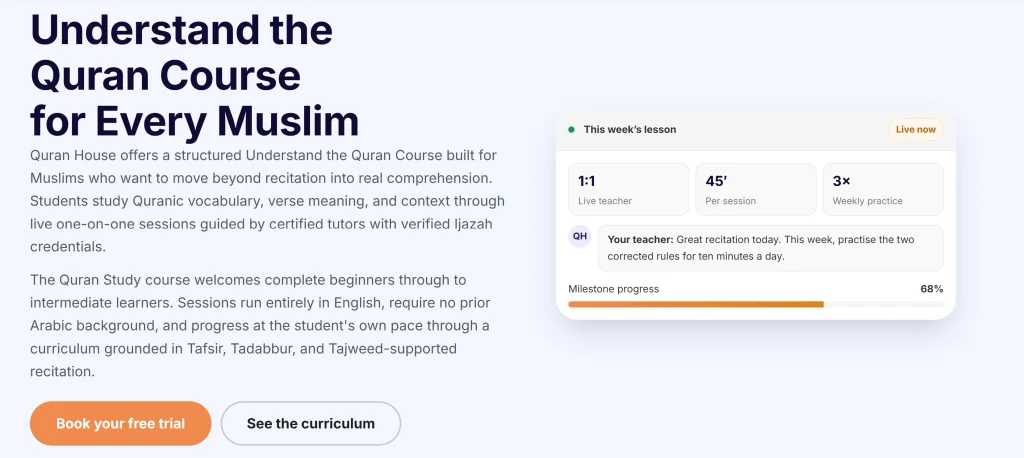
Quran House offers the Understand the Quran Course to help learners follow the meaning of each verse they recite, so reflection becomes part of daily worship.
Start Your Free Quran Meaning Lesson
9. Purify the Soul to Reach True Success
The surah teaches that success belongs to those who purify themselves, remember Allah, and pray. Among the benefits of Surah Al Ala, few are as practical, because anyone can begin today:
قَدْ أَفْلَحَ مَن تَزَكَّىٰ • وَذَكَرَ ٱسْمَ رَبِّهِۦ فَصَلَّىٰ
(Qad aflaha man tazakka • Wa dhakarasma rabbihi fasalla)
(“He has certainly succeeded who purifies himself And mentions the name of his Lord and prays.”)
The Arabic word falah, translated as success, describes flourishing in this life and the next, not only one outcome. Tazkiyah, or purification, means cleaning the heart from arrogance, envy, and heedlessness, and growing in sincerity.
Prayer completes the formula, because remembrance becomes action. A heart that has been purified feels the difference in Salah, where the words of praise from the opening verse return in every prostration.
Purification becomes realistic when it is broken into small daily habits that a believer can keep for years, even during a busy week or a tiring season:
- Repent quickly after a mistake and ask Allah for forgiveness.
- Give charity regularly, even in small amounts.
- Keep a short daily dhikr routine after each prayer.
10. Remember Accountability Through a Clear Reminder
Allah commands the Prophet (ﷺ) to keep reminding people, then explains who benefits and who turns away. The passage presents accountability as a reality every person will meet, not as a threat without purpose:
فَذَكِّرْ إِن نَّفَعَتِ ٱلذِّكْرَىٰ • سَيَذَّكَّرُ مَن يَخْشَىٰ • وَيَتَجَنَّبُهَا ٱلْأَشْقَى • ٱلَّذِى يَصْلَى ٱلنَّارَ ٱلْكُبْرَىٰ • ثُمَّ لَا يَمُوتُ فِيهَا وَلَا يَحْيَىٰ
(Fadhakkir in nafa’atidh-dhikra • Sayadhdhakkaru man yakhsha • Wa yatajannabuhal-ashqa • Alladhee yaslan-narral-kubra • Thumma la yamootu feeha wa la yahya)
(“So remind, if the reminder should benefit; He who fears [Allah] will be reminded. But the wretched one will avoid it, [He] who will [enter and] burn in the greatest Fire, Then he will neither die therein nor live.”)
The verb yakhsha, meaning to fear with knowledge, describes the person who is reminded. This fear grows from knowing Allah, so it leads to humility and action rather than panic.
The wretched one avoids the reminder and faces the greatest Fire, a place where he neither dies nor lives. The verses are serious, yet they appear beside hope, because reminders are given to help people return.
A believer who recites these verses regularly develops a healthy sense of accountability. Decisions about money, speech, and time become easier, because the Day of Judgment is no longer a distant idea.
11. Reset Priorities Between Worldly Life and the Hereafter
The surah names a common human habit: preferring the immediate over the lasting. Allah describes the choice in two short verses that every Muslim can apply to a daily schedule or a bank balance:
بَلْ تُؤْثِرُونَ ٱلْحَيَوٰةَ ٱلدُّنْيَا • وَٱلْـَٔاخِرَةُ خَيْرٌ وَأَبْقَىٰٓ
(Bal tu’thiroonal-hayatad-dunya • Wal-akhiratu khayrun wa abqa)
(“But you prefer the worldly life, While the Hereafter is better and more enduring.”)
The Arabic word tu’thiroon means to prefer one thing over another. It is often used for preferring others over oneself, but here it describes a misplaced preference for the temporary world over eternal reward.
Resetting priorities does not mean abandoning work or family. It means placing prayer, honesty, and service first, so that earning and enjoying life become acts that support the Hereafter instead of competing with it.
12. Connect With the Message of Ibrahim and Musa
The final verses connect the surah to earlier revelation, which reminds Muslims that the Quran confirms a single message sent through many prophets. Allah closes the surah with a statement about the first scriptures:
إِنَّ هَـٰذَا لَفِى ٱلصُّحُفِ ٱلْأُولَىٰ • صُحُفِ إِبْرَٰهِيمَ وَمُوسَىٰ
(Inna hadha lafis-suhufil-oola • Suhufi Ibrahima wa Musa)
(“Indeed, this is in the former scriptures, The scriptures of Abraham and Moses.”)
Ibrahim and Musa (peace be upon them) are named because they stand at the center of Abrahamic faith. Naming them tells the listener that glorification, purification, and preference for the Hereafter were always the core of prophetic teaching.
Seeing this continuity builds respect for earlier prophets and confidence in the Quran. A learner who studies the verses with a teacher also learns how scripture, history, and belief fit together.
Quran House offers the Quran Tafseer Course for All Levels, where tutors explain verses like these within their wider scriptural and historical context.

Try a Free Tafseer Lesson Today
What Is the Meaning of Surah Al Ala?
Surah Al-Ala means The Most High, and its message is that Allah alone deserves glorification, obedience, and trust. The surah has 19 verses, belongs to Juz 30, and is counted among the Musabbihat.
Musabbihat is the name given to surahs that open with glorification of Allah, and the list includes Al-Isra, Al-Hadid, Al-Hashr, As-Saff, Al-Jumuah, At-Taghabun, and Al-Ala.
The table below groups the 19 verses by theme, which makes the structure of the surah easy to remember and to explain to children or new learners.
| Verses | Theme | Key Lesson |
| 87:1 to 87:5 | Glorification and creation | Allah is perfect, and every creature follows His design. |
| 87:6 to 87:8 | Revelation and ease | The Prophet will not forget, and the path will be made easy. |
| 87:9 to 87:13 | Reminder and accountability | Reminders benefit those who fear Allah, while rejecters face the Fire. |
| 87:14 to 87:15 | Success | Purification, remembrance, and prayer lead to true success. |
| 87:16 to 87:17 | Priorities | The Hereafter is better and more lasting than worldly life. |
| 87:18 to 87:19 | Continuity | The message matches the earlier scriptures of Ibrahim and Musa. |
Read together, these themes form a complete lesson: begin with praise, trust Allah’s guidance, accept accountability, work for purification, and keep the Hereafter in view.
Why Was Surah Al Ala Revealed?
Surah Al-Ala was revealed in Makkah to strengthen the Prophet (ﷺ), establish Tawhid, and remind people that the Hereafter is better than worldly gain, as its themes and early Meccan setting show.
As a Meccan surah, it shares familiar Meccan themes: the oneness of Allah, signs in creation, accountability, and the afterlife. It is counted among the early surahs revealed in Makkah.
The reassurance in verses 6 to 8 fits a messenger who carried an enormous responsibility. Allah promised that the Prophet (ﷺ) would not forget, which gave him confidence to continue delivering the message.
Studying the setting also protects against a common mistake. The surah is not only for prayer days; its themes speak to every season of life, from fresh enthusiasm to periods of fatigue.
Recite Surah Al-Ala With Accurate Tajweed
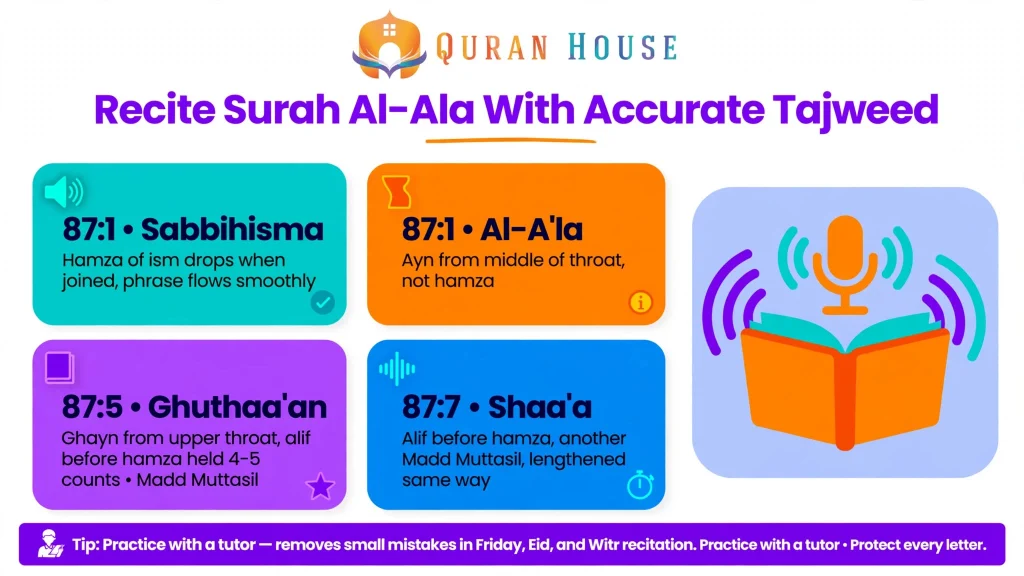
Accurate recitation is part of honoring the surah, and the benefits of Surah Al Ala are felt more deeply when each letter is pronounced correctly. Tajweed gives the rules that protect those letters.
Readers who are new to the science can begin with our guide on what Tajweed is before applying its rules to this surah, then practice the verses listed below with a tutor.
Several verses of this surah give beginners clear practice points, and a tutor can correct each one within a single short session of focused recitation:
| Verse | Word | Tajweed Point |
| 87:1 | Sabbihisma | The hamza of ism drops when joined to the previous word, so the phrase flows smoothly. |
| 87:1 | Al-A’la | The letter ayn comes from the middle of the throat and must not be replaced with a hamza. |
| 87:5 | Ghuthaa’an | The ghayn comes from the upper throat, and the alif before the hamza is held for four or five counts (Madd Muttasil). |
| 87:7 | Shaa’a | The alif before the hamza is another Madd Muttasil and is lengthened in the same way. |
These points take only minutes to practice with a tutor, yet they remove the habits that cause small mistakes in Friday, Eid, and Witr recitation.
Surah Al-Ala Benefits for Memorization and Hifz
Surah Al-Ala benefits students of Hifz in several ways: it is short, it keeps a steady rhythm, and the whole community recites it in prayer, so review happens naturally.
A realistic target for an adult beginner is one week. The plan below assumes about twenty minutes a day with a tutor or a recorded recitation, and it keeps review in every session.
| Day | Task | Duration |
| Day 1 | Listen to the full surah three times and read verses 1 to 5 aloud. | 20 minutes |
| Day 2 | Memorize verses 1 to 3 and review Day 1. | 20 minutes |
| Day 3 | Memorize verses 4 to 7 and recite verses 1 to 7 from memory. | 20 minutes |
| Day 4 | Memorize verses 8 to 13 and review verses 1 to 7. | 25 minutes |
| Day 5 | Memorize verses 14 to 19 and recite verses 8 to 19. | 25 minutes |
| Day 6 | Recite the whole surah to a tutor and fix every mistake. | 20 minutes |
| Day 7 | Recite from memory in prayer, then revise the weakest verses. | 20 minutes |
Consistency matters more than length. Short, daily sessions build stronger memory than one long weekly session, and a tutor’s correction prevents mistakes from becoming habits.
Quran House offers the Juz Amma Memorization Course, a guided path for memorizing short Meccan surahs such as Al-Ala with daily review and tutor correction.

Apply the Benefits of Surah Al Ala in Daily Life
Knowledge becomes a benefit when it changes a habit. Daily life offers many moments where this surah can guide a Muslim, and the steps below make them easy to use.
- Recite Surah Al-Ala in Witr or Friday prayer with attention to the meaning of each verse.
- Say Subhana Rabbiyal A’la slowly in prostration and remember the first verse.
- Recall verse 8 whenever memorization or study feels difficult.
- Use verses 16 and 17 to review your daily schedule and give prayer first place.
- Listen to the surah on the way to work and repeat one verse aloud.
- Teach the surah to a child or relative and review it together each week.
Consistency is the key. Even five minutes a day, supported by a tutor who corrects the recitation, turns scattered knowledge into a lasting relationship with the surah.
A Real Surah Lesson: Surah Ash-Shams
Watch a student work through Surah Ash-Shams step by step with their tutor, practicing each ayah until the recitation flows clearly and correctly.
Start Your Quran Journey With Quran House
Learn live and one-on-one with Al-Azhar-trained tutors, male and female, for children and adults, at a time that fits your timezone.
Try a Free SessionLearn Surah Al-Ala With Expert Quran House Tutors
Quran House tutors, trained in the Al-Azhar tradition, teach recitation, Tajweed, and memorization in live one-on-one sessions for kids and adults. Sisters can choose a female tutor, and every learner can begin with free trial sessions.
Our Quran Courses
- Learn to Read Quran for Beginners.
- Understand the Quran Course.
- Quran Tafseer Course for All Levels.
- Juz Amma Memorization Course.
- Practical (Amali) Tajweed Course.
- Quran Memorization for Adults.
Conclusion
The benefits of Surah Al Ala reach worship, belief, and character at the same time. The surah teaches glorification of Allah, trust in His guidance, accountability for deeds, and a clear path to success.
Its place in Friday, Eid, and Witr prayers shows how much the Prophet (ﷺ) valued it, and its short length makes it ideal for memorization. Surah Al-Ala benefits both new learners and experienced reciters.
Choose one step from this guide today: memorize the first five verses, recite the surah in Witr, or begin a daily review plan. Small, steady effort is how this surah becomes part of life.
FAQs
How Many Verses Does Surah Al-Ala Have?
Surah Al-Ala has 19 verses and is the 87th chapter of the Quran. It is a Meccan surah located in Juz 30, and it opens with the command to glorify Allah.
Is Surah Al-Ala Recited in Witr Prayer?
Yes, the Prophet (ﷺ) recited Surah Al-Ala in Witr, followed by Al-Kafirun and Al-Ikhlas, as reported by Ubayy ibn Ka’b in Sunan Ibn Majah 1171. Many worshippers follow this practice in the three-unit Witr.
Which Prayers Include Surah Al-Ala in the Sunnah?
The reports mention the Friday prayer, the two Eid prayers, and Witr. In the Friday and Eid prayers it was paired with Surah Al-Ghashiyah, while in Witr it was followed by Al-Kafirun and Al-Ikhlas.
How Long Does It Take to Memorize Surah Al-Ala?
Most adult beginners can memorize Surah Al-Ala in about one week with twenty minutes of daily practice and tutor correction. Learners with weaker reading skills may need two weeks or more.
What Does Subhana Rabbiyal A’la Mean?
Subhana Rabbiyal A’la means Glory be to my Lord, the Most High. Muslims say it in prostration, and it echoes the first verse of Surah Al-Ala, which commands the glorification of Allah’s name.