Surah Fatir benefits begin with praise for the One who originated the heavens and the earth. Surah Fatir begins with praise for the One who originated the heavens and the earth and made the angels messengers with wings. It then leads the reader through rain, fruits, mountains, and people of every color, all pointing back to one Creator.
Surah Fatir (The Originator) is the 35th surah of the Quran, a Makki surah of 45 verses in Juz 22. It is also called Surah Al-Mala’ikah (The Angels), and it is the last of the five surahs that begin with “Al-Hamdu lillah” (All praise is due to Allah). What makes it especially meaningful for anyone who reads the Quran is that it describes, in its own verses, the reward of those who recite the Book of Allah.
In this guide, we explore the benefits of Surah Fatir as they appear in authentic evidence: the reward of reciting the Quran and the lessons of the surah’s own verses, rather than unverified narrations. You will discover five key benefits, the main themes of the surah, and practical ways to bring its lessons into your daily life.
1. Strengthening Faith and Trust in Allah
Surah Fatir reminds believers that every mercy and every protection comes from Allah alone.
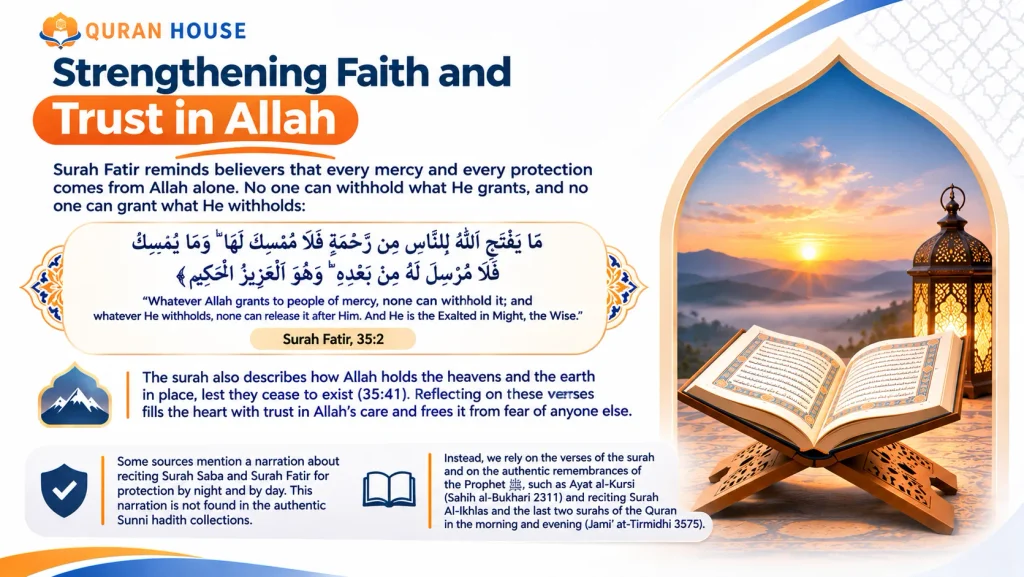
No one can withhold what He grants, and no one can grant what He withholds:
﴿مَّا يَفْتَحِ اللَّهُ لِلنَّاسِ مِن رَّحْمَةٍ فَلَا مُمْسِكَ لَهَا ۖ وَمَا يُمْسِكْ فَلَا مُرْسِلَ لَهُ مِن بَعْدِهِ ۚ وَهُوَ الْعَزِيزُ الْحَكِيمُ﴾
“Whatever Allah grants to people of mercy, none can withhold it; and whatever He withholds, none can release it after Him. And He is the Exalted in Might, the Wise.” (Surah Fatir, 35:2)
The surah also describes how Allah holds the heavens and the earth in place, lest they cease to exist (35:41). Reflecting on these verses fills the heart with trust in Allah’s care and frees it from fear of anyone else.
Some sources mention a narration about reciting Surah Saba and Surah Fatir for protection by night and by day. This narration is not established in authentic Hadith sources, so we rely instead on the verses of the surah and on the authentic remembrances of the Prophet ﷺ, such as Ayat al-Kursi (Sahih al-Bukhari 2311) and reciting Surah Al-Ikhlas and the last two surahs of the Quran in the morning and evening (Jami’ at-Tirmidhi 3575).
2. Finding Spiritual Healing Through the Quran
The Quran as a whole is a source of healing and mercy for the believers, as Allah says:
﴿وَنُنَزِّلُ مِنَ الْقُرْآنِ مَا هُوَ شِفَاءٌ وَرَحْمَةٌ لِّلْمُؤْمِنِينَ﴾
“And We send down of the Quran that which is healing and mercy for the believers.” (Surah Al-Isra, 17:82)
Surah Fatir shares in this healing, above all the healing of the heart. Its verses on Allah’s mercy, His power over all things, and the reward awaiting the righteous treat doubt, anxiety, and despair. The Prophet ﷺ also approved of ruqyah with the Quran as long as it contains no shirk (Sahih Muslim 2200), so a believer may recite its verses seeking Allah’s cure, while trusting that healing comes from Allah alone.
3. Gaining Guidance and Wisdom
Surah Fatir guides the reader to a deeper awareness of Allah through reflection on His creation. After describing the varied colors of fruits, mountains, people, and animals, Allah says:
﴿وَمِنَ النَّاسِ وَالدَّوَابِّ وَالْأَنْعَامِ مُخْتَلِفٌ أَلْوَانُهُ كَذَٰلِكَ ۗ إِنَّمَا يَخْشَى اللَّهَ مِنْ عِبَادِهِ الْعُلَمَاءُ ۗ إِنَّ اللَّهَ عَزِيزٌ غَفُورٌ﴾
“And among people and moving creatures and grazing livestock are various colors similarly. Only those who have knowledge among His servants fear Allah. Indeed, Allah is Exalted in Might and Forgiving.” (Surah Fatir, 35:28)
Lessons of wisdom from the surah:
- Knowledge leads to awe: The more we understand Allah’s creation, the more we revere Him.
- Guidance is from Allah: He guides whom He wills, so the believer asks Him for guidance and does not despair over others (35:8).
- Good deeds rise to Allah: Good words ascend to Him, and righteous action raises them (35:10).
- Contentment with His decree: What Allah grants, no one can withhold (35:2), which brings peace and acceptance.
4. Finding Comfort During Hardship
Surah Fatir reminds believers that they are always in need of Allah, while He is free of all need:
﴿يَا أَيُّهَا النَّاسُ أَنتُمُ الْفُقَرَاءُ إِلَى اللَّهِ ۖ وَاللَّهُ هُوَ الْغَنِيُّ الْحَمِيدُ﴾
“O mankind, you are those in need of Allah, while Allah is the Free of need, the Praiseworthy.” (Surah Fatir, 35:15)
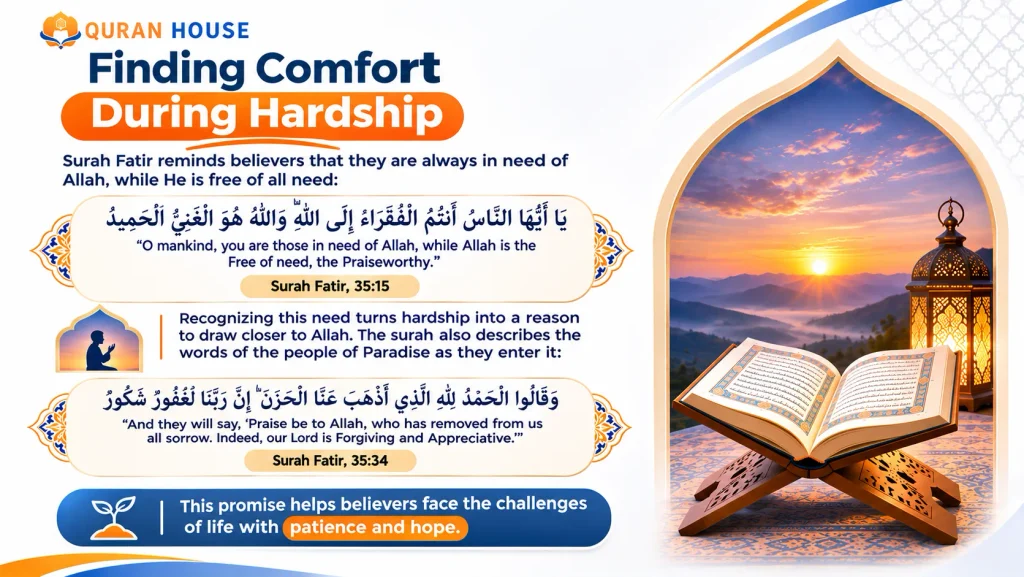
Recognizing this need turns hardship into a reason to draw closer to Allah. The surah also describes the words of the people of Paradise as they enter it, a promise that every sorrow will one day end:
﴿وَقَالُوا الْحَمْدُ لِلَّهِ الَّذِي أَذْهَبَ عَنَّا الْحَزَنَ ۖ إِنَّ رَبَّنَا لَغَفُورٌ شَكُورٌ﴾
“And they will say, ‘Praise be to Allah, who has removed from us all sorrow. Indeed, our Lord is Forgiving and Appreciative.'” (Surah Fatir, 35:34)
This promise helps believers face the challenges of life with patience and hope.
5. Earning Rewards Through Quran Recitation
Surah Fatir describes the reward of those who recite the Book of Allah in its own verses:
﴿إِنَّ الَّذِينَ يَتْلُونَ كِتَابَ اللَّهِ وَأَقَامُوا الصَّلَاةَ وَأَنفَقُوا مِمَّا رَزَقْنَاهُمْ سِرًّا وَعَلَانِيَةً يَرْجُونَ تِجَارَةً لَّن تَبُورَ لِيُوَفِّيَهُمْ أُجُورَهُمْ وَيَزِيدَهُم مِّن فَضْلِهِ ۚ إِنَّهُ غَفُورٌ شَكُورٌ﴾
“Indeed, those who recite the Book of Allah, establish prayer, and spend out of what We have provided them, secretly and publicly, can expect a trade that will never perish, that He may give them in full their rewards and increase them from His bounty. Indeed, He is Forgiving and Appreciative.” (Surah Fatir, 35:29–30)
The three deeds of this “trade that will never perish”:
- Reciting the Book of Allah: Reading it regularly, understanding it, and acting on it.
- Establishing prayer: Performing it on time, with focus and devotion.
- Spending for Allah’s sake: Giving in charity both secretly and openly.
The Prophet ﷺ explained the reward of recitation itself:
«مَنْ قَرَأَ حَرْفًا مِنْ كِتَابِ اللَّهِ فَلَهُ بِهِ حَسَنَةٌ، وَالْحَسَنَةُ بِعَشْرِ أَمْثَالِهَا»
“Whoever recites a letter from the Book of Allah will have a good deed for it, and a good deed is multiplied tenfold.” (Jami’ at-Tirmidhi 2910)
A Comfortable Space for Every Learner
Watch a student recite in a live Quran House class, and remember that sisters can choose a female tutor for a private, supportive one-on-one learning space.
Start Your Quran Journey With Quran House
Learn live and one-on-one with Al-Azhar-trained tutors, male and female, for children and adults, at a time that fits your timezone.
Try a Free SessionSurah Fatir Benefits and Main Themes
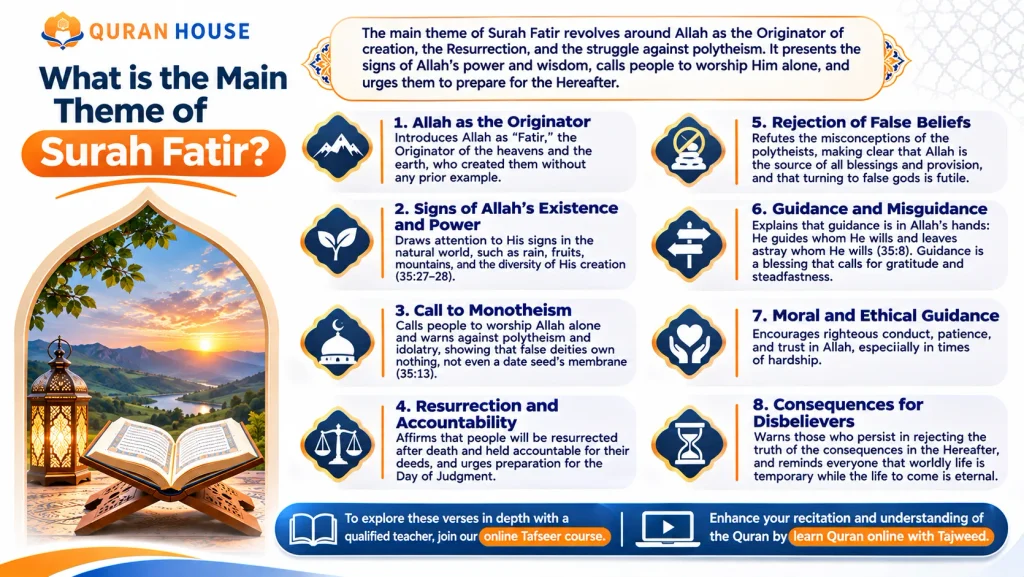
The main theme of Surah Fatir revolves around Allah as the Originator of creation, the Resurrection, and the struggle against polytheism. The surah presents the signs of Allah’s power and wisdom in the natural world, calls people to worship Him alone, and urges them to prepare for the Hereafter.
Surah Fatir primarily focuses on the following themes:
1. Allah as the Originator
The surah opens by introducing Allah as “Fatir,” the Originator of the heavens and the earth, who brought them into existence without any prior example. This name highlights His unmatched creative power and wisdom.
2. Signs of Allah’s Existence and Power
Surah Fatir draws attention to the signs of Allah’s power in the natural world: rain that brings forth fruits of different colors, mountains with streaks of white, red, and deep black, and people, animals, and livestock of varied colors (35:27–28). It invites the reader to contemplate these signs and recognize the Creator behind them.
To explore these verses in depth with a qualified teacher, join our online Tafseer course.
3. Call to Monotheism
The surah calls people to worship and obey Allah alone, and warns against polytheism and idolatry. It shows that the false deities people call upon do not own even the thin membrane of a date seed (35:13).
4. Resurrection and Accountability
The surah affirms that people will be resurrected after death and held accountable for their deeds, and it urges them to reflect on their actions and prepare for the Day of Judgment.
5. Rejection of False Beliefs
Surah Fatir refutes the misconceptions of the polytheists, making clear that Allah is the source of all blessings and provision, and that turning to false gods is futile.
6. Guidance and Misguidance
The surah explains that guidance is in Allah’s hands: He guides whom He wills and leaves astray whom He wills (35:8). Guidance is therefore a blessing that calls for gratitude and steadfastness.
Enhance your recitation and understanding of the Quran by opting to learn Quran online with Tajweed.
7. Moral and Ethical Guidance
Alongside its theological message, Surah Fatir encourages righteous conduct, patience, and trust in Allah, especially in times of hardship.
8. Consequences for Disbelievers
The surah warns those who persist in rejecting the truth of the consequences awaiting them in the Hereafter, and it reminds everyone that worldly life is temporary while the life to come is eternal.
Where Was Surah Fatir Revealed?
Surah Fatir was revealed in Makkah before the Hijrah of Prophet Muhammad ﷺ to Madinah, making it one of the Makki surahs. It consists of 45 verses and is the 35th chapter of the Quran.
Like many Makki surahs, Surah Fatir focuses on Tawhid, Allah’s power over creation, resurrection, and accountability in the Hereafter. Its verses encourage believers to reflect on the signs of Allah’s greatness and strengthen their faith in His wisdom and mercy.
Understanding the historical context and main themes of Surah Fatir can make its verses easier to comprehend and memorize. For step-by-step support with memorization, Tajweed, and regular revision, explore the Quran Memorization Course at Quran House.

Why Does Surah Fatir Open With a Description of Angels?
Surah Fatir opens by describing the angels as messengers with wings, some with two, three, or four:
﴿الْحَمْدُ لِلَّهِ فَاطِرِ السَّمَاوَاتِ وَالْأَرْضِ جَاعِلِ الْمَلَائِكَةِ رُسُلًا أُولِي أَجْنِحَةٍ مَّثْنَىٰ وَثُلَاثَ وَرُبَاعَ ۚ يَزِيدُ فِي الْخَلْقِ مَا يَشَاءُ ۚ إِنَّ اللَّهَ عَلَىٰ كُلِّ شَيْءٍ قَدِيرٌ﴾
“All praise is due to Allah, Originator of the heavens and the earth, who made the angels messengers having wings, two or three or four. He increases in creation what He wills. Indeed, Allah is over all things competent.” (Surah Fatir, 35:1)
This opening sets the tone for the surah’s broader message about Allah’s limitless creative power, moving from the unseen world of angels to the visible signs of the natural world.
The variety among the angels prepares the reader to appreciate the variety described later in the surah, from the colors of fruits and mountains to the different colors of people and animals.
What Does “No Soul Bears Another’s Burden” Mean in Surah Fatir?
Surah Fatir emphasizes personal accountability, teaching that every individual is responsible for their own deeds and choices. Allah says:
﴿وَلَا تَزِرُ وَازِرَةٌ وِزْرَ أُخْرَىٰ﴾
“And no bearer of burdens will bear the burden of another.” (Surah Fatir, 35:18)
This principle means that no one is automatically held responsible for another person’s sins, even those of close family members. However, individuals remain accountable for their own actions, including encouraging others to commit wrongdoing.
The verse encourages Muslims to take responsibility for their decisions, avoid blaming others for their mistakes, and strive toward righteousness. It also reflects Allah’s justice, reminding believers that each soul will be judged fairly according to its own deeds.
How Does Surah Fatir Compare to Other Surahs About Creation?
Several chapters of the Quran highlight Allah’s creative power, including Surah Ar-Rum and Surah Al-An’am. However, Surah Fatir places particular emphasis on Allah as the Originator of the heavens and the earth, bringing creation into existence without any prior example.
The three surahs explore different aspects of Allah’s creation:
- Surah Fatir: Emphasizes Allah as the Originator of creation and highlights His power through the diversity of nature, including mountains, plants, humans, and animals (35:1, 35:27–28).
- Surah Ar-Rum: Focuses on the signs of Allah in the natural world, including the creation of humans, the diversity of languages, and the alternation of night and day (30:20–23).
- Surah Al-An’am: Highlights Allah as the Creator of the heavens and the earth, emphasizing His absolute authority and the importance of worshipping Him alone (6:1, 6:102)).
Together, these surahs encourage believers to reflect on Allah’s power, wisdom, and Oneness. Surah Fatir particularly invites readers to recognize Allah as the source of all creation and appreciate the signs of His greatness throughout the universe.
What Does Surah Fatir Teach About the Dangers of Worldly Life?
Surah Fatir warns Muslims against becoming distracted by worldly pleasures and forgetting their responsibilities toward Allah. It reminds believers that worldly life is temporary, while Allah’s promise of resurrection and accountability is certain.
Allah says:
﴿يَا أَيُّهَا النَّاسُ إِنَّ وَعْدَ اللَّهِ حَقٌّ ۖ فَلَا تَغُرَّنَّكُمُ الْحَيَاةُ الدُّنْيَا ۖ وَلَا يَغُرَّنَّكُم بِاللَّهِ الْغَرُورُ﴾
“O mankind, indeed the promise of Allah is truth, so let not the worldly life delude you, and be not deceived about Allah by the Deceiver.” (Surah Fatir, 35:5)
This verse highlights several important lessons:
- Worldly life is temporary: Material wealth, success, and pleasures should not distract believers from preparing for the Hereafter.
- Allah’s promise is certain: Every person will ultimately return to Allah and be accountable for their deeds.
- Beware of Satan’s deception: Satan encourages people to neglect their responsibilities and develop false confidence about their spiritual condition.
- Balance hope with good deeds: Trusting Allah’s mercy should encourage sincere repentance, worship, and righteous actions rather than complacency.
By reflecting on this warning, Muslims can maintain a balanced relationship with worldly life while prioritizing faith, obedience, and preparation for the Hereafter.
How to Apply Surah Fatir’s Lessons in Daily Life?
Surah Fatir offers practical guidance that helps Muslims strengthen their faith, develop gratitude, and maintain a closer connection with Allah. Its teachings can become part of everyday life through simple, consistent actions.
- Reflect on Allah’s Creation: Observe the natural signs mentioned in Surah Fatir, such as mountains, plants, and the diversity of living beings, to appreciate Allah’s wisdom and creative power.
- Maintain Regular Worship: Make Quran recitation, daily prayers, and charity part of your routine, seeking the lasting rewards described as a “trade that will never perish” (Surah Fatir, 35:29–30).
- Practice Personal Accountability: Reflect on your actions and decisions, remembering that every individual is responsible for their own deeds (Surah Fatir, 35:18).
- Rely on Allah in Every Situation: Remember that all people depend on Allah (Surah Fatir, 35:15). Turn to Him through supplication, gratitude, and sincere trust during both difficult and peaceful times.
Applying these lessons consistently helps believers develop stronger faith, greater self-awareness, and a deeper appreciation of Allah’s mercy and guidance.
It’s Never Too Late to Learn
Adults learn with us too. Watch a real session with one of our adult learners and see how calm, one-on-one guidance makes Quran recitation feel achievable at any age.
Start Your Quran Journey With Quran House
Learn live and one-on-one with Al-Azhar-trained tutors, male and female, for children and adults, at a time that fits your timezone.
Try a Free SessionDeepen Your Understanding of Surah Fatir with Quran House
Surah Fatir invites believers to reflect on Allah’s creation, recognize His mercy, and understand the rewards of reciting the Quran. At Quran House, our Al-Azhar-trained teachers help students explore these meanings through personalized online Quran and Tafseer lessons, connecting each verse to its deeper message and practical lessons.
Since 2018, Quran House has provided live one-on-one classes for children and adults in Quran reading, Tajweed, memorization, Quranic Arabic, and Tafseer. Whether you want to understand Surah Fatir verse by verse, improve your recitation, or memorize the surah, our teachers offer guidance tailored to your level and learning goals.
Ready to strengthen your connection with the Quran? Join Quran House and book your 2 free sessions to begin your Quran learning journey with a qualified Al-Azhar tutor.
Explore Our Quran Courses:
- Noorani Qaida for Adults
- Noor Al-Bayan Course
- Quran Reading Fluency Course
- Word-by-Word Quran Reading Course
- Complete Quran Reading (Khatma) Program
- Intensive Quran Course
- Online Quran Classes for Sisters and Women
- Online Quran Classes for Men and Brothers
Conclusion
Surah Fatir reminds believers of Allah’s greatness as the Originator of the heavens and the earth. Through its descriptions of angels, nature, and divine mercy, the surah encourages reflection on creation and strengthens awareness of Allah’s power and wisdom.
The benefits of reading Surah Fatir come from the general rewards of Quran recitation and the guidance found in its verses. Its teachings emphasize reliance on Allah, patience during hardship, personal accountability, and the lasting rewards promised to those who recite the Quran and perform righteous deeds.
By reciting Surah Fatir regularly, understanding its meanings, and applying its lessons, Muslims can strengthen their faith and develop a deeper connection with the Quran. The goal is not simply to finish its verses, but to carry their guidance into everyday life.
Frequently asked questions about Surah Fatir
Is there an authentic hadith about the virtues of Surah Fatir?
We are not aware of an authentic hadith that assigns a specific reward to reciting Surah Fatir alone. Its virtue comes from the general reward of reciting the Quran and from the guidance in its verses, including its promise of a “trade that will never perish” for those who recite the Book of Allah (35:29–30).
Can Surah Fatir be recited for healing?
The Quran is a source of healing and mercy for the believers (17:82), and ruqyah with the Quran is permitted as long as it contains no shirk (Sahih Muslim 2200). A believer may recite Surah Fatir seeking Allah’s cure, but no authentic narration assigns a specific healing to one of its verses.
What does the name Fatir mean?
Fatir means “Originator,” referring to Allah as the One who brought the heavens, the earth, and all creation into existence without any prior example.
What is the other name of Surah Fatir?
Surah Fatir is also known as Surah Al-Mala’ikah (The Angels), because its opening verse describes the angels as messengers with wings.
What is the main principle regarding accountability in this surah?
The surah establishes that no soul bears the burden of another (35:18), so each person is responsible only for their own actions on the Day of Judgment.
What warning does the surah give about worldly life?
Early in the surah, Allah warns people not to be deceived by worldly life or by Satan’s false promises about Allah’s forgiveness (35:5), urging continued effort rather than complacency.