
Surah Ghafir benefits begin with its name, Allah the Forgiver of sin and Accepter of repentance. Its name means The Forgiver, and from its opening verses to its last, it balances two messages: the door of Allah’s forgiveness is wide open, and arrogance in the face of the truth leads to ruin.
Before going through the benefits, here are the key facts about the surah in one place.
| Surah number | 40 |
| Other name | Al-Mu’min (The Believer) |
| Place of revelation | Makkah (Makki surah) |
| Number of verses | 85 |
| Juz | 24 |
| Position | The first of the seven Ha-Mim surahs (40–46) |
| Name taken from | Allah’s attribute Ghafir Adh-Dhanb (Forgiver of sin) in verse 3 |
1. Emphasis on Tawheed (Monotheism)
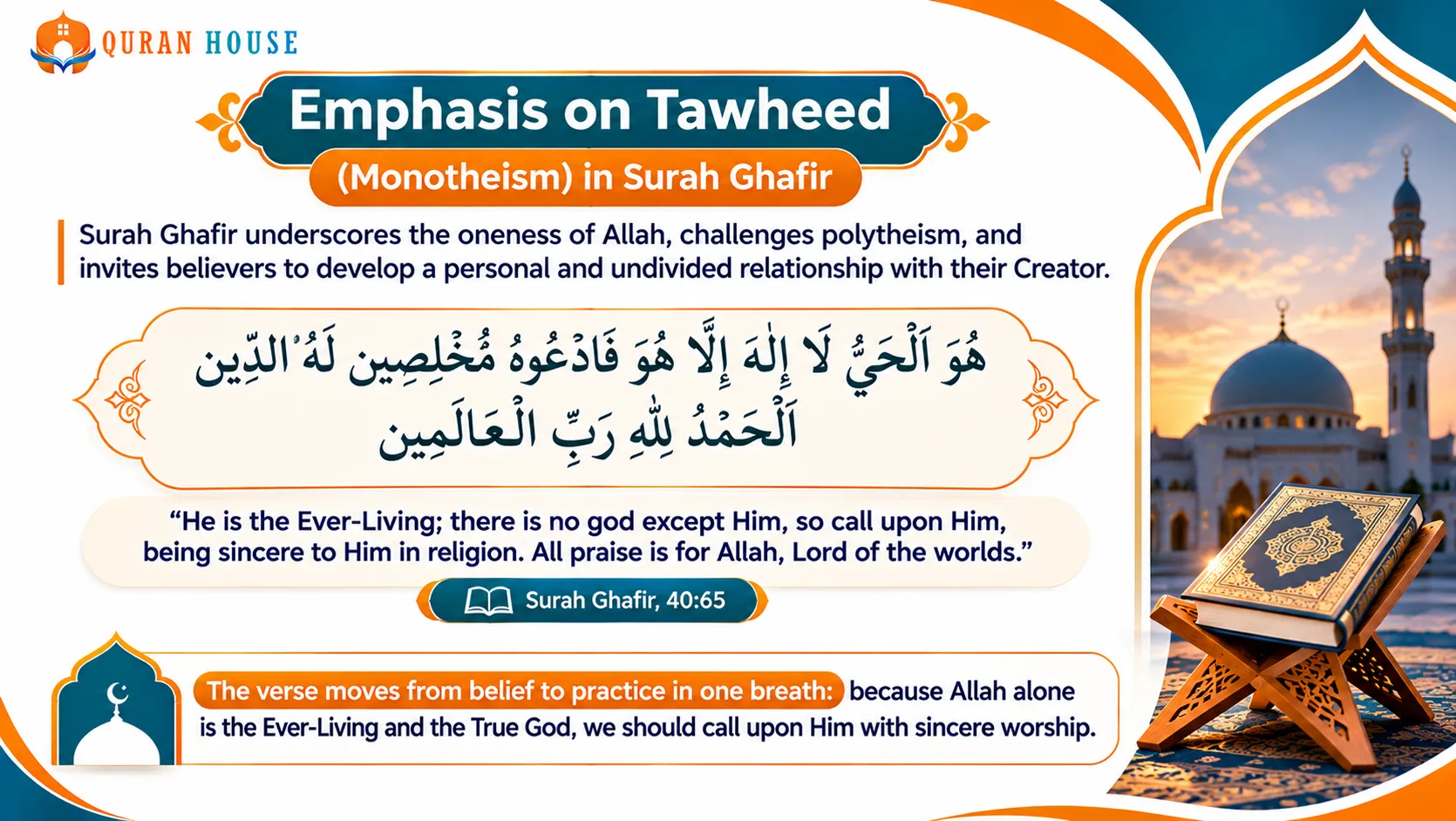
Surah Ghafir underscores the fundamental Islamic belief in the oneness of Allah. Throughout the surah, there are verses that challenge the polytheistic beliefs of the Quraysh and other tribes of Arabia. By emphasizing monotheism, the surah not only establishes the core tenet of Islam but also invites believers to develop a personal and undivided relationship with their Creator.
One verse sums up this message, linking the oneness of Allah directly to sincere worship:
﴿هُوَ الْحَيُّ لَا إِلَٰهَ إِلَّا هُوَ فَادْعُوهُ مُخْلِصِينَ لَهُ الدِّينَ ۗ الْحَمْدُ لِلَّهِ رَبِّ الْعَالَمِينَ﴾
“He is the Ever-Living; there is no god except Him, so call upon Him, being sincere to Him in religion. All praise is for Allah, Lord of the worlds.”
The verse moves from belief to practice in one breath: because Allah alone is the Ever-Living, He alone deserves to be called upon, and that worship must be sincere.
2. Highlighting the Importance of Forgiveness
The surah paints a vivid picture of Allah’s boundless mercy and compassion. It mentions that those who commit sins but later repent sincerely are embraced by Allah’s mercy. This emphasis on forgiveness serves as a beacon of hope for believers, assuring them that no matter how grave their sins are, there’s always a path back to Allah’s grace.
The surah takes its name from the verse that opens with this attribute:
﴿غَافِرِ الذَّنبِ وَقَابِلِ التَّوْبِ شَدِيدِ الْعِقَابِ ذِي الطَّوْلِ ۖ لَا إِلَٰهَ إِلَّا هُوَ ۖ إِلَيْهِ الْمَصِيرُ﴾
“The Forgiver of sin, the Accepter of repentance, Severe in punishment, Owner of abundance. There is no god except Him; to Him is the final return.”
Notice the order: forgiveness and the acceptance of repentance come first, then the severity of punishment. Scholars point out that this balance protects the believer from two extremes, despairing of Allah’s mercy and feeling safe from His punishment.
Unlock the true beauty of Quranic recitation by enrolling in online Tajweed classes taught by Al-Azhar-trained instructors, and receive personal feedback on every verse you recite.
3. The Promise That Allah Answers Every Dua
One of the greatest benefits of Surah Ghafir is the direct promise it contains for everyone who calls upon Allah. There is no condition of wealth, status, or a clean past; the invitation is open to all:
﴿وَقَالَ رَبُّكُمُ ادْعُونِي أَسْتَجِبْ لَكُمْ ۚ إِنَّ الَّذِينَ يَسْتَكْبِرُونَ عَنْ عِبَادَتِي سَيَدْخُلُونَ جَهَنَّمَ دَاخِرِينَ﴾
“And your Lord says: Call upon Me; I will respond to you. Indeed, those who are too proud to worship Me will enter Hell in humiliation.”
The Prophet ﷺ explained this verse by making dua itself an act of worship:
«الدُّعَاءُ هُوَ الْعِبَادَةُ»، ثُمَّ قَرَأَ: ﴿وَقَالَ رَبُّكُمُ ادْعُونِي أَسْتَجِبْ لَكُمْ﴾
“Supplication is worship.” Then he recited: “And your Lord says: Call upon Me; I will respond to you.”
This means that every time you raise your hands in dua, you are worshipping Allah, whether or not you see the answer right away. The verse also calls refusing to ask Allah a form of arrogance, so leaving dua is not a neutral choice.
4. Narratives of Past Nations
The tales of past nations, especially the people of Pharaoh, are recounted with detail. These narratives serve as historical lessons, illustrating the fate of those who arrogantly defied God’s messengers. By studying these stories, believers are reminded of the transient nature of worldly power and the ultimate triumph of divine truth.
The Believing Man From Pharaoh’s Family
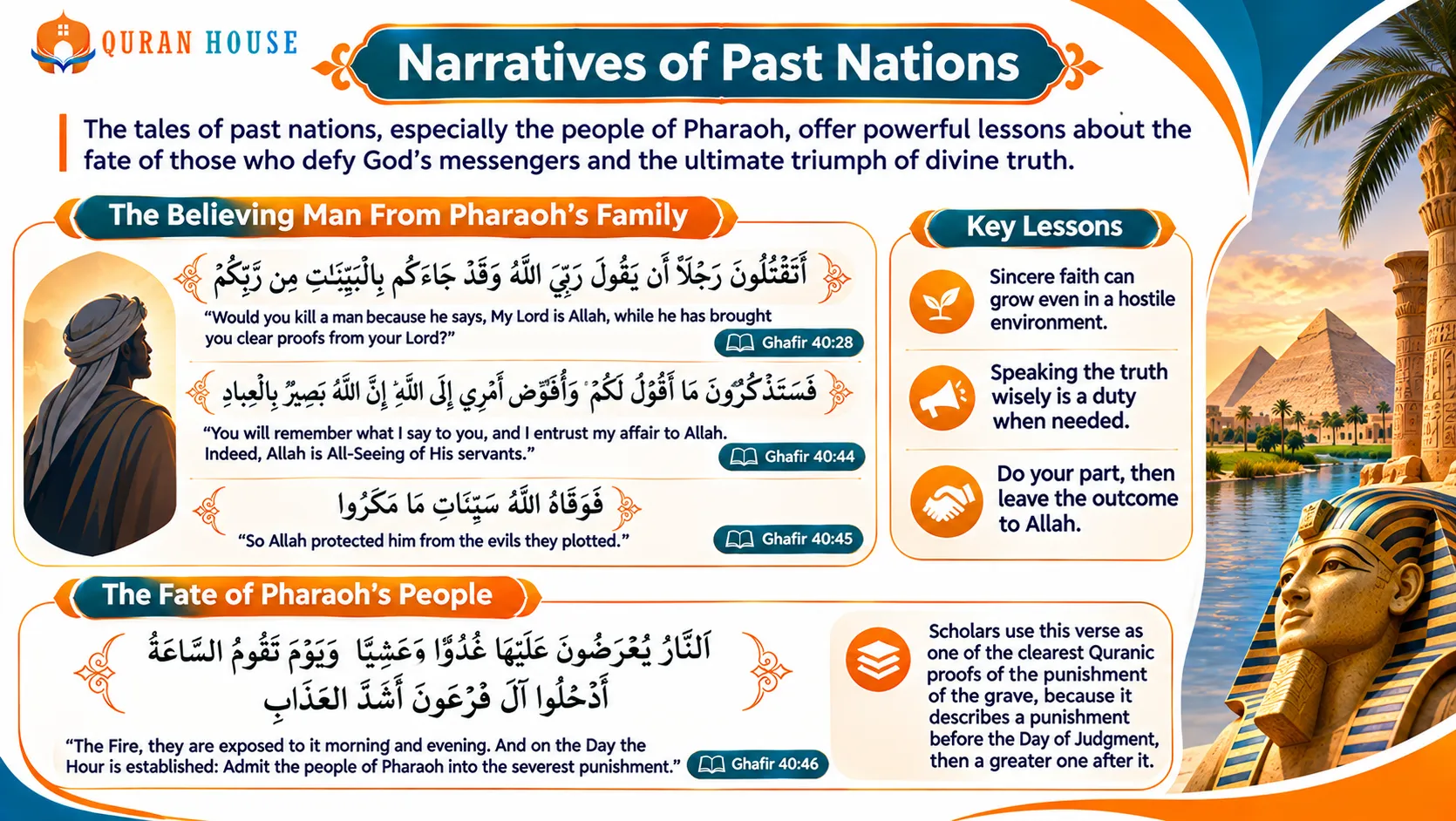
The most moving part of these narratives is the account of a believing man from within Pharaoh’s own family who hid his faith, then spoke out when Pharaoh plotted to kill Musa:
﴿أَتَقْتُلُونَ رَجُلًا أَن يَقُولَ رَبِّيَ اللَّهُ وَقَدْ جَاءَكُم بِالْبَيِّنَاتِ مِن رَّبِّكُمْ﴾
“Would you kill a man because he says, My Lord is Allah, while he has brought you clear proofs from your Lord?”
When his people rejected his advice, he ended his speech with complete reliance on Allah:
﴿فَسَتَذْكُرُونَ مَا أَقُولُ لَكُمْ ۚ وَأُفَوِّضُ أَمْرِي إِلَى اللَّهِ ۚ إِنَّ اللَّهَ بَصِيرٌ بِالْعِبَادِ﴾
“You will remember what I say to you, and I entrust my affair to Allah. Indeed, Allah is All-Seeing of His servants.”
This is why the surah is also called Al-Mu’min. His story shows that sincere faith can grow even in the most hostile environment, that speaking the truth wisely is a duty when it is needed, and that the believer who does his part can leave the outcome to Allah. Allah protected him from their plots, as the very next verse states:
﴿فَوَقَاهُ اللَّهُ سَيِّئَاتِ مَا مَكَرُوا﴾
“So Allah protected him from the evils they plotted”
(Ghafir 40:45).
The Fate of Pharaoh’s People
The surah also describes what happened to Pharaoh’s people after their death:
﴿النَّارُ يُعْرَضُونَ عَلَيْهَا غُدُوًّا وَعَشِيًّا ۖ وَيَوْمَ تَقُومُ السَّاعَةُ أَدْخِلُوا آلَ فِرْعَوْنَ أَشَدَّ الْعَذَابِ﴾
“The Fire, they are exposed to it morning and evening. And on the Day the Hour is established: Admit the people of Pharaoh into the severest punishment.”
Scholars of tafsir use this verse as one of the clearest Quranic proofs of the punishment of the grave, because it describes a punishment before the Day of Judgment, then a greater one after it.
5. The Angels’ Prayer for the Believers
The surah describes how the angels who carry the Throne, and those around it, glorify Allah and ask Him to forgive the believers:
﴿الَّذِينَ يَحْمِلُونَ الْعَرْشَ وَمَنْ حَوْلَهُ يُسَبِّحُونَ بِحَمْدِ رَبِّهِمْ وَيُؤْمِنُونَ بِهِ وَيَسْتَغْفِرُونَ لِلَّذِينَ آمَنُوا﴾
“Those who carry the Throne and those around it glorify the praises of their Lord, believe in Him, and ask forgiveness for those who believe.”
In the verses that follow, the angels ask Allah to protect the believers from Hellfire, to admit them into Paradise together with their righteous parents, spouses, and children, and to shield them from evil deeds. This image offers believers a deep sense of comfort: the loftiest creation of Allah prays for those who repent and follow His path. Reflecting on it can bring reassurance in moments of spiritual doubt, a reminder that sincere efforts toward faith are supported beyond our own awareness.
These lessons are not limited to Surah Ghafir. Reflecting on the benefits of Surah Al-Fajr also helps believers understand the importance of humility, gratitude, and accountability before Allah.
6. Describing the Attributes of Allah
Surah Ghafir delves deep into the attributes of Allah, describing Him as the All-Knowing, the Most Powerful, and the Most Merciful among others. These descriptions serve to enhance the believer’s awe and reverence for Allah, understanding Him as a Lord who is not just all-powerful but also deeply compassionate.
The surah opens with a chain of these names in its first verses, then returns to them, as in:
﴿رَفِيعُ الدَّرَجَاتِ ذُو الْعَرْشِ يُلْقِي الرُّوحَ مِنْ أَمْرِهِ عَلَىٰ مَن يَشَاءُ مِنْ عِبَادِهِ﴾
“Exalted above all ranks, Owner of the Throne; He sends the revelation by His command upon whom He wills of His servants.”
Knowing Allah through His names is the foundation of every other benefit in the surah: you seek forgiveness because He is Ghafir, you call upon Him because He answers, and you fear arrogance because He is above all ranks.
A Real Surah Lesson: Surah Ash-Shams
Watch a student work through Surah Ash-Shams step by step with their tutor, practicing each ayah until the recitation flows clearly and correctly.
Start Your Quran Journey With Quran House
Learn live and one-on-one with Al-Azhar-trained tutors, male and female, for children and adults, at a time that fits your timezone.
Try a Free Session7. Insights into Resurrection
The surah provides glimpses into the Day of Judgment, a day when deeds will be accounted for and justice will be served. It talks about the resurrection, the gathering of souls, and the final reckoning. These descriptions are meant to instill a sense of accountability in believers, urging them to lead righteous lives.
One of the most powerful scenes in the surah is the question Allah asks on that Day, when no one else claims any power:
﴿لِّمَنِ الْمُلْكُ الْيَوْمَ ۖ لِلَّهِ الْوَاحِدِ الْقَهَّارِ﴾
“To whom belongs the dominion this Day? To Allah, the One, the Prevailing.”
Every king, tyrant, and claim of power in this world ends in that moment. Remembering this verse puts worldly status in its true size and strengthens the believer against fear of people.
8. Offering Moral Lessons
The moral lessons embedded in the surah are timeless. They touch upon themes of humility, patience, gratitude, and perseverance. Through the stories of past prophets and their communities, believers are taught the virtues of faith and the pitfalls of arrogance and disbelief.
The clearest of these lessons is patience. After describing how Allah supported Musa against Pharaoh, the surah turns to the Prophet Muhammad ﷺ with this instruction:
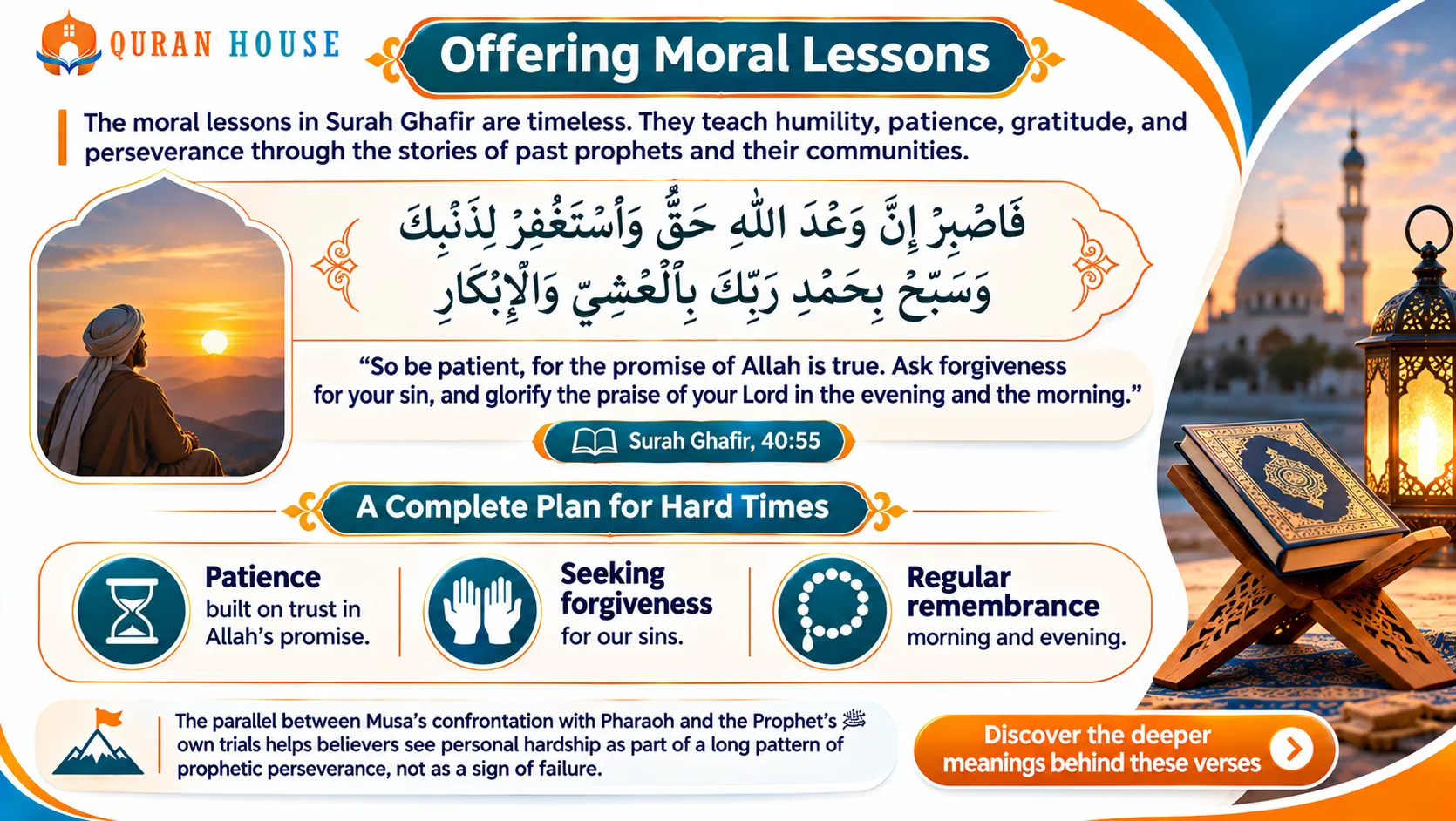
﴿فَاصْبِرْ إِنَّ وَعْدَ اللَّهِ حَقٌّ وَاسْتَغْفِرْ لِذَنبِكَ وَسَبِّحْ بِحَمْدِ رَبِّكَ بِالْعَشِيِّ وَالْإِبْكَارِ﴾
“So be patient, for the promise of Allah is true. Ask forgiveness for your sin, and glorify the praise of your Lord in the evening and the morning.”
The verse gives a complete plan for hard times: patience built on trust in Allah’s promise, seeking forgiveness, and regular remembrance morning and evening. The parallel between Musa’s confrontation with Pharaoh and the Prophet’s ﷺ own trials helps believers see personal hardship as part of a long pattern of prophetic perseverance, not as a sign of failure.
Discover the deeper meanings behind these verses with our online Quran Tafseer course, where expert instructors guide you through the interpretation of the Quran step by step.
9. Protection and Blessings
Many articles claim that reciting Surah Ghafir surrounds the reader with a protective shield. The source of this idea is a narration about its opening verses:
«مَنْ قَرَأَ حم الْمُؤْمِنَ إِلَى ﴿إِلَيْهِ الْمَصِيرُ﴾ وَآيَةَ الْكُرْسِيِّ حِينَ يُصْبِحُ حُفِظَ بِهِمَا حَتَّى يُمْسِيَ، وَمَنْ قَرَأَهُمَا حِينَ يُمْسِي حُفِظَ بِهِمَا حَتَّى يُصْبِحَ»
“Whoever recites Ha-Mim Al-Mu’min up to ‘To Him is the final return’ and Ayat Al-Kursi in the morning will be protected by them until the evening, and whoever recites them in the evening will be protected by them until the morning.”
We should be honest about this narration: Imam At-Tirmidhi pointed out its weakness, and hadith scholars such as Ahmad Shakir and Al-Albani graded it weak because of a weak narrator in its chain. So it is not correct to present this specific protection as an established virtue of Surah Ghafir.
What is authentically established is the protection of Ayat Al-Kursi before sleep. In a famous narration, a visitor who turned out to be Shaytan taught Abu Hurayrah:
«إِذَا أَوَيْتَ إِلَى فِرَاشِكَ فَاقْرَأْ آيَةَ الْكُرْسِيِّ، لَنْ يَزَالَ عَلَيْكَ مِنَ اللَّهِ حَافِظٌ، وَلَا يَقْرَبُكَ شَيْطَانٌ حَتَّى تُصْبِحَ»
“When you go to bed, recite Ayat Al-Kursi; a guardian from Allah will stay with you, and no devil will come near you until morning.”
The Prophet ﷺ confirmed that he had told the truth on this point, even though he is a liar. The real protection Surah Ghafir offers is through its meanings: trusting Allah like the believer from Pharaoh’s family, and calling upon Him with the promise of verse 60.
10. Encouraging Reflection on Divine Signs
The surah is full of verses urging believers to reflect on the world around them. From the heavens to the earth, the alternation of night and day, the stages of human creation, and the animals and ships that carry people, all are presented as signs of a masterful Creator. Such reflections are meant to nurture a sense of wonder and gratitude in the heart of the believer.
One verse puts human arrogance in perspective by comparing it with the size of creation:
﴿لَخَلْقُ السَّمَاوَاتِ وَالْأَرْضِ أَكْبَرُ مِنْ خَلْقِ النَّاسِ وَلَٰكِنَّ أَكْثَرَ النَّاسِ لَا يَعْلَمُونَ﴾
“The creation of the heavens and the earth is greater than the creation of mankind, but most people do not know.”
The verse answers those who doubted the Resurrection: the One who created the vast heavens and earth can easily bring people back to life. It also reminds the believer how small human pride is beside Allah’s creation.
Reflecting on the Quran’s message becomes more meaningful when you can recite its verses correctly and understand their words. Learning how to read the Quran like a pure Arab can help you improve your Arabic pronunciation and develop greater confidence when reciting and reflecting on Allah’s signs.
11. Warning of the Consequences of Denial
Lastly, Surah Ghafir does not shy away from presenting the fate of those who turn away from divine guidance. It speaks of the torment awaiting those who mock the prophets and deny the signs of Allah. These warnings serve as a stark reminder of the consequences of straying from the righteous path.
The surah ends with a decisive warning about the moment when faith no longer benefits:
﴿فَلَمْ يَكُ يَنفَعُهُمْ إِيمَانُهُمْ لَمَّا رَأَوْا بَأْسَنَا﴾
“But their faith did not benefit them once they saw Our punishment.”
This closing verse connects back to the beginning of the surah: the door of repentance is wide open, but only until the punishment arrives. The lesson is to act on the truth now, while there is still time.
What Is the Meaning of Surah Ghafir?
Ghafir means The Forgiver, and the surah is named after Allah’s attribute Ghafir Adh-Dhanb (Forgiver of sin) in its third verse. Its other name, Al-Mu’min (The Believer), refers to the believing man from Pharaoh’s family who defended Prophet Musa and the message of monotheism.
The surah is built around a few connected themes. It calls people to the oneness of Allah and refutes the beliefs of the polytheists. It recounts the stories of earlier prophets, especially Musa and Pharaoh, as lessons for those who reject the truth, and gives a large part of its verses to the believing man who spoke out in a hostile court.
It also describes Allah’s attributes, such as the All-Knowing, the Almighty, and the Most Merciful, and invites believers to reflect on them.
Finally, it speaks of the Resurrection and the Day of Judgment, and it repeatedly calls for repentance, assuring believers that sincere repentance can bring them back to Allah’s grace no matter how grave their sins.
In essence, Surah Ghafir is a reminder of the core tenets of faith, the importance of steadfastness in belief, and the consequences of turning away from divine guidance.
What Is Verse 40 of Surah Ghafir?
Verse 40 of Surah Ghafir promises that every evil deed is repaid only with its equal, while every believer who does good, man or woman, enters Paradise and is provided for without limit. It is part of the speech of the believing man from Pharaoh’s family.
﴿مَنْ عَمِلَ سَيِّئَةً فَلَا يُجْزَىٰ إِلَّا مِثْلَهَا ۖ وَمَنْ عَمِلَ صَالِحًا مِّن ذَكَرٍ أَوْ أُنثَىٰ وَهُوَ مُؤْمِنٌ فَأُولَٰئِكَ يَدْخُلُونَ الْجَنَّةَ يُرْزَقُونَ فِيهَا بِغَيْرِ حِسَابٍ﴾
“Whoever does an evil deed will only be recompensed with its equivalent. And whoever does righteousness, whether male or female, while being a believer, those will enter Paradise, being provided for therein without account.”
Transliteration: Man ʿamila sayyiʾatan falā yujzā illā mithlahā, wa man ʿamila ṣāliḥan min dhakarin aw unthā wa huwa muʾminun fa-ulāʾika yadkhulūna al-jannata yurzaqūna fīhā bighayri ḥisāb.
This verse shows the justice and generosity of Allah together: a sin is counted as one, while the reward of the believer has no limit. It also states clearly that men and women are equal in the reward of good deeds, with one condition, which is faith.
Why the Surah’s Name, Ghafir, Carries Particular Significance
The surah’s name, Ghafir, directly references one of Allah’s attributes highlighted in its verses, describing Allah as forgiving of sin and accepting of repentance, while also being severe in punishment for those who persist in rejection.
This naming reflects the surah’s broader balance between mercy and justice, offering hope to sincere believers who repent while still affirming that rejecting clear guidance carries serious consequences.
Reflecting on this name alongside the surah’s content reinforces a recurring Quranic theme: divine mercy is abundant and freely available, but it calls for genuine repentance and sincere faith.
How Surah Ghafir Compares to Other Surahs About Musa and Pharaoh
Several surahs recount the confrontation between Musa and Pharaoh, such as Al-A’raf, Ta-Ha, Ash-Shu’ara’, and Al-Qasas. Surah Ghafir stands out by centering much of its narrative on a secondary figure, the believing man from within Pharaoh’s court, rather than on Musa and Pharaoh alone.
This choice offers a valuable additional perspective, showing how ordinary individuals within a hostile system can still act with extraordinary moral courage.
Comparing this account with the other tellings of the same story shows how the Quran often approaches a single event from several angles, drawing out different lessons depending on which figures and details each surah emphasizes.
Practical Ways to Apply Surah Ghafir Benefits in Daily Life
Surah Ghafir provides practical guidance that Muslims can apply to everyday challenges, from standing firm in faith to seeking forgiveness and developing patience. Its lessons encourage believers to trust Allah, maintain regular worship, and strengthen their relationship with Him through consistent actions.
1. Stand Firm in Your Faith
Surah Ghafir teaches believers to remain committed to their faith, even when facing pressure or opposition. The story of the believing man from Pharaoh’s family demonstrates how wisdom and courage can work together when defending the truth.
When you face pressure to compromise your faith at work or in social situations, remember his example. He chose his words carefully, spoke the truth when it mattered, and entrusted the outcome to Allah. His story encourages you to remain faithful without abandoning patience or wisdom.
2. Seek Allah’s Forgiveness
One of the central lessons of Surah Ghafir is that Allah’s mercy remains a source of hope for those who sincerely repent. The Surah repeatedly highlights forgiveness and encourages believers to turn to Allah rather than despair over their mistakes.
In moments of spiritual doubt or guilt over past sins, reflect on Surah Ghafir 40:3 and 40:7. Allah describes Himself as the Forgiver of sin, while the angels around the Throne seek forgiveness for the believers. These verses remind you to seek repentance sincerely and maintain hope in Allah’s mercy.
3. Make Dua Part of Your Daily Routine
Surah Ghafir emphasizes the importance of supplication as a direct expression of worship and dependence on Allah. Making dua regularly helps believers maintain their spiritual connection with Him during both comfortable and challenging periods.
In Surah Ghafir 40:60, Allah calls upon His servants to invoke Him. Apply this teaching by asking Allah for your needs, whether small or large, and making supplication a consistent daily habit rather than turning to it only during hardship.
4. Practice Patience and Remember Allah
Patience and remembrance of Allah are essential lessons found throughout Surah Ghafir. They help believers remain spiritually grounded when difficulties continue or when expected solutions take longer to appear.
When challenges last longer than expected, follow the guidance of Surah Ghafir 40:55. Remain patient, seek Allah’s forgiveness regularly, and remember Him with praise in the morning and evening. Practicing these habits consistently can strengthen your faith and help you face difficulties with greater resilience.
A Comfortable Space for Every Learner
Watch a student recite in a live Quran House class, and remember that sisters can choose a female tutor for a private, supportive one-on-one learning space.
Start Your Quran Journey With Quran House
Learn live and one-on-one with Al-Azhar-trained tutors, male and female, for children and adults, at a time that fits your timezone.
Try a Free SessionUnderstand Surah Ghafir With a Qualified Tutor
Reading Surah Ghafir is a blessing, but its real benefits open up when you understand what you recite. Without guidance, it is easy to read the story of the believing man or the verse of dua without stopping to reflect, or to pass over mistakes in pronunciation that change the meaning.
At Quran House, our Al-Azhar-trained tutors study the surah with you verse by verse in live one-to-one sessions. They correct your Tajweed as you recite, explain the meanings and lessons in simple language, and build a plan around your level and schedule. We teach adults and kids, and sisters who prefer a female tutor can learn with a female Quran, Tajweed, and Arabic teacher.
Whether you want to recite the surah correctly, understand its tafsir, or memorize it, you will have a teacher guiding you at every step. The result is a recitation that moves your heart, not just your tongue.
Book your 2 free sessions today and start studying Surah Ghafir with a qualified tutor.

Explore Our Quran Courses:
- Learn to Read Quran in Arabic
- Learn to Read Quran for Beginners
- Quran Reading for Kids
- Quran Reading for Adults
- Quran Reading for Sisters
- Noorani Qaida for Beginners
- Noorani Qaida for Adults
- Noor Al-Bayan Course
- Quran Reading Fluency Course
Conclusion
The benefits of Surah Ghafir are rooted in its meanings. We saw how it opens with Allah as the Forgiver of sin, how it promises that every sincere dua is answered, and how even the angels around the Throne pray for the believers.
Through the believing man from Pharaoh’s family, it shows the courage that faith can give a single person in a hostile place, and through its warnings, it reminds us that the door of repentance stays open only until the end.
We also learned to separate the authentic from the weak: the narration about protection through its opening verses is weak, while its lessons on forgiveness, dua, patience, and trust in Allah are established in the Quran itself. Recite it with reflection, return to its verses in moments of guilt or hardship, and use a trusted source such as Quran.com to follow the Arabic text and its translation.
FAQs
Why is Surah Ghafir also called Al-Mu’min?
Because of the story of the believing man from Pharaoh’s family. Al-Mu’min means The Believer, and a large part of the surah is dedicated to this man who defended Prophet Musa (verses 28–45).
Is Surah Ghafir Makki or Madani?
It is a Makki surah. It was revealed in Makkah and has 85 verses, and it is the first of the seven surahs that begin with Ha-Mim.
Is there an authentic hadith about the virtues of Surah Ghafir?
There is no authentic hadith about a specific reward for reciting the whole surah. The narration about reciting its opening verses with Ayat Al-Kursi for protection (At-Tirmidhi 2879) is graded weak. Its established benefits come from the meanings of its verses, such as the promise to answer dua in verse 60.
Which verse of Surah Ghafir is about dua?
Verse 60. In it Allah says: Call upon Me; I will respond to you. The Prophet ﷺ recited it when he taught that supplication is worship.
What is the significance of the angels bearing the Throne?
They ask Allah to forgive the believers. Verses 7–9 describe how they pray for those who repent, asking Allah to protect them from Hellfire and admit them into Paradise with their righteous families.
How does the surah relate to Prophet Muhammad’s ﷺ own circumstances?
It comforted him with the example of Musa. The surah draws a parallel between Musa’s confrontation with Pharaoh and the Prophet’s ﷺ trials in Makkah, then commands him to be patient because Allah’s promise is true (verse 55).