The benefits of Surah Fajr benefits begin with a powerful oath by the dawn and by ten blessed nights. Surah Al-Fajr is the 89th chapter of the Holy Quran, a Makki surah of 30 verses that speaks about human life, morality, and the Day of Judgment.
Between its opening and its ending, the surah reminds us of nations that were destroyed for their arrogance, explains how Allah tests people with both wealth and hardship, and warns against neglecting orphans and the poor. Each of these themes carries a practical lesson for anyone who approaches it in good faith.
In this guide, we go straight to the 8 benefits of reciting and reflecting on Surah Al-Fajr, each supported by its verse or by an authentic hadith. After that, you will find the best times to recite it, its historical context, and practical ways to apply its lessons.
1. It Draws Your Attention to the Blessed Ten Days of Dhul-Hijjah
Surah Al-Fajr, literally “The Dawn,” starts with a great oath by Allah:
﴿وَالْفَجْرِ وَلَيَالٍ عَشْرٍ وَالشَّفْعِ وَالْوَتْرِ وَاللَّيْلِ إِذَا يَسْرِ هَلْ فِي ذَٰلِكَ قَسَمٌ لِّذِي حِجْرٍ﴾
“By the dawn, and by ten nights, and by the even number and the odd, and by the night when it passes. Is there not in all that an oath sufficient for one of perception?”
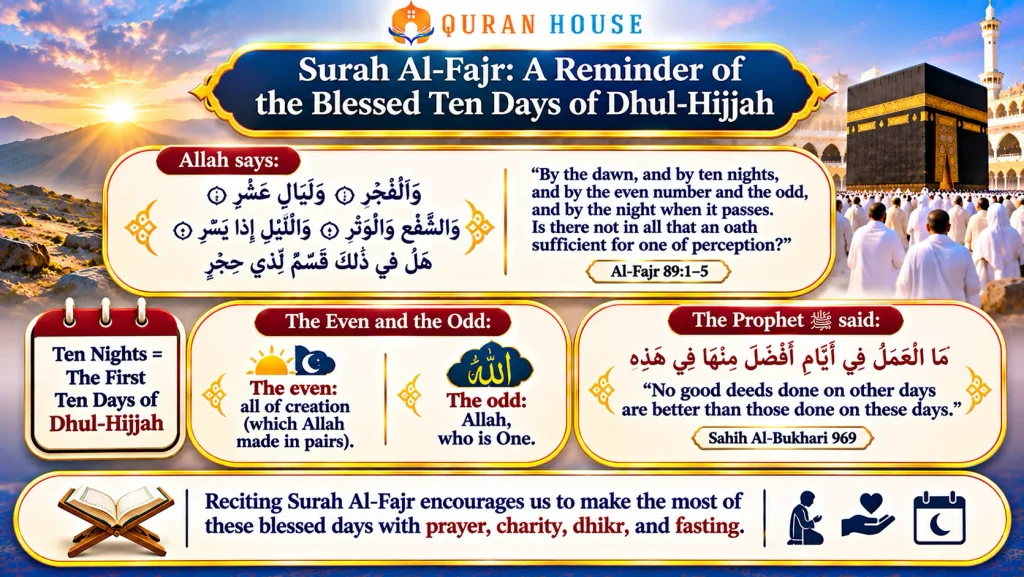
According to the tafsir of Ibn Kathir and most scholars, the “ten nights” are the first ten days of Dhul-Hijjah. For “the even and the odd,” scholars mention several views, including that the even refers to all of creation, which Allah made in pairs, and the odd refers to Allah, who is One. The Prophet ﷺ described the special value of good deeds in these ten days:
«مَا الْعَمَلُ فِي أَيَّامٍ أَفْضَلَ مِنْهَا فِي هَذِهِ» قَالُوا: وَلَا الْجِهَادُ؟ قَالَ: «وَلَا الْجِهَادُ، إِلَّا رَجُلٌ خَرَجَ يُخَاطِرُ بِنَفْسِهِ وَمَالِهِ فَلَمْ يَرْجِعْ بِشَيْءٍ»
“No good deeds done on other days are better than those done on these days.” They asked: Not even jihad? He said: “Not even jihad, except a man who goes out risking his life and wealth and comes back with nothing.”
Reciting Surah Al-Fajr reminds the believer to make the most of these days with prayer, charity, dhikr, and fasting, especially the Day of Arafah, as explained in our guide to fasting in Islam.
2. It Builds Mindfulness of Allah’s Watchfulness
The Prophet ﷺ described the highest level of faith, ihsan, in these words:
«أَنْ تَعْبُدَ اللَّهَ كَأَنَّكَ تَرَاهُ، فَإِنْ لَمْ تَكُنْ تَرَاهُ فَإِنَّهُ يَرَاكَ»
“That you worship Allah as if you see Him, for if you do not see Him, He surely sees you.”
Surah Al-Fajr helps us reach this state of mindfulness by reminding us of Allah’s watchfulness and our accountability to Him. After describing the destroyed nations, it says:
﴿إِنَّ رَبَّكَ لَبِالْمِرْصَادِ﴾
“Indeed, your Lord is ever watchful”
The images of dawn and night in the surah act as a wake-up call to the spiritual side of the believer, making him mindful of his deeds and even his thoughts.
3. It Warns Against Arrogance Through the Fate of ’Ad, Thamud, and Pharaoh
Surah Al-Fajr gives clear moral guidance, warning against arrogance, greed, and oppression by reminding us of the fate of past nations who transgressed against Allah’s commands:
﴿أَلَمْ تَرَ كَيْفَ فَعَلَ رَبُّكَ بِعَادٍ إِرَمَ ذَاتِ الْعِمَادِ الَّتِي لَمْ يُخْلَقْ مِثْلُهَا فِي الْبِلَادِ﴾
“Have you not considered how your Lord dealt with ’Ad, with Iram, who had lofty pillars, the likes of whom had never been created in the land?”
The surah also mentions Thamud, who carved homes out of the rocks, and Pharaoh, the owner of great structures. All of them were punished for their pride and their rejection of the prophets sent to them. The lesson is that even the most powerful and wealthy nation cannot stand against the laws of Allah.
4. It Teaches That Wealth and Hardship Are Both Tests
The surah describes a common mistake in how people understand their circumstances:
﴿فَأَمَّا الْإِنسَانُ إِذَا مَا ابْتَلَاهُ رَبُّهُ فَأَكْرَمَهُ وَنَعَّمَهُ فَيَقُولُ رَبِّي أَكْرَمَنِ وَأَمَّا إِذَا مَا ابْتَلَاهُ فَقَدَرَ عَلَيْهِ رِزْقَهُ فَيَقُولُ رَبِّي أَهَانَنِ﴾
“As for man, when his Lord tries him and is generous to him and favors him, he says: My Lord has honored me. But when He tries him and restricts his provision, he says: My Lord has humiliated me.”
Allah corrects this view: wealth is not proof of honor, and poverty is not proof of humiliation. Both are tests. This lesson protects the believer from arrogance in times of ease and from despair in times of hardship, and it shifts the focus from what we have to how we use it.
5. It Commands Honoring Orphans and Feeding the Poor
The surah directly criticizes those who neglect the weakest members of society:
﴿كَلَّا ۖ بَل لَّا تُكْرِمُونَ الْيَتِيمَ وَلَا تَحَاضُّونَ عَلَىٰ طَعَامِ الْمِسْكِينِ﴾
“No! But you do not honor the orphan, and you do not encourage one another to feed the poor.”
The Prophet ﷺ promised a great reward for those who care for orphans:
«وَأَنَا وَكَافِلُ الْيَتِيمِ فِي الْجَنَّةِ هَكَذَا» وَأَشَارَ بِالسَّبَّابَةِ وَالْوُسْطَى، وَفَرَّجَ بَيْنَهُمَا شَيْئًا
“I and the one who looks after an orphan will be in Paradise like this,” and he pointed with his index and middle fingers, with a little space between them.
These verses and this hadith show the place of social justice in Islam. Caring for orphans and the needy is not a minor good deed; it is a path to being close to the Prophet ﷺ in Paradise, and it builds a community founded on mercy and mutual care.
6. It Warns of Regret on the Day of Judgment
The surah describes a moment every person will face:
﴿يَوْمَئِذٍ يَتَذَكَّرُ الْإِنسَانُ وَأَنَّىٰ لَهُ الذِّكْرَىٰ يَقُولُ يَا لَيْتَنِي قَدَّمْتُ لِحَيَاتِي﴾
“That Day, man will remember, but what good will the remembrance be to him? He will say: I wish I had sent ahead something for my life.”
The person in this verse calls the Hereafter “my life,” because it is the true, lasting life. Reflecting on this verse pushes the believer to use the time he has now to send good deeds ahead, before the day when regret no longer helps.
A Comfortable Space for Every Learner
Watch a student recite in a live Quran House class, and remember that sisters can choose a female tutor for a private, supportive one-on-one learning space.
Start Your Quran Journey With Quran House
Learn live and one-on-one with Al-Azhar-trained tutors, male and female, for children and adults, at a time that fits your timezone.
Try a Free Session7. It Comforts the Heart With the Promise to the Tranquil Soul
Surah Al-Fajr ends with one of the most beautiful passages in the Quran:
﴿يَا أَيَّتُهَا النَّفْسُ الْمُطْمَئِنَّةُ ارْجِعِي إِلَىٰ رَبِّكِ رَاضِيَةً مَّرْضِيَّةً فَادْخُلِي فِي عِبَادِي وَادْخُلِي جَنَّتِي﴾
“O reassured soul, return to your Lord, well-pleased and pleasing to Him, and enter among My righteous servants, and enter My Paradise.”
This ending helps believers remember where they are going and the rest that awaits them, which is a great comfort in difficult times. Reciting the Quran calmly and with understanding brings peace to the heart, and these verses in particular remind the believer that the sufferings of this world are fleeting, while the reward of the patient soul is eternal.
8. It Rewards Learning, Teaching, and Reflection
Reading and studying the Quran, including Surah Al-Fajr, is an act of worship in itself. The Prophet ﷺ said:
«خَيْرُكُمْ مَنْ تَعَلَّمَ الْقُرْآنَ وَعَلَّمَهُ»
“The best among you are those who learn the Quran and teach it.”
This hadith is a call to study the Quran not just by memorization but also by understanding and contemplating its meanings. Studying a surah like Al-Fajr, with its oaths, stories, and warnings, deepens understanding and makes the believer think about the consequences of accepting or rejecting Allah’s guidance.
When To Recite Surah Al-Fajr
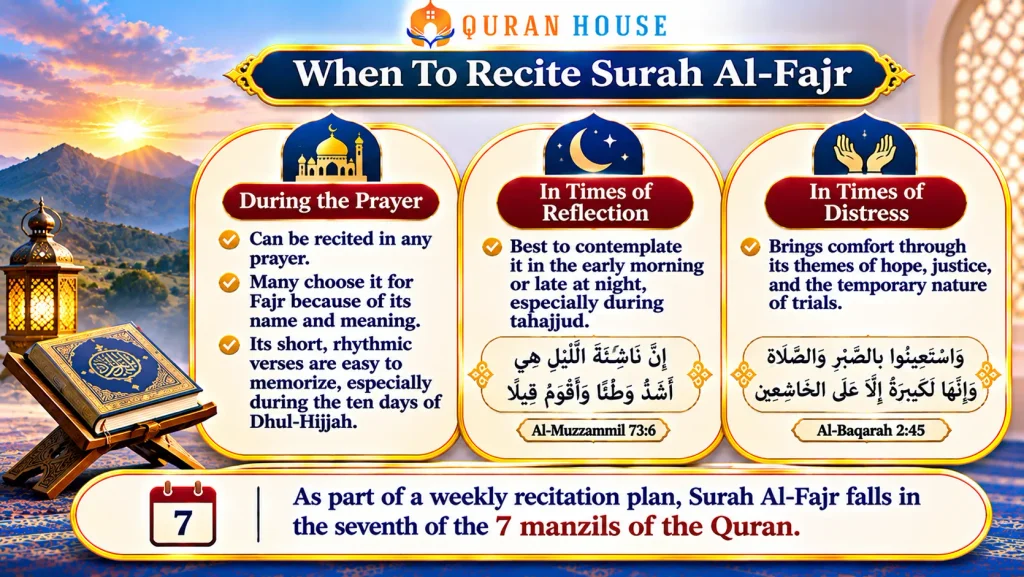
While the Quran can be recited at any time, there are times that suit the themes of this surah especially well. As part of a weekly recitation plan, Surah Al-Fajr falls in the seventh of the 7 manzils of the Quran.
During the Prayer
There is no specific hadith about reciting Surah Al-Fajr in the Fajr prayer, but like any surah, it can be recited in any prayer. Many Muslims choose it for Fajr because of its name and its opening oath by the dawn, which makes it a meaningful start to the day.
Its short, rhythmic verses also make it easy to memorize and recite in voluntary prayers, especially during the ten days of Dhul-Hijjah, which the surah itself mentions.
In Times of Reflection
It is best to contemplate this surah in the early morning or late at night, especially during tahajjud. Allah says:
﴿إِنَّ نَاشِئَةَ اللَّيْلِ هِيَ أَشَدُّ وَطْئًا وَأَقْوَمُ قِيلًا﴾
“Indeed, the hours of the night are more effective for concurrence of heart and tongue and more suitable for words.”
These moments of silence help believers reflect on the messages of the surah and strengthen their relationship with Allah. If you want to learn how to pray at night, our guide to Qiyam Al-Layl prayer explains it step by step.
In Times of Distress
The surah also brings comfort in times of distress through its themes of hope, justice, and the temporary nature of trials. Allah says:
﴿وَاسْتَعِينُوا بِالصَّبْرِ وَالصَّلَاةِ ۚ وَإِنَّهَا لَكَبِيرَةٌ إِلَّا عَلَى الْخَاشِعِينَ﴾
“And seek help through patience and prayer, and indeed, it is difficult except for the humbly submissive.”
Reciting Surah Al-Fajr in these moments is a reminder of Allah’s justice and compassion, and of the promise made to the tranquil soul at its end.
Is There an Authentic Hadith About the Virtue of Surah Al-Fajr?
There is no authentic hadith that sets a special reward for reciting Surah Al-Fajr in particular. Narrations that promise specific rewards for reading it, such as forgiveness for reciting it in the ten nights, come from collections that hadith scholars did not authenticate.
Its real benefits come from its verses, from the authentic virtues of the ten days it mentions, and from the general reward of reciting the Quran. These are more than enough reasons to recite it often and reflect on its meanings.
Practical Ways to Apply Surah Fajr Benefits
The lessons of Surah Al-Fajr are not only for reflection; they can shape the way a believer lives every day. Here are the main ways to apply them.
Encouraging Charity and Kindness
The guidance about honoring orphans and feeding the poor in Surah Al-Fajr can motivate practical deeds in everyday life. Believers can look for ways to support the needy, volunteer, sponsor an orphan, or donate to charity, especially during the ten days of Dhul-Hijjah, when good deeds are most beloved to Allah.
Pairing the recitation of this surah with a regular act of charity turns its warning into action, since the surah explicitly criticizes neglecting the poor and the orphaned.
Social Justice
Through the stories of earlier nations, Surah Al-Fajr emphasizes the concept of justice and the danger of abusing power. Believers can apply this lesson by treating others fairly, standing up for those who are wronged, and supporting causes that protect vulnerable people in society.
Reflecting on the fate of ’Ad and Thamud is also a useful check whenever a person feels pride or overconfidence in their own abilities or achievements.
Personal Reflection and Growth
The surah invites introspection and teaches the reader how to become a better person. A believer can set aside specific times of the day or the week to reflect on its verses and review their behavior, motives, and relationship with Allah.
Its closing verses about the tranquil soul are a source of comfort during times of grief or difficulty, and a goal to work toward: a heart at peace with Allah and pleasing to Him.
Historical Context: The Ten Nights and the Destroyed Nations
Surah Al-Fajr opens with an oath by the dawn and by ten nights, widely understood by commentators to refer to the first ten days of Dhul-Hijjah, a period considered especially blessed for good deeds, worship, and reflection.
The surah then recalls the fates of powerful ancient nations, including ’Ad, Thamud, and the people of Pharaoh, each of whom possessed great strength and resources yet was ultimately destroyed for its arrogance and rejection of guidance.
Understanding this historical backdrop helps clarify why the surah pairs blessed, sacred time with sobering warnings, reminding readers that worldly power offers no protection from consequences when a people turn away from the truth.
The Linguistic Style and Emotional Tone of the Surah
Surah Al-Fajr is recognized for its striking rhythmic style: short, forceful verses that build tension before shifting into direct address of the human soul, particularly in its closing verses about the tranquil soul returning to its Lord. This style mirrors the surah’s content, using compact, memorable phrasing to deliver warnings about heedlessness alongside comfort for those who remain patient and sincere.
Reciters and students often note that this rhythmic intensity makes the surah particularly effective for memorization and for reflection during times of personal accountability. To recite it with the right rhythm and correct pronunciation, our online Tajweed classes help you perfect every verse with a qualified teacher.

Connecting the Surah’s Warnings to Modern Life
Although the destroyed nations mentioned in Surah Al-Fajr belong to ancient history, the underlying warning about arrogance, heedlessness, and neglect of the vulnerable remains directly relevant today.
Modern readers can draw parallels between the surah’s criticism of hoarding wealth while ignoring the poor and orphaned, and ongoing conversations about social responsibility and economic justice.
Approaching the surah with this lens transforms it from a purely historical account into a living text that continues to offer guidance for how individuals and societies should treat those with less power or fewer resources.
It’s Never Too Late to Learn
Adults learn with us too. Watch a real session with one of our adult learners and see how calm, one-on-one guidance makes Quran recitation feel achievable at any age.
Start Your Quran Journey With Quran House
Learn live and one-on-one with Al-Azhar-trained tutors, male and female, for children and adults, at a time that fits your timezone.
Try a Free SessionStudy Surah Al-Fajr With Quran House
Surahs like Al-Fajr reward careful study of both their historical context and their linguistic structure, something best pursued with proper guidance rather than surface-level reading alone. The meanings of its oaths, the stories of ’Ad and Thamud, and the call to the tranquil soul open up much more when a teacher explains them verse by verse.
At Quran House, our Quran Tafseer Course walks students through surahs verse by verse, connecting historical narratives to their moral lessons, taught by instructors trained at Al-Azhar who bring depth and authenticity to each live one-to-one session, for adults and kids alike.
Whether you want to understand Surah Al-Fajr, memorize it, or recite it with correct Tajweed, you will have a trusted teacher by your side at every step.
Explore Our Quran Courses:
- Noor Al-Bayan Course
- Quran Reading Fluency Course
- Word-by-Word Quran Reading Course
- Complete Quran Reading (Khatma) Program
- Intensive Quran Course
- Online Quran Classes for Sisters and Women
- Online Quran Classes for Men and Brothers

Final Thoughts
Surah Al-Fajr weaves together sacred time, historical warning, and spiritual comfort in a single compact surah. Its benefits come directly from its verses and the authentic Sunnah: it draws attention to the blessed ten days of Dhul-Hijjah, builds mindfulness of Allah’s watchfulness, warns against arrogance and neglect of the poor, and ends with a promise of peace for the tranquil soul.
Reflecting on its historical context, memorizing its rhythmic verses, and applying its practical lessons around charity and humility can deepen one’s connection to its message. Approached with sincerity and proper guidance, this surah continues to offer timeless lessons. Use a trusted source such as Quran.com to follow the Arabic text and its translation as you recite.
FAQs
What Are the Main Benefits of Surah Al-Fajr?
Its main benefits come from its verses: it highlights the ten days of Dhul-Hijjah, warns against arrogance, commands caring for orphans and the poor, and comforts the tranquil soul.
What Are the Ten Nights Mentioned in Surah Al-Fajr?
Most scholars, including Ibn Kathir, explain that they are the first ten days of Dhul-Hijjah.
Why Does the Surah Mention Several Destroyed Nations Together?
Grouping them together shows a consistent pattern: worldly power and wealth cannot prevent the consequences of rejecting Allah’s guidance.
What Does the Phrase About the Tranquil Soul Mean?
It describes a soul at peace through sincere faith and righteous deeds, invited at death to return to its Lord pleased and pleasing to Him.
Is There a Specific Time Recommended for Reciting This Surah?
There is no specific hadith about a time for it, but many Muslims recite it often during the first ten days of Dhul-Hijjah because the surah mentions them.