Surah Yunus Benefits And 8 Lessons From Its Verses
The benefits of Surah Yunus begin with a promise no believer can forget: the greatest reward in Paradise is the sight of Allah Himself, and this surah is where that promise is revealed. Surah Yunus is the 10th chapter of the Quran, a Makki surah of 109 verses, named after Prophet Yunus (Jonah), peace be upon him.
The surah speaks to the heart and the mind together. It answers those who doubted the Quran, points to the signs of Allah in the sun, the moon, and the alternation of night and day, and tells the stories of Nuh and Musa.
It also records something no other surah mentions: a whole nation, the people of Yunus, who were saved from punishment because they believed in time.
In this guide, we go straight to the 8 authentic Surah Yunus benefits, each supported by its verse or by an authentic hadith with its source. After that, you will find the famous dua of Yunus, the meaning of verse 5, the key facts about the surah, and practical ways to apply its lessons.
1. It Reveals the Greatest Reward of Paradise: Seeing Allah
Surah Yunus contains a verse that describes what awaits those who do good:
“For those who have done good is the best reward and even more. No darkness or humiliation will cover their faces. They are the companions of Paradise; they will abide therein eternally.”
“When the people of Paradise enter Paradise, Allah will say: Do you want anything more that I may give you? They will say: Have You not brightened our faces? Have You not admitted us into Paradise and saved us from the Fire? Then He will lift the veil, and they will not have been given anything dearer to them than looking at their Lord.”
In another narration of the same hadith, the Prophet ﷺ recited this verse of Surah Yunus right after it. Every time you read verse 26, you are reading the promise of the greatest blessing a human being can receive, and it is tied to one condition: doing good.
2. It Gives Glad Tidings to the Friends of Allah
One of the most comforting passages in the Quran is found in this surah, describing who the true friends of Allah are:
The verses define the friends of Allah in two simple qualities: faith and taqwa. Being close to Allah is not reserved for a special class of people; it is open to every believer who guards against what displeases Him. The reward is freedom from the two things that weigh most on the human heart: fear of what is coming and grief over what has passed.
3. It Describes the Quran as Healing for What Is in the Hearts
Surah Yunus addresses all of humanity with a description of the Quran itself:
Scholars of tafsir explain that this healing is first of all for the diseases of the heart: doubt, envy, arrogance, and despair. Reading Surah Yunus with reflection is itself a way of receiving this healing. To recite it correctly and benefit fully, you can learn with our live online Tajweed classes, where a certified tutor corrects every letter.
4. It Shows That Sincere Repentance Can Change a Nation’s Fate
The surah is named after Prophet Yunus, and it records a unique event about his people:
“Why was there not a single town that believed and benefited from its faith, except the people of Yunus? When they believed, We removed from them the punishment of disgrace in worldly life and gave them enjoyment for a time.”
The people of Yunus are the only nation in the Quran that was warned, saw the signs of punishment, believed before it struck, and was saved. This is one of the strongest messages of hope in the surah: as long as a person is alive and turns to Allah sincerely, the door of repentance is open.
It’s Never Too Late to Learn
Adults learn with us too. Watch a real session with one of our adult learners and see how calm, one-on-one guidance makes Quran recitation feel achievable at any age.
Start Your Quran Journey With Quran House
Learn live and one-on-one with Al-Azhar-trained tutors, male and female, for children and adults, at a time that fits your timezone.
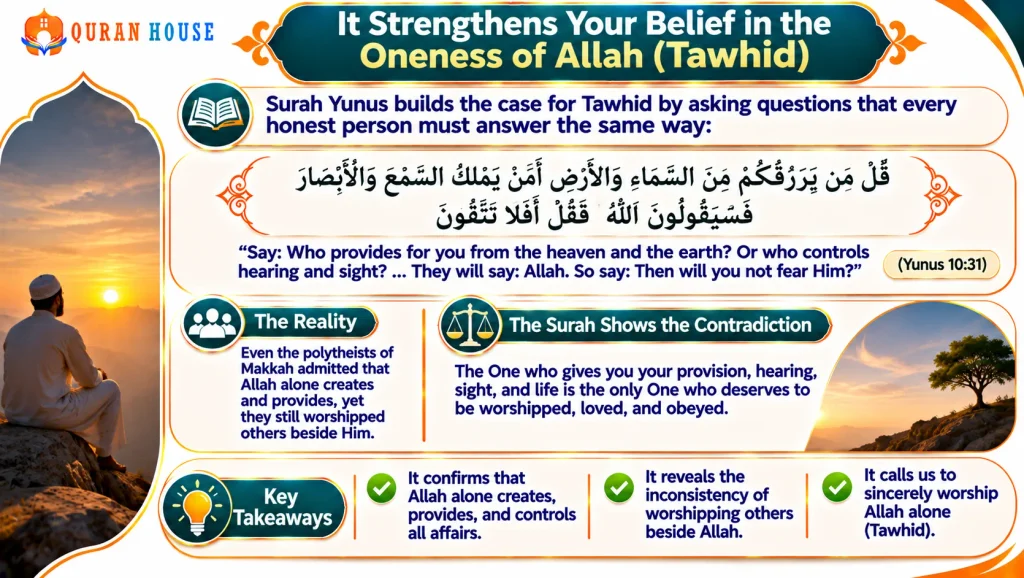
“Say: Who provides for you from the heaven and the earth? Or who controls hearing and sight? … They will say: Allah. So say: Then will you not fear Him?”
Even the polytheists of Makkah admitted that Allah alone creates and provides, yet they worshipped others beside Him. The surah shows the contradiction clearly: the One who gives you your hearing, your sight, and your provision is the only One who deserves your worship. Reflecting on this verse purifies your reliance, so that your hopes and your supplications are directed to Allah alone.
6. It Teaches Patience Through the Stories of Nuh and Musa
Surah Yunus recounts how Nuh called his people despite their mockery, and how Musa confronted Pharaoh until Allah drowned him and his army. At the moment of drowning, Pharaoh declared his faith, and the answer came:
These stories were revealed to console the Prophet ﷺ in Makkah, and they carry two lessons for every believer. The first is patience: the truth may face rejection for a long time, but it prevails in the end. The second is urgency: faith must come while there is still time, not when death is already present. The surah closes with the same instruction for the Prophet ﷺ:
“Indeed, in the alternation of the night and the day and in what Allah has created in the heavens and the earth are signs for a people who fear Allah.”
The precise order of the sun and the moon, the change of night and day, and the countless details of creation are not random. The surah teaches that faith grows through steady reflection on these everyday wonders, and that those who are mindful of Allah are the ones who truly see them.
8. It Warns Against Forgetting Allah Once Hardship Is Over
Surah Yunus describes a very human pattern with striking honesty:
“When affliction touches a person, he calls upon Us, whether lying on his side, sitting, or standing. But when We remove his affliction, he continues as if he had never called upon Us to remove an affliction that touched him.”
The verse is a mirror for every reader. It warns against the arrogance of turning away from Allah once comfort returns, and it teaches that true gratitude means remembering Him in ease just as sincerely as in hardship.
What Is the Dua of Yunus?
The dua of Yunus is “La ilaha illa anta, subhanaka, inni kuntu minaz-zalimin.” He made it in the darkness inside the whale, and it is mentioned in Surah Al-Anbiya, not in Surah Yunus:
“And Dhun-Nun, when he went off in anger and thought that We would not decree anything upon him, then he called out within the darkness: There is no god except You; exalted are You. Indeed, I have been of the wrongdoers.”
“The supplication of Dhun-Nun when he called upon Allah inside the whale was: There is no god except You, exalted are You, indeed I have been of the wrongdoers. No Muslim ever calls upon Allah with it for anything except that Allah answers him.”
Al-Albani graded this hadith authentic. The dua combines the three keys of every answered prayer: affirming the oneness of Allah, glorifying Him, and admitting one’s own mistakes. This is why Muslims recite it in times of distress, and Allah promised in the next verse that He saves the believers just as He saved Yunus.
What Is Surah Yunus Ayat 5 in English?
Verse 5 of Surah Yunus says that Allah made the sun a radiant light and the moon a reflected light, and set the moon’s phases so people can count years and time.
“It is He who made the sun a shining light and the moon a derived light, and determined for it phases, so that you may know the number of years and account of time. Allah has not created this except in truth. He details the signs for a people who know.”
Transliteration: Huwal-ladhi ja’alash-shamsa diya’an wal-qamara nuran wa qaddarahu manazila lita’lamu ’adadas-sinina wal-hisab. Ma khalaqallahu dhalika illa bil-haqq. Yufassilul-ayati liqawmin ya’lamun.
The verse uses two different words: diya’ (radiant light) for the sun, and nur (reflected light) for the moon. It also explains that the moon’s phases are a precise system for measuring time, which is why the Islamic calendar follows the lunar months.
Understanding these word choices directly in Arabic opens up a new level of reflection, and our Quranic Arabic Course helps you understand the language of the Quran without relying only on translation.
Quick Facts About Surah Yunus
Here are the key facts about the surah in one place.
Surah number
10
Named after
Prophet Yunus (Jonah), peace be upon him
Place of revelation
Makkah (Makki surah, according to most scholars)
Number of verses
109
Juz
11
Opens with
The letters Alif-Lam-Ra
Surah Yunus is also the first surah of the third of the 7 manzils of the Quran, the weekly recitation portion that runs from Yunus to An-Nahl.
Surah Yunus Benefits and the Authentic Hadith Question
There is no authentic hadith that sets a special reward for reciting Surah Yunus as a whole. Narrations that promise a specific reward for reading it come from collections that hadith scholars did not authenticate.
What is authentic is connected to its verses: the Prophet ﷺ explained verse 26 as the promise of seeing Allah in Paradise (Sahih Muslim 181), and he taught the virtue of the dua of Yunus (At-Tirmidhi 3505).
Beyond that, the surah carries the general reward of reciting the Quran, ten good deeds for every letter, and the benefits that come from understanding and acting on its lessons.
Why Surah Yunus Is Named After Prophet Yunus
Prophet Yunus himself is mentioned briefly in this surah, while the stories of Nuh and Musa take more space. Yet the surah carries his name because it records something unique: his people are the only nation that believed after being warned, before the punishment struck, and were saved.
The detailed story of Yunus and the whale appears in other surahs, such as As-Saffat and Al-Anbiya.
This makes Surah Yunus different from surahs like Yusuf, where the whole chapter tells one prophet’s story. Here, the name points to the surah’s central message of hope: Allah’s mercy reaches anyone who turns back to Him sincerely, even at the last moment.
How Surah Yunus Responds to the Demand for Miracles
The disbelievers of Makkah repeatedly asked for a miracle before they would believe. Surah Yunus answers with a challenge instead:
The surah presents evidence first, from creation and from history, and then addresses the objections of the deniers directly. Its message is that the greatest miracle is the Quran itself, together with the signs already present in the world, for anyone willing to reflect.
How to Apply the Lessons of Surah Yunus in Daily Life
When distress closes in on you, recite the dua of Yunus with full attention to its meaning, and remember the promise that Allah answers every Muslim who calls upon Him with it.
When life becomes easy again, remember verse 12, and keep the remembrance of Allah you had in hardship. Gratitude in ease is part of the faith the surah calls for.
Take a few minutes to look at the sky, the sun, and the moon as verses 5 and 6 invite you to do. If you want to build this habit of reflection in a structured way, our Tadabbur (Quran Reflection) Course teaches you how to reflect on the verses you recite every day.
A Comfortable Space for Every Learner
Watch a student recite in a live Quran House class, and remember that sisters can choose a female tutor for a private, supportive one-on-one learning space.
Start Your Quran Journey With Quran House
Learn live and one-on-one with Al-Azhar-trained tutors, male and female, for children and adults, at a time that fits your timezone.
Surah Yunus is full of verses that change how you see your life: the promise of seeing Allah, the glad tidings for His friends, the people saved by repentance, and the dua that Allah answers. But reading them alone, it is easy to pass over their meanings or to recite them with mistakes you never notice.
At Quran House, our Al-Azhar-trained tutors take you through the surah verse by verse in live one-to-one sessions. They correct your recitation, explain the stories and lessons behind each passage, and build a plan around your level and schedule. Children can start understanding the words of the Quran early with our Quranic Arabic for Kids course.
Whether you want to recite Surah Yunus correctly, understand its tafsir, or memorize it, you will have a trusted teacher guiding you at every step, relying only on authentic sources.
The benefits of Surah Yunus reach every part of a believer’s life. It holds the promise of the greatest reward, seeing Allah in Paradise, and it comforts the friends of Allah with freedom from fear and grief. It describes the Quran as healing for the hearts, and through the people of Yunus, it shows that repentance can change even a destiny that seemed sealed.
The surah also trains the mind and the character: it strengthens Tawhid with clear questions, teaches patience through the stories of Nuh and Musa, invites reflection on the sun, the moon, and the alternation of night and day, and warns against forgetting Allah once hardship ends.
Recite Surah Yunus with these meanings in mind, keep the dua of Yunus on your tongue in moments of distress, and use a trusted source such as Quran.com to follow the Arabic text and its translation as you read.
Frequently Asked Questions About Surah Yunus
What are the main benefits of Surah Yunus?
Its main benefits come from its verses. It promises the sight of Allah to those who do good (verse 26), gives glad tidings to the friends of Allah (verses 62–63), describes the Quran as healing for the hearts (verse 57), and shows through the people of Yunus that sincere repentance is never too late (verse 98).
Why is Surah Yunus named after Prophet Jonah when his story is only briefly mentioned?
Because it records the unique story of his people. They are the only nation in the Quran that believed after being warned and were saved from punishment, which makes the surah a message of hope.
Is the dua of Yunus in Surah Yunus?
No, it is in Surah Al-Anbiya, verse 87. Surah Yunus mentions his people, while the dua he made inside the whale is recorded in Al-Anbiya.
Is Surah Yunus a Meccan or Medinan surah?
It is a Makki surah according to most scholars. It was revealed in the late Makkan period, before the migration to Madinah.
How many verses does Surah Yunus contain?
It contains 109 verses. It is the 10th surah of the Quran and is found in the 11th juz.