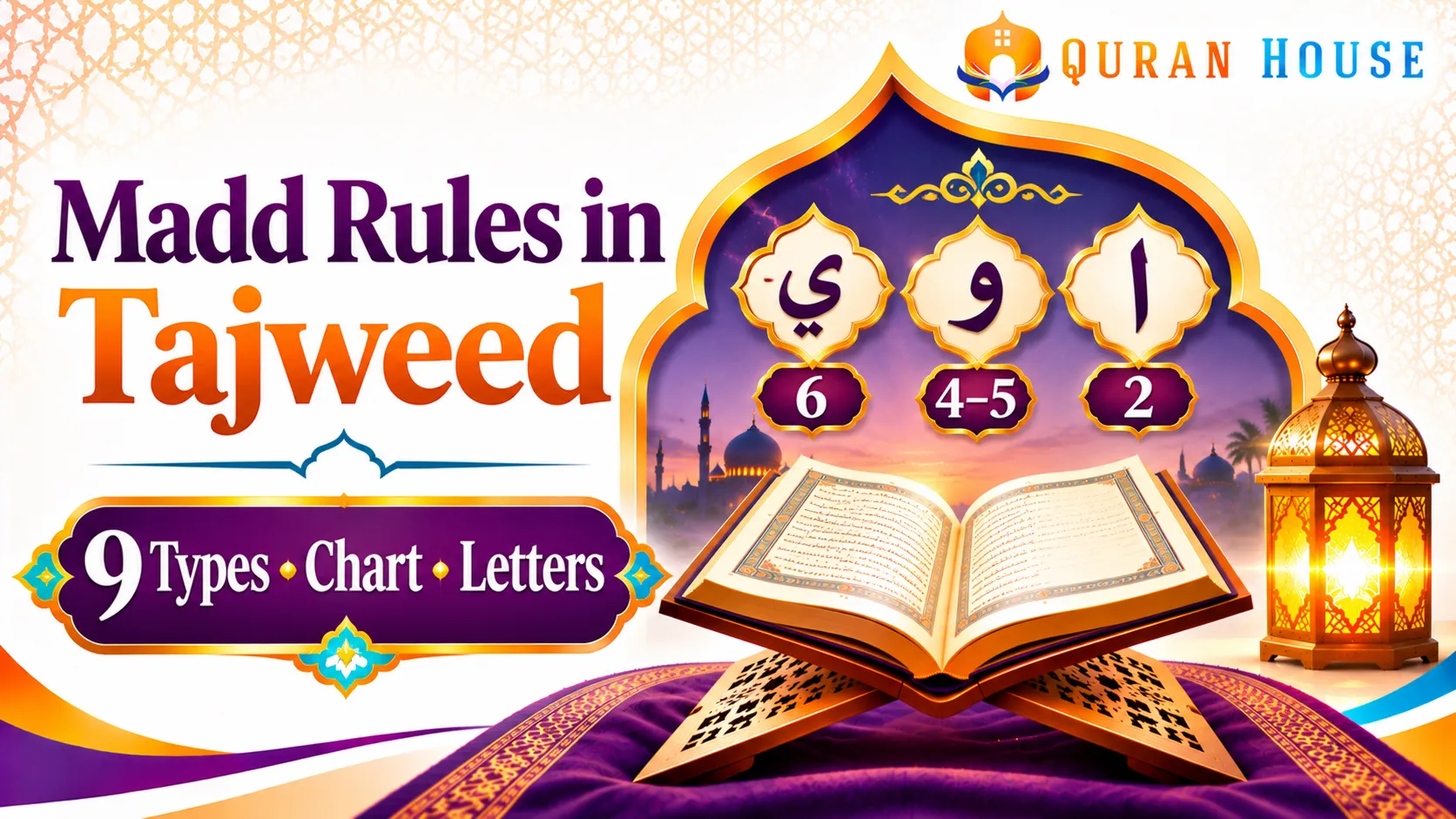
In Tajweed, the Arabic term “Madd” refers to the elongation or prolongation of vowel sounds in specific circumstances. This practice is essential in the correct recitation of the Quran.
Madd involves lengthening the sound of a vowel due to the presence of certain letters, and its length is measured in counts (harakat), where one count is roughly the time it takes to open or close a finger at a normal pace.
The rules of Madd vary based on what comes after the Madd letter: a hamzah, a sukoon, or a stop. This is why a single Madd rules chart is the fastest way to learn them, because it shows every type side by side with its length.
In this guide, we go straight to the types of Madd according to the recitation of Hafs from ’Asim, each with its length and examples from the Quran. After that, you will find the complete Madd rules chart that sums up all the types in one table, and the letters of Madd.
1. Madd Tabee’ee (Natural Madd)
Madd Tabee’ee, or Natural Madd, is a fundamental concept in Tajweed. It involves the natural elongation of vowel sounds in Arabic letters when followed by a Madd letter (Alif, Waw, or Ya) that has no hamzah or sukoon after it. This elongation extends the sound for two Harakat (beats or units of time).
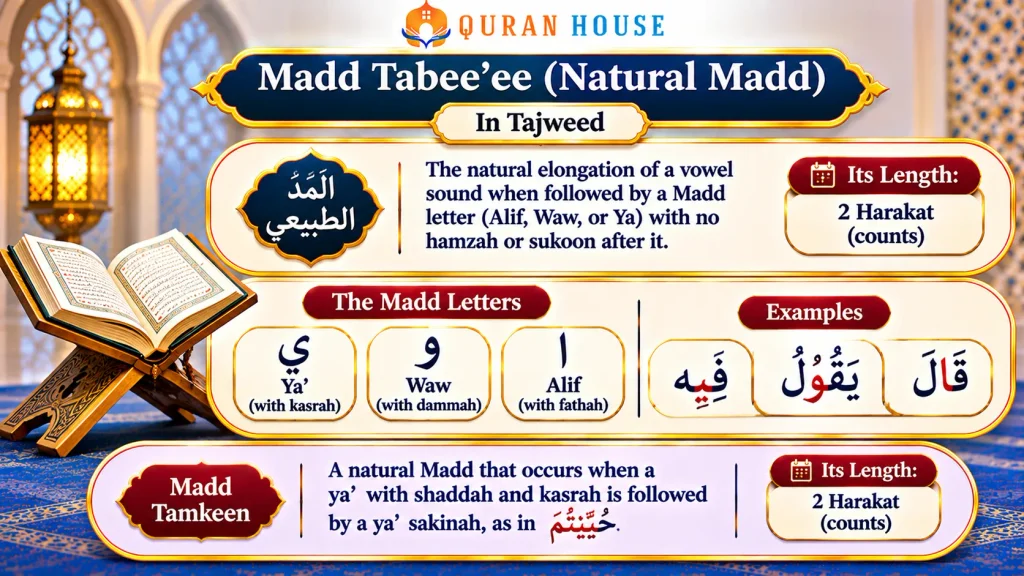
Madd Tabee’ee is considered the simplest form of Madd and is an essential aspect of proper Quranic recitation, adding melody and clarity to the spoken word.
Some teachers also mention Madd Tamkeen, a name for the natural Madd that occurs when a ya’ with shaddah and kasrah is followed by a ya’ sakinah, as in حُيِّيتُم. It is recited for 2 counts, like Madd Tabee’ee.
Examples of Madd Tabee’ee
The table below shows how each of the three Madd letters is prolonged naturally for 2 counts:
| Arabic Word | Transliteration | Description |
|---|---|---|
| قَالَ | Qaala | Alif after a fathah on the qaf extends the “a” sound for 2 counts. |
| يُوسُفُ | Yoosufu | Waw after a dammah on the ya’ elongates the “oo” sound for 2 counts. |
| قِيلَ | Qeela | Ya’ after a kasrah on the qaf elongates the “ee” sound for 2 counts. |
2. Madd Al-Badal
Madd Al-Badal happens when a hamzah comes before a Madd letter in the same word, and the Madd letter is not followed by a hamzah or a sukoon.
It is called “badal” (substitution) because in most of its words, the Madd letter replaced an original second hamzah: آمَنُوا was originally أَأْمَنُوا, and the second hamzah was changed into an alif.
In the recitation of Hafs, Madd Al-Badal is prolonged for 2 counts, just like the natural Madd.
Examples of Madd Al-Badal
In each of these words, a hamzah comes before the Madd letter, which is prolonged for 2 counts:
| Arabic Word | Transliteration | Description |
|---|---|---|
| آمَنُوا | Aamanoo | A hamzah followed by an alif in the same word; the alif is prolonged for 2 counts. |
| إِيمَانًا | Eemaanan | A hamzah followed by a ya’ of Madd; the ya’ is prolonged for 2 counts. |
| أُوتُوا | Ootoo | A hamzah followed by a waw of Madd; the waw is prolonged for 2 counts. |
3. Madd Al-’Iwad (Compensation Madd)
Madd Al-’Iwad, also known as the Compensation Madd, happens when the reader stops on a word that ends with tanween fath. The tanween is dropped, and an alif is pronounced in its place for 2 counts, as compensation for the dropped tanween.
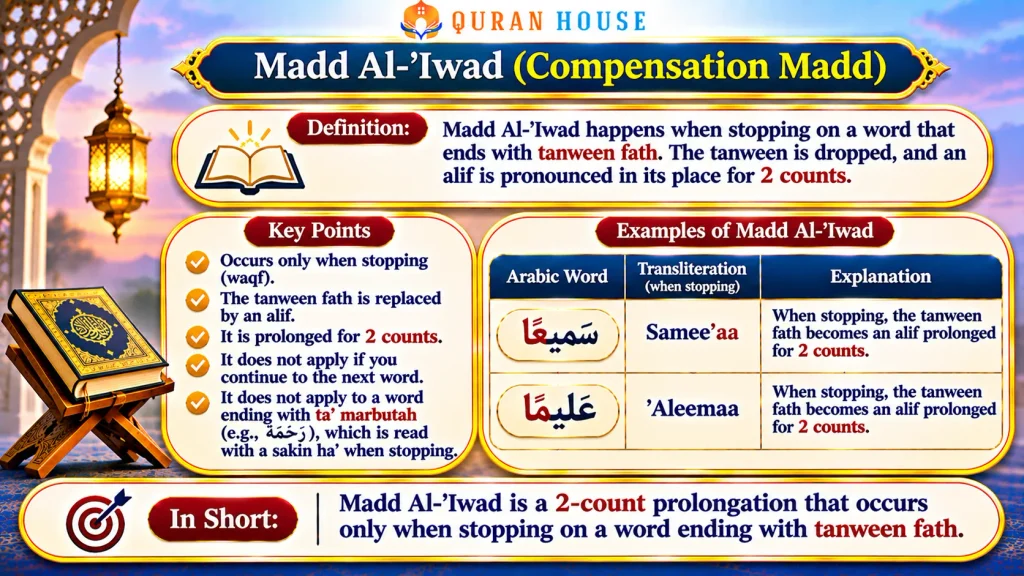
This Madd only exists when stopping. If the reader continues to the next word, the tanween is pronounced normally and there is no Madd. It does not apply to a word ending with ta’ marbutah, such as رَحْمَةً, which is read with a sakin ha’ when stopping.
Examples of Madd Al-’Iwad
Here is how the tanween fath changes into an alif of 2 counts when stopping on these words:
| Arabic Word | Transliteration | Description |
|---|---|---|
| سَمِيعًا | Samee’aa | When stopping, the tanween fath becomes an alif prolonged for 2 counts. |
| عَلِيمًا | ’Aleemaa | When stopping, the tanween fath becomes an alif prolonged for 2 counts. |
4. Madd ’Arid Lis-Sukoon
Madd ’Arid Lis-Sukoon is one of the types of Madd that can be defined as “temporary Madd for stopping.” If the Madd Tabee’ee (Natural Madd in the letters ا or و or ي) is followed by a letter at the end of a word which has been made sakin temporarily because the reader has to stop at the word, the reader should prolong the Madd Tabee’ee to be Madd ’Arid Lis-Sukoon. It is prolonged for 2, 4, or 6 beats.
(Note: Madd ’Arid Lis-Sukoon only exists if the reader stops on that word. If the reader doesn’t stop on it, it should be considered as a Madd Tabee’ee, “Natural Madd,” of 2 beats.)
Examples of Madd ’Arid Lis-Sukoon
These two words show how stopping turns a natural Madd into a Madd of 2, 4, or 6 counts:
| Arabic Word | Transliteration | Description |
|---|---|---|
| الدِّينِ | Ad-Deen | When stopping, the nun becomes sakin, and the ya’ before it is prolonged for 2, 4, or 6 counts. |
| النَّاسِ | An-Naas | When stopping, the seen becomes sakin, and the alif before it is prolonged for 2, 4, or 6 counts. |
5. Madd Al-Leen (the Madd of Softness)
Madd Al-Leen happens when a waw sakinah or ya’ sakinah comes after a fathah, and the letter after it becomes sakin because the reader stops on it. The two letters of Leen are pronounced smoothly, with a soft “aw” or “ay” sound.
When stopping, the reader may prolong the Leen letter for 2, 4, or 6 counts. If the reader continues without stopping, there is no Madd at all: the waw or ya’ is pronounced as a normal sakin letter.
Examples of Madd Al-Leen
All three examples come from Surah Quraysh, where the ya’ of Leen is prolonged when stopping:
| Arabic Word | Transliteration | Description |
|---|---|---|
| قُرَيْشٍ | Quraysh | When stopping, the ya’ of Leen is prolonged for 2, 4, or 6 counts. |
| وَالصَّيْفِ | Waṣ-Ṣayf | When stopping, the ya’ of Leen is prolonged for 2, 4, or 6 counts. |
| الْبَيْتِ | Al-Bayt | When stopping, the ya’ of Leen is prolonged for 2, 4, or 6 counts. |
6. Madd Wajib Muttasil (the Obligatory Connected Madd)
Madd Wajib Muttasil is a Tajweed rule that involves mandatory elongation due to the presence of a Hamzah (ء) that comes right after a Madd letter within the same word.
This rule dictates that the vowel sound preceding the Hamzah must be prolonged for four to five beats, and for six beats if the reader stops on a word that ends with the Hamzah, such as السَّمَاءِ.
Madd Wajib Muttasil is essential for maintaining the correct pronunciation, rhythm, and flow of Quranic verses. It ensures that the Hamzah is pronounced clearly and that the recitation adheres to the rules of Tajweed.
Examples of Madd Muttasil
In each of these words, the Madd letter and the hamzah come together in the same word:
| Arabic Word | Transliteration | Description |
|---|---|---|
| جَاءَ | Jaa’a | An alif followed by a hamzah in the same word; prolonged for 4 or 5 counts. |
| السَّمَاءِ | As-Samaa’ | An alif followed by a hamzah at the end of the word; 4 or 5 counts, or 6 when stopping on it. |
| سُوءَ | Soo’a | A waw of Madd followed by a hamzah in the same word; prolonged for 4 or 5 counts. |
It’s Never Too Late to Learn
Adults learn with us too. Watch a real session with one of our adult learners and see how calm, one-on-one guidance makes Quran recitation feel achievable at any age.
Start Your Quran Journey With Quran House
Learn live and one-on-one with Al-Azhar-trained tutors, male and female, for children and adults, at a time that fits your timezone.
Try a Free Session7. Madd Ja’iz Munfasil (the Permissible Separated Madd)
Madd Ja’iz Munfasil happens when a Madd letter comes at the end of one word, and a hamzah comes at the beginning of the next word.
It is called “ja’iz” (permissible) because reciters differ in its length, and “munfasil” (separated) because the Madd letter and the hamzah are in two different words.
In the recitation of Hafs by way of Ash-Shatibiyyah, it is prolonged for 4 or 5 counts, and the reader should keep the same length as the Muttasil. If the reader stops on the first word, the Munfasil disappears and the letter is read as a natural Madd of 2 counts.
Examples of Madd Ja’iz Munfasil
In each of these examples, the Madd letter ends one word and the hamzah starts the next:
| Arabic Words | Transliteration | Description |
|---|---|---|
| إِنَّآ أَعْطَيْنَاكَ | Innaa a’ṭaynaaka | An alif at the end of the first word, followed by a hamzah in the next; 4 or 5 counts. |
| وَمَآ أُنزِلَ | Wa maa unzila | An alif at the end of the first word, followed by a hamzah in the next; 4 or 5 counts. |
| يَٰٓأَيُّهَا | Yaa ayyuhaa | The alif of “yaa” followed by the hamzah of “ayyuhaa”; 4 or 5 counts. |
8. Madd As-Silah (the Madd of the Pronoun Ha’)
Madd As-Silah applies to the pronoun ha’ (the “his” or “him” at the end of a word) when it comes between two voweled letters.
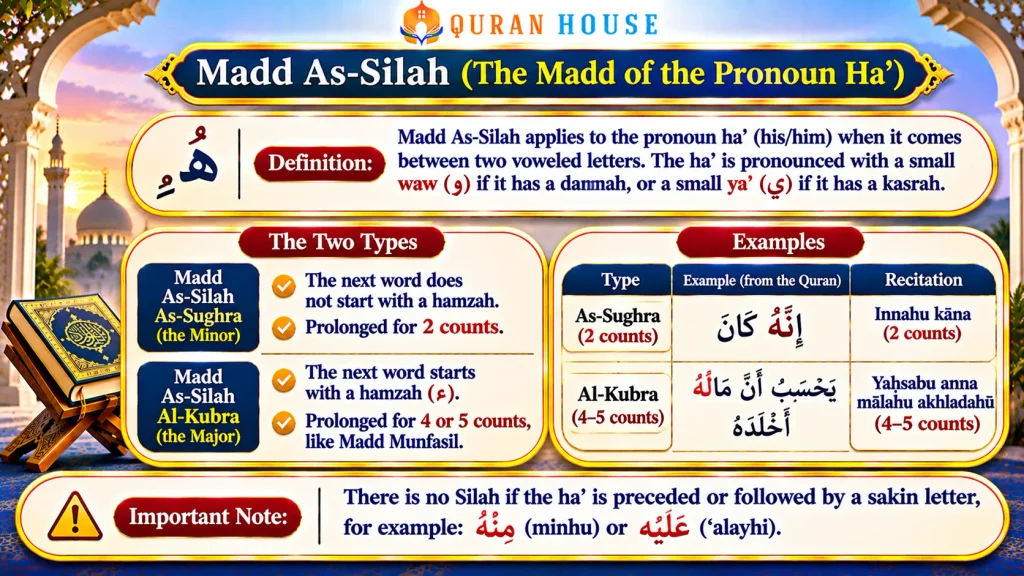
The ha’ is then pronounced with a small waw if it has a dammah, or a small ya’ if it has a kasrah. It has two types:
- Madd As-Silah As-Sughra (the minor): when the next word does not start with a hamzah. It is prolonged for 2 counts, as in إِنَّهُۥ كَانَ.
- Madd As-Silah Al-Kubra (the major): when the next word starts with a hamzah. It is prolonged for 4 or 5 counts, like the Munfasil, as in ﴿يَحْسَبُ أَنَّ مَالَهُۥٓ أَخْلَدَهُ﴾ (Al-Humazah 104:3).
There is no Silah if the ha’ is preceded or followed by a sakin letter, as in مِنْهُ or عَلَيْهِ, and there is no Silah when stopping on the ha’.
9. Madd Lazim (the Necessary Madd)
Madd Lazim, also known as Necessary Prolongation, is a Tajweed rule that involves the obligatory elongation of a Madd letter followed by an original sukoon or shaddah.
This elongation is required by the rules of Tajweed and is not subject to variation or choice by the reciter: it is always 6 beats.
Madd Lazim has two main types, and each type of them has another 2 types. So the overall types of Madd Lazim are 4 types of necessary prolongation.
Madd Lazim Chart
Madd Lazim occurs either in a word (Kalimi) or in one of the separate letters at the start of some surahs (Harfi), and each can be heavy (Muthaqqal, with a merging or shaddah) or light (Mukhaffaf, without merging).
| Type | When it happens | Length | Example |
|---|---|---|---|
| Kalimi Muthaqqal | A Madd letter followed by a letter with shaddah in the same word | 6 | الْحَاقَّةُ، الضَّالِّينَ |
| Kalimi Mukhaffaf | A Madd letter followed by a sakin letter in the same word, without shaddah | 6 | آلْآنَ |
| Harfi Muthaqqal | An opening letter whose last sound is sakin and merges into the next letter | 6 | the lam in الٓمٓ, the seen in طسٓمٓ |
| Harfi Mukhaffaf | An opening letter whose last sound is sakin and does not merge | 6 | صٓ، قٓ، نٓ، the meem in الٓمٓ |
1. Madd Lazim Kalimi Muthaqqal
Madd Lazim Kalimi Muthaqqal occurs when a Madd letter is followed by a letter with shaddah in the same word. The shaddah is an original sukoon merged into the next letter, so the reader must prolong the Madd letter for 6 counts.
Here are some of the most common words with this type of Madd in the Quran:
| Arabic Word | Transliteration |
|---|---|
| الْحَاقَّةُ | Al-Ḥaaqqah |
| الصَّاخَّةُ | Aṣ-Ṣaakhkhah |
| وَلَا الضَّالِّينَ | Wa laḍ-ḍaalleen |
2. Madd Lazim Kalimi Mukhaffaf
Madd Lazim Kalimi Mukhaffaf occurs when a Madd letter is followed by an original sakin letter in the same word, without shaddah. In the recitation of Hafs, it occurs only in the word آلْآنَ, which appears twice in Surah Yunus (verses 51 and 91), and it is prolonged for 6 counts.
This is the only word in the recitation of Hafs where this type occurs:
| Arabic Word | Transliteration |
|---|---|
| آلْآنَ | Aal-aana |
3. Madd Lazim Harfi Muthaqqal
Madd Lazim Harfi occurs in the separate letters at the start of some surahs, when the name of the letter is spelled with three letters, the middle one a Madd letter, such as “laam” or “meem.”
It is Muthaqqal when the last sound of the letter merges into the next letter. In الٓمٓ, the meem at the end of “laam” merges into the meem that follows, so “laam” is read with 6 counts and a merging, which follows the rules of the meem sakinah.
The table shows which letter in each opening carries the Muthaqqal Madd:
| Letters | Transliteration | The letter with Muthaqqal Madd |
|---|---|---|
| الٓمٓ | Alif-laaam-meeem | laam |
| طسٓمٓ | Ṭaa-seeem-meeem | seen |
4. Madd Lazim Harfi Mukhaffaf
Madd Lazim Harfi Mukhaffaf occurs in the same opening letters when the last sound of the letter is sakin but does not merge into the next letter. It is prolonged for 6 counts without merging.
The letters prolonged for 6 counts are gathered in the phrase “نقص عسلكم”: nun, qaf, sad, ’ayn, seen, lam, kaf, and meem. The ’ayn may also be read with 4 counts. The letters in “حي طهر” (ha’, ya’, ta’, ha’, ra’) are read with 2 counts only, and the alif has no Madd at all.
The table shows which letter in each opening carries the Mukhaffaf Madd and how long it is:
| Letters | Transliteration | The letter with Mukhaffaf Madd |
|---|---|---|
| صٓ | Ṣaaad | sad |
| قٓ | Qaaaf | qaf |
| الٓمٓ | Alif-laam-meeem | the final meem |
| كٓهيعٓصٓ | Kaaaf-haa-yaa-’aaayn-ṣaaad | kaf and sad (6), ’ayn (4 or 6) |
Madd Rules Chart: All Types of Madd at a Glance
The chart below summarizes every type of Madd in the recitation of Hafs from ’Asim, by way of Ash-Shatibiyyah, the most widely read recitation in the world today.
| Type of Madd | When it happens | Length (counts) | Example |
|---|---|---|---|
| Madd Tabee’ee (Natural) | A Madd letter with no hamzah or sukoon after it | 2 | قَالَ، يَقُولُ، قِيلَ |
| Madd Al-Badal | A hamzah comes before the Madd letter in the same word | 2 | آمَنُوا، إِيمَانًا، أُوتُوا |
| Madd Al-’Iwad | Stopping on a word that ends with tanween fath | 2 | عَلِيمًا ← عَلِيمَا |
| Madd As-Silah As-Sughra | The pronoun ha’ between two voweled letters, not followed by a hamzah | 2 | إِنَّهُۥ كَانَ |
| Madd As-Silah Al-Kubra | The pronoun ha’ between two voweled letters, followed by a hamzah | 4 or 5 | مَالَهُۥٓ أَخْلَدَهُ |
| Madd Wajib Muttasil | A Madd letter followed by a hamzah in the same word | 4 or 5 (6 when stopping on the hamzah) | جَاءَ، السَّمَاءِ |
| Madd Ja’iz Munfasil | A Madd letter at the end of a word, followed by a hamzah at the start of the next | 4 or 5 | إِنَّآ أَعْطَيْنَاكَ |
| Madd ’Arid Lis-Sukoon | A Madd letter followed by a letter made sakin because of stopping | 2, 4, or 6 | نَسْتَعِينُ، الرَّحِيمُ |
| Madd Al-Leen | A waw or ya’ sakinah after a fathah, followed by a letter made sakin because of stopping | 2, 4, or 6 | قُرَيْشٍ، الْبَيْتِ |
| Madd Lazim | A Madd letter followed by an original sukoon or shaddah | 6 | الْحَاقَّةُ، آلْآنَ، صٓ |
The lengths in the chart follow the path of Ash-Shatibiyyah. In other paths of Hafs, such as At-Tayyibah, the Munfasil can also be read with 2 counts, which is why some books mention it.
Madd Letters in Arabic
In Arabic Tajweed, the concept of Madd involves prolonging vowel sounds, executed through specific letters, categorized into the letters of Madd (Huroof Al-Madd) and the letters of Leen.
- Huroof Al-Madd (the letters of Madd):
- Alif Saakinah (ا): always preceded by a fathah, it stretches the “a” sound into a clear “aa.”
- Waw Saakinah (و): when preceded by a dammah, it elongates the “u” sound into “oo.”
- Ya’ Saakinah (ي): when preceded by a kasrah, it lengthens the “i” sound into “ee.”
- Huroof Al-Leen (the letters of Leen):
- Waw Saakinah (و): when preceded by a fathah, it gives a soft “aw” sound, as in خَوْف.
- Ya’ Saakinah (ي): when preceded by a fathah, it gives a soft “ay” sound, as in بَيْت.
The difference is in the vowel before the letter: a matching vowel makes it a letter of Madd, while a fathah before waw or ya’ makes it a letter of Leen.
What Are the Madd Rules in Quranic Recitation?
In Quranic recitation, “Madd” is the term for vowel elongation, integral to Tajweed, the art of precise Quranic recitation. This practice ensures adherence to the way the Quran was revealed and transmitted.
Madd rules provide specific guidelines for the duration of vowel extension in various contexts, and understanding these categories is crucial for mastering Tajweed and enhancing Quranic recitation.
Learning the rules from a chart is a good start, but hearing and practicing them with a teacher is what makes them stick. Our online Tajweed classes help you apply every type of Madd correctly with feedback from a qualified teacher.
Common Mistakes Students Make With Madd Rules
Beginners frequently struggle to distinguish between the varying durations required by different Madd types, often either shortening a Madd that requires extended elongation or over-extending a natural Madd beyond its proper 2 counts.
Another common error involves failing to recognize which type of Madd applies in a given word, leading to inconsistent application even after the durations themselves have been memorized.
A third common mistake is inconsistency: reading the Munfasil with 4 counts in one place and 5 in another, or changing the length of Madd ’Arid from one stop to the next. Identifying these error patterns early, ideally with feedback from an experienced teacher, prevents them from becoming habits.
Children in particular learn Madd best by listening and repeating, and our Quran teachers for kids teach these rules through short, guided practice.

Practical Drilling Exercises for Mastering Madd Durations
Rather than memorizing Madd rules purely as abstract definitions, practicing with a steady counting method to internalize the correct number of counts for each type builds more reliable habits than reading about the rules alone.
Repeating short passages containing multiple Madd types back to back, deliberately checking each elongation against the chart, reinforces accurate application in a way that isolated word drills often fail to achieve.
Recording yourself reciting and comparing the result against a qualified reciter also helps identify inconsistencies that might otherwise go unnoticed.
Practical Tips for Mastering Madd Rules
These simple tips help you turn the Madd rules chart into accurate, consistent recitation:
- Practice counting durations aloud, with a finger or a steady beat, to internalize the correct Madd lengths.
- Drill passages containing multiple Madd types together rather than isolated single words.
- Choose one length for the Muttasil and Munfasil, and one for Madd ’Arid, and keep it the same throughout your recitation.
- Record your own recitation and compare it against a qualified reciter for feedback.
- Seek correction from an experienced teacher early to prevent inconsistent habits from forming.
Madd is one part of Tajweed, and it works together with the other rules. Once you are comfortable with it, the laam sakinah rules are a natural next step.
Memorizing Surah Ad-Duha in Class
Memorization is easier with structure. See how a student reviews and recites Surah Ad-Duha in a live lesson, guided by a tutor who follows every step of their progress.
Start Your Quran Journey With Quran House
Learn live and one-on-one with Al-Azhar-trained tutors, male and female, for children and adults, at a time that fits your timezone.
Try a Free SessionMaster Madd Rules With a Qualified Teacher at Quran House
A chart tells you how long each Madd should be, but only a trained ear can tell you whether your recitation actually matches it. Small mistakes in Madd, like shortening a Muttasil or stretching a natural Madd, are hard to notice on your own.
At Quran House, our Al-Azhar-trained teachers provide detailed feedback on Madd application in live one-to-one sessions, helping students correct inconsistencies early in their learning.
Dedicated learners can continue all the way to an Ijazah with a connected chain of recitation through our Ijazah-certified Quran teachers.
Whether you are learning your first Tajweed rules or polishing your recitation, you will have a trusted teacher by your side at every step, for adults and kids alike.
Explore Our Tajweed Courses:
- Learn Quran Reading with Tajweed for Beginners
- Basic Tajweed for Non-Arabic Speakers
- Practical (Amali) Tajweed Course
- Online Tajweed Classes for Sisters and Women
- Advanced Tajweed Course
- Tajweed Ijazah Course

Final Thoughts
The Madd rules chart puts every type of elongation in one place: 2 counts for the natural, Badal, ’Iwad, and minor Silah; 4 or 5 for the Muttasil, Munfasil, and major Silah; 2, 4, or 6 when stopping on ’Arid and Leen; and 6 for Madd Lazim.
Mastering these rules requires moving beyond memorized definitions toward consistent, correctly timed application built through deliberate practice.
Identifying common mistakes early and using structured drilling methods helps students develop accurate and confident recitation habits. With consistent practice and qualified feedback, Madd rules become a natural part of fluent Quranic recitation.
FAQs
How Many Types of Madd Are There in Tajweed?
The most common classification lists nine types, from the natural Madd of 2 counts to Madd Lazim of 6 counts, as shown in the Madd rules chart above.
What Is the Most Common Mistake Students Make With Madd Rules?
Inconsistently applying the correct duration for different Madd types is among the most common errors, often improving with focused teacher feedback.
What Is the Difference Between Madd Muttasil and Madd Munfasil?
In Muttasil, the Madd letter and the hamzah are in the same word, while in Munfasil, they are in two separate words, and both are read with 4 or 5 counts in Hafs.
Is It Helpful To Use a Metronome When Practicing Madd Durations?
Yes, many students find that counting aloud or using a steady beat helps internalize correct durations more reliably than reading alone.
How Long Does It Take To Learn Tajweed Rules Like Madd?
It depends on your level and practice time, and our guide on the online Tajweed course duration explains what to expect.