The benefits of Surah Ibrahim begin with one of the clearest promises in the Quran: if you are grateful, Allah will give you more. Surah Ibrahim, named in honor of Prophet Abraham, peace be upon him, is the 14th chapter of the Quran, a Makki surah of 52 verses that explores monotheism, the Day of Judgment, and the stories of the prophets who came before.
The surah speaks to the heart in many ways. It describes a good word as a firmly rooted tree, promises believers firmness in this life and in the grave, and records some of the most beautiful supplications of Prophet Ibrahim for himself, his children, and his parents.
In this guide, we go straight to the 8 authentic Surah Ibrahim benefits, each supported by its verse or by an authentic hadith. After that, you will find the duas of Prophet Ibrahim, Allah’s promise to him, and practical ways to apply the surah’s lessons.
1. It Promises More Blessings to Those Who Are Grateful
The most famous verse of Surah Ibrahim is a direct promise from Allah:
﴿وَإِذْ تَأَذَّنَ رَبُّكُمْ لَئِن شَكَرْتُمْ لَأَزِيدَنَّكُمْ ۖ وَلَئِن كَفَرْتُمْ إِنَّ عَذَابِي لَشَدِيدٌ﴾
“And when your Lord proclaimed: If you are grateful, I will surely increase you; but if you deny, indeed, My punishment is severe.”
This verse is a powerful emphasis on the virtue of gratitude and the promise linked to it. Gratitude is shown with the heart, the tongue, and the limbs: acknowledging that every blessing is from Allah, praising Him for it, and using it in what pleases Him.
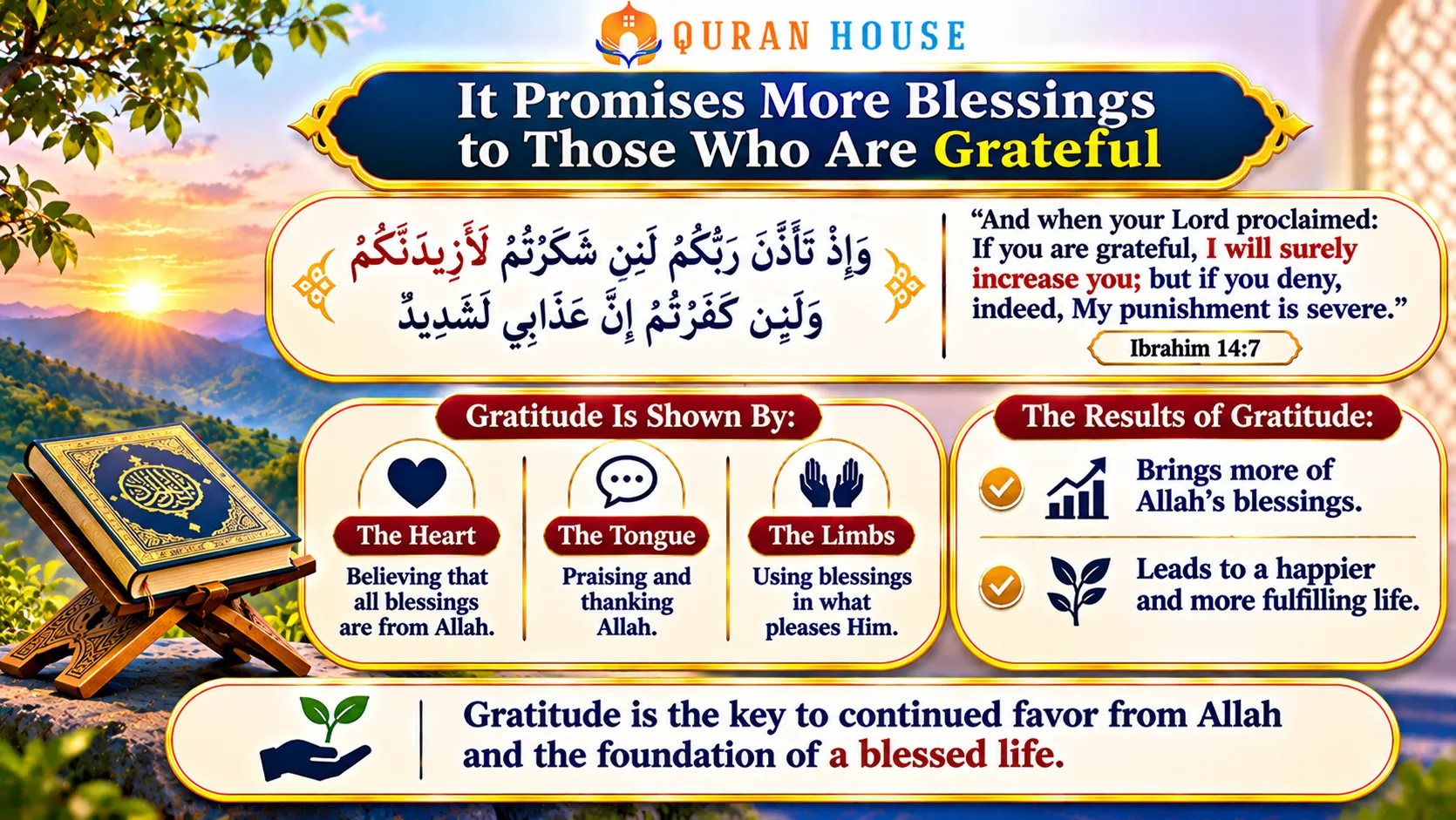
A grateful disposition attracts more of Allah’s favor and makes gratitude the cornerstone of a fulfilling life.
2. It Reminds You That Allah’s Blessings Cannot Be Counted
After listing the blessings of the heavens, the earth, the rain, the rivers, the sun, the moon, and the alternation of night and day, the surah says:
﴿وَآتَاكُم مِّن كُلِّ مَا سَأَلْتُمُوهُ ۚ وَإِن تَعُدُّوا نِعْمَتَ اللَّهِ لَا تُحْصُوهَا ۗ إِنَّ الْإِنسَانَ لَظَلُومٌ كَفَّارٌ﴾
“And He gave you from all you asked of Him. And if you should count the favors of Allah, you could not enumerate them. Indeed, mankind is most unjust and ungrateful.”
This verse is a gentle yet powerful reminder: no one could ever count Allah’s blessings, let alone thank Him enough for them. Reflecting on it fosters a heightened sense of gratitude, which brings contentment and happiness, and reminds us to use these blessings responsibly.
3. It Shows the Power of a Good Word Through the Parable of the Good Tree
Among the surah’s most memorable passages is the parable comparing a good word to a firmly rooted tree:
﴿أَلَمْ تَرَ كَيْفَ ضَرَبَ اللَّهُ مَثَلًا كَلِمَةً طَيِّبَةً كَشَجَرَةٍ طَيِّبَةٍ أَصْلُهَا ثَابِتٌ وَفَرْعُهَا فِي السَّمَاءِ تُؤْتِي أُكُلَهَا كُلَّ حِينٍ بِإِذْنِ رَبِّهَا﴾
“Have you not considered how Allah presents an example, making a good word like a good tree, whose root is firmly fixed and its branches high in the sky? It produces its fruit all the time, by permission of its Lord.”
The Prophet ﷺ explained which tree resembles the believer in a famous teaching moment:
«أَخْبِرُونِي بِشَجَرَةٍ تُشْبِهُ، أَوْ: كَالرَّجُلِ الْمُسْلِمِ، لَا يَتَحَاتُّ وَرَقُهَا… تُؤْتِي أُكُلَهَا كُلَّ حِينٍ» … قَالَ رَسُولُ اللَّهِ ﷺ: «هِيَ النَّخْلَةُ»
“Tell me of a tree which resembles a Muslim man, whose leaves do not fall… and which gives its fruit at all times.” … The Messenger of Allah ﷺ said: “It is the date palm.”
Imam Al-Bukhari placed this hadith in his chapter on the tafsir of this very verse. Like the palm tree, the believer’s faith is firmly rooted, his good deeds rise to the heavens, and his benefit to others never stops.
In contrast, the surah likens a corrupt word to an uprooted tree with no stability, a clear lesson about the lasting impact of sincere faith and good speech compared to the fragile nature of falsehood.
4. It Promises Believers Firmness in This Life and in the Grave
Right after the parable of the two trees, Allah gives the believers a great promise:
﴿يُثَبِّتُ اللَّهُ الَّذِينَ آمَنُوا بِالْقَوْلِ الثَّابِتِ فِي الْحَيَاةِ الدُّنْيَا وَفِي الْآخِرَةِ﴾
“Allah keeps firm those who believe with the firm word, in worldly life and in the Hereafter.”
The Prophet ﷺ explained one meaning of this firmness:
«الْمُسْلِمُ إِذَا سُئِلَ فِي الْقَبْرِ يَشْهَدُ أَنْ لَا إِلَهَ إِلَّا اللَّهُ وَأَنَّ مُحَمَّدًا رَسُولُ اللَّهِ، فَذَلِكَ قَوْلُهُ: ﴿يُثَبِّتُ اللَّهُ الَّذِينَ آمَنُوا بِالْقَوْلِ الثَّابِتِ فِي الْحَيَاةِ الدُّنْيَا وَفِي الْآخِرَةِ﴾»
“When the Muslim is questioned in the grave, he testifies that there is no god but Allah and that Muhammad is the Messenger of Allah. That is His saying: Allah keeps firm those who believe with the firm word, in worldly life and in the Hereafter.”
The “firm word” is the testimony of faith. Allah keeps the believer firm with it in the trials of this life, so he does not abandon the truth, and in the grave, so he answers the questions of the angels without hesitation.
5. It Teaches the Duas of Prophet Ibrahim for You and Your Family
Near the end of the surah, Prophet Ibrahim makes supplications that every Muslim can repeat:
﴿رَبِّ اجْعَلْنِي مُقِيمَ الصَّلَاةِ وَمِن ذُرِّيَّتِي ۚ رَبَّنَا وَتَقَبَّلْ دُعَاءِ رَبَّنَا اغْفِرْ لِي وَلِوَالِدَيَّ وَلِلْمُؤْمِنِينَ يَوْمَ يَقُومُ الْحِسَابُ﴾
“My Lord, make me an establisher of prayer, and from my descendants. Our Lord, and accept my supplication. Our Lord, forgive me and my parents and the believers the Day the account is established.”
These duas show what a prophet asked for most: steadfastness in prayer for himself and his children, and forgiveness for himself, his parents, and all believers. Many Muslims recite them in their prayers, and learning to recite them correctly with our online Tajweed classes helps you pray with them as they were revealed.
6. It Teaches Reliance on Allah Through the Stories of the Prophets
The surah recounts how earlier prophets faced rejection, mockery, and threats from their people. Their answer was firm trust in Allah:
﴿وَمَا لَنَا أَلَّا نَتَوَكَّلَ عَلَى اللَّهِ وَقَدْ هَدَانَا سُبُلَنَا ۚ وَلَنَصْبِرَنَّ عَلَىٰ مَا آذَيْتُمُونَا ۚ وَعَلَى اللَّهِ فَلْيَتَوَكَّلِ الْمُتَوَكِّلُونَ﴾
“And why should we not rely upon Allah while He has guided us to our ways? And we will surely be patient against whatever harm you should cause us. And upon Allah let those who would rely, indeed rely.”
These stories serve as a moral and spiritual compass for believers. They remind us that life on earth is temporary and that the reward of the Hereafter is lasting, and they strengthen faith in the face of challenges. To understand this kind of reliance more deeply, read our guide to the meaning of tawakkul.
Inside an Interactive One-on-One Session
Every class is live and personal. See how our tutor uses on-screen tools, quick reviews, and gentle correction to help a student build confidence with every new word.
Start Your Quran Journey With Quran House
Learn live and one-on-one with Al-Azhar-trained tutors, male and female, for children and adults, at a time that fits your timezone.
Try a Free Session7. It Reassures You That Allah Is Never Unaware of the Wrongdoers
For anyone who has been wronged and sees no justice, the surah carries a powerful reassurance:
﴿وَلَا تَحْسَبَنَّ اللَّهَ غَافِلًا عَمَّا يَعْمَلُ الظَّالِمُونَ ۚ إِنَّمَا يُؤَخِّرُهُمْ لِيَوْمٍ تَشْخَصُ فِيهِ الْأَبْصَارُ﴾
“And never think that Allah is unaware of what the wrongdoers do. He only delays them for a Day when eyes will stare in horror.”
This verse is a comfort for the oppressed and a stern warning for the oppressor. It underscores the principles of divine justice and accountability, reminding every person to live justly, as they will be held accountable for their deeds on the Day of Reckoning.
8. It Invites Reflection on Allah’s Signs in Creation
Surah Ibrahim invites believers to reflect on the natural world as a manifestation of Allah’s wisdom and power:
﴿وَسَخَّرَ لَكُمُ الشَّمْسَ وَالْقَمَرَ دَائِبَيْنِ ۖ وَسَخَّرَ لَكُمُ اللَّيْلَ وَالنَّهَارَ﴾
“And He subjected for you the sun and the moon, continuous in orbit, and subjected for you the night and the day.”
Engaging with these verses deepens the believer’s connection with Allah and stimulates the mind to think about the order of the universe and the purpose of life. If you want to build this habit of reflection in a structured way, our Tadabbur (Quran Reflection) Course teaches you how to reflect on the verses you recite.
Surah Ibrahim Overview
The Quran is revered as a holistic guide that addresses the spiritual, emotional, and intellectual needs of its readers. Within it, Surah Ibrahim is distinguished by its many teachings on gratitude, faith, and accountability.
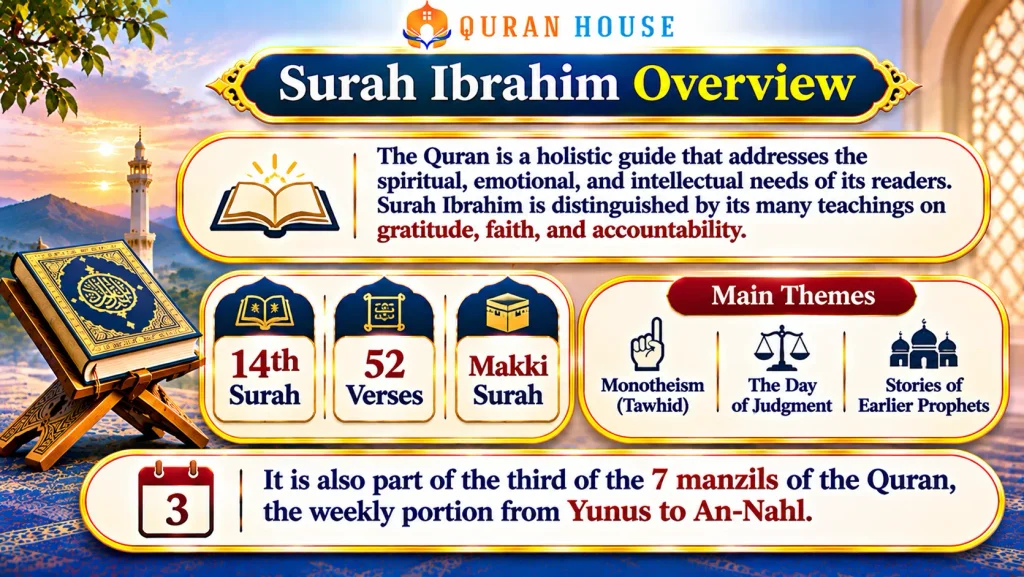
Surah Ibrahim is the 14th chapter of the Quran and has 52 verses. It is a Makki surah that explores the principle of monotheism, the Day of Judgment, and the inspiring and cautionary stories of earlier prophets. It is also part of the third of the 7 manzils of the Quran, the weekly portion from Yunus to An-Nahl.
What Is the Dua of Prophet Ibrahim?
The duas of Prophet Ibrahim are mentioned in several places in the Quran, each reflecting a different aspect of his life and mission. In Surah Ibrahim itself, he prayed for the safety of Makkah and for his children to stay away from idol worship:
﴿رَبِّ اجْعَلْ هَٰذَا الْبَلَدَ آمِنًا وَاجْنُبْنِي وَبَنِيَّ أَن نَّعْبُدَ الْأَصْنَامَ﴾
“My Lord, make this city secure and keep me and my sons away from worshipping idols.”
Another of his most famous duas is found in Surah Al-Baqarah, made while he and his son Isma’il were raising the foundations of the Kaaba:
﴿رَبَّنَا تَقَبَّلْ مِنَّا ۖ إِنَّكَ أَنتَ السَّمِيعُ الْعَلِيمُ﴾
“Our Lord, accept this from us. Indeed, You are the Hearing, the Knowing.”
The dua continues in the next two verses: “Our Lord, make us Muslims in submission to You and from our descendants a Muslim nation in submission to You. And show us our rites and accept our repentance. Indeed, You are the Accepting of repentance, the Merciful.
Our Lord, and send among them a messenger from themselves who will recite to them Your verses and teach them the Book and wisdom and purify them. Indeed, You are the Exalted in Might, the Wise.” (Al-Baqarah 2:128–129)
Interpretation and Implications
This dua, made while Prophet Ibrahim and his son Isma’il were laying the foundations of the Kaaba in Makkah, encompasses several key themes:
- Acceptance of Deeds: Prophet Ibrahim starts by asking Allah to accept their efforts, acknowledging that Allah is All-Hearing and All-Knowing.
- Submission to Allah: he prays for himself and his descendants to be Muslims, those who submit to Allah’s will.
- Guidance in Rituals: he asks for guidance in religious rites, emphasizing the importance of correct worship.
- Repentance: he seeks Allah’s forgiveness, recognizing Him as the One who accepts repentance.
- Divine Messenger: finally, he prays for a messenger to be sent among his descendants, a prayer answered with the sending of Prophet Muhammad ﷺ.
This dua is a comprehensive prayer that asks for personal and communal well-being, spiritual upliftment, and guidance. It serves as a model for how believers should approach Allah: with humility, sincerity, and a desire for both worldly and spiritual betterment.
What Was Allah’s Promise to Ibrahim?
The Quranic account of Allah’s promise to Prophet Ibrahim touches on various aspects of his life and mission.
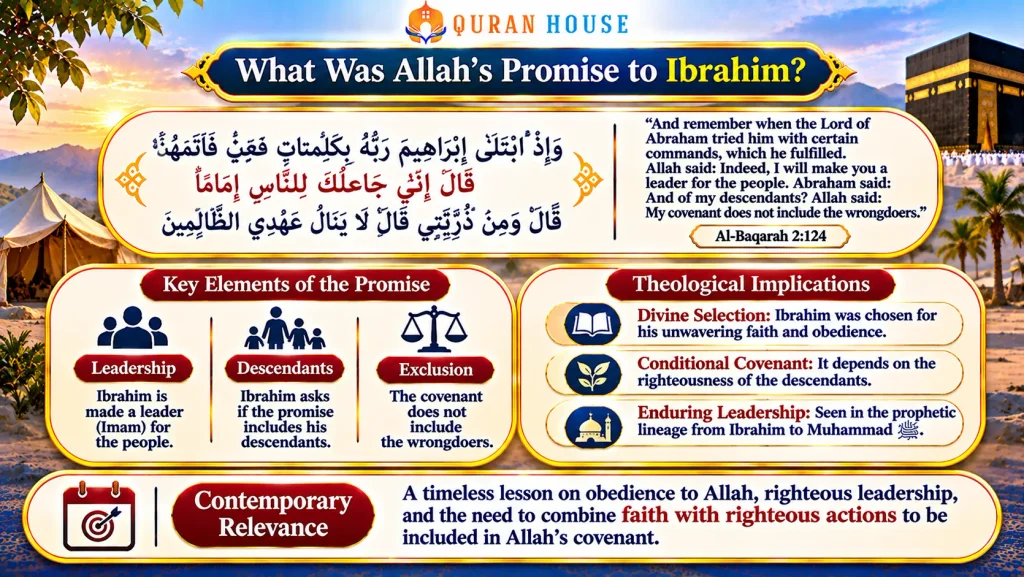
One of the most notable promises is mentioned in Surah Al-Baqarah:
﴿وَإِذِ ابْتَلَىٰ إِبْرَاهِيمَ رَبُّهُ بِكَلِمَاتٍ فَأَتَمَّهُنَّ ۖ قَالَ إِنِّي جَاعِلُكَ لِلنَّاسِ إِمَامًا ۖ قَالَ وَمِن ذُرِّيَّتِي ۖ قَالَ لَا يَنَالُ عَهْدِي الظَّالِمِينَ﴾
“And remember when the Lord of Abraham tried him with certain commands, which he fulfilled. Allah said: Indeed, I will make you a leader for the people. Abraham said: And of my descendants? Allah said: My covenant does not include the wrongdoers.”
Key Elements of the Promise
Surah Al-Baqarah 2:124, highlights the importance of faith, obedience, and righteousness. The verse presents three key elements that explain the nature of this divine covenant:
- Leadership: Allah promises to make Ibrahim a leader (Imam) for the people, recognizing his obedience and devotion.
- Descendants: Ibrahim asks about his descendants, showing concern for their spiritual well-being and leadership.
- Exclusion of Wrongdoers: Allah clarifies that the covenant will not extend to wrongdoers among his descendants, showing that the promise depends on righteousness.
Theological Implications
This divine promise carries important theological lessons about leadership, accountability, and Allah’s wisdom in choosing His servants. It emphasizes that noble ancestry alone does not guarantee inclusion in the covenant, as righteousness remains essential.
- Divine Selection: the promise shows that Ibrahim was chosen for his unwavering faith and obedience to Allah’s commands.
- Conditional Covenant: the promise is not unconditional; it depends on the righteousness of the descendants, which introduces the concept of individual accountability.
- Enduring Leadership: the promise has lasting implications, seen in the prophetic lineage that descended from Ibrahim, including Prophets Isma’il, Ishaq, Ya’qub, and ultimately Muhammad ﷺ.
Contemporary Relevance
The promise made to Prophet Ibrahim serves as a timeless lesson for Muslims today. It emphasizes the importance of obedience to Allah, the significance of righteous leadership, and the conditional nature of divine promises. It reminds us that faith must be accompanied by righteous actions to be included in Allah’s covenant.
The Historical Significance of the Surah’s Title
Surah Ibrahim takes its name from the prophet whose supplications and steadfast faith feature prominently within its verses, particularly his prayers for his descendants and the sacred city of Makkah.
This naming reflects a broader Quranic pattern of highlighting prophets whose stories carry lessons directly relevant to the surah’s central themes of gratitude, patience, and trust in Allah’s promises.
It is one of several surahs named after prophets, along with surahs like Yunus, whose benefits of Surah Yunus carry a similar message of hope and reliance on Allah.
Understanding this connection helps readers appreciate why Ibrahim’s example anchors a surah otherwise focused on broader themes of faith and accountability.
Practical Applications From the Surah’s Teachings
The teachings of Surah Ibrahim can be turned into daily habits. Here are some practical ways to apply them:
- Reflect on Ibrahim’s supplications as a model for personal prayers regarding family and future generations.
- Use the parable of the good word as a reminder to choose speech and actions rooted in sincerity and truth.
- Practice gratitude regularly by counting and acknowledging Allah’s blessings, remembering His promise in verse 7.
- Consider the surah’s warnings about accountability as motivation for consistent, sincere worship.
Learning Through Play: A Live Kids Class
Young learners stay focused when lessons feel like a game. Watch a real Quran House class where interactive activities and a patient tutor keep a child engaged, reciting, and smiling from start to finish.
Start Your Quran Journey With Quran House
Learn live and one-on-one with Al-Azhar-trained tutors, male and female, for children and adults, at a time that fits your timezone.
Try a Free SessionExplore Surah Ibrahim Further With Quran House
Surah Ibrahim weaves together gratitude, faith, and accountability in a way that rewards careful study. The parable of the good tree, the questioning in the grave, and the duas of Prophet Ibrahim all open up much more when a teacher explains them verse by verse.
At Quran House, our Quran Tafseer Course helps students explore surahs like this one in depth, guided by instructors trained at Al-Azhar who bring historical and scholarly context to every live one-to-one session, for adults and kids alike.
Whether you want to understand Surah Ibrahim, memorize the duas of Prophet Ibrahim, or recite it with correct Tajweed, you will have a trusted teacher by your side at every step.
Explore Our Quran Courses:
- Quran Reading Course Online for Kids and Adults
- Learn to Read Quran in Arabic
- Learn to Read Quran for Beginners
- Quran Reading for Kids
- Quran Reading for Adults
- Quran Reading for Sisters
- Noorani Qaida for Beginners
- Noorani Qaida for Adults
Final Thoughts on Surah Ibrahim Benefits
The benefits of Surah Ibrahim come from its verses and the authentic Sunnah: Allah promises increase to the grateful, reminds us that His blessings cannot be counted, describes the good word as a firmly rooted tree, and keeps the believers firm in this life and in the grave.
Through the duas of Prophet Ibrahim and the stories of the prophets, it teaches reliance on Allah, patience, and trust in His justice.
Understanding these interconnected themes deepens appreciation for the surah’s unified message. Approaching it with careful study and reflection offers lasting benefit for cultivating gratitude and sincerity in daily life. Use a trusted source such as Quran.com to follow the original text as you recite.
FAQs
What Are the Main Benefits of Surah Ibrahim?
Its main benefits come from its verses: the promise of increase for the grateful, the parable of the good word, firmness in the grave, and the duas of Prophet Ibrahim.
Why Is Ibrahim’s Example So Central to This Surah?
His sincere supplications and steadfast faith model the surah’s themes of gratitude, patience, and trust in Allah’s promises, making him a fitting namesake for the chapter.
What Makes the Parable of the Good Word So Widely Referenced?
Its clear image of a firmly rooted tree, which the Prophet ﷺ explained as the date palm, offers a powerful lesson about the lasting impact of sincere faith.
What Is the Dua of Prophet Ibrahim in Surah Ibrahim?
One of his most famous duas is “Rabbij’alni muqimas-salati wa min dhurriyyati, Rabbana wa taqabbal du’a,” asking Allah to make him and his descendants steadfast in prayer (14:40).
How Can Modern Readers Apply This Surah’s Lessons?
Many readers focus on practicing gratitude daily and choosing speech rooted in sincerity, as taught by the surah’s core verses.