
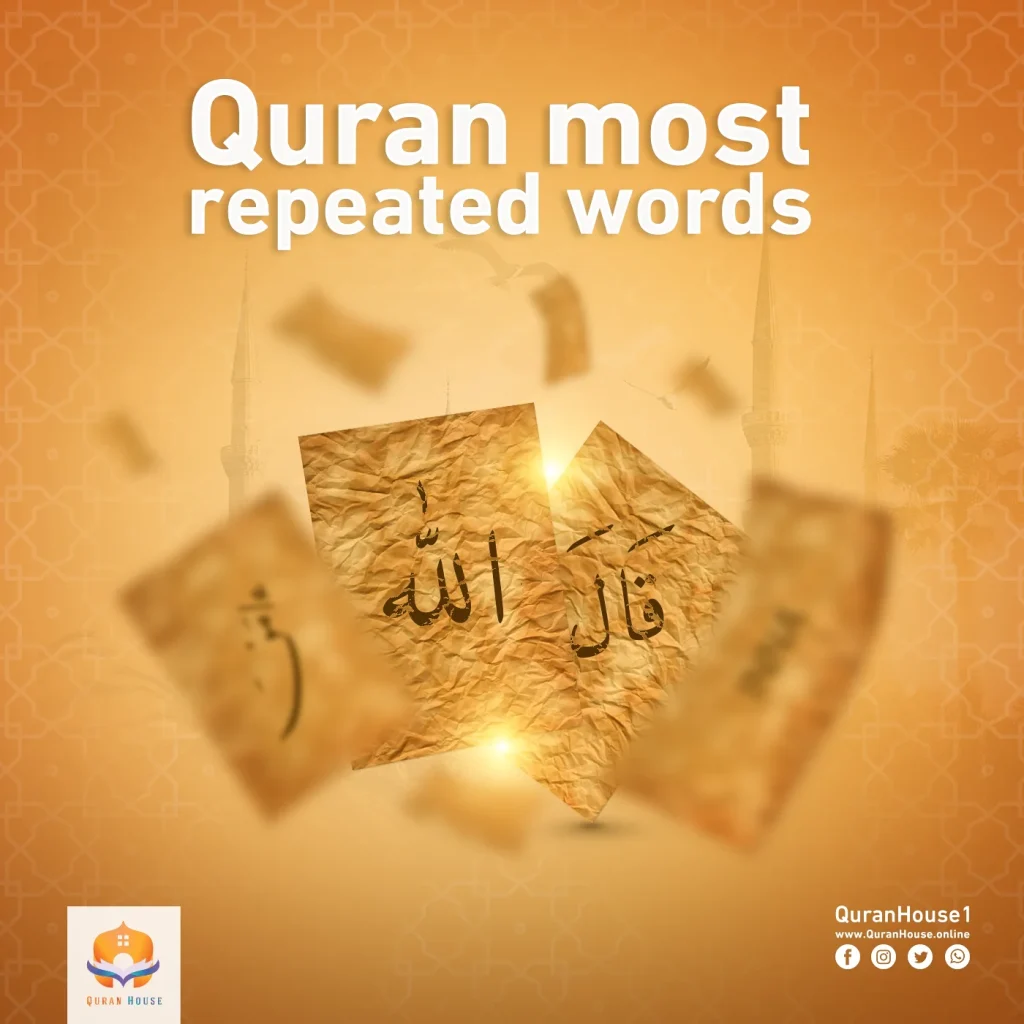

Studying repeated words helps students in our Tafseer course at Quran House understand deeper themes.
The Quran is known for its unparalleled eloquence and depth. Within its verses, certain words are repeated frequently, serving as anchors for its profound messages. Understanding these repeated words can significantly enhance a reader’s comprehension and reflection on its verses.
Significance of repeated words
The repetition of specific words in the Quran is not arbitrary. Each repetition serves a purpose, whether that is emphasis, highlighting core themes and messages, guidance, directing believers to essential teachings, or reflection, encouraging deeper contemplation on specific topics.
Benefits of recognizing repeated words
Understanding the most frequently used words in the Quran offers several benefits. Enhanced comprehension comes from familiarity with these words, which provides context and makes verses more accessible. Deeper reflection follows from recognizing patterns in word repetition, leading to a more profound understanding of the Quran’s themes. Aided memorization is another benefit, since repeated words can serve as memory anchors, assisting students of Hifz as they work through longer passages.
Some of the most frequently repeated words
1. Allah
Occurring 2,816 times, this word emphasizes the centrality of the Divine throughout the Quran. It serves as a constant reminder of monotheism and the omnipresence of Allah, appearing in nearly every surah in some form.
2. Qala, meaning “to say”
This word is used frequently to relay conversations, especially prophetic dialogues. It underscores the importance of communication, conveying divine messages, and recording the responses of people throughout the Quran’s many narratives.
3. Amana, meaning “to believe”
Appearing numerous times, this word highlights the essence of faith and belief in the Quranic narrative. It calls upon believers to have faith in the unseen and in divine revelation, forming one of the Quran’s most central recurring themes.
4. Inna, meaning “indeed”
Occurring 1,682 times, this is a word of affirmation and certainty. It is used to emphasize truths, facts, and divine decrees, often signaling that an important statement is about to follow.
5. Alladhi, meaning “the one who”
Used multiple times throughout the text, this word often points to attributes or actions of specific entities. It is frequently used to refer to Allah, highlighting His attributes and actions in a grammatically elegant way.
6. Min, meaning “from”
Appearing several times, this word denotes origin, source, or a starting point. In many verses, it is used to signify guidance, blessings, or knowledge coming directly from Allah.
If you would like to explore these words and their contexts in more depth, take a look at our online Tafseer course.
Benefits of recognizing repeated words in the Quran
The Quran’s linguistic depth is unparalleled, and its repeated words serve as keys to unlocking its profound wisdom. Recognizing and understanding these frequently repeated words offers several benefits.
1. Enhanced comprehension
The Quran is a text filled with layers of meaning. Recognizing words that appear frequently can provide context, making verses more accessible and understandable, and helping readers grasp the overarching themes and messages of the Quran more effectively.
2. Faster memorization
Memorization, known as Hifz, is a noble endeavor, and familiarity with the Quran’s frequently repeated words can serve as a memory aid. These words act as milestones or markers, helping memorizers navigate through verses and chapters, making the process smoother and more efficient.
3. Deeper reflection
The Quran encourages reflection, known as tadabbur, on its verses. Recognizing patterns in word repetition can lead to insights into its themes, allowing readers to contemplate these repeated words and their contexts, achieving a deeper understanding and connection with the Quran that supports spiritual growth.
Why repetition is a deliberate literary feature, not a limitation
Some readers unfamiliar with classical Arabic rhetoric might assume that repeated words reflect a limited vocabulary or a stylistic weakness. In reality, deliberate repetition is a well established and highly regarded feature of classical Arabic literature, used specifically to reinforce meaning and aid memory in an oral tradition. The Quran was revealed into a culture that placed enormous value on oral poetry and memorized speech, and its repeated words function much like recurring motifs in a symphony, returning at key moments to reinforce the composition’s central themes.
How word frequency analysis supports modern Quranic study
In recent decades, scholars and technologists have used computational tools to analyze word frequency across the entire Quran with remarkable precision, confirming and expanding on observations that classical scholars made through careful manual study centuries earlier. These modern tools allow students to search for every occurrence of a specific word instantly, comparing its usage across different surahs and contexts. This kind of analysis has made it far easier for contemporary students to notice patterns that once required years of dedicated scholarship to identify.
Practical ways to use repeated words in your own study
- Keep a simple list of words you notice appearing often during your recitation, and look up their meaning and grammatical role when you encounter them repeatedly.
- Use a Quranic word frequency index or concordance to explore every place a specific word appears, comparing its context across different surahs.
- When memorizing a new passage, pay special attention to recurring words, since they often serve as natural anchor points that make recall easier.
- Discuss a repeated word’s various contexts with a teacher, since the same root word can carry slightly different shades of meaning depending on its placement.
Frequently asked questions
Why does the word Allah appear so much more often than any other word?
Since the Quran is fundamentally a text centered on the relationship between Allah and humanity, it makes sense that His name would appear far more frequently than any other single word, reinforcing the Quran’s central theme of monotheism throughout nearly every surah.
Does recognizing repeated words replace the need to study tafseer?
No. Recognizing repeated words is a helpful complement to deeper study, not a replacement for it. A word’s precise meaning often depends heavily on its surrounding context, which is exactly what tafseer, or Quranic exegesis, is designed to explain.
Are repeated words distributed evenly throughout the Quran?
No, certain words cluster more heavily in specific surahs depending on their themes. Words related to belief and disbelief, for example, appear more frequently in surahs that directly address the early Meccan disbelievers.
Can studying repeated words help someone who does not yet read Arabic?
Yes, many translations and study guides highlight these frequently repeated words alongside their transliteration and meaning, allowing non-Arabic speakers to begin recognizing these patterns even before they achieve full fluency in the language.
Comparing repeated words across different translations
Readers who rely on translated versions of the Quran sometimes miss the full extent of a word’s repetition, since translators occasionally use different English words for the same underlying Arabic term depending on context, in an effort to preserve natural readability. A student who only reads translation may not immediately notice that several different English phrases actually trace back to the same repeated Arabic word. This is one reason many serious students eventually move toward studying the Arabic text directly, even if only alongside a trusted translation, in order to catch these patterns that translation alone can sometimes obscure.
Comparing multiple translations side by side can also be a useful exercise, since noticing where translators diverge in their word choice for the same Arabic term often highlights subtle shades of meaning worth exploring further with a teacher or a dedicated tafseer resource.
Studying Quranic vocabulary in more depth
Recognizing repeated words is only the beginning of a much deeper study of the Quran’s vocabulary and structure. At Quran House, our online Tafseer and Quranic Arabic courses walk students through the meaning, grammar, and context behind these recurring words, connecting them to the Quran’s broader themes. Instructors trained at Al-Azhar help students move from simple word recognition toward genuine understanding of how these words shape the Quran’s overall message.
How repeated words connect surahs to one another
Beyond reinforcing individual themes within a single surah, repeated words also create meaningful connections across the Quran as a whole. When a specific word, such as Inna or Alladhi, appears in vastly different contexts, from stories of previous prophets to direct legislative instructions, it links those passages together conceptually, even when they are separated by many chapters. Readers who begin to notice these threads often find that their understanding of the Quran shifts from viewing it as 114 separate chapters toward appreciating it as a single, interconnected text with recurring vocabulary tying its many parts together.
This interconnected quality is part of why classical scholars often studied the Quran holistically rather than treating each surah as an isolated unit, cross referencing word usage across the entire text to build a fuller picture of its meaning.
The role of root letters in Arabic vocabulary
Arabic vocabulary is built around a system of root letters, typically three consonants that carry a core meaning, from which many related words are formed through different patterns and additions. Understanding this system adds another layer of depth to studying repeated words, since words that look different on the surface may share the same underlying root and, therefore, a related core meaning. For example, words related to belief, guidance, or mercy often share roots with other words carrying similar or complementary meanings elsewhere in the text.
Learning to recognize root patterns, rather than memorizing each word as an entirely separate unit, tends to accelerate vocabulary growth significantly for students of Quranic Arabic, since a single root can unlock the meaning of dozens of related words encountered later.
Common mistakes when studying word frequency
Students new to this kind of study sometimes assume that a word’s frequency alone determines its importance, overlooking words that appear less often but carry significant theological or legal weight. A word mentioned only a handful of times can still shape an entire area of Islamic jurisprudence or belief, so frequency should be treated as one useful lens among several, rather than the sole measure of a word’s significance.
Another common mistake is assuming a repeated word always carries the exact same meaning in every context. Arabic words frequently shift in nuance depending on their grammatical form and surrounding verses, which is why frequency analysis works best when paired with careful attention to context rather than used as a standalone shortcut.
Building a personal vocabulary study habit
Students who want to build lasting familiarity with the Quran’s core vocabulary often benefit from a simple, consistent routine rather than an intensive but short lived push. Spending just a few minutes several times a week reviewing a small set of frequently repeated words, along with their meanings and a few example verses, tends to produce steadier, more lasting retention than cramming a large vocabulary list all at once. Pairing this review with actual recitation, noticing the words as they appear naturally during daily reading, reinforces the connection between abstract vocabulary study and lived, practical engagement with the text.
How teachers use repeated words when guiding new students
Experienced Quran teachers often introduce frequently repeated words early in a student’s journey, precisely because early familiarity with these words pays dividends throughout the rest of a student’s study. Rather than waiting until a student has memorized several full surahs, many teachers point out words like Allah, Inna, and Alladhi as soon as they first appear, building a habit of active recognition rather than passive reading. This approach mirrors how children naturally acquire vocabulary in any language, through repeated, contextual exposure rather than isolated memorization of word lists.
Over time, this early emphasis on recognizing recurring vocabulary tends to make later stages of memorization noticeably smoother, since students already carry a working vocabulary that makes new passages feel more familiar rather than entirely foreign.
Final thoughts
The Quran’s most frequently repeated words are far from arbitrary. Each one, from Allah to Inna to Alladhi, carries deliberate weight, reinforcing the text’s central themes of monotheism, faith, and divine guidance. Recognizing these patterns offers real, practical benefits for comprehension, memorization, and reflection, turning familiar recitation into an opportunity for deeper engagement with the Quran’s remarkable linguistic design, one that rewards patient, sustained attention rather than a single quick reading.
Final Thoughts
Noticing repeated words while reading builds stronger retention over time. For the original text, see Quran.com.