
Can I Read Overview

Understanding can i read matters for every student, and our courses at Quran House cover it in depth.
Reciting the Quran is a miracle at birth in our souls and hearts, and whether this recitation is aloud or in silence, undeniable lights storms into our hearts, lighting up every spot and every corner of our being.
Though, in order for the light to fully claim us, and for faith to inhabit our souls, hearts, and minds, we have to recite the Quran in the correct way; in the way Allah has instructed.
The act of reciting of the Quran:
The act of reciting of the Quran is extremely important; the word Quran itself is derived from the Arabic verb “read”, which means that the Quran is meant to be recited and read by Muslims, and only listening to it is like taking a sip of water after almost dying of thirst, it’s not enough in the slightest.
Allah has not left us with unanswered questions about anything related to how to worship him, including how to read the Quran in the proper manner. Our prophet is narrated to have said: “He who recites the Quran loudly is like he who gives Sadaqah in public, and he who recites it quietly is like he who gives Sadaqah in secret”.
This Hadith proves the religious legitimacy of reading the Quran in silence as well as out loud; though, each method has its own set of rules, and its own circumstances that need to be respected.
Reciting the Quran out loud:
Loud recitation of the Quran is but one of the ways through which we can accept the wisdom of the Quran. This method of reading the Quran is very beneficial for us human beings:
1- Reciting the Quran out loud allows us to focus easily on the meaning of the verses, and offers a smooth dive into those verses; as our own voices and our state of concentration keeps us from getting distracted by anything else.
2- Hearing the verses of the Quran in one’s own voice will make it easier to remember those verses, and summon them from memory at any moment.
3- Reading the Quran has an emotional and spiritual effect on us; as it has the ability to calm us down, and relieve our stress, and reading it out loud only strengthens these impacts.
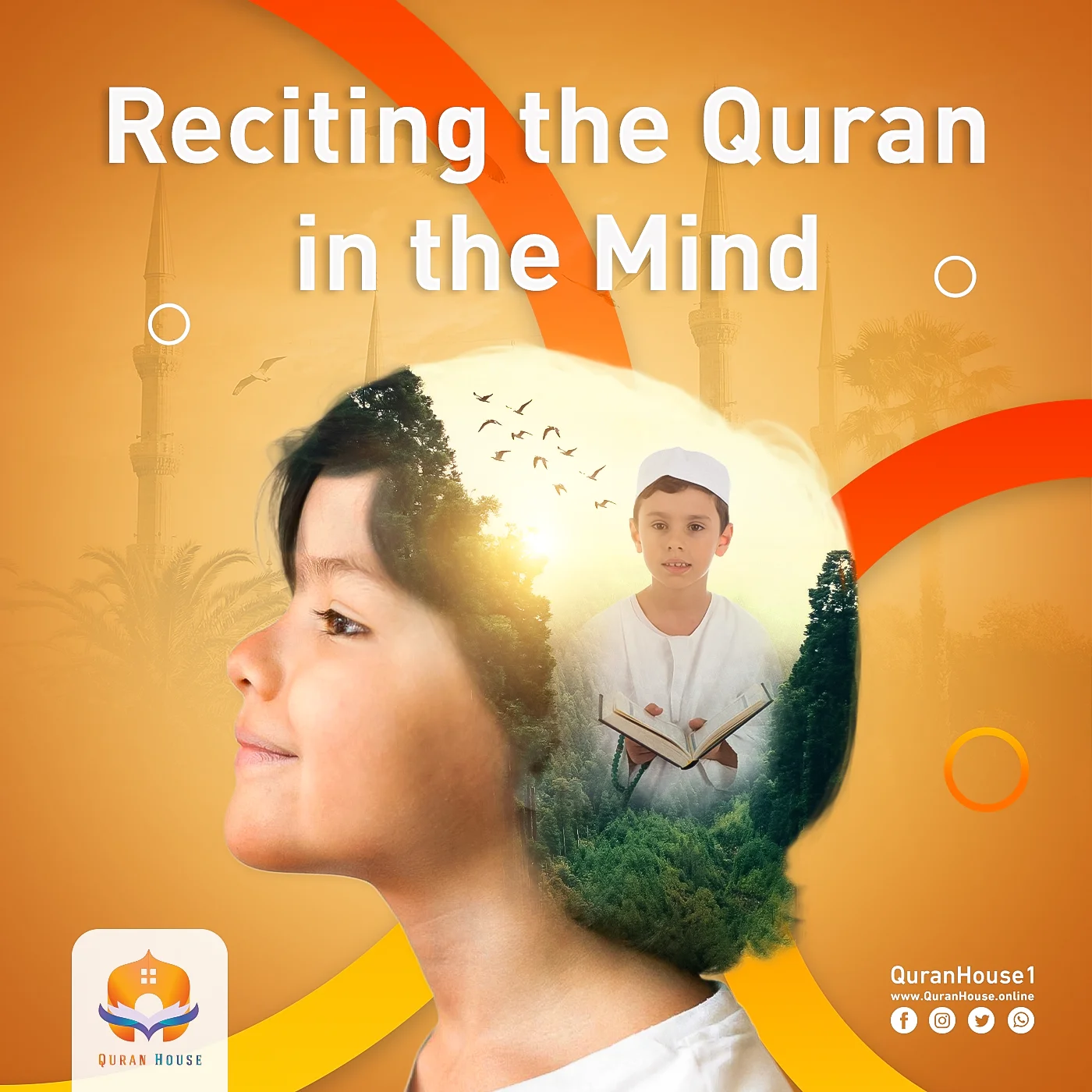
Reciting the Quran in the mind:
The idea of reciting the Quran in the mind is reading the Quran without moving the lips or tongue is one of the methods of interacting with the Quran silently indeed, but it can’t be considered recitation, but rather thinking and meditating spiritually and intellectually with the Quran.
Islamic scholars concluded that mental interaction with the Quran is permissible in general, but in situations where the act of recitation in itself is required: such as praying, it’s not permitted to only interact with it in one’s mind without moving the lips and tongue, and produce the sounds from their positions of articulation.
Islam does not forbid mental interaction with the Quran; as thinking about Allah’s Quran and meditating in one’s heart is an act of worship, and it is Inshallah handsomely rewarded by Allah.
Reciting the Quran audibly:
Reciting the Quran audibly is the articulation of the sounds in a clam, and quiet voice. Reading the Quran audibly is preferred in case one can’t recite the Quran out loud, and can’t recite the Quran mentally as well.
In such cases, reciting the Quran audibly combines the advantages of both methods, but evades the elements of these methods not eligible in this case, creating a method of reciting the Quran that can always work.
The proper way to recite the Quran:
The proper way to recite the Quran translation is to move the lips and tongues in the articulation of the correct sounds, whether loudly enough for others to hear, or in a quiet voice, in which only you can hear it.
Religious scholars have agreed that audible recitation is very important; as it’s the basis of the act of recitation of the Quran, and it significantly enhances our absorbance of all the goodness the Quran offers us: a better understanding of how to live our lives, and a much more peaceful heart.
Quran tutors and specialized religious scholars at certified Islamic academic institutions such as Quran House will help you practice your recitation to perfection, through a set of courses that work together to help you acquire the skills needed to recite the Quran like a native Arab person.
Misconceptions and clarifications around the proper way of Quran recitation:
There are many misconceptions around the proper way of reciting the Quran, and it’s important to clarify these misunderstandings; as they can lead Muslims to do some acts of worship in a wrong way:
1- Mental recitation of the Quran during prayers:
Many people believe that mental recitation of the Quran during performing prayers is valid, but that’s not true. It’s invalid to recite the Quran in our minds, without moving our lips and tongues.
The reason behind this is due to the act of recitation of the Quran being mandatory while performing prayers, and the act of recitation isn’t complete without using the articulation system to produce the sounds.
2- Mental recitation equals audible recitation:
It’s a common false belief that mental recitation and audible recitation are equal and interchangeable, but that is not true at all; as each of them is preferred during certain circumstances.
One is preferred to recite the Quran out loud if he is alone, or in the company of those who would like to listen to his recitation. On the other hand, one is advised to read the Quran in a quiet voice, or even do mental recitation in case those around him are not ready to listen to the Quran for whatever reason.
All the benefits we gain from reading the Quran are linked to the manner of carrying out the act of recitation itself, which is instructed clearly for Muslims to follow. Therefore, reciting the Quran in our minds is permissible, and preferred in a few cases only.
Such matters are always cleared out by prominent Muslim scholars; such as the ones on the following websites:
https://www.islamweb.net/en/fatwa/84707/movement-of-the-lips-and-tongue-when-silently-praying
https://fiqh.islamonline.net/en/reciting-the-quran-silently-or-aloud/
We are well aware that this issue is complicated, with several layers, and many details; so, for more information, take a tour around our website. You will definitely come across an answer to your every question.
FAQ:
-Does reading the Quran in your head count?
It’s valid as an interaction with the Quran, and rewarded accordingly, but isn’t considered recitation of the Quran.
-Can you read the Quran silently?
Yes, you can read the Quran silently, and in order to be counted as an actual recitation, just move your lips and tongue and use them to articulate the sounds.
-Can I read the Quran in my head?
Yes, you can read the Quran in your head, but it’s not called reading the Quran, but is a mere interaction with it.
-Can you read the Quran without moving your lips?
Yes, you can read the Quran without moving your lips.
Why scholars differ on the reward of silent versus audible recitation
Scholars across the major schools of thought generally agree that reciting the Quran audibly, even in a whisper, carries additional reward compared to purely mental recitation without any movement of the lips, since actual verbal recitation engages the tongue in worship in a way that mental reflection alone does not. However, most scholars also affirm that silently reflecting on the Quran’s meaning in the mind still carries value, particularly when circumstances make audible recitation impractical or inappropriate.
Understanding this nuance helps clarify that mental engagement with the Quran is never without merit, even if audible recitation remains the preferred practice whenever feasible.
Situations where silent, mental recitation may be preferable
There are practical circumstances in which silent or mental recitation becomes the more appropriate choice, such as in shared public spaces where audible recitation might disturb others, or during moments requiring discretion, such as certain professional or social settings. In these situations, mentally reciting or reflecting on verses allows a believer to maintain a connection to the Quran without creating disruption or discomfort for those around them. Recognizing these practical exceptions helps believers apply the general preference for audible recitation with appropriate flexibility rather than rigid inflexibility.
How audible recitation supports memorization and correction
Reciting the Quran audibly, even quietly, plays an important practical role in memorization, since hearing one’s own voice reinforces retention more effectively than silent reading alone. Audible recitation also allows a teacher or study partner to identify and correct pronunciation errors in real time, something that is simply not possible when recitation remains purely mental. For this reason, structured memorization and Tajweed programs consistently emphasize audible practice, even at a low volume, as an essential component of accurate learning.
Practical tips for balancing silent and audible recitation
- Default to audible recitation, even in a soft whisper, whenever your surroundings allow it comfortably.
- Reserve purely mental recitation for situations where audible recitation would be genuinely disruptive or inappropriate.
- Use audible recitation specifically during memorization and Tajweed practice, where correction and reinforcement are most valuable.
- Treat mental reflection on the Quran’s meaning as a valuable complement to, rather than a replacement for, audible recitation.
Additional frequently asked questions
Does silent recitation fulfill obligations during prayer?
Scholars generally hold that the obligatory portions of prayer require at least a minimal audible movement of the lips, even if quiet, rather than purely silent mental recitation without any vocalization.
Is there a difference between silent reading and silent reflection?
Silent reading typically involves following the text with the eyes without vocalization, while silent reflection may occur without the text present at all, both are considered valuable though generally viewed as carrying less reward than audible recitation.
Deepening your practice of Quran recitation
Understanding the nuances between audible and mental recitation is best developed through structured guidance rather than isolated reading. At Quran House, our Tajweed and recitation courses help students build strong audible recitation habits while also understanding when mental reflection is an acceptable, valuable alternative, guided by instructors trained at Al-Azhar. This structured approach helps students recite confidently and correctly across a variety of circumstances.
How different schools of thought approach this question
The four major schools of Islamic jurisprudence generally converge on the core principle that audible recitation, even at a whisper, is required to fulfill the specific ritual obligations of prayer, though they differ somewhat in the finer details of how much sound must be produced for the recitation to count as valid. Outside of formal prayer, most scholars across these schools agree that both audible and mental engagement with the Quran carry spiritual benefit, with audible recitation still considered the preferred general practice.
Being aware of these shared principles, rather than assuming a single rigid rule applies universally, can help students better understand the reasoning behind scholarly guidance they encounter from different teachers or resources.
Building a sustainable daily recitation habit
For many people, the debate between silent and audible recitation matters less in the abstract and more in practical terms, how to build a recitation habit that is actually sustainable given daily constraints like limited privacy, work schedules, or family responsibilities. A helpful approach is to identify small, realistic windows in the day, such as early morning or before sleep, where audible recitation is comfortable and undisturbed, while reserving mental reflection for moments when those windows are not available.
Over time, this flexible but intentional approach tends to produce more consistent long-term engagement with the Quran than a rigid all-or-nothing standard that becomes difficult to maintain.
Final thoughts
While audible recitation of the Quran generally carries greater reward and offers clear practical benefits for memorization and correction, silent or mental engagement with the Quran still holds genuine value, particularly in circumstances where audible recitation is impractical. Understanding this balance allows believers to maintain a consistent, meaningful connection to the Quran across a wide range of daily situations. Prioritizing audible recitation whenever possible, while remaining flexible when circumstances require otherwise, offers a practical and spiritually sound approach to daily recitation.
Final Thoughts
To sum up, can i read is an important topic, and learning more about can i read helps every sincere student. For the original text, see Quran.com.