
Quran House

Difference Between Hafs and Warsh Quran Explained

Online Quran Tutor
Facebook
Twitter
LinkedIn
Telegram
WhatsApp
Pinterest
Table of Contents

The difference between Hafs and Warsh Quran is one of the most frequently asked questions among Muslims beginning their Quran learning journey. Many learners notice that skilled reciters sometimes pronounce certain words differently, apply different Tajweed rules, or vary the length of vowel sounds. This often leads to the misconception that there are different versions of the Quran.

In reality, there is only one Quran revealed by Allah to the Prophet Muhammad ﷺ. Hafs and Warsh are two authentic narrations transmitted through reliable chains of narration, preserving the same divine revelation without altering its message, beliefs, or rulings. The differences relate only to pronunciation, recitation techniques, and a small number of linguistic variations accepted within the science of Qira’at. Understanding these authentic recitations helps Muslims appreciate the remarkable preservation of the Quran and the precision of Islamic scholarship.

In this guide, you will learn the Difference Between Hafs and Warsh Quran, discover why these recitations exist, and understand how to choose the most suitable narration for your studies. Quran House Academy also offers expert online instruction to help students master authentic Quran recitation with confidence.

Understanding Quran Recitation and Qira’at
Online Quran Tutor
Online Quran Tutor

Before exploring the Difference Between Hafs and Warsh Quran, it is essential to understand what the science of Qira’at actually means.

The Arabic word Qira’at (القراءات) refers to the authentic methods of reciting the Quran that were taught directly by the Prophet Muhammad ﷺ. These recitations were neither invented by scholars nor developed by different Islamic groups. Instead, they were transmitted through continuous chains of trustworthy teachers who carefully preserved every aspect of pronunciation.

When the Quran was revealed, Arabia consisted of numerous tribes with different dialects and speaking styles. Allah, in His wisdom and mercy, allowed the Quran to be recited according to several authentic modes that made memorization and pronunciation easier for these tribes while preserving exactly the same revelation.

This flexibility never changed the beliefs, commandments, stories, or guidance contained in the Quran. Rather, it reflected the linguistic richness of classical Arabic and the ease that Allah intended for His servants.

The Companions learned these recitations directly from the Prophet ﷺ. They then passed them to their students, who transmitted them to later generations with remarkable precision. Over time, Muslim scholars carefully documented every accepted narration, ensuring that only authentic recitations continued to be taught.

Today, the recognized Qira’at remain among the greatest proofs of how carefully the Quran has been preserved throughout history.

Start Your Quran Learning Journey Today

Begin your Quran learning journey with confidence through structured lessons specially designed for beginners. Whether your aim is to improve pronunciation, master Tajweed rules, or learn to read the Quran step by step, Quran House Academy provides clear guidance in a simple and flexible learning environment.

With experienced tutors, personalized one-on-one sessions, and patient teaching methods, learners of all ages can build strong Quran reading skills from the comfort of their homes. The program is designed to support steady progress, ensuring that each student learns at their own pace without pressure.

Start today and take the first step toward accurate, fluent, and confident Quran recitation through a system built for long-term improvement and lasting success.

Difference Between Hafs and Warsh Quran

How Were the Authentic Qira’at Preserved?

Unlike ordinary books, the Quran has always been preserved through two complementary methods:

  • Written manuscripts.
  • Oral transmission.

Although written copies of the Quran were compiled during the era of Caliph Uthman ibn Affan (RA), oral recitation remained the primary method of preservation. Students learned directly from qualified teachers, who corrected every pronunciation until it matched the narration they had received.

This chain of learning, known as Isnad, continues even today. Qualified Quran teachers receive authorization (Ijazah) after demonstrating precise mastery of a particular recitation.

Because of this rigorous process, no authentic recitation can exist without fulfilling strict scholarly conditions.An accepted Quran recitation must:

  • Possess an authentic chain of narration reaching the Prophet Muhammad ﷺ.
  • Agree with the Uthmanic script of the Quran.
  • Conform to classical Arabic grammar.
  • Be accepted by recognized scholars of Qira’at.

These conditions explain why Muslims confidently accept both Hafs and Warsh as authentic methods of reciting the same Quran.

Why Were Multiple Authentic Recitations Allowed?

Many beginners ask why Allah permitted more than one authentic recitation if the Quran is one. Islamic scholars explain that the early Muslim community consisted of tribes speaking different dialects. Pronouncing certain words the same would have been difficult for many new Muslims.

Therefore, Allah granted flexibility in pronunciation while preserving the same divine revelation. This wisdom provided several benefits.

1. Making Quran Learning Easier

Different Arab tribes naturally pronounced some sounds differently. Authentic recitations accommodated these linguistic differences without changing Allah’s message. As a result, more people could memorize the Quran accurately.

2. Preserving the Richness of Arabic

Arabic is one of the world’s richest languages. Some authentic recitations reveal subtle grammatical or linguistic variations that enrich the understanding of Quranic verses without creating contradictions. Scholars often study these variations to gain deeper insight into Quranic meanings.

3. Demonstrating Divine Preservation

Perhaps one of the greatest lessons behind the authentic Qira’at is the extraordinary preservation of the Quran. Instead of losing pronunciation details over time, Muslims preserved every accepted variation through continuous teaching. This meticulous preservation distinguishes the Quran from every other religious text.

What Is Hafs Recitation?

To fully understand the Difference Between Hafs and Warsh Quran, we first need to know who Hafs was. Hafs refers to Hafs ibn Sulayman, who transmitted the recitation of Imam Asim ibn Abi Al-Najud, one of the most respected scholars of Quran recitation.

Today, Hafs is the most widely used narration across the Muslim world. Millions of Muslims read the Quran according to Hafs every single day. Countries commonly using Hafs include:

  • Saudi Arabia
  • Egypt
  • Jordan
  • Syria
  • Turkey
  • Pakistan
  • India
  • Indonesia
  • Malaysia
  • Europe
  • North America
  • Australia

Most printed Mushafs, Quran applications, online learning platforms, and Islamic schools use Hafs because of its widespread historical adoption. This popularity makes it especially convenient for beginners. Students can easily find:

  • Qualified teachers.
  • Audio recitations.
  • Tajweed lessons.
  • Memorization resources.
  • Educational videos.

However, its popularity should never be misunderstood as superiority over other authentic narrations. Hafs became widespread due to historical developments in education—not because other authentic recitations are less correct.

Characteristics of Hafs Recitation

Several characteristics distinguish Hafs from other narrations. These include:

  • Clear pronunciation that many beginners find easy to follow.
  • Extensive educational resources worldwide.
  • Wide availability of printed Qurans.
  • Consistent teaching in most international Islamic schools.
  • Strong support through online learning platforms.

Because of these advantages, many students begin their Quran journey with Hafs before exploring additional Qira’at later.

What Is Warsh Recitation?

The Difference Between Hafs and Warsh Quran also requires understanding the background of Warsh. Warsh refers to Imam Warsh, whose full name was Uthman ibn Sa’id Al-Misri. He transmitted the recitation of Imam Nafi’ Al-Madani, one of the seven famous Imams of Quran recitation.

Warsh remains one of the most respected and authentic Quran narrations in Islamic history. Although less widespread globally than Hafs, it remains the primary recitation in many regions of Africa. Countries where Warsh is commonly taught include:

  • Morocco
  • Algeria
  • Mauritania
  • Libya
  • Senegal
  • Mali
  • Niger
  • Parts of Tunisia
  • Several West African nations

Millions of Muslims memorize, recite, and teach the Quran according to Warsh every day. Just like Hafs, every pronunciation has been preserved through reliable scholarly chains reaching Prophet Muhammad ﷺ. Therefore, Muslims who recite according to Warsh are following an authentic prophetic tradition.

Characteristics of Warsh Recitation

Warsh possesses several distinctive features appreciated by Quran scholars. Among them are:

  • Beautiful rhythmic pronunciation.
  • Certain unique vowel patterns.
  • Specific Madd rules.
  • Characteristic Hamzah treatment.
  • Occasional Imalah in selected words.

These features often sound unfamiliar to students accustomed only to Hafs. Nevertheless, every rule follows authentic scholarly transmission. Learning about Warsh allows Muslims to appreciate the remarkable precision with which Allah preserved His Book.

Why Should Beginners Learn About Hafs and Warsh?

Why Should Beginners Learn About Hafs and Warsh?

Many students assume they only need to memorize the Quran without understanding how to recite it. However, learning the foundations of Qira’at offers several important benefits.

  • First, it removes unnecessary doubts.
  • Second, it increases appreciation for Islamic scholarship.
  • Third, it demonstrates the remarkable preservation of the Quran.
  • Finally, it helps students understand why qualified reciters may sound different even when reciting the same revelation.

As students continue learning, this knowledge builds confidence and deepens their connection with the Quran.

Difference Between Hafs and Warsh Quran in Detail

After understanding the background of both narrations, it becomes easier to explore the Difference Between Hafs and Warsh Quran in greater detail. At first glance, beginners may think the differences are major because the recitations sound different in certain verses. However, scholars explain that almost all variations are related to pronunciation, Tajweed application, vowelization, and a limited number of authentic linguistic forms.

Most importantly, these differences never produce two different Qurans. Every authentic narration conveys the same revelation, the same beliefs, the same acts of worship, and the same guidance revealed to Prophet Muhammad ﷺ.

For this reason, Muslim scholars have always regarded Hafs and Warsh as complementary recitations rather than competing versions of the Quran.

Difference Between Hafs and Warsh Quran at a Glance

Aspect Hafs Warsh
Narrator Hafs ibn Sulayman Warsh (Uthman ibn Sa’id)
Imam Asim ibn Abi Al-Najud Nafi’ Al-Madani
Most Common Regions Middle East, Asia, Europe, Americas Morocco, Algeria, Mauritania, West Africa
Popularity Most widespread narration Second most widely used narration
Written Mushaf Common worldwide Common in North Africa
Tajweed Style Familiar to most learners Contains distinctive pronunciation features
Authenticity Authentic Authentic
Quran Exactly the same Exactly the same

This comparison immediately shows that the Difference Between Hafs and Warsh Quran lies in the method of recitation rather than in the content of the Quran itself.

Difference Between Hafs and Warsh Quran in Pronunciation

The first difference beginners usually notice is pronunciation. When listening to experienced reciters, some words may sound slightly different even though they are reciting the very same verse. These pronunciation differences include:

  • Vowel movements.
  • Length of certain sounds.
  • Treatment of Hamzah.
  • Letter articulation.
  • Pausing rules.
  • Certain grammatical pronunciations.

Every one of these differences follows detailed rules taught by qualified scholars.No reader is free to invent a new pronunciation or choose whichever version sounds easier. Instead, every reciter faithfully follows the narration they learned from their teacher.

This disciplined method of transmission explains why the Difference Between Hafs and Warsh Quran has remained unchanged for centuries.

Difference in Madd (Lengthening)

One of the clearest distinctions concerns Madd, the elongation of vowel sounds. In Arabic recitation, certain letters are naturally extended. However, Hafs and Warsh sometimes apply different lengths in specific situations. For example:

  • Some connected Madd rules are longer in Warsh.
  • Certain separated Madd rules differ in duration.
  • Some extensions that are optional in Hafs become preferred in Warsh.

Although these differences are noticeable to trained listeners, they never alter the words or meanings of the Quran. Instead, they preserve authentic prophetic methods of recitation. Students should therefore avoid mixing the two narrations while reading.A learner should complete one narration correctly before studying another.

Difference in Hamzah Pronunciation

Another important aspect of the Difference Between Hafs and Warsh Quran involves the pronunciation of Hamzah (ء).Hamzah is among the most distinctive letters in Arabic. Warsh contains several unique rules concerning Hamzah, including:

  • Easier pronunciation in specific contexts.
  • Modified articulation in certain combinations.
  • Different methods when two Hamzahs appear together.

Hafs generally preserves a more direct pronunciation in many of these cases. These rules require careful study because incorrect pronunciation may unintentionally mix narrations.

Qualified teachers, therefore, introduce these topics gradually after students master the fundamentals of Tajweed.

Difference in Imalah

One of the most recognizable features that many students associate with the Warsh recitation is Imalah. Imalah is a controlled and authentic pronunciation in which a vowel sound is inclined slightly toward another vowel according to established rules of Quranic recitation. It is not a regional accent, a personal style, or a modern variation in pronunciation.

Instead, it is a carefully preserved feature transmitted through authentic chains of narration from the early scholars of Qira’at. Warsh includes several well-known examples where Imalah is applied, while Hafs generally recites those same words without using Imalah.

As a result, listeners who are unfamiliar with Warsh often notice this difference immediately because it creates a distinct sound during recitation. Even so, both pronunciations are equally authentic, fully accepted within the canonical Quranic recitations, and faithfully preserve the exact meaning and message of the Holy Quran without any alteration.

Difference in Tafkheem and Tarqeeq

Another area where the Difference Between Hafs and Warsh Quran appears is the treatment of heavy and light letters. Arabic contains letters that may sometimes be pronounced with heaviness (Tafkheem) or lightness (Tarqeeq). Warsh applies different rules in several situations involving:

  • The letter Raa (ر).
  • Certain occurrences of Lam (ل).
  • Some vowel environments.

These rules create a distinctive rhythm while preserving the exact wording of the Quran. Scholars have documented every detail with remarkable precision.

Difference Between Hafs and Warsh Quran in Selected Words

Many beginners become worried when they hear that Hafs and Warsh occasionally use slightly different forms of certain words. This concern usually disappears after understanding the nature of these differences. Most variations involve:

  • Different grammatical forms.
  • Different vowel markings.
  • Alternative authentic pronunciations.
  • Complementary linguistic meanings.

Importantly, these differences never create contradictory teachings. Instead, they often enrich the understanding of a verse. Islamic scholars frequently explain that multiple authentic readings provide broader insight into the eloquence of the Quran.

Example One: Surah Al-Fatihah

Perhaps the most famous example illustrating the Difference Between Hafs and Warsh Quran appears in Surah Al-Fatihah.

Hafs

مَالِكِ يَوْمِ الدِّينِ

Meaning:

“Master of the Day of Judgment.”

Warsh

مَلِكِ يَوْمِ الدِّينِ

Meaning:

“King of the Day of Judgment.”

At first glance, beginners may assume these meanings conflict. In reality, they complement each other beautifully.Allah is both:

  • The King.
  • The Master.

The two authentic readings, therefore, increase the richness of the verse instead of creating contradiction.

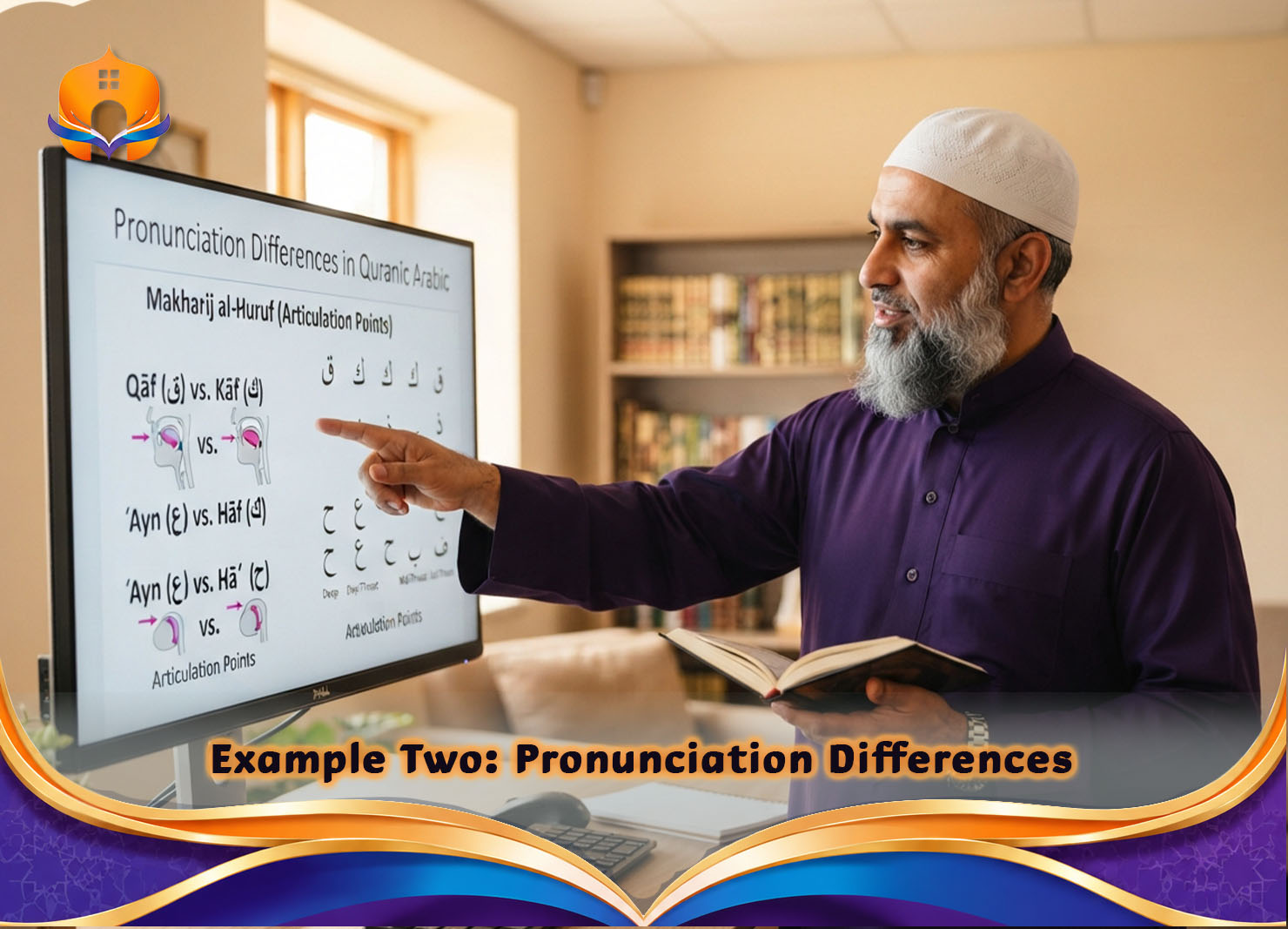
Example Two: Pronunciation Differences

Example Two_ Pronunciation Differences

In many verses, the written word remains identical while only the pronunciation differs. For instance, a Warsh reciter may lengthen a vowel according to the narration’s rules, whereas a Hafs reciter reads the same word with a different permissible duration.

The written Mushaf still represents the same Quran. Only the oral transmission varies according to authentic scholarly narration

Example Three: Grammatical Variations

Some authentic recitations present slight grammatical differences. These variations were taught directly by the Prophet Muhammad ﷺ and transmitted through reliable chains. Rather than changing Islamic rulings, they reveal the remarkable flexibility and eloquence of classical Arabic. Many Quran commentators benefit from these readings when explaining verses in greater linguistic depth.

Do These Differences Affect the Meaning?

This question lies at the heart of understanding the difference between the Hafs and Warsh Quran. The simple answer is:

No.

  • The Quran remains the same revelation.
  • Its message remains unchanged.
  • Its beliefs remain unchanged.
  • Its laws remain unchanged.
  • Its guidance remains unchanged.

What changes is only the manner in which certain authentic words are pronounced according to the narration being followed.In some verses, authentic readings highlight complementary shades of meaning.

Far from weakening the Quran, these variations demonstrate the extraordinary precision with which every aspect of revelation has been preserved.

Why do scholars consider both narrations authentic?

Some beginners mistakenly think one narration must be “more correct.”Islamic scholarship rejects this assumption. Both Hafs and Warsh fulfill every condition required for an authentic Quranic recitation. Each narration:

  • Has an uninterrupted chain reaching the Prophet ﷺ.
  • Agrees with the Uthmanic Mushaf.
  • Conforms to classical Arabic.
  • Has been accepted by generations of leading scholars.

Therefore, Muslims should never criticize another Muslim simply because they recite according to a different authentic narration. Instead, these recitations should increase respect for the diversity that Allah allowed within the preserved revelation.

Appreciating the Wisdom Behind the Difference Between Hafs and Warsh Quran

As students deepen their knowledge, they often discover that the Difference Between Hafs and Warsh Quran is not a source of confusion but a sign of divine wisdom. It demonstrates:

  • The remarkable preservation of the Quran.
  • The precision of oral transmission.
  • The richness of the Arabic language.
  • The dedication of Muslim scholars.
  • The beauty of authentic Quran recitation.

Every authentic narration has reached Muslims today through centuries of careful teaching, memorization, correction, and verification.

This preservation remains one of the greatest miracles associated with the Quran and continues to inspire millions of learners around the world.

Which Quran Recitation Should Beginners Learn?

After understanding the Difference Between Hafs and Warsh Quran, one of the most common questions beginners ask is:

“Which recitation should I learn first?”

The answer depends on several practical factors rather than on superiority. Both Hafs and Warsh are authentic narrations that trace directly back to the Prophet Muhammad ﷺ through reliable chains of transmission. Therefore, choosing one over the other does not mean choosing a “better” Quran. Instead, it means selecting the narration that best fits your learning environment and long-term goals.

For most students worldwide, Hafs is the preferred starting point because it is the most widely taught narration. Most printed Mushafs, Quran applications, Islamic schools, and online learning platforms use Hafs, making it easier for beginners to find teachers and educational resources.

However, students living in Morocco, Algeria, Mauritania, or other regions where Warsh is commonly taught often begin with Warsh naturally. Since local mosques, Quran schools, and scholars use this narration daily, learning Warsh allows students to study within the tradition of their community.

The most important principle is consistency. A student should master one narration before attempting to learn another. Constantly switching between Hafs and Warsh without proper instruction may lead to confusion in pronunciation and Tajweed.

Factors to Consider Before Choosing a Recitation

Choosing the right narration becomes much easier when beginners focus on practical considerations rather than misconceptions.

1. Availability of Qualified Teachers

Learning directly from a knowledgeable teacher remains the safest and fastest way to develop correct Quran recitation.

Every narration contains detailed pronunciation rules that cannot always be mastered through books or videos alone. A qualified teacher listens carefully, corrects mistakes immediately, and helps students build confidence step by step.

Without guidance, beginners may unintentionally mix rules from different narrations, creating inaccurate recitation.

2. Learning Resources

Students should also consider the educational materials available to them. For example, if your local mosque, Quran school, or online platform teaches Hafs, beginning with Hafs often makes learning smoother because every lesson follows the same methodology.

Likewise, if your community primarily uses Warsh, studying Warsh allows you to practice regularly with local teachers and fellow students.

3. Personal Goals

Some students simply want to read the Quran fluently during daily worship. Others hope to become teachers, earn an Ijazah, or specialize in the science of Qira’at. For beginners, mastering one narration is more beneficial than trying to study several simultaneously. After building a strong foundation, students can later explore additional authentic recitations with greater confidence.

4. Consistent Practice

Regardless of the chosen narration, consistency remains the key to success. Even fifteen or twenty minutes of focused daily recitation produces better results than occasional long study sessions. Regular revision strengthens pronunciation, improves fluency, and develops long-term memorization.

Benefits of Understanding Different Quran Recitations

Learning about authentic Quran recitations offers benefits far beyond simple curiosity. Even students who plan to memorize only Hafs gain valuable insight by understanding why Warsh also exists. Some of the most important benefits include:

  • Greater confidence when hearing different reciters.
  • Better appreciation of Quran preservation.
  • Deeper understanding of Arabic linguistics.
  • Stronger respect for Islamic scholarship.
  • Improved awareness of Tajweed principles.
  • Increased love for the Quran.

Perhaps the greatest benefit is realizing that every authentic narration demonstrates Allah’s protection of His revelation across more than fourteen centuries.

Learning the Quran the Right Way

Regardless of whether a student chooses Hafs or Warsh, success depends on following a structured learning path.

A balanced Quran program should include reading, pronunciation, Tajweed, revision, and regular teacher feedback.

Many students begin with a quran reading course to recognize Arabic letters correctly, improve fluency, and become comfortable reading directly from the Mushaf. Building strong reading skills creates a solid foundation for every later stage of Quran learning.

Once reading becomes comfortable, students usually continue with a quran with Tajweed course. At this stage, they learn proper articulation points, characteristics of letters, stopping rules, elongation, and other essential aspects of beautiful Quran recitation.

As students gain confidence, they often enroll in a Quran memorization course to preserve selected Surahs or even complete the memorization of the Quran. Combining memorization with accurate Tajweed ensures that every verse is recited exactly as it was transmitted.

Students who wish to deepen their pronunciation further may also study a specialized rules of Tajweed course, where they examine advanced topics such as Makharij, Sifaat, Madd, Ghunnah, Waqf, and the detailed applications found within authentic narrations like Hafs and Warsh.

Understanding these sciences gradually helps learners appreciate why every authentic recitation follows carefully preserved principles rather than personal preference.

Building a Broader Islamic Foundation

While mastering Quran recitation is an essential goal, many students also seek a broader understanding of Islamic knowledge.

For example, learners frequently ask what is islamic fiqh after becoming familiar with Quran recitation. Fiqh is the branch of Islamic knowledge that explains how Muslims apply the teachings of the Quran and the Sunnah in their daily lives. It covers areas such as worship, family matters, business transactions, ethics, and personal conduct.

Studying the Quran alongside foundational Islamic sciences helps students understand not only how to recite Allah’s words correctly but also how to implement their guidance with wisdom and sincerity.

Why Learning With Qualified Teachers Matters?

Although modern technology has made Quran learning more accessible than ever, the traditional teacher–student relationship remains essential.

A qualified teacher can immediately recognize subtle pronunciation mistakes that students often overlook when studying alone. Teachers also help learners:

  • Correct articulation points.
  • Apply Tajweed accurately.
  • Develop confidence during recitation.
  • Maintain motivation through regular lessons.
  • Build consistent revision habits.
  • Progress according to a structured learning plan.

For this reason, Muslim scholars throughout history emphasized learning the Quran directly from those who had mastered its recitation through authentic chains of transmission.

Learn With Quran House Academy

Choosing the right learning environment can make understanding the Difference Between Hafs and Warsh Quran much easier while making your Quran journey more enjoyable, effective, and spiritually rewarding.

At Quran House Academy, students of all ages receive personalized online instruction from experienced Quran teachers who specialize in authentic Quran recitation. Whether a learner is taking the first steps toward understanding the Difference Between Hafs and Warsh Quran, improving Arabic reading skills, or working toward advanced Tajweed and memorization, every lesson follows a structured curriculum designed to build confidence and accuracy. Students benefit from:

  • One-on-one online Quran classes.
  • Experienced male and female teachers.
  • Flexible scheduling for children and adults.
  • Step-by-step Tajweed instruction that explains the Difference Between Hafs and Warsh Quran clearly.
  • Personalized memorization plans.
  • Regular progress assessments.
  • Interactive lessons suitable for every level.

The academy helps students master correct pronunciation while gaining a deeper understanding of the Difference Between Hafs and Warsh Quran through practical lessons and expert guidance. Whether your goal is daily recitation or advanced Quran studies, qualified teachers ensure that learning the Difference Between Hafs and Warsh Quran becomes clear and easy to understand.

How to Identify Whether Your Mushaf Is Hafs or Warsh?

Many beginners who start researching the Difference Between Hafs and Warsh Quran wonder whether the Quran they own follows the Hafs or Warsh narration. Fortunately, identifying the narration of a Mushaf is usually straightforward.

The easiest method is to check the title page or the publication information at the beginning or end of the Mushaf. Most publishers clearly state whether the Quran is printed according to Hafs ‘an Asim or Warsh ‘an Nafi’. This information helps students ensure they are studying the same narration as their teacher while better understanding the Difference Between Hafs and Warsh Quran.

Another clue is the region where the Mushaf was printed. Qurans published in countries such as Saudi Arabia, Egypt, Pakistan, Indonesia, and Turkey are almost always printed according to Hafs. By contrast, Mushafs printed in Morocco, Algeria, and Mauritania are commonly based on the Warsh narration.

Beginners should not worry if they encounter a Mushaf that differs from the one they usually read. Both narrations are authentic, and the Difference Between Hafs and Warsh Quran reflects two accepted methods of reciting the same revelation rather than two different Qurans.

Can You Memorize the Quran in Hafs and Later Learn Warsh?

One of the most frequently asked questions after understanding the Difference Between Hafs and Warsh Quran is whether a student can begin memorizing the Quran in Hafs and later study Warsh.

The answer is yes. Many advanced students and qualified Quran teachers eventually learn more than one authentic narration. However, scholars generally recommend mastering one narration first before moving to another.

Learning Hafs thoroughly allows students to develop confidence in pronunciation, Tajweed, and memorization. Once this foundation becomes strong, studying Warsh becomes much easier because the learner already understands the structure of the Quran and the principles behind the Difference Between Hafs and Warsh Quran.

Attempting to study two narrations simultaneously as a beginner may lead to confusion, especially when the rules of Madd, Hamzah, or vowel pronunciation differ between the two narrations. Therefore, it is better to complete one narration accurately before expanding to another.

Many Huffaz around the world have successfully memorized the Quran in Hafs before earning an Ijazah in Warsh or other authentic Qira’at, demonstrating that this gradual approach has been followed by scholars for generations studying the Difference Between Hafs and Warsh Quran.

Can Hafs and Warsh Be Mixed During Recitation?

As students continue learning about the Difference Between Hafs and Warsh Quran, they sometimes wonder whether it is acceptable to combine rules from both narrations while reciting.

The general answer given by Quran scholars is no.

Each narration is a complete and independent method of recitation transmitted through its own authentic chain. When a person begins reciting according to Hafs, they should continue following Hafs throughout that recitation. Likewise, a person reciting according to Warsh should consistently apply the rules of Warsh.

Understanding the Difference Between Hafs and Warsh Quran also means understanding that every narration should be recited independently according to its authentic transmission.

Mixing pronunciations or Tajweed rules from different narrations without proper scholarly knowledge is discouraged because it does not reflect the way these recitations were transmitted.

Advanced scholars who specialize in Qira’at may study multiple narrations and switch between them intentionally during formal teaching or academic recitation. However, beginners should focus on accuracy and consistency within a single narration until they have mastered it.

Maintaining this discipline preserves the authenticity of Quran recitation and helps students appreciate the Difference Between Hafs and Warsh Quran without creating unnecessary confusion.

Common Mistakes Beginners Make When Learning Hafs and Warsh

Common Mistakes Beginners Make When Learning Hafs and Warsh

Learning the Quran is a lifelong journey, and beginners often make understandable mistakes while studying the Difference Between Hafs and Warsh Quran. Being aware of these mistakes can help students avoid confusion and progress with confidence.

1. Thinking They Are Different Versions of the Quran

The most common misunderstanding is believing that Hafs and Warsh represent different Qurans. In reality, they are two authentic narrations of the same revelation, which is one of the most important facts about the difference between the Hafs and Warsh Quran.

2. Mixing Rules During Recitation

Some beginners unknowingly combine Hafs pronunciation with Warsh Tajweed rules. This usually happens after listening to different reciters without fully understanding the Difference Between Hafs and Warsh Quran.

3. Comparing One Narration as Better Than the Other

Another mistake is assuming that Hafs is more authentic because it is more widespread, or that Warsh is superior because it preserves certain pronunciation features. Islamic scholars agree that both narrations are authentic and equally accepted.

4. Learning Without a Qualified Teacher

Although books and recordings are valuable learning tools, they cannot replace direct correction from an experienced Quran teacher. Proper guidance helps students understand the Difference Between Hafs and Warsh Quran correctly while improving their pronunciation and Tajweed.

5. Focusing Only on Differences

Some learners become so interested in comparing Hafs and Warsh that they forget the main purpose of Quran recitation: seeking Allah’s pleasure, understanding His guidance, and implementing His teachings in daily life.

By avoiding these common mistakes, students can build a stronger foundation, gain a balanced understanding of the Difference Between Hafs and Warsh Quran, and develop a deeper appreciation for the authentic science of Qira’at.

Frequently Asked Questions About the Difference Between Hafs and Warsh Quran

Below are answers to the most frequently asked questions about the Difference Between Hafs and Warsh Quran, helping clarify their key differences, authenticity, and significance in Quranic recitation.

1. What is the Difference Between Hafs and Warsh Quran?

The Difference Between Hafs and Warsh Quran lies in the method of recitation rather than the content of the Quran. The differences include pronunciation, vowelization, certain Tajweed rules, and a small number of authentic linguistic variations. These do not change the beliefs, message, or guidance of the Quran.

2. Are Hafs and Warsh two different versions of the Quran?

No. Hafs and Warsh are two authentic narrations of the same Quran revealed to the Prophet Muhammad ﷺ. Both have been preserved through reliable chains of transmission and are accepted by Muslim scholars worldwide.

3. Which is more common: Hafs or Warsh?

Hafs is the most widely used Quran narration across the world and is the standard recitation in most countries. Warsh is primarily used in Morocco, Algeria, Mauritania, and several other North and West African countries.

4. Can I learn Warsh after studying Hafs?

Yes. Many students begin with Hafs because of its widespread availability and later study Warsh under the guidance of a qualified Quran teacher. Scholars generally recommend mastering one narration before learning another.

5. Do the differences between Hafs and Warsh affect the meaning of the Quran?

No. The differences do not change the core meaning, beliefs, rulings, or message of the Quran. In some verses, the authentic readings provide complementary shades of meaning that enrich the understanding of the text without creating contradictions.

6. Which narration should beginners choose?

Beginners should usually learn the narration that is most commonly taught by qualified teachers in their community or through their chosen Quran academy. The most important goal is to learn one authentic narration correctly before exploring other Qira’at.

In conclusion, understanding the Difference Between Hafs and Warsh Quran allows Muslims to appreciate one of the greatest aspects of Quran preservation.

Although these two narrations differ in pronunciation, vowelization, certain Tajweed applications, and a limited number of authentic linguistic forms, they remain two perfectly valid methods of reciting the same Quran revealed to the Prophet Muhammad ﷺ.

They do not represent different books, different beliefs, or different messages. Instead, they reflect the remarkable precision with which Allah protected His revelation through generations of dedicated scholars and teachers.

For beginners, the best approach is simple: choose one authentic narration, study with a qualified teacher, practice consistently, and focus on building a strong relationship with the Quran. As knowledge grows, exploring additional Qira’at becomes an enriching way to appreciate the depth of the Arabic language and the extraordinary legacy of Quranic scholarship.

With sincere effort, patience, and proper guidance, every student can confidently recite the Quran while recognizing that the Difference Between Hafs and Warsh Quran is not a source of confusion but a beautiful testimony to the preservation of Allah’s final revelation.

Facebook
Twitter
LinkedIn
Telegram
WhatsApp
Pinterest

Related Posts