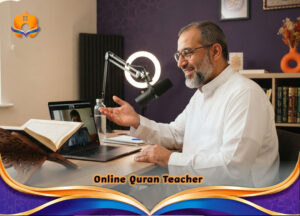
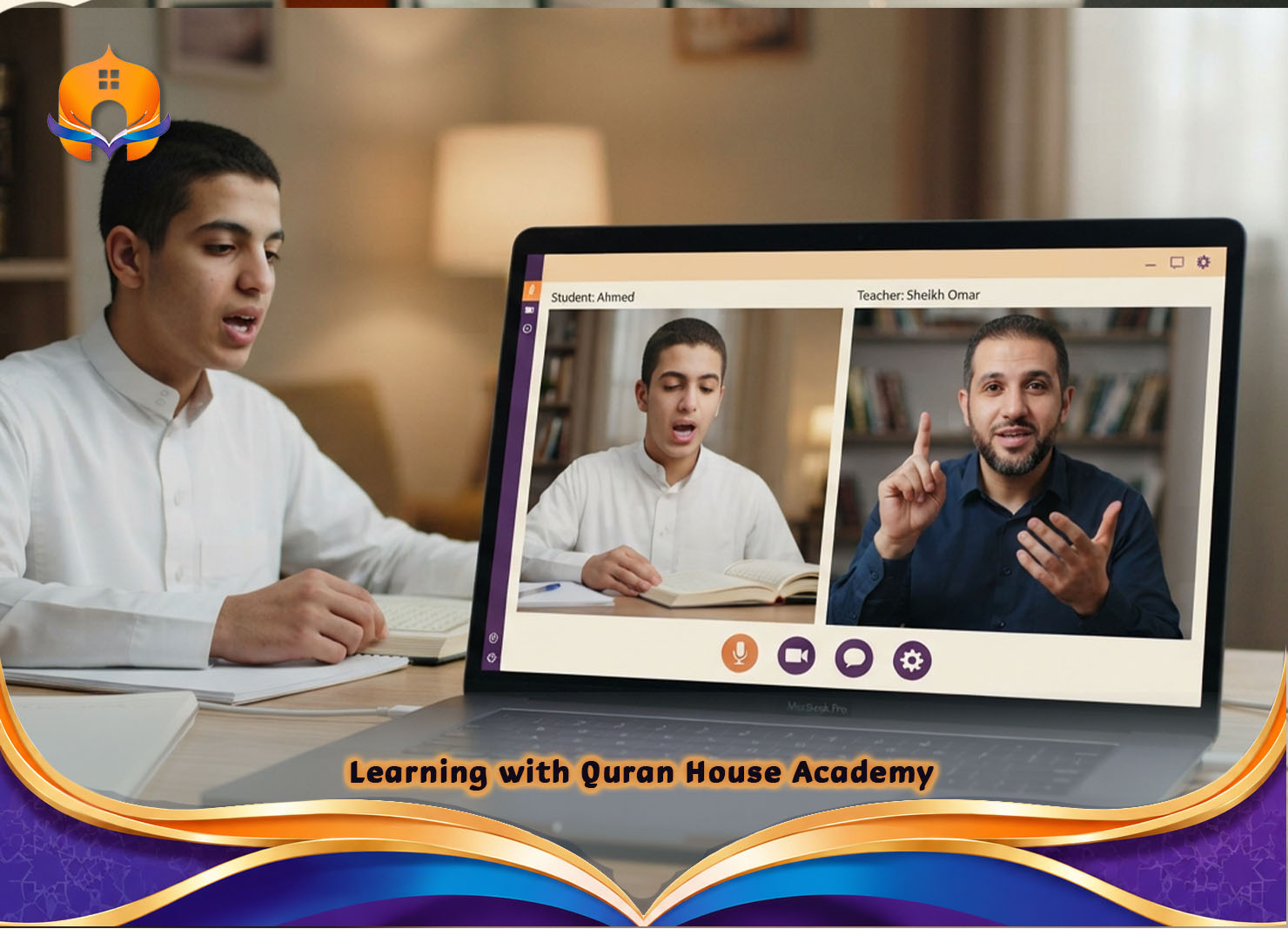
Many students want to learn the Quran with Tajweed on their own, but a guided Tajweed course at Quran House speeds up progress significantly.
How to learn the Quran with Tajweed, and is self-studying it possible?
Tajweed is a science concerned with the recitation of the Quran. Its aim is to perfect Quran recitation by giving every letter its due right and everything it deserves in terms of pronunciation, articulation, and timing.
The Prophet, peace and blessings be upon him, used to teach his companions the Quran with tajweed. The companions would learn the Quran with tajweed practically, by listening to the Prophet recite and then reciting it back to him exactly as he had recited it to them.
The Quranic recitation was then passed down through consecutive reporting, known as tawatur. One generation taught the Quran to the next generation, who in turn taught it to the next, and so on, until the recitation reached our current generation intact.
This is the original way through which the companions of the Prophet Muhammad learned the Quran directly from him. That is why it is highly discouraged to self-study the Quran. Instead, you should learn the Quran with tajweed from a qualified teacher. Learning with a qualified teacher helps you avoid the mistakes you would likely make on your own, and it also helps you avoid frustration and inconsistency. Even for native Arabic speakers, self-studying the Quran without a teacher is considered disliked by scholars of Quran and tajweed.
This connects closely with our hams tajweed, which many find useful.
For learners who want to go further, take a look at our reward of learning tajweed.
It’s worth pairing this with our learning tajweed online for a fuller picture.
What about apps and websites for learning tajweed?
You might ask, there are many applications and websites that help you listen to Quran recitation and learn Quran recitation online, so what about those?
These websites are great as an additional supplement to the original way of learning, but they do not substitute learning the Quran with a teacher. The developers of these websites did not design or intend for them to replace a teacher entirely. However, you might need to practice for much longer than the duration of your class, and your Quran teacher might have a tight schedule that limits how long they can teach you in a single session. In that case, these websites are excellent tools for additional practice between lessons.
If you wish to learn the Quran with tajweed, you will need to invest not just money, but also time and effort. Dedicate a portion of your time specifically to the study of the Quran. If it is difficult for you to take a Quran course at the mosque, or the mosque is too far away, you can learn the Quran with tajweed online with a qualified teacher and a professional school, but the idea of self-studying it entirely on your own remains foreign to the tradition of Quranic study.
For structured guidance, consider our Quran classes for sisters, our online Quran academy for sisters, or our online Quran academy for adults.
Those who found this helpful often continue with our rules madd tajweed.
This connects closely with our reading the quran to understand islam, which many find useful.
Why oral transmission matters so much in Islamic tradition
The chain of transmission, or isnad, that carries the Quran’s recitation from the Prophet to the present day is not a minor historical detail. It is central to how Islamic scholarship verifies the authenticity and accuracy of religious knowledge more broadly. Every qualified Quran teacher today can trace their own chain of authorization, known as an ijazah, back through generations of scholars, ultimately connecting to the Prophet himself. This unbroken chain is precisely what self-study cannot replicate, since a book or an app has no chain of verified, personal correction connecting a student to that original source.
Our quran adults can be a good complement for anyone following this path.
Those who found this helpful often continue with our is the quran hard to learn.
The specific risks of learning tajweed entirely alone
- Mispronunciation that goes unnoticed, since self-assessment of one’s own speech is notoriously unreliable, particularly for sounds a person has never been trained to hear accurately.
- Inconsistent application of rules, since a self-taught student has no external check to confirm whether a rule is being applied correctly across different verses and contexts.
- Loss of motivation, since self-study lacks the accountability and encouragement that regular sessions with a teacher naturally provide.
- Missing the subtler, harder to describe aspects of recitation, such as rhythm and natural flow, which are far easier to absorb by listening and receiving direct correction than by reading written descriptions alone.
Many students pair this with our quran memorization to round out their learning.
Our not reading the quran fluently can be a good complement for anyone following this path.
How a qualified teacher corrects mistakes that self-study cannot catch
A trained teacher listens not just for obvious errors, but for subtle habits that a student has no way of noticing independently. This might include a slightly shortened elongation, an emphatic letter that is not receiving its full weight, or a consistent substitution of one sound for a similar but incorrect one. These small inaccuracies often feel completely normal to the student producing them, precisely because there is no internal signal indicating something is wrong. Only an external, trained ear can reliably catch these patterns, which is exactly the role a qualified teacher plays throughout the learning process.
If this is an area you’d like to explore in more depth, check out our quran memorization.
Many students pair this with our surah naziat to round out their learning.
Using technology as a supplement, not a substitute
Modern apps and websites genuinely add value to the learning process when used correctly, offering convenient access to recordings from master reciters, searchable Quran text, and tools for tracking memorization progress. The key distinction is treating these tools as a supplement to structured lessons with a teacher, rather than as a replacement for them. A student might use a recitation app to practice between lessons, reinforcing what a teacher has just taught, while relying on the teacher for the actual correction and guidance that technology cannot reliably provide on its own.
For learners who want to go further, take a look at our female quran teacher.
If this is an area you’d like to explore in more depth, check out our surah nahl.
Frequently asked questions
For learners who want to go further, take a look at our surah lahab.
Can someone with no access to a mosque still learn tajweed properly?
Yes, online Quran academies with qualified teachers make it possible to learn tajweed properly regardless of geographic access to a physical mosque, as long as the student is working with a real, qualified teacher rather than self-study alone.
For a deeper dive, take a look at our surah hud.
Is it acceptable to use recitation apps while also working with a teacher?
Yes, this is actually an ideal combination. Apps and recordings can reinforce what a teacher has taught and provide extra practice, as long as they remain a supplement rather than the primary source of correction.
It’s worth pairing this with our surah hajj for a fuller picture.
Why is self-study specifically discouraged for tajweed, compared to other subjects?
Tajweed depends heavily on precise pronunciation that is difficult to self-assess accurately, and the Quran’s oral transmission tradition places particular importance on learning directly from a qualified, chain-verified teacher rather than through books or independent study alone.
This connects closely with our surah hadid, which many find useful.
Does being a native Arabic speaker change this recommendation?
No. Even native Arabic speakers are discouraged from self-studying tajweed, since correct application of tajweed rules requires specific training beyond general fluency in spoken Arabic.
Those who found this helpful often continue with our surah furqan.
What a typical qualified teacher relationship looks like
Working with a qualified teacher typically involves regular, scheduled sessions where the student recites while the teacher listens closely, correcting mistakes in real time and explaining the reasoning behind each correction. Over time, this relationship builds toward increasingly independent, confident recitation, with the teacher gradually stepping back as the student’s accuracy improves. This is a fundamentally different experience from self-study, where a student has no reliable way to know whether their independent practice is reinforcing correct habits or unintentionally deepening mistakes.
Our surah fatir can be a good complement for anyone following this path.
Building a sustainable long term learning plan
Committing to learning tajweed with a qualified teacher is a meaningful investment of time and, in many cases, money. Setting a realistic, sustainable schedule from the outset, rather than an ambitious but short lived pace, tends to produce far better long term results. Many students find success with regular weekly sessions paired with consistent daily practice on their own, using apps or recordings specifically to reinforce what a teacher has already corrected, rather than to introduce new material independently.
Many students pair this with our surah dahr to round out their learning.
The difference between reading translations alone and learning recitation
It is worth distinguishing between reading a translation of the Quran to understand its meaning, which can certainly be done independently, and learning to recite the Arabic text with correct tajweed, which cannot be responsibly self-taught. Understanding meaning through translation is a valuable, accessible form of engagement with the Quran that does not carry the same risks as mispronouncing the sacred text itself. Recitation, by contrast, involves reproducing precise sounds tied to centuries of verified oral transmission, which is exactly why the two activities call for very different approaches to learning.
If this is an area you’d like to explore in more depth, check out our surah balad.
Why this tradition has endured for fourteen centuries
The insistence on learning tajweed directly from a qualified teacher, rather than through self-study, has remained remarkably consistent throughout Islamic history, even as technology has transformed nearly every other aspect of how people access information and learn new skills. This consistency reflects a deep, deliberate commitment to preserving the Quran’s recitation with total accuracy across generations, rather than allowing gradual, unnoticed drift that might occur if every generation learned independently from written descriptions alone. Understanding this historical context helps explain why this particular recommendation has proven so resistant to being replaced by convenient, modern alternatives.
For learners who want to go further, take a look at our surah qariah.
Learning the Quran with Tajweed at Quran House
At Quran House, our instructors are trained at Al-Azhar and hold verified chains of authorization, ensuring that the tajweed you learn traces back through a legitimate, unbroken line of transmission. Whether you are a complete beginner or looking to refine recitation you have practiced for years, our qualified teachers provide the structured, personalized correction that self-study alone simply cannot offer.
Common excuses people give for self-studying, and why they fall short
Many people turn to self-study for reasons that feel entirely practical: lack of time, cost concerns, or simple unfamiliarity with how to find a qualified teacher. While these concerns are understandable, each one has a realistic solution that does not require abandoning teacher-led learning altogether. Online academies have significantly reduced both the cost and time barriers that once made in-person study difficult, offering flexible scheduling and a wide range of price points to fit different budgets. Unfamiliarity with finding a qualified teacher is easily resolved by researching an academy’s credentials and asking about a teacher’s ijazah and chain of authorization before committing to lessons.
How to evaluate whether a teacher is truly qualified
Not every person offering Quran lessons online holds the same level of qualification, so it is worth taking time to verify a teacher’s background before committing to lessons. Look for teachers who hold a verified ijazah, ideally from a recognized institution, along with a demonstrable track record of teaching experience. Reputable online academies typically vet their instructors carefully, and it is entirely reasonable to ask directly about a teacher’s credentials, chain of authorization, and prior teaching experience before beginning a course of study.
What genuine progress looks like under proper guidance
Students working with a qualified teacher typically notice steady, cumulative improvement, with each lesson building directly on corrections made in the previous one. This differs sharply from the experience many self-taught students report, where progress feels directionless, and the same mistakes tend to resurface repeatedly without any external signal indicating what needs to change. The structured feedback loop that a qualified teacher provides is, in many ways, the single biggest factor separating consistent, lasting improvement from stalled, uncertain self-study.
Making the decision to start with a qualified teacher
Ultimately, the decision to begin learning tajweed under proper guidance, rather than continuing to postpone it in favor of self-study or informal listening alone, is a decision worth making sooner rather than later. Every month spent practicing without correction is a month during which incorrect habits can become more deeply ingrained, making them harder to unlearn once formal lessons finally begin. Starting with a qualified teacher from the very first lesson, even as a complete beginner, tends to produce a smoother, more efficient learning journey than starting alone and later needing to correct months or years of unguided practice.
Final thoughts
Learning the Quran with tajweed is fundamentally a relationship between a student and a qualified teacher, rooted in a tradition of oral transmission that stretches back to the Prophet himself. While apps and websites offer valuable supplementary practice, they cannot replace the real time correction, accountability, and verified chain of authorization that a qualified teacher provides. If you are serious about learning tajweed properly, investing your time and effort into structured lessons with a qualified teacher remains the surest path toward accurate, beautiful, and authentically transmitted recitation.
Final Thoughts
You can learn the Quran with Tajweed through self-study, but expert feedback catches mistakes self-study alone misses. For the original text, see Quran.com.
Quick FAQ
Is self-study enough to learn the Quran with Tajweed? It helps, but most students learn the Quran with Tajweed faster with a certified teacher.
To sum up, students who learn the Quran with Tajweed through a mix of self-study and guided feedback progress fastest, and anyone can learn the Quran with Tajweed with patience and the right resources.
Ultimately, the best way to learn the Quran with Tajweed combines daily self-practice with periodic teacher review, since most students who learn the Quran with Tajweed alone eventually seek correction from an expert.